 Kerala Backwaters Escape

Tamil Nadu Tour Packages
Chennai – Kanchipuram – Mahabalipuram – Pondicherry – Chidambaram – Tranquebar – Kumbakonam – Gangaikonda Cholapuram – Swamimalai – Tanjore – Trichy – Chettinad – Madurai – Rameswaram – Dhanushkodi – Kanyakumari – Kodaikanal – Coonoor – Ooty – Coimbatore
At a glance
Three weeks is the point at which Tamil Nadu stops being a highlights reel and starts making sense as a whole. Our complete Tamil Nadu tour 3 weeks long covers every region of the state in a single loop: the Pallava north coast around Chennai and Mahabalipuram, the fort and holy hill of the interior, French Pondicherry and Danish Tranquebar, the Kaveri delta of the Chola kings, the merchant mansions of Chettinad, Pandya country around Madurai, the pilgrim island of Rameswaram, the land's-end cape at Kanyakumari, and last of all the Palani hills and the Nilgiris.
Twenty-one days on Tamil roads can wear anyone down, so we drew the map around realistic driving hours first and fitted the sightseeing in afterwards. Most legs run two to four hours. The three long ones, Rameswaram to Kanyakumari, Kanyakumari to Kodaikanal and Kodaikanal to Coonoor, take six to seven hours each and are broken with lunch stops, and each is followed or preceded by a slower day. A full free day at the cape and a relaxed day in the hills give your body a chance to catch up with the miles.
This 3 week Tamil Nadu itinerary suits British, European, American, Canadian and Australian visitors who would rather know one state well than glimpse four, and NRI parents keen for children raised abroad to see all of Tamil country in one go. Nothing in this Tamil Nadu tour package is shared: one cooled vehicle with the same English-speaking chauffeur for 21 days, licensed local guides in each historic town, and hotels chosen for location. It finishes with the Nilgiri toy train and a departure from Coimbatore.
Your three weeks in Tamil Nadu begin outside the international terminal in Chennai, where one of our staff stands holding a sign with your surname on it. The car that collects you is the same one that will carry you all the way to Coimbatore, and the driver you meet today stays with you for the entire tour, so it is worth spending a few minutes getting to know him. Planes from Europe and the Gulf usually touch down somewhere between midnight and first light, which is why nothing is scheduled before mid-afternoon. Guests arriving around 3 or 4 am are best served by paying for one extra night, which means a bed is ready the minute they walk in.
During the afternoon a member of our Chennai team drops by your hotel for a short briefing. You get a paper copy of the full 21-day plan, help buying an Indian prepaid SIM, and a sheet of the closing days and dress rules for the temples and museums along the route. Use this meeting to mention anything that might change the plan, from dietary needs to a knee that dislikes stairs, because small adjustments are much easier to make now than in week two. Any questions about money, tipping or how to behave in a working temple can be settled over a cup of filter coffee.
Around 5 pm the car heads to Besant Nagar on the southern side of the city, a leafy residential district where the city comes to breathe in the evening. Elliot's Beach is smaller and calmer than the Marina, and local families stroll here after work, buying roasted peanuts and sundal, a spiced chickpea snack sold in paper cones. A short walk inland brings you to the Ashtalakshmi Temple, a tiered shrine near the shore where eight forms of the goddess of prosperity are worshipped on different levels. Keep the evening short and eat early, since tomorrow is a full day of city sights. Overnight in Chennai.
Chennai began life as a Company warehouse on a strip of sand, so your guide opens the morning at Fort St. George, raised by English merchants in 1644. Government offices and the state assembly still occupy much of the compound, so some buildings are closed to visitors, but you can walk to St. Mary's Church, dating to 1680, its bomb-proof roof built thick to survive cannon fire during sieges. Memorial tablets on its walls record soldiers, officials and children who died far from home, and Robert Clive was married here. A few steps on, the Fort Museum sits in a colonnaded Georgian building that once served as an exchange, its rooms full of muskets, faded flags, silver and Company-era rupees.
By eleven you are at the Government Museum in Egmore, whose collections were begun in 1851. Its bronze gallery holds an outstanding collection of Chola metal images, including several dancing Natarajas and a graceful Ardhanarishvara, half Shiva and half Parvati, cast around a thousand years ago. Seeing them now gives you a reference point for the Swamimalai foundries and the Chola temples later in the trip. The museum campus also has a section of Buddhist limestone reliefs from Amaravati in Andhra Pradesh. For lunch, try a full meals plate on a banana leaf at a crowded vegetarian canteen, where waiters keep refilling rice and rasam until you fold the leaf.
Once the heat has eased, the car takes you to Kalakshetra in Thiruvanmiyur, a campus by the sea where Rukmini Devi Arundale, a theosophist and dancer, gathered teachers in 1936 to give temple dance a respectable public stage. Classes meet under palm-leaf roofs with no walls, shaded by big old trees, and when term is running, guests are sometimes allowed to observe quietly from the edge. Your guide explains the hand gestures and footwork that you will later see carved on temple walls across the state. Should a concert be scheduled at a Mylapore sabha that night, we will happily reserve seats. Overnight in Chennai.
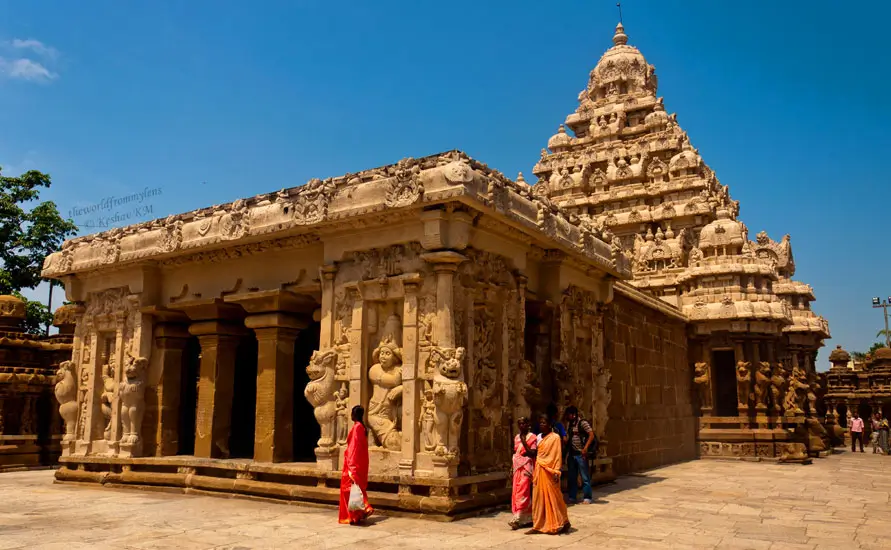
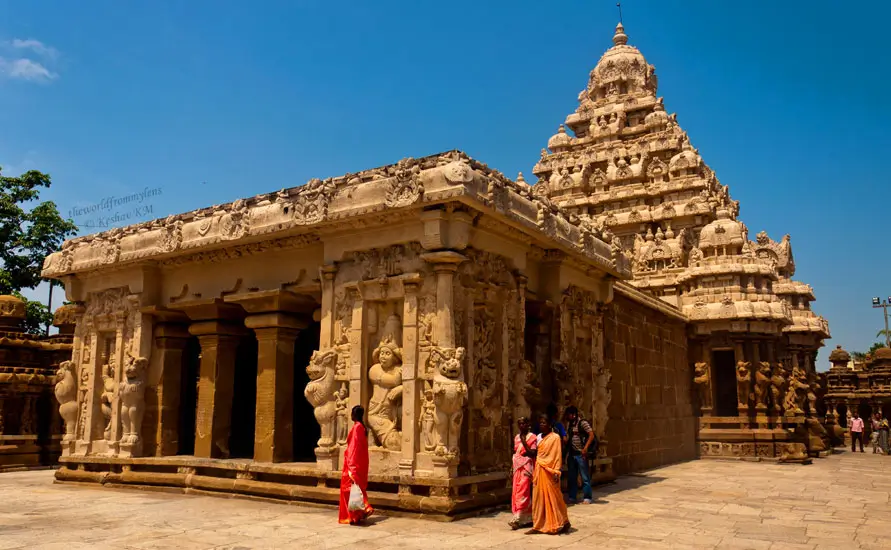
Leaving the city early beats the morning traffic, and the road to Kanchipuram takes about two hours past textile mills, brick kilns and green paddy. This was the Pallava capital, and your guide begins at the Vaikuntha Perumal Temple, built for Vishnu by Nandivarman II in the 8th century. Its inner cloister is lined with sculpted panels that read almost like a stone chronicle of Pallava kingship, showing coronations, battles and royal councils. Three shrines are stacked one above another inside the tower, with Vishnu standing, seated and reclining, an arrangement that is rare in Tamil temples.
Next comes the Varadaraja Perumal Temple, whose hall of a hundred carved pillars is famous for its stone chains, each link cut from a single block. The temple also keeps a wooden image of the deity, called Athi Varadar, beneath the waters of its tank, raised for public viewing only once every forty years. Before lunch you visit a weaving household to see how a Kanchipuram silk sari is made, with the border and body woven separately and then interlocked by hand, a method that makes the borders very strong. Your guide shows you how to test genuine silk and real zari if you plan to buy.
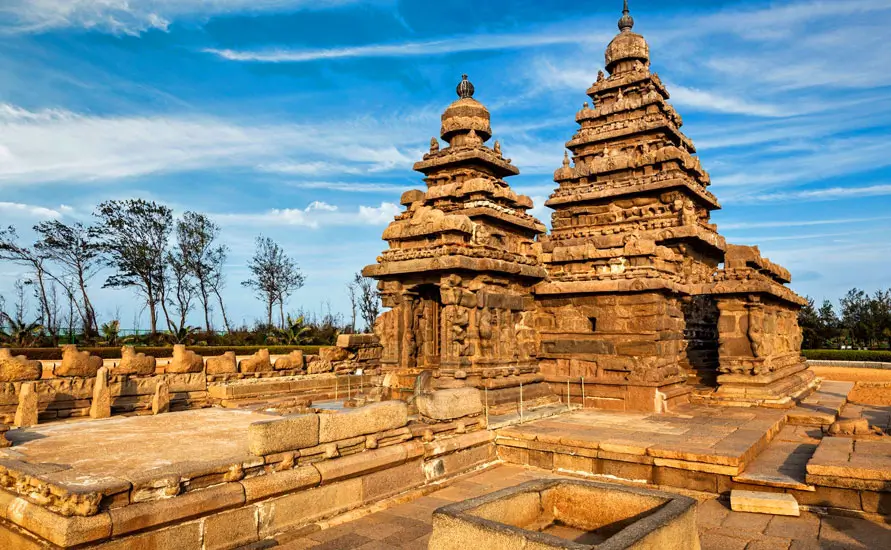
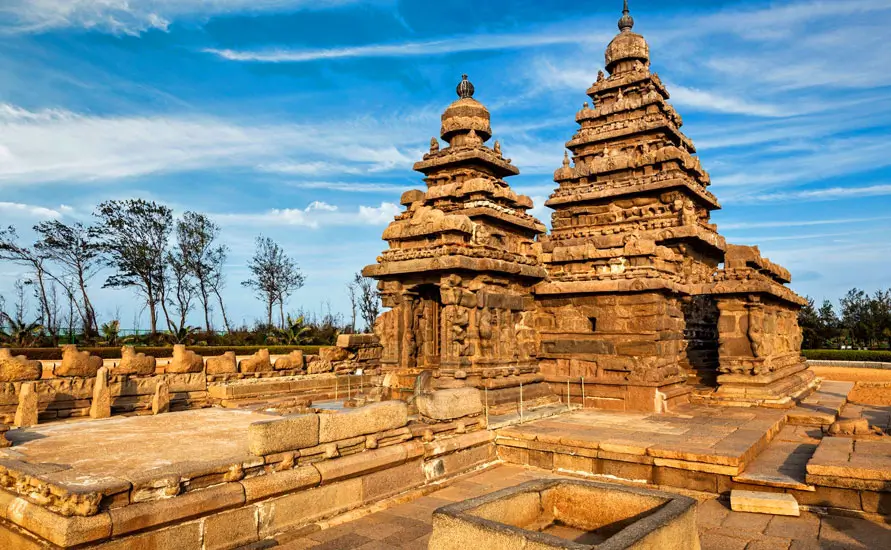
From Kanchipuram it is roughly ninety minutes to the coast at Mahabalipuram. After check-in at your beach hotel, wait for the late afternoon and walk down to the Shore Temple while the sun drops behind it and the granite turns a warm brown. Your guide points out the eroded lions guarding the enclosure and explains how the sea has crept closer over the centuries. Tomorrow begins early, so dinner is best kept simple, perhaps grilled fish at a small family restaurant near the fishing hamlet, where boats are dragged up onto the sand each evening. Overnight in Mahabalipuram.
Daybreak, before the coach parties, is when the Mahabalipuram monuments, a UNESCO World Heritage Site, are at their coolest and emptiest, and your guide uses it for the sites that most visitors rush. You start at the Trimurti Cave, where Brahma, Vishnu and Shiva each have a separate niche, and then the Ganesha Ratha, a small monolith whose barrel roof ends in carved faces. Up on the main ridge, the Varaha Cave depicts Vishnu with a boar's head rescuing Bhudevi from the floodwaters. Above the lighthouse, the ruined Olakkanesvara Temple was once used as a beacon, and from its rock the whole carved landscape and the coastline lie below you.
Before leaving you stop at Arjuna's Penance, this time with an eye for the small details: an ascetic cat standing on its hind legs with mice gathered at its feet, deer scratching their noses, and a mother monkey picking lice from her mate's fur. Guides like to say the cat is a joke at the expense of fake holy men, and the sculptors clearly enjoyed themselves. After an early lunch you head inland through Chengalpattu and Tindivanam toward the dry, rocky interior. The plains change color as you go, from coastal green to red earth and granite outcrops scattered across the fields like dropped boulders.
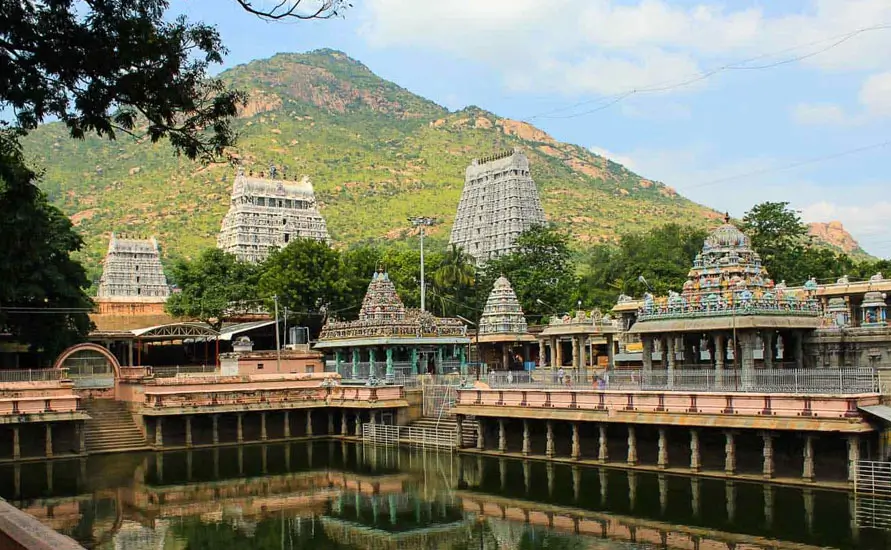
You reach Tiruvannamalai by late afternoon and check in within sight of Arunachala, the hill that devotees regard as Shiva himself. At dusk your guide takes you into the Arunachaleswarar Temple, the fire shrine among Shiva's five elemental temples, and shows you the Patala Lingam, an underground shrine where the young Ramana Maharshi sat in deep meditation, unaware of insects biting his legs. The thousand-pillared hall, the oil lamps and the evening crowds give the town a real sense of pilgrimage. The innermost shrine is reserved for Hindus, though everyone is welcome in the outer enclosures. Overnight in Tiruvannamalai.
Before breakfast there is a chance to walk part of the girivalam, the 14 km path that pilgrims follow barefoot around Arunachala, especially on full-moon nights. You do not need to complete the loop. Your driver can drop you at one of the eight directional lingam shrines and collect you a few kilometers further on, after the hill has shown you several different faces. Afterwards you visit Sri Ramana Ashram, where the old hall in which the sage received visitors is kept as it was, and anyone may sit quietly for a while. You return for a late breakfast and then load the car.
Gingee Fort lies forty minutes east. Its walls tie together three granite hills, and in 2025 UNESCO added it to the Maratha Military Landscapes of India. Shivaji called it one of the hardest forts in the country to take, and later the Mughal army spent years besieging it. With your guide you climb Rajagiri, the highest of the three hills, by a long stone stairway that passes granaries, small temples, cisterns and a narrow bridge over a ravine just below the summit citadel. The climb takes about an hour up, so wear firm shoes and carry water; a gentler alternative is the lower Krishnagiri hill.
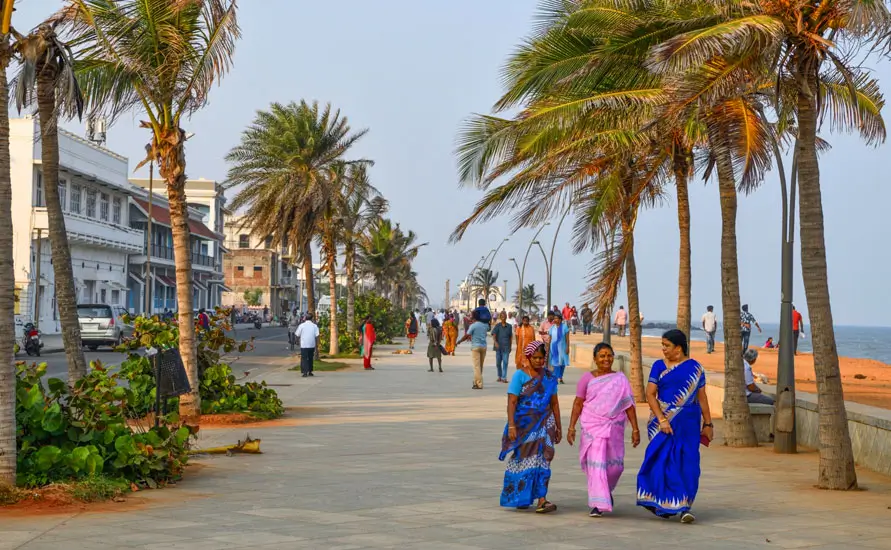
A late lunch at a roadside restaurant gives you energy for the last stretch, about ninety minutes through cashew groves and small towns to Pondicherry on the coast. Tonight's address is a renovated villa close to the old canal, and no plans are made for after dark. Once traffic is barred from Goubert Avenue at dusk, the seafront belongs to strollers, joggers and grandparents buying ice cream for grandchildren. Away from the water, the grid of streets behind the canal stays calm after dark, and many restaurants mix French and Tamil cooking on one menu, from baked fish with herbs to a crab curry. Overnight in Pondicherry.
Your guide deliberately starts on the inland side of the canal, in the Tamil Quarter, where raised stone benches called thinnai flank each front door for neighbors to sit and talk, and fresh rice-powder kolam designs are drawn outside every morning. On one of these streets is the home of Subramania Bharati, the Tamil poet who took refuge in French territory from 1908 to 1918 to avoid British arrest; it now displays his handwriting and family photos. Bharati wrote some of his most stirring patriotic and devotional poems in this town, and Tamil schoolchildren still learn them by heart.
Crossing to the seaward side, the French Quarter has broad shaded streets, colonial villas with tall shuttered windows and churches with French inscriptions. You pause at Notre-Dame des Anges, a pink-and-cream church across from the beach where Mass is still said in French on some days, and walk past the old lighthouse and the French consulate. Visitors may enter the Sri Aurobindo Ashram during fixed morning and afternoon slots, and the flower-covered samadhi in its courtyard is a place for silence rather than photographs. Your guide can recommend a café for a late breakfast of croissants or a South Indian lunch on a banana leaf.
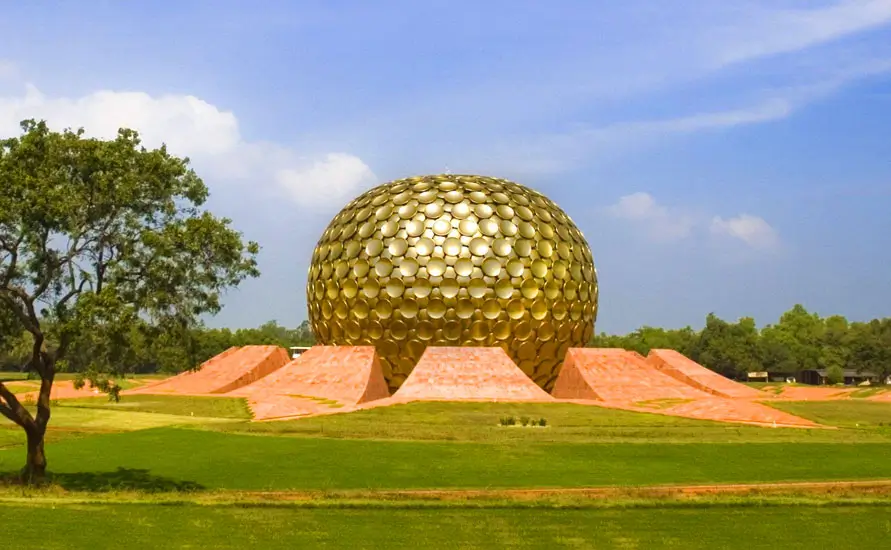
After lunch the car covers the short distance to Auroville, the 1968 settlement planned by the Mother so that settlers from any country could live and work side by side. The visitor center has an exhibition and short film on how the project began, and a footpath leads through planted forest, much of it replanted by early settlers on what was then a bare red plateau, to a clearing where day visitors can see the golden Matrimandir across the lawns. Going inside requires a reservation made days ahead, and places are few. Driving back, there is time to browse an Auroville craft shop selling recycled paper, incense and glazed ceramics. Overnight in Pondicherry.
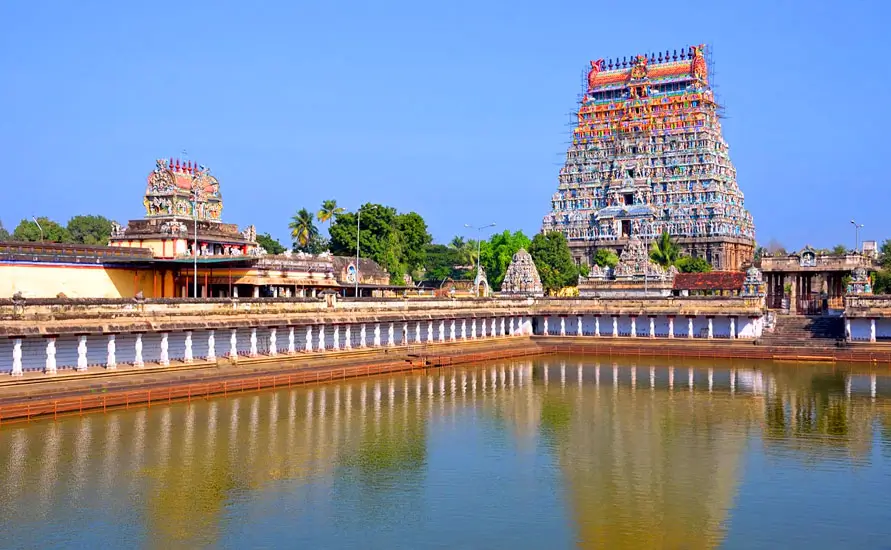
The coast road south takes about ninety minutes to Chidambaram, home of the temple of Shiva as Nataraja, the cosmic dancer. Your guide brings you first to the eastern gateway, where small carved panels show the 108 poses of classical dance as described in the old treatise on drama, and many Bharatanatyam students come here to see them in stone. The inner hall in which the bronze Nataraja dances has a roof of gold-plated tiles, and nearby is the empty sanctum known as the secret of Chidambaram, a space that stands for the formless divine. Priests may ask men to remove their shirts in certain areas.
Before leaving Chidambaram you walk around the Sivaganga tank and the thousand-pillared hall, used for the Natyanjali dance festival that is held at the temple each year around February or March. If you would rather swap stone for water, an optional detour of about thirty minutes takes you to the Pichavaram mangroves, where rowing boats glide through narrow channels under arching roots. After a plain lunch in town you carry on southward through the delta past Sirkazhi and fields of rice and sugarcane, crossing the mouths of several branches of the Kaveri, for roughly an hour and a half.
You arrive in Tranquebar, or Tharangambadi, by mid-afternoon. Denmark held this small port from 1620 until 1845, and the town is little more than a few quiet streets running down to a long sandy shore. You stay at a restored seafront bungalow, leaving the afternoon open for an amble along King Street, past the old governor's house and the whitewashed churches, or to sit on the beach while fishermen mend their nets. The small 14th-century Masilamani Nathar Temple stands right on the sand, partly broken by the waves. Overnight in Tranquebar.
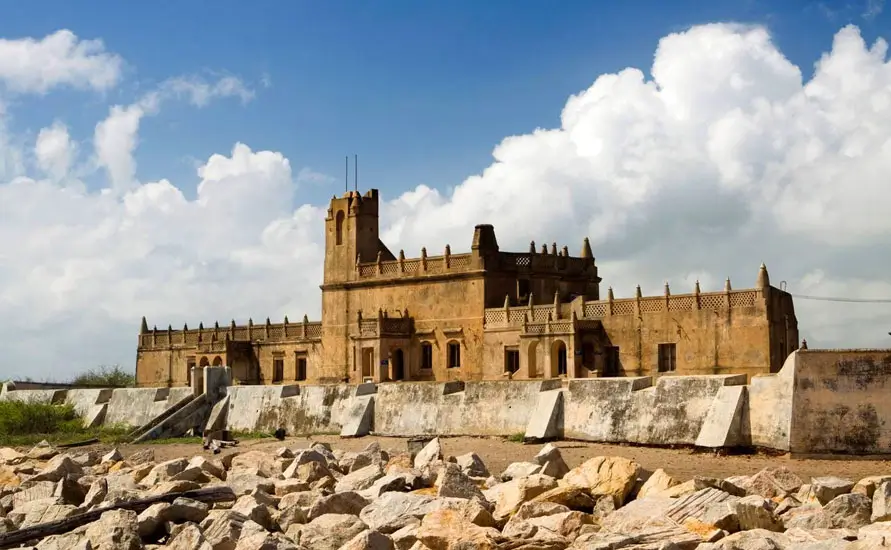
An early morning walk takes you to Fort Dansborg, the Danish fort on the beach, while the light is still soft. Its small museum, usually closed on Fridays, displays Danish coins, ship models and colonial records. Nearby stands the New Jerusalem Church, linked to the Lutheran missionary Bartholomäus Ziegenbalg, who arrived in 1706, learned Tamil and produced the first Tamil Bible translation that was printed in Tamil on a press shipped out from Europe. The restored town gate of 1792 marks the edge of the old settlement. After breakfast you leave the coast and head inland into the Kaveri delta.
About two hours later you reach Kumbakonam, a crowded, devout town where temple towers rise above almost every neighborhood. Your guide leads you to the Mahamaham Tank, its banks lined with sixteen little shrines, where crowds gather every twelve years to bathe at the moment the planet Jupiter enters the sign of Leo. The Sarangapani Temple, dedicated to Vishnu, has a central shrine shaped like a chariot with carved wheels and horses. After lunch, order the local degree coffee, a strong chicory-laced brew that the waiter pours back and forth between tumbler and bowl to raise a froth.
At about four o'clock it is a ten-minute ride to Darasuram, where Rajaraja II's Airavatesvara Temple completes, with Tanjore and Gangaikonda Cholapuram, the UNESCO trio called the Great Living Chola Temples. It is smaller than its famous relatives but carved with extraordinary precision, from tiny dancers no bigger than a hand to rows of pillars shaped like mythical beasts. Near the entrance your guide taps a set of granite steps, and each one gives back its own musical tone. By late afternoon only a handful of local worshippers and a priest or two remain. Overnight in Kumbakonam.
An hour north of Kumbakonam, in a landscape of fields and village ponds, rises the temple of Gangaikonda Cholapuram, built by Rajendra I around 1035 to celebrate his armies' march to the Ganges. He moved the Chola capital here, which explains a name that translates roughly as city of the Chola who conquered the Ganga. Today almost nothing remains of the royal city, which gives the temple a lonely grandeur. Its tower curves gently inward toward the top, softer in outline than the one at Tanjore, and the panels around the sanctum include a fine carving of Shiva crowning the devotee Chandesha.
Outside, look for the huge brick-and-plaster Nandi and the well entered through a lion's mouth, where tradition says the king poured Ganga water brought home by his troops. On the drive back south you stop at Swamimalai, a riverside village where perhaps a few hundred artisans still make temple bronzes using lost wax. You watch a figure being modeled in beeswax, then covered in fine clay from the riverbed and fired so that the wax melts away, leaving a mold for molten metal. Each piece is unique, since the mold is broken to release it. Finished work can be shipped abroad.
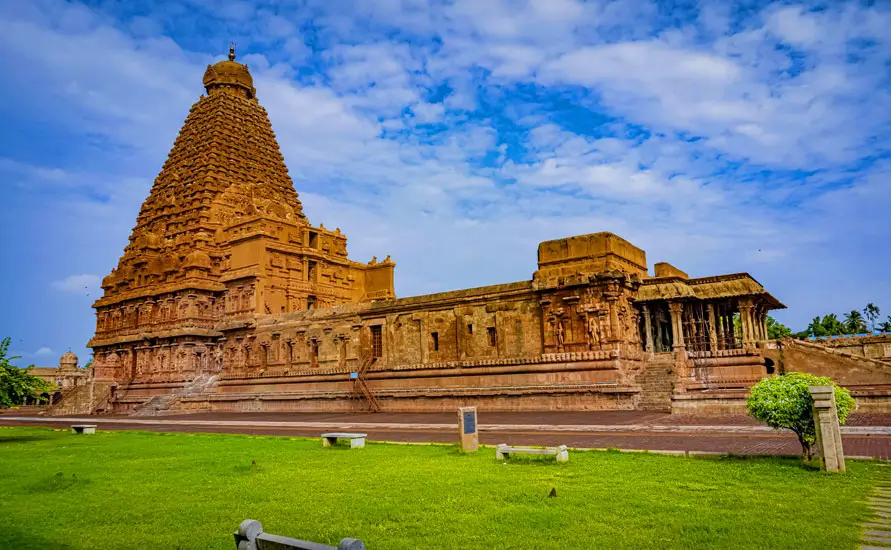
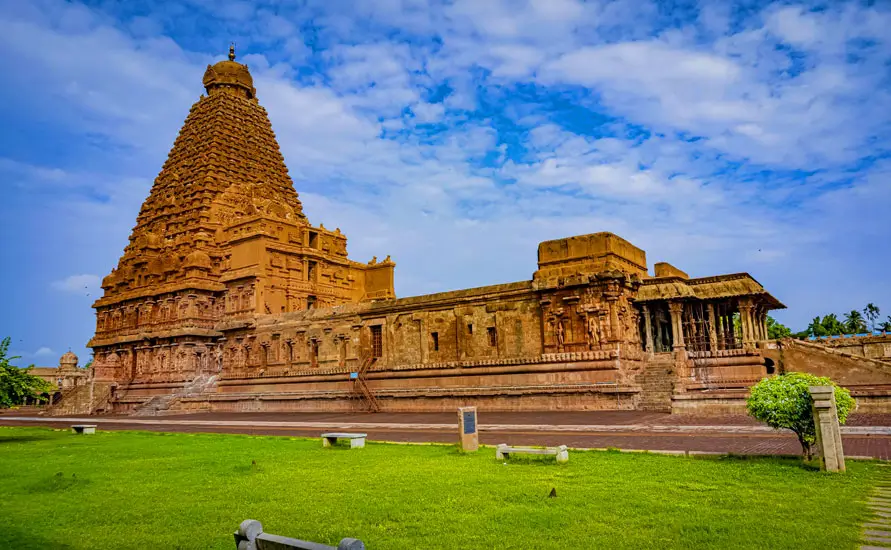
The village's Murugan temple stands on an artificial mound, and its sixty stairs are named after the sixty years of the Tamil calendar. A forty-minute road then brings you to Tanjore (Thanjavur), base for the next two nights. If you have energy left, head to the Brihadeeswarar Temple at dusk, when the granite tower glows orange and then fades to gray as the lights come on. Families sit on the lawns, children run around the huge Nandi pavilion, and the evening bells ring from the main shrine. It is a lovely first look before tomorrow's guided visit. Overnight in Tanjore.
Your guided visit to the Brihadeeswarar Temple begins soon after opening, before the stone paving becomes too hot for bare feet. Rajaraja I completed it in 1010, and its tower of about 66 meters made it the tallest temple in India of its time. The granite had to be brought from quarries far from the stoneless delta, and historians still debate exactly how the capstone was lifted to the top. Your guide leads you along the walls carved with inscriptions that list donations, temple dancers and staff by name, a rare record of how a medieval temple was run.
Around eleven you move to the Thanjavur Royal Palace, first a Nayak and then a Maratha seat, with a bronze gallery and the Saraswathi Mahal Library, whose palm-leaf and paper collection owes most to Serfoji II, a ruler who corresponded with European scholars around 1800. Some of its rare maps and illustrated works are on display. Before lunch you visit a studio of Tanjore painting, where artists build up raised designs in chalk paste and gold foil, and a stall selling the wobbling thalaiyatti bommai, the bobble-headed Thanjavur dolls that rock back and forth when touched.
With so many miles still ahead, the afternoon is left open. Many guests sleep, swim or read at the hotel, while others take a cycle rickshaw through the old streets around the palace. If you wish, we can take you to a workshop where a family builds veenas, the long-necked lutes of Carnatic music, carved from single blocks of jackwood. The evening is free; one option is a vegetarian dinner of rice, sambar, rasam and curd at a local restaurant, ending with sweet payasam. Pack tonight, since tomorrow's route takes you through Trichy and on to Chettinad. Overnight in Tanjore.
An hour and a half west along the Kaveri brings you to Srirangam, a river island framed by the Kaveri and the Kollidam and enclosed almost entirely by the walls of the Ranganathaswamy Temple, a Vishnu complex so big that thousands of people live inside its outer rings. Its seven concentric walls enclose streets, homes and markets, and its main gateway, completed in 1987, rises to about 73 meters. Your guide takes you to the Sesharaya Mandapa, where pillars are carved as rearing horses with riders, and to the rooftop viewpoint, where a small ticket gives a view across the golden vimana and the many gateways. Only Hindus may pass into the sanctum itself.
Across the river in Trichy town, the Rock Fort rises abruptly from the plain, a mass of ancient rock topped by a small temple to Ganesha. Roughly 400 rock-hewn stairs, partly roofed, climb past the Thayumanavar shrine of Shiva to the top, where the view takes in Srirangam's towers and the curve of the Kaveri. The climb is best taken slowly with water stops. Lunch is in town, perhaps a plate of biryani or a vegetarian thali, and afterwards you take the road south-east for about two hours through dry fields and palmyra groves.
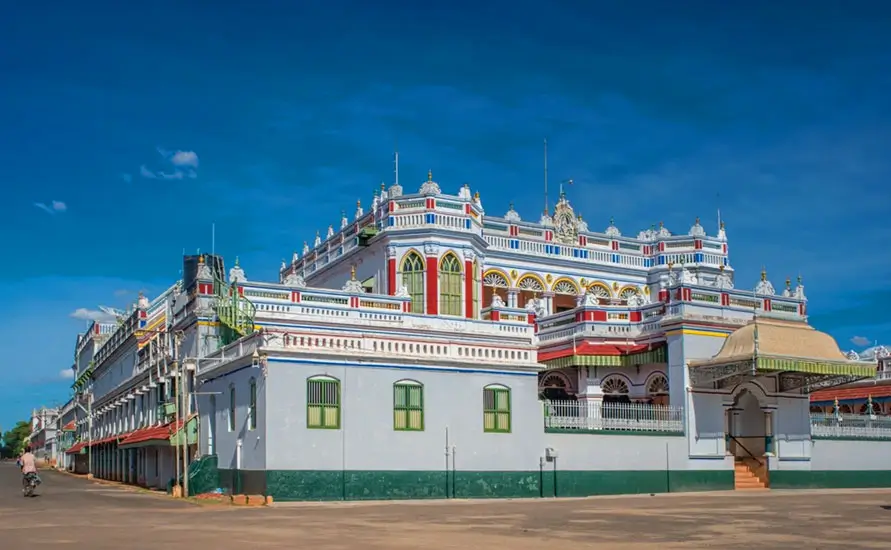
Around six you pull into Chettinad, a cluster of seventy-odd villages built by the Chettiar moneylenders, whose fortunes came from lending and trading in Rangoon, Colombo, Penang and Saigon during the colonial era. You stay in a restored mansion hotel near Karaikudi, its courtyards lined with Burma teak pillars and its floors laid with handmade local tiles. Dinner is a full Chettinad meal, heavy with black pepper, star anise and the local kalpasi lichen, served on banana leaves. Ask for milder dishes if you prefer; the cooks are used to adjusting the heat. Overnight in Chettinad.
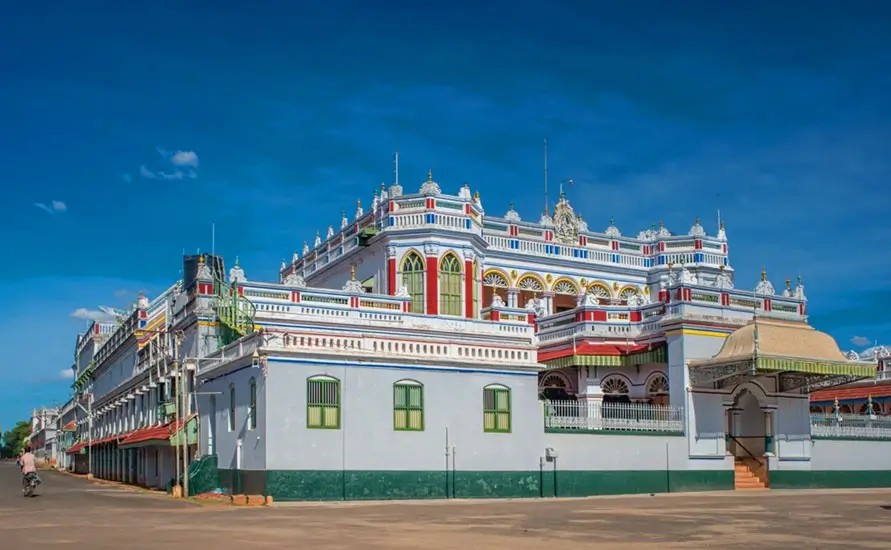
The morning is spent in Kanadukathan and its neighboring villages, where whole streets are lined with Chettiar mansions, some restored, others locked and slowly decaying. Your guide knows which families open their homes to visitors, and inside, Carrara marble floors, mirrors from Belgium and tiles from Japan sit next to carved teak doors made by local craftsmen. Many houses have a long series of courtyards, each used for a different stage of family life, from receiving guests to cooking rice for hundreds at weddings. The quiet, dusty lanes outside give little hint of the wealth behind the doors.
In Athangudi, a short drive away, you visit a tile workshop where each tile starts as a slurry of pigment and cement poured into a metal stencil on a sheet of glass, then gets soaked for days. No kiln is used, and the shine comes from the glass. Next is the rock-cut Pillaiyarpatti temple, one of the most revered shrines to Ganesha in the region, where the deity is carved directly into the cliff face and the temple kitchen prepares a giant offering of sweet modak on festival days. Lunch is a lighter Chettinad meal back at your mansion before you check out.
After lunch the road leads west toward Madurai, about two hours away, the old capital of the Pandya kings and one of the longest continuously inhabited cities in India. You check in by late afternoon. Near 6 pm the guide meets you at the Thirumalai Nayak Palace of 1636, its open court ringed by massive white columns supporting high, decorated arches. Most evenings an English-language son et lumière recounts Nayak court history inside these walls. Afterwards, try a paper-thin ghee dosa at a busy eatery near the temple. Overnight in Madurai.
If you are up before dawn, the Mattuthavani flower market is the most colorful place in Madurai. Farmers from across the district arrive with sacks of jasmine, marigold, rose and tuberose, and traders weigh and auction them by the kilo in the half-light. Madurai malli, the local jasmine, has its own geographical indication and is shipped all over India and beyond. Your guide explains how a single string of flowers ends up in a woman's hair, on a temple deity or around a bride's neck. Back at the hotel, breakfast is followed by a short rest.
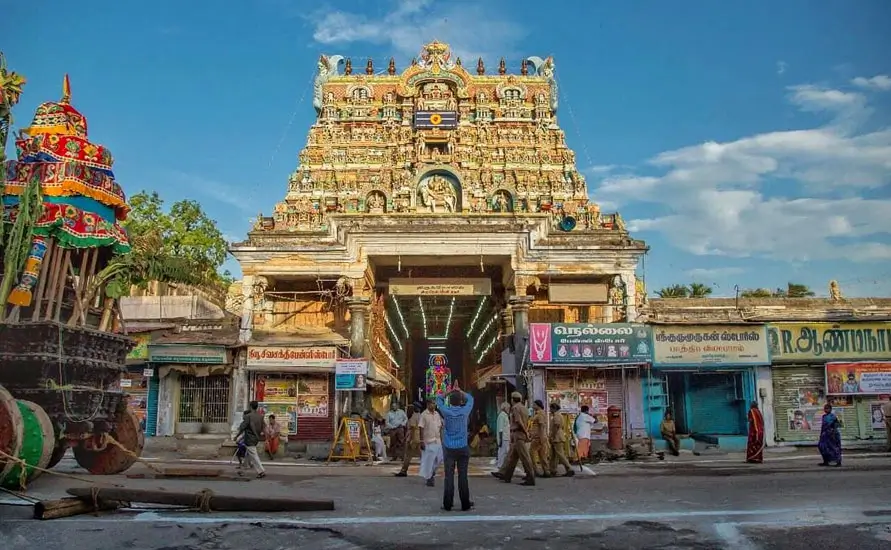
Mid-morning is devoted to the Meenakshi Amman Temple, where a warrior queen turned goddess shares the precinct with her husband Sundareswarar. Before going in, you check your mobile and camera at a counter outside the tower gate; foreign visitors may walk the outer halls freely, while the sanctums of the goddess and her husband admit Hindu worshippers only. You pause beside the Golden Lotus Tank, where, the story goes, a floating plank accepted good verse and sank bad poets, then step into the thousand-pillar mandapam, whose carved columns frame a small art collection. In the late morning you continue to the Gandhi Memorial Museum, where a glass case holds the stained dhoti he had on when he was shot in 1948.
The afternoon is free, perhaps for shopping at the Puthu Mandapam, an old pillared hall where tailors can make you a shirt or dress in a day, or for a walk around the vast Mariamman Teppakulam tank. Shortly before 9 pm you return for palliyarai, when Sundareswarar's festival image is escorted on a palanquin to rest with the goddess for the night, to the sound of drums and pipes. It is a short, intimate ritual and gives a different feeling from the daytime crowds. Your driver waits outside to take you back. Overnight in Madurai.
After an early breakfast you leave Madurai and drive east across the plains of Ramanathapuram district, a dry landscape of thorny scrub, salt pans and small villages. The final stretch crosses the Pamban Channel to Rameswaram island on the long road bridge, with the rail bridges running alongside. The old cantilever railway bridge of 1914, which lifted to let ships pass, has been replaced by a new vertical-lift bridge opened in 2025, and from the road you can see both and the fishing boats rocking in the shallow turquoise water below. Ask the driver to pull over on the approach for pictures.
After check-in and lunch you visit the Dr. A. P. J. Abdul Kalam National Memorial, built at Peikarumbu near the place where the former President of India and space scientist is buried. Kalam was born on this island to a family of boat owners, and the memorial displays his life story, models of rockets and missiles, and personal objects. His childhood home on Mosque Street now holds a family-run exhibition of letters, awards and photographs. Many Indian visitors come here as a sort of pilgrimage, and it is moving to see how much he is still loved.
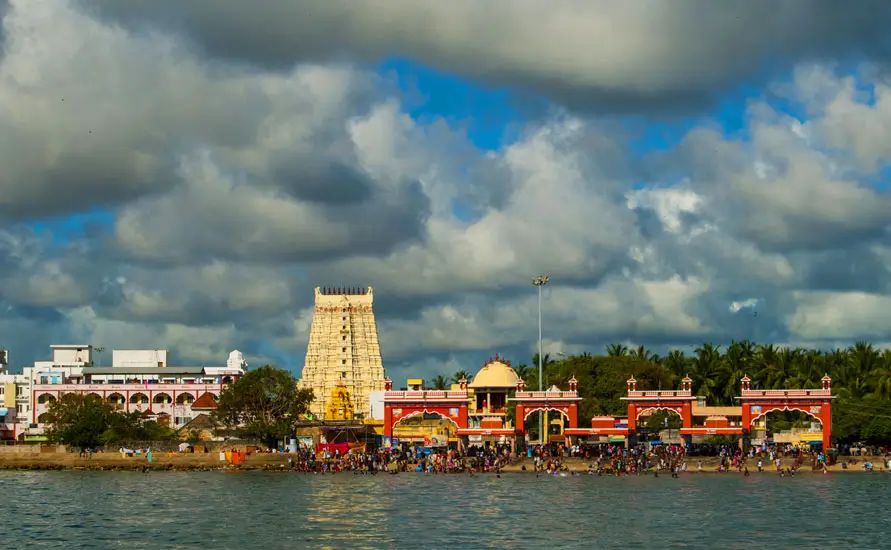
When the sun is low, you enter the Ramanathaswamy Temple on foot, known for its long pillared corridors, among the longest in any Hindu temple. Painted ceilings and rows of carved pillars stretch into the distance, and the light falls in bands through the side openings. Pilgrims come to bathe in the water of the 22 sacred wells inside the temple complex before worship, and attendants pour buckets over them, so expect wet floors. The main sanctum is closed to non-Hindus. In the evening you can walk along the shore near the temple's eastern gate. Overnight in Rameswaram.
Today's long drive is preceded by an early start to reach Dhanushkodi, at the tip of Rameswaram island, around sunrise. Until the night of 22 December 1964 it was a lively railhead with boats to Talaimannar, but a cyclone and storm surge flattened it, and what remains are roofless walls of a church, the station and a few shops. Beyond the ruins, tarmac continues to Arichal Munai, a sandspit where two seas, the Bay of Bengal and the Gulf of Mannar, lap either side and Sri Lanka lies only about thirty kilometers away. Fishermen's huts and the wind are almost the only signs of life here.
Back in Rameswaram for breakfast, you then check out and begin the drive south along the coast toward Kanyakumari, about six and a half hours with stops. The route passes through Thoothukudi, known for its port, pearls and salt works, where you can stop for lunch and fresh seafood, then through Tiruchendur and the palmyra country of the far south, where tall palms provide sugar, toddy and roofing for village houses. Your driver suggests short tea breaks every two hours or so, and the scenery changes from beaches and salt pans to red soil and, near the tip, wind farms turning on the hills.
Pulling into Kanyakumari around five, you should have time to catch the sun dropping into the western sea. This is the southernmost point of mainland India, where three bodies of water, the Bay of Bengal, the Indian Ocean and the Arabian Sea, meet, and on clear days you can watch both sunrise and sunset over water from the same beach. After the long drive, an early dinner and an early night are the best choice. Ask the reception desk for tomorrow's sunrise time and pick a room facing the sea if possible. Overnight in Kanyakumari.
A slow day at the cape starts with sunrise, which draws hundreds of people to the shore and the rooftops. Pilgrims bathe at the ghats where the waters meet, children paddle in the shallows and vendors sell tea and shells. Once you have eaten, join the line at the jetty for the short boat ride to the Vivekananda Rock Memorial; tradition holds that the young monk swam out here in late 1892 and meditated before his voyage to America. The memorial hall has a meditation room where silence is expected, and the views back across the water to the town are wonderful.
Beside it rises the stone figure of Thiruvalluvar, whose height of 133 feet matches the 133 chapters of his Thirukkural, 1,330 two-line verses that Tamil politicians, teachers and bus conductors still quote. Since late 2024 a glass-decked walkway joins the two islets, saving you another boat ride and giving a view straight down into the swell. Ashore, the Kumari Amman Temple honors the maiden goddess still waiting for a wedding that never happened; men enter bare-chested. Nearby, the Gandhi Mandapam was designed so that sunlight falls on the spot where his ashes were kept on his birthday, 2 October.
The afternoon is free. After two weeks on the road, many guests simply rest, but there are several optional excursions if you want them. The Suchindram temple, about half an hour away, has musical pillars and a large Hanuman figure, while the wooden Padmanabhapuram Palace, just across the state line in Kerala, shows off old Travancore carpentry at its best (shut Mondays). Late in the afternoon, the shore is a good place for a walk, and street stalls serve fried fish, banana chips and fresh lime soda. Overnight in Kanyakumari.
Nothing on the route covers more ground than today's run, so the wheels turn at about 7 am. The road runs north through Tirunelveli, famous for its sweet, glossy halwa, and continues through Kovilpatti and the plains of the south, with a tea and coffee break every couple of hours. Lunch is at a highway restaurant around the halfway point, near Madurai, where your driver knows a clean place with good vegetarian and non-vegetarian food. The landscape changes slowly, from coconut palms to cotton fields and finally, as the afternoon wears on, to the blue outline of the Palani hills ahead.
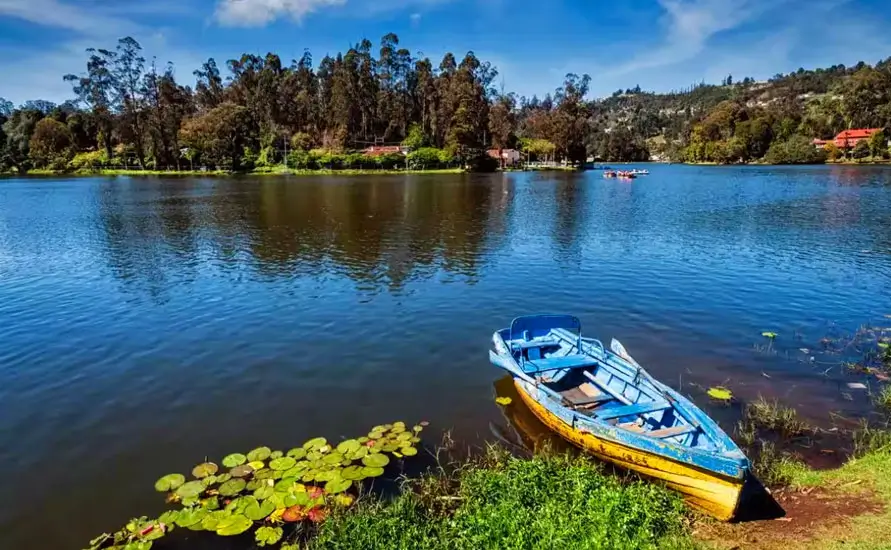
From Batlagundu the Kodai ghat road twists up through dozens of bends, and the air grows cooler noticeably as you rise from the plains to over 2,000 meters. You pass the Silver Cascade waterfall by the road, a good place to stretch your legs, where monkeys gather near the parking area hoping to grab biscuits, so leave food in the car. Kodaikanal appears around a final bend, its houses spread around a lake and up wooded slopes. You check in at a hotel with views of the valley, and after hot soup at dinner you will sleep soundly in the cool mountain air. Overnight in Kodaikanal.
Set up as a summer retreat by missionaries from Madurai's American mission in 1845, Kodaikanal still has a quieter, more wooded feel than Ooty. Today is kept deliberately easy. After a late breakfast you amble along Coaker's Walk, a narrow ledge of a footpath cut into the hillside which, when the clouds clear, offers views down to the plains far below. Your guide points out the campus of the Kodaikanal International School, founded in 1901, and the stone churches and bungalows built by missionary families. Mist often moves in and out quickly, so carry a light jacket.
Before lunch there is a stop at the small Jesuit-run natural history museum at Shembaganur, with cases of local plants, birds, insects and orchids that helps you identify what you see in the forest. Nearby is the Bear Shola Falls, a short walk through shola, the patchy native evergreen forest of these hills. If you are lucky with the season, you may see the Kurinji, a blue-purple flower that carpets these slopes only once in about twelve years, so ask your guide whether any patches are out. Lunch is at a café in town known for homemade bread and cheese.
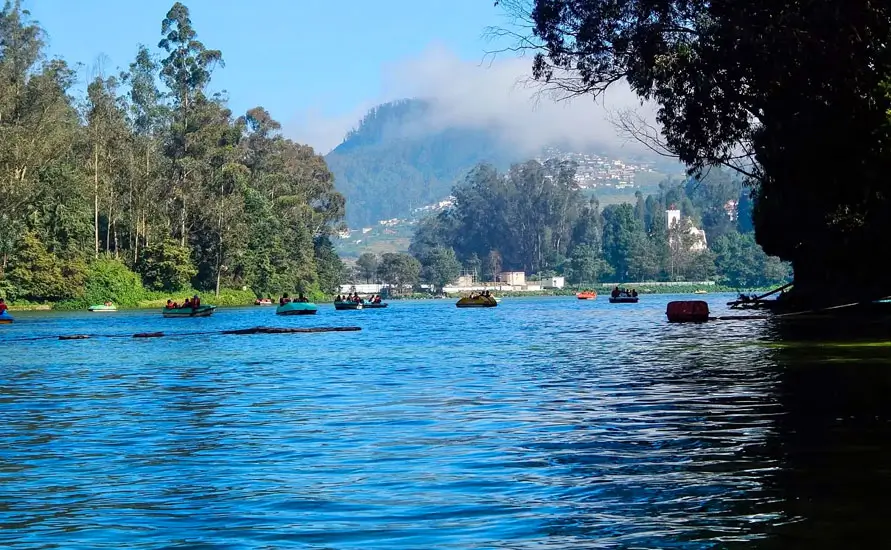
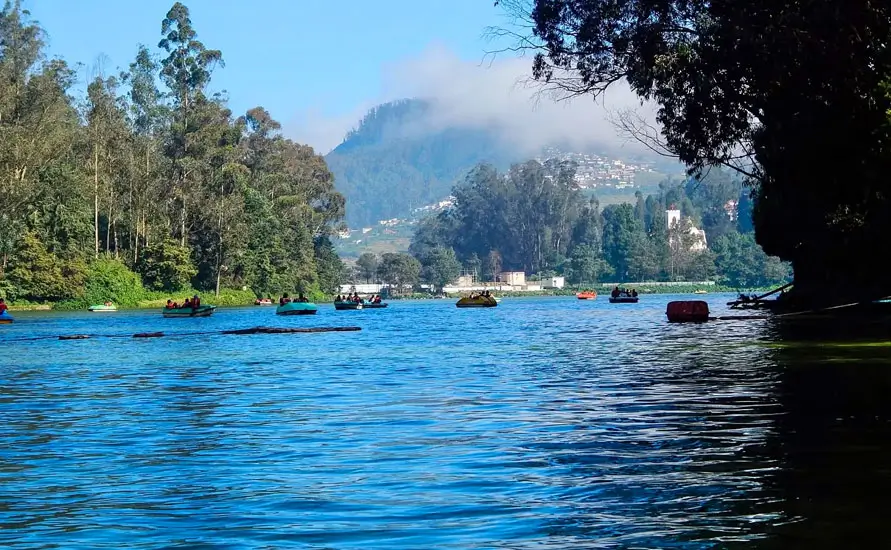
After lunch you have the hours to yourself. Many guests rent a bicycle or a pedal boat on the Kodaikanal Lake, a star-shaped artificial lake about five kilometers around, or ride a horse along the lakeshore. The market lanes are good for plums in season, fudge, eucalyptus oil and hand-knitted caps. As the light fades, the temperature drops quickly, so plan to be back at your hotel before dark for a warm dinner. Your driver will check the car and fuel tonight, ready for tomorrow's long run to the Nilgiris. Overnight in Kodaikanal.
Today you swap one range for another, crossing from the Palanis to the Blue Mountains. You descend the western ghat road from Kodaikanal toward Palani, where the hilltop Murugan temple, one of the six sacred abodes of the god, can be seen high above the town; devotees climb the steps or ride the winch railway to the top. From there the road continues through Pollachi or Udumalpet, coconut and banana country, and around the edge of Coimbatore. Your driver stops for lunch along the way and for tea at regular intervals, so the long hours do not become tiring.
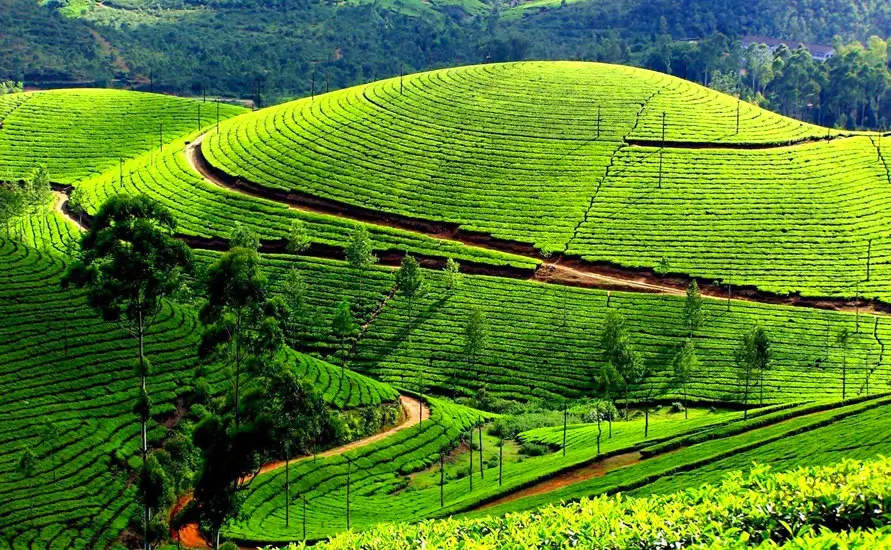
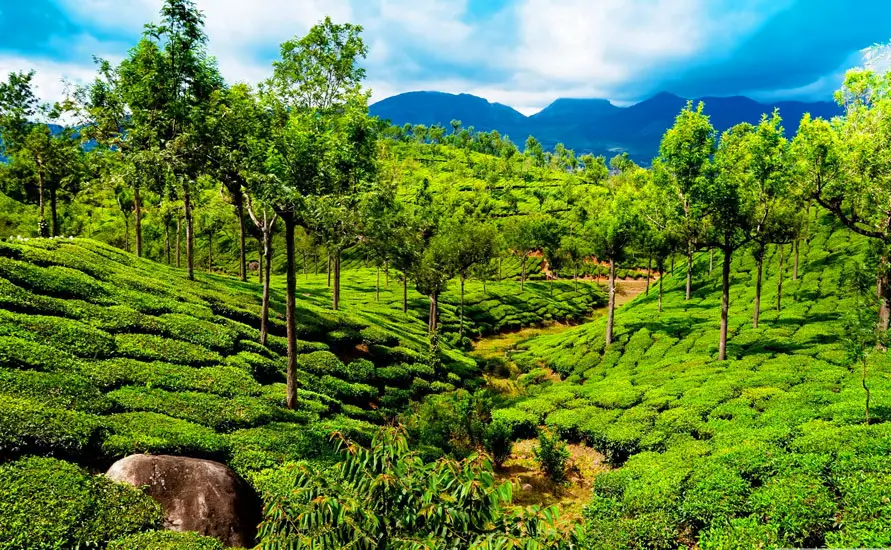
After Mettupalayam, the last town on the plains, the highway begins to climb again through steep forested slopes, and you can catch glimpses of the rack railway line winding up alongside. The air becomes fresh and scented with eucalyptus as tea estates replace the forest. You arrive in Coonoor in the late afternoon and check in at a colonial-style hotel or tea estate bungalow set among the plantations. A quiet evening with a cup of Nilgiri tea on the veranda is the perfect end to the day. Overnight in Coonoor.
Coonoor is smaller and calmer than Ooty, and the morning is spent among its tea gardens. Your guide takes you to Dolphin's Nose, a rock outcrop looking across a deep gorge toward Catherine Falls, best seen early before the clouds rise. A working tea factory follows, where staff walk you from withering troughs to rolling machines and dryers, then pour samples of dust, fannings and whole-leaf grades. Sim's Park, a sloping garden begun by a British official in 1874, has rare trees and a small lake, good for a short walk before lunch.
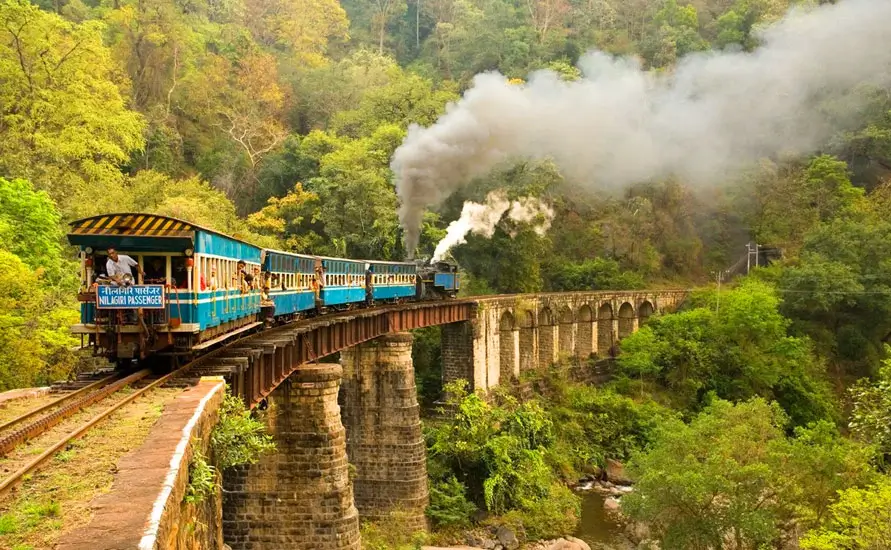
In mid-afternoon you take your reserved seats on the little Nilgiri Mountain Railway train at Coonoor for the run up to Ooty. UNESCO lists the line alongside the Darjeeling and Kalka-Shimla railways, and the stretch below Coonoor uses a rack-and-pinion system to climb the steepest gradients. The upper stretch to Ooty passes through tunnels and over bridges, with views of tea estates, eucalyptus forests and small towns like Wellington and Lovedale. Seats are limited and booked in advance, and your luggage travels separately by car, so you only need a small bag on the train. Your driver meets you at Ooty station.
Ooty, or Udhagamandalam, was the summer headquarters of the Madras government in British times, and the town still keeps some old buildings, such as St. Stephen's Church, built in 1829 with timber said to have come from Tipu Sultan's palace. By five you are free to wander around Charing Cross and the markets, where you can buy tea, spices and homemade chocolate. This is your final evening in Tamil Nadu, and many guests like to end with a celebratory dinner at the hotel, looking back on three weeks across the state. Overnight in Ooty.
With an afternoon flight, you can fit in an hour at Ooty's Government Botanical Garden, terraced in 1848 with old trees, a fossil tree trunk and a fern house. Then your driver takes you down the ghat road via Coonoor and Mettupalayam to Coimbatore International Airport, a drive of about three hours. Coimbatore's airport links to Chennai, Bengaluru, Delhi and Mumbai, and has direct services to Sharjah and Singapore for long-haul connections.
Over the last three weeks, this complete Tamil Nadu tour has taken you from Pallava cave temples to Chola towers, through the merchant towns of Chettinad and the great temple city of Madurai, to the southern tip of India and up into the tea hills. Your driver will say goodbye at the terminal entrance, and our team remains available by phone until your flight departs. Come back one day for Kerala or Karnataka, and we will be glad to plan the next chapter. Safe travels.
Your Journey

N.S. Rathore & Mrs. Omlata Rathore · Managing Director
We still read every enquiry ourselves. Tell us the places you liked and our planners will send a day-by-day route with drive times and a clear price.
Every package can be customised and no pressure to book. A planner from our office replies within 24 hours with a route written for your group.
Fill this in and your planner will send a first draft itinerary.
Explore more
Kerala Backwaters Escape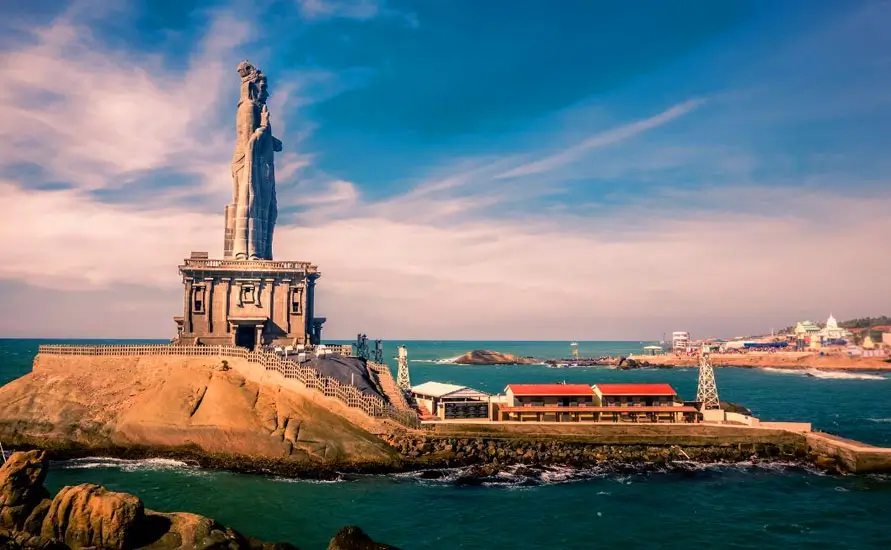 Kerala Backwaters Escape
 Kerala Backwaters Escape
 Kerala Backwaters Escape
 Kerala Backwaters Escape
 Kerala Backwaters Escape
 Kerala Backwaters Escape
 Kerala Backwaters Escape
 Kerala Backwaters Escape
 Kerala Backwaters Escape
 Kerala Backwaters Escape
 Kerala Backwaters Escape
 Kerala Backwaters Escape
 Kerala Backwaters Escape
 Kerala Backwaters Escape
 Kerala Backwaters Escape
 Kerala Backwaters Escape
 Kerala Backwaters Escape
 Kerala Backwaters Escape
 Kerala Backwaters Escape
 Kerala Backwaters Escape
 Kerala Backwaters Escape
 Kerala Backwaters Escape
 Kerala Backwaters Escape