 Kerala Backwaters Escape

Tamil Nadu Tour Packages
Chennai – Kanchipuram – Swamimalai – Tanjore – Karaikudi – Madurai
At a glance
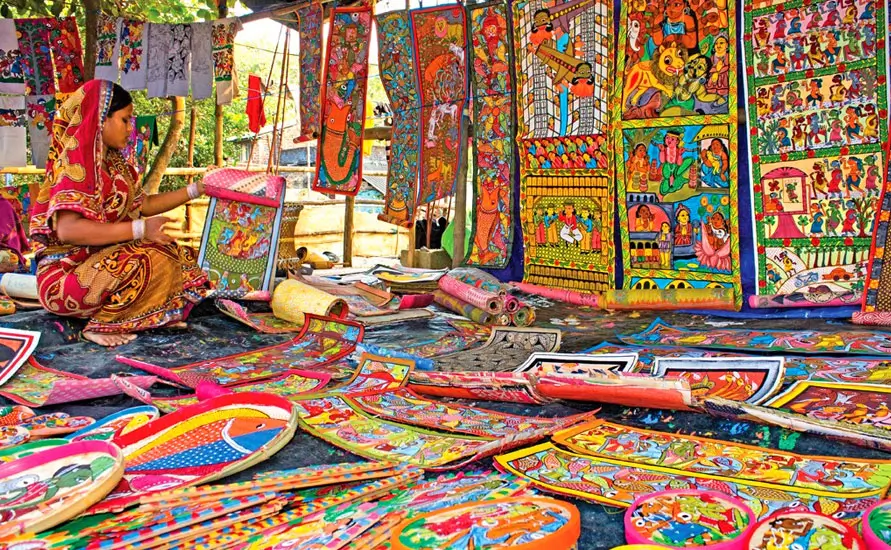
Most visitors see the finished silk sari, the polished bronze Nataraja or the gold-leaf painting in a shop window. Our Tamil Nadu art craft and textile tour takes you one step back, into the workshops where these things are made by hand. Over nine days you sit beside weavers in Kanchipuram, watch molten metal poured into clay molds in Swamimalai, see gesso and gold foil applied to a Tanjore painting, and follow the making of Athangudi tiles and Chettinad cotton saris before ending with the dotted Sungudi cloth of Madurai.
Each stop on this Tamil Nadu craft tour is a living craft town rather than a museum display. Families in these places have passed their skills from parent to child for generations, and several crafts on the route hold a Geographical Indication tag that protects their name and method. Your guide arranges visits to working units, explains each process in plain English and translates your questions for the artisans. Buying is entirely optional, but if you do want a piece, you will know how it was made and what a fair price looks like.
The route runs from the north of the state to the south with short, manageable drives, and two nights in both Chennai and Swamimalai give you time to stay longer at the looms and foundries. The trip suits textile collectors, designers, art students, photographers and anyone who likes to see skilled hands at work. You ride in your own cooled vehicle with a fluent English-speaking chauffeur, specialist guides meet you in each craft town, and we can shift dates to match festivals or a craft you care about most. Weather is kindest between the end of the northeast monsoon and the spring heat, roughly late October to early March.
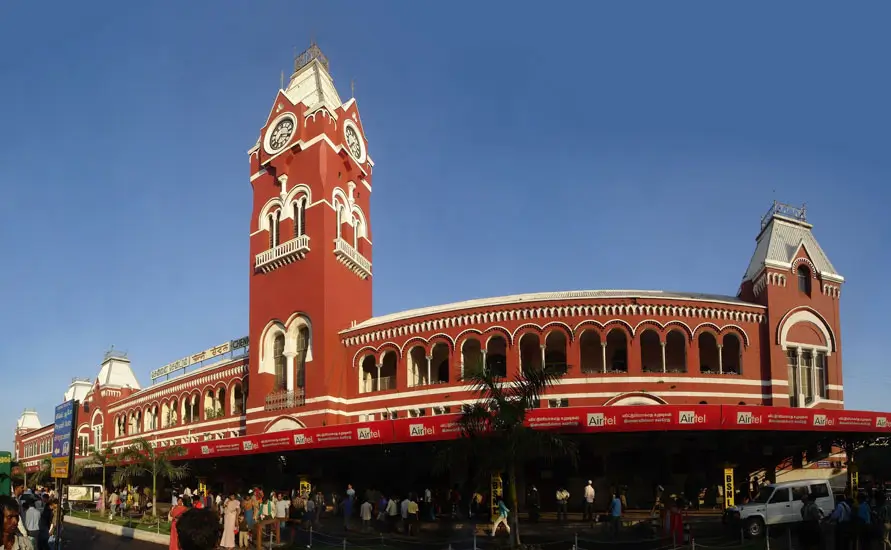
Once you clear immigration at Chennai International Airport, our representative waits with a placard bearing your surname; the private car parked outside will carry you through all nine days. Since many long-haul arrivals touch down in the small hours, the first morning is kept clear for sleep, with an early check-in booked ahead if your plane lands before dawn. Before leaving you to sleep, our representative goes over the route, hands you a printed plan of the workshop visits and shares a few basics on buying textiles in India, from checking labels to paying artisans directly.
The craft story of this tour really begins in the afternoon at the Government Museum in Egmore, one of the oldest museums in the country. Its Bronze Gallery holds a large collection of South Indian metal icons, many dating from the Chola period, and your guide uses them to show what Swamimalai's foundries still aim for today: balanced proportions, flowing ornament and hands caught in precise ritual gestures. Look closely at the Nataraja figures and the Ardhanarishvara, which joins Shiva and Parvati in a single body. The museum is closed one day each week, usually Friday, so we schedule this visit around your arrival date.
Back outside, the red-brick Indo-Saracenic buildings of the museum campus make a good first glimpse of colonial Madras. On the drive back your guide can stop at a textile showroom on the city's main shopping streets, not to buy, but to see the range of silk, cotton and blended saris that Tamil women actually wear, and to learn how much variety the coming week will cover. Dinner can be a simple South Indian meal of dosa, sambar and coconut chutney at a local restaurant, followed by your first proper night of sleep in India. Overnight in Chennai.
Your morning is spent at Kalakshetra Foundation in Thiruvanmiyur, the arts campus set up in 1936 by Rukmini Devi Arundale, who wanted dance, music and textiles taught side by side. Beyond the dance school, the campus runs a weaving centre where artisans produce cotton and silk saris on handlooms using vegetable dyes such as indigo, madder and pomegranate rind. A small Kalamkari unit next door prints and paints fabric with wooden blocks and bamboo pens. Visits run on working days and are arranged in advance, and your guide will ask the weavers to show the dyeing vats as well as the looms.
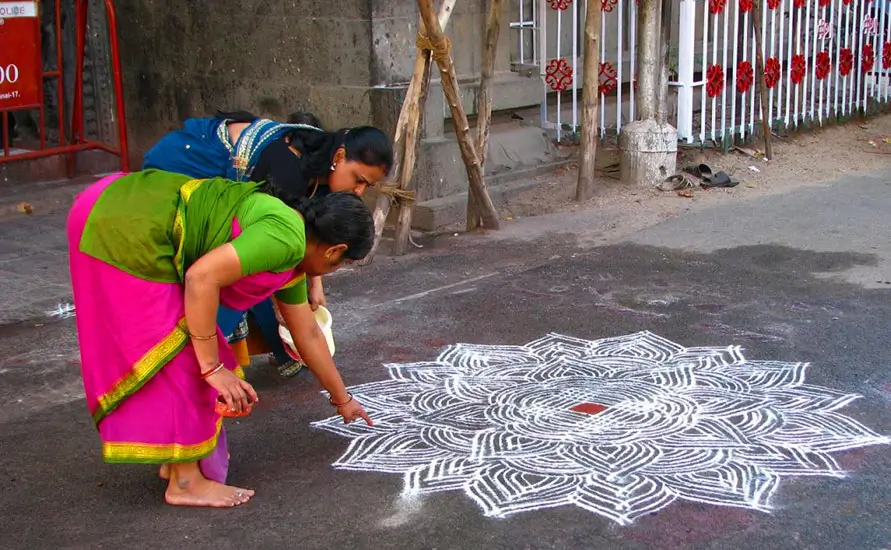
After lunch you drive about 25 km south along the East Coast Road to DakshinaChitra, a heritage center that has reassembled old homes from four southern states on one shaded site. Each house was taken apart in its home village and put back together here, from a Chettiar merchant's courtyard to a weaver's home with a pit loom sunk into the floor. Craftspeople give regular demonstrations, and on a typical afternoon you may see a potter at the wheel, a basket maker splitting palm leaf or a woman drawing a rice-flour kolam. DakshinaChitra is closed on Tuesdays.
Before you leave, spend some time in the center's craft shop, which buys directly from rural artisans and labels each piece with its maker's region, a useful reference for prices later in the trip. If time allows, there is also a short pottery or kolam session you can join, and your guide will explain how kolam patterns are drawn each morning at the threshold of Tamil homes as a sign of welcome. The drive back into Chennai takes about an hour, depending on evening traffic on the coast road. The rest of the evening is yours to rest before the move to the silk town tomorrow. Overnight in Chennai.
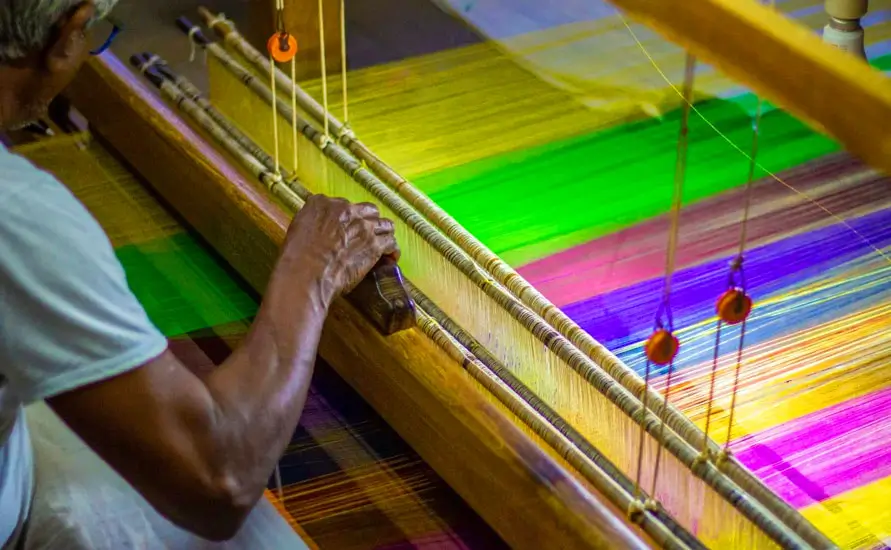
Leaving after breakfast, you head west through the industrial edges of Chennai to Kanchipuram, where the clack of handlooms can still be heard from open doorways in the weavers' streets. The town has been tied to silk for centuries, and its saris carry a Geographical Indication tag. Your guide introduces you to a weaving family who work from home, often with the loom set into a pit in the floor so the weaver sits at ground level with legs below the warp. The raw mulberry silk usually comes from Karnataka, and the gold thread, called zari, is made from silver wire coated with gold.
Spend as long as you like watching the weaving itself. Kanchipuram silk is known for its heavy body and for the korvai technique, in which the border and the body are woven in separate colors and interlocked by hand, thread by thread, so firmly that the join will not tear. Patterns are fed to the loom by punched cards in a jacquard frame above the weaver's head, and a single wedding sari with dense zari can take a weaver and an assistant two or three weeks. Your guide shows you how weavers test pure zari and how to read the silk mark label on a genuine piece.
In the afternoon you visit the Kailasanathar Temple, built by the Pallava rulers in the early 8th century, to see how motifs such as temple towers, peacocks and rudraksha beads moved from stone into silk borders. You may also stop at a weavers' cooperative society, where prices are fixed and labeled, which is a calm place to buy if you prefer not to bargain. As evening falls, the streets fill with women carrying jasmine strings for their hair, and you can watch the town's large temples light their lamps. Kanchipuram hotels are simple but comfortable. Overnight in Kanchipuram.
Expect the longest stretch of road on the whole tour today, heading south through Tindivanam and across the flat rice country of the Kaveri delta. Your driver plans comfortable stops for coffee and a stretch, and the road passes palmyra palms, village shrines with clay horses and fields worked by hand in the planting season. Around midway you can break the drive at a roadside restaurant for a banana-leaf lunch, where rice, sambar, rasam, vegetables and curd are served in a fixed order and refilled until you fold the leaf to signal you are done.
By mid-afternoon you reach Swamimalai, a small temple town on the Kaveri a few kilometers west of Kumbakonam and the leading center of South Indian bronze casting. Families of Sthapathis, the traditional temple sculptors, have run foundries here for generations, and many trace their craft back to the age of the Chola kings. The town's bronze icons carry a Geographical Indication tag. Your guide takes you on a first walk down the main street, where open workshops display half-finished figures of Ganesha, Nataraja and Lakshmi, some still rough from the mold and others polished to a soft gold.
Late in the day you climb the steps of the Swaminatha Swamy Temple, raised on a man-made mound and counted among Murugan's six sacred abodes, the Arupadai Veedu. There are sixty steps, each linked to a year in the Tamil sixty-year cycle, and from the top you look over coconut groves and the river. Visitors of all faiths may walk the outer corridors, though photography rules vary by section. Home for two nights is a village-style heritage property close to the foundries, where dinner is usually served in a courtyard. Overnight in Swamimalai.
The whole morning belongs to the Swamimalai bronze casting process, and our team times the visit so that you can watch a pouring if one is planned. Each figure begins as a wax model made from beeswax, resin from the kungiliyam tree and a little oil, carved and finished in fine detail according to the proportions set down in old sculptural texts. The model is coated in several layers of fine clay taken from the Kaveri riverbed, dried and then heated so that the wax melts away, which is why the method is called lost-wax casting. Every mold can be used only once.
Next comes the pouring. Molten metal, a mix based mainly on copper with smaller amounts of brass and lead, is ladled into the hollow mold, and once it has cooled the clay is broken off to reveal a rough, blackened figure. The longest part of the work follows, as the artisans chisel, file and polish the surface, sharpen the details of jewelry and fingers and add the eyes, which can take weeks for a large piece. Your guide explains how to tell a hand-cast icon from a machine-made copy and how foundries ship pieces abroad with paperwork for customs.
After lunch you drive about 15 km to Nachiarkoil, a village known for its brass oil lamps, called kuthuvilakku, which also hold a Geographical Indication tag. Small family units cast and assemble the tall lamps in sections, and you can see the molds for the swan and peacock finials. Returning toward Swamimalai, you pause at the 12th-century Airavatesvara Temple at Darasuram, a UNESCO-listed Chola temple whose tiny carved panels show dancers, musicians and craftsmen at work. The evening is quiet, with time to sort through the day's notes and photographs. Overnight in Swamimalai.
A short morning drive brings you to Tanjore, also called Thanjavur, the old royal capital where a distinct style of painting grew up under Nayak and Maratha rulers between the 16th and 19th centuries. The craft is still practiced in family studios around the city, and your guide takes you to one where you can try the first steps yourself. A Tanjore painting starts with cloth pasted onto a wooden board and coated with a paste of chalk powder and gum, which is rubbed smooth before the outline of the deity is drawn in pencil.
The details that make this style stand out are the raised areas and the gold. Artists build up crowns, jewelry and pillars with a thick gesso paste applied in layers, then press thin sheets of gold foil over the relief and set glass or semi-precious stones into it. Colors are flat and bright, and the faces of Krishna and other deities are round and calm. In a short session you can work on a small panel under the artist's guidance. A full painting can take several weeks, so your studio will explain how to order one and have it shipped home after it is finished.
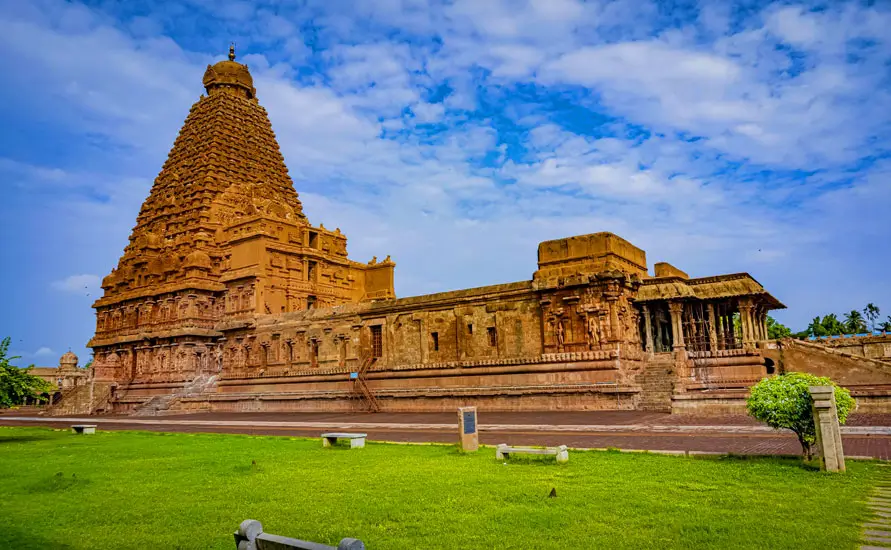
Toward sunset comes the Brihadeeswarar Temple, consecrated by Rajaraja I in 1010 and still a working shrine within a UNESCO World Heritage listing, at the hour when the granite tower turns a warm orange in the low sun. You also stop at a workshop making Thanjavur art plates, decorative brass or copper plates with embossed silver and copper figures, and, if the craftsman is available, a veena maker who carves the body of the instrument from a single piece of jackwood. Your guide can point you to a mess serving Thanjavur-style meals for supper. Overnight in Tanjore.
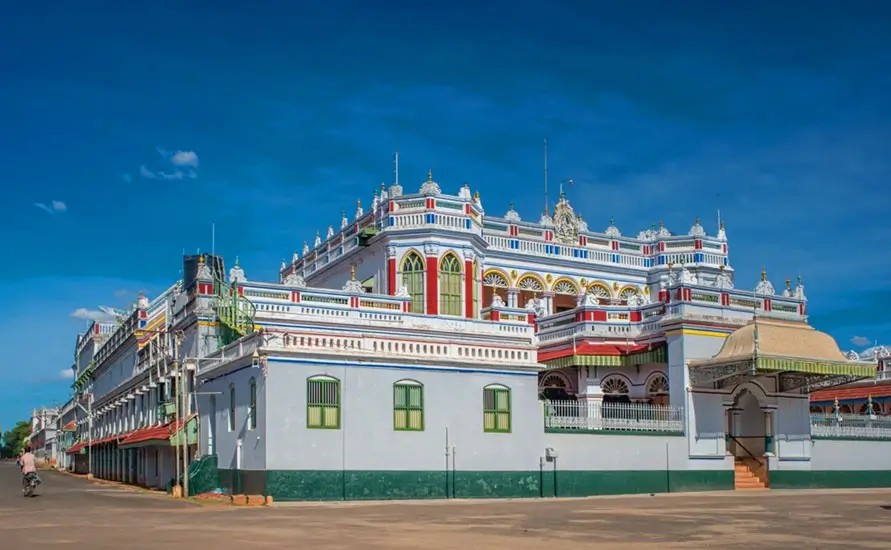
Before leaving Tanjore, a morning stop at the Thanjavur Royal Palace lets you see the art gallery's collection of bronze and stone sculpture, and the Saraswathi Mahal Library, which holds old palm-leaf manuscripts and illustrated works collected by the Maratha ruler Serfoji II. Then you drive south into Chettinad, the home region of the Nattukottai Chettiars, a merchant and banking community who traded across Burma, Ceylon and Southeast Asia from roughly 1850 to the 1930s. With the money they earned, they built huge mansions in their home villages, and filled them with Burmese teak, Italian marble and Japanese and European tiles.
In the afternoon you visit a workshop in the village of Athangudi, where the famous Athangudi tiles are made by hand. The process is simple to watch and hard to master. A craftsman sets a patterned metal frame on a glass plate, fills each section with colored cement mixed with natural oxides, then fills the mold with a dry mix of sand and cement that soaks up the moisture from the color layer. The tile is pressed, lifted off the glass, dried in the shade and then soaked in water tanks to cure. Fire plays no part in the whole method.
The smooth face of each tile comes from the glass it was cast on, and the floor gets glossier with years of walking. Your guide can arrange for you to make a single tile yourself to collect later or have shipped. Afterwards you walk through one of the large Chettiar mansions, many of which still use these tiles in their halls and courtyards. Your hotel tonight is a restored Chettiar mansion or heritage property, where dinner is a full Chettinad meal, famous for freshly ground spice pastes built on black pepper, dried red chili, fennel and the stone flower lichen called kalpasi. Overnight in Karaikudi.
Chettinad's own textile is the kandangi sari, a heavy cotton sari with bold checks, wide contrasting borders and colors such as brick red, mustard, black and deep green. It was once the daily wear of Chettiar women and has a Geographical Indication tag. Early this morning you visit a weaving cluster near Karaikudi, where artisans work on handlooms in their own homes. Your guide shows you how the thick cotton gives the fabric its stiff body and why the traditional sari is shorter than a silk one. Kandangi saris are good value, and many visitors buy them as tablecloths or curtain fabric.
Afterwards you drive west to Madurai, the oldest city in Tamil Nadu. Here you meet a family of the Sourashtra community, whose ancestors moved from Gujarat to the south several centuries ago and brought with them the art of tie-and-dye. Madurai Sungudi is made by marking dots on cloth, pinching up each point and tying it tight with thread before the fabric is dipped in dye, so the tied spots stay pale. A sari can carry thousands of dots arranged in squares, circles and floral patterns. You watch the tying and dyeing, and the family will explain how a modern fabric mix differs from pure cotton.
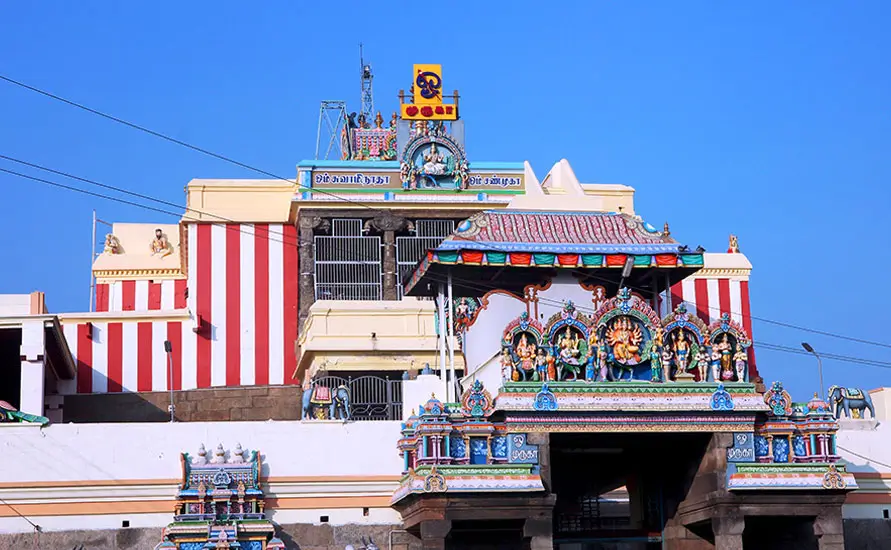
In the evening you visit the Meenakshi Amman Temple, where painted gods, demons and animals crowd every tier of the four main towers. Only Hindus may enter the inner shrines, and all phones and cameras go into deposit counters near the entrances, so plan to carry nothing but a little cash. Linger in the pillared mandapams and the long corridors where vendors sell bangles, brass lamps and fresh jasmine. If you are willing to stay late, the palliyarai ceremony takes place at about 9 pm, when the image of Shiva is carried to Meenakshi's chamber. Overnight in Madurai.
Rise early for a last walk through the Mattuthavani flower market, where farmers bring in sacks of jasmine, marigold and rose before sunrise and wholesalers weigh them out for temples, weddings and the strings women wear in their hair. Madurai's jasmine is prized enough to hold a protected regional name of its own. Return to your hotel for breakfast and packing, and if time allows, a quick stop is possible at the Thirumalai Nayak Palace, whose huge white stucco columns and arches were built by a 17th-century Nayak king.
The car then heads to Madurai Airport in good time for your onward flight, usually via Chennai, Bengaluru, Mumbai or another hub for international connections. If you bought larger pieces such as bronzes or paintings that are being shipped, our team will confirm their status before you fly and share the tracking details once they leave India. We can also extend the trip with a few days in Rameswaram, Kodaikanal or Kerala. We hope the pieces you carry home remind you of the hands that made them.
Your Journey

N.S. Rathore & Mrs. Omlata Rathore · Managing Director
We still read every enquiry ourselves. Tell us the places you liked and our planners will send a day-by-day route with drive times and a clear price.
Every package can be customised and no pressure to book. A planner from our office replies within 24 hours with a route written for your group.
Fill this in and your planner will send a first draft itinerary.
Explore more
Kerala Backwaters Escape Kerala Backwaters Escape
 Kerala Backwaters Escape
 Kerala Backwaters Escape
 Kerala Backwaters Escape