
 Kerala Backwaters Escape

Tamil Nadu Tour Packages
Chennai – Kanchipuram – Mahabalipuram – Pondicherry – Chidambaram – Kumbakonam – Tanjore – Trichy – Chettinad – Madurai – Rameswaram – Tiruchendur – Kanyakumari – Tirunelveli – Kodaikanal – Ooty – Coonoor – Coimbatore
At a glance
Most visitors see a slice of Tamil Nadu; the Grand Tamil Nadu Tour 18 Days is for those who want the whole state, from its northern temple towns to the very tip of the subcontinent and back up into the Western Ghats. You begin among the Pallava shrines of Kanchipuram and Mahabalipuram, spend a week in the Cauvery delta at Chidambaram, Kumbakonam, Tanjore and Trichy, and then head south through Chettinad and Madurai to the island pilgrimage town of Rameswaram and the three-sea shore of Kanyakumari. Two hill stations, Kodaikanal and Ooty, close the trip.
A route this long only works if the pace is honest. Distances in the deep south are large, so we break them up: the coastal run from Rameswaram to Kanyakumari pauses at the seaside Murugan temple of Tiruchendur, and the climb from Kanyakumari toward Kodaikanal is split with a night in Tirunelveli. Pondicherry, Kumbakonam, Madurai, Rameswaram and Kodaikanal each get two nights. Kodaikanal to Ooty is the one full road day and carries no sightseeing. The same car and English-speaking driver are with you throughout, and local guides lead each major site.
This Tamil Nadu tour 18 days program suits seasoned travelers from Britain, Europe, North America and Oceania, retired couples with time on their hands and NRI families who want a thorough look at the region their parents left. Temples dominate, of course, but there are also Danish-era churches, French streets, Chettiar mansions, fishing harbors and tea slopes. Plan the Grand Tamil Nadu Tour 18 Days for November to February, when the south is at its driest, and finish with a ride on the Nilgiri toy train before your flight from Coimbatore.
Your trip opens in the arrivals area at Chennai, where someone from our ground staff stands beyond the customs hall holding a placard in your name. Within minutes your bags are in the boot of an air-conditioned car and you are heading into the city. Because intercontinental arrivals cluster between midnight and dawn, the morning is set aside for rest. After lunch your guide drops by the hotel to hand over a printed route covering all eighteen days, introduce the driver who will be at the wheel throughout, and talk through money, phone connections and what to wear in temples.
The first visit is to Triplicane, a crowded old quarter just back from the sea, for the Parthasarathy Temple. Founded under the Pallavas in the 8th century and expanded by later dynasties, it honors Vishnu as Krishna the charioteer of the Mahabharata, and the main image is said to show the scars left by arrows during that battle. It counts among the 108 Divya Desams, shrines praised in the hymns of the Alvar saints. Non-Hindus can usually walk the outer courtyards. Around it, little mess halls ladle out simple vegetarian meals, and older houses keep their carved wooden doors.
From Triplicane it is only a few minutes to the Marina and Vivekananda House, a round, pale building once used to store blocks of ice shipped all the way from New England in the 1840s. Swami Vivekananda stayed here for nine days in 1897 on his return from America, and the rooms now hold an exhibition about his life. Toward sunset you stroll the beachfront promenade past statues of Tamil poets and statesmen while families buy mango slices dusted with chili. For supper, try a paper-thin rava dosa and a tumbler of filter coffee at a busy old tiffin hall. Overnight in Chennai.
Leave soon after breakfast to reach Kanchipuram ahead of the temple crowds. Locals call it the town of a thousand shrines; it was the Pallava capital and later a major seat under the Cholas and Vijayanagara. You begin at the Varadharaja Perumal Temple, a Vishnu complex of many courtyards whose pillared hall is alive with carved musicians, riders on rearing horses and a stone chain whose links were cut from one block. Beneath the waters of the temple tank lies a wooden image of Vishnu called Athi Varadar, brought up for public worship only once every forty years, most recently in 2019.
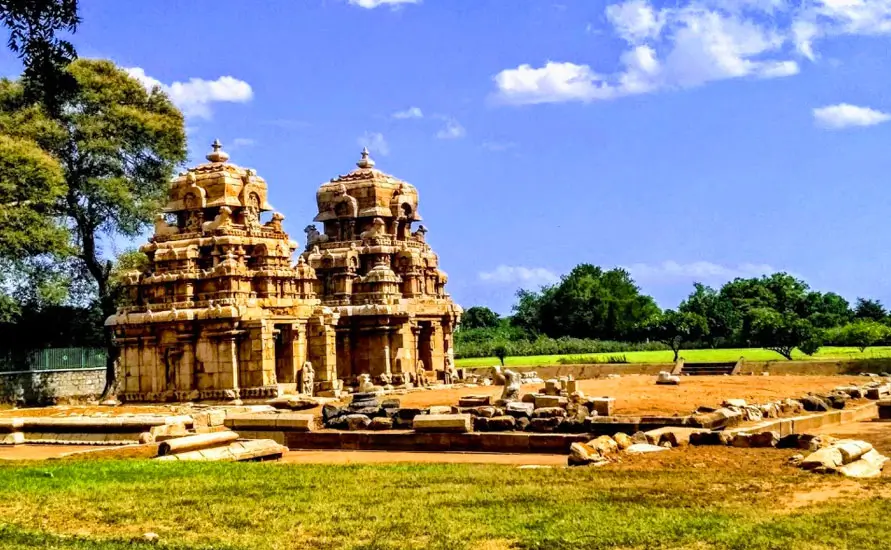
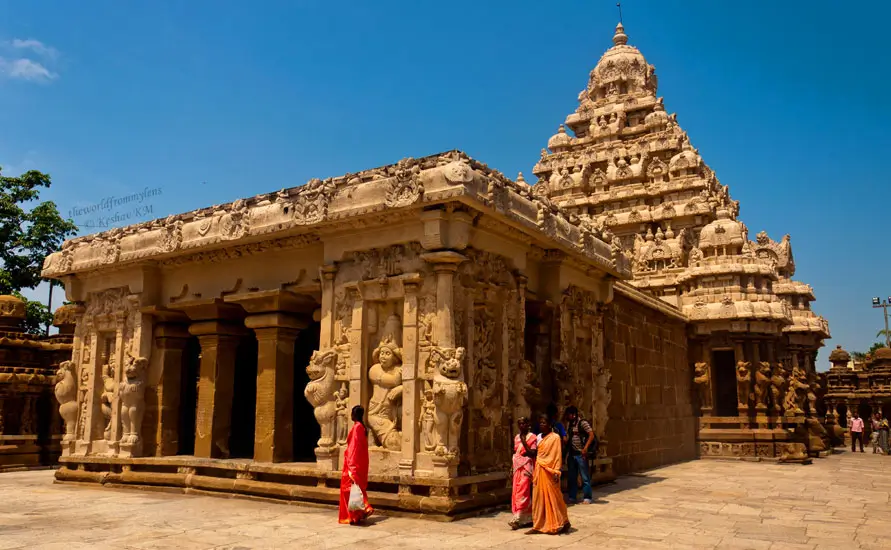
Next comes the Kamakshi Amman Temple, the city's principal goddess shrine, where the deity is seated in a yogic posture, and then the compact sandstone Kailasanathar Temple, where traces of the original painted plaster survive in a handful of niches. Between temples you stop at a weavers' cooperative to see korvai work, in which a border of a contrasting color is interlocked with the body of the sari by hand, thread by thread. Should you decide to buy, ask the weavers to demonstrate how to check silver zari against cheaper copper or plastic imitations; reputable sellers will happily show you.
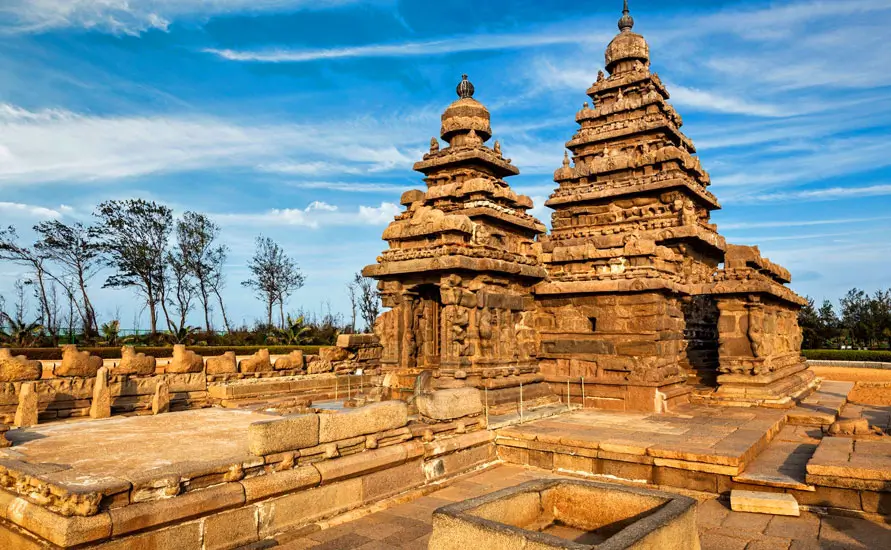
Late morning the car turns south-east for Mahabalipuram, roughly two hours away on the coast. This was the main Pallava port, and its rock-cut monuments carry UNESCO status. After lunch and a rest, the afternoon round covers the Shore Temple and the great carved rock face of Arjuna's Penance, picking out small touches that are easy to overlook, such as a deer scratching its nose with a hind leg, and naga spirits with snake tails rising up the central cleft, where water may once have run down from a cistern on top. After that, the sand and the sea breeze are yours. Overnight in Mahabalipuram.
Climb the low granite ridge behind the town while the air is still cool. The path passes the Ganesha Ratha, a little temple shaped from one rock, and Krishna's Butter Ball, a rounded rock perched improbably, which sits on a slope and, the story goes, refused to budge even when a British governor sent elephants to drag it away. Higher up are the Trimurti Cave and the old lighthouse, with wide views of the shore. The morning ends at the Pancha Rathas, where rough, uncut bases show that each shrine was shaped from the summit of the rock toward the ground.
On the way out of town, a short stop at a sculpture studio lets you watch a granite figure taking shape under chisel and hammer before being polished with abrasive stones. The coast road then leads south to Pondicherry, with an optional halt at the Madras Crocodile Bank, founded in 1976 to save India's crocodiles from extinction and now home to many species of reptile. Beyond it you pass fishing villages where nets dry on the sand and women sell the morning catch from baskets on their heads. Your hotel in Pondicherry is in or near the French Quarter, often a renovated villa with a garden.
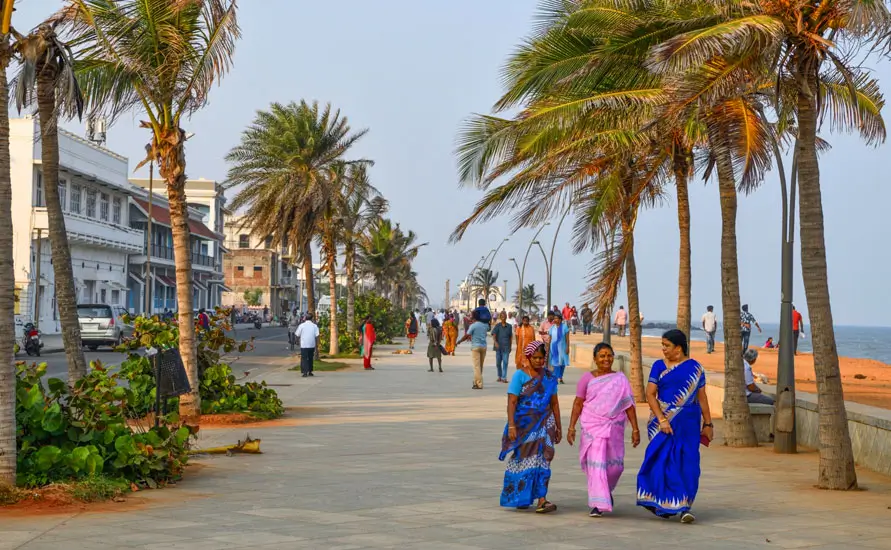
Pondicherry stirs back to life after four o'clock. A walk along Beach Road passes the Gandhi statue framed by eight carved pillars carried here from Gingee Fort, and the Douane, the old customs house. Inland lies Bharathi Park, a French-era garden centered on a white classical pavilion built to celebrate the arrival of piped drinking water. Around it stand the Raj Nivas, residence of the Lieutenant Governor, the old Hôtel de Ville and the members' club called the Cercle de Pondichéry. Finish the evening with a crêpe or a bowl of fish curry at a nearby café. Overnight in Pondicherry.
This morning's walk crosses from the French grid into the Tamil town. In White Town you pause at the Immaculate Conception Cathedral on Mission Street, first raised by Jesuits in the 1690s and rebuilt in its present form a century later, and at the Sri Aurobindo Ashram, where people sit in silence beside the flower-covered tomb. Across the canal, the Tamil Quarter shows pillared front porches and inner courtyards, and the Vedapureeswarar Temple, rebuilt after French troops pulled it down in 1748. A bakery stop for coffee and a croissant breaks up the walk.
Later you visit the Pondicherry Museum, which keeps bronzes, colonial furniture and finds from Arikamedu, an Indo-Roman trading site south of town whose trenches yielded Mediterranean wine jars, glassware and carved beads of the early Christian era. The story of the French East India Company comes alive here: Pondicherry was its Indian capital, lost and won back several times in wars with Britain, and in 1761 the British flattened it almost completely. Lunch could be at a Creole kitchen where duck curry, fish in tamarind and coconut, and French pastries all appear on the same menu.
Afterward the car heads north to Auroville, set up in 1968 by Mirra Alfassa, known to followers as the Mother, as a township belonging to no nation. A film and a small exhibition at the information hall introduce its founding ideas, and a woodland trail ends at the spot from which outsiders may look across to the Matrimandir, the gold-clad globe at its center. A visit inside the meditation chamber must be booked in advance and is never guaranteed. On your return, community shops sell organic produce, natural soaps and handmade paper. Overnight in Pondicherry.
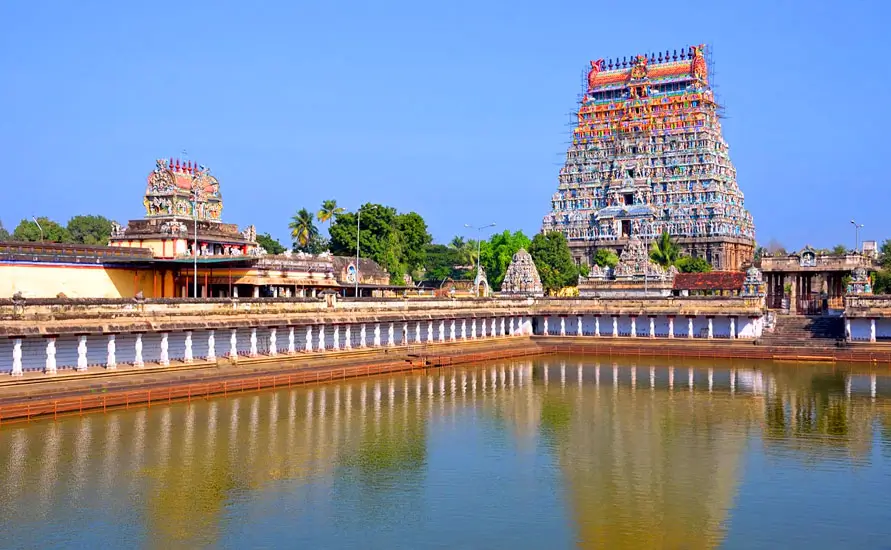
Heading south from Pondicherry, you reach Chidambaram in about an hour and a half. Its Thillai Nataraja Temple is unusual among the great temples of the state because Shiva is worshipped here chiefly as the dancing Nataraja rather than as a lingam, and the gold-roofed inner hall is the focus of devotion. Look for the gopuram passages lined with small panels of dancers frozen in classical poses, and the thousand-pillared hall used during festivals. Mornings get busy, so give yourself time to see it calmly, and dress conservatively for the inner areas.
Outside the temple, stalls sell brass lamps, puja items and devotional posters, and sweet shops fry jalebi and murukku in great iron pans. Anyone interested in Bharatanatyam should ask the guide about the link between the temple carvings and the dance revival of the 20th century, since scholars used these panels to reconstruct lost movements. After lunch you continue west into the Cauvery delta, among the most fertile farmland in South India, passing paddies, villages and small shrines, and cross the Kollidam River, the northern arm of the Cauvery, on a long bridge.
Late in the afternoon you arrive in Kumbakonam, a temple town wedged between the Cauvery and Arasalar rivers, where you stay for two nights. More than a hundred temples stand within the municipal limits, and the town is also the base for pilgrims making the circuit of the Navagraha shrines, nine village temples to the nine celestial bodies of Hindu astrology. At dusk you visit the Sarangapani Temple, a large Vishnu shrine whose sanctum is designed as a chariot on wheels. Round off the day with a cup of local coffee, strong, sweet and frothed by pouring. Overnight in Kumbakonam.
The day opens at the Mahamaham Tank, a broad stepped pool in the middle of town with sixteen small shrines along its edges. Once every twelve years, at the Mahamaham festival, vast crowds bathe here at an auspicious moment, convinced that the holy rivers of India join the tank at that hour. The last festival took place in 2016, and the next is expected in 2028. Close by, the Adi Kumbeswarar Temple gives the town its name: legend says that a pot, or kumbha, holding the seed of creation floated here after a great flood and was broken open by an arrow of Shiva.
About an hour north stands Gangaikonda Cholapuram, which Rajendra I made his capital in the 11th century to celebrate a northern campaign that ended on the banks of the Ganges. Its temple is part of the UNESCO-inscribed group of Great Living Chola Temples, and its tower is admired for its gently curving sides. Driving back toward Kumbakonam, you halt at Darasuram, home of the Airavatesvara Temple, the third of the group, built in the 12th century and admired for the precision of its tiny carvings. Comparing the two in a single morning makes the change in Chola style easy to see.
After lunch you visit Swamimalai, a village of bronze casters, where families of sthapatis still cast temple images exactly as their ancestors did for the Cholas. You can follow the stages: modeling the figure in wax mixed with tree gum, coating it in fine clay from the riverbed, melting out the wax, pouring in molten bronze and finally chasing the details with fine tools. Swamimalai also counts among the six sacred seats of Murugan, with his temple on a small hill reached by sixty steps, one for each year of the Tamil calendar cycle. The evening is free. Overnight in Kumbakonam.
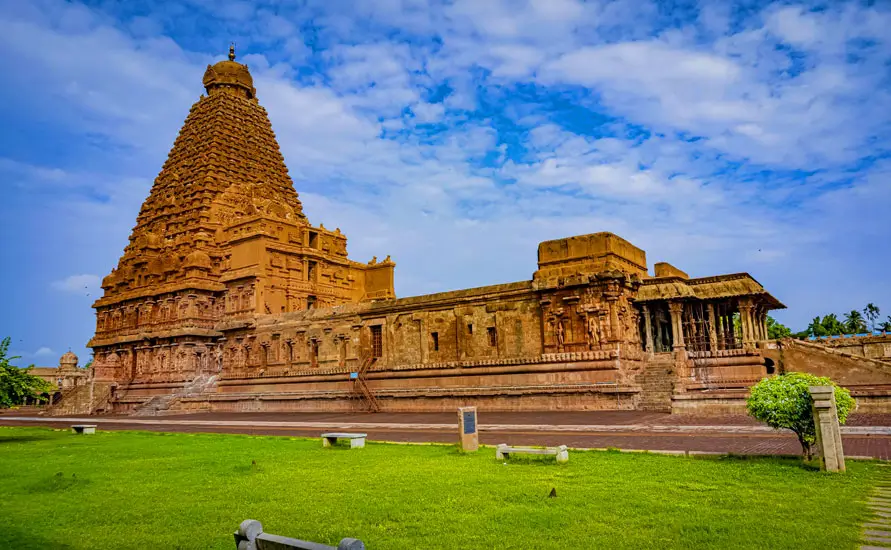
Before mid-morning you are in Tanjore, the Chola capital at the peak of its reach. First stop is the Brihadeeswarar Temple, which Rajaraja I consecrated in 1010. Its tower, about 66 meters high, was built from granite carted in over long distances, because the delta has none of its own. A giant monolithic Nandi faces the shrine from its own pillared pavilion. Inscriptions around the base list in remarkable detail the gold, jewels, villages, musicians and lamp-lighters assigned to the temple, and your guide translates parts of them for you on the spot.
Later you move on to the Thanjavur Palace, built by the Nayak and Maratha rulers, and its gallery of Chola bronzes. The palace also holds the Saraswathi Mahal Library, with a public room displaying old manuscripts and maps. A few minutes away is Schwartz Church, built in 1779 by the Maratha king Serfoji II in memory of the Danish missionary Christian Friedrich Schwartz, who had been his tutor and guardian. Inside, a marble relief by the English sculptor John Flaxman shows Schwartz on his deathbed, the young king at his side, a touching record of their friendship.
The afternoon offers a choice of crafts. A Tanjore painting studio shows how raised gesso, gold foil and colored stones build the shimmer of these devotional panels, while a nearby workshop makes the wobbling Thanjavur dolls that always right themselves. You may also want to stroll in Sivaganga Park beside its old tank, just north of the temple. After dark, go back for a second look as floodlights pick out the tower against the night sky while families sit on the cool stone after the evening puja. A banana-leaf thali makes a fitting dinner. Overnight in Tanjore.
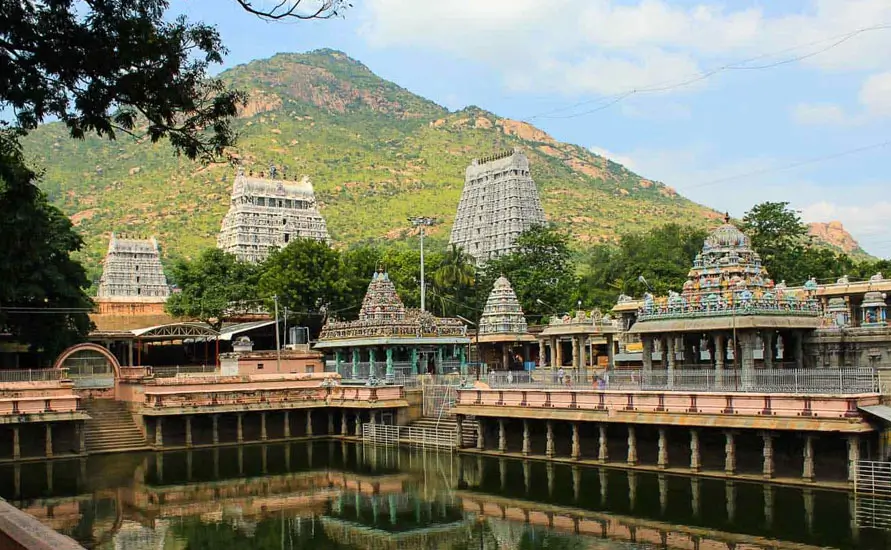
An hour west of Tanjore, Trichy, officially Tiruchirappalli, straddles the Cauvery. You start at Srirangam, an island between the Cauvery and the Kollidam, home of the Sri Ranganathaswamy Temple, one of the biggest working Hindu temples anywhere. Seven rings of walls nest one inside the other, pierced by twenty-one gopurams, and the outermost Rajagopuram, finished only in 1987, rises about 73 meters. Non-Hindus may enter the outer enclosures, where the Sesharaya Mandapa has pillars carved as rearing horses with riders. Daily life goes on inside the walls, with houses, shops and schools.
Nearby on the same island is the Jambukeswarar Temple, one of the five Shiva temples standing for the elements, in this case water; a small spring seeps up in the sanctum all year round. You then cross to the city for the Rock Fort, a great hump of ancient rock around 83 meters high, crowned by the little Ucchi Pillayar shrine to Ganesha. Roughly four hundred steps, many cut into the stone, lead past Pallava cave shrines to the summit, from where Srirangam's towers line the far bank of the river. Those who would rather skip the steps can wait below with a fresh lime soda.
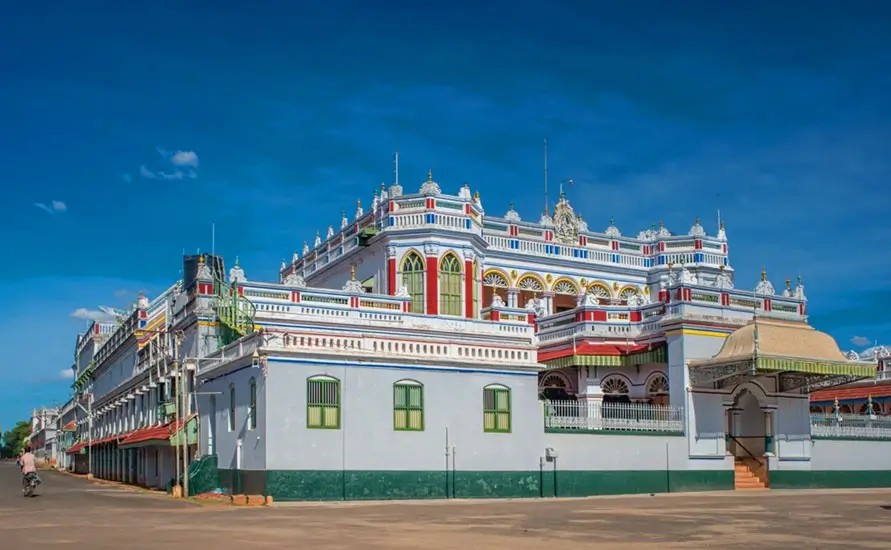
After lunch in Trichy you drive about two and a half hours south-east into Chettinad, where the land turns dry and red and villages are dominated by immense mansions built by the Chettiar merchant community. Tonight you stay in one of them, restored as a heritage hotel, with courtyards open to the sky, pillared halls and walls polished with a traditional egg-white plaster. A short walk around the village at dusk shows rows of shuttered facades glowing in the last light. Dinner is a Chettinad spread of pepper chicken, kara kuzhambu and soft appams. Overnight in Chettinad.
Morning is for the villages of Chettinad. In Kanadukathan you enter one of the mansions open to visitors and walk from courtyard to courtyard under columns of Burmese teak, across cool marble and below ceilings painted with floral scrolls. In Karaikudi, the regional market town, the antique lanes are packed with brass lamps, wooden chests, Japanese tiles, enamel plates and coffee grinders taken from homes whose families moved away. The guide explains how the Chettiars ran their banking business from Rangoon to Saigon, and how the Second World War and Burmese nationalization ended it almost overnight.
Before turning west, you stop at Athangudi to watch tile makers pour colored cement into patterned frames on glass and leave the tiles to cure in water rather than firing them in a kiln. A short detour takes you to the Pillaiyarpatti cave temple, where a two-armed Ganesha carved in the living rock is among the oldest Ganesha images in Tamil Nadu. The drive to Madurai passes through farming villages and stretches of scrub with grazing goats. You arrive in the early afternoon and settle in for two nights, with time for a rest before the evening.
Around sunset, your guide leads you into the Puthu Mandapam, the unfinished Nayak hall facing the temple's east gate, now crowded with tailors at treadle machines, brass sellers and bangle stalls; its carved pillars show the Nayak kings and their queens. Then wander the lanes beyond, where vendors thread jasmine into strands sold by the arm's length. Madurai's food scene is lively after dark: try a kothu parotta chopped on a hot griddle, or kari dosai topped with spiced mutton, and end with jigarthanda, the chilled Madurai drink of reduced milk, gum and ice cream. Overnight in Madurai.
Reach the Meenakshi Amman Temple shortly after the doors open, while the flagstones are still wet from their dawn washing and the first bells sound from the shrines. Meenakshi, the fish-eyed goddess, was by legend a three-breasted Pandya princess who lost her third breast the moment she set eyes on Shiva, and the city still celebrates their marriage every spring. Fourteen towers ring the compound. Hindus alone may enter the two main sanctums, and all mobile phones and cameras are left at a deposit counter by the gate, so carry only a little cash and your shoes in the car.
Inside, your guide walks you round the Ashta Shakti Mandapam with its eight carved goddesses, through the dim corridors where astrologers and garland-makers wait for customers, and into the Thousand Pillar Hall, which now holds a small art museum of bronzes and ivory. At the stepped Golden Lotus Tank you hear the tale of the Sangam poets whose work was judged by the water itself. By late morning the crowds thicken, so you leave for the Thirumalai Nayak Palace, where white stucco columns, each several arm-spans around, hold up lofty domed ceilings in a style mixing Dravidian and Indo-Islamic ideas.
Only part of King Thirumalai's 1630s palace still stands, and the rest was quarried away long ago, yet the courtyard and throne room give a fair idea of its scale. Rest through the hottest hours, then visit the Gandhi Memorial Museum in Rani Mangammal's old palace, whose most solemn exhibit is the cloth stained on the day of his death, and a panel telling how he chose village dress here in 1921. At about nine at night the temple holds palliyarai, the bedtime ceremony, when Shiva's image is taken in procession to the goddess with pipes, drums and oil lamps. Overnight in Madurai.
Eastward from Madurai the land flattens and dries out. Palmyra palms stand alone in fields of thorn scrub, and seasonal lakes near Ramanathapuram fill with painted storks and pelicans during the winter months. Halfway along, a village tea stall is a good place to try karupatti, a dark sweet made from palm jaggery. Near the coast you reach Mandapam, the last town on the mainland, and the road bridge launches you across the strait to Pamban Island. Look south from it: the old 1914 cantilever rail bridge sits rusting below, and beside it runs the new vertical-lift rail bridge opened in 2025.
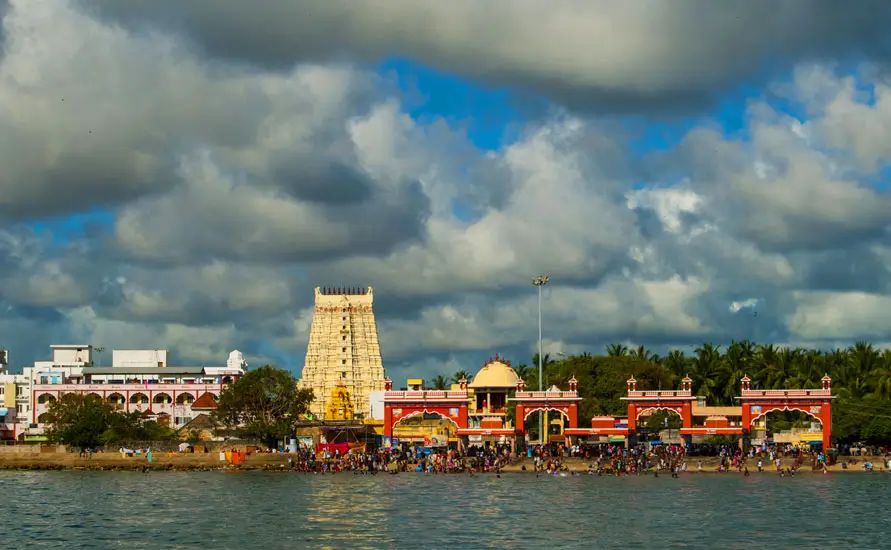
On the island lies Rameswaram, one of the four great pilgrimage seats of Hinduism and home to a Shiva lingam of the highest sanctity. The Ramayana tells that Rama stopped here on his return from Lanka to atone for slaying Ravana, and pilgrims from every part of India follow in his footsteps. After checking in for two nights, rest through midday. Late in the day your guide brings you to Agni Theertham, the calm shallow sea before the temple's eastern gate, where whole families wade in fully dressed, pray and splash water over each other before going to worship in their dripping clothes.
The Ramanathaswamy Temple is at its most atmospheric in the evening. Its pillared corridors, added mostly by the Sethupathi rulers of Ramanathapuram in the 17th and 18th centuries, stretch for well over a kilometer in total, and the longest single passage is often described as the longest temple corridor in the world. Rows of painted ceiling medallions recede into the distance under the electric lamps. Inside sit two lingams, one believed to have been modeled from sand by Sita, the other carried from the Himalaya by Hanuman. Non-Hindus may usually walk the corridors but not enter the sanctums. Overnight in Rameswaram.
Return to the temple at first light for the ritual that brings most pilgrims here: bathing at the 22 theerthams, sacred wells set around the inner precincts. A temple helper with a rope and bucket leads each group from well to well, pouring cold water over their heads at each, until everyone is drenched and grinning. Several wells taste noticeably sweeter or saltier than their neighbors, though they lie only a few steps apart. Taking part is open to all who wish, so if you would like to try, wear light cotton you can get soaked and pack dry clothes in the car.
Then you head about 20 km down the long sandy spit to Dhanushkodi. Just before Christmas in 1964, a cyclone sent the sea surging over this town and swept away a passenger train, and it was never rebuilt. What remains are the roofless walls of a church, the stub of a water tank and the tracks of the old station half lost in sand. A newer road runs on to Arichal Munai, the final tip of land, with the Bay lapping one shore and the Gulf of Mannar the other, and the coast of Sri Lanka lies beyond the horizon only about 30 km away.
After lunch you visit the APJ Abdul Kalam Memorial at Peikarumbu, built in a blend of Mughal and Indian styles for the boy from a Rameswaram boatman's family who became a rocket scientist and then President of India. Inside are replica missiles, his writings, photographs and the veena he played. In town you can also call at the House of Kalam, his family's modest home, where relatives keep a display of awards and letters. Toward evening, wander down to the fishing harbor, where catamarans unload crabs, squid and silver fish onto the sand in a flurry of auction calls. Overnight in Rameswaram.
A full day on the road begins straight after an early breakfast, so pack the night before. Leaving the island, you trace the shore of the Gulf of Mannar past Ramanathapuram and Sayalgudi and skirt Thoothukudi, known to the Portuguese and Dutch as Tuticorin, where pearl divers once worked the beds offshore and where salt is still raked from shallow pans for much of the state. Many coastal villages here are Catholic, converted in the 16th century by Portuguese missionaries, and their tall white churches rise above the palmyras. Your driver stops for coffee and leg-stretching whenever you like.
By midday you reach Tiruchendur, where the Subramaniya Swamy Temple stands directly on the beach, its tower visible from far along the coast. Of the six principal shrines of Murugan, it is the only one by the sea, and it marks the spot where the young god is said to have defeated the demon Surapadman, an event replayed on the sand by vast crowds at the Skanda Shashti festival each October or November. Pilgrims bathe in the surf before going in, and male visitors are generally asked to remove their shirts. A simple lunch in town follows before you set off south again.
South of Tiruchendur the road passes the red sand dunes of the Teri country, then wind turbines and coconut groves as it nears the tip of the peninsula. You arrive at Kanyakumari in the late afternoon, check in and walk straight to the shore for sunset. Three bodies of water come together at this point, and on clear evenings the light turns the water three slightly different shades. The Kumari Amman Temple on the seafront honors the goddess as a young girl doing penance, and its dress code requires men to go shirtless inside. Overnight in Kanyakumari.
Sunrise at the southernmost point of mainland India is the reason many people come here, and it is worth the early alarm. Crowds gather on the steps of the bathing ghat in the dark, and a cheer often goes up as the sun clears the sea. After breakfast you join the ferry queue for the short crossing to the Vivekananda Rock Memorial, which marks the spot where the young monk is said to have swum out and meditated for three days at the end of 1892, shortly before he sailed to America. The memorial has a meditation hall and a small shrine with a mark on the rock said to be the goddess's footprint.
The neighboring islet carries the Thiruvalluvar Statue, its height of 133 feet chosen to match the 133 chapters of the Thirukkural, the two-thousand-year-old Tamil book of couplets on virtue, wealth and love. A glass-floored footbridge opened at the end of 2024 now links the two rocks, so you can walk from one to the other. Back on shore, you visit the Gandhi Mandapam, built where an urn of his ashes stood before the ashes went into the sea, and designed so that on 2 October each year sunlight falls through a gap in the roof onto that exact spot. Ferry queues can be long at weekends, so we start early.
After lunch you drive north to Tirunelveli, crossing the Aralvaimozhi pass, where row upon row of wind turbines spin on the ridges of the Western Ghats. The trip takes about two hours. Late in the day you go to the Nellaiappar Temple, a vast double temple to Shiva and his consort Kanthimathi, linked by a long pillared corridor. The temple is famous for its musical pillars, clusters of slender stone columns cut from single blocks that ring with different notes when gently struck. Afterwards, try the town's celebrated wheat halwa, glossy with ghee and sold warm in leaf cones. Overnight in Tirunelveli.
Today the trip turns back north and up into the hills. The national highway from Tirunelveli runs through Kovilpatti, known across Tamil Nadu for its crunchy peanut-and-jaggery kadalai mittai, and past Virudhunagar, a busy trading town for chilies and oilseed. Buy a packet of the sweets at a roadside shop to share in the car. The ride is smooth and fast as far as the outskirts of Madurai, where you bypass the city and turn west toward Batlagundu, with a lunch stop at a clean highway restaurant serving meals on banana leaves before the long climb begins in earnest.
From Batlagundu the ghat road rises in a series of switchbacks into the Palani Hills. The planting changes as you gain height: first banana and mango, then pepper vines climbing silver oak above coffee bushes, and finally eucalyptus, wattle and pine. Halfway up, the Silver Cascade tumbles down a rock face beside the road, a good spot for a photo. Groups of bonnet macaques wait at the bends, but feeding them only makes them aggressive. Within an hour or so the temperature drops markedly, and you will want a light jacket by the time the town comes into view.
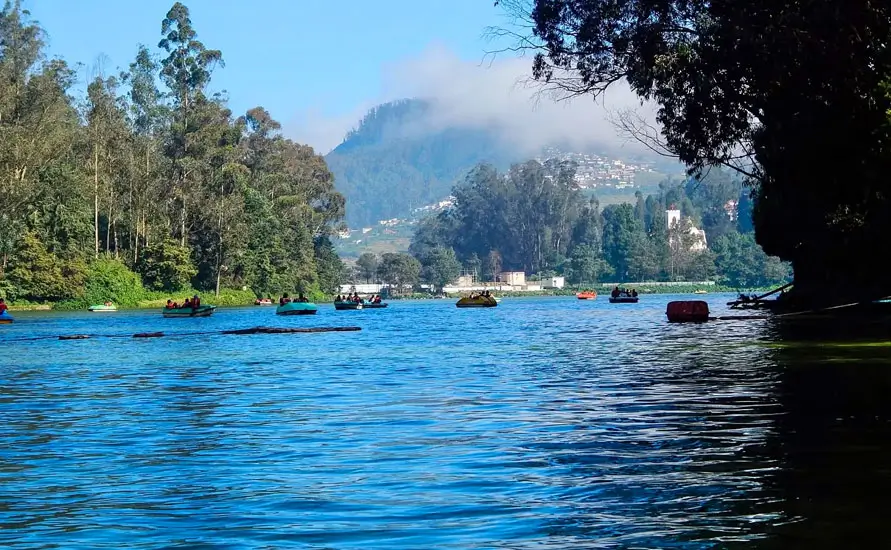
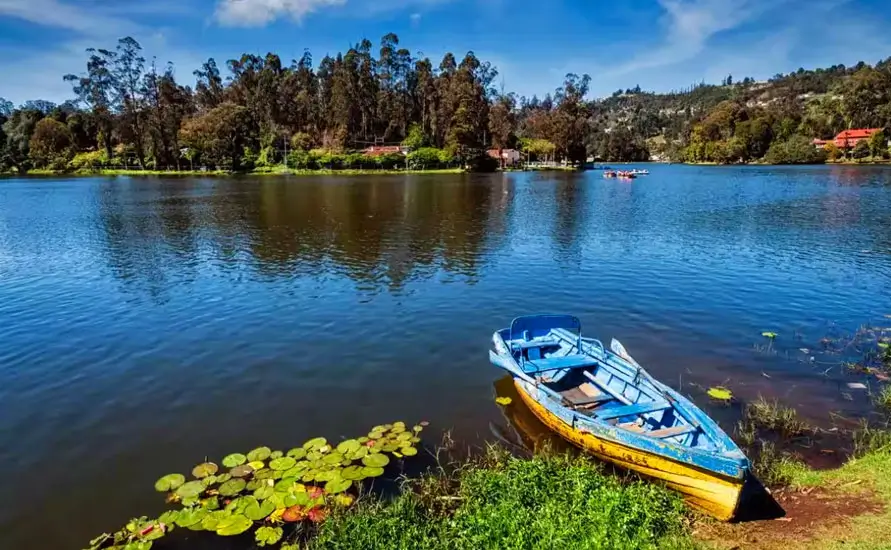
At around 2,100 meters, Kodaikanal began life in the 1840s as a cool-season retreat for American missionaries from Madurai, and the British followed soon after. You check in for two nights in the late afternoon. If you are not too tired, take a gentle stroll by Kodai Lake, where mist slides off the surrounding slopes at dusk and the boathouse lights come on across the water. Shops near the bazaar sell homemade chocolate, eucalyptus oil, local cheese and seasonal plums. Nights can be chilly in any month, so the fireplace in your room will be welcome. Overnight in Kodaikanal.
Begin with Coaker's Walk, the cliff-top promenade on the southern side of town, ideally before nine when the valley is usually clearest. Below the railings the hillside drops steeply to the plains, and on good days you can trace rivers, tanks and villages for many kilometers. Within minutes a bank of cloud may surge up and blot it all out, then lift again just as fast. A short walk away, Bryant Park has well-kept flower beds and a greenhouse full of ferns and orchids. Your guide points out the old missionary bungalows and churches along the way, many with their original stone chimneys.
Later the car follows the road west through the Pine Forest, where straight rows of trees planted early in the 20th century stand over a soft carpet of needles and Tamil film crews often shoot songs. Nearby are the Guna Caves, deep clefts in the rock now viewed from behind safety fencing, and then the three gray columns of Pillar Rocks, standing over a hundred meters high at the plateau's edge. Mist drifts between them most mornings. On the return you can stop at Moir Point for a last look into the valley. Lunch in town might be a hearty North Indian thali or fresh trout where available.
Spend the afternoon as you wish. One option is the Kurinji Andavar Temple, a hilltop shrine to Murugan looking over the valley, named after the shrub that blooms in purple-blue waves over these hills just once in twelve years, most recently in 2018. Another is the Kodaikanal Solar Observatory, at work since 1899, whose museum opens only at set hours; your guide will check before you go. Or simply rest, read or walk the lanes around the market. In the evening your driver will go over tomorrow's long transfer to the Nilgiris and agree a departure time with you. Overnight in Kodaikanal.
This is the one full road day of the eighteen, so plan for an early breakfast and a relaxed attitude. The car descends the western side of the Palani Hills to the temple town of Palani, where the Murugan shrine crowns a rocky hill above the road, then runs across the coconut plantations of Pollachi and the edge of Coimbatore before reaching Mettupalayam at the foot of the Nilgiris. Including a lunch break and tea stops, the transfer takes around seven to eight hours. Your driver drives at an even pace and stops any time you need a pause.
Beyond Mettupalayam the ghat road climbs in a long ladder of numbered hairpins, and tea gardens and eucalyptus close in around you as the air cools. You arrive in Ooty in the late afternoon. Many hotels here have their own gardens and rooms with a fireplace, which feels very welcome after dark, especially from December to February, when frost can whiten the lawns at dawn. Keep the evening quiet with dinner in your hotel, since tomorrow begins with the toy train and ends with your flight. Overnight in Ooty.
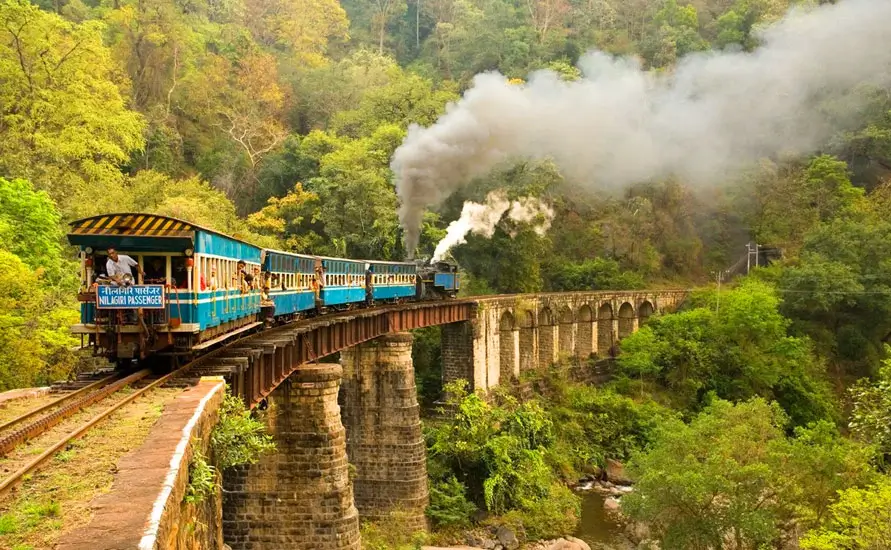
The last morning brings the toy train: the UNESCO-listed Nilgiri Mountain Railway from Ooty down to Coonoor. The little blue train threads through short tunnels and over viaducts, with tea terraces dropping away on one side, and calls at Lovedale and at Wellington, home of the Madras Regiment. The trip lasts a little over an hour, while your car takes the luggage by road. At Coonoor station your driver is waiting, and if your flight allows, there is time for a short tea estate stop or a walk in Sim's Park before heading down the hill.
The drive from Coonoor to Coimbatore International Airport takes roughly 150 minutes, so we recommend booking an afternoon or evening flight. In eighteen days you have crossed almost every region of Tamil Nadu, from Pallava Kanchipuram and the Chola delta to the island of Rameswaram, the shore at Kanyakumari and two ranges of hills. Our team stays on call until you have checked in. Kerala's backwaters or the ruins of Hampi would make an obvious next trip whenever you are ready. Safe travels home.
Your Journey

N.S. Rathore & Mrs. Omlata Rathore · Managing Director
We still read every enquiry ourselves. Tell us the places you liked and our planners will send a day-by-day route with drive times and a clear price.
Every package can be customised and no pressure to book. A planner from our office replies within 24 hours with a route written for your group.
Fill this in and your planner will send a first draft itinerary.
Explore more
Kerala Backwaters Escape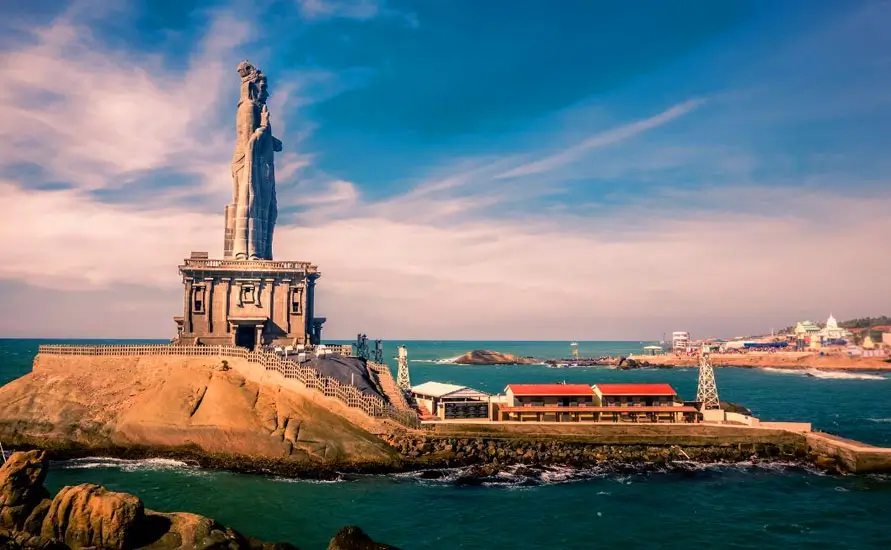 Kerala Backwaters Escape
 Kerala Backwaters Escape
 Kerala Backwaters Escape
 Kerala Backwaters Escape
 Kerala Backwaters Escape
 Kerala Backwaters Escape
 Kerala Backwaters Escape
 Kerala Backwaters Escape
 Kerala Backwaters Escape
 Kerala Backwaters Escape
 Kerala Backwaters Escape
 Kerala Backwaters Escape
 Kerala Backwaters Escape
 Kerala Backwaters Escape
 Kerala Backwaters Escape
 Kerala Backwaters Escape
 Kerala Backwaters Escape
 Kerala Backwaters Escape
 Kerala Backwaters Escape
 Kerala Backwaters Escape Kerala Backwaters Escape Kerala Backwaters Escape