
 Kerala Backwaters Escape

Tamil Nadu Tour Packages
Chennai – Tanjore – Darasuram – Madurai – Rameswaram – Dhanushkodi – Kanyakumari – Coimbatore – Mettupalayam – Coonoor – Ooty
At a glance
Some travelers measure a country in kilometers of track. For them we built the Tamil Nadu tour by train, a fourteen-day loop that uses Indian Railways as the main way to move around the state. You ride day expresses from Chennai into the Cauvery delta, roll south to Madurai, cross the sea to Rameswaram on the new Pamban rail bridge, sleep in a berth from Kanyakumari to Coimbatore, and finish with the climb into the Nilgiris aboard the Nilgiri Mountain Railway, a World Heritage line, where a rack-and-pinion line hauls you up gradients few railways anywhere attempt.
Rail days come with a safety net. Our team books reserved seats in air-conditioned chair car or two-tier and three-tier sleeper classes, someone from our team or a licensed porter is at your coach door, and a private car with driver waits at the arrival station for the transfer and sightseeing. Seats can be reserved only within a fixed window before departure, and every train booking depends on availability, so we confirm your trains as early as the booking window allows and have road transfers ready as a fallback. Only the Rameswaram to Kanyakumari leg runs by road.
Between rides there is plenty to see off the platform: Chola stonework in Tanjore and at Darasuram, the halls of the Meenakshi temple, the cyclone-ruined station at Dhanushkodi and the sunrise at land's end. This Tamil Nadu rail tour suits rail enthusiasts, photographers and curious travelers who want to share a compartment with local families, buy coffee through the window and watch the state change from delta paddy to tea-covered hills. Departure is from Coimbatore airport. Pleasant weather lasts roughly from October until March.
Your rail holiday begins at the airport rather than a platform, as our representative greets you outside the arrival hall holding your printed name and leads you to a waiting air-conditioned car. The ride into Chennai follows the Grand Southern Trunk Road, and if you look left near Tirusulam you may catch your first suburban electric train rattling past on the line toward Tambaram. Most flights from Europe touch down at night, so a room kept ready from the previous night, booked as early check-in, is wise, and nothing is planned until the afternoon apart from sleep, a meal and a shower.
Later in the day your tour manager meets you in the hotel lobby with a folder of printed train tickets, platform tips and a simple guide to Indian rail travel. Trains here are divided into classes. AC First Class has lockable two- and four-berth cabins, AC two-tier and three-tier offer open bays of curtained berths, and AC Chair Car is the daytime option with reclining seats in rows. Non-AC sleeper and unreserved general coaches carry most of India's passengers and are lively places to look into, though we do not book them for long legs. Bedding is supplied in AC sleeper classes, and many trains have a pantry car.
Your manager also explains platform life: how to read the coach position board, why porters wear red shirts and brass arm badges, and how passenger names and berth numbers appear on reservation charts. Booking windows for Indian trains open only a limited period before travel, and popular trains fill quickly, so some legs may need a different class or train from the one first planned. You will always know your seats a few days in advance. The evening is free, and the beach promenade at Besant Nagar is a short drive away for a relaxed first dinner by the sea. Overnight in Chennai.
Morning starts at Royapuram, where the first passenger train in South India left in 1856 for Arcot. The small classical building with its columns and pale facade is widely described as the oldest surviving railway station in India still in service, and it has been restored in recent years. From there you continue to Chennai Central, the red-brick terminus with a clock tower that opened in its present form in 1873 and now handles long-distance trains to Delhi, Kolkata, Mumbai and Bengaluru. Your guide leads you through the concourse to watch the morning rush, with families sitting on luggage and vendors selling vadai.
Late morning brings the Regional Rail Museum at Perambur, set up beside the Integral Coach Factory, where many of the coaches you will ride in were built. Out in the open yard stand steam engines of broad, meter and narrow gauge, old inspection carriages and a coach once used by colonial officials. A small toy train loops round the grounds, popular with children and grown-ups alike, and the indoor gallery covers the history of railway building in southern India. The museum keeps a weekly closing day, so we confirm before your visit. Lunch is at a nearby South Indian restaurant serving meals on banana leaves.
For the afternoon you ride the city's local trains like a commuter. From Chennai Beach station the MRTS line, raised on concrete pillars, carries you south above the canals and rooftops to Thirumayilai, the stop for Mylapore. Coaches are crowded at rush hour but quiet in the early afternoon, and ladies' compartments are marked on the platform. In Mylapore your guide walks you to the Kapaleeshwarar temple tank, the flower stalls and a filter coffee shop where the brew is poured from tumbler to bowl to cool it. Your car meets you at the temple to drive back to the hotel. Overnight in Chennai.
After an early breakfast your car takes you to Chennai Egmore, the terminus for most southbound trains, opened in 1908 with domes and arches in Indo-Saracenic style. A porter carries your luggage to the coach while you watch the platform fill with pilgrims, students and business travelers. The day express heads south through Chengalpattu and Villupuram on the main line and swings east across the Cauvery delta, with paddy fields, coconut groves and irrigation canals passing for hours. Seats in AC chair car or a lower berth in a sleeper coach give you a wide window, and your manager can tell you which side has the better view.
On the way, vendors move through the coaches calling out coffee, tea, samosas, curd rice and vegetable biryani, and at bigger stations you can step down for a few minutes to buy bananas or a paper cone of murukku. Stops are often short, so stay near the door and listen for the whistle. Expect the timetable to slip by an hour or so on some days, which is normal on Indian railways. Around midday the train passes Kumbakonam, where temple towers rise above the rooftops. You reach Tanjore junction in the afternoon, and your driver waits on the platform to take you to your hotel.
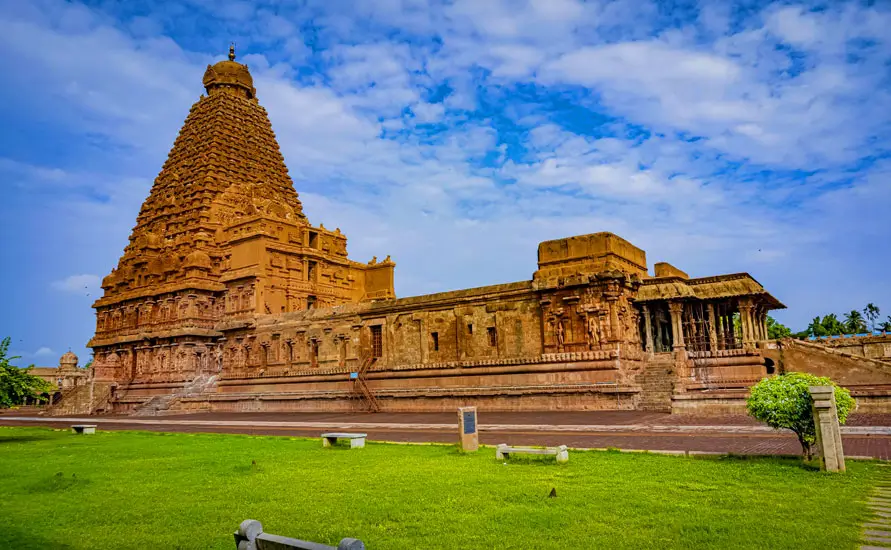
Toward sunset you walk into the Brihadeeswarar Temple, Rajaraja Chola's masterwork of 1010 and one of three UNESCO-listed Chola temples. Evening is a good time because the granite courtyard has cooled and the tower changes from pale gray to gold as the light drops. Your guide points out the huge monolithic Nandi, the frescoes in the inner corridor from the Chola and later Nayak periods, and the base inscriptions naming the dancers, musicians and lamp-keepers paid by the temple a thousand years ago. Shoes stay at the counter by the gate. Dinner is at your hotel. Overnight in Tanjore.
A slow morning after yesterday's long ride leads to the Thanjavur Palace, begun under Nayak rule and enlarged by the Maratha kings who ruled here in the 17th to 19th centuries. The tall bell tower and armory offer views across the old town, and the art gallery holds a fine set of Chola bronzes. Best of all is the Saraswathi Mahal Library, counted among Asia's oldest surviving libraries and holding manuscripts in Tamil, Sanskrit and Marathi, with maps, medical texts and illustrated books collected by Serfoji II, a king with a passion for science and printing who brought some of the first printing presses to this part of India.
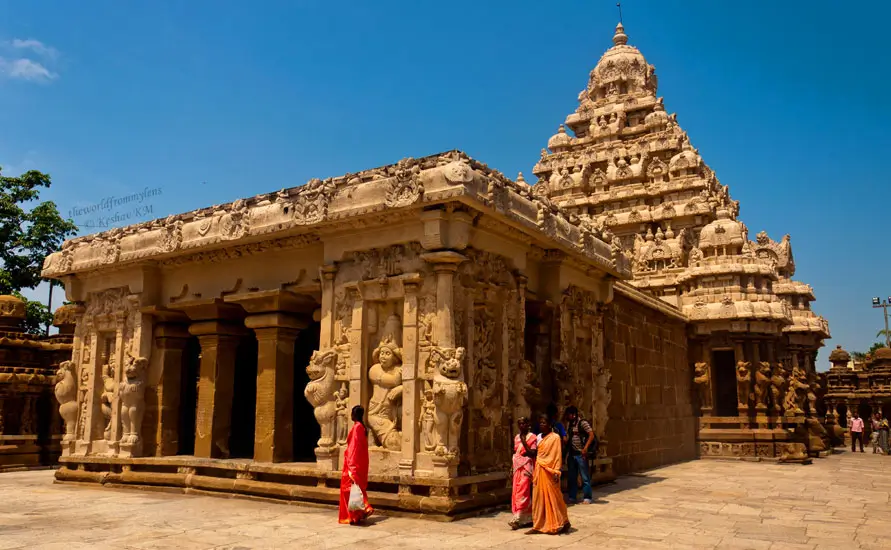
Post-lunch, forty minutes by car brings you to Darasuram to see the Airavatesvara Temple, the smallest and most delicately carved of the trio UNESCO groups as Great Living Chola Temples. One hall is designed as a chariot with stone wheels and horses, and the steps at the entrance give out musical notes when tapped. Rail fans tend to like the temple's precision: the fine friezes of dancers and musicians run along the base in rows as neat as a timetable. Returning, a Tanjore painting workshop is an easy detour to see gold leaf laid onto a wooden board, or at a veena maker if music interests you.
In the evening, if you would like a little more railway, your guide can take you back to Thanjavur Junction to watch the evening trains come and go. Small stations like this show the daily rhythm of the network: a stationmaster in white, the clatter of the signal levers, the porters weighing parcels and the platform tea stall that never seems to close. Station life in Tamil Nadu is friendly, and people will often ask where you are from and where you are going. Photography on platforms is generally tolerated, but avoid military trains and security points. Dinner is free tonight. Overnight in Tanjore.
Today's train runs west to Tiruchirappalli, one of the most important rail junctions in Tamil Nadu and home to the large Golden Rock railway workshop, then turns south on the main line to Madurai. As you leave Trichy, look out of the window for the Rock Fort, a steep granite outcrop crowned by a temple that rises sharply above the town. The landscape grows drier as you head south, with rock hills, palmyra palms and red earth replacing the green delta. Lunch can be the station-style meals sold on board or a picnic box packed by your Tanjore hotel, depending on the train's timing.
You arrive at Madurai Junction, a busy station with a long platform and an old stone frontage, in the early afternoon. Your driver meets you and takes you to the hotel to check in and rest. Madurai is a city of temple towers and night-long street life, and locals will tell you people have lived on this spot without a break for well over two thousand years, a claim tied to the Tamil Sangam poets who gathered here. From the hotel roof or the station footbridge you may already see the painted gopurams of the Meenakshi temple standing above the low roofs of the old city.
Around five you visit the Thirumalai Nayak Palace, the 1636 showpiece of the king who remade Madurai. Its courtyard is ringed by giant white columns nearly 20 meters tall, and the throne room has a high dome supported without beams. Nayak builders combined Dravidian, Islamic and European ideas here, and your guide shows you the stucco work that survives. On most evenings a light-and-sound program narrates Nayak history in the courtyard. Afterwards you can walk through the streets near the palace, where tailors sew in the open air and vendors fry banana bajji in huge pans. Overnight in Madurai.
Dawn is the time to visit the Meenakshi Amman Temple, before the heat and crowds arrive. Cameras and mobiles are handed in at the counters by the gate, and the two innermost shrines are for Hindus only, but the outer halls alone take two hours to see properly. With your guide you inspect the thousand-pillared mandapam and its carved figures, the musical pillars that ring when tapped, and the painted ceilings with their mandalas. Rail fans might enjoy the scale: the temple covers about 14 acres, with fourteen gopurams of which the tallest, on the southern side, reaches more than 50 meters.
After breakfast you visit the Gandhi Memorial Museum in the 17th-century palace of Rani Mangammal. Gandhi traveled throughout India by train in third class, and it was on a 1921 trip to Madurai that he decided to adopt the simple dhoti, a turning point in his life that the museum explains clearly. Among the exhibits is the bloodstained dhoti from the day of his death. After lunch, a drive takes you to the Mariamman Teppakulam, a vast temple tank with a pavilion in the center, where the float festival takes place in January or February each year, and the steps are a lovely place to sit in the late afternoon.
After dinner you head back into the temple with your guide to watch the palliyarai ceremony around nine at night, as the image of Shiva travels on shoulder poles to the chamber where Meenakshi rests with drums, pipes and lamps. It is a short ritual but full of atmosphere. Before you head back, try a glass of jigarthanda, a chilled Madurai specialty that layers reduced milk, nannari syrup, almond gum and a scoop of ice cream, sold at stalls around the old town until late. The name is said to mean 'cool heart', and on a warm Madurai night it does the job well. Overnight in Madurai.
Today brings the most anticipated rail crossing of the tour. The train from Madurai heads east across the flat plains through Manamadurai and Ramanathapuram, small stations where vendors sell guava, cucumber with chili and hot vadai through the windows. After Mandapam the line runs out onto the sea on the Pamban rail bridge, about two kilometers long. The original bridge of 1914, with its famous Scherzer rolling lift span that opened like a jaw to let ships through, has been replaced by a new bridge that opened in 2025, with a vertical lift span that rises straight up for passing vessels.
Trains cross slowly, so you have time to look out over the turquoise water of the Palk Bay, the fishing boats and the old bridge piers running parallel. Sit on the right-hand side for the best view toward the road bridge and the island. Arriving at Rameswaram station, a terminus built close to the temple town, you are met by your driver and taken to your hotel. In the afternoon you visit the Dr. A.P.J. Abdul Kalam National Memorial, dedicated to India's 'missile man' and eleventh President, born on this island, whose father ran ferry boats and who sold newspapers as a boy at the station.
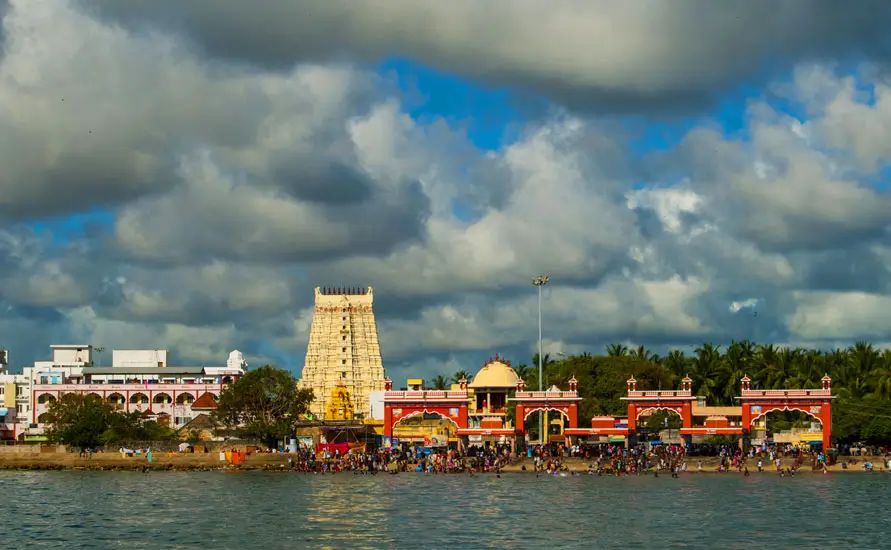
In the evening you walk into the Ramanathaswamy Temple, one of the twelve jyotirlinga shrines of Shiva. Its outer corridor runs for roughly a kilometer and has about 1,200 carved pillars, lit at dusk by rows of lamps that make the long perspective look endless. Non-Hindus can walk through the corridors but usually not into the inner sanctum, and men may be asked to remove shirts in some areas. Your guide explains the story of Rama installing a Shiva lingam made of sand here after returning from Lanka. Dinner is at a vegetarian restaurant in the temple streets. Overnight in Rameswaram.
Pilgrims gather before sunrise at Agni Theertham, the sea beach in front of the temple, and then line up inside for a soaking at each of the 22 sacred wells of the Ramanathaswamy Temple. Temple helpers pour a bucket over each pilgrim at every well, and the whole group moves on cheerfully from well to well, soaked and barefoot. You can join if you bring a change of clothes, or watch from the corridor. Back at the hotel for breakfast, your guide sets out the history of the railway that once ran past the temple town to the port at the tip of the island.
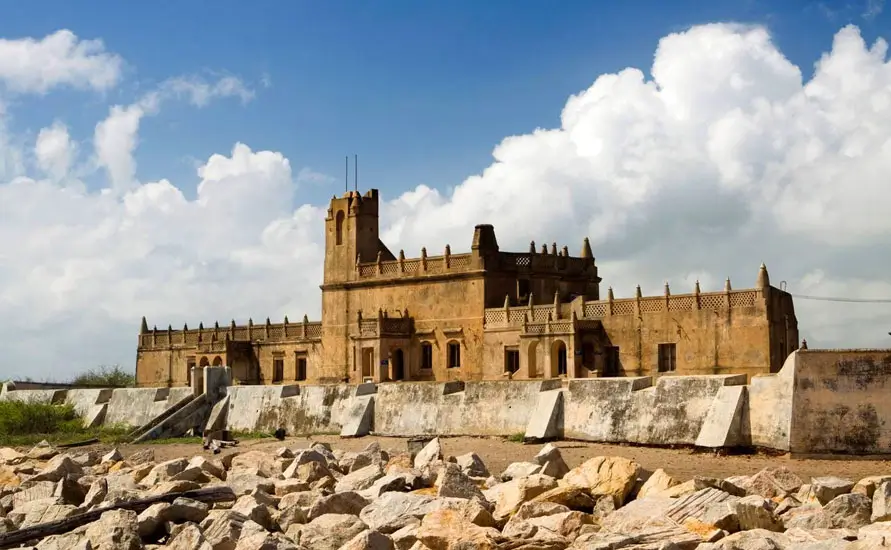
Until 1964 the line continued another 20 km to Dhanushkodi, where passengers changed to a steamer for Talaimannar in Sri Lanka on the Indo-Ceylon boat mail route. On the night of 22 December that year a cyclone and storm surge flattened the town, and the evening passenger train bound for Dhanushkodi vanished with all its travelers. Today you drive along the same spit and walk among the ruins of the church, the post office and the station, with rails long gone and sand filling the platforms. Plans to rebuild the rail line have been announced, and our guide will update you on the current status.
From Dhanushkodi a paved road runs to Arichal Munai, the last point of land, where the Bay of Bengal and the Palk Strait meet in two shades of blue. Police clear the spit by sunset, which is why this outing happens in the morning or early afternoon. Heading back, there is a halt at the Kothandaramaswamy Temple, which survived the 1964 cyclone. After lunch you have the rest of the afternoon free to rest, walk on the beach, or return to Pamban for the view of the two bridges from the shore, where photographers like to wait for a train to cross in the late light. Overnight in Rameswaram.
Direct trains between Rameswaram and Kanyakumari run only on a few days of the week and at awkward hours, so this leg is planned by private car, the only road transfer between rail cities on the tour. After breakfast you drive back across the sea on the road bridge, with a last look at the rail bridge beside you, and follow the shoreline of the Gulf of Mannar southward via Sayalgudi and Tuticorin, past salt pans and palmyra groves. Coffee, toilet and lunch halts are built into the timing, and your driver can pull over at level crossings if a train is due.
Kanyakumari comes into view before five, early enough to walk to the shore for sunset over the Arabian Sea. Families crowd the steps and rocks near the Kumari Amman Temple, and vendors sell bottles of colored sand, shell necklaces and roasted peanuts. The town station is the southern end of the line in mainland India and the start of the longest train route in the country, which runs about 4,200 km to Dibrugarh in Assam over three to four days. Your hotel is a short walk from the seafront. Overnight in Kanyakumari.
Be on the seafront by first light for sunrise at Kanyakumari, with hundreds of onlookers waiting for the sun to clear the Bay of Bengal. Post-breakfast, a short boat ride reaches the Vivekananda Rock Memorial, finished in 1970 on the outcrop where that monk sat in meditation in 1892, and cross the glass footbridge to the 133-foot Thiruvalluvar statue, which honors the Tamil poet whose Thirukkural is quoted on buses and trains across the state. Ferries stop in rough seas and lines can be long, so going early helps. Back on the mainland you visit the Kumari Amman Temple of the virgin goddess.
In the afternoon you check out, with a day room kept for a shower and rest if your train leaves late. Your guide takes you to Kanyakumari station, where a board marks the southern end of the network, and explains how overnight trains work: the coach attendant brings sealed bedding packets with sheets, blanket and pillow, the lower berths serve as seats until bedtime, and the middle berth folds up during the day. Pack a small bag with a shawl, water, toothbrush and slippers. Depending on the train, you leave from Kanyakumari or nearby Nagercoil Junction in the evening, in AC two-tier or three-tier class.
Night trains are a big part of Indian rail travel, and this is your chance to share a compartment with Tamil families heading home, students returning to college and traveling salesmen. Dinner can be ordered from the pantry or picked up as a parcel before departure, and by about 10 pm the lights go out and the bays are curtained off. The train runs north through the night, and the regular sway and the horn at each level crossing become the soundtrack of the night. Our representative keeps in touch by phone, and your berth numbers are shared with the driver waiting at the other end. Overnight on the train.
Early morning sounds of tea vendors calling 'chai, coffee' along the coach mean you are close to Coimbatore. As dawn breaks, the plains give way to the dark outline of the Western Ghats and the Nilgiri hills to the north. Coimbatore Junction is a large, busy station serving the textile and engineering city known as the Manchester of South India for its cotton mills. On the platform your driver collects you for the ride to the hotel, where an early check-in is reserved so you can shower, have breakfast and rest after the night on the train.
In the afternoon the Perur Pateeswarar Temple, on Coimbatore's western edge, is the first stop, a Shiva temple with a Nayak-era hall whose pillars carry some of the finest stone sculptures anywhere in the Kongu region, among them a dancing Shiva and a figure of Kali. Its quiet courtyards make a pleasant contrast to the crowds in Madurai and Rameswaram. Coming back, the Gass Forest Museum is worth a short look, a small old museum on the campus of a forestry institute with tree samples and wildlife exhibits, or browse the textile shops of the Town Hall area for cotton shirts and saris.
Your tour manager meets you in the evening to prepare for tomorrow's highlight, the Nilgiri Mountain Railway. The toy train leaves Mettupalayam, about an hour north of Coimbatore, early in the morning, so departure from the hotel is at dawn. Tickets on the toy train are limited and much in demand, especially in holidays, and they are booked as soon as the reservation window opens, subject to availability. Pack a light bag for the train, a sweater, since Ooty can be cold, and a camera with a charged battery. Your main luggage travels by car. Overnight in Coimbatore.
In the early-morning darkness your driver takes you to Mettupalayam, base station of the Nilgiri Mountain Railway, which joined the UNESCO Mountain Railways of India inscription in 2005. On the small meter-gauge platform, a steam locomotive built for the rack section stands at the rear of a short train of blue and cream coaches, pushing rather than pulling. Passengers board in first or second class, and the guard checks tickets at the door. The line was opened to Coonoor in 1899 and to Ooty in 1908, and no other line in India still runs a rack section in daily service.
After Kallar the steep section begins. A toothed rack between the rails engages a cog on the engine, letting the train climb gradients of up to about 1 in 12, among the steepest anywhere. The line passes through tunnels and over viaducts, with views down to the plains and up through forest to the tea slopes. The train stops at Hillgrove for a refreshment break and to take on water for the steam engine, a chance for photos on the platform. Above Runneymede the forest opens, and you arrive at Coonoor around midday, where the steam locomotive is usually replaced by a diesel for the last stretch to Ooty.
From Coonoor the line climbs more gently through Wellington, the cantonment of the Indian Army, and through tea estates and eucalyptus groves to Lovedale and Ooty. Ooty station, at around 2,200 meters, has a small stone building with a sloping roof that feels more like an English country station than a Tamil one. Having driven up with your suitcases, your driver meets you on the platform and takes you to your hotel. After the warmth of the plains, Ooty's cool evening air is a surprise, and a fireplace or a cup of Nilgiri tea is welcome. Overnight in Ooty.
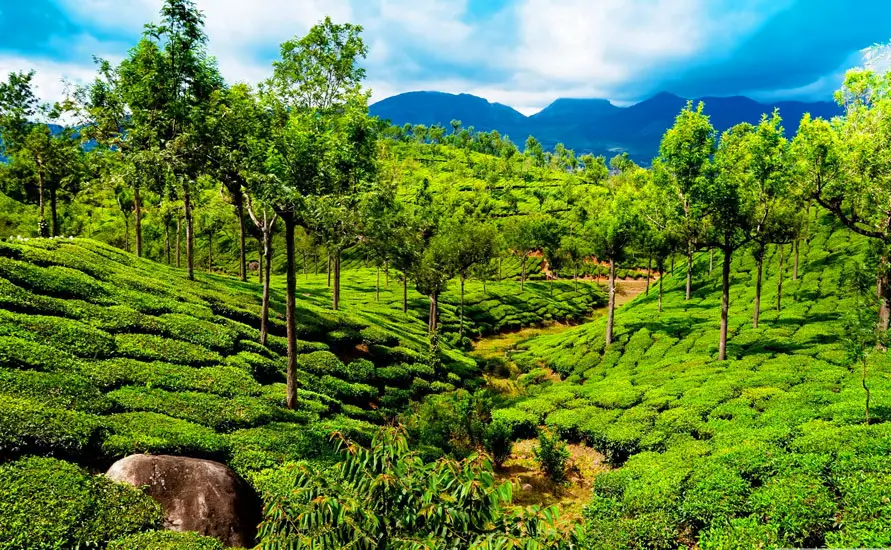
After a slow breakfast you visit a tea estate in the hills around Ooty, where tea pickers work along the green rows and a small factory shows the stages from withering to rolling, drying and grading. Nilgiri leaf brews a brisk, perfumed cup, and you can taste several grades. Your guide also explains the role of the railway in the hill economy: before the line was built, tea and supplies traveled up and down the hills by road and pack animals. In town, the Government Botanical Garden dates from 1848 and repays an hour, with its terraced lawns, glasshouses and a petrified tree trunk thought to be some twenty million years old.
In the afternoon you take a short ride on the toy train from Ooty to Lovedale or to Ketti, the stations just below Ooty, if tickets and timings allow on your date. It is a chance to sit at an open window, watch the train curve through the hills and hear the horn echo off the valley. Lovedale station is small and tidy, with a red-roofed waiting room and a flower bed at the end of the platform, and it is often used in Indian films. Your driver waits at the station to bring you back to Ooty, or you can return on the train if the timing works.
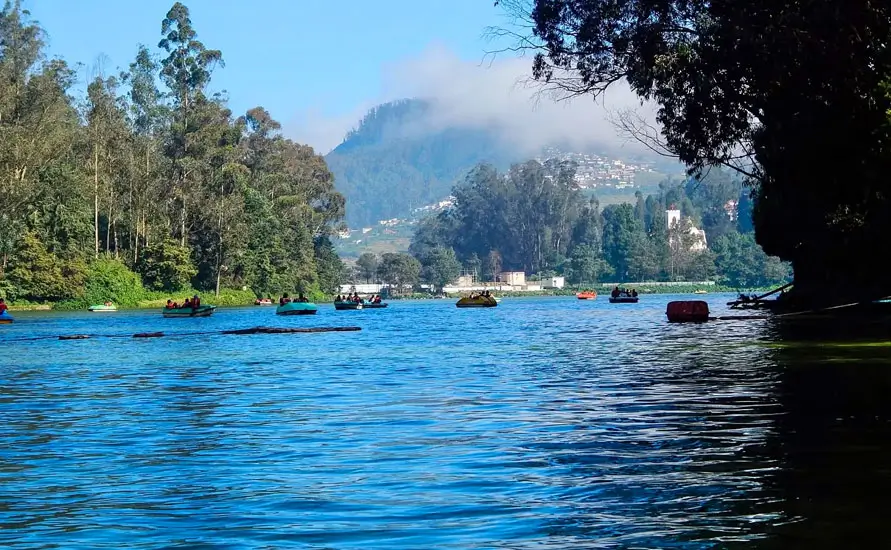
Spend the free evening in Ooty's market, where you can buy homemade chocolates, eucalyptus oil and Nilgiri tea. If you prefer a quieter end to the day, the lake area is pleasant at sunset, and a visit to St. Stephen's Church, dating from the early 1830s, adds a colonial touch. Your guide will go over tomorrow's departure plans and confirm your flight timing from Coimbatore. A farewell dinner can be arranged at a hotel restaurant with a view of the hills, where the cool night air reminds you how far you have come from the coast. Overnight in Ooty.
Breakfast over, the car starts the descent on the Nilgiri ghat road, a series of hairpin bends that descend through tea gardens, forest and finally the plains around Mettupalayam. On the way you may see the rack line far below or a train crawling up toward Coonoor, a last chance to wave at the railway that brought you up. Allow about three hours; your driver sets the departure time with enough margin for traffic in Coimbatore and for international or domestic check-in at Coimbatore International Airport.
Coimbatore has direct flights to the Gulf, Singapore and Sri Lanka, as well as domestic connections through Chennai, Bengaluru, Mumbai and Delhi. Late flights can be covered with a day-use room booked near the terminal. Over two weeks you have traveled across Tamil Nadu by express, local, sleeper and mountain train, crossed the sea on the Pamban bridge, walked the ruins of a lost station and climbed into the Nilgiris by rack and pinion. We hope you go home with a notebook full of train numbers and memories, and we wish you a safe flight.
Your Journey

N.S. Rathore & Mrs. Omlata Rathore · Managing Director
We still read every enquiry ourselves. Tell us the places you liked and our planners will send a day-by-day route with drive times and a clear price.
Every package can be customised and no pressure to book. A planner from our office replies within 24 hours with a route written for your group.
Fill this in and your planner will send a first draft itinerary.
Explore more
Kerala Backwaters Escape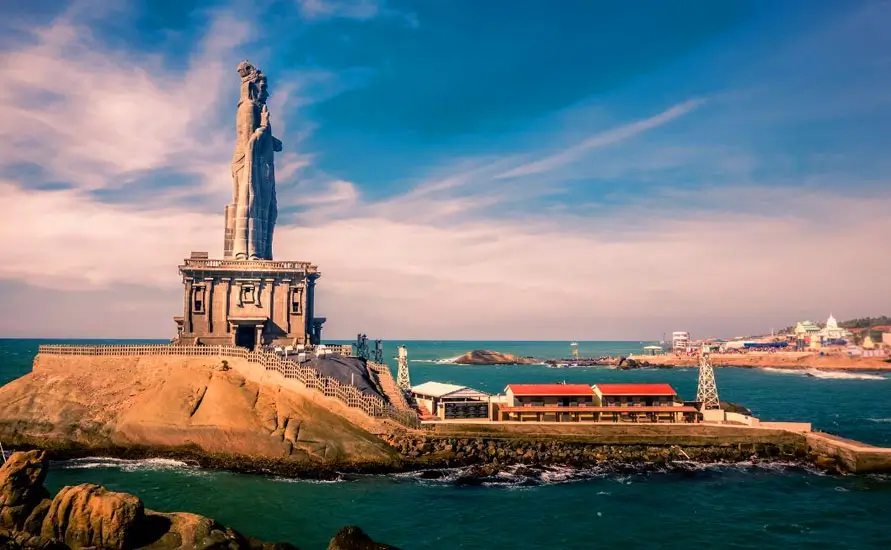 Kerala Backwaters Escape
 Kerala Backwaters Escape
 Kerala Backwaters Escape
 Kerala Backwaters Escape
 Kerala Backwaters Escape
 Kerala Backwaters Escape
 Kerala Backwaters Escape
 Kerala Backwaters Escape
 Kerala Backwaters Escape
 Kerala Backwaters Escape
 Kerala Backwaters Escape
 Kerala Backwaters Escape
 Kerala Backwaters Escape
 Kerala Backwaters Escape
 Kerala Backwaters Escape
 Kerala Backwaters Escape
 Kerala Backwaters Escape Kerala Backwaters Escape