 Kerala Backwaters Escape

Tamil Nadu Tour Packages
Chennai – Mahabalipuram – Gingee Fort – Tiruvannamalai – Tanjore – Darasuram – Gangaikonda Cholapuram – Coimbatore – Coonoor (Nilgiri Mountain Railway) – Ooty
At a glance
Tamil Nadu holds four separate entries on the UNESCO World Heritage List, and this Tamil Nadu UNESCO heritage tour is planned so that you see every one of them in a single trip. The route starts with the Pallava rock carvings of Mahabalipuram, climbs the granite citadel of Gingee Fort, spends three nights among the Great Living Chola Temples at Tanjore, at Darasuram and at Gangaikonda Cholapuram, and ends on the rack-and-pinion line of the Nilgiri Mountain Railway, which climbs from the plains to Coonoor before you continue by road to Ooty.
The newest name on the list is Gingee. In July 2025 UNESCO inscribed the Maratha Military Landscapes of India, a group of twelve forts, and Gingee is the only one of the twelve that lies outside Maharashtra, in Tamil Nadu. Pairing it with Pallava, Chola and colonial railway engineering gives you roughly 1,300 years of building history in one Tamil Nadu heritage tour package. Each site is covered with a licensed local guide who knows the inscriptions, the dynasties and the restoration stories, not only the dates.
Long drives are kept to a minimum, with one exception: the move from Tanjore to Coimbatore runs about six hours by road, or slightly less by daytime train, and we schedule it as a quiet travel day. Everything else stays within four hours. The Tamil Nadu UNESCO heritage tour is aimed at overseas guests, from Britain to Canada to New Zealand, who prefer architecture and history to beach time, and it works best between October and March. The tour ends with a departure from Coimbatore airport.
Once you clear immigration and customs, look for our Chennai representative with your name printed on a card; they escort you by private air-conditioned car to your hotel. Since long-haul arrivals here usually touch down between midnight and dawn, nothing is scheduled before lunch, and the morning belongs to sleep and a slow breakfast. During the drive you receive a folder with vouchers, emergency numbers and a short guide to the four UNESCO listings you will see on this Tamil Nadu UNESCO heritage tour, along with a local SIM card if you requested one when booking.
Around 3 pm your guide collects you for Fort St. George, the first stronghold of the English East India Company, begun in 1644 on the beach that later grew into the city of Madras. The Tamil Nadu legislature still sits here, so parts are off limits, but St. Mary's Church is open to visitors. Consecrated in 1680, it is the oldest Anglican church in India, and its floor and walls carry memorial stones for soldiers, clerks and their families. Robert Clive was married in this church, and the register recording it is kept in the parish archive. The small Fort Museum nearby displays company uniforms, coins and portraits.
Before closing time you drive to Egmore for the Government Museum, founded in 1851 and second in age only to the Indian Museum in Kolkata. Its bronze gallery is the reason to come: room after room of Chola metal icons, including several dancing Nataraja figures cast by the same lost-wax method you will see again near Tanjore later in the week. Seeing them now gives useful background before the Chola temples. Note that the museum closes on Fridays, so on a Friday arrival we swap this visit with a walk around the temple tank in Mylapore. For dinner, your guide can name a few vegetarian places close to the hotel. Overnight in Chennai.
Leaving Chennai after breakfast, you follow the East Coast Road south past glass office parks, then fishing settlements, then casuarina plantations that shield the shore from wind. About halfway along, your driver stops at DakshinaChitra, a living-history campus where old homes from four southern states were dismantled beam by beam and put back together on site. You can step inside a Chettiar merchant's home, a weaver's cottage and a potter's workshop, and craftspeople often demonstrate basket weaving or glass bangle making. The center is closed on Tuesdays, so the stop moves to another day if needed.
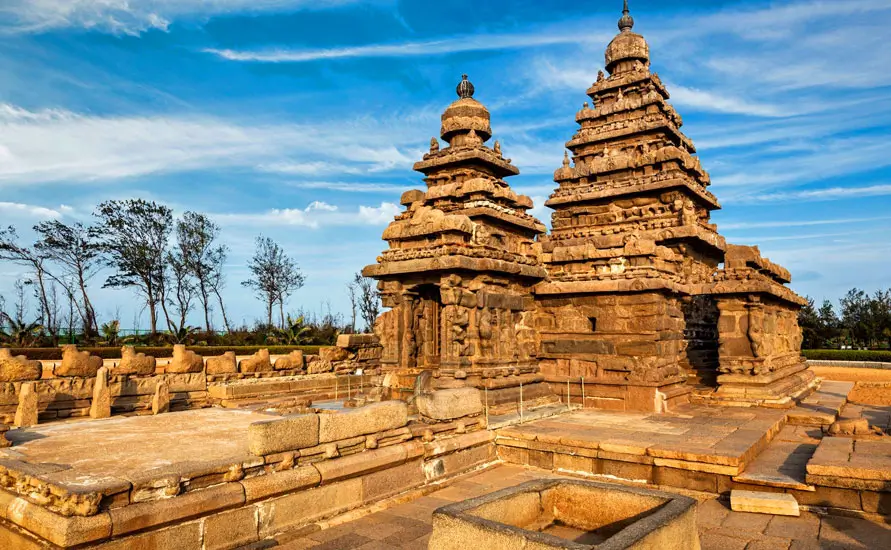
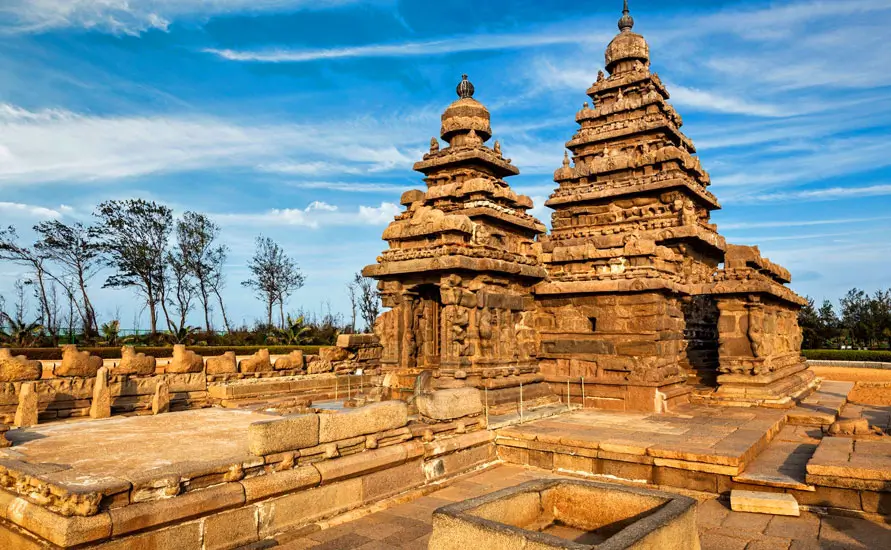
Arrival in Mahabalipuram comes around midday, with lunch and a seaside hotel check-in. Because you stay two nights, today's visits are short and relaxed. In the late afternoon your guide walks you to the Shore Temple, a built rather than rock-cut shrine that the Pallava ruler Rajasimha raised by the waterline around the year 700. Low sun from the west lights its weathered walls in warm orange tones, and the crowds of the middle of the day have mostly gone. Your guide shows you the rows of Nandi bulls lining the compound wall and the small Vishnu chamber that sits, oddly, between the pair of Shiva sanctuaries.
Afterwards there is time to wander through the town, where the sound of chisels on granite comes from dozens of open sculpture workshops along the main roads. Mahabalipuram has a government college of sculpture, and many carvers here trained in methods described in old Tamil texts on temple proportions. Some workshops are happy to let you watch a deity being shaped from a raw block, and smaller pieces can be shipped home. Supper might be the day's catch, grilled with chili and lime at a shack near where the boats are pulled up. Overnight in Mahabalipuram.
Most visitors give the UNESCO Group of Monuments at Mahabalipuram just two or three hours, but a full day lets you see the quieter caves and the unfinished carvings that explain how Pallava sculptors worked. Sunrise finds you at the Pancha Rathas, carved out of a single sloping ridge of granite and never used for worship. Your guide points out how each shows a different roof form, from a thatched hut shape to a barrel vault, and how these forms became the blueprints for later South Indian temple towers. A stone elephant, lion and Nandi stand beside them, carved from the same rock.
Mid-morning you move to the central hill, where the Varaha Cave and the Mahishasuramardini Cave hold some of the finest relief panels in India. In the second, Durga charges Mahisha on her lion, all arrows and raised weapons, while across the hall Vishnu lies asleep on his serpent, perfectly still; the contrast is deliberate. Nearby, Arjuna's Penance covers two huge boulders, and below it the Krishna Mandapa shows cowherds sheltering under a hill lifted by the god. You also climb to the old lighthouse, from where the whole site, the town and the coast are laid out below you.
After lunch and a rest in the hottest hours, you drive about 5 km north to Saluvankuppam to see the Tiger Cave, a small shrine framed by a ring of carved yali heads, and the excavated base of an early Murugan shrine in brick, found when the 2004 waves stripped away the dunes. Few tour groups come this far, so it is usually calm. You return to town before sunset, and the evening is free. If you happen to be here in late December or January, the annual Mamallapuram Dance Festival stages classical performances in the open air with Arjuna's Penance as the backdrop. Overnight in Mahabalipuram.
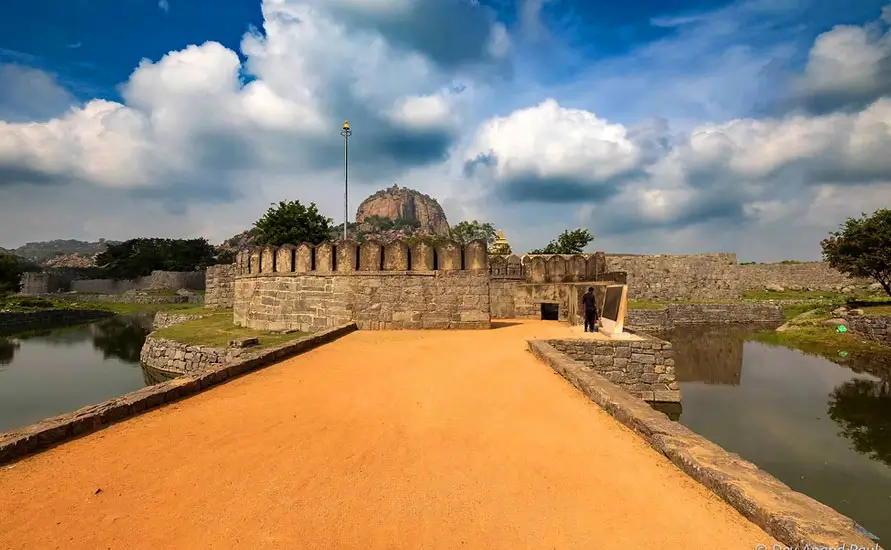
An early breakfast is worth it today, because the climb at Gingee Fort is best done before the rock heats up. The drive inland takes about three hours through sugarcane fields and granite hills. Gingee is spread across three hills, Rajagiri, Krishnagiri and Chandrayan Durg, joined by curtain walls that enclose a large area of plain. Over three centuries it passed from Nayak chiefs to Shivaji's Marathas, then to Mughal commanders, the Nawabs of Arcot, the French and finally the British, and UNESCO listed it in 2025 as part of the Maratha Military Landscapes of India, which makes it Tamil Nadu's newest UNESCO World Heritage site.
With your guide you start on the lower ground at the Kalyana Mahal, a square court topped by a tall pyramidal tower, then pass the granaries, the gymnasium and a large stepped tank. The ascent of Rajagiri follows a stone stairway of many hundreds of steps, with gateways, guard posts and a small bridge over a natural cleft in the rock near the top, once the last line of defense. Allow about two hours up and down, with rests in the shade. Good shoes, a hat and water are essential, and anyone who prefers not to climb can stay on the lower level with the guide's assistant.
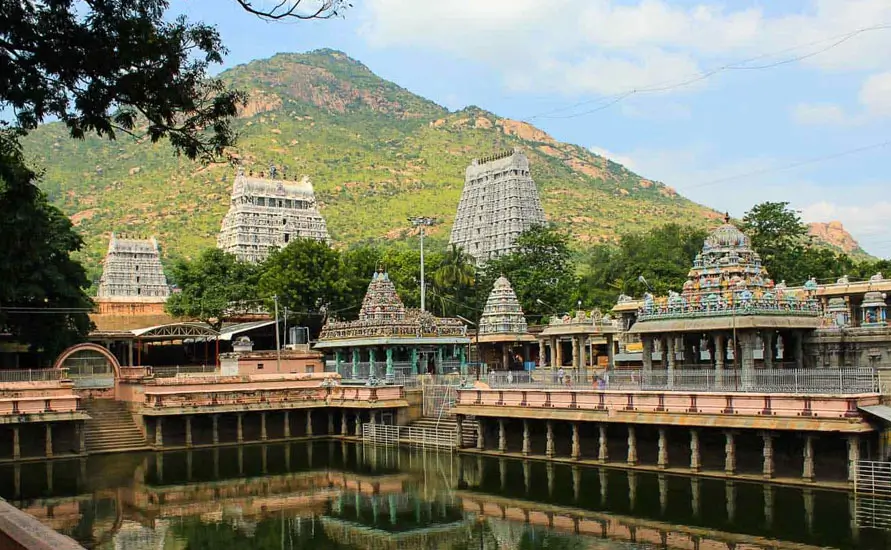
After a late lunch you drive about an hour west to Tiruvannamalai, a temple town at the foot of the sacred hill of Arunachala. In the evening you visit the Arunachaleswarar Temple, which covers about ten hectares behind four gopurams, the eastern one rising eleven stories. The temple represents Shiva as the element of fire, and every November or December a huge flame is lit on the summit for the Karthigai Deepam festival. Many pilgrims walk the 14 km path around the hill barefoot, and some visitors also stop at the Ramana Maharshi Ashram at the hill's southern edge. Overnight in Tiruvannamalai.
If you are up early, the hour after dawn is a peaceful time to walk a short stretch of the Girivalam path that circles Arunachala, passing small shrines, banyan trees and sadhus sitting outside their huts. After breakfast you set off south-east through the Cauvery delta, where canals first dug in the Sangam era still carry water to the fields of paddy and coconut. Your driver plans a lunch stop at a clean local restaurant serving full meals on banana leaves, with rice, sambar, rasam, poriyal and curd. Allow roughly five hours on mostly smooth highway, counting the halts.
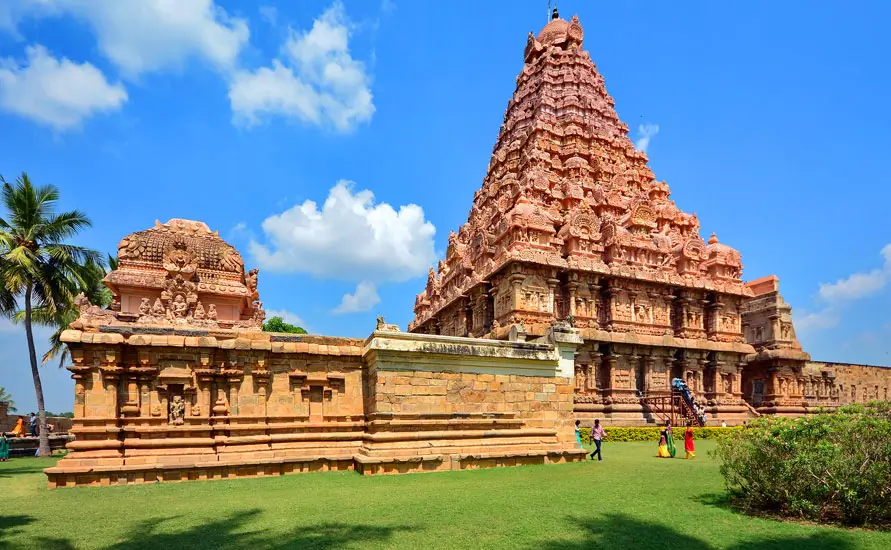
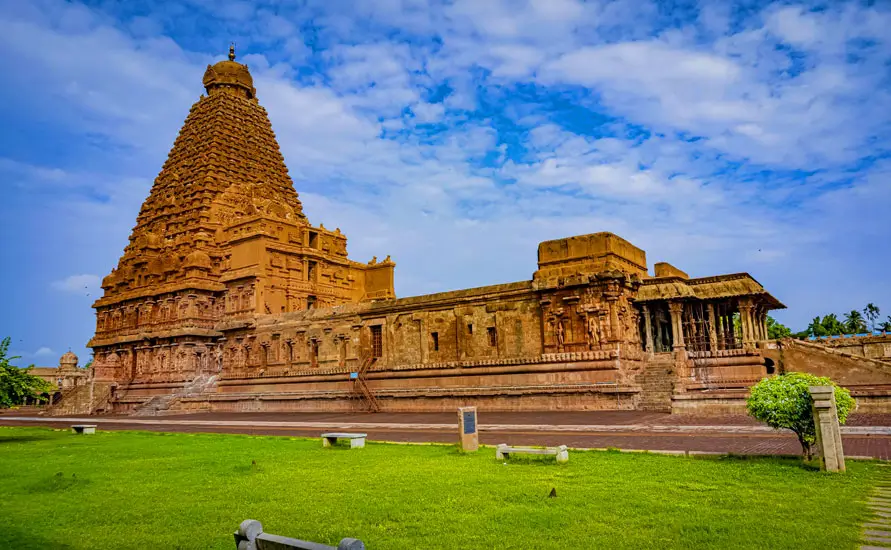
You reach Tanjore, also called Thanjavur, by mid-afternoon and check in for three nights, which means no packing until you leave for Coimbatore. Tanjore was the capital of the imperial Cholas from the 9th to the 13th century, when their navy and armies reached Sri Lanka, the Maldives and parts of Southeast Asia. Once you have rested, your guide brings you to the Brihadeeswarar Temple for a first visit as the sun drops behind the western wall. Rajaraja Chola I consecrated it in 1010; it was the first temple named in the Great Living Chola Temples listing, and priests still perform rites here every day.
Today's visit is an introduction, so your guide keeps it simple: the two great entrance gateways, the giant monolithic Nandi in its own pavilion and the main tower, about 66 meters high and capped by a dome-shaped stone. Evening is a good time to stay on in the courtyard as oil lamps are lit and local families come for evening worship, sitting on the warm stone floor. The detailed study of the carvings, inscriptions and frescoes follows tomorrow morning. Dinner can be at a restaurant in town known for its Thanjavur-style meals and strong filter coffee. Overnight in Tanjore.
A morning return to the Brihadeeswarar Temple shows a different side of the building. With fewer people around, your guide reads parts of the long Tamil inscriptions on the base of the main shrine, which list the land grants, gold, jewelry and the names of hundreds of temple dancers and musicians supported by the king. On the walls of the cloister you can see 108 dance poses from the Bharatanatyam tradition, some left unfinished. The guide also explains why the old claim that the tower casts no shadow at noon is a myth, and how engineers still debate the methods used to lift the capstone to the top.
Later in the morning you visit Thanjavur Palace, a rambling complex begun by the Nayaks and enlarged by the Bhonsle Marathas who took Tanjore in 1674. The art gallery in the old durbar hall holds a large collection of Chola stone and bronze sculpture, and the bell tower gives views over the town. Within the same walls sits the Saraswathi Mahal Library, where King Serfoji II, a pupil of Danish missionaries and a keen collector, gathered thousands of palm-leaf texts, painted atlases and European books on medicine and astronomy. Photography rules inside are strict, and your guide will advise.
The afternoon is given to Tanjore painting, a court art form that took shape under Maratha patronage. At a family studio you see artists build up raised areas with a paste of chalk and gum, press in thin gold foil and set small colored stones before painting the figure of Krishna or a goddess in bright, flat colors. Nearby, a doll maker shapes the round-bottomed Thanjavur thalaiyatti bommai, figures that wobble and nod but always come upright. Both make light, easy-to-pack souvenirs. In the evening, ask your guide about a Carnatic music recital, as Tanjore hosts small concerts most weeks. Overnight in Tanjore.
Today completes the set of Great Living Chola Temples. After breakfast you drive about 40 minutes to Darasuram, just outside Kumbakonam, for the Airavatesvara Temple, built by Rajaraja II in the 12th century. It is smaller than Tanjore, but its carving is far more detailed, with friezes so fine that your guide may use a torch to show figures only a few centimeters tall. The front hall is shaped like a chariot pulled by horses and elephants, with carved stone wheels. Near the entrance a set of stone steps once gave musical notes when tapped, and the tradition is still pointed out today.
From Darasuram you continue north for about an hour to Gangaikonda Cholapuram, whose name means the city of the Chola who took the Ganges; Rajendra I built it around 1035 after his northern campaign. The old palace city has vanished under farmland, and only the temple remains, standing alone among the fields. Its tower is lower than Tanjore's, with gently curving sides that many architects consider more graceful. Your guide shows you the panel of Shiva garlanding the devotee Chandesha, one of the finest Chola carvings, and the lion-mouthed well where water from the Ganges is said to have been poured.
On the return, Kumbakonam is the place for lunch and for a tumbler of degree coffee, the frothy local brew made with fresh cow's milk. In the afternoon you can stop at Swamimalai, where families of bronze casters still make icons by the lost-wax method, shaping each figure in beeswax, coating it in clay and pouring in molten metal. It links directly to the bronzes you saw in Chennai on your first day. You return to Tanjore by early evening with time to rest before tomorrow's long transfer to the hills. Overnight in Tanjore.
No monuments are planned today: crossing from the delta to the western hills is the single long leg of the Tamil Nadu UNESCO heritage tour, so the focus is on arriving rested. Depending on the season and your preference, you either drive west across the state via Trichy, Karur and Tiruppur, with stops for tea and lunch, or take a daytime express train from Thanjavur to Coimbatore, with your car and driver meeting you on arrival. The road option takes about six hours and lets you pause at a roadside coconut stall or a temple along the way. The train is often a little quicker and lets you stretch your legs.
Coimbatore is an industrial city known for textile mills and pump manufacturing, and for most travelers it serves as the base for the climb into the Nilgiris. Hotel check-in is late afternoon; aim for an early meal and early bed, as the toy train pulls out of Mettupalayam soon after first light and the platform must be reached in good time. Your driver confirms the pickup time this evening. If you have energy left, a short walk in the RS Puram area offers sweet shops, silk stores and a chance to try a local dosa. Overnight in Coimbatore.
A very early start takes you about an hour north to Mettupalayam station at the foot of the Nilgiri hills. Here you board the Nilgiri Mountain Railway, opened in 1908 and added by UNESCO in 2005 to the listing of the Mountain Railways of India. Over the 46 km to Coonoor the gain in height is around 1,700 meters, steep enough that a toothed center rail is laid between the running rails, and the engine pushes the blue and cream carriages from behind using cog wheels. Seats are reserved for you in advance, though availability is never guaranteed in peak season, and the ride takes several hours.
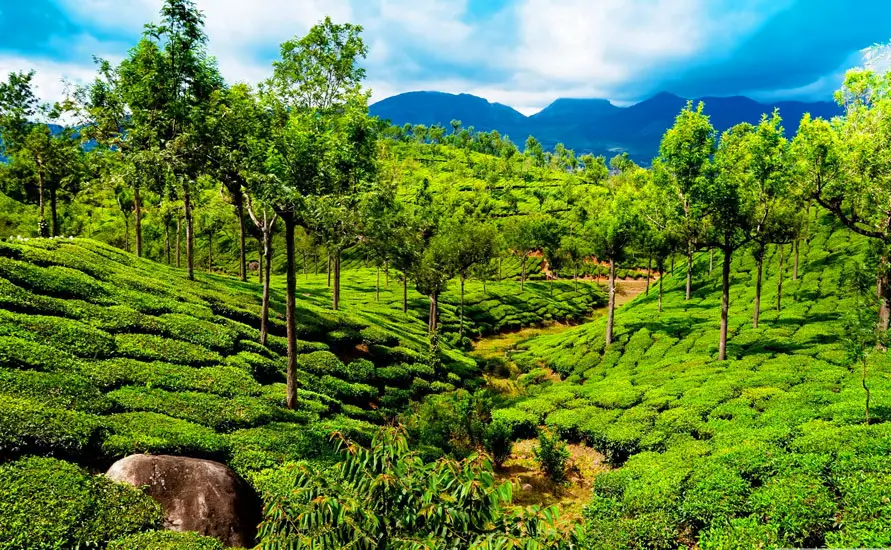
The track crosses more than two hundred curves, passes through about a dozen tunnels and runs over tall stone and steel bridges above forested ravines. At small stations such as Hillgrove the train stops to take on water, and passengers buy tea and snacks from vendors on the platform. Areca and plantain give way to bamboo, then to eucalyptus and wattle, and finally to clipped tea terraces wrapping each upper slope. Sit on the left side for the best views of the valley, and keep valuables close, as the open windows invite leaning out with cameras.
Your driver, who has brought your luggage up by road, meets you at Coonoor station. Lunch is followed by Sim's Park, a sloping garden of the 1870s with rare conifers, and a ride out to the Dolphin's Nose outcrop, where the land falls away to a gorge and Catherine Falls drops on the far side. A short stop at a tea factory shows the withering, rolling and drying of Nilgiri leaf, with a tasting at the end. The final 19 km to Ooty takes about forty minutes, and the air is noticeably cooler when you arrive, so keep a jacket handy. Overnight in Ooty.
John Sullivan, a Coimbatore collector, built the first stone house here in the 1820s, and within decades Udhagamandalam was where Madras officials spent the hot months. First comes the Government Botanical Garden, terraced up the slope since the late 1840s, with a fern house, an Italian-style garden, a fossilized tree trunk and the lawns that host the May flower show. From there you drive to St. Stephen's Church, completed in 1829 and roofed, according to local tradition, with teak salvaged from Tipu Sultan's fallen capital, then wander the graveyard where early settlers lie under weathered headstones.
Before lunch you call at a small Toda village, home to the pastoral people who herded buffalo on these grasslands long before tea arrived. Their traditional homes are barrel-shaped huts of bamboo and thatch with a tiny entrance you have to crawl through, and the women are known for embroidered shawls in red and black on white cotton. Visits are arranged respectfully with the community, and buying a piece of their needlework directly is a good way to support them. Your guide also explains the Badaga and Kota communities who share the hills, and how tea plantations changed their land and way of life.
Afternoon is for Doddabetta, the range's top summit at roughly 2,630 meters, where a telescope house looks over tea slopes and forest and, if the haze lifts, all the way to the lowlands. Clouds often roll in by mid-afternoon, so the timing depends on the weather. Coming down, there is a tea museum on the same road, and Ooty's homemade chocolate shops are hard to pass. Use the free evening to stroll Charing Cross and the municipal market, or simply rest by a fire after ten days of forts and gopurams. Overnight in Ooty.
After a slow breakfast with a final cup of Nilgiri tea, you check out and descend by road through the Kallar hairpin bends to the plains, a drive of about three hours to Coimbatore International Airport. The route follows the same hills you climbed by toy train, so you get a second look at the valley from a different angle. Pickup is set with plenty of slack, since weekend traffic on the ghat road can crawl. A day-use hotel room in Coimbatore can be arranged at extra cost if your flight leaves late.
From Coimbatore you can fly to the big Indian hubs or straight to Singapore and Sharjah, then on to your home country. Over eleven days you have stood inside all four of Tamil Nadu's UNESCO listings, from Pallava caves to Chola towers, a Maratha-era hill fort and a working colonial railway. We remain on call until check-in is done, and if Madurai, Chettinad or Kerala is calling for next time, we can sketch that route too. Have a safe flight home.
Your Journey

N.S. Rathore & Mrs. Omlata Rathore · Managing Director
We still read every enquiry ourselves. Tell us the places you liked and our planners will send a day-by-day route with drive times and a clear price.
Every package can be customised and no pressure to book. A planner from our office replies within 24 hours with a route written for your group.
Fill this in and your planner will send a first draft itinerary.
Explore more
Kerala Backwaters Escape Kerala Backwaters Escape
 Kerala Backwaters Escape
 Kerala Backwaters Escape
 Kerala Backwaters Escape
 Kerala Backwaters Escape
 Kerala Backwaters Escape
 Kerala Backwaters Escape
 Kerala Backwaters Escape
 Kerala Backwaters Escape
 Kerala Backwaters Escape
 Kerala Backwaters Escape