 Kerala Backwaters Escape

Tamil Nadu Tour Packages
Chennai – Mahabalipuram – Pondicherry – Pichavaram – Tranquebar – Velankanni – Nagapattinam – Darasuram – Tanjore – Trichy
At a glance
Long before Europe had a name for it, the shoreline south of Chennai was trading pepper, cotton and pearls with Rome, China and Southeast Asia. Our Coromandel Coast Tour Tamil Nadu follows that story town by town. You start at the British fort that grew into Chennai, see the Pallava harbor carvings of Mahabalipuram, walk the French streets of Pondicherry, sleep two nights beside the Danish Fort Dansborg in Tranquebar, and visit the pilgrim town of Velankanni before turning inland to the Chola capital of Tanjore.
The pace is easy. No drive on this Coromandel coast tour runs much beyond three hours, the coastal leg uses the East Coast Road with its salt pans, casuarina plantations and fishing hamlets, and the two-night stays in Pondicherry and Tranquebar give you breathing room. Your own chauffeur-driven AC car covers every kilometer between the Chennai arrivals hall and the Trichy terminal, and local guides lead the walks in Chennai, Mahabalipuram, Pondicherry, Tranquebar and Tanjore. You fly out from Trichy, so there is no need to drive back to Chennai at the end.
Travelers who like history with salt air in it will enjoy this route most: retired couples, small groups of friends, photographers and NRI families curious about the coast their grandparents described. For this Tamil Nadu coast tour, aim for the cool season between October and March, keeping in mind that the northeast monsoon can bring heavy showers in November and early December. Hotels range from beach resorts to restored Danish and French mansions, and every element of the trip can be adjusted to your dates and budget.
Your coastal trip begins at Chennai International Airport, where our representative waits outside the arrivals hall with a placard bearing your name. A private air-conditioned car takes you to your hotel, and the rest of the morning is kept free so you can sleep off the long flight. Rooms are normally ready at 2 pm; travelers on a pre-dawn arrival often reserve the night before so the bed is waiting for them. On the drive in, your welcome pack changes hands, along with any SIM you ordered and some plain advice on cash, tipping and this week's coastal weather.
Chennai makes most sense when you begin where the city itself began, so that is where the afternoon goes. In 1640 the English East India Company built a small trading post on a strip of sand here, and Fort St. George grew around it into the seed of modern Chennai. Inside the walls stands St. Mary's Church, dating from 1680, whose floor and walls carry tombstones of Company clerks, captains and young wives who died far from home. Nearby, the fort museum fills a building that once served as the merchants' exchange, and its cases show weapons, medals, Company coinage and painted portraits of governors. Plan around Fridays, when the museum stays shut.
A few minutes north lies George Town, the district that the British once labeled 'Black Town', where Telugu, Armenian, Portuguese and Gujarati merchant families settled beside one another. Each lane still keeps to its own business: one sells brass pots, the next sells stationery by the bundle, and a third smells of chilli sacks and salted fish. Your guide points out the Armenian Church, built in 1772, a walled garden and bell tower kept by a congregation now reduced to a handful of families. You return to the hotel through the evening traffic, and dinner can be a Chettinad or coastal seafood meal at a nearby restaurant. Overnight in Chennai.
Morning traffic thins once your car joins the East Coast Road, a road with the sea glinting through the palms for much of the run south. Halfway along, DakshinaChitra is worth a stop: rescued homes from four states stand here, each carried over in numbered pieces after its owners had planned to pull it down. Among them is a fisherman's hut, a merchant's home from Chettinad and a weaver's house with a pit loom, which together show how coastal and inland families lived a century ago. Craftspeople often give demonstrations of pottery, basket weaving or glass bangle making, and your guide can explain the many different roof styles. The museum is closed on Tuesdays.
Lunch is in Mahabalipuram, and the afternoon treats the town as a seaport first and a temple site second. When Pallava rulers held this coast some 1,300 years ago, ships sailed from here for Sri Lanka, Myanmar and the kingdoms of Southeast Asia, and Roman and Chinese coins have been found along this stretch of shore. Your guide takes you up the rock behind the modern lighthouse to the Olakkanesvara Temple, a small granite shrine that is thought to have held a beacon fire for sailors. The view from up there takes in the sandy shoreline, the fishing hamlet and granite boulders dotted between the houses.
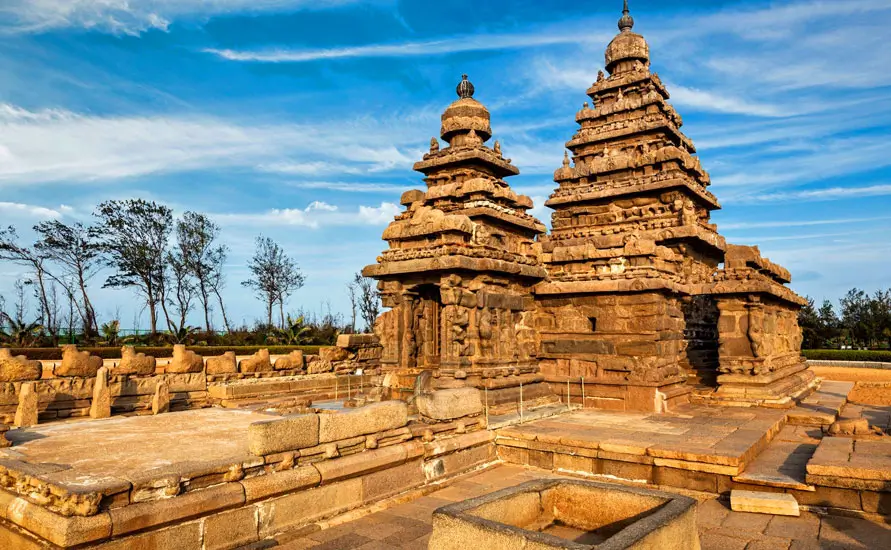
Late in the day you walk down to the UNESCO-listed Shore Temple, whose two towers have stood at the water's edge for some thirteen centuries. Sailors once used them as a landmark, and old travelers' accounts speak of further temples now lost under the waves, a story that gained weight when the 2004 tsunami briefly uncovered carved stones offshore. Sit on the stone breakwater that now shields it from the surf and let the low sun warm the weathered granite to a honey color. Afterwards you can stroll through the sculptors' lanes, where the tap of chisels on stone continues well after dark, before dinner at a small seafood restaurant. Overnight in Mahabalipuram.
Set the alarm for sunrise and walk down to the beach north of the Shore Temple, where the local fishing community brings in the night's catch. Brightly painted fiber boats are pushed up the sand on wooden rollers, women sort mackerel, sardines and crab into plastic tubs, and buyers bargain loudly for the best baskets. Your guide can explain how the fishing panchayat, an old village council, still sets many of the rules on this beach. After that you return for breakfast, then visit the Pancha Rathas, a row of five chariot-shaped shrines sharing one granite base, and the crowded rock face of Arjuna's Penance before the tour buses arrive.
Before heading south, a short detour north to Saluvankuppam brings you to the Tiger Cave, whose entrance is ringed by a row of snarling carved heads. Excavations near it uncovered a brick temple to Murugan that is older than the Pallava stone monuments, a sign that this shore was a busy place long before the famous carvings. Back on the coast road, the scenery alternates between white salt pans, square prawn ponds and windbreaks of feathery casuarina. You also cross the backwater bridge at Muttukadu and pass through villages where fishing nets hang to dry beside the road.
By early afternoon you are settling into a restored townhouse hotel near the old French town of Pondicherry. Around dusk, your first stroll leads along the Promenade, the sea road that served as the colony's public front and still goes car-free once the light fades. You pass the old customs house and the French war memorial, and you hear how the settlement changed hands between the French, the Dutch and the British several times in the 18th century. Dinner tonight is your choice from the small cafés of the old town. Overnight in Pondicherry.
Pondicherry's story as a trading town starts not with the French but with Rome. Ten minutes south of town, on the Ariyankuppam river, lies Arikamedu, where excavators dug up Mediterranean wine jars, glass beads and glossy red Roman pottery about two thousand years old. The site itself is quiet and overgrown, but your guide helps you picture the warehouses and wharves that once stood here, and explains how wine and olive oil arrived from the Mediterranean in exchange for textiles, beads and pepper. Back in town, the Pondicherry Museum displays many of the Arikamedu finds alongside French furniture and bronzes. It is closed on Mondays.
Late in the morning you walk through the French Quarter, built on a grid plan by the French East India Company after it made Pondicherry its main base in India in the late 17th century. Your guide shows you the Hôtel de Ville, the Governor's residence, the pink-and-cream Notre-Dame des Anges on the waterfront, and the shuttered villas on Rue Romain Rolland and Rue Dumas. The old canal that divided the town marks the boundary with the Tamil Quarter, where you see verandah-fronted houses with carved wooden pillars and the thinnai, the raised platform beside the door where neighbors sat to talk.
The afternoon is yours to spend as you like. Some guests visit the Sri Aurobindo Ashram or rent a bicycle to ride along the seafront, while others drive out to Auroville to see the Matrimandir from the public viewing point, which can be arranged with your car at no extra charge. Before dinner you might stop at the Goubert Market in the Tamil Quarter for fresh jasmine, spices and the local sweets, then end the day with a French or Creole meal in one of the old colonial houses. Overnight in Pondicherry.
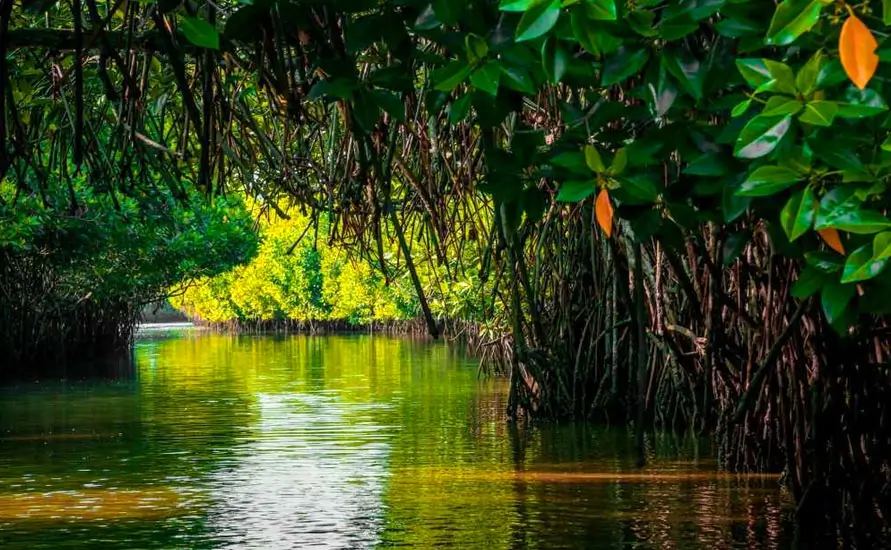
Today the road runs south toward the Cauvery delta, where rivers split into many channels before they reach the sea. After breakfast you drive through Cuddalore, once the site of the British Fort St. David, and continue to Pichavaram, close to Chidambaram, one of the largest mangrove forests on the Indian coast. A rowing boat with a local boatman takes you through narrow green tunnels of mangrove roots, past egrets, herons and kingfishers fishing in the shallow water. The boatmen here are mostly from local fishing families, and many lost relatives in the 2004 tsunami, when these mangroves helped protect the villages behind them.
From Pichavaram you continue south through rice fields and small temple towns, crossing the branches of the Kollidam and Cauvery rivers before reaching Tranquebar, known in Tamil as Tharangambadi, the 'place of the singing waves'. In 1620 the Danish admiral Ove Gjedde signed a treaty with the Nayak ruler of Thanjavur, and the Danish East India Company held this small town for more than two centuries, until it was sold to the British in 1845. Your room tonight is inside the old walled town, where several Danish-era houses have been restored as small hotels with tall ceilings and deep verandahs.
When the heat softens, a guided walk takes you along King Street, passing the pale yellow Zion Church of 1701 and the New Jerusalem Church that the German Lutheran Bartholomäus Ziegenbalg raised in 1718. Ziegenbalg learned Tamil here, rendered the Christian scriptures into it and set up a printing press that produced some of the first books printed in an Indian script. The walk ends at the shore, where the Masilamani Nathar Temple, first built in the early 14th century, stands half ruined at the water's edge, battered by the sea. Sunset from the beach beside it is very quiet and very beautiful. Overnight in Tranquebar.
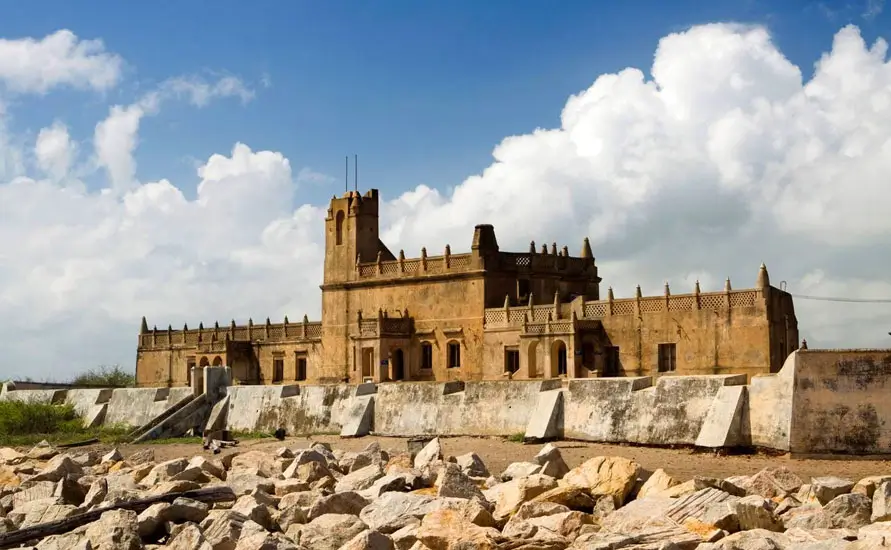
Start the morning with a visit to Fort Dansborg, the Danish fort that has watched over this beach since 1620. It is the second-largest Danish fort ever built, after Kronborg in Denmark, and its thick walls, ramparts and arched storerooms are well preserved. A small museum inside displays Danish coins, porcelain, swords, letters and Tamil palm-leaf manuscripts, and your guide explains how ships from Copenhagen once anchored offshore to load textiles and spices. You also pass under the Town Gate, rebuilt in 1792, and see the Governor's bungalow and the old Danish cemetery. The fort museum is closed on Fridays.
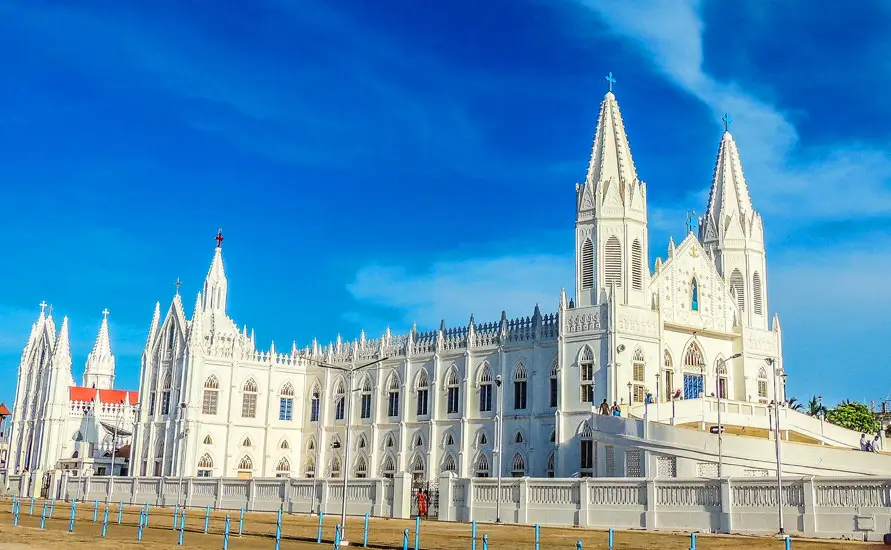
Later you drive south through Karaikal, a former French enclave that is still part of the Union Territory of Puducherry, to the pilgrim town of Velankanni, about 60 km away. The white Basilica of Our Lady of Good Health draws Christians, Hindus and Muslims alike, and local tradition tells of Portuguese sailors caught in a storm who vowed to build a chapel if they reached land safely. The museum behind the church is filled with offerings left by grateful pilgrims, from silver models of houses and body parts to wedding dresses. Modest dress is required, and the town is very crowded during the annual feast from late August to early September.
Heading home, you pause in Nagapattinam, chief harbor of the Chola kings, whose 11th-century war fleets sailed from here toward Sri Lanka and the Malay world. A king of the Srivijaya empire in Sumatra paid for a Buddhist monastery here, and the town later passed to the Portuguese and then the Dutch. Your guide shows you the busy fishing harbor and the old Dutch-era quarter, then you drive back to Tranquebar in the late afternoon. Dinner tonight might be a fish curry cooked with tamarind and coconut, the specialty of these coastal villages. Overnight in Tranquebar.
Those who wake early can walk down to the beach before breakfast, when the Tranquebar fishing fleet comes back with its catch and the auction begins on the sand. Then the sea drops behind you, and the car heads inland via Mayiladuthurai across a flat delta of paddy, coconut palms and Cauvery-fed channels. This is the old heartland of the Chola kings, and almost every village along the road has a temple tank and a gopuram rising above the palm trees. Ask your driver to pull over wherever you like for tender coconut or a tumbler of filter coffee.
Just outside Kumbakonam waits the Airavatesvara Temple of Darasuram, a 12th-century work of Rajaraja II that shares World Heritage status with the two larger Chola shrines. What it lacks in height compared with Tanjore it repays in fine detail, including miniature dance panels, stone wheels and horses that turn the front hall into a chariot, and a set of steps that once rang with musical notes. Look too for the row of panels telling the lives of the 63 Nayanmars, the Shaivite poet-saints. Visitors are few, and late morning sun shows the carving at its sharpest.
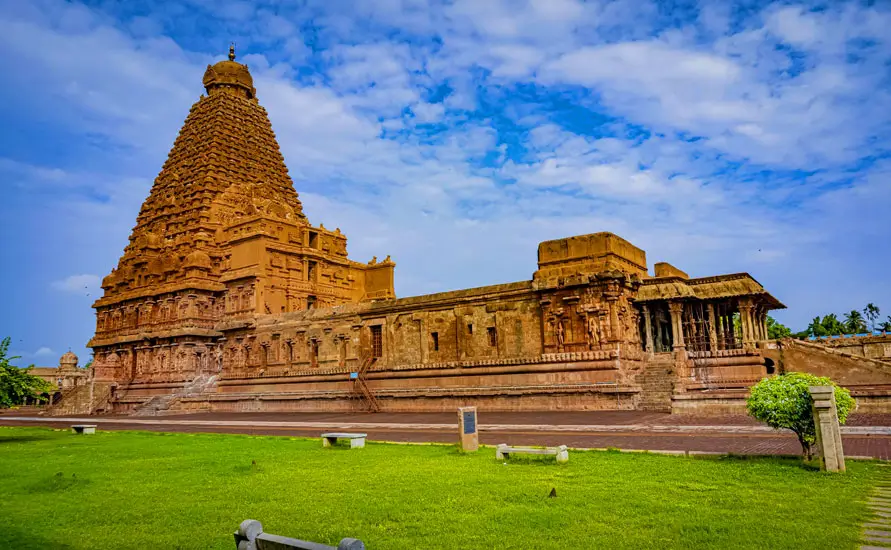
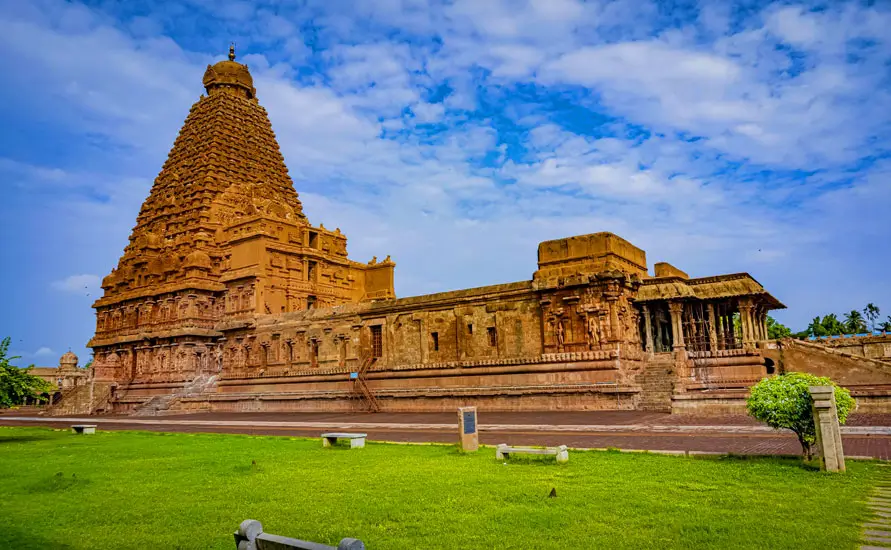
You continue to Tanjore, also called Thanjavur, and check in before an afternoon rest. As the sun drops you walk into the Brihadeeswarar Temple, which Rajaraja Chola I dedicated around 1010, its tower climbing some 66 meters above the courtyard. Your guide explains how the Chola navy carried the power of this inland capital across the Bay of Bengal as far as Sumatra, bringing the coastal story of the past week full circle. Stay until the granite turns pink and orange in the evening light, then return to your hotel for dinner. Overnight in Tanjore.
On your last morning, if your flight time allows, you can see the Thanjavur Royal Palace, home first to Nayak and then to Maratha kings, and the Saraswathi Mahal Library, whose shelves include books in Tamil, Marathi and Sanskrit, some of them printed on the Danish mission press you heard about in Tranquebar. Its art gallery displays dancing Shiva figures and other bronzes cast in Chola workshops. Your car then heads west for Trichy International Airport, around 60 km away, which has direct flights to Chennai, Bangalore, Singapore, Kuala Lumpur, Colombo and the Gulf for onward connections home.
Departure is timed with a generous margin; on an evening flight there is room for a climb up Trichy's Rock Fort, or we can reserve a short-stay room near the terminal for an added charge. In eight days you have followed the Coromandel coast from the British fort in Chennai to the Danish ramparts of Tranquebar and the Chola temples of the delta. Should the south call you back, a second route through Chettinad, Madurai and Rameswaram follows naturally from this one, and our team can shape it for you. Safe travels home.
Your Journey

N.S. Rathore & Mrs. Omlata Rathore · Managing Director
We still read every enquiry ourselves. Tell us the places you liked and our planners will send a day-by-day route with drive times and a clear price.
Every package can be customised and no pressure to book. A planner from our office replies within 24 hours with a route written for your group.
Fill this in and your planner will send a first draft itinerary.
Explore more
Kerala Backwaters Escape Kerala Backwaters Escape
 Kerala Backwaters Escape
 Kerala Backwaters Escape
 Kerala Backwaters Escape