 Kerala Backwaters Escape

Tamil Nadu Tour Packages
Kochi – Munnar – Madurai – Chettinad – Tanjore – Darasuram – Gangaikonda Cholapuram – Pondicherry – DakshinaChitra – Chennai
At a glance
Plenty of international flights land at Cochin, and many travelers assume that means a Kerala-only holiday. It does not have to. Our Tamil Nadu tour from Kochi uses Kerala as the arrival point and then turns east: a single night among the tea gardens of Munnar, a winding descent down the Western Ghats past cardamom slopes, and eight days in the temple towns of Tamil Nadu. You finish in Chennai, which has direct or one-stop flights to most of Europe, the Gulf and Southeast Asia, so there is no need to fly back to Kochi.
The crossing from Munnar down to Madurai is the hinge of the trip. Within four or five hours the road drops from cool, misty estates to the hot, flat plains around Theni, and the language on the shop signs changes from Malayalam to Tamil. From there the route follows Tamil history in a sensible order: Nayak-era Madurai, the merchant mansions of Chettinad, the great Chola shrines in and around Tanjore, the French streets of Pondicherry, and finally Chennai. Drives stay mostly between two and five hours.
This Tamil Nadu tour package is fully private. One driver and one air-conditioned vehicle stay with you from the moment you land in Kochi until your departure from Chennai, with licensed local guides joining you in each main town. It works well for couples, small families and NRIs who already know Kerala and now want the other side of the ghats. Aim for a date from late October through March, when the plains are warm rather than fierce and Munnar is dry and clear.
Outside the arrivals gate at Cochin International Airport, your driver is ready with a name card, takes charge of the bags and starts the drive of roughly an hour to Fort Kochi, the historic harbor quarter at the far end of the peninsula. Flights from the Gulf often arrive in the small hours, so if you land early we suggest booking an early check-in in advance and sleeping until lunch. During the drive the representative gives you a printed itinerary, a local SIM card if you have asked for one, and some quick tips on cash, tipping and dress for the Tamil temples that come later in the week.
After lunch, a Kochi-born guide leads a stroll through the less visited corners of Fort Kochi, away from the main waterfront. The Dutch Cemetery, with weathered tombstones from the 1700s, sits beside the beach road and is usually seen through its locked gate. Nearby, the brick walls of old trading houses on Princess Street and Burgher Street still show the mix of Portuguese, Dutch and British building styles. Your guide explains how pepper and ginger shipped from this harbor drew European fleets for three centuries, and why Kochi became one of the busiest spice ports on the Malabar Coast.
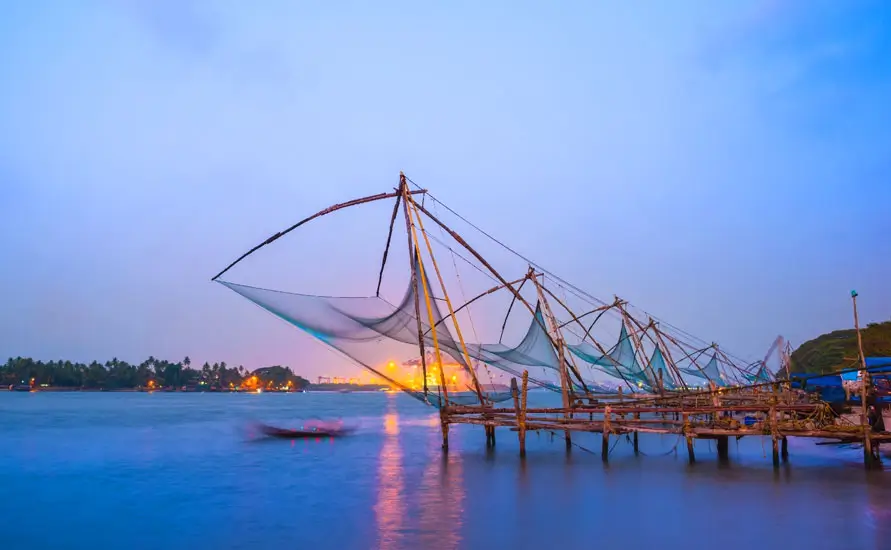
Toward sunset, wander down to the shoreline near the cantilevered fishing nets, but turn your attention to the harbor mouth instead, where container ships, ferries and tiny fishing canoes share the same channel. The small Vypeen ferry crosses the water every few minutes and is a cheap, ten-minute ride if you want to see Fort Kochi from the sea. Dinner tonight can be a simple Kerala fish curry with boiled tapioca in a small family-run restaurant near the old bus stand. An early night helps, since the mountain road begins after breakfast. Overnight in Kochi.
Leaving Kochi after breakfast, the road runs east through Perumbavoor and Kothamangalam, small towns surrounded by rubber plantations and pineapple farms. At Neriamangalam you cross the Periyar River on an old stone bridge, and from there the climb begins in earnest. The Cheeyappara and Valara waterfalls tumble right beside the road, carrying the most water in the months after the rains, roughly August to December. A planned halt at a family spice plantation follows, where a farmer shows you pepper vines, cardamom bushes, nutmeg and cinnamon growing side by side, and explains how each one is harvested and dried.
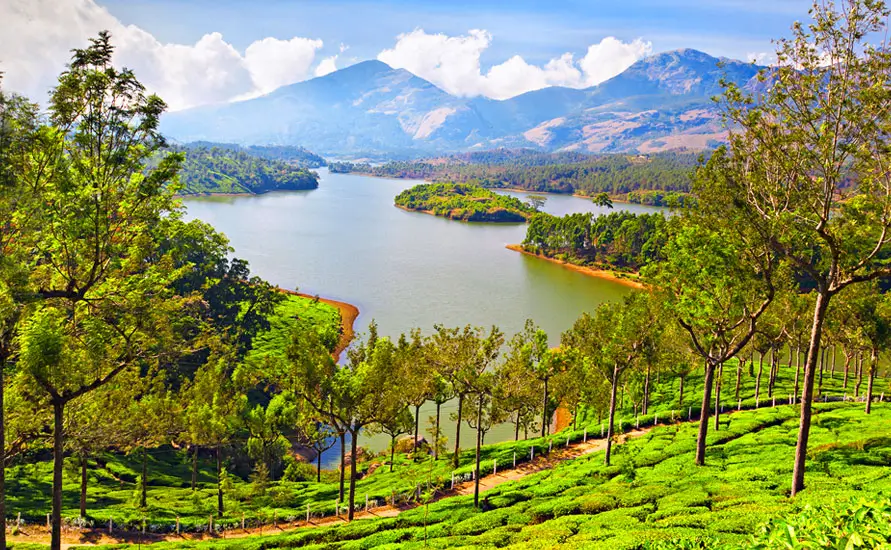
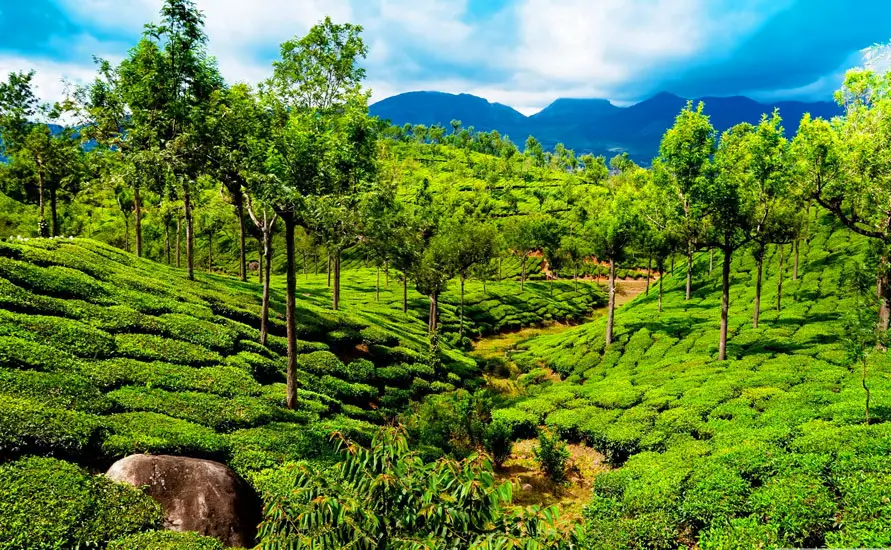
At roughly 1,600 meters above the sea, Munnar feels cooler at once, and you notice the change in air as soon as you open the car door. The hills around the town are covered with tea bushes trimmed to waist height, laid out in tight contour rows that look almost like green fingerprints from a distance. After checking in to a tea estate resort, visit the Tea Museum run by the Kanan Devan company, where old rolling machines, photographs of the British planters and a short film explain how tea came to these hills in the late 1800s. A tasting at the end shows the difference between orthodox and CTF teas.
Because there is only one night here, we keep the rest of the afternoon flexible. Options include the reservoir behind Mattupetty Dam, where pedal boats can be hired for half an hour, stop at a roadside stall for hot banana chips and spiced tea, or simply sit on your balcony and watch the clouds roll over the ridge. Evenings in Munnar can be cool from November to February, so pack a light jacket. Dinner is at the resort, and a staff member can arrange an early estate walk for the following morning. Overnight in Munnar.
Set your alarm for first light and walk between the tea rows with a naturalist or estate worker before breakfast. At this hour the pickers are just arriving with their baskets, mist fills the valleys, and you may hear the call of a Malabar whistling thrush from the shola forest patches above the estate. Back at the resort, have breakfast and check out by mid-morning. The road to Tamil Nadu leaves Munnar through the Devikulam area and climbs gently to Bodimettu, the pass on the state border, where a forest checkpost marks the point where Kerala ends.
The descent from Bodimettu is one of the most dramatic drives in South India. The road drops more than a thousand meters through a long run of hairpin bends, with cardamom grown under a canopy of old forest trees lining both sides. Halfway down, the views open over the Theni valley, and the shift in landscape is sudden: green slopes give way to coconut groves, banana fields and dry red earth. Bodinayakanur, at the foot of the ghat, has long been a trading town for cardamom, and your driver can stop so you can see sacks of the green pods stacked in small shops.
The last stretch through Theni and Usilampatti is flat and straight, and you reach Madurai in the afternoon. After a rest, make your way in the evening to the Thirumalai Nayak Palace, put up in the 1630s by the same ruler who enlarged the Meenakshi Temple. Its main courtyard is ringed by giant round pillars with stucco arches, and the hall of dance once had a roof painted with scenes from Hindu stories. The evening sound and light show in English narrates the life of the Nayak ruler, and sets the scene well for tomorrow. Overnight in Madurai.
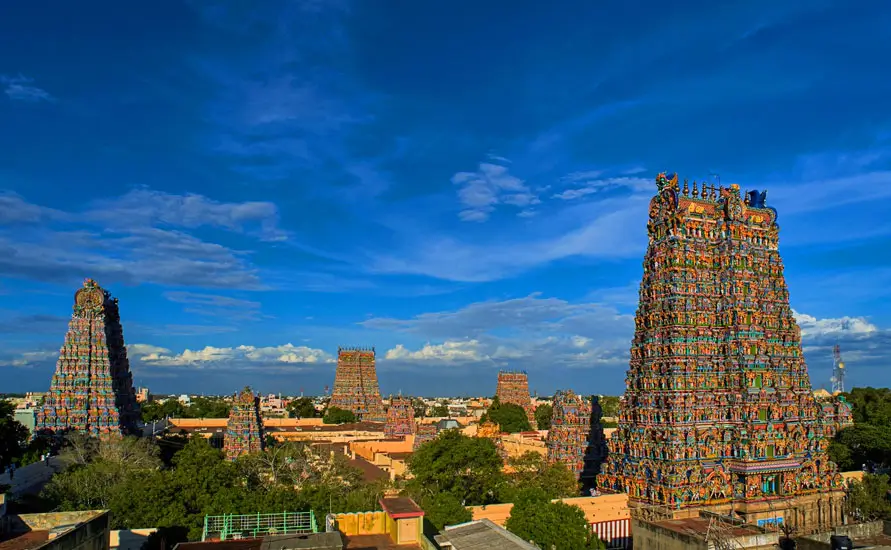
Reach the Meenakshi Temple in the first hour of the morning, when devotees are carrying jasmine garlands and offerings of coconut and the corridors still feel calm. Fourteen gopurams rise around the compound, the tallest of them on the southern side, each one covered with hundreds of painted plaster figures. Your guide leads you to the Golden Lotus Tank, linked by legend to the judging of Sangam-era Tamil poetry, and then among the carved columns of the Hall of a Thousand Pillars, today home to a modest museum of temple art. Mobiles and cameras go into safekeeping at counters near the entrance, and only Hindu worshippers may pass into the innermost shrines.
After a mid-morning break for filter coffee and soft idli with spicy podi in one of the old eateries near the West Tower, take an autorickshaw or the car east of the river to Vandiyur, where the Mariamman Teppakulam forms a vast stepped reservoir with a small shrine on an island in the middle. At the Float Festival, held around the Thai month of the Tamil calendar, decorated images of Meenakshi and Sundareswarar are floated across the water on a lit raft, and the steps around the tank fill with thousands of people. For the rest of the year it is a quiet place where local boys turn the empty basin into a cricket ground when the level drops.
The afternoon belongs to the streets around the temple. Your guide walks you through the Puthu Mandapam, a 17th-century pillared hall now filled with tailors at their sewing machines, brass vendors and bangle sellers, and then through lanes where whole rows of shops sell only steel vessels or only cloth. Try jigarthanda, the frothy, chilled local cooler sold from carts near the temple, sweet and thick enough to count as dessert. If you have energy late in the evening, go back to the temple at about nine at night for the palliyarai ceremony, when Sundareswarar is carried to Meenakshi's bedchamber. Overnight in Madurai.
Leave Madurai after a relaxed breakfast and drive north-east toward Chettinad, the home region of the Nagarathar Chettiars, a merchant and banking community whose trade once reached Burma, Ceylon, Malaya and Vietnam. On the way you stop at Pillaiyarpatti, where a rock-cut cave shrine to Ganesha, known here as Karpaga Vinayagar, has been worshipped for well over a thousand years. The image is carved straight out of the hillside, and the temple is run by the Chettiar community itself. Men are asked to remove shirts before entering parts of the inner area, and your guide will explain the custom.
You reach the village of Kanadukathan by midday, where your room is in a restored Chettiar mansion now run as a heritage hotel. Lunch is your first taste of Chettinad cuisine, served on a banana leaf with a parade of dishes that may include pepper chicken, a dry mutton fry, a sour tamarind kuzhambu, and vegetables cooked with spices such as kalpasi, a dried lichen that gives the food its earthy aroma. Spice levels are high by default, so tell the kitchen early if you prefer a gentler version. After the meal, a siesta is the sensible choice while the sun is high.
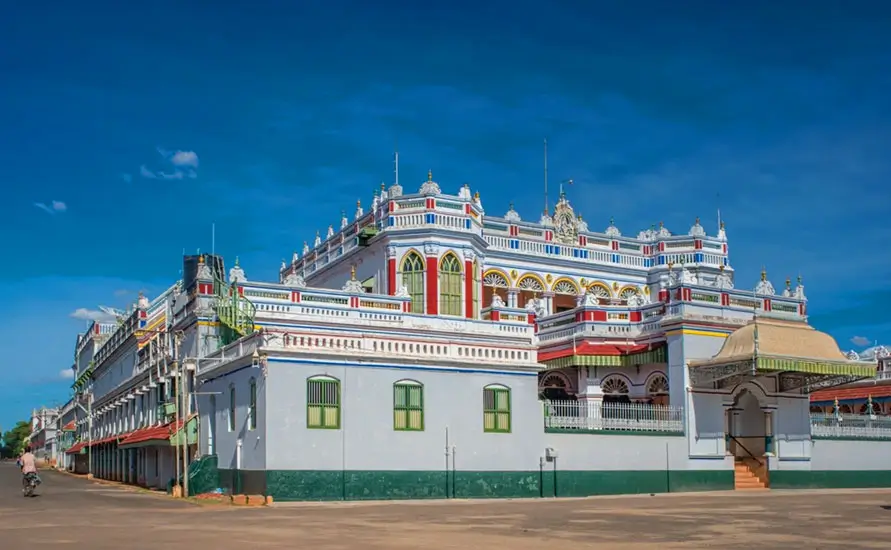
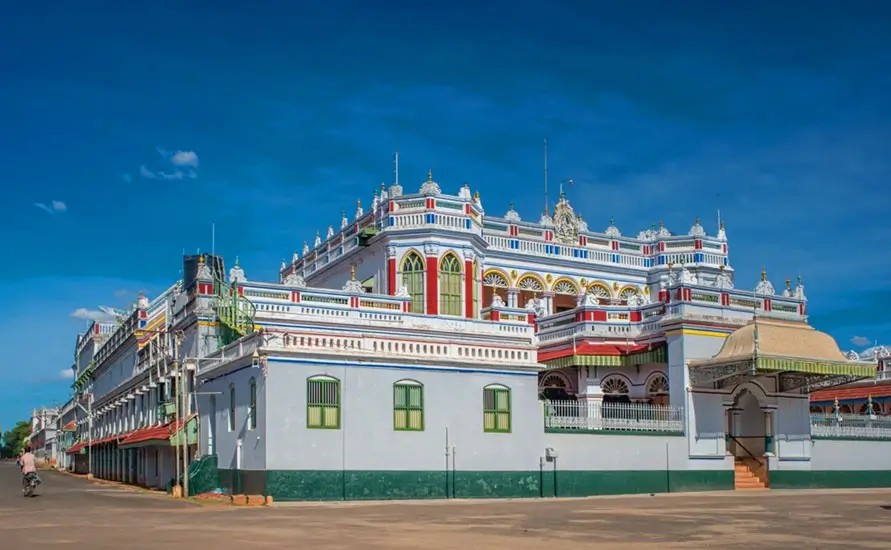
Once the heat drops, a village guide walks you through Kanadukathan, where mansions with tall wooden doors and long pillared verandas stand in silent rows, many of them locked for most of the year while their owners live in Chennai or abroad. The Chettinad Palace, completed in the early 20th century, is the best-known of them, though entry depends on the family. Your guide points out Burma teak columns, imported tiles and the open courtyards that kept these homes cool. The evening is quiet, with only temple bells and the sound of birds. Overnight in Chettinad.
Begin the morning at Athangudi, a short drive from Kanadukathan, where craftsmen still make the hand-poured floor tiles that cover so many Chettiar mansions. In a small open-air workshop you can watch a worker pour colored cement mixed with local sand into a metal pattern frame set on a glass plate, then back it with dry cement and leave it to set. The tiles are cured in water and dried in the shade rather than fired in a kiln, which is why each one has a soft, slightly uneven sheen. Small sets of tiles can be bought on the spot and shipped home by courier if you wish.
On the way out of the region, stop at one of the antique shops in Karaikudi, the main town of Chettinad, where furniture, brass lamps, enamel tiffin carriers and old wooden pillars salvaged from demolished houses are piled to the ceiling. Bargaining is expected, and your guide can point out which pieces are genuinely old and which are recent copies. You then drive north through Pudukkottai district toward Tanjore, or Thanjavur, the old Chola royal seat, reaching your hotel by early afternoon after a simple vegetarian lunch at a highway restaurant on the way.
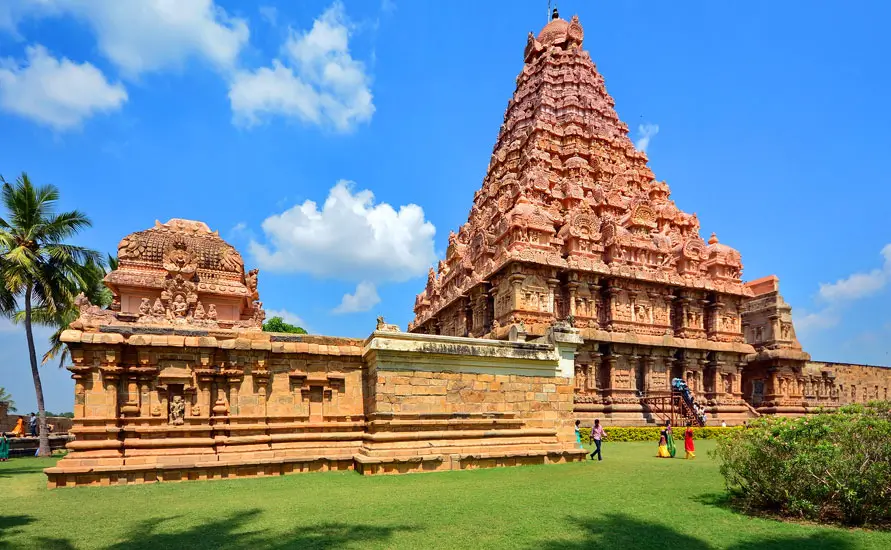
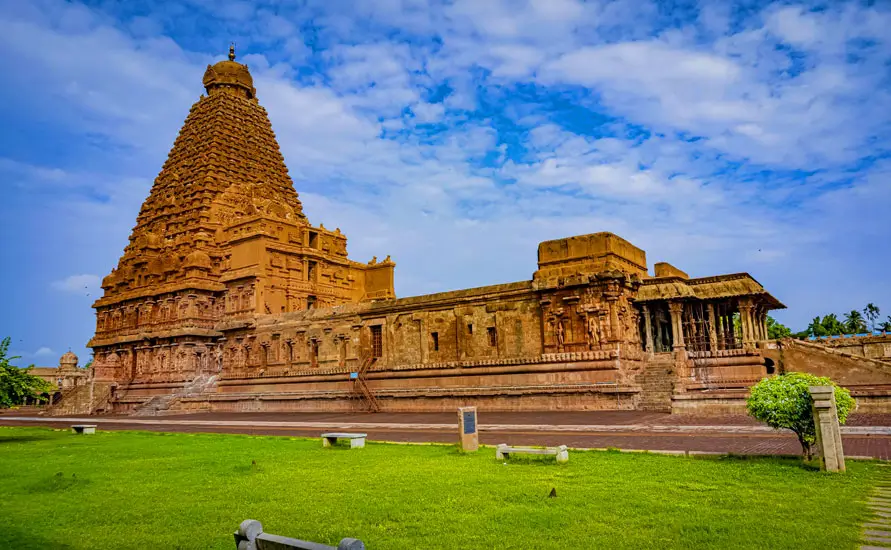
Save the Brihadeeswarar Temple for the late afternoon, when the low sun turns its granite tower a warm gold. Rajaraja I had it finished around 1010, and today it is one of the three temples that UNESCO lists together as the Great Living Chola Temples. Its vimana soars to roughly 66 meters, topped by a massive stone cupola, while the seated Nandi bull in its own pavilion was cut from one piece of rock. Your guide traces the long inscriptions on the base, which list the gifts and staff of the temple. Overnight in Tanjore.
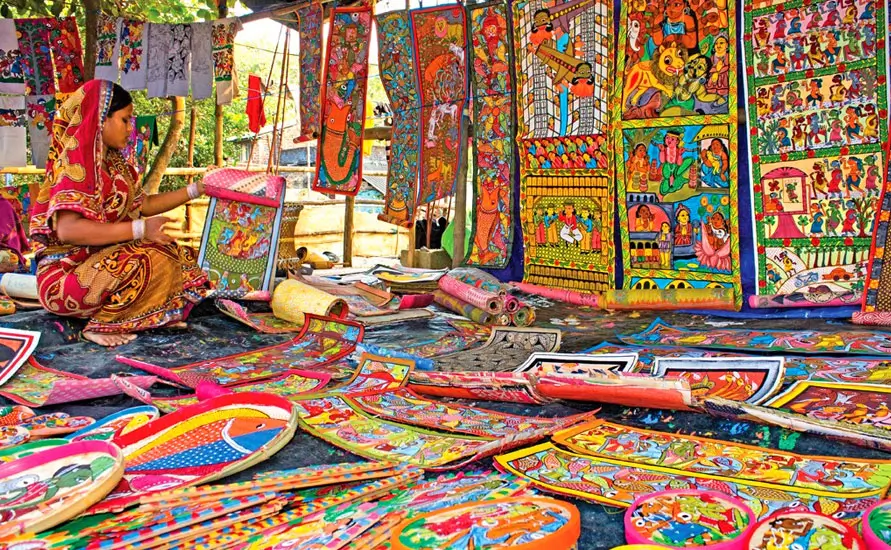
Before leaving Tanjore, spend an hour in the Thanjavur Palace, a rambling set of courtyards and halls added to over time by Nayak and then Maratha kings. Inside, the art gallery displays Chola-period bronze images of Shiva, Parvati and the saints, while the Saraswathi Mahal Library, enlarged by the scholar-king Serfoji II, guards a vast archive of palm-leaf texts, maps and old books in several Indian and European tongues. A few pages are displayed in glass cases. Close by, you can call at a small studio where artists make Tanjore paintings, building up raised details with chalk paste and covering them with thin gold foil.
About 40 km away, the Airavatesvara Temple at Darasuram is the most compact member of the UNESCO Chola trio, a 12th-century work commissioned by Rajaraja II. Its front hall is designed as a chariot drawn by horses, with stone wheels carved on the sides, and the plinth carries rows of tiny dancers and musicians, some no larger than a matchbox. Another 35 km brings you to Gangaikonda Cholapuram, the royal city Rajendra I created to celebrate his northern campaign to the Ganges. The tower here has a gentler, curved outline than Tanjore, and the surrounding village is so quiet that you may have the lawns to yourselves.
From Gangaikonda Cholapuram the road crosses the Kollidam River and heads east through sugarcane and paddy country toward the coast, about 150 minutes of driving. Your driver will suggest a break for tea and a snack at a highway stop. Arrival in Pondicherry is around late afternoon, at a heritage property close to the old town. After a long day in the car, a short evening walk along the seafront Promenade is enough, followed by dinner at one of the many restaurants serving French or Creole dishes alongside Tamil food. Overnight in Pondicherry.
Most visitors stay inside the French grid by the sea, but your guide begins on the other side of the old canal in the Tamil Quarter, where the houses have raised front platforms called thinnai and wooden columns facing the street. In the early morning, women sprinkle kolam designs in white rice powder outside each door, a daily ritual meant to welcome visitors and feed ants and birds. The walk continues to the Goubert Market, also called the Grand Bazaar, where fish, vegetables, jasmine and spices are sold under one long roof. It is noisy and crowded, and well worth an hour with a guide.
Late in the morning you cross back into the French Quarter for a short visit to the Sri Aurobindo Ashram, whose flower-strewn samadhi is surrounded by people in quiet meditation, and the Bharathi Memorial Museum, the house where the Tamil poet Subramania Bharati lived in exile from British India. Your guide tells the story of how French Pondicherry became a refuge for Indian freedom fighters in the early 20th century. Lunch is free, and the old town has everything from baguettes and quiche to fish curry with red rice, often within the same street.
In the afternoon you drive to Auroville, about 12 km north. The visitor center shows a short film about the township and its ideas, and a shaded path leads to the viewpoint for the golden Matrimandir. Going inside the chamber itself requires a reservation made ahead at the visitor center, with few places each day, so tell us early if it matters to you. Before returning, browse an Auroville craft shop for handmade paper, incense or organic cotton clothing. Later, dinner and an evening stroll by the sea wall are yours to plan. Overnight in Pondicherry.
Checkout is after breakfast, then the car turns north on the East Coast Road, running close to the Bay of Bengal past salt pans, fishing hamlets and the backwaters at Marakkanam. The road is mostly four-laned now and makes for an easy morning in the car. Your driver can stop for a fresh coconut at a beach stall or at a roadside shop selling palm-leaf baskets made by local women. The total drive is about four hours including breaks, and the plan is to reach the outskirts of Chennai by lunchtime so that you have a long afternoon at a museum along the way.
DakshinaChitra, at Muttukadu just south of the city, is an open-air heritage museum where genuine old homes from across South India were dismantled elsewhere and pieced back together here. Step inside a Chettiar trader's home, a potter's cottage, a Syrian Christian house from Kerala and a weaver's home, each furnished with its original tools and utensils. Artisans demonstrate pottery, basket weaving and glass painting on most days. Since it shuts every Tuesday, we shuffle the final days when your dates require it. Lunch at the on-site café is simple and good.
In the late afternoon you continue into Chennai and check in to your hotel. With energy to spare, an evening drive can follow the Marina and through Mylapore, where the streets near the temple tank fill with shoppers buying flowers and brass lamps after work. The state capital is also the home ground of Carnatic music and Bharatanatyam, and if your visit falls in December or January, your guide can help you find a concert during the Margazhi music season. A farewell dinner tonight is at a long-running vegetarian restaurant known for its banana-leaf meals. Overnight in Chennai.
With a flight later in the day, there is time for a last morning at the Kapaleeshwarar Temple in Mylapore, whose dawn puja is accompanied by drums and the nadaswaram, a long double-reed pipe used at Tamil temples and weddings. A quick stop at a silk shop in T. Nagar or a coffee in a traditional tiffin room is also easy to fit in. Rooms are normally vacated by noon; extra hours can be booked if you ask ahead.
Your driver takes you to Chennai International Airport about three hours before an international departure, with a margin for the city traffic. Over ten days you have crossed from the Kerala coast into the tea hills and then down into the temple country of Tamil Nadu, seeing Nayak, Chola, Chettiar and French history along the way. If you want to return for Rameswaram, Kanyakumari or the Nilgiris, just write to us and we will draw up a route. Safe travels home.
Your Journey

N.S. Rathore & Mrs. Omlata Rathore · Managing Director
We still read every enquiry ourselves. Tell us the places you liked and our planners will send a day-by-day route with drive times and a clear price.
Every package can be customised and no pressure to book. A planner from our office replies within 24 hours with a route written for your group.
Fill this in and your planner will send a first draft itinerary.
Explore more
Kerala Backwaters Escape Kerala Backwaters Escape
 Kerala Backwaters Escape
 Kerala Backwaters Escape
 Kerala Backwaters Escape
 Kerala Backwaters Escape
 Kerala Backwaters Escape
 Kerala Backwaters Escape
 Kerala Backwaters Escape