 Kerala Backwaters Escape

Tamil Nadu Tour Packages
Coimbatore – Mettupalayam – Coonoor (Nilgiri Mountain Railway) – Ooty – Valparai – Palani – Kodaikanal – Madurai
At a glance
Most visitors know the Western Ghats as Kerala's backdrop, yet some of the range's highest and wildest country lies on the Tamil Nadu side. Our Tamil Nadu hill stations and toy train tour follows that eastern flank for ten days, from the cotton city of Coimbatore up into the Nilgiris, across to the little-visited Anamalai hills around Valparai and on to the Palani range at Kodaikanal, before dropping to Madurai on the plains. Steam, tea and cloud forest set the tone, and the pace leaves room for long walks between the drives.
The trip opens with the one train ride every rail fan in India talks about: the rack-and-pinion climb of the Nilgiri Mountain Railway from Mettupalayam to Coonoor, a line UNESCO protects alongside two Himalayan hill railways. After Ooty, the route turns south to Valparai, a plantation town at roughly 1,100 meters where rainforest patches between the tea gardens shelter the endangered lion-tailed macaque. Kodaikanal brings lakeside paths, garlic terraces and pine woods, and Madurai's Meenakshi Temple gives a city finale before your flight home.
This Tamil Nadu hill stations tour package is shaped for overseas guests, from Britain and the Continent to the Americas and Australia, plus NRI families, who prefer cool air, birdsong and estate bungalows to a checklist of monuments. One driver and one cooled private car handle every road leg, while a local English-speaking guide joins you in each hill town. Two ghat drives are long, so we say so plainly and break them with stops. October to May is the most reliable season, while the monsoon months turn Valparai green, wet and leech-friendly.
Coimbatore's compact airport sits on the eastern edge of a busy industrial city that grew rich on cotton mills and pump manufacturing, which is why Indians still call it the Manchester of South India. A member of our Coimbatore team stands by the exit holding a sign with your surname, helps load the bags and introduces the driver who stays at the wheel for all ten days. Direct flights arrive here from Gulf hubs and from Singapore, as well as from Chennai, Mumbai and Delhi. Once you are settled in the car, we go over the plan for tomorrow's train, which leaves early and needs a short briefing tonight.
Heading west from the airport, a local guide brings you to the Perur Pateeswarar Temple, a Shiva shrine on the western outskirts that locals say is older than Coimbatore itself. Its pride is the Kanaka Sabha, a pillared hall added under Nayak rule, where each column is carved with life-size figures of dancing deities, a fierce Shiva as the slayer of the elephant demon, and the god Murugan on his peacock. Pujas at dawn and dusk come with the wail of the nadaswaram pipe and the thud of the tavil drum. Dress modestly, leave your shoes at the stand outside and ask before taking photographs inside the halls.
From Perur the road runs north through coconut groves and banana plantations to Mettupalayam, a market town at the foot of the Nilgiris, where the hills rise straight up from the plain like a wall. The town lives on the trade in areca nut, vegetables and timber from the slopes above, and the Bhavani River flows along its northern side. Your room tonight is in a hotel a few minutes from the railway station, so that tomorrow's early boarding is a five-minute ride rather than a predawn dash from the city. Have a simple supper in the hotel restaurant and get to bed early, since tomorrow's wake-up call comes before six. Overnight in Mettupalayam.
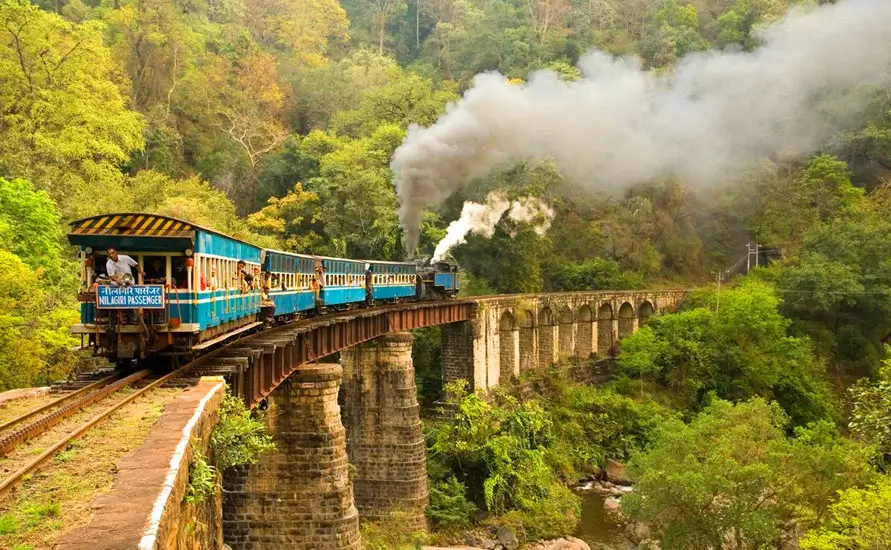
Mettupalayam station wakes up before dawn, with porters, tea sellers and families from Chennai crowding the platform beside a small blue-and-cream train. Your seats on the Nilgiri Mountain Railway are reserved in advance, because the uphill service has only a few carriages and fills weeks ahead in the busy months, while your driver takes the luggage up by road. Trains first ran up to Coonoor in 1899, the extension to Ooty followed in 1908, and UNESCO recognition came in 2005. Steam locomotives still push the train from behind on this lower stretch.
Beyond Kallar the gradient sharpens to roughly one in twelve, and a toothed rack laid between the rails engages a cog wheel under the engine, the only system of its kind still working in India. The train crawls through tunnels cut into bare rock, over trestle bridges above jungle-filled ravines and past waterfalls that run strong after the rains. At Hillgrove there is a halt long enough to stretch your legs, buy a cup of tea and watch the crew top up the locomotive's water tank. Langurs sometimes sit on the station roofs, and the air already feels several degrees cooler than the plain below.
You pull into Coonoor around late morning, after about four hours of climbing, and your driver is waiting outside with the bags. Following lunch, a guide walks you gently through Sim's Park, an 1874 garden that tumbles down a ravine, planted with tree ferns, magnolias and specimens gathered from several continents. Later hours are yours to nap or to wander Upper Coonoor, a quiet residential area of old cottages, fenced gardens and hedges of wild hydrangea, where an occasional bison grazes at the edge of town. Coonoor sits lower and gets less rain than Ooty, so evenings are mild here. Overnight in Coonoor.
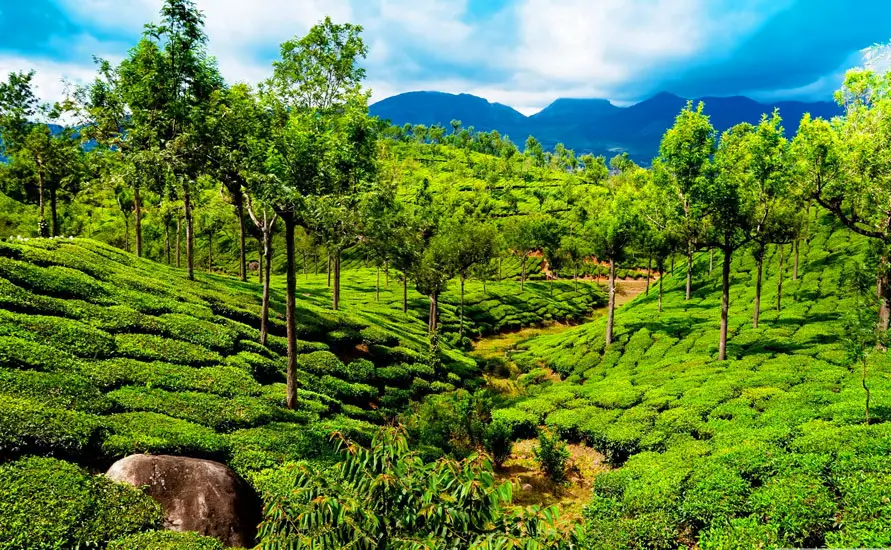
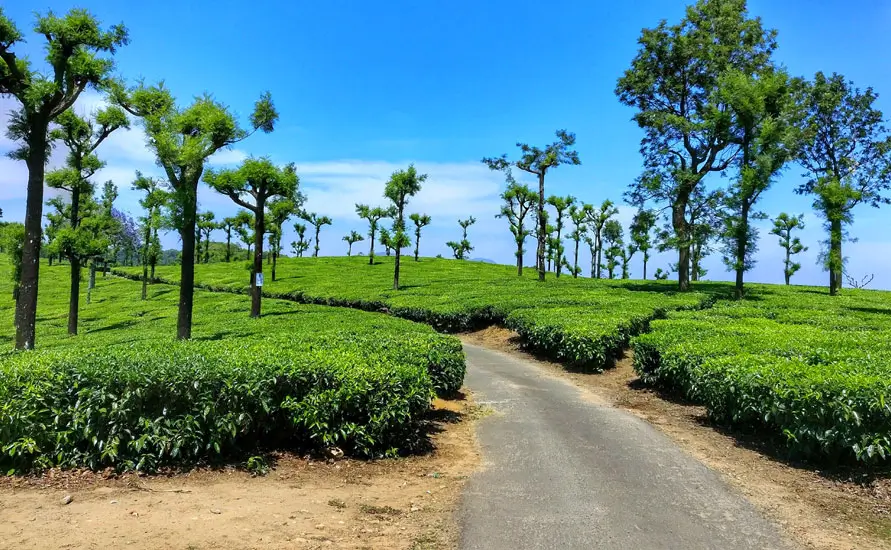
The road east of Coonoor narrows into a ribbon of tarmac between tea bushes clipped flat like hedges, with silver oak trees planted among them for shade. Your guide begins at Lamb's Rock, a cliff edge looking straight down over the Coimbatore plains, where on a clear morning you can trace the line of the railway you rode yesterday. Further on lies Dolphin's Nose, a narrow rocky promontory facing the deep Catherine Falls valley, with the falls themselves visible as a white thread on the far side. Mornings are usually the clearest, so we set off soon after breakfast, before cloud fills the gorges.
Heading back toward town, a working tea factory shows how green Nilgiri leaf becomes the bright, fragrant brew shipped worldwide. Freshly plucked leaf is withered on long troughs, rolled, left to oxidize and then fired, and in most Nilgiri factories the crush-tear-curl method produces the small granules used in tea bags. The frost-season teas made here between December and February are prized for their brisk flavor. A short tasting follows, and you can buy packets directly from the factory counter. Your guide also explains the tea-picking day for the women who work these slopes, many from families settled here for generations.
In the afternoon your driver takes the short hill road through Wellington, home to India's Defence Services Staff College and an army cantonment, and on up to Ooty, which locals call Udhagamandalam. The climb is gentle and takes under an hour, past eucalyptus woods and terraced fields of carrots, cabbages and potatoes. You check in to a hotel with a fireplace and a garden, since nights at more than 2,200 meters can drop close to freezing in winter. Evening is for Charing Cross, Ooty's shopping crossroads, with counters of fudge-like hill chocolate, little bottles of eucalyptus oil and piles of wool shawls. Overnight in Ooty.
Long before the British built their summer capital here, the Nilgiri plateau belonged to the Toda people, buffalo herders whose lives still center on their animals and their small settlements, called munds. With your guide and by prior arrangement, you visit a Toda hamlet on the edge of town to see the half-barrel-shaped huts with tiny doorways and the separate temple hut used only by men. Toda women are known for pukhoor, a red-and-black embroidery stitched by hand on white cloth, and you may be able to buy a shawl straight from the person who made it. Be respectful with cameras and ask first.
Next is the Government Botanical Garden, laid out from 1848 across terraced slopes below Doddabetta, Ooty's highest peak. Rather than rushing round, follow your guide to the lower lawn with its cork oak and the giant monkey puzzle tree, then up through the glasshouse, where orchids and ferns grow under glass, toward a small Toda-style hut built inside the garden. A twenty-million-year-old fossil tree trunk lies near the entrance. The garden is at its fullest in May, when the annual flower show draws big crowds from the plains, but it is pleasant and much quieter between October and March.
After lunch, a short drive leads to Stone House, the first stone building on the plateau, built in the 1820s for John Sullivan, the Collector of Coimbatore who founded the hill station. A government college occupies it today, so you view it from outside while your guide recounts how Sullivan blocked a stream in 1824 and so created Ooty Lake. Toward sunset you may hire a pony, row out on the lake or follow a footpath into the pines above town. Pack layers for tonight, because the air chills quickly as soon as the sun drops. Overnight in Ooty.
This is the longest drive in the trip, and there is no shortcut, because no road crosses the forest directly between the Nilgiris and the Anamalais. After an early breakfast your driver descends the Coonoor ghat to Mettupalayam, skirts Coimbatore and heads south through the coconut belt around Pollachi, one of India's biggest markets for tender coconuts and jaggery. A tea break and lunch are planned along the way, and the driver will stop whenever you need. Fields of maize, banana and sugarcane line the road, and the Anamalai range rises steadily ahead, usually under a lid of cloud by the afternoon.
Below the hills lies Aliyar Reservoir, a large dam lake with the Anamalai peaks reflected in it on calm days. From here begins the climb to Valparai, a road of forty numbered hairpin bends that gains well over a thousand meters in about 25 km. Near bend nine a lookout faces back over the water, and higher up the Nilgiri tahr, a wild mountain goat endemic to the southern Ghats, sometimes grazes on the rocky verges. Drive slowly, because elephants occasionally cross the road here, and our drivers are used to waiting patiently until they move on.
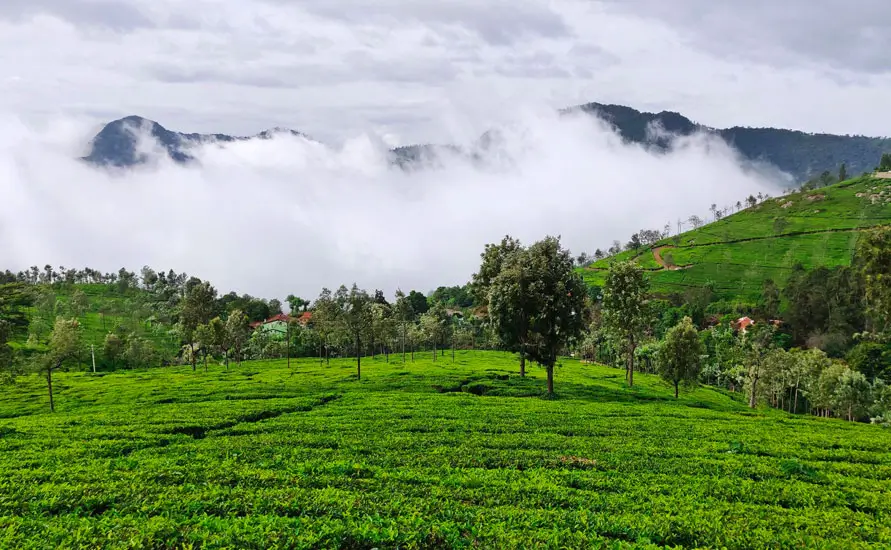
At the top, the forest gives way to rolling tea estates that run in every direction, broken by streams and dark patches of native trees. Valparai itself is a small town with a market, a few churches, temples and mosques, and it serves dozens of surrounding estates, many of them started by British planters around the start of the twentieth century. You check in to an estate bungalow or a quiet plantation stay, where dinner is home cooked and the evening sounds are crickets, frogs and wind in the silver oaks. Mobile coverage can be patchy up here. Overnight in Valparai.
Few spots anywhere give you as good a chance as Valparai of watching the lion-tailed macaque, a dark primate framed by a grey ruff of hair, with a tasseled tail, found nowhere outside these mountains and reduced to a few thousand animals. A local naturalist joins you after breakfast and heads to Puthuthottam, a strip of rainforest beside the road where a troop is often seen feeding in the fig and jack trees. Conservation groups have built rope canopy bridges here so the monkeys can cross the road safely. Keep your distance, never offer food and keep voices low when they come close.
The same forests hold the Nilgiri langur, with its glossy black coat and pale head, the Malabar giant squirrel in shades of maroon and cream, and the great hornbill, whose wingbeats you hear before you see the bird. Your naturalist explains how Valparai's estates, long seen only as tea gardens, now form part of a working landscape where wildlife moves between protected forest and plantations. You then walk a quiet estate trail, stopping at a stream and at a small shrine where workers leave flowers in the morning. Leeches are common in the wet months, so leech socks are handed out when needed.
After lunch your driver heads for Nallamudi Viewpoint, reached by a short walk through tea, where the ground falls away into the deep forested valleys of the Anamalai Tiger Reserve and the Kerala border. On some days the valleys fill with cloud below you while the peaks stay clear. Returning, there is time for the Sholayar Dam, a sizeable reservoir in this range, and at a view over the Chinnakallar area, which ranks among the wettest places in South India. Back at the bungalow, a fire and an early dinner end a long outdoor day. Overnight in Valparai.
Another full road day links two ranges that look close on a map but are separated by the plains. You drive back down the forty hairpins in the cool of the morning, often with mist still sitting on Aliyar Reservoir, then turn east through Pollachi and Udumalpet. Windmills stand in long rows along the ridges near Udumalpet, catching the wind that blows through the Palghat Gap between the Nilgiris and the Anamalais. The roads are good and mostly flat on this middle stretch, and your driver plans a breakfast or coffee stop at a local restaurant serving dosa and filter coffee.
Around midday you reach Palani, a pilgrim town crowned by a hilltop shrine to Lord Murugan, counted among the six sacred Arupadai Veedu of the Tamil god. Pilgrims climb several hundred steps, many with heads freshly shorn, while others take the old winch line or the cable car up. The deity is said to be made of a compound of medicinal herbs, and the temple's sweet panchamirtham, made from banana, jaggery and ghee, is famous. Access rules for non-Hindu visitors can change, so your guide confirms on the day how far you may go, and the town below is lively in any case.
From Palani the ghat road climbs about 65 km into the Palani Hills, passing small coffee and pepper farms before the tree line changes to eucalyptus and pine. The air cools quickly, and you may see Indian gaur, a large wild bison, grazing at the roadside near the top. By late afternoon Kodaikanal appears, and your hotel sits either by the lake or on a ridge looking down on it. Take it easy this evening, because the town sits at more than 2,000 meters, the thin air tires newcomers, and after two long drives you will be glad of a quiet dinner by the heater. Overnight in Kodaikanal.
American missionaries founded Kodaikanal in the 1840s as a cool retreat from the plains around Madurai, and the town still has an international school, old churches and a slightly bohemian feel. Your guide starts the day away from town, driving about 20 km west to Poombarai, a village of terraced fields stepping down the hillside toward an old Murugan temple. The farmers here grow a hill garlic with a strong flavor, known as Kodaikanal malai poondu, which has its own geographical indication tag. Walk the paths between the terraces, watch the farming families at work and enjoy views across the valley.
Returning, you pause among the tall, straight trunks of the pine forest, set out by a forest officer early in the last century, and at Pillar Rocks, three granite columns rising over 100 meters from the forest, often half hidden by passing cloud. Back in town, you stroll Coaker's Walk, a railed path along the drop, named after the British engineer who marked it out in 1872, and look south to the plains around Periyakulam when skies are clear. Rare weather sometimes produces a rainbow circle around your own shadow in the mist below, a sight locals call the Brocken spectre.
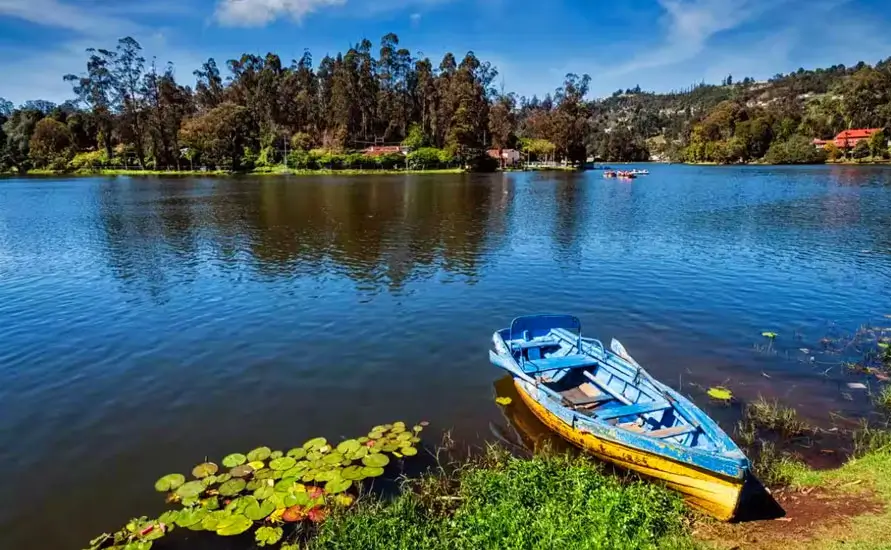
Leave the last hours of daylight for Kodai Lake, dammed in 1863 by a British collector named Levinge; its five-kilometer shoreline road suits a walk, a hired bicycle or a pony. Rowboats and pedal boats can be hired at the boat club jetties. Market stalls offer plums, pears and local cheese, and the town's bakeries turn out dense fruit cake that travels well. If your timing works, a small concert or church service in one of the old churches is a pleasant way to see the town's community life. Overnight in Kodaikanal.
The descent from Kodaikanal is a beautiful drive in its own right, down a winding road through shola forest, past Silver Cascade, a waterfall that pours over a rock face beside the road, and into the warm plains near Batlagundu. Within an hour the pine trees give way to coconut palms, rice fields and the bright stalls of roadside villages selling mangoes, jackfruit and tender coconuts. Your driver times the drive so that you reach Madurai by lunchtime, giving you a few hours at the hotel to rest before the evening visit. The heat on the plains is a sharp change after the hills.
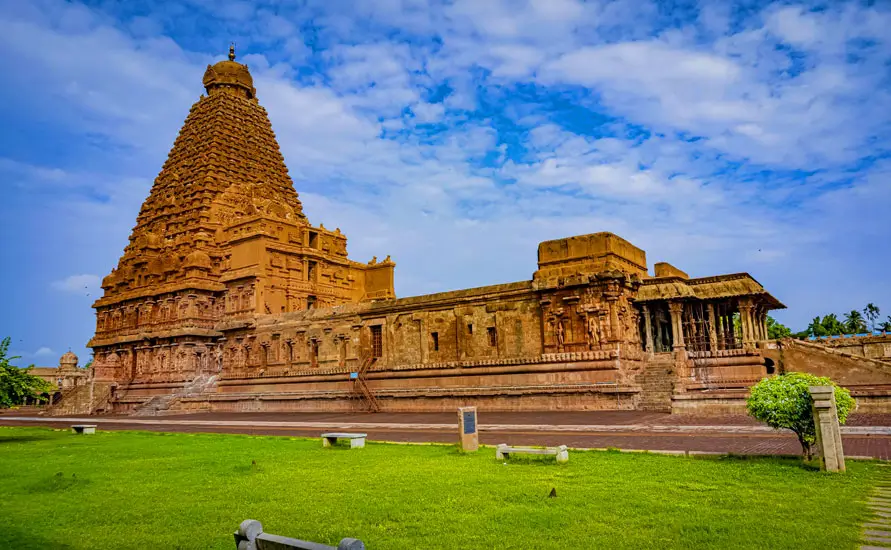
Around five, a local guide walks you to the Meenakshi Temple, a sacred precinct of some six hectares built for Meenakshi, whose name means the one with fish-shaped eyes, and for Sundareswarar, the form Shiva took to marry her. Fourteen gopurams teem with painted stucco gods and demons, and the southern one climbs to roughly 50 meters. Leave phones and cameras at the deposit counter by the gate; entry to the two inner sanctums is for Hindus only, though the long corridors, the sacred tank of golden lotuses and the carved mandapams stay open to everyone. Ask your guide to tap the musical pillars, each giving off its own note.
As darkness falls the temple grows busier, with families arriving after work, priests carrying flame lamps and the scent of jasmine and camphor filling the halls. Stay on if you can for the palliyarai ritual near 9 pm, when priests bear Shiva's small silver feet in a curtained litter to the goddess's chamber, the procession led by pipes and drums. Supper could be kari dosai, the local dosa layered with egg and spiced minced mutton, followed by jigarthanda, a chilled drink of milk, almond gum and sarsaparilla syrup that Madurai claims as its own. Street stalls around the temple's east gate stay open late, so the walk back to your car is part of the evening. Overnight in Madurai.
If your flight leaves after midday, an early visit to the Mattuthavani flower market is a lively last look at Tamil Nadu. Well before seven the lorries back in with sacks of jasmine buds, marigold and tuberose, prices shift by the minute as auctioneers shout bids, and garland makers knot strings so fast their fingers blur, supplying shrines, weddings and hair buns all over town. Madurai jasmine, called Madurai malli, carries its own geographical indication tag. After breakfast and a little time to pack, check out from the hotel at the standard time.
Madurai Airport lies around thirty minutes south of the center by car, and its domestic flights to the big metros, plus a few direct services to the Gulf and Southeast Asia, make onward links home simple to book. In ten days you have ridden a rack railway, met Toda herders, watched lion-tailed macaques in the Anamalais and walked along the cliffs of Kodaikanal before ending in a great temple city. Chettinad mansions and the Chola temples are waiting whenever you plan a return, and we would happily map that route.
Your Journey

N.S. Rathore & Mrs. Omlata Rathore · Managing Director
We still read every enquiry ourselves. Tell us the places you liked and our planners will send a day-by-day route with drive times and a clear price.
Every package can be customised and no pressure to book. A planner from our office replies within 24 hours with a route written for your group.
Fill this in and your planner will send a first draft itinerary.
Explore more
Kerala Backwaters Escape Kerala Backwaters Escape
 Kerala Backwaters Escape
 Kerala Backwaters Escape
 Kerala Backwaters Escape
 Kerala Backwaters Escape
 Kerala Backwaters Escape
 Kerala Backwaters Escape
 Kerala Backwaters Escape