 Kerala Backwaters Escape

Tamil Nadu Tour Packages
Chennai – Mahabalipuram – Pondicherry – Chidambaram – Tanjore – Trichy – Srirangam – Madurai
At a glance
Walk into a big Tamil temple for the first time and a lot happens at once: bells, drums, a priest waving a camphor flame, families queuing with coconuts and jasmine, a tower of painted figures rising over your head. Our Tamil Nadu temple tour is built to make sense of that scene. Over eight days a specialist guide in each town explains how a living temple actually runs, from the dawn waking ritual of the deity to the night procession that puts the god to bed, so that by Madurai you can read a temple on your own.
The route follows the story of temple building in roughly the order it happened. The Pallava rock carvings of Mahabalipuram show the first experiments in stone, the Chola masterpiece of Brihadeeswarar Temple in Tanjore shows the form at full confidence, and the huge walled complexes of Srirangam and the Meenakshi Temple show what later dynasties added: towering gopurams, pillared halls and whole streets laid out around the shrine. Along the way you also stop at Chidambaram, home of the dancing Shiva, and the Rock Fort temple high above Trichy.
This Tamil Nadu temple tour package suits first-time visitors to South India who want depth without a long trip. Drives stay mostly between one and four hours, one longer day is broken by the Chidambaram stop, and you sleep two nights in Madurai at the end. Everything is private: car, English-speaking driver, guides and hotels, so the order of visits can shift to catch a festival or avoid a closing hour. Modest clothing and bare feet are part of every visit, and we brief you on both before Day 1 is over.
Past immigration and the baggage belts at Chennai International Airport, our staff member stands with a card bearing your name; bags go straight into a private air-conditioned car and the hotel is usually under an hour off. Long-haul flights from Europe, North America and the Gulf tend to land around midnight or before dawn, so the morning is kept clear for rest. At the hotel desk our representative runs through the eight-day plan, gives you the phone numbers for your driver and our office, and covers the one rule that applies at nearly every stop: arms to the shoulder and legs to the knee stay covered, and footwear is left behind at the temple gate.
Around 4:30 pm your guide collects you for Mylapore, the old Brahmin quarter of Chennai and a good classroom for a first temple lesson. Outside the Kapaleeshwarar Temple you watch how a visit begins: worshippers buy a small basket of flowers, bananas, a coconut and a camphor tablet from the stalls, then wash their feet at a tap before crossing the threshold. Inside, your guide explains the basic layout found in almost every Shiva temple in Tamil Nadu, from the tall flagstaff and the seated Nandi bull that always faces the sanctum, to the clockwise path worshippers follow around the inner shrines.
Timing is set so you are inside for the evening deeparadhana, when priests wave multi-tiered brass lamps in front of the deity while bells ring and the crowd raises its hands in greeting. Your guide explains why the ritual is a form of seeing and being seen by the god, called darshan, and what the ash and red kumkum powder handed out afterwards mean. Non-Hindus are welcome in most parts of this temple, though the innermost sanctum may be restricted, and photography of the main deities is not allowed. Afterwards a walk around the large temple tank leads you to a small café for a first tumbler of filter coffee. Overnight in Chennai.
Start early at the Parthasarathy Temple in Triplicane, a Vishnu shrine whose origins go back to the Pallava period in the 8th century, which makes it one of the oldest working temples in the city. The presiding image is Krishna as Parthasarathy, driver of Arjuna's war chariot, and devotees point out the marks on his face, believed to be wounds from Mahabharata arrows. Morning is a good time to see the temple at its most ordinary: elderly residents doing their daily round of the shrines, a priest tying fresh tulsi garlands onto the images, and schoolchildren in uniform pausing for a quick blessing before class. Vishnu temples hand out holy water and a silver crown touched to the head instead of ash. Your guide uses the visit to explain the differences between Shiva and Vishnu temples, from the forehead marks of devotees to the shape of the offerings.
Bharati, the nationalist Tamil poet, lived his final years in Triplicane, and his home on one of these lanes is now a small memorial; around it stand tall old houses of priestly families with carved wooden doors and raised front verandas called thinnai, used by residents for gossip once the heat drops. After a short stop for breakfast items like crisp vada and coconut chutney, you join the East Coast Road and head south past the long beaches and fishing hamlets below Chennai. Allow roughly ninety minutes to Mahabalipuram; you check in to a seaside hotel before lunch and keep the midday hours, when stone and sand get very hot, for a rest.
In the late afternoon your guide starts the architecture story at the Pancha Rathas, five shrines each cut from a single outcrop of granite in the 7th century. Their real value for this trip is that they look like stone copies of wooden and thatched buildings, and each one tests a different roof shape that later builders would use across South India, including the pyramidal tower that became the vimana over every sanctum. Near the Dharmaraja Ratha your guide points out the first appearance of features you will see again in Tanjore and Madurai, such as pilaster columns, lion brackets and miniature roof pavilions. Overnight in Mahabalipuram.
Be at the Shore Temple for first light, when the low sun turns its two 8th-century granite towers gold against the sea; it ranks among the first temples in Tamil Nadu built up from separate stones. Yesterday's rathas were sculpted out of living rock, whereas these towers were stacked block by block, and your guide shows why that shift freed later kings to build as high and as wide as they liked. The UNESCO-listed group of monuments also includes Arjuna's Penance, a vast relief on two boulders, and the Mahishasuramardini cave, where a panel shows the goddess Durga riding her lion into battle with the buffalo demon. These scenes come from the same stories that are still told during festivals in temples today.
Mid-morning is for a sculptors' yard in town, where carvers chip granite deities by hand following rules laid down in the Shilpa Shastras, the traditional craft texts. A carver can show you how the proportions of an image are measured in finger widths and face lengths, and why a temple statue only becomes a deity after a consecration ceremony. Mahabalipuram supplies new images to temples all over India and abroad, and your guide explains how a damaged or worn statue is retired and replaced through formal ritual rather than simply thrown away.
Then you follow the coast road south, stopping once for chai, and pull into Pondicherry after about 150 minutes. Late afternoon brings a visit to the Manakula Vinayagar Temple, devoted to elephant-headed Ganesha and older than the French grid of streets around it; local lore says colonial officials tried more than once to shift it, without success. Because Ganesha removes obstacles and opens every new venture, Hindus greet him before any other god, and here you can see worshippers smash a coconut on a stone block, a gesture that stands for breaking the ego. The walls inside are covered with painted stories of Ganesha's life. Later, the seafront Promenade makes a pleasant stroll before dinner. Overnight in Pondicherry.
An early departure gets you to Chidambaram by mid-morning, about an hour and a half down the road. The Chidambaram Nataraja Temple is one of the most important Shiva temples in South India, and it differs from almost every other one you will see. Here Shiva is worshipped mainly as Nataraja, the lord of the cosmic dance, in a hall roofed with gold tiles, and the temple represents space or ether among the five elemental Shiva shrines of the south. Rituals are carried out not by government-appointed priests but by a hereditary community called the Dikshitars, who wear their hair in a distinctive side knot.
Your guide explains the famous Chidambaram secret, a curtained space beside the Nataraja image that devotees believe holds an empty presence, standing for the formless side of the divine. Look up inside the eastern gateway: its passage shows all 108 karanas, the dance positions described in the Natya Shastra, each in a small carved panel that Bharatanatyam teachers still use as a reference. Every year around Maha Shivaratri, usually in February or March, dancers from across India perform here at the Natyanjali festival. Inside the same complex stands a shrine to Vishnu as Govindaraja, a sign of how Shiva and Vishnu worship often share space in Tamil Nadu.
After lunch you continue west through the green Kaveri delta, a region of rice paddies, coconut groves and small temple towns so dense that locals joke you cannot walk a kilometer without passing a gopuram. The drive to Tanjore, also known as Thanjavur, takes about three hours via Kumbakonam, with a tea stop on the way. Check-in is around 5 pm, and after this longer stretch of driving most guests are happy to stay in for a quiet dinner. Guests still awake after dinner sometimes ask for a short drive past the big temple's floodlit ramparts, which takes ten minutes. Overnight in Tanjore.
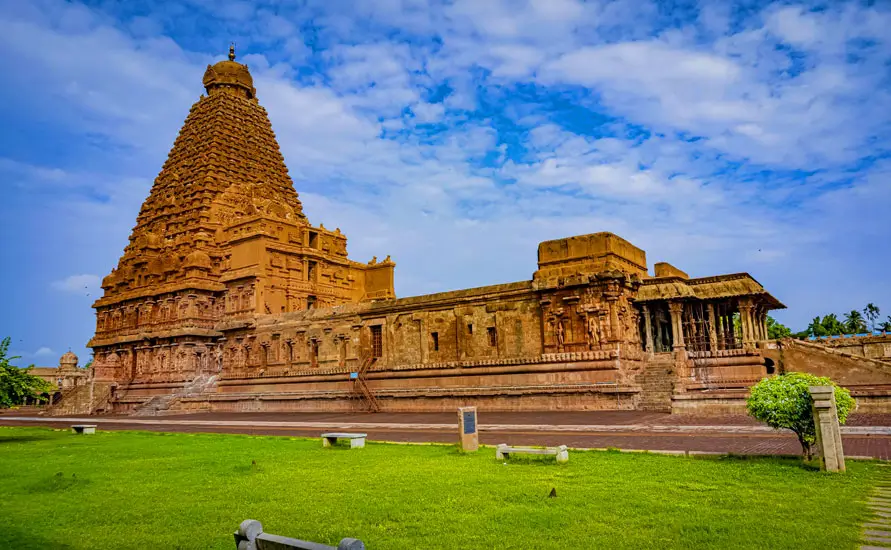
Rajaraja I, the greatest of the Chola emperors, saw his Brihadeeswarar Temple finished around 1010, and few buildings in India have matched its scale since. UNESCO groups it with Gangaikonda Cholapuram and Darasuram as the Great Living Chola Temples, and priests still perform puja here several times a day. Your guide explains the turning point you can see here: the vimana over the sanctum soars to about 66 meters, while the entrance towers are much lower. In later centuries that balance flipped, and by the time you reach Srirangam and Madurai the outer gopurams will dwarf the shrine itself. A huge monolithic Nandi sits in its own pavilion facing the sanctum.
Stone inscriptions running around the base of the main shrine record the temple's staff and budget in great detail, listing dancers, musicians, lamp lighters, accountants and the villages that paid grain to support them. Your guide reads out parts of these records to show that a Chola temple worked like a small city, with its own land, treasury and payroll. The grounds are paved in granite that heats up quickly, so we plan the visit for early morning and suggest light socks. Before leaving Tanjore you stop at a workshop where artists make traditional Tanjore paintings with gold foil and raised gesso, a style first created for temple and palace walls.
Lunch is followed by a ninety-minute road trip to Trichy (Tiruchirappalli), a river city on the Kaveri. After check-in and a rest, head out around 4:30 pm for the Rock Fort, an ancient outcrop rising above the old bazaar. A covered stairway cut into the rock climbs past a rock-cut Pallava cave shrine to the Thayumanavar Shiva temple, and then on to the small Ucchi Pillayar shrine of Ganesha at the summit. The full climb is about 400 steps and is done barefoot, so take it slowly. Up there the whole plain opens out, with the Kaveri below and Srirangam's towers lined up across the water. Overnight in Trichy.
Ringed by the Kaveri and its sister channel the Kollidam, the island of Srirangam holds what many call the biggest working Hindu temple on earth. At its core lies Vishnu as Ranganatha, stretched out on the coils of the cosmic snake, and around him the Ranganathaswamy Temple spreads through seven nested enclosures and 21 gopurams; the southern Rajagopuram tops 70 meters. The outer rings contain ordinary streets with houses, shops and restaurants, and only the inner rings are strictly sacred space. Your guide uses this layout to explain the idea of a temple town, where the sacred center shapes daily life for thousands of residents.
Highlights inside include the Sesharaya mandapa, where stone horses rear up on their hind legs carrying armed riders, and a vast pillared hall used during festivals. Your guide explains the temple calendar, which revolves around festivals such as Vaikunta Ekadasi, usually in December or January, when crowds line up to pass through a special gate believed to open the way to Vishnu's heaven. Non-Hindus can visit most of the complex but not the innermost sanctum. A ticketed rooftop viewpoint, when open, gives a good look across the many gopurams. On the way out you stop at the nearby Jambukeswarar Temple at Thiruvanaikaval, the water shrine among the five elemental Shiva temples.
After lunch you drive south for about three hours to Madurai, the oldest continuously inhabited city in Tamil Nadu and the setting for much of early Tamil literature. After a rest, head to the Meenakshi Temple by 8:30 pm for palliyarai, the nightly bedtime rite around 9 pm: a small festival image of Sundareswarar, Shiva's local form, rides a silver palanquin to his consort's chamber, led by nadaswaram players and a thavil drummer. Phones and cameras have to be checked in at the counters by the gates; the two inner sanctums are for Hindus only, yet anyone may stand along the corridor where the palanquin passes. Overnight in Madurai.
Return to the Meenakshi Temple in the morning to see it in daylight with your guide. The complex is famous for its 14 gopurams, covered with thousands of brightly painted stucco figures that are repainted and reconsecrated in a ceremony held roughly every twelve years. Your guide explains why the goddess Meenakshi, not Shiva, is the main focus here, and tells the story of her marriage to Shiva, which the city restages each spring in the Tamil month of Chithirai, when temple cars are pulled through the streets by thousands of devotees. Your guide stops at the Golden Lotus tank, linked in legend to the Tamil Sangam academies of poets.
In the Aayiram Kaal Mandapam, the thousand-pillared hall that now doubles as a temple museum, no two columns show the same sculpted figure, and a set of granite columns close by produce distinct tones if struck. Around the outer corridors, stalls sell bangles, brass lamps and religious pictures, and your guide explains how temple income from shops, donations and land still supports priests, musicians and the daily food offerings. By late morning you reach the Thirumalai Nayak Palace, completed in the 1630s by King Thirumalai, also a major patron of the temple; its giant round columns and stucco domes show Dravidian and Indo-Islamic ideas side by side.
Around 4 pm you walk through the Mattuthavani flower market with your guide, where traders weigh jasmine buds and marigold heads on hanging scales for garland makers. Madurai malli, the local jasmine, carries its own geographical indication tag, and seeing it threaded into strands answers the question of where every temple garland of the week began. Those still keen can add the Gandhi Memorial Museum, whose 17th-century building was once Queen Mangammal's residence; on display is the blood-marked garment from the moment he was shot in Delhi in January 1948. In the evening, a farewell dinner with a full banana-leaf meal is a good way to round off the trip. Overnight in Madurai.
Madurai Airport lies around half an hour south of the old city, and your driver collects you from the hotel at a time fixed the evening before. Overseas guests usually fly on via Chennai, Bengaluru, Colombo, Dubai or Singapore, so we leave two hours before a domestic departure and three ahead of an international one. With a late flight, spend the spare morning at a small local shrine for one last puja, or browse Sungudi cotton saris near the old market.
Over eight days you have watched Tamil temple worship grow from the Pallava rock carvings of Mahabalipuram, through the Chola ambition of Tanjore and the dance hall of Chidambaram, to the crowded walled temple cities of Srirangam and Madurai, and you now know what the bells, lamps and ash actually mean. Rameswaram, Kanchipuram and the mansion villages of Chettinad make a good second chapter, and we are happy to put that trip together whenever you wish. Safe travels home.
Your Journey

N.S. Rathore & Mrs. Omlata Rathore · Managing Director
We still read every enquiry ourselves. Tell us the places you liked and our planners will send a day-by-day route with drive times and a clear price.
Every package can be customised and no pressure to book. A planner from our office replies within 24 hours with a route written for your group.
Fill this in and your planner will send a first draft itinerary.
Explore more
Kerala Backwaters Escape Kerala Backwaters Escape Kerala Backwaters Escape Kerala Backwaters Escape