 Kerala Backwaters Escape

Tamil Nadu Tour Packages
Chennai – Kanchipuram – Uttaramerur – Mahabalipuram – Pondicherry – Chidambaram – Gangaikonda Cholapuram – Kumbakonam – Darasuram – Tanjore – Trichy – Kodumbalur – Madurai
At a glance
For about four centuries, a family of kings from the Kaveri delta ruled much of South India, shipped soldiers by sea as far as Sumatra and the Malay coast and left behind granite temples that still hold daily worship. Our Great Chola Temples tour follows that story in order, from the Pallava shrines that came before the Cholas, through the rise of Rajaraja I and his son Rajendra, to the later kings who built smaller but more finely carved temples. On this Tamil Nadu heritage tour you read the inscriptions, look closely at the bronzes and learn who paid for what, and why.
The heart of the trip is a trio of shrines that UNESCO lists together: the Brihadeeswarar Temple in Thanjavur, the temple of Gangaikonda Cholapuram and the Airavatesvara Temple at Darasuram. Around them, the route adds sites many tours skip, such as the village assembly inscriptions of Uttaramerur, the early Chola Nageswaran Temple in Kumbakonam and the twin shrines of Kodumbalur. Guides with a strong background in history and temple architecture lead each visit, and the pace allows unhurried mornings at the most important places.
Drives are short, between one and four hours, and you stay two nights in Mahabalipuram, Kumbakonam and Thanjavur. The tour ends in Madurai, the old Pandya capital that fought the Cholas for centuries, with departure from Madurai Airport. The Chola temples of Tamil Nadu are active places of worship, so expect to remove shoes and dress modestly. Everything is private, and we can match your dates to festivals such as Rajaraja's birthday celebrations in Thanjavur, usually held in the Tamil month of Aippasi (October or November).
Your tour starts at Chennai International Airport, where a company representative greets you outside the terminal and rides with you to the hotel. Because overseas arrivals into Chennai cluster in the hours after midnight, nothing is booked before lunch, and the hotel can usually serve a late breakfast if you sleep in. At a short briefing in the hotel lobby, your representative gives you the printed itinerary, a simple timeline of the Chola kings to keep in your day bag, and practical tips on temple dress, footwear and handling cash in small towns along the route.
In the afternoon, a historian-guide leads you into Egmore's Government Museum, open since the 1850s, whose hall of Chola bronzes ranks with the best anywhere. These figures were cast between roughly the 10th and 13th centuries for temple processions, and many were found buried in temple grounds, where priests had hidden them during periods of war. Your guide shows you how to read a bronze: the base holes where poles were slotted for carrying, the flame arch around the dancing Shiva, and the fine finish of Parvati's hands. The museum is generally closed on Fridays, which we plan around.
The museum also displays stone sculpture from the Pallava and Chola periods and a section on coins and copper-plate grants, the land deeds that Chola kings issued and engraved in Tamil and Sanskrit. Looking at these is a good preparation for the inscriptions you will see on temple walls in the coming days. On the way back, your guide may stop briefly at Fort St. George, the walled English trading post completed in 1644, a reminder of how much later the colonial period arrived. Dinner is at leisure in the city. Overnight in Chennai.
To understand the Cholas, you first need to know the dynasty that came before them, and that is why the morning starts in Kanchipuram, the Pallava capital. The Kailasanathar Temple, built by King Rajasimha around the year 700, is small, made of sandstone and ringed by tiny cell shrines, and historians often name it as one of the models that inspired Rajaraja's much larger project three centuries later. Your guide points out the faint traces of painted plaster in some cells and the pillars resting on seated lions, a motif Pallava builders loved.
From Kanchipuram you drive about 30 km south to Uttaramerur, a quiet agricultural town with an extraordinary record on the walls of its Vaikunta Perumal Temple. Inscriptions from the reign of Parantaka I, in the early 10th century, set out rules for electing members of the village assembly: who could stand, who was disqualified for corruption, and how names were drawn by lot from a pot, a system called kudavolai. Your guide translates key lines and shows how these texts reveal everyday Chola government, a level of detail that few medieval states anywhere left behind in stone.
Continuing east to the coast, you reach Mahabalipuram before dusk, where a seaside hotel is booked for two nights. If the light is good, stroll down to the sand where fishermen drag their catamarans ashore, or try a dinner of grilled fish on one of the rooftop restaurants on the main street. Your guide will also outline the plan for tomorrow, so you know which Pallava monuments to look at with Chola architecture in mind, especially the early step-pyramid shape of the temple towers. Bring a hat and water for the morning, as the rock sites offer little shade. Overnight in Mahabalipuram.
The World Heritage monuments of Mahabalipuram form the clearest open-air classroom in India to see how stone temple building evolved, and you visit it in the order the Pallava craftsmen worked. Start with the cave temples, such as the Mahishasuramardini Mandapa, whose north wall carries the warrior goddess on her lion, bow drawn, pressing back Mahisha and his army. Then move to the Pancha Rathas, monolithic models of temple forms cut from a single rock outcrop. Your guide explains how the square, multi-tiered roof of the Dharmaraja Ratha points toward the vimana form that Chola builders later took to enormous heights.
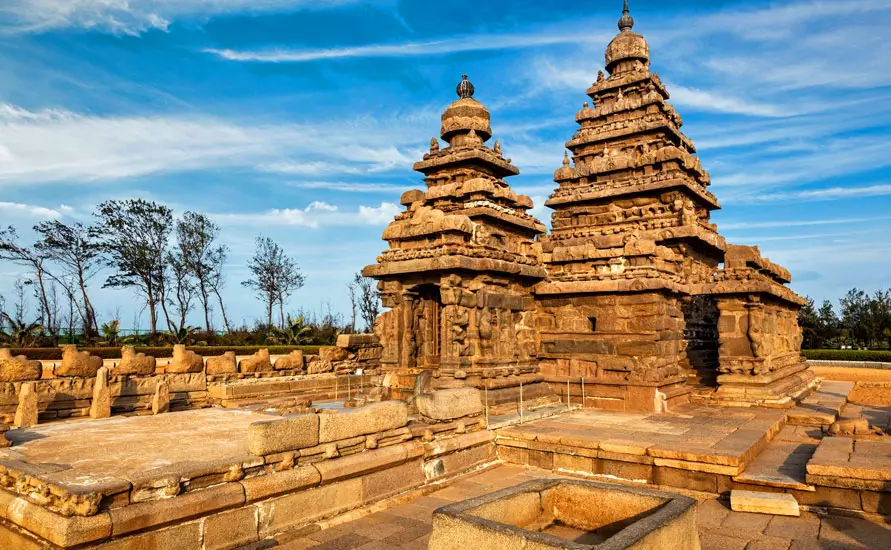
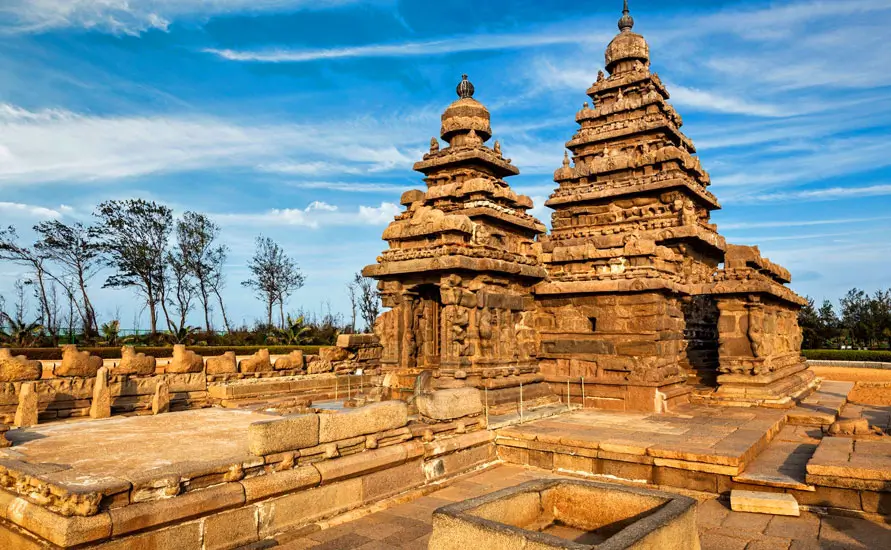
The Shore Temple, built under Rajasimha, is the first major structural stone temple of the region and stands only a short walk from the waves, protected today by a breakwater. Here your guide talks about the sea trade that linked this coast to Southeast Asia, a network the Cholas later controlled. You also see the less visited Tiger Cave at Saluvankuppam, a few kilometers north, where a row of carved tiger or yali heads frames a small shrine. In 2004, the tsunami exposed older structures near this site, and excavations since then have added to what is known about Pallava building.
Later on, wander the lanes of stone carving workshops, where sculptors still shape granite figures by hand with chisels and hammers, many of them ordered by new temples in India, Singapore and the United States. Ask one of the carvers how long a single life-size deity takes, and the answer, often several months, helps you imagine the army of masons, polishers and engravers that a project like Thanjavur needed. Many of these sculptors trained at the government college of architecture and sculpture in town, which teaches the old Shilpa Shastra rules of proportion. Dinner is at your leisure. If you would like a quiet evening, the hotel garden or beach is a good spot to read about Rajaraja I before tomorrow's drive south. Overnight in Mahabalipuram.
Leaving the coast road in the morning, you head south past salt pans, lagoons and cashew orchards to Pondicherry, the former capital of French India. Most visitors come for the colonial streets, and you will walk through them later in the day, but this tour first adds a thread that connects to the Tamil coast's much older trade. A few kilometers south of the town lies Arikamedu, an archaeological site where excavations found Roman pottery, glass and beads from the first centuries CE, evidence that ships from the Mediterranean were trading here long before the Cholas built their fleets.
Back in town, the Pondicherry Museum holds finds from Arikamedu as well as a small collection of bronzes and stone sculpture from the Chola period, many of them gathered from temples in the surrounding district. It is a modest museum, so a short visit is enough, and your guide picks out the pieces most relevant to the trip. After lunch, you walk through the French Quarter, to the gates of the French Institute of Pondicherry, which runs a long-standing research program on South Indian temple inscriptions and photography. Its archive of tens of thousands of temple photographs has helped scholars date many Chola buildings.
In the late afternoon the seaside Promenade is a pleasant place for a walk as the wind picks up and locals come out for the evening. You may also visit the Sri Aurobindo Ashram, a hushed courtyard where cameras stay in your bag. Dinner can be in the French Quarter at a restaurant serving Creole-style seafood or in the Tamil part of town, where small eateries offer dosa and filter coffee. Your guide can help you pick a place based on how adventurous you feel with spice, and can suggest a bakery for the early croissants many guests buy before the drive south. Tomorrow begins the Chola part of the story proper, so it is worth an early night. Overnight in Pondicherry.
Ninety minutes down the coast lies Chidambaram, whose Nataraja Temple honors Shiva performing the dance that sustains the universe. For the Chola kings, this temple held special meaning: Parantaka I is recorded as covering the roof of the inner hall with gold, and later Chola rulers made donations here as a sign of their devotion. You arrive in the morning, when rituals are underway and the corridors fill with the sound of bells and drums. Cover shoulders and knees; in some inner areas male visitors are expected to go bare-chested.
Inside, your guide shows you the four tall gopurams, two of which carry carvings of the 108 karanas from the ancient treatise on dance, each panel captioned in old script. Rituals are conducted by the Dikshitars, a priestly clan who inherit their role, recognizable by the tuft of hair tied at the front of their heads. The golden-roofed hall is open only to Hindus, but much of the outer temple can be visited by all. Each year in February or March, the Natyanjali dance festival brings classical dancers from across India to perform here as an offering.
After lunch you continue south-west through the delta, crossing the Kollidam river, to Kumbakonam, a temple town with dozens of shrines, many with Chola foundations. Two nights are booked at a quiet property just outside the town. In the evening, stroll over to the Mahamaham tank, its stone steps framed by sixteen little pavilion shrines. Every twelve years, huge crowds gather here for a holy dip during the Mahamaham festival. On ordinary evenings, the tank is a quiet place where locals sit, talk and watch the lamps glow. Overnight in Kumbakonam.
Setting off soon after sunrise, you cover the 35 km north to Gangaikonda Cholapuram, the city Rajendra I founded around 1025 as his new capital after his army marched north to the Ganges. The name celebrates the king's claim to have conquered all the way to the holy river, and inscriptions say he had water brought from the river to fill a vast reservoir nearby, the Cholagangam, now called Ponneri. Today only the temple stands in the fields, and the palace that once surrounded it is marked by low mounds and an archaeological dig at nearby Maligaimedu.
The Brihadisvara Temple of Gangaikonda Cholapuram shares the World Heritage listing with Thanjavur and Darasuram. Its vimana is lower than the one at Thanjavur, but its concave, curving profile gives it a more graceful look, and many visitors prefer it. Look for the panel of Shiva handing a garland to his devotee Chandesha, which some historians read as Rajendra's own image of royal reward. A large Nandi bull sits outside in the open, and near the entrance is a well with a lion-shaped entry, called the simha keni. Arrive early, as the site is calm and the granite is still cool underfoot.
Back in Kumbakonam in the afternoon, you visit the Nageswaran Temple, an early Chola temple dating from the late 9th or early 10th century, known for some of the finest stone figures from that period, including life-size images of men and women in niches on the outer walls. During the Tamil month of Chithirai, sunlight falls directly on the main image through the entrance. Later you may visit the Sarangapani Temple, dedicated to Vishnu, with its chariot-shaped shrine and towering gopuram, where the Vaishnava poet-saints known as the Alvars sang hymns that are still chanted today. On the way back to your hotel, your guide can point out the brass and bell-metal shops of Kumbakonam, and the betel leaf sellers whose stalls line the road near the temple car street. Overnight in Kumbakonam.
Before reaching Darasuram, you make a short stop at Thirubuvanam, a few kilometers east of Kumbakonam, to see the Kampaheswarar Temple, built by Kulottunga III, one of the last great Chola kings, in the late 12th century. The temple was planned on the model of the Darasuram shrine, so seeing the two in one morning makes the family resemblance easy to spot. Thirubuvanam is also known for its silk weaving, and your guide may point out handlooms in the lanes nearby. It is a good point in the trip to discuss how the Chola empire slowly weakened and fell in the 13th century.
Rajaraja II raised the Airavatesvara Temple at Darasuram during the mid-1100s; it is the smallest of the three World Heritage Chola shrines, but its carving is the most detailed. Its entrance pavilion rolls forward on carved stone wheels pulled by stone horses, and a set of stone steps near the entrance is said to produce different musical notes when tapped. Look for the tiny panels along the base that show dancers, acrobats and episodes from the lives of the Shaiva poet-saints, with labels in Tamil script that the guide can read for you.
By mid-afternoon you reach Thanjavur, the royal seat under Rajaraja I, and check in for two nights. Late in the day, take a first look at the Brihadeeswarar Temple from the outside walls, as the light fades on the tower and the evening lamps are lit inside. The full visit is planned for tomorrow morning, so this first glimpse simply gives you a sense of its scale and of how the town grew up around it. For supper, try a simple local eatery serving a traditional Thanjavur meal with spiced rice, vegetables and curd. Overnight in Tanjore.
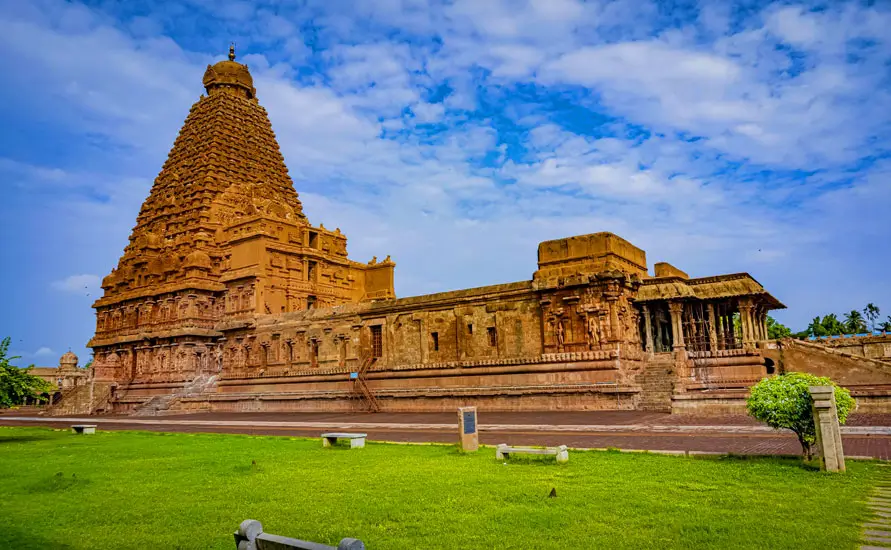
Several unhurried hours belong to the Brihadeeswarar Temple, consecrated in 1010 and still the largest Chola temple ever built. The vimana rises to about 66 meters, and the dome at the top is traditionally said to be cut from a single granite block weighing many tons. Your guide explains how granite was brought from quarries far away, since none exists near Thanjavur, and how the tower was built with interlocking stones and no mortar. The monolithic Nandi facing the shrine was carved later, in Nayak times, which your guide explains with a quick look at the style.
What makes this temple special for historians is its inscriptions. Running around the base are long Tamil texts in which Rajaraja lists his conquests, his gifts of gold and jewels, and he names some four hundred dancers, musicians, washermen and accountants, with their pay set in measures of paddy. His sister Kundavai and his queens also recorded gifts. Even the architect, Kunjara Mallan Raja Raja Perunthachan, is named. The inner corridor holds Chola wall paintings beneath later Nayak work, though access to this passage is restricted and usually closed to visitors.
In the afternoon, you visit the Thanjavur Royal Palace complex, built mainly by the later Nayak and Maratha rulers. The Art Gallery inside holds a large set of Chola bronzes and stone sculptures, many brought from temples in the delta, and it lets you compare them with the ones you saw in Chennai. Next door, the Saraswathi Mahal Library guards palm-leaf texts and rare books in several languages. After dark, you might go back to the temple to see it lit up or take a quiet walk around the moat. Overnight in Tanjore.
Heading west from Tanjore along the Kaveri, you stop at the Kallanai, or Grand Anicut, a stone dam across the river that tradition credits to Karikala Chola, a king of the early Chola line who lived nearly two thousand years ago. It has been strengthened many times since, including by British engineers in the 19th century, but parts of the original structure are believed to survive, and it still sends water into the delta's canals. For the Chola kingdom, this water meant rice, and rice meant the wealth that paid for armies and temples.
Continuing to Trichy, also called Tiruchirappalli, you cross onto Srirangam, a river island where the Ranganathaswamy Temple spreads across a walled town of its own, with seven walled enclosures and 21 gopurams. The Cholas donated heavily to the temple, and its inscriptions record many royal gifts, though much of what you see today was added by later dynasties. Nearby is Jambukeswarar Temple at Thiruvanaikaval, linked by legend to the early Chola king Kocengannan, whose story is told in temple sculptures. Non-Hindus cannot enter the main sanctums in either temple, but the outer courts hold plenty to see.
In the late afternoon, climb the 400-odd steps cut into the Rock Fort, a huge outcrop rising above the old town of Trichy. Along the way, you pass a Pallava cave temple with fine carvings before the last flight of steps ends at Ganesha's little Ucchi Pillayar shrine on the very top. The summit view takes in the Kaveri, the island of Srirangam and the gopurams of the city at sunset. Your Trichy hotel is a short drive from the foot of the rock, and the old town's crowded vegetarian canteens are good for a quick dosa supper. Overnight in Trichy.
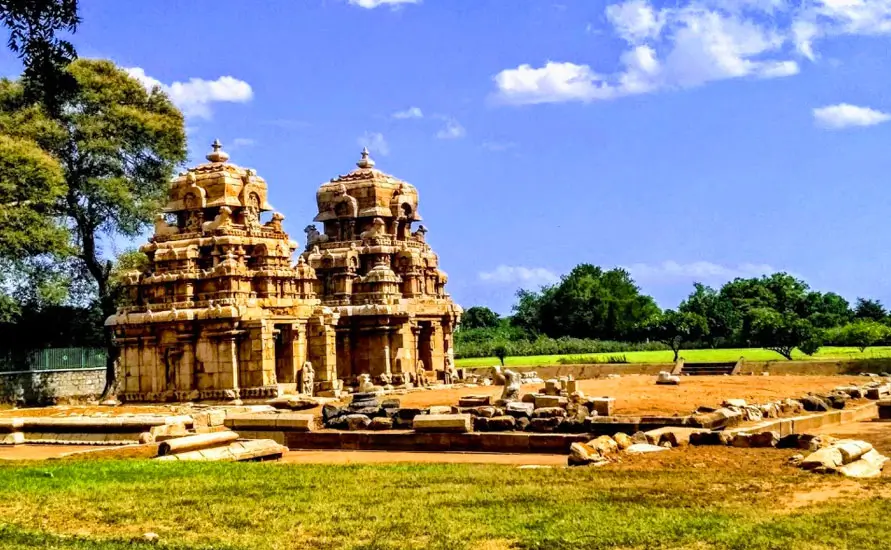
On the way south to Madurai, you turn off the highway at Kodumbalur, a small village that was home to the Irukkuvel chiefs, close allies of the Cholas who married into the royal family. Here stand the Moovar Koil, or "three temples", built in the 10th century by a local chief named Bhuti Vikramakesari. Two of the three shrines survive, standing side by side on a raised platform, with crisp carvings of Shiva in several forms. The site is quiet and few tourists stop here, so it suits a conversation about how Chola power relied on local allies.
After lunch you continue to Madurai, the capital of the Pandyas, the Cholas' long-time rivals in the south. The two dynasties fought for centuries, and at times the Cholas held Madurai, as did the Pandyas who later turned the tables. After some rest at the hotel, you head out to the Meenakshi Amman Temple in the evening, when the main corridors are full of worshippers. Its huge colorful gopurams were mostly built later, under the Nayak rulers, which gives a useful contrast to the Chola style you have seen all week.
Entry to the inner sanctums is limited to Hindus, and phones and cameras stay at deposit counters by the gates. Spend time in the long pillared halls, watch priests performing rituals, and if you have the energy, stay for the night ceremony around 9 pm, in which the god is borne to the goddess's bedchamber, an event called palliyarai. It is a vivid scene, with drums, oil lamps, the scent of camphor and the chanting of Tamil hymns. A late dinner at the hotel rounds off the last full day of the tour. Overnight in Madurai.
With an afternoon or evening flight, there is time for the Thirumalai Nayak Palace of the 1630s, whose courtyard is lined with massive pillars and arches. You may also stop at the Gandhi Memorial Museum, set up in Rani Mangammal's Tamukkam palace, where you can see the bloodstained cloth Gandhi wore when he was killed in 1948. Both sites help close the story of Tamil Nadu's history, from the Cholas to the Nayaks to modern India.
The car then brings you to Madurai Airport for your onward flight, usually connecting through Chennai, Bengaluru or Mumbai to international destinations. If you would like more time, we can add a few nights in Chettinad, Rameswaram or Kodaikanal, or continue into Kerala. Over eleven days you have followed the Chola story from its roots to its last great temples, and we hope it helps you see South India's past in a new way. Safe travels home.
Your Journey

N.S. Rathore & Mrs. Omlata Rathore · Managing Director
We still read every enquiry ourselves. Tell us the places you liked and our planners will send a day-by-day route with drive times and a clear price.
Every package can be customised and no pressure to book. A planner from our office replies within 24 hours with a route written for your group.
Fill this in and your planner will send a first draft itinerary.
Explore more
Kerala Backwaters Escape Kerala Backwaters Escape
 Kerala Backwaters Escape
 Kerala Backwaters Escape
 Kerala Backwaters Escape
 Kerala Backwaters Escape
 Kerala Backwaters Escape
 Kerala Backwaters Escape
 Kerala Backwaters Escape