 Kerala Backwaters Escape

Tamil Nadu Tour Packages
Coimbatore – Mettupalayam – Coonoor (Nilgiri Mountain Railway) – Ooty – Palani – Kodaikanal – Madurai – Theni – Munnar – Kochi
At a glance
Three hill stations in a row can start to blur together, so this route breaks the climb in the middle. Our Tamil Nadu hill stations with Munnar tour rides the toy train into the Nilgiris, spends time in Coonoor and Ooty, crosses to the Palani range at Kodaikanal, then comes down for two full nights in Madurai, where the warm air smells of jasmine and temple camphor. Only after that pause does the road climb again, over the Bodimettu pass into Kerala's Munnar tea country, before the trip ends by the sea in Kochi.
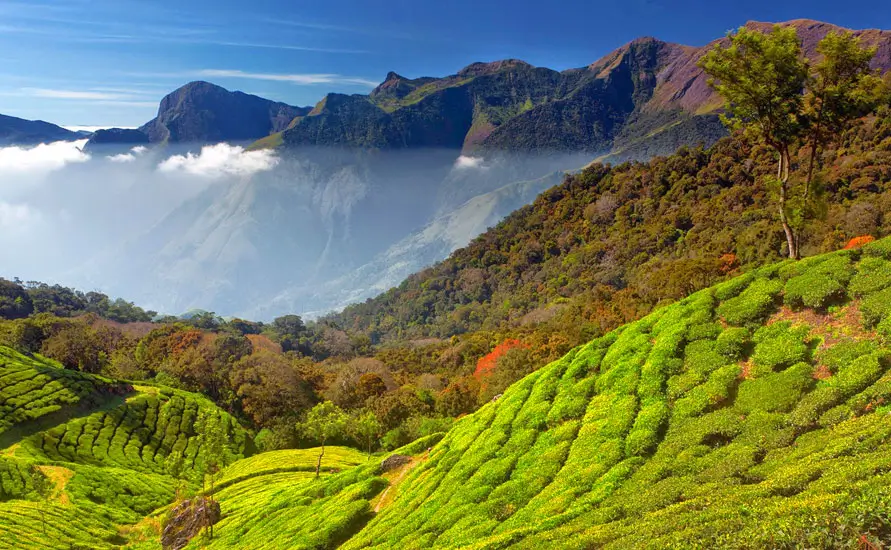
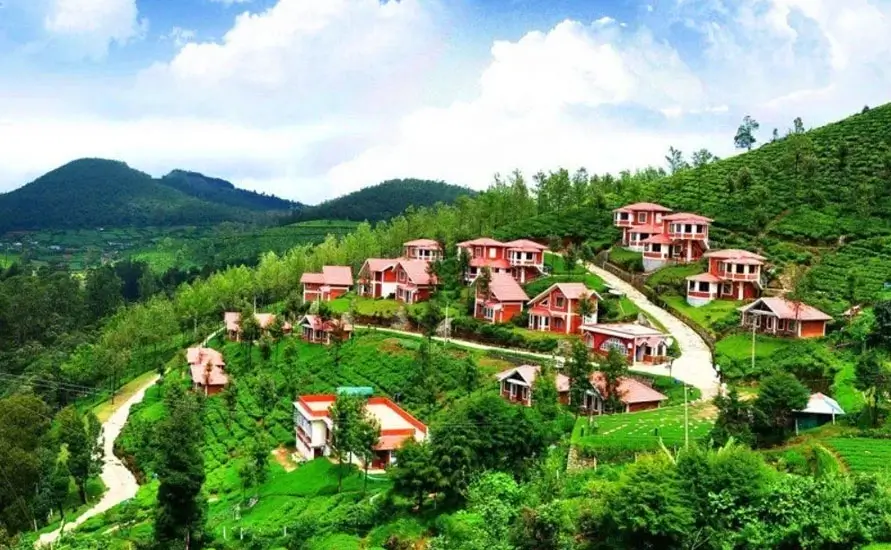
Each stop has been chosen for something the others lack. Coonoor is quieter and better for walking than its busy neighbor, Ooty has the gardens and the Toda heritage, Kodaikanal offers cliff paths and village terraces, and Madurai brings Tamil Nadu's great temple city into a trip that might otherwise be all tea and pine. Munnar finishes the hill part with Kerala's tea, the Nilgiri tahr of Eravikulam and the steep organic gardens of Kolukkumalai, while Fort Kochi gives you a sea breeze for the last evening.
We put this Ooty Kodaikanal Munnar tour together for guests flying in from Britain, Ireland, mainland Europe, North America and Australia, and for NRI families after a cooler side of the south. One chauffeur and one cooled private sedan carry you from Coimbatore right through to Kochi, with local guides at each main stop. One drive, between Ooty and Kodaikanal, is long, and we schedule it as a travel day with breaks rather than pretend otherwise. Weather is kindest from October through March, while April and May draw Indian families fleeing the heat below.
Flights from the Gulf, Singapore and the big Indian metros bring you into Coimbatore, a textile and engineering city of more than two million people sitting where the plains meet the Ghats. Someone from our local office greets you outside the terminal doors, takes care of the luggage and introduces your driver, who will stay with you all the way to Kochi. The hotel is a short ride away, and the morning or early afternoon is left free for rest, a shower and a light South Indian meal. Landing before dawn? Mention it when you book, and the room can be reserved from the previous night so it is ready on arrival.
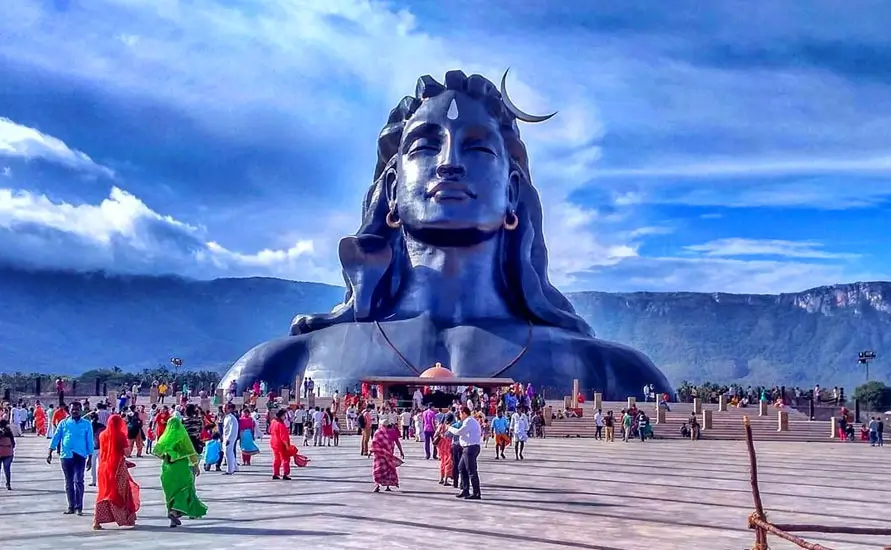
Late in the afternoon your driver heads about 30 km west, toward the Velliangiri Mountains, a forested ridge that Tamil pilgrims call the Kailash of the South. At their foot stands the Adiyogi bust, a steel face of Shiva about 34 meters tall, unveiled in 2017 and recognized by Guinness as the largest bust sculpture in the world. Families from across the state come at dusk, when a short light-and-sound program is often projected onto the face. Nearby, the domed Dhyanalinga meditation hall welcomes visitors of all faiths for silent sitting; cover arms and legs to the knee and switch off phones.
Heading back, dinner could be Kongu food, the home cooking of this western belt, which leans on coconut, black pepper and roasted spice pastes more than on raw chili heat. Dishes worth trying include arisi paruppu sadam, a rice-and-lentil comfort dish, and pallipalayam chicken cooked with shallots and coconut slivers. Your driver drops you back at the hotel in good time, because tomorrow's train leaves Mettupalayam shortly after seven. Lay out a fleece or warm layer for the morning, since the hills will feel cool after the plains. Overnight in Coimbatore.
Breakfast is packed by the hotel, and your driver leaves Coimbatore well before dawn for the hour's drive to Mettupalayam, the bottom station of the Nilgiri Mountain Railway. The platform is already crowded with holiday families and their tiffin boxes when the narrow-gauge coaches are shunted in. Your seats are reserved ahead, because tickets on this morning service go quickly, especially at weekends and during Indian school holidays. Your driver then takes the bags by road to Coonoor, so you board with nothing more than a daypack, a camera and a jacket.
Once the train leaves the plain at Kallar, a cogged rail between the tracks takes over and the climb becomes slow and deliberate. The Swiss-built steam engines on this stretch push rather than pull, and their whistle echoes back from the cliffs as the line threads through tunnels, crosses spidery viaducts and loops along the side of the gorge. At several stops the crew takes on water, and you can step down to buy a cup of sweet tea or fried snacks from vendors. Watch the vegetation change from bamboo and teak to tree ferns and finally to the first tea bushes.
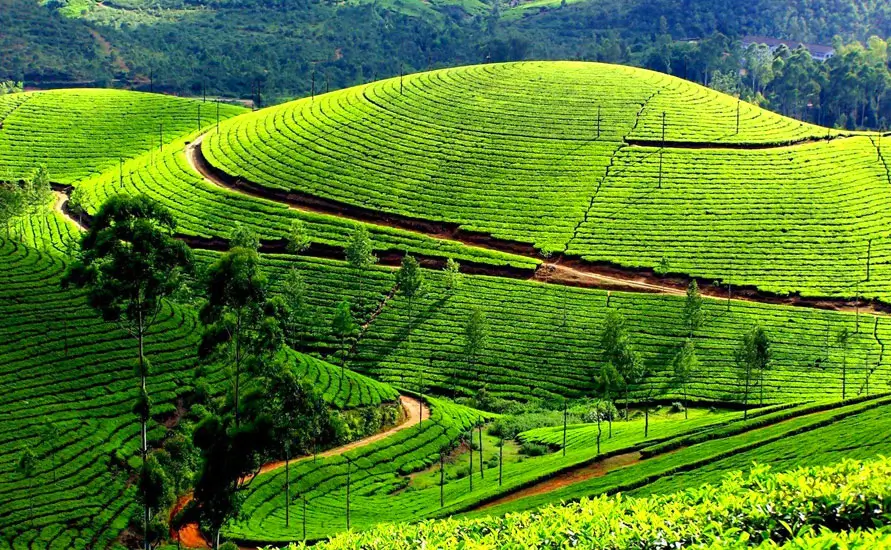
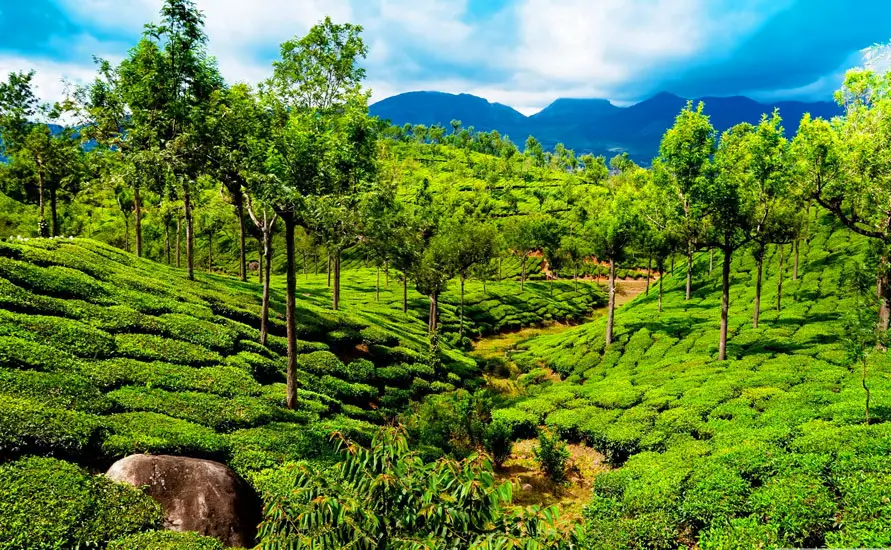
Your driver collects you at Coonoor station around noon, and after lunch a local guide introduces you to a tea planter for an afternoon walk through his estate. He shows why each bush is kept clipped at waist level, why pickers snap off just the top shoots, and how the frost of December and January shapes the flavor of the leaf. The walk ends at Lady Canning's Seat, a viewpoint named after the wife of India's first Viceroy, with tea slopes falling away toward the Mettupalayam plains. Your hotel tonight is a converted planter's bungalow or a small hill hotel. Overnight in Coonoor.
The second half of the railway, from Coonoor up to Ooty, runs without the rack and is hauled by a diesel engine, but it is just as scenic and much less crowded. After a slow breakfast you climb aboard at Coonoor for roughly seventy minutes of riding, while your driver goes ahead by road with your luggage. The line passes the army town of Wellington, then climbs through Aruvankadu, Ketti and Lovedale, and near Ketti it runs along a hillside high above a wide valley of small farms. Lovedale, the last stop before Ooty, has a pretty station built in the colonial style.
Bags dropped, your Ooty guide leads the way to the Government Rose Garden in the Vijayanagaram area, laid out on terraces in 1995 to mark a century of the Ooty flower show and now one of the largest rose collections in India. Thousands of varieties grow here, from tea roses and climbers to miniatures, and the best blooms come between April and June, though there is color for much of the year. From the upper terraces you look across the town to the hills beyond. Small labels give the names of each variety, and some carry the names of Indian film stars and politicians.
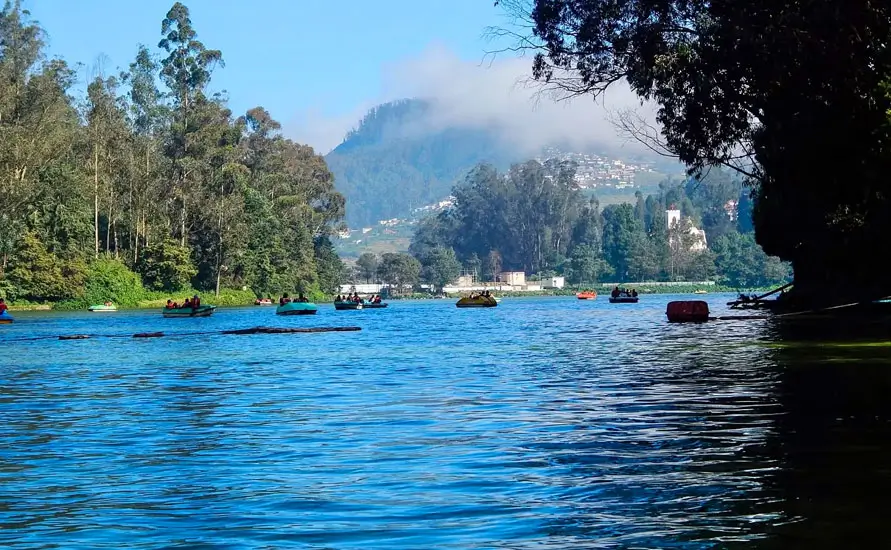
Toward the end of the afternoon, walk down to Ooty Lake, dug out in the 1820s when the town's founder blocked a valley stream. Boats can be hired at the jetty, and a toy train for children runs along the shore. For those keeping to their feet, the shoreline path is a pleasant place to watch local families, honeymooners from the plains and pony owners touting rides. Back near the town center, a bakery or a tea shop makes a good stop before dinner. Ooty nights bite for much of the year, so ask reception for a heater. Overnight in Ooty.
West of Ooty the land opens up into rolling grassland and patches of dark shola forest, the original vegetation of the Nilgiri plateau before tea and eucalyptus arrived. Your guide spends today out here, about 20 km from town, where traffic thins and the air is noticeably cleaner. The first stop is the Pine Forest, a slope of tall straight trunks running down toward a reservoir, popular with Indian film crews. A little further on is Shooting Point, also called the Ninth Mile, a sweep of grassy hills where many Tamil and Bollywood films have staged their song-and-dance scenes.
Pykara Lake and Pykara Falls come next. The lake, formed by a hydroelectric dam, offers boat rides on calm water surrounded by eucalyptus and grassland, while the falls tumble down a series of rocky steps through the forest a short walk away. They run strongest after the southwest monsoon, between July and October, and slow to a trickle in the dry months. Your guide points out how the shola grasslands act like a sponge, holding rainwater and feeding rivers that flow down to the plains. Keep an eye out for the Nilgiri pipit and other birds that live only on these high slopes.
On the drive back you can stop at a roadside factory outlet to buy loose-leaf Nilgiri tea, or at a farm stall selling carrots, strawberries and passion fruit grown on the hillside. The evening is free. Your guide can also slip you into St. Stephen's Church, consecrated in 1830, before the doors shut for the day. You might also visit the Tibetan market near the lake for shawls and souvenirs. It is your last night up in the Blue Mountains, and tomorrow is a long road, so enjoy the crisp air early and sleep well. Overnight in Ooty.
Today is about distance, and we are upfront about that: there is no road linking the Nilgiris and the Palani Hills directly, so you descend to the plains and climb again. Breakfast is early, then the car winds down the Coonoor ghat to Mettupalayam, skirts the edge of Coimbatore and heads south-east through Pollachi and Udumalpet. Regular stops for coffee, a toilet break and lunch at a clean highway restaurant are built in. Allow around seven hours in total, more if traffic is heavy around Coimbatore, and keep a book or playlist handy.
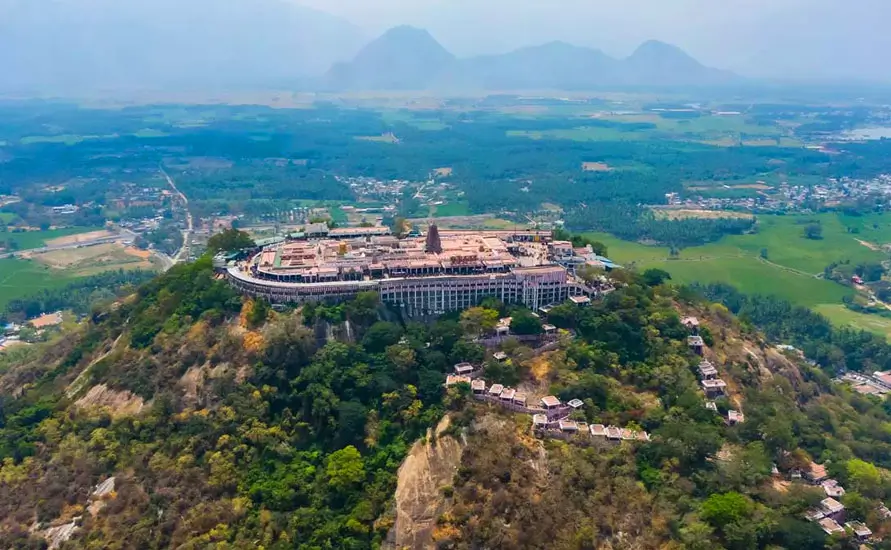
Before the final climb, you pass the pilgrim town of Palani, crowned by its hilltop Murugan temple, which you see from the road. From the foothills, a ghat road of about 65 km winds up through coffee estates and mixed forest into the Palani Hills, often with views back over the plains and the Palani reservoir. The air turns cooler as you climb, and around the halfway point you may see wild Indian bison grazing beside the road. You reach Kodaikanal by late afternoon and settle into your hotel for a quiet evening. Overnight in Kodaikanal.
Kodaikanal was set up by American missionaries in the 1840s as a cool summer retreat, and its school, churches and stone cottages still carry that history. Your guide starts the morning with a walk to Vattakanal, a small hamlet about 4 km below town, along a road that ends at a footpath leading to the Dolphin's Nose rock. The path drops through shola forest and past small farms, and the rock itself juts out over a sheer drop into the valley. The walk is moderate but steep in places, so wear proper shoes, and on the way back stop for a cup of tea in one of the hamlet's small cafés.
Later in the morning you visit Kurinji Andavar Temple, a small Murugan shrine on the eastern edge of town with a terrace that looks out over the plains toward Palani. The temple is named after the kurinji, a mauve shrub that flowers across the Palani and Nilgiri hills only once every twelve years; the last mass bloom was in 2018, so the next is due around 2030. Your guide explains how the Paliyan tribal people traditionally used the flowering cycle to count their age. It is a plain, uncrowded shrine where nobody minds if you sit for a while in the courtyard.
After lunch you drive to Bryant Park, a botanical garden by the lake laid out in 1908 by a forest officer named H. D. Bryant, with flower beds, glasshouses and a collection of hybrid roses. It hosts the town's summer flower show in May. Spend what is left of the afternoon circling the lake on foot, hire a bicycle or simply sit in a café overlooking the water. In the evening, the Kodaikanal Solar Observatory, established in 1899 and known for its work on sunspots, can be seen from the outside on a short drive. Back at the hotel, enjoy a fire and a quiet dinner. Overnight in Kodaikanal.
Leaving the hills behind, the road from Kodaikanal winds down through shola forest and past Silver Cascade, where water slides down a rock face beside the highway, before dropping onto the plains near Batlagundu. As the temperature rises, the landscape changes from pine and eucalyptus to coconut palms, banana groves and rice paddies. Ask to pull over at a stall for tender coconut, or at a village temple where the painted clay horses of Ayyanar, the guardian deity, line the entrance. Madurai comes into view around lunchtime, and the afternoon heat is a good excuse for a couple of hours in your air-cooled room.
Around four, your Madurai guide collects you for the Thirumalai Nayak Palace, completed in 1636 for the city's best-known Nayak ruler. What remains today is only part of the original complex, but it is still impressive: a huge courtyard surrounded by massive white columns, more than twelve meters high, supporting arches and domes decorated with fine stucco. The palace mixes Dravidian and Islamic styles, and Italian influence is sometimes claimed for its arches. Your guide shows you the throne hall and the dance hall, and tells how Madurai's Nayak line began as viceroys sent from Hampi and stayed on as independent rulers.
When darkness falls, the palace hosts a sound-and-light show in English that tells the story of Thirumalai Nayak and the city of Madurai, using the columns and arches as a backdrop. It lasts close to an hour, and the English session time is checked on the day. Afterward, take a short stroll around the streets near the palace, where shops sell brass lamps, cotton saris and bronze statues. For dinner, try parotta with salna, a flaky flatbread served with a thin spiced gravy that Madurai's street kitchens do especially well. Overnight in Madurai.
Visiting the Meenakshi Temple early has real advantages: the stone floors are still cool under bare feet, the queues are short and morning rituals fill the halls with chanting and music. Phones and cameras go into the cloakroom at the gate, shoes onto the racks beside it, then follow your guide through the eastern gate. Non-Hindus are not permitted in the two inner sanctums, but the rest of the complex is open to all. Inside, the Thousand Pillar Mandapam holds 985 carved columns, no two alike, and stop at the sacred tank in the center of the complex.
Your guide tells the founding story of Meenakshi, the Pandya princess who led armies across the land until, facing Shiva on Kailash, she found her match. Their marriage is re-enacted each spring during the Chithirai Thiruvizha, when chariots roll through the outer streets and lakhs of devotees pack the city. Afterward you can wander the Pudhu Mandapam, an old pillared hall opposite the eastern gate, where tailors and bangle sellers work among the carved columns. Lunch is a full Tamil vegetarian spread, rice, sambar, rasam, kootu and payasam, served on a leaf near the temple.
Later, the Gandhi Memorial Museum fills a seventeenth-century palace of Rani Mangammal, the Nayak queen regent. Its galleries follow the independence movement, and a glass case keeps the bloodstained garment from 30 January 1948, the day he was shot in Delhi. The city has its own place in his life: on a 1921 visit he first adopted the simple loincloth of a farmer. The last stop is Vandiyur Mariamman Teppakulam, an enormous stepped tank with a pillared pavilion rising from its island; in the Tamil month of Thai, around January or February, decorated deities are floated across it on a lit raft. Overnight in Madurai.
The road west from Madurai crosses a flat, fertile plain toward Theni, a market town surrounded by vineyards, coconut farms and cotton fields, with the Western Ghats rising like a wall on the horizon. Grapes from the Cumbum valley nearby are sold at roadside stalls for much of the year, and your driver can stop to let you try a bunch. Small villages along the way have painted temples, tea shops and weekly markets, and the drive is a good chance to see rural Tamil Nadu at work. A breakfast or coffee break is planned along the way.
From Bodinayakanur the Bodimettu ghat zigzags upward in tight bends, rising well over a thousand meters to the Kerala border. As you gain height, the plains below spread out in a patchwork of fields and lakes, and the slopes fill with cardamom grown in the shade of old forest canopy. The green pods need that dappled shade and steady rain, and these slopes, known simply as the Cardamom Hills, supply a large share of the spice sold in Indian markets, often auctioned in nearby Bodinayakanur. Cresting the pass, you enter Kerala, and the landscape changes again to the rolling tea gardens of the Munnar region.
Munnar arrives by mid-afternoon, and you settle into a tea estate resort or hillside hotel looking across the plantations for the next two nights. The town was the summer center of British planters in Travancore, and today it is surrounded by around fifty tea estates spread over the slopes of the Kannan Devan hills. In the evening, take a short walk through the gardens of your hotel or a nearby estate road, watching the pickers return home with their baskets as the light fades. Dinner tonight could include a Kerala dish such as appam with vegetable stew. Overnight in Munnar.
Morning starts at Eravikulam National Park, roughly half an hour north, which shelters the largest surviving population of the Nilgiri tahr, a mountain goat that lives only in the high hills of Kerala and Tamil Nadu. Visitors ride a park bus up to the tourist zone at Rajamala, then stroll a paved lane where tahr wander almost within touching distance. Since the reserve closes while the tahr give birth, typically for a stretch of February to April, we verify it will be open. When cloud allows, Anamudi rises behind, at about 2,695 meters the highest peak in South India.
Back in Munnar, a local guide takes you to the Tea Museum run by the Kannan Devan Hills Plantations company. Sepia photos, rusting rollers and a documentary follow local tea from the late nineteenth century, when Scottish planters began clearing forest for the first gardens. In the working section of the museum you see fresh leaf being processed and can taste the finished tea. Your guide explains how the plantations are now largely owned by the workers themselves, under a cooperative structure set up in 2005, an unusual model in the Indian tea industry.
After lunch the road runs out to Mattupetty Dam, its water ringed by tea and grassy slopes, close to the Indo-Swiss dairy project that has bred cattle here since the 1960s. Echo Point follows, where a shout carries across the water and returns, then Kundala Lake, where you can hire a pedal boat or a shikara. A spice garden on the return leg shows pepper, cardamom, cinnamon and vanilla growing, and buy fresh spices for home. Get to bed early, because tomorrow's alarm goes off around four. Overnight in Munnar.
For those willing to rise in the dark, an optional outing reaches Kolukkumalai, a garden just inside Tamil Nadu at about 2,100 meters, said to grow tea at a greater height than almost anywhere on earth. From Suryanelli an open jeep grinds up a stony track for about an hour, arriving in time to watch the sun rise over the clouds in the valleys below. The estate still uses old machinery to make its orthodox tea, and a short factory visit and tasting are usually possible. Bring a warm jacket, because it is cold at dawn up here.
Return to Munnar for a late breakfast, then check out for the descent toward the coast. The road follows the Muthirappuzha River, descending through tea, cardamom, rubber and finally coconut country. Cheeyappara falls drops in seven steps right next to the road, loudest in the wet months, and monkeys often wait on the railing for snacks, so keep food in the car. Your driver can stop for jackfruit chips or banana fritters at a roadside stall, or at a shop selling homemade chocolates. As you approach the plains the air grows warm and humid, and the traffic thickens as you near Kochi.
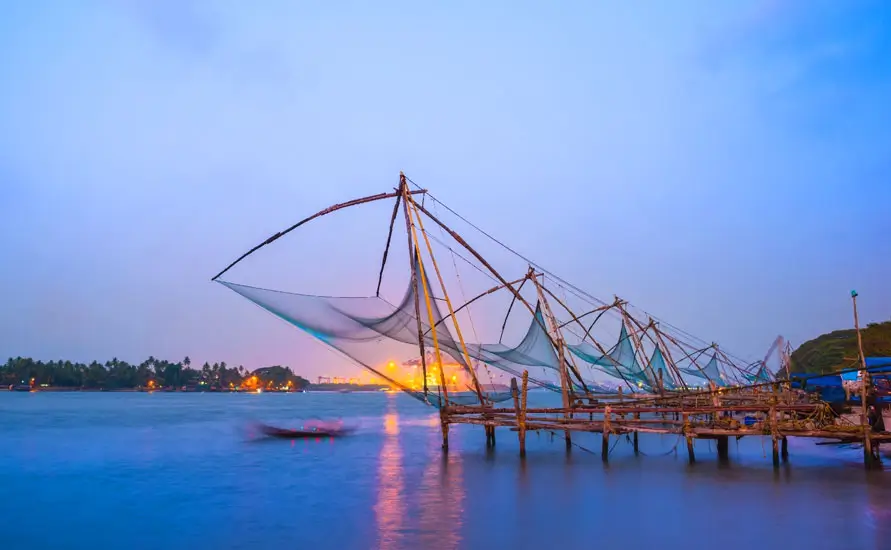
Fort Kochi greets you late in the day with salt air, and a heritage hotel in its old quarter is your base. After a rest, take a walk along the waterfront to see the Chinese fishing nets silhouetted against the evening sky, and watch the fishermen lower and raise them with ropes and stone weights. Nearby stalls sell the day's catch, and small kitchens will cook your chosen fish for a modest fee. Afterward, wander the lanes past colonial bungalows, art cafés and small boutiques. Dinner tonight could be a Kerala fish curry or prawns cooked in coconut milk. Overnight in Kochi.
With a later flight, the morning leaves room for a short walk to St. Francis Church, the old Dutch cemetery or the spice warehouses of Mattancherry, where pepper and ginger are still sorted by hand. Note the weekly closures: no Mattancherry Palace on a Friday, and no Paradesi Synagogue on Friday, Saturday or Jewish holidays, which we check against your date. Hotel checkout is usually around noon, and a later checkout can be requested in advance if your flight leaves at night.
Expect ninety minutes on the road up to Cochin International Airport, and your driver times the departure so you arrive around three hours before an international flight. Gulf carriers and Singapore Airlines fly out daily, linking you to long-haul routes home. Over twelve days you have ridden the Nilgiri toy train, walked through tea estates on both sides of the state border, seen the Meenakshi Temple and ended on the Arabian Sea. Safe travels, and we hope the hills call you back.
Your Journey

N.S. Rathore & Mrs. Omlata Rathore · Managing Director
We still read every enquiry ourselves. Tell us the places you liked and our planners will send a day-by-day route with drive times and a clear price.
Every package can be customised and no pressure to book. A planner from our office replies within 24 hours with a route written for your group.
Fill this in and your planner will send a first draft itinerary.
Explore more
Kerala Backwaters Escape Kerala Backwaters Escape
 Kerala Backwaters Escape
 Kerala Backwaters Escape
 Kerala Backwaters Escape
 Kerala Backwaters Escape
 Kerala Backwaters Escape
 Kerala Backwaters Escape
 Kerala Backwaters Escape
 Kerala Backwaters Escape
 Kerala Backwaters Escape
 Kerala Backwaters Escape
 Kerala Backwaters Escape
 Kerala Backwaters Escape
 Kerala Backwaters Escape
 Kerala Backwaters Escape
 Kerala Backwaters Escape Kerala Backwaters Escape Kerala Backwaters Escape