 Kerala Backwaters Escape

Tamil Nadu Tour Packages
Chennai – Kanchipuram – Tiruvannamalai – Gingee – Pondicherry – Auroville – Chidambaram – Kumbakonam – Srirangam – Madurai
At a glance
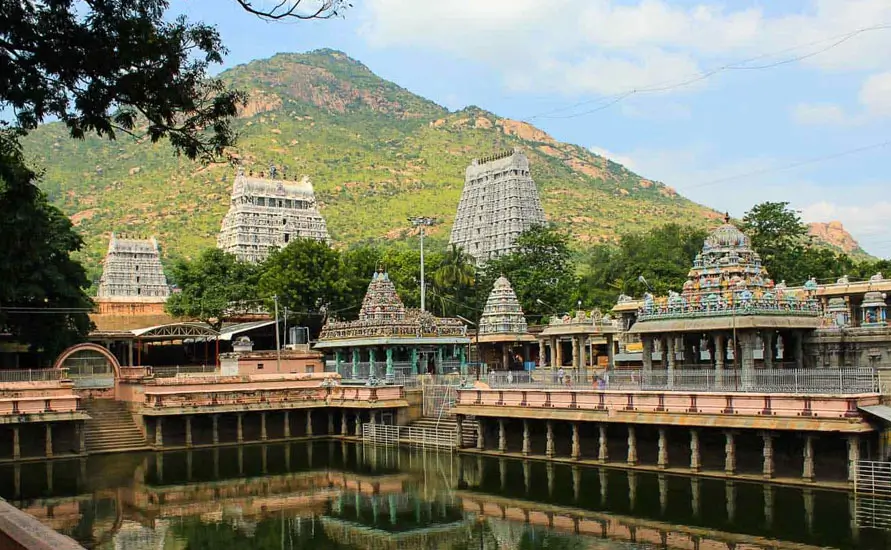
Some travelers come to South India for beaches and palaces. Others come because a book by Ramana Maharshi or Sri Aurobindo found its way into their hands years ago and never quite left. Our Tamil Nadu spiritual tour is written for the second group. It gives three full nights at the foot of Arunachala in Tiruvannamalai, the hill Ramana called his guru, with time to sit in the old hall of his ashram, walk the 14 km girivalam path around the mountain and climb to the caves where he lived in silence for years.
From there the route turns to the coast and to a different kind of practice at the Sri Aurobindo Ashram in Pondicherry and the township of Auroville, then heads into the Kaveri delta, where the temple towns sit so close together that a single day can include four or five living shrines. You visit the Chidambaram Nataraja Temple, spend two nights in Kumbakonam, cross the river to Srirangam and close with two nights in Madurai. This Tamil Nadu temple towns tour balances quiet days with guided ones, so reflection never gets squeezed out by sightseeing.
Everything is private and flexible. Your English-speaking driver and air-conditioned car are yours for all twelve days, while local guides appear only where they genuinely help, so the ashram days can stay unguided if you like. Drives are short, mostly two to four hours. We can arrange simple vegetarian meals, advise on ashram rules and help you time your stay with the monthly full-moon walk or a festival such as Karthigai Deepam. The best season is November to February, when the mornings on the hill are cool.
Welcome to Chennai. Whichever hour your plane touches down, a member of our team is at the international arrivals gate with your name on a board, ready to load your bags and drive you across the city to your hotel. Red-eye arrivals from London, Frankfurt or New York are common here, which is why the schedule stays empty until mid-afternoon. Sleep, eat something light and drink plenty of water. Our representative leaves a folder with your vouchers, a printed route and the numbers of your driver and our office, and can help you buy a local SIM card if you need one.
Around 4:30 pm your guide picks you up for Mylapore, a neighborhood that has been a center of worship since long before Chennai existed, praised in Tamil saint-poets' hymns more than a millennium old. Start at the Sri Ramakrishna Math, the southern branch of the order founded by Swami Vivekananda, where the prayer hall is open to all and evening arati is sung in Sanskrit and Bengali. Visitors sit on the floor or on benches in silence, and the hall's mix of Hindu, Buddhist, Islamic and Christian architectural motifs reflects the founder's view that every path leads to the same truth. It is a gentle first step into the themes of the coming days.
A few minutes away stands the Kapaleeshwarar Temple, where Shiva and his consort Karpagambal receive a steady flow of local families after work. Your guide gives you a simple vocabulary for what you will see all trip: the sanctum, the circumambulation path, the flagstaff, the offerings of flowers and camphor, and the sacred ash pressed onto foreheads. Removing shoes and dressing modestly are expected, and the innermost sanctum may not be open to non-Hindus. Before returning to the hotel, sit for a while by the large temple tank, where pigeons settle on the steps as the lamps come on. Overnight in Chennai.
Leave Chennai after an early breakfast and drive about two hours to Kanchipuram, an ancient seat of learning where Buddhist, Jain, Shaiva and Vaishnava teachers all once had their schools. The town is also the home of the Kanchi Kamakoti Peetham, a monastic seat associated with the philosopher Adi Shankaracharya, and your guide can explain how this lineage of teachers still shapes Hindu practice in the south. Your main stop is the Ekambareswarar Temple, which stands for earth among Shiva's five elemental shrines, its lingam said to have been molded from sand by Parvati herself.
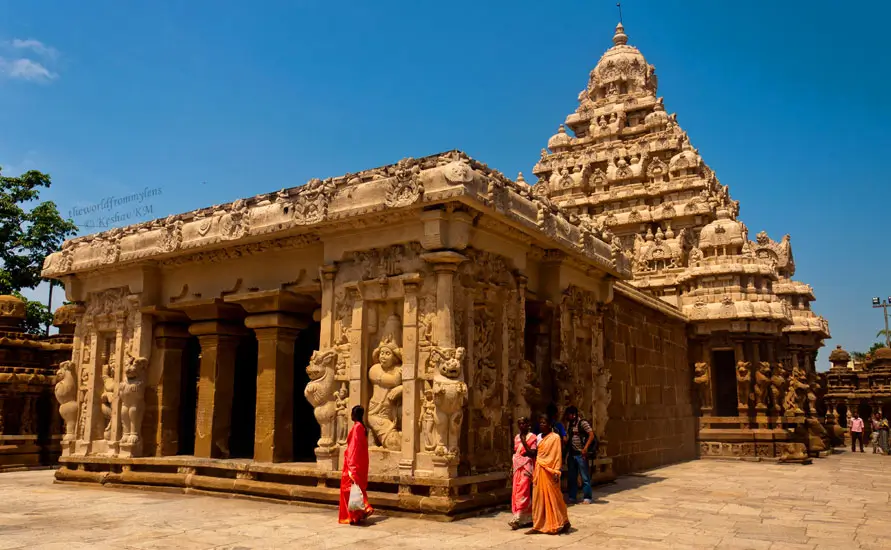
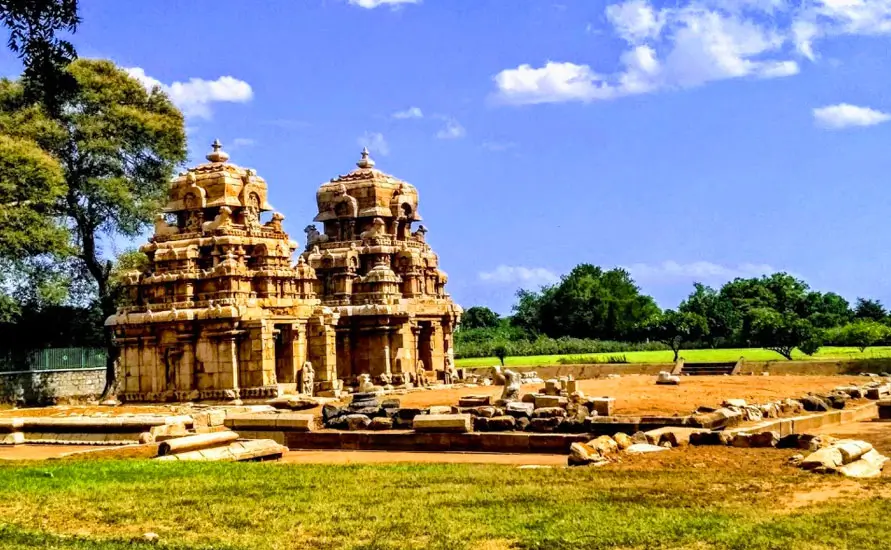
Next door to the town's busier streets, the small Kailasanathar Temple is a quieter place to sit for a few minutes before you move on. Commissioned by Rajasimha of the Pallava line at the turn of the 8th century and carved in soft sandstone, it is one of the oldest structural temples in South India, and its rows of small cells around the courtyard were probably used by monks and meditators. Your guide points out the fading traces of painted plaster on some of the inner walls. Most temples in Kanchipuram close for a few hours at midday, so we keep both visits in the morning and stop for a simple vegetarian lunch in town.
In the afternoon the road runs southwest through granite hills, coconut groves and villages with brightly painted shrines to village guardian deities. You see Arunachala long before you reach the town, a lone hill rising above the plain, and many visitors find the first sight surprisingly moving. Check in to your hotel or guesthouse close to the ashram area in Tiruvannamalai in the late afternoon. If you feel ready, take a short walk to the ashram gate to get your bearings, but there is no plan tonight beyond rest and an early dinner. Overnight in Tiruvannamalai.
Sri Ramana Ashram sits on the southern foot of Arunachala and remains much as visitors described it decades ago: shaded courtyards, peacocks on the roofs and a steady stream of seekers from every continent. Ramana Maharshi arrived here at sixteen in 1896 and never left the area until his death in 1950. Begin with the old meditation hall, where he sat on a couch for many years receiving visitors, often in silence. People still sit here every day, and the only rule is quiet. You can also visit his samadhi shrine, where the morning chanting of Vedic hymns and Tamil devotional verses is open to everyone.
Mid-morning, take the shaded footpath that starts beside the ashram and climbs gently up the hillside to Skandashram, where Ramana lived from 1916 to 1922 with his mother and a small group of disciples. The climb takes about 30 to 40 minutes and is rocky in places, so wear proper sandals and bring water. The small stone house has a single meditation room, and the terrace outside looks over the town and the giant towers of the Arunachaleswarar Temple below. A little further down the path lies Virupaksha Cave, where he stayed for about seventeen years before that.
The caves are kept in silence and are usually open through the morning and late afternoon, with a break in the hottest hours, so time your walk with care. Visitors may sit inside for a short meditation and leave a small donation if they wish. Afternoons in Tiruvannamalai are best spent quietly, reading in the ashram library, which holds Ramana's teachings in many languages, or resting at your guesthouse. Before sunset, walk back to the ashram for the evening recitation. This day is deliberately unguided, though a local guide can join you if you prefer company. Overnight in Tiruvannamalai.
Rise well before dawn for girivalam, the barefoot or sandal-clad walk around the holy hill. The 14 km road circles Arunachala clockwise, keeping the hill always on the walker's right, and passes eight lingam shrines that mark the directions of space, along with dozens of small temples, tanks and ashrams. Starting around 5 am lets you finish before the heat sets in, and most walkers take three to four hours at a gentle pace. Your driver can follow at a distance with water and a change of shoes, and if you get tired the car can carry you the rest of the way.
Ramana Maharshi often encouraged visitors to make this walk slowly and attentively, comparing it to the way a queen moves in the presence of a king. Along the path you see sadhus resting under trees, women drawing kolam patterns outside their homes and pilgrims buying tea and vada from roadside stalls. On full moon nights tens of thousands join the walk, and during the Karthigai Deepam festival, usually in November or December, the crowd can reach well over a million. If your dates coincide, we will advise you on safety and timing, since the town becomes extremely crowded.
After breakfast and rest, visit the Arunachaleswarar Temple in the late afternoon. Spread over roughly 10 hectares, it ranks among India's biggest temple enclosures, with four towering gopurams on its outer walls. Shiva is worshipped here as fire, the element of this hill, and the temple is one of the five Pancha Bhuta Sthalams. Your guide shows you the underground Patala Lingam shrine, where the young Ramana sat in deep meditation so absorbed that insects bit his legs without him noticing, and the thousand-pillared hall beside it. Stay for the evening puja as the lamps are lit. Overnight in Tiruvannamalai.
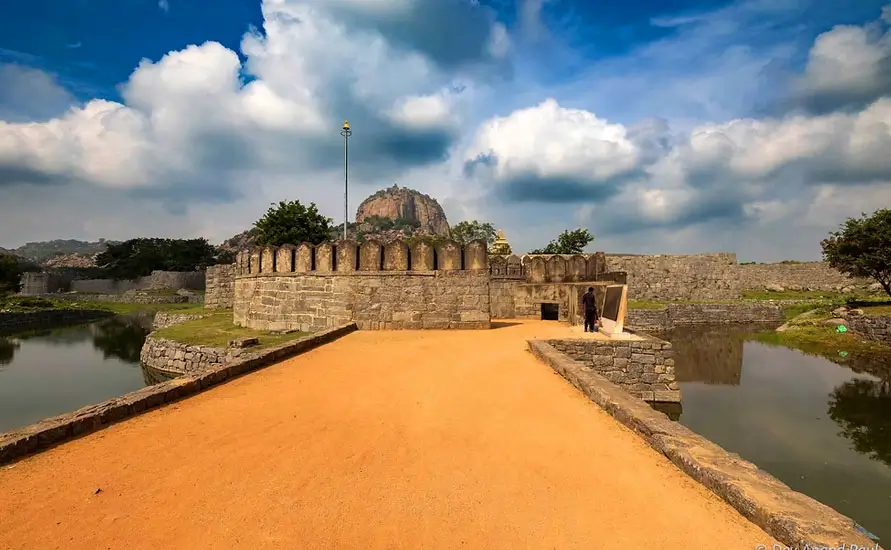
Spend the early morning at your own pace, perhaps with a final hour in the old hall or a quiet walk to Ramana's samadhi. After breakfast, leave Tiruvannamalai and drive east for about an hour to Gingee, where a 15th to 17th-century fort spreads across three rocky hills joined by walls. The Maratha king Shivaji called it one of the most secure forts in India, and later the French and British fought over it. The climb to Rajagiri, the highest citadel, is steep and takes over an hour each way, so most visitors limit themselves to the lower ruins and the Kalyana Mahal, a tall tower with a pyramid roof.
Gingee is also a useful lesson in how kingdoms and temples were linked in medieval Tamil Nadu. Inside the fort area you find the ruined Venkataramana temple, whose carved pillars were taken by the French to Pondicherry, and a granary and stables that show how armies kept supplies here during long sieges. Our guide brings the story to life and explains why rulers so often built temples inside forts, both for protection and to show that their rule was blessed. The site is quiet compared to coastal attractions, and you may well share it only with a few local schoolchildren.
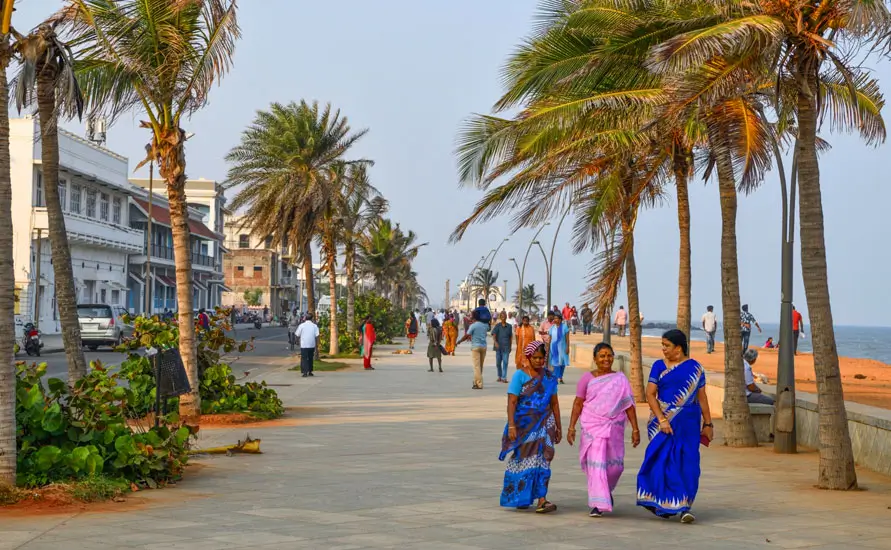
From Gingee the road runs southeast for about two hours to Pondicherry, with the scenery changing from dry granite hills to coconut palms and the first breezes from the sea. You reach the old town by about 4 pm. In the evening, walk along Goubert Avenue, the sea road where cars are kept out after dusk, where locals and visitors gather to watch the waves break against the rocks. The town's long French history shows in its gridded streets, mustard-colored villas and bilingual street names, and many ashram members cycle past on old black bicycles as the light fades. Overnight in Pondicherry.
Morning starts at the Sri Aurobindo Ashram, which grew up from 1926 around the revolutionary-turned-yogi Sri Aurobindo and his spiritual partner Mirra Alfassa, known as the Mother. The main building opens to visitors in the morning, and the center of the courtyard is the shared samadhi of Aurobindo and the Mother, beneath a frangipani tree, covered every day with fresh flowers in elaborate patterns. People sit or kneel nearby in silence, and you are welcome to do the same. Phones must be switched off and photography is not allowed. Your guide can introduce the main ideas of Integral Yoga before you go in.
The ashram runs many departments across town, from a paper factory and a printing press to bakeries, a dining hall and guesthouses, and some of these units sell handmade paper, incense and books. Your guide takes you to a few of them and explains how members combine work and spiritual practice, an idea central to Aurobindo's teaching. Nearby, the Manakula Vinayagar Temple is a lively place to see Ganesha worship in action, with walls covered in colorful painted panels. For lunch, the ashram's own simple dining hall or a vegetarian café run by community members are both easy options.
In the afternoon drive about 30 minutes north to Auroville, the experimental township the Mother founded in 1968 to test whether people from every country could share one town beyond nationality and creed. At the visitor center a short video explains its aims, after which a woodland path of around 1.5 km ends at a viewing garden facing the Matrimandir, its gold discs catching the afternoon sun. Sitting inside the chamber itself requires a prior booking made through the visitor center, with only a handful of places each day, so tell us well before the trip if this matters to you. Return to Pondicherry in the evening. Overnight in Pondicherry.
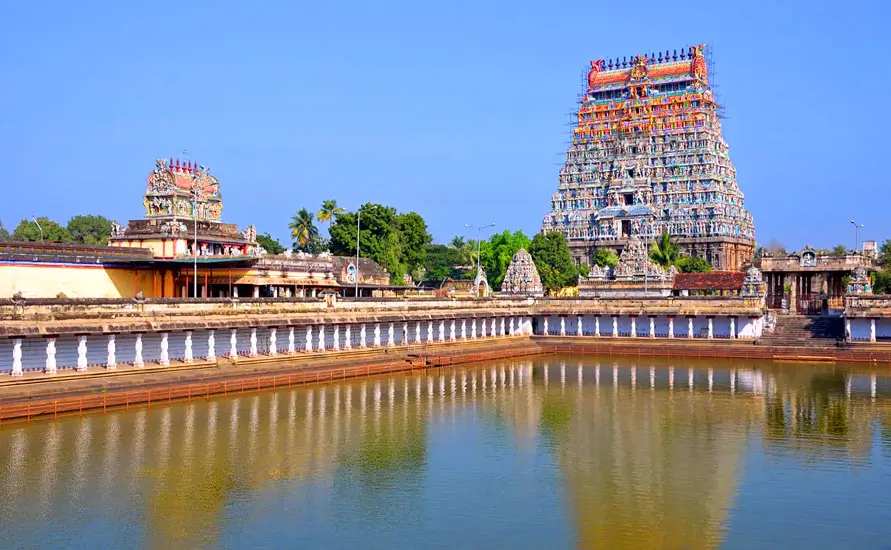
After breakfast the car heads ninety minutes down the coast to Chidambaram, the town that grew around Shiva as Nataraja, lord of the cosmic dance. The Chidambaram Nataraja Temple covers about 16 hectares and is one of the five element temples of Shiva, representing space. Its inner hall, the Chit Sabha, wears a roof of gilded tiles, and the dancing figure inside has become the best-known image of Shiva anywhere. Rituals here are performed by the Dikshitars, a hereditary community of priests, and your guide explains how their role differs from the government-managed priesthood of most other temples.
Your guide also explains the deeper meaning of the dancing Shiva: the drum in one hand stands for creation, the flame in another for destruction, and the foot raised over the dwarf of ignorance for release. Next to the Nataraja image is the Chidambara Rahasyam, a curtained space believed to represent the formless, empty presence of the divine, and it is shown only during particular rituals. Look also at the dance sculptures in the gateways, which show the classical poses used in Bharatanatyam. Around Maha Shivaratri, classical dancers offer their art to the deity here during Natyanjali, a festival held in the temple courtyards.
After lunch, continue for about two hours west through the delta of the Kaveri River to Kumbakonam, a town where temples outnumber almost everything else. The road crosses irrigation channels and passes paddy fields, banana plantations and small villages where elderly men sit on stone verandas. Once settled at the hotel, take a gentle evening walk to the riverbank or to a nearby shrine, where you may hear the nadaswaram, the long double-reed instrument that is played at temple ceremonies and weddings throughout Tamil Nadu, usually paired with the barrel-shaped thavil drum. Overnight in Kumbakonam.
Kumbakonam is sometimes called the temple town of South India, and within a few kilometers you find dozens of active shrines. Start early at the Mahamaham Tank, a large sacred pool surrounded by small pavilions. Every twelve years, during the Mahamaham festival, hundreds of thousands of pilgrims bathe here in a single day, believing that the waters of India's holy rivers gather in the tank at that moment. On an ordinary morning it is quiet, with a few elderly people praying on the steps. Next comes the Sarangapani Temple, a Vishnu shrine whose sanctum is shaped like a chariot drawn by horses and elephants.
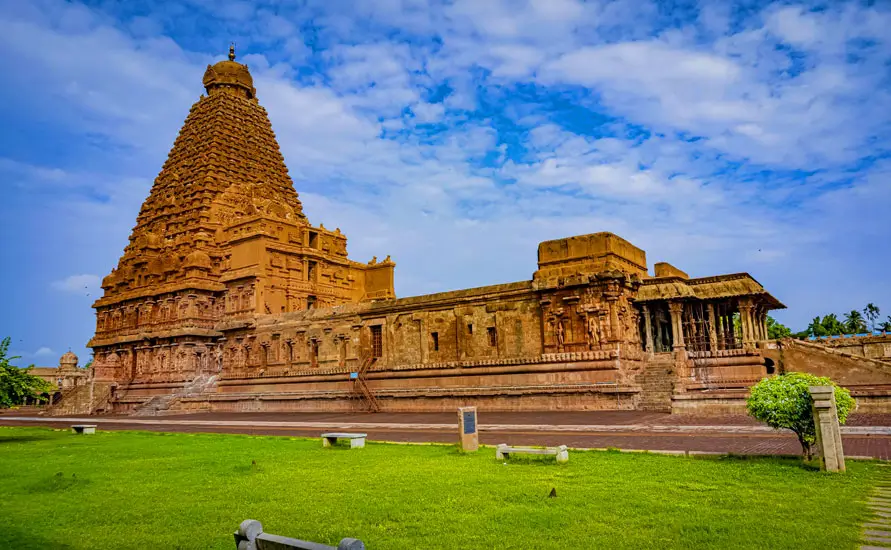
Just outside the town, the Airavatesvara Temple at Darasuram dates from the 12th century and shares UNESCO status with the Tanjore and Gangaikonda Cholapuram temples. Smaller and less crowded than the Tanjore temple, it is covered with very fine carvings, from tiny dance panels on the steps to stories from Shiva's life along the walls. Its mandapa takes the form of a stone chariot pulled by horses, and the entrance steps produce musical notes when tapped. Your guide reads the carvings as a lesson in Shaiva devotion, showing the 63 Nayanar saints whose hymns are still sung in temples throughout the state.
After lunch you head a few kilometers to Swamimalai, where foundry families have poured temple bronzes for generations by the ancient lost-wax technique. A family workshop lets you see the stages, from a wax model to a clay mold and the pouring of molten metal, and explains why the proportions of each deity must follow exact rules. The village's hillock temple counts among the Arupadai Veedu, the six sacred abodes of Murugan, and the climb is short if you wish to add it. Kumbakonam also has the Navagraha temples, one for each planet, and if your interests run to astrology we can add one or two of these. Overnight in Kumbakonam.
Drive west after breakfast along the Kaveri to Srirangam, an island formed between the Kaveri and Kollidam rivers. The Ranganathaswamy Temple here is one of the most important shrines in Vaishnavism and one of the largest active temple complexes in the world. It contains seven walled enclosures, one inside the other, and 21 gopurams. The outer rings are full of houses, shops and markets, and only the inner parts are treated as sacred space. Walking inward from street to sanctum mirrors the inner movement of a seeker, a point your guide makes as you pass from bazaar to cloister to shrine, following rules set out in the old Agama texts.
Srirangam is also central to the Sri Vaishnava tradition founded by the philosopher Ramanuja, whose preserved body is enshrined inside the temple complex. Your guide explains his teaching of qualified non-dualism and how it differs from the non-dual Advaita taught by Ramana Maharshi in Tiruvannamalai, which helps link the different strands of the trip. You also see the fine carved pillars of the Sesharaya mandapa and, when it is open, take the stairs to the roof for a panorama of towers. The innermost sanctum is reserved for Hindus, though nearly everything else is open to visitors.
In the afternoon cross the river to the Jambukeswarar Temple at Thiruvanaikaval, the water element temple of Shiva, where a small spring keeps the sanctum floor damp throughout the year. Then visit the Rock Fort Temple in Trichy, reached by about 400 rock-cut steps that lead past a Shiva shrine to a small Ganesha temple at the top. Go up in the late afternoon for cooler air and views over the river and the city. You check in to your hotel in Trichy after the climb and have the evening free. Overnight in Trichy.
A slow breakfast is followed by a three-hour road trip to Madurai, whose claim to be the cradle of Tamil letters reaches back over two millennia. The early Tamil Sangam poets are believed to have gathered here, and the city is still seen as the home of the classical Tamil language. On the way you pass dry farmland, granite quarries and small towns with roadside shrines to local guardian deities, often with large terracotta horses standing outside. You arrive around lunchtime and stay indoors through the hottest hours, when even local shopkeepers pull down their shutters for a nap.
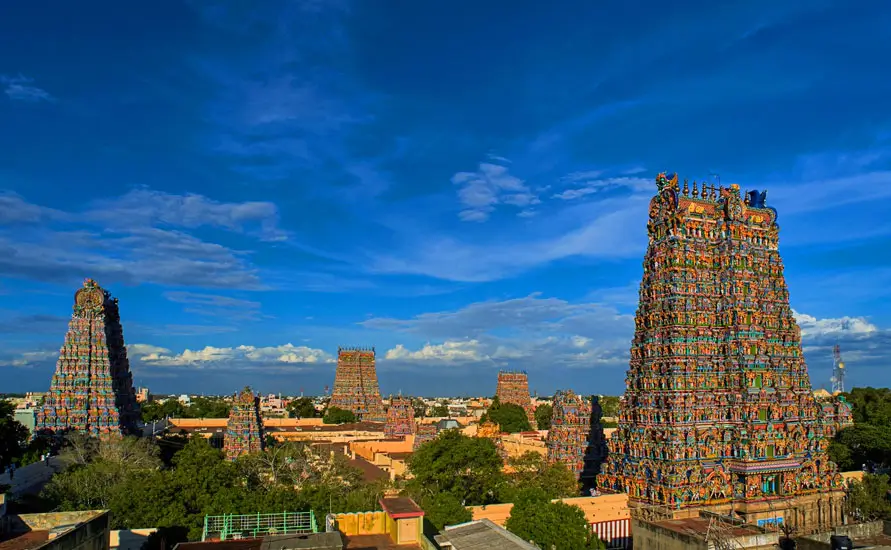
Near 5 pm you set out with your guide for the Meenakshi Temple, home of the fish-eyed goddess and of Sundareswarar, the handsome lord, as Shiva is known here. Phones and cameras cannot go in, so hand them in at the deposit booths by the entrance. The complex is enclosed by high walls and topped by 14 gopurams covered with thousands of painted stucco figures. The two inner sanctums are reserved for Hindus, but you can walk through the long corridors, sit by the Golden Lotus tank and watch the steady stream of pilgrims carrying flowers, ghee lamps and coconuts.
Stay on, or come back, for palliyarai at about 9 pm, the nightly rite that closes the temple day, when priests bear the god's festival image on a silver palanquin to the goddess's sleeping room, with pipes and chants marking each stop. The procession is a moving close to the temple day, and seeing it after so many other temples gives a good sense of how Tamil worship treats the divine almost as a royal family with a daily routine of waking, bathing, eating and sleeping. Your guide explains the stages as they happen. Dinner tonight is late and simple, back at your hotel. Overnight in Madurai.
A second visit to the Meenakshi Temple comes at breakfast time, when it is fresher and less crowded, to see the parts you missed in the evening. Legend says Meenakshi was a warrior princess born with three breasts who conquered the world until she met Shiva in battle, when the third vanished and she knew him as her husband; the city reenacts their wedding each spring at the Chithirai festival. You also visit the temple's museum in the thousand-pillared hall, with its bronzes, carvings and old photographs. Afterwards, stop for filter coffee at a small café on one of the streets around the temple.
At the Gandhi Memorial Museum later in the morning, galleries trace the freedom movement and Gandhi's own life step by step. For travelers interested in spiritual practice, it is a reminder of how Gandhi drew on Indian religious traditions in his philosophy of nonviolence. From there it is a short hop to the Thirumalai Nayak Palace, whose courtyard of giant white columns once formed the throne area of the Nayak king. The evening sound and light show, when running, tells the history of the palace, and the restored central hall gives a sense of how Nayak kings combined royal display with temple patronage. Lunch and a long siesta follow at your hotel.
In the late afternoon, there is time for a final quiet activity, such as a visit to the Thiruparankundram Murugan Temple, cut into a rock hill on the edge of the city, or a walk through the flower market where jasmine is sold by weight for temple garlands. If you prefer, your guide can arrange a short talk with a local scholar or a visit to a yoga or meditation center. For a last dinner, try a Madurai-style vegetarian spread on a plantain leaf, with rasam, kootu and payasam. Overnight in Madurai.
After breakfast, transfer to Madurai Airport for your flight home or onward travel. Most guests connect through a domestic hub such as Chennai or Bengaluru, or fly direct to the Gulf or Colombo, and your driver allows generous time for check-in and security. If your flight is in the evening, the morning can be spent at a small local temple, browsing the shops around the Meenakshi Temple for brass lamps and cotton saris, or simply resting.
Over twelve days you have walked around Arunachala, sat in the meditation halls of two great teachers and visited many of the most important living temples of Tamil Nadu. We hope this Tamil Nadu spiritual tour leaves you with both memories and a quieter mind, and our office can design a return visit to Rameswaram, Kanchipuram or the Himalayan ashrams whenever you are ready.
Your Journey

N.S. Rathore & Mrs. Omlata Rathore · Managing Director
We still read every enquiry ourselves. Tell us the places you liked and our planners will send a day-by-day route with drive times and a clear price.
Every package can be customised and no pressure to book. A planner from our office replies within 24 hours with a route written for your group.
Fill this in and your planner will send a first draft itinerary.
Explore more
Kerala Backwaters Escape Kerala Backwaters Escape
 Kerala Backwaters Escape
 Kerala Backwaters Escape
 Kerala Backwaters Escape
 Kerala Backwaters Escape
 Kerala Backwaters Escape
 Kerala Backwaters Escape
 Kerala Backwaters Escape
 Kerala Backwaters Escape
 Kerala Backwaters Escape
 Kerala Backwaters Escape