
 Kerala Backwaters Escape

Tamil Nadu Tour Packages
Chennai – Kanchipuram – Mahabalipuram – Pondicherry – Gingee – Tiruvannamalai – Chidambaram – Gangaikonda Cholapuram – Tanjore – Kumbakonam – Trichy – Chettinad – Madurai – Thekkady – Alleppey – Kochi
At a glance
Tamil Nadu has more working temples than almost anywhere on earth, and many of them have held daily worship without a break for a thousand years. Our Tamil Nadu Temple Tour with Kerala Backwaters spends eleven of its fourteen days among them. You see Pallava shrines in Kanchipuram and Mahabalipuram, four of Shiva's five element shrines, every one of the World Heritage Chola trio, the island temple of Srirangam, the cave shrine of Pillaiyarpatti in Chettinad and the vast Meenakshi Temple in Madurai, before crossing into Kerala.
The Kerala part is short and restful by design: two nights in the cardamom hills at Thekkady, then a night on a private Alleppey houseboat, before your flight home from Kochi. Drives on this Tamil Nadu temple tour mostly stay between two and four hours, with one longer day through the Chola country that is broken up by three temple stops. One chauffeur and one cool, private sedan handle every Tamil Nadu kilometer, with a Kerala car taking over at the border, and local guides who know temple customs and festival calendars join you in every major town.
The trip suits travelers with a real interest in architecture, sculpture and living ritual, from first-time visitors to India to returning guests and NRI families who want to see the temples their parents spoke about. You will be given advice on temple dress, shoe etiquette and photography rules before each visit. Travel between October and March for milder heat; should your dates match a temple festival or Chidambaram's Natyanjali dance festival, we will build it into your South India temple tour.
Welcome to Tamil Nadu. As you come out of the terminal at Chennai International Airport, our representative will be holding a placard with your name and will take you to the private air-conditioned car that stays with you for the Tamil Nadu part of the tour. The drive to your hotel is usually less than an hour. Most overseas flights reach Chennai late at night, which is why nothing is planned before evening and the hours in between are for sleep. Standard check-in is mid-afternoon, so for a pre-dawn landing, booking the previous night lets you go straight to bed.
Around six, your guide joins you for tea to go over the fortnight ahead and the temple etiquette that will soon become second nature. Footwear stays with a paid attendant at the gate, clothing should reach past the elbows and knees, and a few shrines prefer that leather belts and bags remain in the car. Photography is often allowed in the outer corridors but not near the main shrine, and your guide will tell you each time. A few simple words such as 'vanakkam' (hello) will earn you smiles from priests and pilgrims alike.
Your first temple is close to the sea in Triplicane, an old quarter of narrow lanes and Brahmin houses. The Parthasarathy Temple was first built by the Pallava kings in the 8th century and is dedicated to Krishna as the charioteer of Arjuna; the main image shows him with a moustache and battle scars from the Mahabharata war. Evening worship, with bells, camphor flames and Tamil hymns of the Alvar saints, is a fine introduction to the ritual life you will see throughout the trip. Afterwards your guide can show you a nearby sweet shop for a taste of Mysore pak. Overnight in Chennai.
Begin the morning in Mylapore, where the Kapaleeshwarar Temple has served as the spiritual center of the neighborhood for centuries. Rather than rushing straight in, your guide first leads you around the outside of the large temple tank, where devotees bathe on the steps and priests' families live in old houses facing the water. Inside, you see the shrine of Parvati as a peahen worshipping Shiva, and the bronze images of the 63 Nayanmar saints that are carried through the streets during the spring Arupathimoovar festival. Use this visit to learn the plan of a Tamil shrine, moving inward from the entrance tower past the flagstaff to the sanctum, because the same logic repeats at every stop ahead.
At the Government Museum in Egmore you then see the temple bronzes up close, without crowds or oil lamps. Cases of dancing Shiva figures let you trace how metal casters refined the image from Pallava times through the Chola peak and into the Vijayanagara period. Your guide points out details that are hard to see in a working temple, such as the fine jewelry, the flame halo and the small dwarf of ignorance under the dancing foot. Note that the museum is closed on Fridays, in which case we reverse the order of the day. For lunch, a meals hall nearby serves rice with a dozen small dishes on a steel plate.
Later, head to Thiruvanmiyur and the Marundeeswarar Temple, honoring Shiva as divine physician, where families often bring prayers for an ailing parent or child. The temple is peaceful in the late afternoon, and its long pillared corridors and sacred tank see few foreign visitors. Nearby is the beach at Besant Nagar, where you can end the day with a walk along the sand before dinner. Before you part, plan on a prompt departure tomorrow, since Kanchipuram's sanctums are busiest and most rewarding before noon. Dinner tonight can be light, perhaps a plate of idiyappam with coconut milk at a local eatery, followed by an early night. Overnight in Chennai.
Leave Chennai early and head two hours inland to Kanchipuram, once the Pallava royal seat, which the saying calls the city of a thousand temples. First up is the Varadharaja Perumal Temple, whose Vishnu complex was enlarged by dynasty after dynasty. Its hundred-pillared hall is famous for carvings of warriors on horseback and for chains cut from a single block of stone, hanging from its corners. Every forty years, the old wooden image of the god called Athi Varadar is raised from the temple tank for public worship; the last time was in 2019, when millions of pilgrims came to the town.
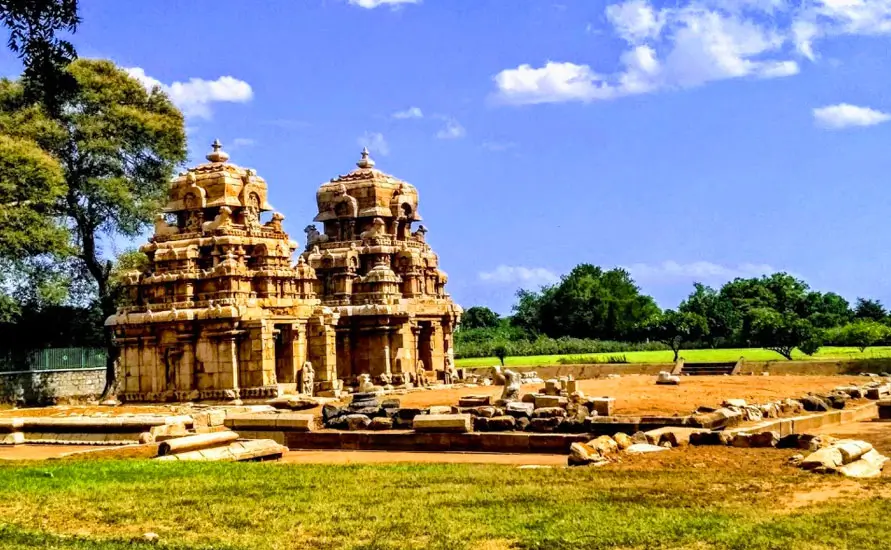
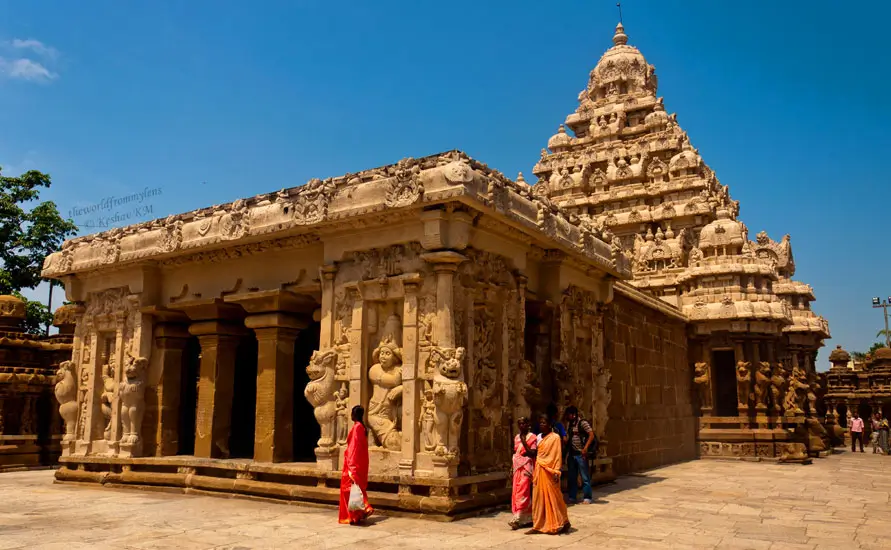
Across town rises the Ekambareswarar Temple, earth in the set of five element shrines that Tamil devotees know as the Pancha Bhoota sthalams. Here Shiva is worshipped as earth, in the form of a sand lingam, and an old mango tree in the courtyard is said to bear four kinds of fruit on its four branches. Over the next week you will also see the temples of fire at Tiruvannamalai, space at Chidambaram and water at Thiruvanaikaval in Trichy. Your final Kanchipuram stop is the compact sandstone Kailasanathar Temple from about 700, where faint patches of painted plaster still cling to the cell walls.
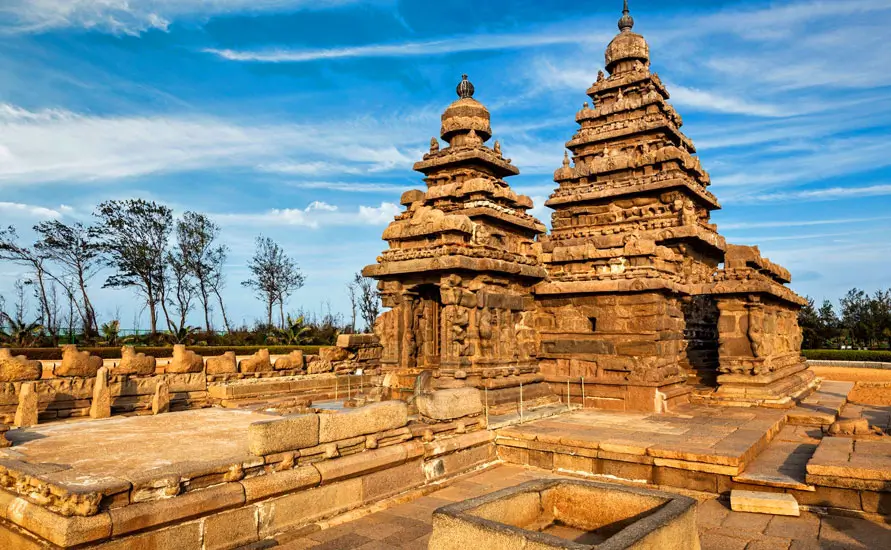
Following lunch, the car heads back east to the sea at Mahabalipuram and a beachside room. As the sun drops, you walk out to the Shore Temple, where two Pallava shrines face the waves, one dedicated to Shiva and the other housing a reclining Vishnu. Your guide explains how the two temples, built in stone rather than carved from the rock, mark an important step in South Indian temple design that would lead to the great Chola towers you will see later. The evening is free for seafood and a walk through the sculptors' lanes. Overnight in Mahabalipuram.
Spend the early morning at the rock-cut monuments of Mahabalipuram, which are listed together by UNESCO. Among the Pancha Rathas, all hewn from one granite ridge, notice how every shrine imitates a timber or thatch original, ranging from a humble hut roof to a stepped, many-storied tower. Inside the Mahishasuramardini Cave, Durga charges on her lion toward the buffalo-headed demon in one of the liveliest battle panels in India. Nearby, Arjuna's Penance and several half-finished carvings show how many chisels were busy here thirteen centuries ago. Your guide points out lines scratched into some rocks that mark where the next cut was planned.
After lunch, the shore road carries you south to Pondicherry, seat of French rule in India until 1954. Settle in near the old town and keep the hottest hours for a siesta. At about five, walk to the Manakula Vinayagar Temple, the town's beloved Ganesha shrine a block from the French streets, where residents stop before every fresh start, whether a new scooter or an exam. Its walls are covered in painted panels showing the different forms of Ganesha, and the evening puja is lively and loud with drums and bells.
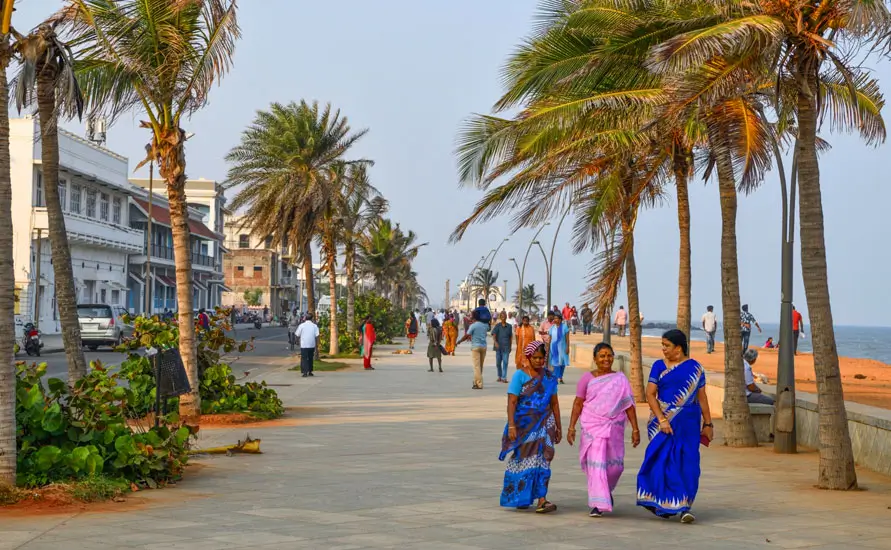
From the temple you walk into the French Quarter, with its straight streets of colonial villas, and continue to the Promenade, where the town comes out every evening to walk by the sea. Along the way you hear how the French Company built and lost and rebuilt this town, and you pass the old lighthouse and the Joan of Arc figure in front of the church. Dinner can be in a restored colonial house, perhaps with a Creole fish curry that mixes French and Tamil cooking. Tomorrow is a long and interesting day, so an early night is wise. Overnight in Pondicherry.
After an early breakfast you drive inland to Gingee, about one and a half hours from Pondicherry, where a fort spreads across three steep granite hills joined by thick walls. Over the centuries it passed from local chieftains to Vijayanagara, Maratha, Mughal, French and British hands, and the British nicknamed it the 'Troy of the East'. Your guide leads you through the lower fort to the Kalyana Mahal, a tall square tower with a pyramid roof, and the granary and temples nearby. Fit visitors can climb the steps to the top of Rajagiri hill, a climb of about an hour each way; others can enjoy the lower fort at a slower pace.
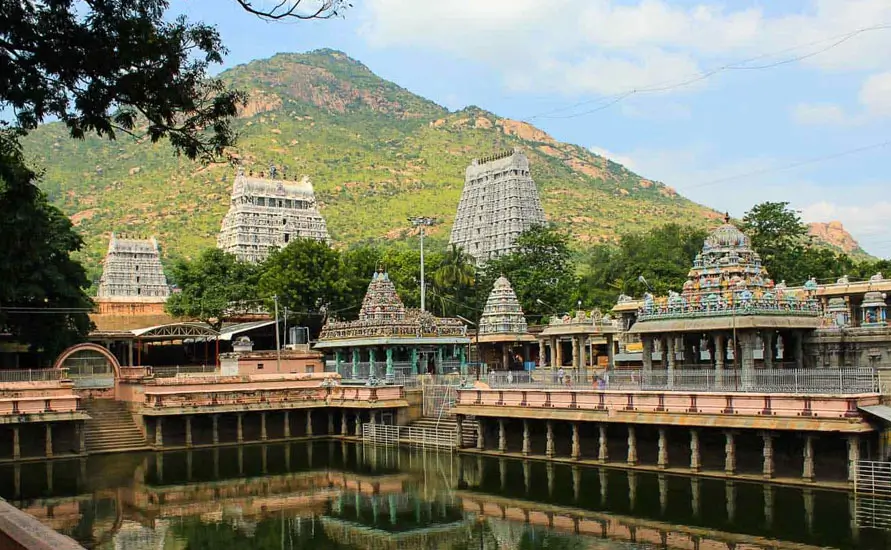
From Gingee it is about an hour to Tiruvannamalai, where the huge Arunachaleswarar Temple stands at the foot of the sacred Arunachala hill. Fire is the element worshipped here; each year at Karthigai Deepam a beacon blazes on the summit and can be seen from far across the plain. The temple has nine gopurams and covers about ten hectares, and your guide walks you through its courtyards and halls to the inner areas open to visitors. On full moon nights, huge crowds circle the mountain barefoot along its girivalam road.
Before heading back, you visit the Sri Ramana Ashram, where the sage Ramana Maharshi lived and taught until his death in 1950. Visitors from all over the world sit quietly in its meditation hall, and the peaceful garden is full of peacocks and monkeys. Your guide explains how this small town became a center for seekers from Europe and America in the 20th century. Expect to be back at your Pondicherry hotel by early evening, in time for a shower before dinner. It is a long day, so we pack a picnic breakfast for anyone who prefers to eat in the car. Overnight in Pondicherry.
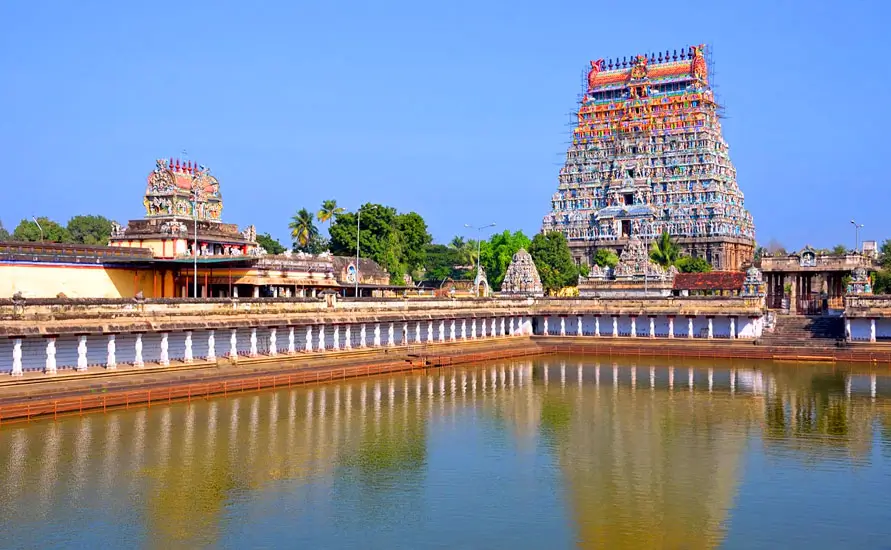
Today is a long day on the road, but it is broken up by two of the most important temples in South India. After breakfast you drive about 70 km south to Chidambaram and the Nataraja Temple, the Pancha Bhoota temple of space. The inner shrine has a golden roof, and the main image shows Shiva as Nataraja in his cosmic dance. Behind a curtain beside him is the famous 'Chidambara Rahasyam', an empty space hung with golden leaves that represents the formless god. Your guide also points out the carved panels of Bharatanatyam poses on the eastern gopuram, which inspire the Natyanjali dance festival held here each year around February or March.
Around midday comes Gangaikonda Cholapuram, whose name means 'the Chola town that took the Ganges', founded by Rajendra I after his northern campaign. Of the great royal capital only the temple remains, set among fields and quite empty of crowds. Its tower is lower than the one in Tanjore and has gently curved sides, and the carvings include a famous panel of Shiva crowning the saint Chandesha, thought to be a portrait of the king himself. An outsized Nandi rests in the courtyard, and legend says the lion-mouthed well beside it once held Ganges water carried south in triumph. UNESCO counts it among the Great Living Chola Temples.
After lunch you continue south-west to Tanjore, also called Thanjavur, about two hours away through rice fields and villages. Check-in is late afternoon, and nothing more is scheduled, which you will welcome after this much driving. Anyone still keen can visit a family studio producing Tanjore paintings, where you can see gold leaf, gesso and colored glass stones being applied to images of Krishna and other gods. The workshops are happy to explain the process even if you do not buy. A small piece makes a light, flat souvenir that travels well in a suitcase. Overnight in Tanjore.
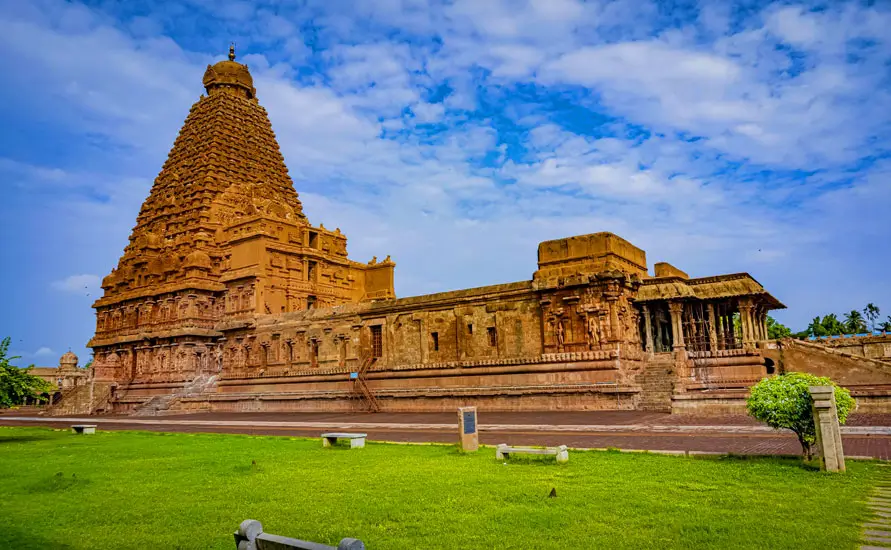
Be at the Brihadeeswarar Temple soon after it opens, when Rajaraja Chola I's great shrine of about 1010 is at its calmest. In the soft morning light, the granite tower glows gold, and the huge courtyard is quiet apart from priests and early pilgrims. Your guide explains how the capstone at the top, said to weigh around 80 tonnes, may have been raised along a long earth ramp, and reads out lines from the wall inscriptions that name the temple's dancing women, drummers and oil-lamp keepers one by one. Access to the Chola murals in the circumambulatory passage is irregular, so ask on the day.
By late morning you are at Darasuram, where Rajaraja II's 12th-century Airavatesvara Temple completes your set of three World Heritage Chola shrines. Of the three it has the most delicate carving, with miniature panels of dancers, drummers and village scenes, and wheels and prancing horses on its entrance pavilion. Lunch is in Kumbakonam, a busy temple town that your guide calls the 'temple capital' of the delta. Then come the Mahamaham tank, scene of a mass holy dip held once every twelve years, and the Sarangapani Temple, whose Vishnu sanctum sits on carved wheels of its own.
Before driving back to Tanjore, you may stop at the Nageswaran Temple in Kumbakonam, an early Chola shrine from the 9th century with some of the finest stone sculptures of the period, including graceful female figures in the niches of the outer walls. The light is warm in the late afternoon and the carvings are at their clearest. Back in Tanjore by dusk, you still have time to eat out. Your guide knows a family-run place for a delta-style banana-leaf supper, though an early night at the hotel is just as sensible. Overnight in Tanjore.
Sixty minutes west of Tanjore lies Trichy, properly Tiruchirappalli, astride the Cauvery. Your first stop is the island of Srirangam, where the Ranganathaswamy Temple spreads across some 60 hectares, ringed by seven walls with 21 gopurams. Its southern Rajagopuram, completed only in 1987, soars to roughly 73 meters, among the tallest temple gateways anywhere. Inside the walls are streets of houses, shops and markets, so the outer rings feel like a town in their own right. Inside, look for the rearing-horse columns of the Sesharaya mandapam, among the boldest carving of the Vijayanagara age. Non-Hindus may not enter the main sanctum.
Nearby is the Jambukeswarar Temple at Thiruvanaikaval, the Pancha Bhoota temple of water, where a small spring rises from the ground in the sanctum. It completes the set of four Pancha Bhoota temples on this route, and your guide explains how the five elements link the temples into one sacred map of the south. If time and energy allow, you can climb the steps of the Rock Fort, a huge rock above the city with the Ucchi Pillayar Temple on top, for a view over the Cauvery and the gopurams of Srirangam. The climb is steep, with about 400 steps.
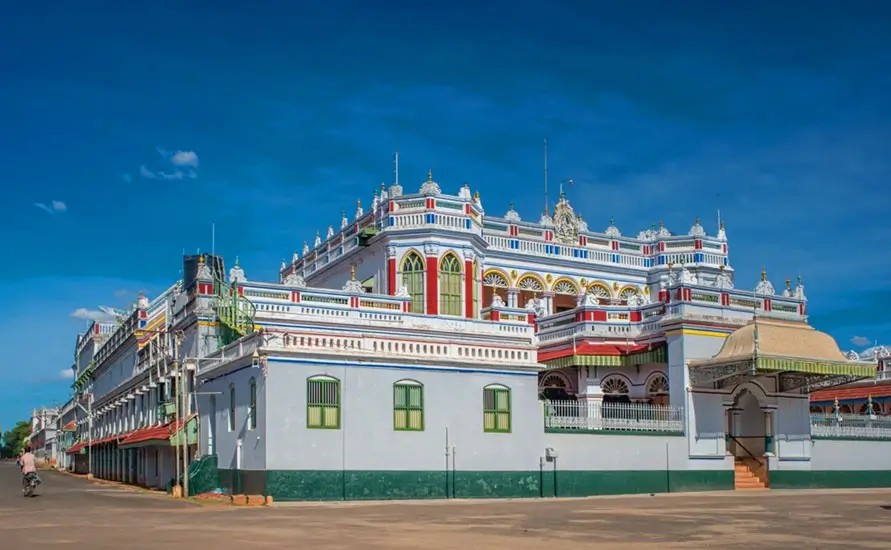
Two hours south after lunch lies Chettinad, land of the Nattukottai Chettiar bankers whose fortunes were made lending and trading across Burma, Malaya and Ceylon a century ago. Tonight's room is in a converted merchant house of colonnaded courtyards, teak beams shipped from Rangoon and imported floor tiles. Toward sunset, wander the lanes of Kanadukathan, where palatial facades line up wall to wall, most of them locked and silent behind their grand doorways. Dinner is a traditional Chettinad meal, known for its pepper, fennel and dried red chillies. Overnight in Chettinad.
Morning brings you to Pillaiyarpatti and its Karpaga Vinayagar Temple, where a Ganesha image hewn straight from the hillside is among the oldest of its kind in Tamil Nadu. The temple is closely tied to the Chettiar community, and local families come here before weddings, long trips and business deals. Your guide explains the community's network of nine clan temples, which kept family and trade ties strong even when the men spent years abroad. Next you stop at Athangudi, a village where craftsmen make the famous handmade cement floor tiles in bright colors, using glass plates and local sand, for homes across Tamil Nadu.
Before leaving Chettinad, your guide can take you into one of the old mansions that is open to visitors, where you see the large entrance hall, the wedding hall, the inner courtyard and the rooms where the women of the household lived. You also stop at a small antique market in Karaikudi, full of brass lamps, wooden doors and enamel tins from the old houses. After lunch you cover the last 90 km or so to Madurai, a city already known to Greek and Roman writers, where your hotel is booked for two nights. The afternoon is free to rest after the past few busy days.
At dusk, drive out to Thiruparankundram on the city's southern fringe, one of the six holy seats of Murugan. The temple is cut partly into the rock of the hill, and the inner shrines rise in levels, so you climb as you go deeper. It is popular with newly married couples, since Murugan is believed to have married Deivanai here. Back in the center, cool off with jigarthanda, Madurai's own chilled mix of reduced milk, almond resin and a scoop of ice cream. The stalls near the old town are busiest after eight, when families come out after dinner. Overnight in Madurai.
Madurai grew up around the Meenakshi Amman Temple, and the whole of today belongs to it. Arrive soon after opening, when the stone floors are still cool and devotees file in carrying coconuts and garlands. The temple has fourteen gopurams, the tallest of them about 52 meters high, covered in thousands of brightly painted figures of gods, demons and animals. Legend says Meenakshi, the fish-eyed warrior princess, came into the world with three breasts, one of which vanished when she first set eyes on Shiva, who wed her as Sundareswarar. Leave phones and cameras in the deposit booths at the gate; the two main sanctums are open to Hindus only.
Within, the Thousand Pillar Mandapam is crowded with carved musicians and mythic figures, and a set of musical pillars gives out separate notes when struck. Beside the Golden Lotus Tank you hear how the divine wedding is staged again each spring at the Chithirai festival, when the city fills with pilgrims. Later, the 17th-century Thirumalai Nayak Palace impresses with its giant white pillars and arches that marry Dravidian and Indo-Islamic design. Lunch is at a busy vegetarian restaurant near the temple, where servers walk the aisles with buckets of rasam and refill your leaf until you fold it shut.
The afternoon is free to rest. Near 9 pm you go back inside for the palliyarai, the bedtime rite in which priests bear Sundareswarar in a silver litter to the room where Meenakshi rests, to the music of drums and the long nadaswaram pipe. Respectful onlookers are welcome to stand at the edges and watch. Walking out afterwards, you find the surrounding lanes still awake with garland sellers, tailors at their machines and shops full of brass. Your driver waits at an agreed corner so you do not have to find the car in the crowds. Overnight in Madurai.
If you wake early, ask your driver to take you to the Mattuthavani flower market before breakfast to see the jasmine trade at its busiest. Then the car points west toward the Western Ghats, crossing farmland of cotton, coconut palms and the vineyards of the Cumbum valley near Theni. The road then climbs steeply in hairpin bends up to the Kerala border at Kumily, and the air becomes noticeably cooler. At the state line, Tamil script gives way to Malayalam on the shop boards, and the dry plains give way to dense green slopes.
By lunch you are in Thekkady, at a forest-edge resort that will be home for two nights. After the long run of temples, the change of pace is welcome. Around four, a farmer shows you his spice garden outside Kumily: cardamom clumps in the shade, pepper twining up silver oaks, and trees of nutmeg, clove and cinnamon. He explains harvesting and drying, and anything you want to take home can be bought straight from his store. Growers in these hills are proud of their green cardamom, which fetches top prices at the auctions.
After dark, an optional hour of Kalaripayattu, Kerala's old fighting art, brings leaps, high kicks and sword-and-shield duels to a small pit arena in Kumily. Or stay in for a relaxed Kerala dinner of lacy rice hoppers with a coconut-milk stew. The temperature drops at night, and a light sweater may be useful. Your guide will confirm tomorrow's boat ride timing on Periyar Lake, as tickets are sold on a first-come basis and the early boats are the best for wildlife. Pack binoculars and a light jacket for the morning on the water. Overnight in Thekkady.
The first departure of the morning on Periyar Lake is the one to catch, deep within the Periyar Tiger Reserve. The Mullaperiyar dam, finished by British engineers in 1895, drowned this valley, and the bleached stumps of drowned trees still poke above the surface. Scan the shoreline for elephant herds, gaur, sambar and wild pigs, while darters and cormorants dry their wings on the stumps. Big cats are present but almost never show themselves. Even on a quiet wildlife morning, the ninety minutes of mist lifting off the water make the early start worthwhile. Sit on the open upper deck for the best views and keep voices low.
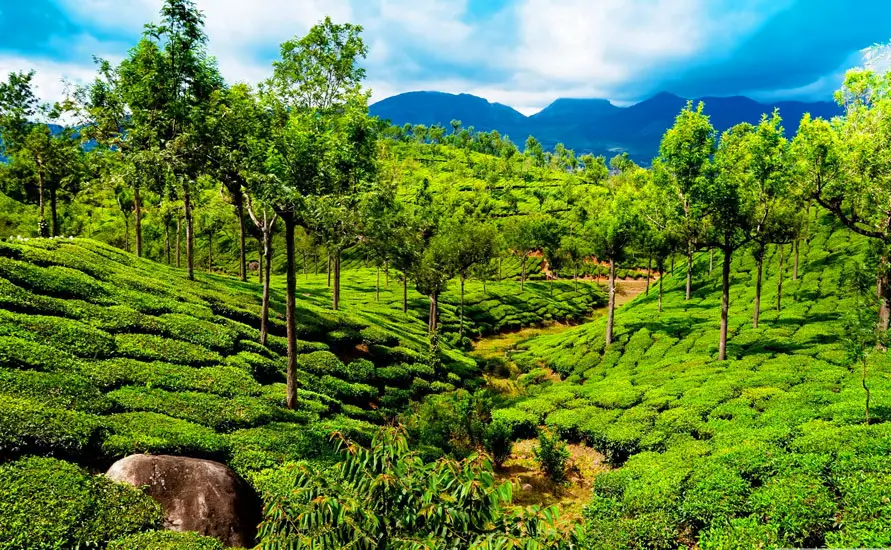
Breakfast is followed by a choice: a pre-booked trek inside the reserve led by a tribal tracker from the forest department, or a scenic hill drive to a tea and cardamom estate, where you see the processing sheds and learn how the leaves and pods are sorted and dried. Many guests also like to have an Ayurvedic massage at the resort in the afternoon after the long days of temple visits. The afternoon is free, and you can relax with a book on the balcony and listen to the birds.
In the late afternoon, you may like to take a short walk to the small town of Kumily to shop for spices, tea and handmade soaps, or visit a local home for a short cooking demonstration of Kerala dishes using fresh coconut and curry leaves. Your guide will also brief you on tomorrow's houseboat, including what to pack for one night on board and the meals that will be served. The evening is quiet, with dinner at your resort and early to bed before the drive down to the coast. Overnight in Thekkady.
Descending the Ghats after breakfast, the road winds through rubber estates and market towns to the flat rice country of Alleppey (Alappuzha) by about midday. Your crew of three, the boatman, his cook and one assistant, are waiting at the jetty beside your private houseboat. Its hull follows the old kettuvallam design, planks once stitched together with coconut-fiber rope, now topped with a rounded canopy of split bamboo and woven palm. You settle into your air-conditioned cabin while the crew prepares lunch. Take a moment to look around the boat, from the open sitting deck at the front to the small kitchen at the back.
Once a lunch of red rice, fish curry and pickles is cleared, the boat eases out into the waterways of Kuttanad, where paddy grows on polders reclaimed from the lake and protected by mud dykes. You pass small churches and temples on the banks, villagers going about their day, and boats loaded with coconuts or sand. After the crowded temples of Tamil Nadu, the slow pace and the quiet water feel very relaxing. In the afternoon, tea is served on deck with banana fritters, and you can sit and watch the scenery go by.
Since local rules halt houseboat traffic in the early evening, the boatman moors at a calm spot along the bank for the night. If you like, a crewman leads you along the bund to a nearby hamlet in time for lamp-lighting at its little church or shrine. Supper comes from the galley, spiced as mildly or as fiercely as you request. After dinner, sit on the deck and listen to the sounds of the night on the water, a peaceful end to two weeks of temples, towns and hills. Overnight on the houseboat.
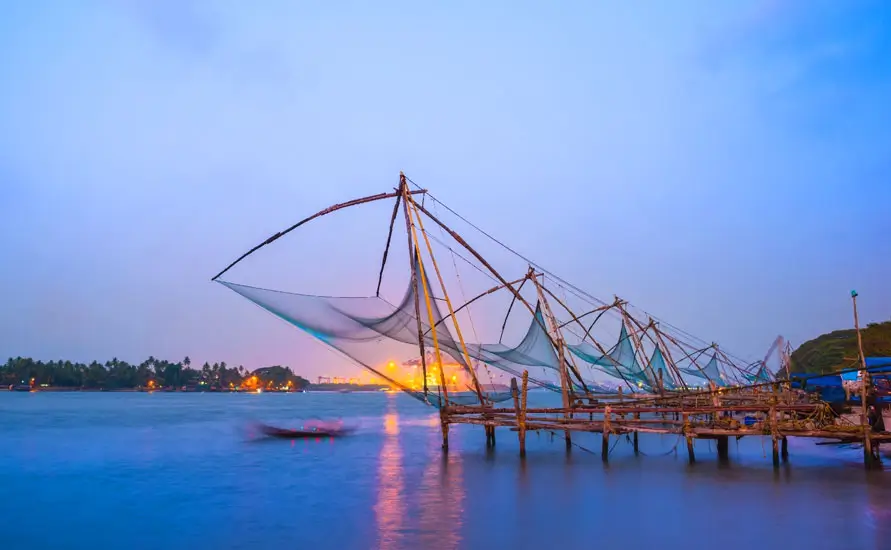
Breakfast is served on deck while the skipper steers back toward the landing, and you step ashore around 9 am. From there it is roughly 85 km to Cochin International Airport, which links to Gulf, Singapore and Colombo hubs for long-haul connections home. An evening departure leaves time for a detour to Fort Kochi and its waterfront fishing nets, or we can book you an airport-area hotel room for the afternoon at extra cost.
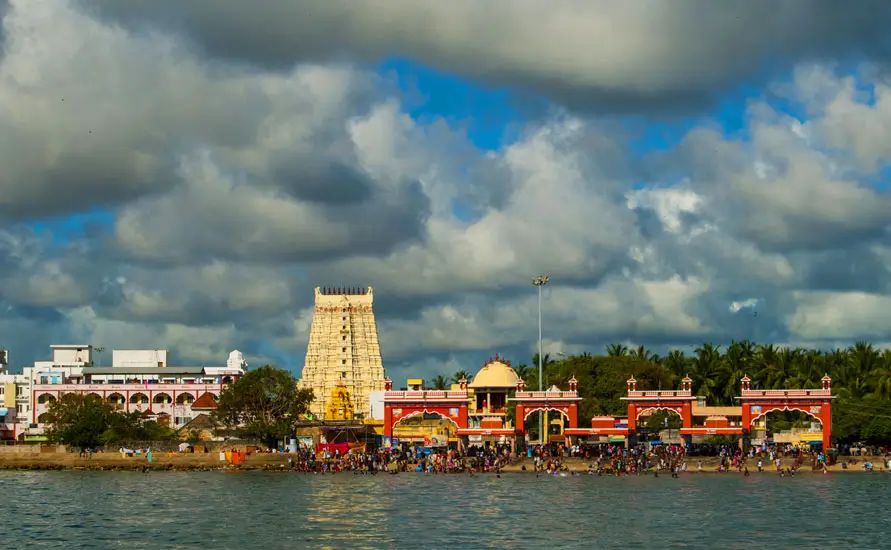
Over fourteen days you have followed more than a thousand years of temple building, from the Pallava shrines of Kanchipuram to the Chola towers of the Cauvery delta and the painted gopurams of Madurai, and ended with the cool hills and slow waters of Kerala. Your driver sees you to the departures door, and our office phone line stays open until you are in the air. For a future visit, the island temple of Rameswaram, the southern tip at Kanyakumari and the Nilgiri hills make a fine sequel, and our planners are ready when you are.
Your Journey

N.S. Rathore & Mrs. Omlata Rathore · Managing Director
We still read every enquiry ourselves. Tell us the places you liked and our planners will send a day-by-day route with drive times and a clear price.
Every package can be customised and no pressure to book. A planner from our office replies within 24 hours with a route written for your group.
Fill this in and your planner will send a first draft itinerary.
Explore more
Kerala Backwaters Escape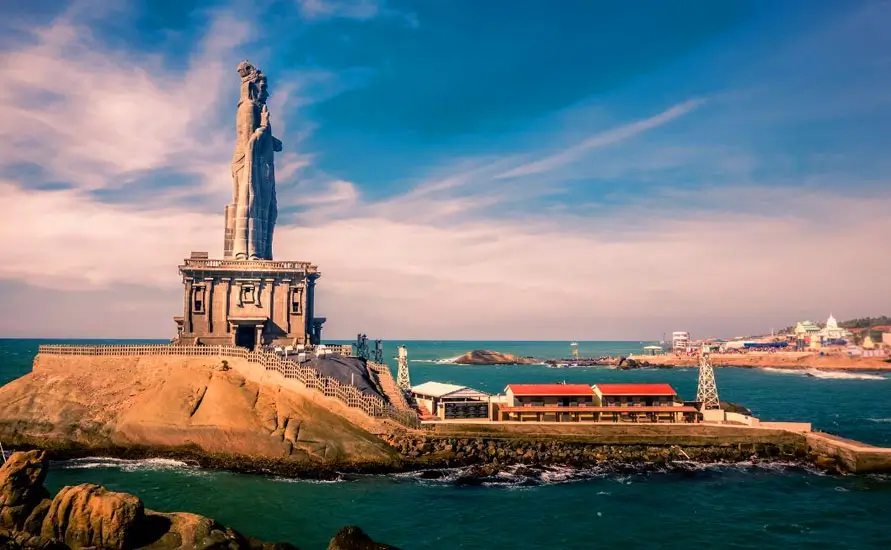 Kerala Backwaters Escape
 Kerala Backwaters Escape
 Kerala Backwaters Escape
 Kerala Backwaters Escape
 Kerala Backwaters Escape
 Kerala Backwaters Escape
 Kerala Backwaters Escape
 Kerala Backwaters Escape
 Kerala Backwaters Escape
 Kerala Backwaters Escape
 Kerala Backwaters Escape
 Kerala Backwaters Escape
 Kerala Backwaters Escape
 Kerala Backwaters Escape
 Kerala Backwaters Escape
 Kerala Backwaters Escape
 Kerala Backwaters Escape Kerala Backwaters Escape