 Kerala Backwaters Escape

Tamil Nadu Tour Packages
Chennai – Mahabalipuram – Pondicherry – Auroville – Villianur – Tranquebar – Tanjore – Madurai
At a glance
Most itineraries in South India change hotels every night. This one does the opposite. Our Tamil Nadu and Pondicherry Slow Travel Tour gives you two nights in Chennai, four full nights in Pondicherry and two in Madurai, with single-night stops only where the drive is short and the town is small. Instead of ticking off sights, you spend mornings in markets with the people who shop there, ride a bicycle through rice fields, cook lunch in a family kitchen and get your hands dirty at a potter's wheel and on an Auroville farm.
Slow does not mean empty. A typical day holds one or two booked sessions, mostly before the midday heat; after that you might read on a verandah, return to a favorite café or ask your guide to add something. Drives on this slow travel Tamil Nadu route are short, mostly under three hours, and the same English-speaking chauffeur drives every leg in a cool, private car. Local guides join you in Chennai, Mahabalipuram, Pondicherry, Tranquebar, Tanjore and Madurai, and our hosts for the classes speak good English.
The trip suits people who have already done a fast tour of India and want to go deeper, as well as first-time visitors who simply dislike rushing: couples, solo travelers, retired friends and NRI families who want their children to learn more than temple names. Plan for the drier, milder months from October through March. Every class, workshop and stay on this Tamil Nadu and Pondicherry Slow Travel Tour is private and can be swapped or skipped to suit your energy and interests.
Look for your name on a card as you walk out of the Chennai terminal with your luggage; the colleague holding it leads you to the car you will keep for all twelve days. Expect thirty to sixty minutes in the car, more at rush hour. Since this is a slow tour, nothing is scheduled before the evening: sleep, swim, eat something light and let your body catch up with the clock. Hotel rooms open around 2 pm, so on an early-hours landing it is worth paying for the previous night and heading straight under the covers.
When you feel ready, your guide comes by the hotel for a short conversation over coffee. This is the moment to talk through the coming twelve days, mention any food needs, and tell us which activities interest you most and which you would rather drop. Some guests want more cycling, others would happily swap a temple for a second cooking session, and the plan has room for both. Your guide also gives you a few words of Tamil to try, starting with 'vanakkam' for hello and 'nandri' for thank you, which open a surprising number of doors.
In the early evening you take a short drive to Besant Nagar, a leafy neighborhood on the south side of the city, where Chennai families walk along Elliot's Beach after work. The mood is relaxed, with balloon sellers, roasted peanut vendors and young couples sitting on the sand. Nearby stands the small Ashtalakshmi Temple, built in tiers so that visitors climb past eight shrines, one for each aspect of Lakshmi, with a view of the sea from the top. For supper, the plain-fronted eateries near the beach turn out paper-thin dosas hot off the tawa. Overnight in Chennai.
Chennai wakes early, and the best way to meet it is on foot before seven. At dawn your guide leads you into the lanes by the Kapaleeshwarar Temple tank in Mylapore; doorsteps are still wet from scrubbing, white kolam designs appear under quick fingers, and garland makers measure jasmine against their forearms. Stalls are piled with banana flowers, drumsticks, curry leaves and green mangoes, and your guide explains what each one is used for at home. Breakfast is at a long-running local tiffin room, where idli, vada and pongal arrive on a steel plate with sambar and coconut chutney, followed by frothy filter coffee.
Once you have rested, spend the late morning at Egmore's Government Museum, founded back in 1851. Walk past the older halls to its bronze wing, where dancing Natarajas, slender Parvatis and the Tamil poet-saints stand in long glass cases, most of them cast a thousand years ago. Ask your guide how wax, clay and molten metal produced them, because you will watch that very process in a village workshop near the end of the trip. The museum also has a section on the Amaravati Buddhist sculptures. Fridays and certain holidays see the museum shut, and we simply swap days if your dates fall that way.
At about four you head south to Kalakshetra, the dance and music school that Rukmini Devi Arundale started in the 1930s, when Bharatanatyam was close to dying out on the public stage. Its campus of thatched classrooms under banyan trees is a calm place to walk, and on many days visitors can watch students at practice from the edge of the open-air halls (classes follow the academic calendar and need prior permission). Your guide explains the basic hand gestures and footwork so you can follow what you see. Travelers here in December, the height of the music season, can ask us for tickets to an evening recital at one of the city's concert halls. Overnight in Chennai.
There is no early alarm today. Leave the city around mid-morning, after the commuter traffic, and follow the coast road south past fishing villages, art galleries and new beach houses. Pause first at Injambakkam, where the Cholamandal Artists' Village has housed a painters' and sculptors' cooperative since the 1960s, with studios, homes and a modest gallery under the trees. Chatting with people who earn their living by hand makes a fitting prelude to the classes coming up later in the trip. From there it is about an hour to Mahabalipuram, where you settle into a beach hotel for the night.
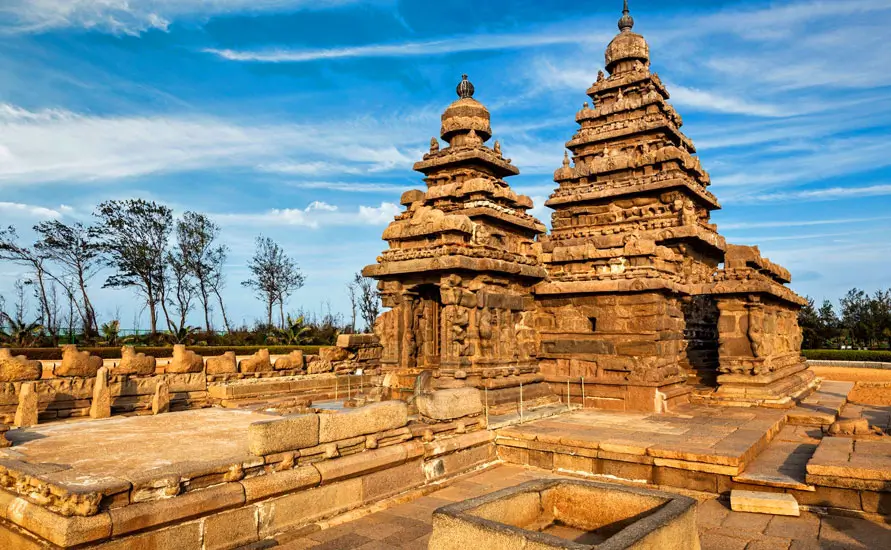
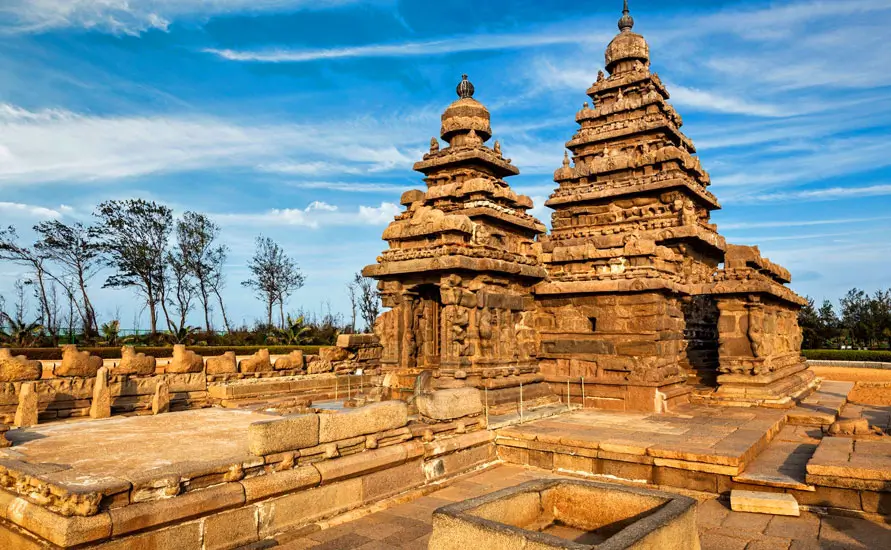
Lunch and an afternoon break come first. Then, as the light softens, your guide leads a walk around the UNESCO-listed monuments, choosing a quieter loop than the usual tour. Start with the small Varaha Cave, a pillared hall whose side walls show Vishnu in boar form rescuing Bhudevi from the ocean and two elephants pouring water over Lakshmi. From there you climb the boulder hill to the unfinished rathas and rock-cut shrines on top, where few visitors go. You end at the Shore Temple shortly before closing time, when the tour groups have left and the waves are loud against the breakwater.
Back in the village, the evening is yours. Many small restaurants along the lanes near the beach serve grilled fish, prawns and squid, often caught the same morning, and you can choose your fish from a tray before it goes on the fire. Afterwards stroll by the waterline in the dark, where the fishing boats lie pulled up in long rows ready for the next dawn. Your guide will explain tomorrow's carving session before you part, and suggest simple clothes you will not mind covering in granite dust. Overnight in Mahabalipuram.
Mahabalipuram has been a town of stone carvers for more than 1,300 years, and many families here still work with granite every day. This morning you spend about three hours in the open-air workshop of a sculptor's family, sitting on a low stool under a palm-leaf shade. The master carver shows you how to mark a design on a small block of soapstone, which is softer than granite and better for beginners, then hands you a chisel and a mallet. Most guests carve a simple motif such as a lotus, a fish or a small elephant, and you take your piece home at the end, wrapped in newspaper.
While you work, the family will explain how they learned the craft from their fathers, how they read the old Sanskrit texts on proportion that guide the size of each part of a temple figure, and how orders now come from temples as far away as the United States and Australia. Tea and biscuits arrive in the middle of the session, and children often wander in after school to see what the visitors have made. It is a friendly, unhurried morning, and it gives you a very different view of the monuments you saw yesterday.
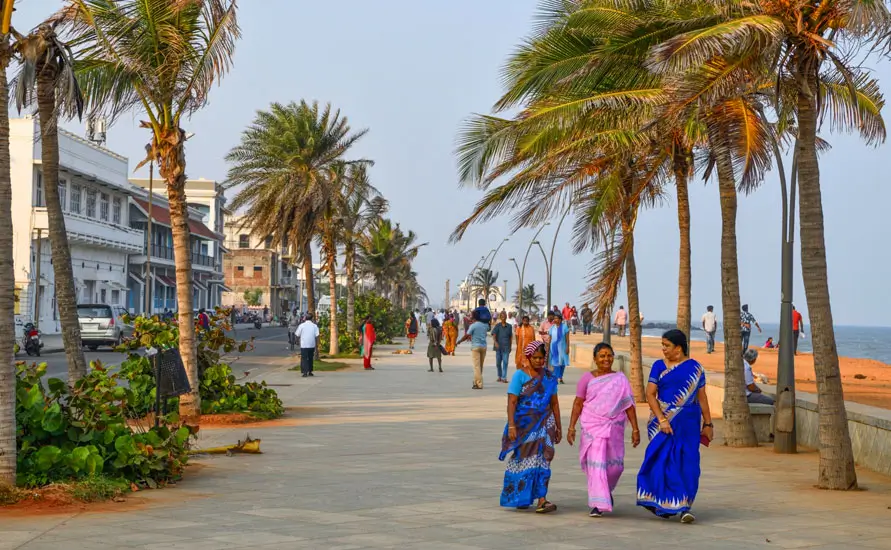
After a simple lunch, the coast highway carries you on to Pondicherry, some 100 km further, past salt flats and fishing hamlets. You check in to a heritage guesthouse in the old town that will be your home for the next four nights, so you can unpack fully and leave the suitcase in the cupboard. In the early evening, take your first slow walk to the seafront and watch the town come out for its daily stroll as the road closes to traffic. Dinner can be at a café a few streets inland, and there is no plan at all for tomorrow before seven. Overnight in Pondicherry.
Pondicherry is flat, compact and best seen from a bicycle, so today begins at about 6:30 am with a guided ride while the streets are still cool and empty. Bikes and helmets are ready at the guesthouse gate, and your guide pedals slowly through the French Quarter, by the old lighthouse, the town hall and rows of cream villas with green shutters. Over the drained canal lies the Tamil Quarter, its courtyard houses fronted by carved teak pillars, where brooms are already swishing across the street. Allow roughly 150 minutes, stops included.
The ride ends at Goubert Market, Pondicherry's main fresh market, at its busiest time of day. Fish sellers lay out tuna, seer fish and crab on wet sacking, the flower section is a mass of jasmine and roses sold by weight, and stalls sell masala powders, palm jaggery and milk sweets, many minded by grandchildren of the original owners. Your guide helps you buy a few things to taste and explains how to tell a good banana from a bad one, a skill the vendors find very funny to watch a foreigner learn. Breakfast follows at a local café with dosas and strong coffee.
After that, the day is deliberately open. Rest through the heat, sit in the guesthouse garden, or spend a quiet half hour at the Sri Aurobindo Ashram, whose courtyard tomb is laid fresh with blossoms each day. Later on, an optional hour at the Pondicherry Museum shows Roman shards dug up at Arikamedu, or to a bookshop and café where you can find French and Tamil titles side by side. In the evening, try a Creole dish such as a spicy fish curry with a French touch, a style of cooking found mainly in this town. Overnight in Pondicherry.
Today you cook. In the morning your host, a Tamil home cook who has taught visitors for years, meets you at a neighborhood market to shop for the day's lunch. You learn to choose fresh coconuts by shaking them for water, pick out curry leaves, tamarind, shallots and green chillies, and buy fish or vegetables depending on your diet. Back at the family home in the Tamil Quarter, the kitchen is laid out with stone grinders, brass pots and steel tins of spices, and your host explains the logic of a Tamil meal: rice in the middle, with a sambar, a rasam, a dry vegetable, a curry and curd around it.
The class lasts about three hours and is fully hands-on. You might temper mustard seeds and urad dal in hot oil, grind fresh coconut paste for a kootu, roll out a few parottas or chapatis and make a Pondicherry-style fish curry with tamarind. Your host talks about how French and Tamil cooking met in this town and shares the family's own variations. When everything is ready, you sit down together to eat on banana leaves, using your right hand if you like, and you leave with printed recipes and a small bag of spice mix to take home.
Nothing else is planned after the meal, which suits most people once they have eaten that well. Late in the day you might walk along the Promenade to the old pier, step inside Notre-Dame des Anges, whose bells you can hear from the beach, or hunt for handloom cotton, leather sandals and incense in the small boutiques of the old town. Your driver is on call if you want to go further, for example to the quiet Serenity Beach north of town. In the evening there is no fixed plan, and a light dinner is probably all you will want. Overnight in Pondicherry.
Volunteers keep much of Auroville running, the township begun in 1968 a short drive north of Pondicherry, and for a few hours this morning you become one of them. Depending on the season and what is running, you may help on an organic farm, weeding beds, collecting seeds or harvesting greens, or join a tree-planting team whose predecessors turned a red, gullied plateau into the woodland around you. A resident explains the work and the ideas behind the project as you go. It is real work in the sun, so bring a hat and water, and the coordinator will match the task to your fitness.
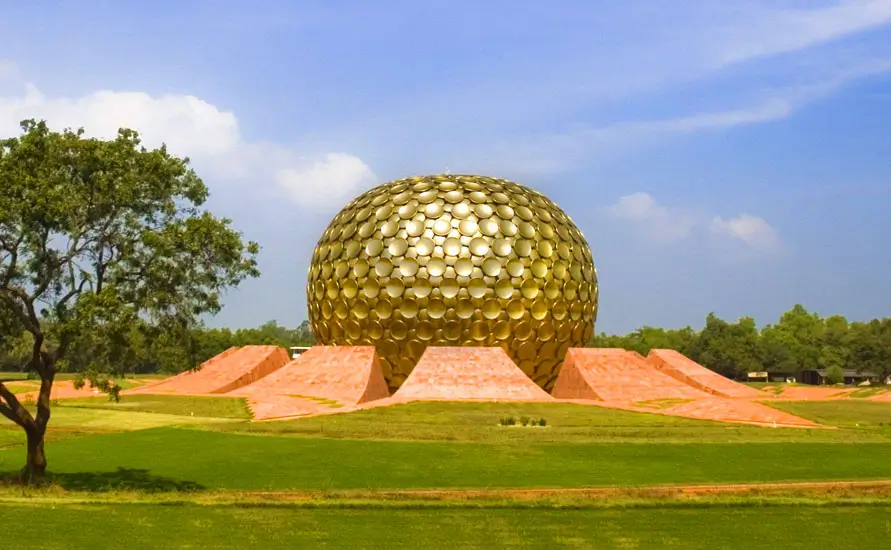
Lunch follows at a shared kitchen or café, cooked largely from greens and grains grown inside the township. Next comes the Visitors Center, an introductory film and a woodland path ending at the official spot for viewing the golden Matrimandir. Sitting inside its chamber requires a separate booking made well ahead, and slots are few, so mention it at the planning stage. In the afternoon you join a pottery class in one of the Auroville studios, where a potter teaches you the basics of centering clay on the wheel and pulling up a simple bowl or cup.
Pottery takes patience, and the teacher usually lets you try several times until a piece holds its shape. Your best work can be fired and glazed, but this takes a few days, so the studio will either keep it for you to collect before you leave Pondicherry or ship it on at extra cost. The teacher also explains the local red and black clays and the wood-fired kilns used in the area. You return to Pondicherry before dark, a little tired and probably dusty, with the evening free for a meal and an early night. Overnight in Pondicherry.
A short drive west of Pondicherry brings you to Villianur, a town known for its terracotta and papier-mâché craft, where potters make large horses, deities and lamps for local temples and homes. This morning your guide introduces you to a family workshop, where you see clay mixed with river sand, shaped by hand and on the wheel, dried in the sun and fired in an open kiln. Large terracotta horses are still offered at village shrines to Ayyanar, the guardian god of rural Tamil Nadu, and your guide explains why they stand at the edge of so many villages. If you enjoyed yesterday's class, you can try your hand again here.
Before leaving Villianur, call in at the Thirukameeswarar Temple, a sizable Chola-era shrine beside a broad tank that sees hardly any overseas visitors. Your guide explains the inscriptions and the temple festival, when a big wooden chariot is pulled through the streets. You return to town in time for lunch, perhaps at a small family-run restaurant serving a full vegetarian meal on a banana leaf with unlimited refills of rice and sambar. If you have left a pottery piece with the Auroville studio, your driver can collect it this afternoon.
The afternoon and evening are free on your last full day in Pondicherry. Some guests book an Ayurvedic massage, others spend the time cycling again on their own or sitting by the sea with a book. You might also return to one of the cafés or shops you liked earlier in the week, which is one of the pleasures of a longer stay. In the evening your guide can recommend a rooftop restaurant with a sea breeze, or you can simply walk to the beach and watch the last light over the town. Tomorrow you move on, and the drive is short. Overnight in Pondicherry.
Leave Pondicherry after a late breakfast and drive south into the delta, past Cuddalore and the long rows of coconut palms that line the road. Around midday you reach Chidambaram, whose Nataraja Temple honors Shiva as lord of the dance. Your guide explains the four tall gopurams, the gold-roofed inner shrine and the carved panels of the 108 dance poses of Bharatanatyam on the eastern gateway. Priests from the Dikshitar families, recognizable by the topknot worn to one side, have looked after it for generations. Wear covered shoulders and knees; in a few inner halls men are expected to go bare-chested.
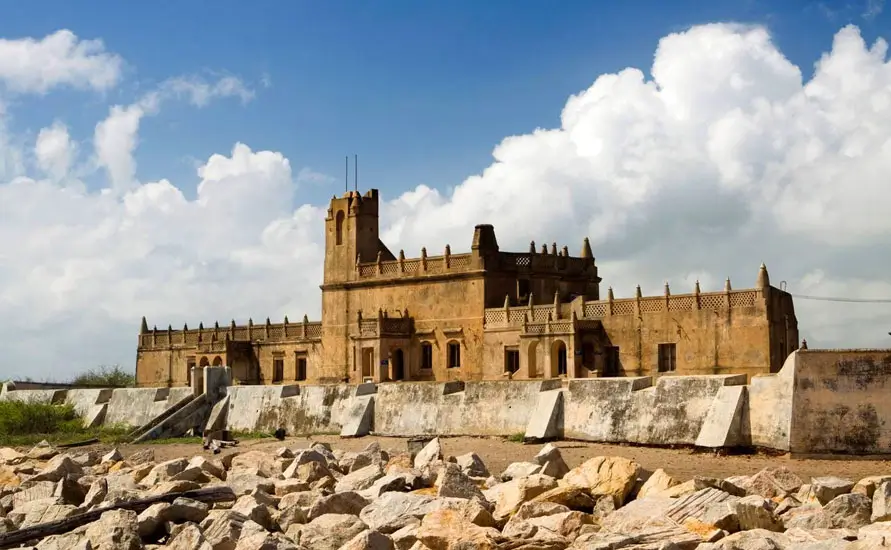
After a simple South Indian lunch in Chidambaram, the road takes you further south across the Kollidam river to Tranquebar, also called Tharangambadi, a small seaside town that the Danish East India Company held from 1620 until 1845. Your room is in a restored colonial house within the old walls, and by mid-afternoon the lanes outside are nearly deserted. The pace here is even slower than in Pondicherry, with few cars, a handful of shops, and the sound of waves from almost every street. Take a rest before a short walk in the cooler hours.
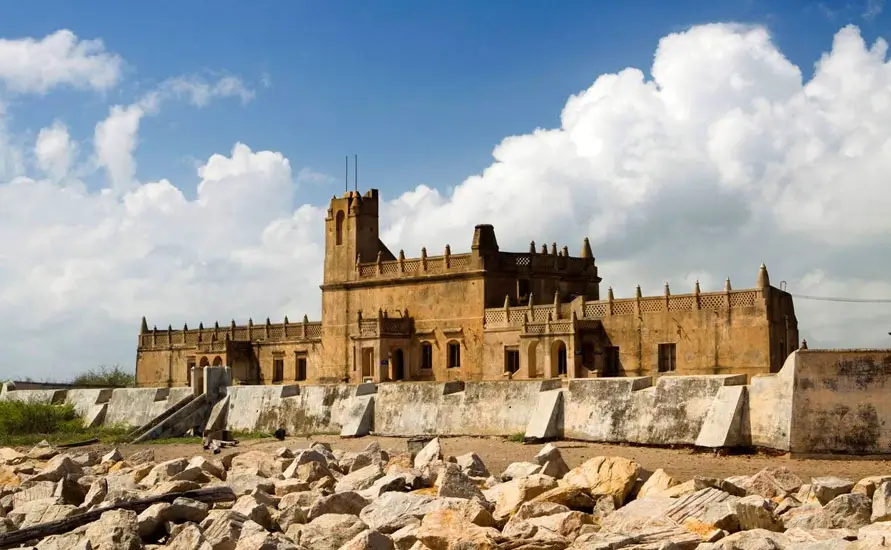
Later, an easy walk down King Street reaches Fort Dansborg, the Danish stronghold of 1620, where a modest museum keeps coins, correspondence and household pieces (shut on Fridays). Up on the walls, look down on beached fishing boats and a crumbling shore temple slowly giving way to the surf. In the evening the beach fills with local families and fishermen mending nets, and it is a lovely place to sit and watch the sky change color. Dinner at the hotel is often fresh fish cooked in a simple coastal style. Overnight in Tranquebar.
Get up early enough to see the boats land just after daybreak, when buyers crowd round to bid for the fish right there on the beach. After breakfast, you drive inland through the green rice country of the Cauvery delta to Swamimalai, near Kumbakonam, a village where families of sthapathis have cast temple bronzes for many generations. At a workshop you see each stage of the lost-wax process: the wax model shaped by hand, the clay mould built around it, the molten metal poured in and the finished figure chiseled and polished. It links directly to the Chola bronzes you saw in the Chennai museum on Day 2.
From Swamimalai it is a short drive to Darasuram, where the 12th-century Airavatesvara Temple shares World Heritage listing with the great shrines of Tanjore and Gangaikonda Cholapuram. Your guide shows you the carved musicians and dancers, the rearing stone horses and carved wheels that make the entrance pavilion look ready to roll, and the tiny panels of everyday life, from wrestlers and acrobats to mothers carrying children on their hips. Lunch is in Kumbakonam, and by mid-afternoon you have reached Tanjore, known locally as Thanjavur, for a single night. There is time for a short rest before the evening's visit.
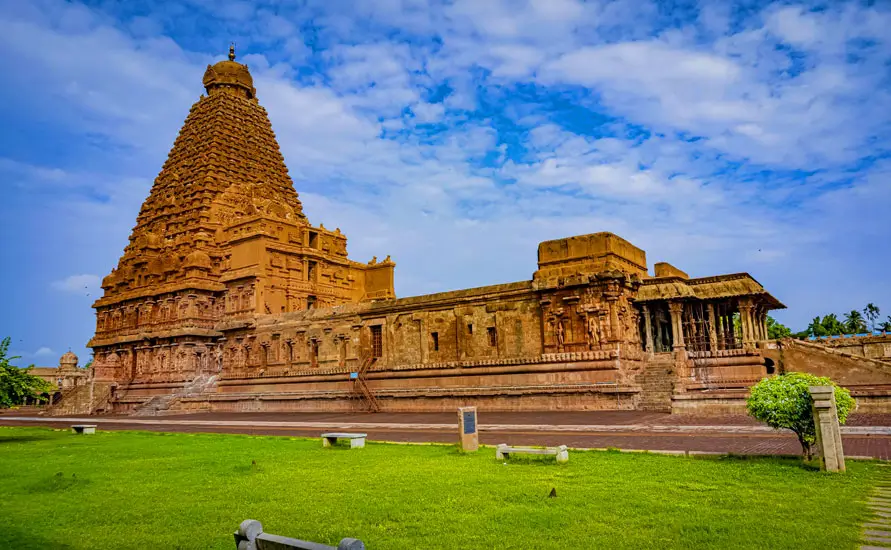
Near sunset you enter the Brihadeeswarar Temple, Rajaraja Chola I's great offering, finished about the year 1010. The granite tower rises about 66 meters over the sanctum, and the huge Nandi bull, carved from a single stone, faces the shrine from its own pavilion. Walk slowly around the outer cloister, where faded frescoes and long rows of lingams line the walls, and wait for the evening lamps to be lit. On the way back, ask your guide about a short visit to a family workshop that makes traditional Tanjore paintings with gold leaf and glass stones. Overnight in Tanjore.
Begin with an hour in the Thanjavur Palace, seat of Nayak and later Maratha kings, and its Saraswathi Mahal Library, where cases display painted manuscripts, early atlases and treatises on herbal remedies and ragas. After a coffee, you set off for Madurai, about four hours away, along a highway through dry plains and small towns. The scenery changes as you go, from the wet delta rice fields to fields of cotton, chilli and millet. Your driver will stop for lunch at a reliable roadside restaurant, and you reach Madurai in the middle of the afternoon to check in for two nights.
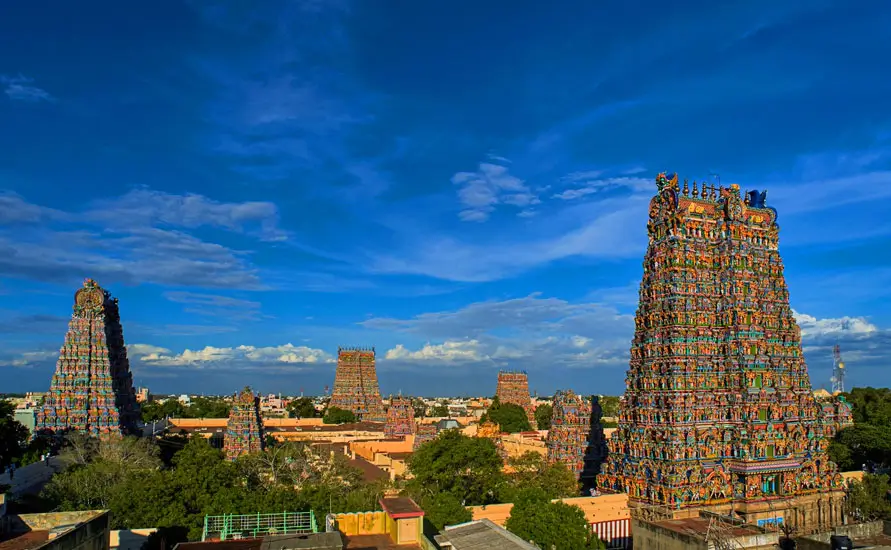
After a rest, your guide meets you at about five for a walk through the old city streets that circle the Meenakshi Amman Temple. Square rings of streets surround it, each ring bearing the name of a Tamil month whose festival parade once used it. You pass tailors working at sewing machines in a long colonnaded market hall, shops selling brass lamps and temple jewelry, and stalls of jasmine garlands. Then you enter the temple itself, home to the goddess Meenakshi and her husband Sundareswarar, with towering gopurams covered in painted figures. Phones and cameras go into safekeeping at the entrance counters; the innermost shrines are reserved for Hindus.
Within the walls, a modest art gallery occupies the Hall of a Thousand Pillars; legend says poets of the ancient Sangam academy proved their verses at the Golden Lotus Tank by setting the palm leaves on its water. Those with stamina can return around nine for the palliyarai, the nightly rite in which priests carry Sundareswarar on a palanquin to the goddess's chamber, accompanied by drums and the nadaswaram. It is a moving ritual, and visitors may watch from a respectful distance. Your driver will be waiting near the gate afterwards to take you back. Overnight in Madurai.
Your last morning starts at first light at the Mattuthavani flower market, one of the biggest in South India, where farmers bring in huge sacks of jasmine, marigold and rose petals that are sold by weight and sent on to temples, weddings and homes across the state. Madurai jasmine, known as malli, has its own geographical indication tag, and the scent in the hall is extraordinary. With time before your flight, choose between the Gandhi Memorial Museum, keeper of the garment he wore on the day of his murder in 1948, and the huge stucco columns of the Thirumalai Nayak Palace.
Expect a drive of about thirty minutes to Madurai Airport, with services to Chennai, Bangalore, Mumbai and Colombo that link to long-haul routes. For an evening departure, a short-stay room or one more night can be added. Over twelve days you have shopped in markets, ridden through Pondicherry at sunrise, cooked, carved and thrown clay, and found time to sit and watch daily life go by. Someone from our office remains reachable by phone until boarding, and we would love to host you again for a further unhurried chapter in the south.
Your Journey

N.S. Rathore & Mrs. Omlata Rathore · Managing Director
We still read every enquiry ourselves. Tell us the places you liked and our planners will send a day-by-day route with drive times and a clear price.
Every package can be customised and no pressure to book. A planner from our office replies within 24 hours with a route written for your group.
Fill this in and your planner will send a first draft itinerary.
Explore more
Kerala Backwaters Escape Kerala Backwaters Escape
 Kerala Backwaters Escape
 Kerala Backwaters Escape
 Kerala Backwaters Escape
 Kerala Backwaters Escape
 Kerala Backwaters Escape
 Kerala Backwaters Escape
 Kerala Backwaters Escape
 Kerala Backwaters Escape
 Kerala Backwaters Escape
 Kerala Backwaters Escape