 Kerala Backwaters Escape

Tamil Nadu Tour Packages
Chennai – DakshinaChitra – Mahabalipuram – Pondicherry – Chidambaram – Gangaikonda Cholapuram – Tanjore – Darasuram – Karaikudi (Chettinad) – Madurai
At a glance
Few regions let you follow a building tradition from its first experiments to its grandest conclusions in a single week. Our Tamil Nadu heritage tour with Chettinad does exactly that. You start with the colonial courts and forts of Chennai, then see how Pallava sculptors in Mahabalipuram carved the earliest prototypes of the South Indian temple straight out of granite boulders. Further south come the Chola vimanas of Tanjore, the banker mansions of Chettinad and the painted gopurams of Madurai, so every stop adds one more chapter to a single architectural story.
The defining feature of this Tamil Nadu heritage tour is the stay in the Chettinad country around Karaikudi. Instead of a single rushed afternoon, you spend two nights in a restored mansion built by a Nattukottai Chettiar banking family, with pillared courtyards, Burma teak doors and hand-made Athangudi floor tiles underfoot. That gives you time to walk the quiet villages, visit a tile workshop, and eat Chettinad food where it was first cooked. Your own driver, fluent in English, keeps the same air-conditioned car with you for all nine days, while licensed local guides handle the key monuments.
You visit each Great Living Chola Temple inscribed by UNESCO, plus Chidambaram, the Pondicherry Tamil and French quarters and DakshinaChitra's collection of rebuilt village houses. Road legs last two to five hours, and the longest one is split by two temple stops. Our past guests on this route include retired architects from Edinburgh, photographers from Melbourne and history teachers from Ohio, along with NRI families who brought grandparents and teenagers to see the stonework their ancestors prayed in. November to February brings the most pleasant weather.
Past the customs hall, our host stands by the arrivals barrier with a sign bearing your name, takes charge of the bags and guides you out to the waiting car. Since most overseas arrivals reach Chennai between late evening and dawn, the morning stays empty on purpose. Hotel check-in normally opens at 2 pm, and an early room can be reserved for you if your flight touches down in the small hours. During the drive your host goes through the week ahead, hands over a printed route plan and covers the practical basics, from ATMs and mobile data to what to wear in a temple.
At about 3 pm your heritage guide arrives at the hotel to show you the Madras that East India Company traders put up on a strip of sand in the 1600s. Fort St. George, begun in 1644, was the first English fortress in India, and its walls now enclose the Tamil Nadu legislature and a small museum of arms, coins and portraits. Inside the fort stands St. Mary's Church, completed in 1680 and the earliest surviving British church anywhere in Asia. Its thick walls and bomb-proof vaulted roof were designed for a frontier settlement, and memorial tablets inside record the governors, soldiers and merchants who lived and died here. The museum is closed on Fridays.
Leaving the fort, the drive passes some of the best examples of Indo-Saracenic architecture in South India, a colonial style that mixed Gothic arches with Mughal domes and Hindu brackets. The red towers of the Madras High Court, completed in 1892, rise beside the brick and stone bulk of Chennai Central station and the white Ripon Building, home of the city corporation. Your guide explains how British engineers borrowed from Indian builders to give the empire a local face. Your walk wraps up near sunset by the red-and-white lighthouse on the Marina, after which the car heads back for dinner. Overnight in Chennai.
Breakfast is unhurried before the car turns onto ECR, the coastal highway heading south past fishing hamlets and new beach villas. Roughly sixty minutes south of the city sits DakshinaChitra, a living museum where genuine village homes from all five southern states now stand side by side. Each one was dismantled in its original village, numbered piece by piece and reassembled here with the help of the same kinds of craftsmen who built it. The center is usually closed on Tuesdays, so the itinerary is adjusted if your second day falls on one. Allow around three hours to walk the site properly.
For an architecture-minded traveler, the Tamil section is the most useful hour of the whole tour. You walk through a Chettiar merchant house with its long central courtyard, a Brahmin agraharam home with a raised thinnai verandah facing the street, and a weaver's house where the pit loom sits in the main room. Kerala's sloping tiled roofs and carved wooden walls stand a short walk away, making the differences between the two states easy to see. Potters, basket makers and puppeteers often work on site, and a small café serves South Indian lunch on banana leaves.
Half an hour more on the road takes you into Mahabalipuram, where your seaside room is ready by mid-afternoon. On the way in, ask the driver to pause at Saluvankuppam, a few kilometers short of town, where the so-called Tiger Cave is ringed by eleven carved yali heads with bared teeth. It is rarely crowded and makes a good preview of tomorrow's monuments. Supper can be squid or kingfish from a family kitchen in the old fishing quarter, after a short stroll on the sand, and the hotel can pack a flask of coffee for tomorrow's early start. Overnight in Mahabalipuram.
Start soon after sunrise at the Pancha Rathas, five temples hewn from a single ridge of granite in the 7th century, before tour buses arrive. Your guide treats them as an architect's sketchbook. Draupadi's shrine copies a thatched village hut, Bhima's long barrel roof foreshadows the later gopuram, and Dharmaraja's stepped tower is an early version of the vimana that the Cholas would raise to great heights in Tanjore. The apsidal Nakula-Sahadeva ratha, shaped like the back of an elephant, has a life-size stone elephant parked beside it as a visual pun. All of them belong to a single World Heritage listing that covers the town's Pallava monuments.
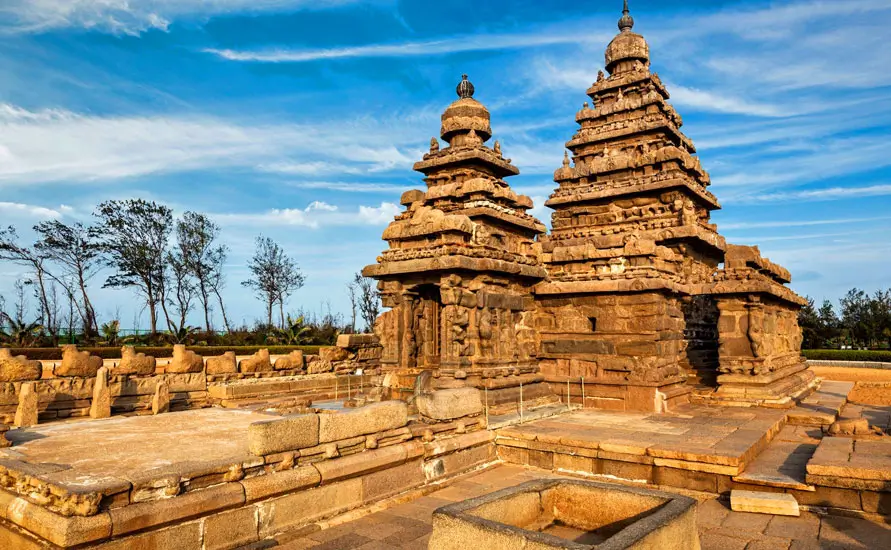
Moving into town, you look at the cave halls cut into the main hill. The Varaha Mandapa and the Mahishasuramardini Mandapa show how Pallava craftsmen shaped pillars with seated lions at their bases and filled the walls with crisp narrative panels, including the goddess Durga on her lion fighting the buffalo demon. Above them, the little Olakkannesvara temple once served as a lighthouse, and the view from the rock takes in the whole site. Last comes the Shore Temple, raised under Narasimhavarman II around 700 AD, where the builders switched from carving a hillside to stacking dressed granite blocks, a decisive step for South Indian architecture.
After lunch you follow the coast road south for around two and a half hours, past casuarina plantations, prawn farms and salt flats shining white in the sun. Your hotel in Pondicherry sits close to the old town, and late afternoon is set aside for a guided walk through the Tamil Quarter west of the canal. Street fronts here carry thinnai, raised stone benches built for chatting with passers-by, plus pillared talvaram verandahs that shade each doorway. Restoration work by local conservationists has saved many of these houses, and your guide points out the ones that kept their original timber columns. Overnight in Pondicherry.
An early morning stroll covers the French side of Pondicherry while the streets are still cool. White Town was laid out on a strict grid in the 18th century, and its houses face the street with high walls, tall shuttered windows and arched gateways, the reverse of the open Tamil homes you saw yesterday. You pass the pastel facade of Notre-Dame des Anges, the colonnaded Aayi Mandapam in Bharathi Park and the seafront promenade. By 8:30 am you are on the road south, crossing the Gingee and Vellar rivers on the way to Chidambaram, a drive of a little under two hours.
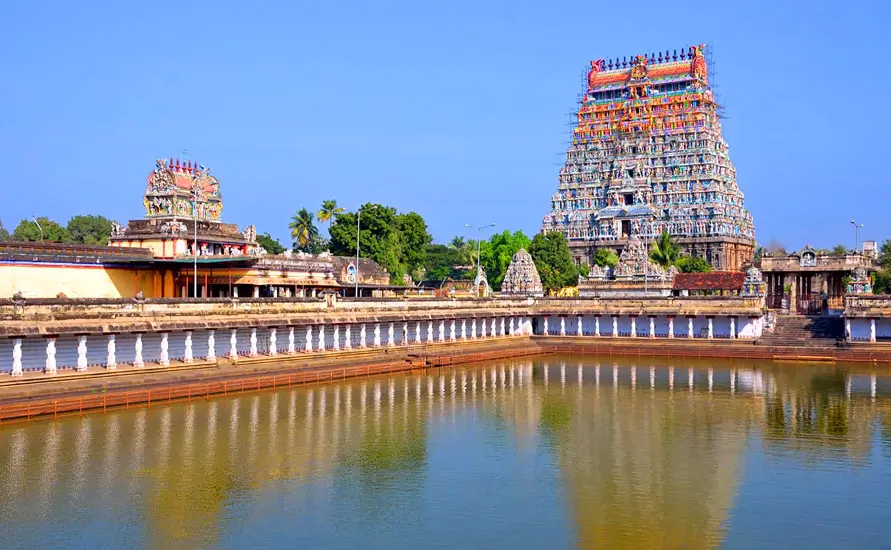
The Nataraja Temple of Chidambaram honors Shiva in his dancing form and ranks among the holiest Shaiva sites in the state. Its inner hall, the Chit Sabha, carries a roof covered in gold plates, and the eastern gopuram is carved with the 108 karanas, the classical dance poses later used by Bharatanatyam teachers. Around Maha Shivaratri each year, classical dancers arrive for the Natyanjali festival and perform as an offering to the deity. Priests may request that men take off their shirts for the innermost halls; the doors close near noon, which is why you get here by about 11.
A thali lunch near the temple fuels the next hour on the road to Gangaikonda Cholapuram, which Rajendra Chola I founded around 1035 to celebrate his campaign north to the Ganges. The tower here is shorter than the one in Tanjore and curves gently inward as it rises, a softer profile that many architects prefer. Near the north entrance, a relief shows Shiva crowning his devotee Chandesha with flowers, a small masterpiece worth several minutes, and across the lawn sits a brick-and-stucco Nandi. The site is usually quiet, which suits photography. Tanjore comes into view around dusk. Overnight in Tanjore.
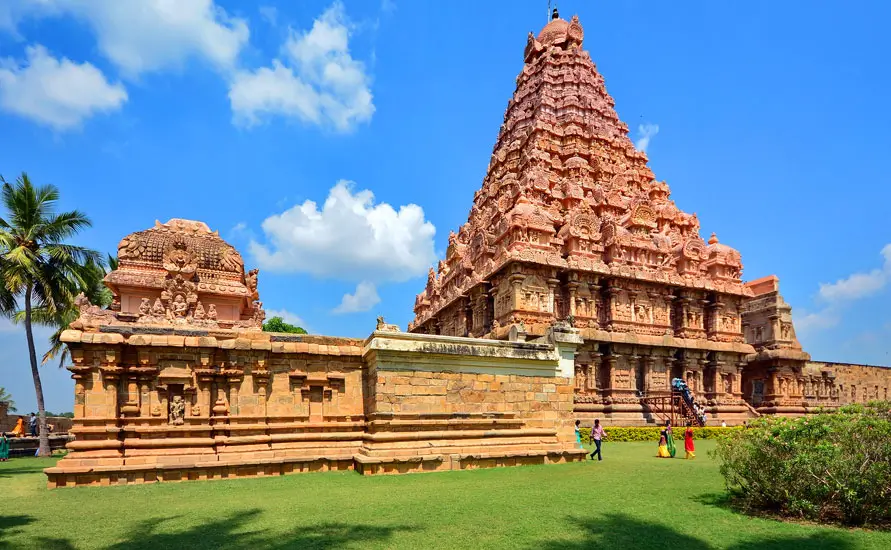
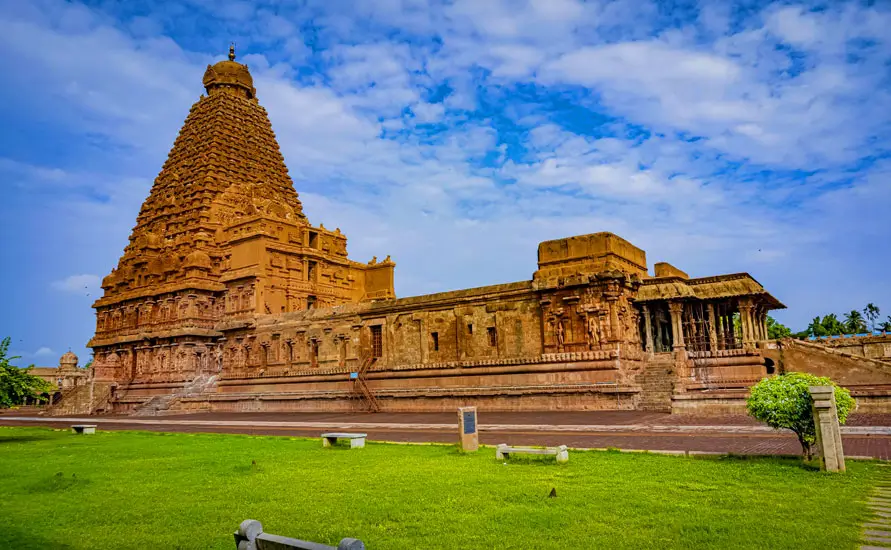
The morning belongs to the Brihadeeswarar Temple, consecrated by its royal builder Rajaraja Chola I in 1010, and the largest of the Great Living Chola Temples. Its granite vimana climbs to about 66 meters, and the domed capstone at the top is often said to weigh around 80 tonnes, which raises the obvious question of how it got up there. Your guide covers the theories, from a long earthen ramp to scaffolding towers, and reads you lines from the Tamil inscriptions on the plinth, which record the temple dancers, musicians and lamp-keepers on the royal payroll. The monolithic Nandi in the courtyard dates from the later Nayak period.
Around 11 am you head into town for the Thanjavur Royal Palace, whose courts and towers were expanded over three centuries by Nayak and then Maratha rulers. Its gallery has one of India's best sets of Chola bronzes, with several dancing Shivas made by Chola metalworkers, and the Saraswathi Mahal Library next door guards thousands of palm-leaf and paper manuscripts, a few painted with miniatures. Climb the bell tower for a view over the city's rooftops toward the temple tower. Lunch is at a local restaurant, and your guide can recommend a studio where you can watch a Tanjore painting being built up in gesso, gold foil and bright colors.
After a rest, the car takes you toward Kumbakonam and Darasuram, where Rajaraja II built the Airavatesvara Temple in the mid-1100s, completing the World Heritage trio. Compared with Tanjore it is small and intimate, but the stone is carved with remarkable detail, from miniature dancers on the pillars to a front hall designed as a chariot pulled by horses with stone wheels. A short flight of steps at the entrance produces different musical notes when tapped, though you are asked to touch gently. Late light here is warm and the crowds are thin. You return to Tanjore for dinner. Overnight in Tanjore.
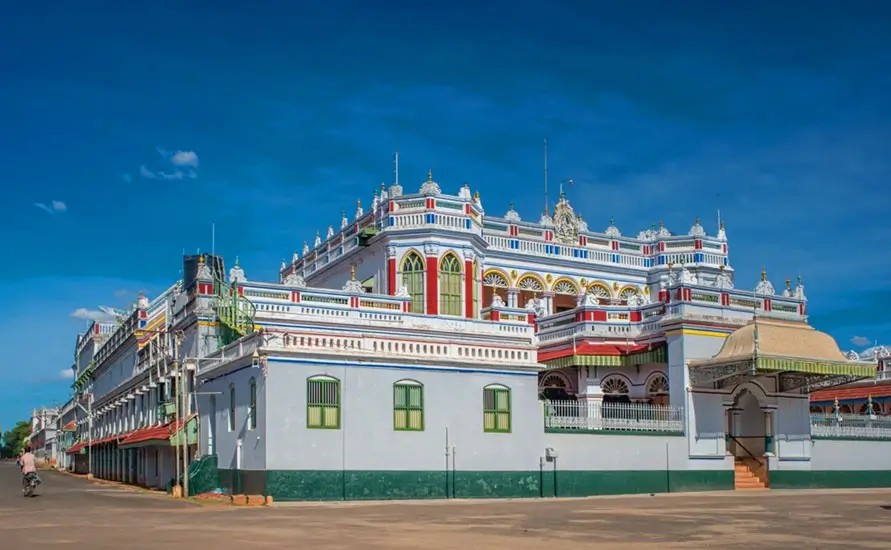
A short drive south brings you into the dry, red-earth country of Chettinad, a cluster of about 75 villages around Karaikudi. Between roughly 1850 and 1940, Nattukottai Chettiar moneylenders financed rice farmers and merchants from Rangoon to Saigon, and they poured their profits into ever larger houses back home. Your base for the next two nights is one of these houses, carefully restored as a heritage hotel. Arrival is in time for lunch, which is likely to be your first real Chettinad meal, rich with black pepper, fennel and roasted spices.
Your mansion shows the standard Chettiar plan clearly. A raised front verandah opens into a long series of courtyards, each one lined with pillars, and the family rooms, kitchens and stores lead off them in strict order. The pillars are often Burma teak, the floors carry patterned tiles from Athangudi or Japan, and some walls keep their polished lime plaster, traditionally finished with egg white to give it a soft shine. Take the afternoon slowly, sit in the courtyard with a filter coffee and let the house staff explain how a joint family of several generations once lived, cooked and celebrated weddings here.
Later, as the light turns golden, your local guide walks you through Kanadukathan, a village known for some of the largest mansions in the region. Many houses are locked or used only for family festivals, but the long facades, carved doors and painted parapets are visible from the street, and one or two homes usually open to visitors for a small fee. You also see a temple tank, or oorani, where villagers still gather in the evening. Dinner back at the mansion is served course by course, often including kuzhi paniyaram and a Chettinad chicken or vegetable curry. Overnight in Chettinad.
Morning starts with a visit to an Athangudi tile workshop, a short drive from your mansion. The process is surprisingly simple and entirely manual. On a glass plate the worker sets a brass stencil, fills each cell with liquid pigment mixed into cement, backs it with a dry sand mix, and leaves the tile to cure in water tanks; no kiln is ever used. The glass gives the finished surface its smooth sheen. You can try pouring a tile yourself, and the workshops ship sets overseas if you want to take the look home for a kitchen or terrace.
Next is the Athangudi Palace, one of the best-kept Chettiar homes open to the public, with Italian marble, Belgian glass and ceilings painted in floral designs. Your guide then takes you to Pillaiyarpatti, a rock-cut cave temple to Ganesha that predates most of the region's mansions by more than a thousand years, with an image of the god carved straight into the hillside. Lunch is a home-style Chettinad meal arranged with a local family or at the mansion, depending on availability, and is a chance to try dishes such as kavuni arisi, a sweet made from black rice.
After lunch you can nap, read, or ride into Karaikudi town. On the antique lanes near the Muneeswaran temple, shops are filled with old pillars, brass lamps, enamel tiffin carriers, wooden toys and bric-a-brac salvaged from demolished houses. Haggling is normal, and anything over a hundred years old may need export paperwork, which your guide can explain. Fabric lovers can look for kandangi, the checked cotton saris woven in the area. Back at the mansion, the evening is quiet, with tea in the courtyard and a slow dinner. The Chettinad region has very little traffic or light at night, so the stars are often clear. Overnight in Chettinad.
Two hours of country road west of Karaikudi lead to Madurai, the old Pandya capital mentioned by Greek and Roman writers, which later became the seat of the Nayak kings. On the way you pass Thirupattur and small villages where the mansions thin out and cotton fields begin. Check-in is around noon. The first stop after lunch is the Thirumalai Nayak Palace of 1636, where giant round pillars around the central court lift scalloped arches and stucco domes far overhead. The style combines Dravidian and Islamic elements, and the scale shows the ambition of the Nayak court. There is also an English-language light show in the evening.
From the palace you continue by car to the Meenakshi Amman Temple, around which the old city was laid out in concentric streets. Its 14 gopurams, the tallest on the southern side at about 52 meters, are crowded with painted stucco figures that are renewed during major restorations. Non-Hindus may visit the corridors, courtyards and the Golden Lotus Tank, but the two main shrines are reserved for Hindu worshippers. Mobile phones and cameras stay behind at deposit counters near each gate, so leave valuables at the hotel. The Thousand Pillar Hall holds a small museum with bronzes and carved columns.
The temple is at its liveliest after dark, when families come to pray and the stalls under the outer colonnades sell bangles, jasmine garlands and brass lamps. Night owls can return close to 9 pm for palliyarai, the nightly procession that carries Sundareswarar by palanquin to his consort's bedchamber with drums and nagaswaram pipes. Otherwise, your driver takes you back to the hotel for dinner. Before bed, a street-side glass of jigarthanda, made with reduced milk, ice cream and almond gum, is the local way to cool down, and late-night stalls near the east tower fry kari dosa layered with spiced mutton keema. Overnight in Madurai.
Early risers can visit the central flower market near Mattuthavani with your driver, where traders sell piles of jasmine, marigold and rose petals by weight from dawn. With a later flight, there is time for the Gandhi Memorial Museum on the far bank of the Vaigai, where the cloth he wore at his assassination in 1948 is displayed behind glass. The airport lies about half an hour south of the center, with domestic services to the main Indian hubs and a few international routes to the Gulf and Southeast Asia.
Over nine days you have followed a building story from Pallava caves to Chola towers, Nayak palaces and Chettiar mansions, seen in the order it actually happened. Extensions are easy from here: Rameswaram's island temple sits roughly 170 km east, and the hill town of Kodaikanal is a winding climb to the west. We can also arrange an extra night in the city if your onward flight leaves the following morning. Our phone line stays open until your boarding pass is in hand. Safe travels.
Your Journey

N.S. Rathore & Mrs. Omlata Rathore · Managing Director
We still read every enquiry ourselves. Tell us the places you liked and our planners will send a day-by-day route with drive times and a clear price.
Every package can be customised and no pressure to book. A planner from our office replies within 24 hours with a route written for your group.
Fill this in and your planner will send a first draft itinerary.
Explore more
Kerala Backwaters Escape Kerala Backwaters Escape
 Kerala Backwaters Escape
 Kerala Backwaters Escape
 Kerala Backwaters Escape