 Kerala Backwaters Escape

Tamil Nadu Tour Packages
Chennai – Mahabalipuram – Pondicherry – Kumbakonam – Tanjore – Trichy – Chettinad – Madurai – Chennai (flight)
At a glance
Ten days is the length most first-time visitors choose for Tamil Nadu, and it is enough to see the state properly without paying for extra hotel nights you do not need. Our Tamil Nadu tour package 10 days links the coast, the Kaveri delta and the dry south in one loop: Chennai, the Pallava carvings of Mahabalipuram, French-flavored Pondicherry, the Chola temples around Tanjore, a night in Chettinad and two nights in Madurai. A short flight back to Chennai at the end replaces an eight-hour drive and gets you to your international connection on time.
Value here means getting more out of each night rather than cutting corners. Two-night stays in Pondicherry, Tanjore and Madurai give you full sightseeing days without hotel changes, and Tanjore doubles as the base for a half-day trip to the Rock Fort and Srirangam in Trichy. Kumbakonam and Darasuram are covered on the transfer day, so no time is lost on the road. The price of this Tamil Nadu tour package covers your own AC sedan or SUV with a driver who speaks English, a licensed guide at every major stop, and comfortable three- or four-star rooms, which can be swapped for heritage properties.
We see this loop booked most by couples, groups of two or three friends, recently retired travelers and NRI families who want a wide first look at Tamil Nadu before choosing a region to return to. Each day mixes one or two main monuments with something lighter, such as a market, a beach walk, a craft workshop or a long South Indian lunch. Driving times stay between one and five hours. Weather is kindest from November through March; in the April to June heat, the plan shifts toward dawn starts and long midday breaks.
Look for our representative and your name card right outside the international arrivals doors in Chennai; the bags go straight into your car and the ride to the hotel takes 30 to 45 minutes. With so many long-haul arrivals landing after dark, nothing is planned before lunch. Hotels usually allow check-in from 2 pm, and if you would like a room ready the moment you arrive, we can book an early check-in for you in advance. Ask your host about a prepaid Indian SIM, where to change money, and the printed ten-day plan they bring along.
Your first stop with the Chennai guide, after lunch, is the 1851 Government Museum at Egmore, among the oldest public museums in the country. Head straight for the bronzes: case after case of Chola metal figures, still sharp after a millennium, preview the temples coming up in Kumbakonam and Tanjore. The museum also holds limestone panels from the Buddhist stupa at Amaravati and a red sandstone hall built in the Indo-Saracenic style. The museum is closed on Fridays, so on that day we switch to the Fort St. George area instead.
Toward 5 pm you ride down to Besant Nagar and Elliot's Beach, a quieter, cleaner strand than the Marina, where joggers, dog walkers and young couples come out and vendors sell sundal, spiced chickpeas in paper cones. Behind the sand rises the Ashtalakshmi Temple, eight shrines to the goddess of wealth stacked on several levels, with the white Annai Velankanni church a few minutes away. Stay until the lights come on along the beach road, then try a crisp ghee roast dosa in one of the small eateries of Besant Nagar. Overnight in Chennai.
Morning begins in Thiruvanmiyur at Kalakshetra Foundation, set up in 1936 by the dancer Rukmini Devi Arundale to restore temple dance to respectability. Lessons take place in open thatched pavilions under banyan and neem trees, and on term-time weekday mornings guests can stand quietly at the edge while students drill Bharatanatyam steps or repeat Carnatic scales after their teacher. Silence and modest clothing are expected, and photography rules are explained at the gate. A craft unit on site turns out handloom saris with temple-border patterns, and it is open to visitors. Visits are subject to the academic calendar and holidays, so your guide confirms the timing a day before.
From Kalakshetra the car joins the East Coast Road and stops at the Cholamandal Artists' Village near Injambakkam, a cooperative started in 1966 where painters and sculptors live and work in the same compound. A small gallery shows modern Indian art, from abstract canvases to metal and terracotta sculpture, and you may meet one of the resident artists in their studio. It is a useful contrast to the ancient temple art that fills the rest of this 10-day Tamil Nadu itinerary. The drive continues along the coast past crocodile and snake parks, seafood shacks and new beach houses, reaching Mahabalipuram in time for a late lunch.
Check-in is at a beach hotel, and once the afternoon heat drops you walk with your guide to Arjuna's Penance, a relief spread across twin boulders about 27 meters wide. At sunset the stone takes on a warm orange color and the details stand out sharply, from the cat pretending to meditate on one leg to the line of serpent figures in the central cleft. Before dark, scramble up the low ridge past Krishna's Butter Ball, the boulder that seems about to roll downhill, for a view over rooftops and the sea. Dinner tonight can be seafood at a family-run place in the fishing village. Overnight in Mahabalipuram.
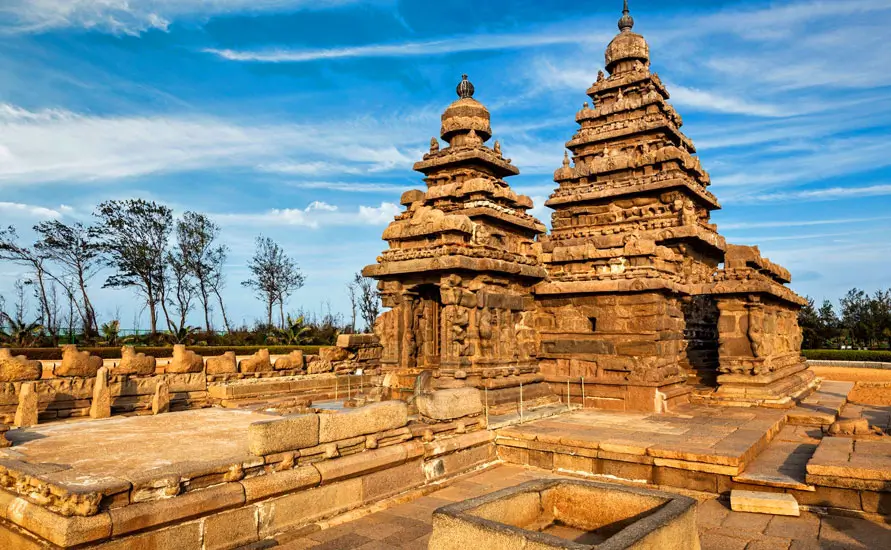
Set an alarm for the Shore Temple, which opens at sunrise and is at its quietest in the first hour. The two granite towers face the Bay of Bengal, and the low morning sun lights their eastern sides while fishermen haul their boats onto the beach below. Your guide explains how the temple combines shrines to Shiva and Vishnu, and points out the rows of Nandi bulls along the compound wall, worn smooth by centuries of salt spray. A single World Heritage ticket is valid for the town's main Pallava sites, so you move from coast to inland without queuing twice.
Five minutes away by car are the Pancha Rathas, carved from one long whaleback of granite and named, much later, for the five Pandava brothers and Draupadi. They were never consecrated, and some of the carving was left unfinished, which shows that carvers began at the roof and worked downward. Heading back to the hotel, call in at a carving yard by the road; many artisans here studied at the town's government college of architecture and sculpture and still work granite and soapstone by hand. Small pieces can be packed for travel, while larger figures can be shipped overseas by the workshop if you decide to buy one.
After lunch the coast road carries you south to Pondicherry, entering the Union Territory at Kalapet after roughly 150 minutes behind the wheel. Check in to your hotel and take the evening off or join your driver for a short ride to Rock Beach, where the seafront Goubert Avenue closes to traffic in the evening and fills with walkers. The French War Memorial and the old customs house line one side of the road, and small kiosks sell ice cream, roasted peanuts and cups of tea. Dinner can be crêpes, Creole fish curry or a local thali. Overnight in Pondicherry.
The day opens with a half-hour ride out of town to Auroville, a township created in 1968 by the Mother, Sri Aurobindo's French-born spiritual partner. Start at the visitor center, where an exhibition and short video explain how residents from about 60 countries manage farms, schools, workshops and forest restoration on what was once bare red soil. From there, walk roughly a kilometer through planted forest to the official lookout point opposite the Matrimandir, its golden disks catching the morning sun. Going inside requires a separate reservation in person, and only a few places open each day. The boutiques here sell handmade paper, pottery and incense.
Back in town for lunch, you pick up bicycles for a guided ride through White Town, the old French Quarter, where the streets are flat, straight and shaded. The route passes the Lycée Français, the Hôtel de Ville, the French Institute and colonial mansions now used as boutique hotels, cafés and art galleries. Your guide explains how the canal once divided the French residents from the Tamil town to the west, and how Pondicherry stayed French until 1954. Cycling is optional, and the same route can be covered on foot or by car. A stop at the Sri Aurobindo Ashram fits into the ride, where silence is observed.
Late in the day you walk west over the canal bridge into the Tamil Quarter, with its deep verandahs, carved doors and the morning's kolam designs, drawn in rice powder, still visible on the steps. Stop at the Ganesha shrine of Manakula Vinayagar, painted inside with dozens of his forms, then wander through Goubert Market, where fish, flowers and vegetables share one big roof. Many travelers end the evening with dinner in a restored colonial house in White Town. This second full day in Pondicherry is what makes this Tamil Nadu tour package feel unhurried. Overnight in Pondicherry.
Leave by 7:30 am for a long day heading south-west into the Kaveri delta, where green paddies, palm groves and canals still follow the pattern that fed the Chola state. By late morning you roll into Kumbakonam, a crowded temple town with well over a hundred shrines. First comes the Mahamaham Tank, ringed by sixteen small mandapams, where millions of pilgrims gather to bathe on one auspicious day every twelve years. The nearby Sarangapani Temple, one of the larger Vishnu shrines in the state, has a stone chariot carved into its inner walls, complete with wheels and horses.
A short drive brings you to Swamimalai, a village known for the lost-wax casting of bronze images, a craft passed down in a few families who trace their skills back to the Chola workshops. In a working foundry you can see each stage: a model shaped in beeswax and resin, coated in fine clay from the Kaveri riverbed, heated so the wax melts out, then filled with molten metal and polished by hand. The finished idols are sold to temples and private buyers worldwide. After lunch in Kumbakonam, you continue to the Airavatesvara Temple at Darasuram, a UNESCO site carved in remarkable detail.
The temple was built by the Chola king Rajaraja II in the 12th century, and many visitors find it more beautiful than the larger temples. Stone horses and wheels turn the front pavilion into a temple car, while tiny panels on pillars and walls show acrobats, drummers, wrestlers and stories of the sixty-three Nayanmar saints. Afternoon light is good for photographs, and the site is calm. From Darasuram it is a short drive of under an hour to Tanjore, your base until Day 7. Eat at the hotel or at a vegetarian mess near the old town, where meals come on banana leaves. Overnight in Tanjore.
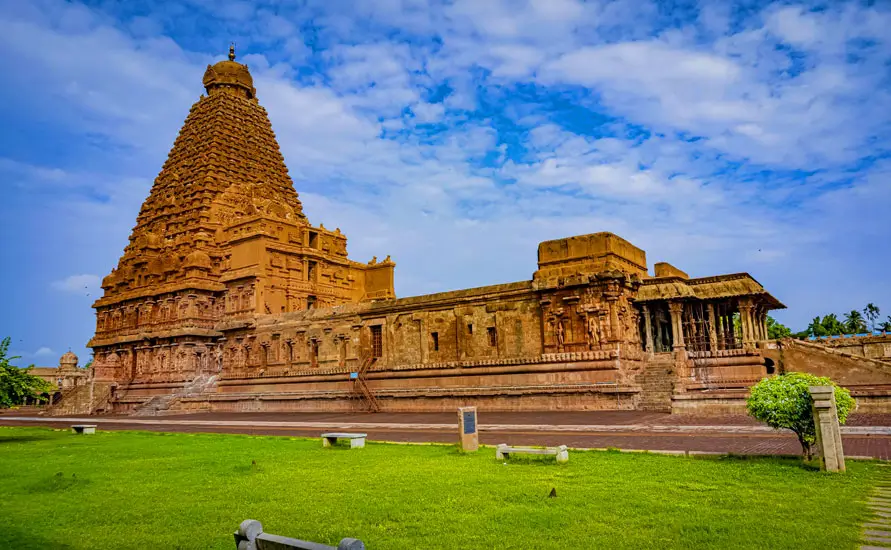
Before 7 am you pass under the twin entrance towers of the Brihadeeswarar Temple, built as the crowning project of Rajaraja Chola I and the biggest of the Great Living Chola Temples inscribed by UNESCO. At that hour the granite glows pink, and local families come in with jasmine and coconuts for the first puja of the day. Your guide explains the rare Chola murals found beneath later Nayak paintwork in the inner passage, though access to them varies, and the giant Nandi carved from one block. There is also the Thanjavur palace complex nearby, and with time permitting, the Saraswathi Mahal Library is a short visit for book and manuscript lovers.
After lunch you drive about 1.5 hours to Trichy, also known as Tiruchirappalli, on the banks of the Kaveri. The Rock Fort crowns a gneiss outcrop said to be billions of years old, and roughly 400 rock-cut steps climb past the Thayumanavar Shiva temple to the Ganesha shrine on the summit. Inner shrines are closed to non-Hindus, yet the top gives a sweeping view of the Kaveri, the town rooftops and the gopurams of the island temple. Remove your shoes at the bottom and bring socks, since the stone steps get hot by midday.
From there it is ten minutes to Srirangam, a river island where the Sri Ranganathaswamy Temple to Vishnu takes up most of the land and whole streets of homes sit within its walls. Seven concentric walls enclose streets, homes, shops and shrines, and the main entrance tower, finished in 1987, rises about 73 meters. Do not miss the Seshagiri mandapa, where stone horses rear up with riders and hunters on their backs. Non-Hindus stop short of the golden-roofed shrine, but a small fee usually buys access to a rooftop over the courts. You drive back to Tanjore for the night. Overnight in Tanjore.
Before leaving Tanjore, your guide can arrange a stop at a family workshop where Tanjore paintings are made, a style known for raised gesso work, real gold leaf and bright colors around images of Krishna and other deities. Pieces range from small panels to large framed works, and the artists explain how each one takes days or weeks to complete. Then the land turns dry and red as you head south toward Chettinad, where a community of moneylenders built their family seats. Check in to a heritage hotel, often a restored mansion with pillared courtyards and tiled floors, and settle in for lunch with a first taste of Chettinad spices.
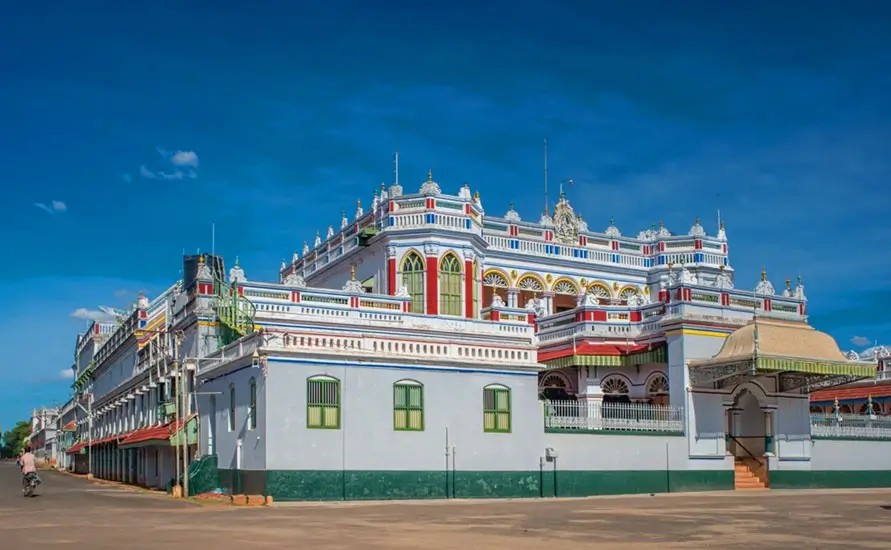
Once the heat eases, a village guide walks you round Kanadukathan, where some of the grandest homes stand. Many grand houses stand closed most of the year, but their scale is obvious from the street: long facades, tall gates, painted plaster and rows of windows. At least one house opens its doors for you, so you can see the teak-pillared front hall for male guests, the inner courts used by the women and the store rooms once piled with wedding gifts. Old photographs on the walls show families who made their money in Burma, Malaya and Ceylon.
Dinner at the heritage hotel is a highlight of this Chettinad tour stop. Chettinad cooking is known for its spice mixes, freshly ground for each dish and built around black pepper, dried red chilies, fennel, star anise and a lichen called kalpasi. Expect dishes such as pepper chicken, a mutton kola urundai meatball, vegetable kurma and appam, with mild options available for anyone who prefers less heat. Some hotels offer a short cooking demonstration in their kitchen if you ask in advance. After dinner, the courtyard is lit with oil lamps and the village falls quiet early. Overnight in Chettinad.
Morning brings a short stop at a kandangi loom shed, where bold checked cotton saris are still woven on wooden shuttle looms. The cloth is still popular with Tamil women for everyday wear, and the weavers can show you how the colored threads are set up before weaving begins. You may also stop at a small Chettinad snack shop for murukku and other fried treats to take on the road. Then you drive to Madurai, about two hours away, passing small towns and farmland, and check in to your hotel around noon for the next two nights.
Mid-afternoon your Madurai guide meets you for the Thirumalai Nayak Palace, finished in 1636 for the best-remembered ruler of his dynasty. Only about a quarter of the original complex survives, but it is enough to show how grand the court must have been, with tall round columns, arches and a domed ceiling covered in stucco decoration. The Swarga Vilasam, the old throne room, is the best preserved space. Later you drive east to see the Vandiyur Mariamman Teppakulam, an enormous tank with an island shrine at its center, the scene of the float festival around January when lit rafts carry the deities.
Shopping is the evening theme: tailors around the old city will sew a shirt or kurta from chosen fabric within a day or two. Cotton saris, brass lamps and sandalwood carvings are good value here. Madurai is also known for its late-night food, and a guide or your driver can point you to one of the busy places for parotta with salna or a cold glass of jigarthanda. For a quiet night, order a set Tamil meal in the hotel instead. Tomorrow is a full day in the temple city. Overnight in Madurai.
Wake at 5:30 for the Madurai flower market, a wholesale yard where the day's trading is mostly done by 8. Farmers arrive on motorbikes with sacks of blooms, and the prized Madurai malli, a jasmine with a protected local name, is weighed out by the kilo for garland makers. Your guide steers you through the crush and explains who buys what: temple suppliers, wedding decorators and the stringers who make the hair garlands worn all over town. Breakfast and a nap follow before the central visit of this Tamil Nadu temple tour.
Fish-eyed Meenakshi, a local princess who became a goddess, and Sundareswarar, her Shiva husband, are the presiding deities at the Meenakshi Amman Temple, whose painted towers carry thousands of figures. All visitors may walk the halls and corridors and sit by the sacred tank, though the two sanctums admit Hindus only. Phones and cameras stay with the cloakroom staff outside. Inside you see the thousand-pillar mandapam and its small museum, columns that ring with musical notes, and passages where stalls sell bangles, cloth and puja items. The temple is very busy in the morning, but the atmosphere is the most authentic then.
Your afternoon stop, the Gandhi Memorial Museum, occupies a Nayak-era palace and traces the independence movement, ending with the cloth he was wearing on 30 January 1948. At around 9 pm you head back to Meenakshi's courts for palliyarai, the bedtime procession that takes Sundareswarar by palanquin to his wife's chamber with pipes and lamps. The ceremony is a very special moment that Hindus and visitors can watch from the corridor. Then it is back to the hotel for your final night in the south, with bags to pack for the morning flight. Overnight in Madurai.
Your Journey

N.S. Rathore & Mrs. Omlata Rathore · Managing Director
We still read every enquiry ourselves. Tell us the places you liked and our planners will send a day-by-day route with drive times and a clear price.
Every package can be customised and no pressure to book. A planner from our office replies within 24 hours with a route written for your group.
Fill this in and your planner will send a first draft itinerary.
Explore more
Kerala Backwaters Escape Kerala Backwaters Escape
 Kerala Backwaters Escape
 Kerala Backwaters Escape
 Kerala Backwaters Escape
 Kerala Backwaters Escape Kerala Backwaters Escape Kerala Backwaters Escape Kerala Backwaters Escape