
 Kerala Backwaters Escape

Tamil Nadu Tour Packages
Chennai – Mahabalipuram – Pondicherry – Gangaikonda Cholapuram – Darasuram – Tanjore – Trichy – Chettinad – Madurai – Rameswaram – Thekkady – Kumarakom – Kochi
At a glance
Few routes in India give you as much variety at such an easy pace as our Chola Temples Chettinad and Kerala Tour. Over nineteen days you travel the long way down the Tamil coast and through the Kaveri delta, stopping at the three World Heritage temples of the Chola kings, sleeping in the merchant mansions of Chettinad, joining the evening crowds of Madurai and walking the pillared corridors of Rameswaram. Only in the last four days does the road climb over the Western Ghats for spice hills, a lake resort and a final afternoon in Kochi.
Tamil Nadu takes up fifteen of the eighteen nights, and that is deliberate. Most two-state tours rush through the temple towns in a few days to make room for Kerala, while this plan books two nights almost everywhere, so you can visit the big sites early, rest in the heat of the afternoon and go back out in the evening. The Chola temples tour section links Gangaikonda Cholapuram, Darasuram and Thanjavur in sequence, and Chettinad brings a complete change, from stone to teak, Burmese lacquer and peppery home cooking.
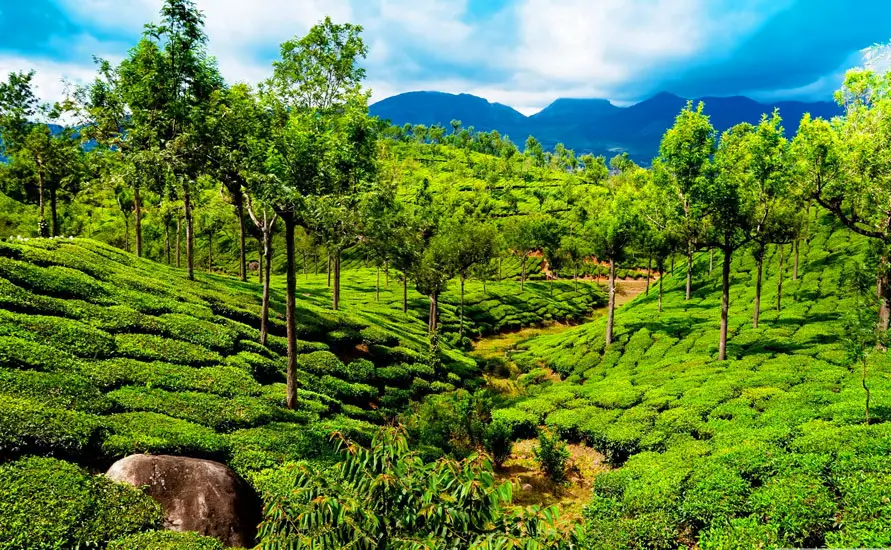
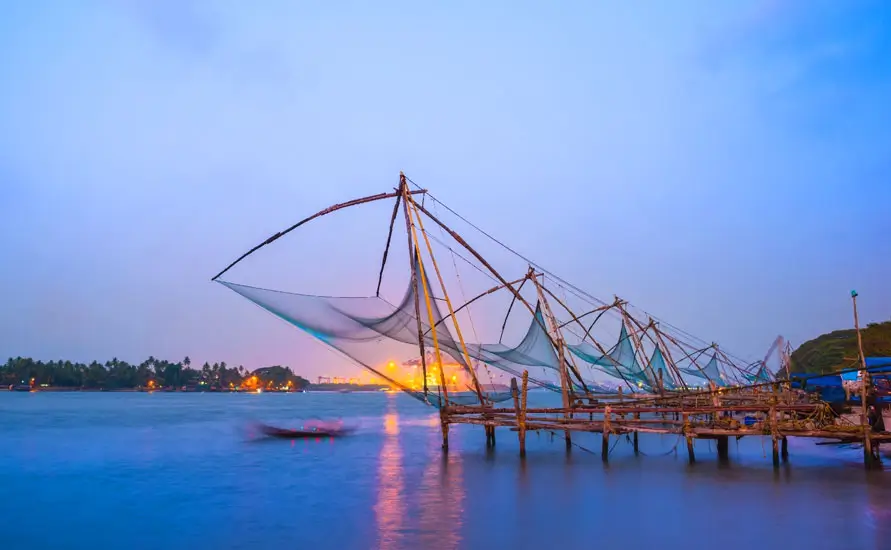
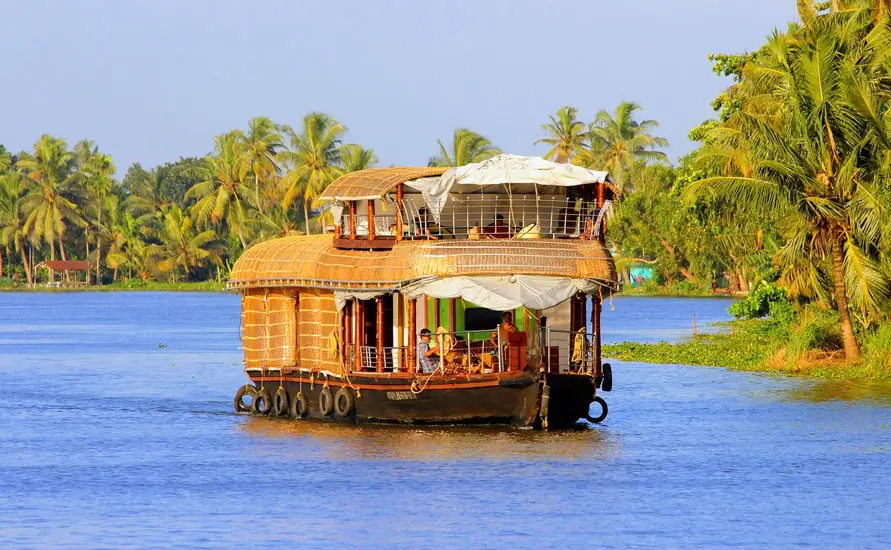
The finish in Kerala is gentle: a boat ride on Periyar Lake and a walk through spice gardens in Thekkady, a night beside Vembanad Lake in Kumarakom, then a drive to Kochi for your flight home. This Tamil Nadu and Kerala tour suits travelers with time who prefer depth to speed, including retired couples, history readers and NRI families returning to show their children the south. One chauffeur and one car carry you the whole way from Chennai to Kochi, and local guides join at each major site. November to February brings the gentlest weather.
Welcome to Tamil Nadu. When you walk out of the international arrivals hall at Chennai airport, a member of our ground team is ready with your name on a board and a cold bottle of water. Reaching the hotel usually means forty-five minutes on Anna Salai, the old Mount Road, longer at rush hour. Because this is a long trip, we keep the first day almost empty. Sleep off the flight, order a light breakfast of idli and coconut chutney when you wake, and let your body slowly adjust to the humid coastal air and the new time zone.
In the afternoon, your tour manager meets you at the hotel for an unhurried briefing over coffee. With nineteen days ahead, it is worth going through the route in some detail: where the drives are longest, which temples need modest clothing and bare feet, how to handle tipping, and which evenings are free. Any phone SIM you requested in advance is handed over here, with a folder of vouchers and emergency numbers. Tell us now about food preferences, mobility issues or special interests, so that guides farther along can adjust what they show you.
If you feel rested by early evening, a short drive takes you to Besant Nagar beach, also called Elliot's Beach, a quieter alternative to the city's main seafront, where students and young families gather after work. Snack stalls sell sundal, a spiced chickpea dish, and slices of raw mango sprinkled with chili powder. The small Ashtalakshmi Temple stands at one end of the sand, its shrines stacked on several levels so that pilgrims climb and descend in a spiral past each one. Back at the hotel, an early dinner sets you up for tomorrow's dawn start. Overnight in Chennai.
Chennai is easiest to enjoy early, before the heat and traffic build, so your guide is at the hotel door by half past six for a walk through Mylapore. At this hour, women draw kolam patterns in white rice flour on the doorsteps, milk vendors cycle past with steel cans, and bells inside the Kapaleeshwarar Temple announce the opening rites. Walk the four streets around the temple tank, stop at a tiny shop where coffee is tipped between tumbler and davara in long frothy arcs, and watch flower sellers string jasmine and marigold into garlands for the shrines and for weddings.
After breakfast, the tour moves to Fort St. George, the fortified base the English traders raised on this shore in the 1640s. Inside the walls, Anglican St. Mary's, completed in 1680, carries memorial tablets to soldiers, clerks and children who never sailed home, and Robert Clive married here in 1753. The Fort Museum next door holds old maps, uniforms, coins and the large painted portraits of governors. From here your guide drives you along the Marina past Indo-Saracenic buildings such as the Madras High Court and the University of Madras, whose domes and arches mix Mughal and Gothic forms.
Toward evening, head to the Kalakshetra Foundation in the south of the city, the arts campus where Bharatanatyam was reshaped into the form taught across the world today. If classes are running, you may hear students practicing rhythmic footwork under banyan trees. Later, with some luck, your guide can book seats at a classical dance recital or a Carnatic vocal concert in one of the sabhas, the neighborhood music societies that keep Chennai's concert calendar full, especially from mid-December into January. Dinner can be a full South Indian thali or a plate of crisp dosa. Overnight in Chennai.
Leaving Chennai by the East Coast Road, you make a mid-morning stop at DakshinaChitra, an open-air museum of southern architecture where whole village houses were dismantled and rebuilt beam by beam. It gives a useful preview of what you will see later on the trip: a Chettiar merchant house similar to those you will stay in near Karaikudi, a Syrian Christian home from central Kerala, and a Tamil weaver's home with a loom set into the floor. Craftspeople show glass painting, basket weaving and pottery, and a small gallery displays traditional textiles. The center shuts every Tuesday, so the days are arranged around that.
From DakshinaChitra it is a short drive to Mahabalipuram, the port town of the Pallava kings, whose sculptors carved temples and reliefs out of the local granite in the 7th and 8th centuries. Two nights are booked at a hotel by the beach, and lunch is at a small seafood place where the fishermen's morning haul, often prawns, squid or pomfret, is rubbed with red masala and grilled. In the heat of the afternoon, rest at the hotel or by the pool, since most of the sightseeing here is outdoors and on bare rock with little shade.
At around four, when the sun begins to drop, your guide takes you up the hill behind the town to the Mahabalipuram lighthouse, built in the 19th century, and the older Olakkanesvara Temple beside it, a Pallava shrine once used as a beacon for sailors. Up on the gallery you see boulders, coconut palms and the fishing hamlet below, and your guide uses it as a living map for tomorrow. Coming down, look into the small Mahishasuramardini cave, where carvings show Vishnu resting on the serpent Ananta while two demons plot nearby. Overnight in Mahabalipuram.
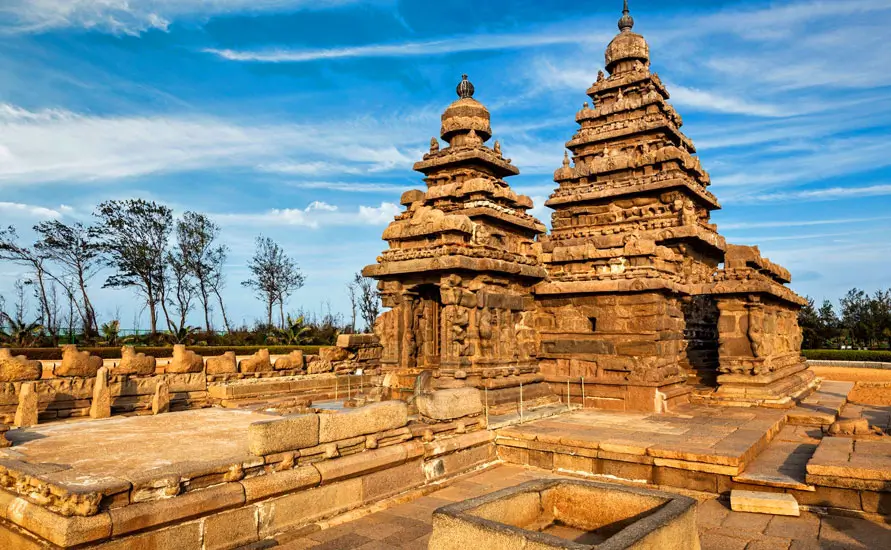
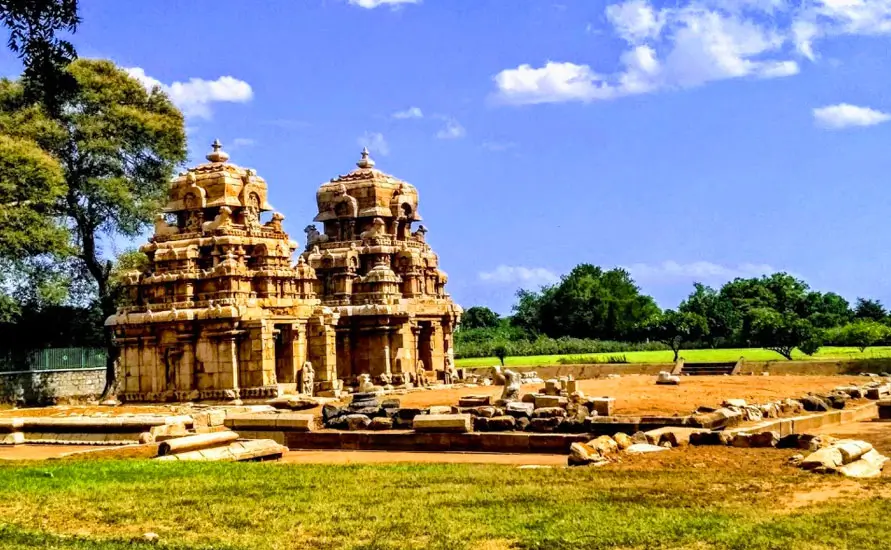
Reach the Shore Temple by seven, when the low sun turns the salt-worn granite of its twin towers almost pink. Built around 700 CE and now under UNESCO protection with the rest of the town's monuments, it hides a reclining Vishnu in its smaller cell, and your guide points out the little seated bulls that once lined the enclosure wall like sentries. From here you move on to the Pancha Rathas, whose five shrines were sculpted from one long granite ridge, with a stone elephant, lion and Nandi standing beside them as if guarding the group.
At the great carved boulder of Arjuna's Penance, also read as the Descent of the Ganges, and this time your guide focuses on small details that many visitors miss, such as a cat posing as an ascetic, balanced on its hind legs, while a crowd of mice gather trustingly at its feet, a sly joke about false holy men. Nearby you visit the Varaha cave, whose side wall shows the boar-headed Vishnu cradling the earth goddess on his knee, and the Krishna Mandapa, where Krishna lifts a mountain to shelter cowherds and their cattle from a storm.
Spend the late afternoon in the town's sculpture workshops, where stonemasons still work granite by hand, from palm-sized Ganeshas to statues for temples overseas. The sound of chisels is everywhere along the main road. Your guide can arrange a chat with a senior carver who explains the measurements set out in the Shilpa Shastra, the traditional texts on sculpture, and how many weeks a large figure may take. Later, enjoy a quiet dinner by the sea or a stroll on the sand as the light fades and the catamarans are hauled up above the tide line. Overnight in Mahabalipuram.
Heading south along the coast, the road passes salt pans, casuarina plantations and the lagoon at Kalpakkam on the way to Pondicherry. If you are curious about reptiles, a short detour can be made to the Crocodile Bank, a conservation center just north of Mahabalipuram that breeds endangered crocodiles and gharials. You reach Pondicherry around midday and settle into a restored colonial house turned hotel, your address until the day after tomorrow. In the afternoon, rest or wander the streets near your hotel, where cafés and bakeries make a welcome change from the spicy food of the past few days.
Later, your guide walks you through the Tamil Quarter of Pondicherry, a part of town many visitors skip in favor of the French streets. Here, houses have deep verandas with wooden pillars, called thinnai, where neighbors once sat and talked in the evening. You visit a local market where traders sell fish, vegetables and flowers, and a small temple dedicated to Ganesha. Along the way your guide recounts how the colonial and Tamil districts developed on opposite banks of an old drainage canal, which today is lined with trees and a walking path.
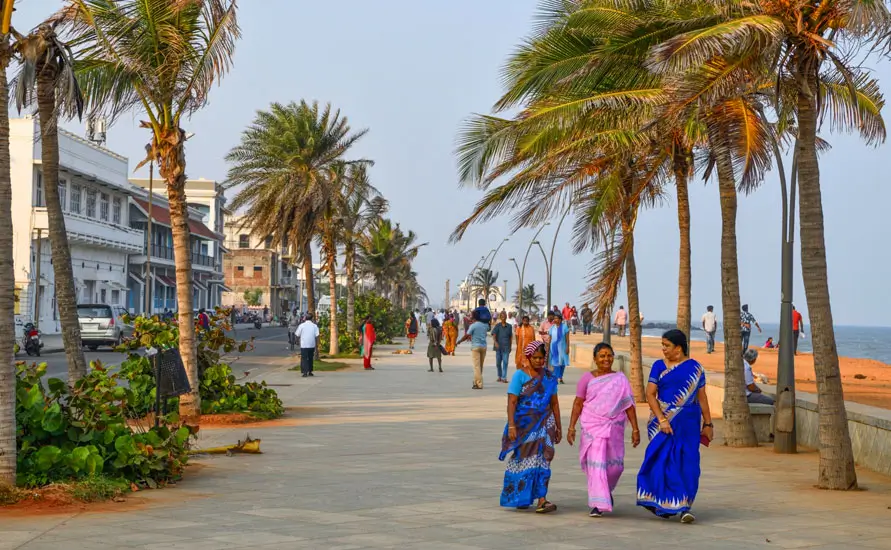
As dusk falls, follow the Promenade along the seawall, past the old lighthouse, the war memorial and the statue of Gandhi surrounded by stone pillars. Locals come here to walk, jog and buy snacks from the carts, and the sea breeze is pleasant after the heat of the day. For dinner, try a Franco-Tamil dish such as fish in a coconut and tomato sauce at one of the old restaurants in the French Quarter, or a plate of hot parottas with chicken curry from a street stall, eaten standing as the locals do. Overnight in Pondicherry.
Twenty minutes north lies Auroville, the township the Mother launched in 1968, where settlers from dozens of nations share land, schools and work without claiming a single flag. The visitor center has a short video and an exhibition about the project. Then walk the woodland trail to a spot where the Matrimandir, a sphere clad in gilded discs, can be seen across its gardens. Entering the inner meditation chamber is possible only with an advance booking made through Auroville, and places are scarce, so we try to reserve well ahead.
Auroville is also home to many small enterprises making handmade paper, incense, pottery and clothing, and several of them have shops near the visitor center. Lunch is at a café serving vegetables, millets and bread grown and baked on Auroville's own farms. Back in Pondicherry in the afternoon, a guided walk covers the French Quarter, with its yellow and white houses, the seafront Notre Dame des Anges with its pastel façade and the Sri Aurobindo Ashram, where you may step in quietly to see the samadhi covered with fresh flowers arranged in patterns each day.
The evening is free. You may want to shop for handmade paper, leather sandals or cotton clothes in the boutiques of the French Quarter, or simply sit in a café with a glass of fresh lime soda. If you want something different, ask your guide about a short yoga or meditation session, which some ashrams and centers in town offer to visitors. Tomorrow is a long and important day, as you begin the Chola temple part of the tour, so plan on an early meal and lights out at a sensible hour. Overnight in Pondicherry.
Leave Pondicherry early for the drive inland, across the Vellar and Kollidam rivers, to Gangaikonda Cholapuram, built by Rajendra I as his capital in the early 11th century. The temple stands alone in open countryside, since the royal city around it has vanished. Your guide shows you the doorway guardians, or dvarapalas, carved larger than life, and the graceful divine couples set into the recesses of the outer walls. Inside the compound, look for the small chariot-shaped platform with the nine planets carved in stone, a feature rarely seen in other temples of the period.
After a simple lunch in a roadside restaurant, you continue south to Darasuram, on the western edge of Kumbakonam, for the Airavatesvara Temple. Among the trio of World Heritage Chola shrines, its stonework is the most delicate. Instead of looking at the main hall, your guide this time focuses on the pillars carved with yalis, the mythical lion-like beasts, and the tiny figures on the outer walls showing scenes of everyday life, from wrestlers to women churning butter. Next door, the separate shrine of the goddess Periya Nayaki was built a little later and is worth a short look.
By late afternoon you reach Tanjore, where the same hotel is yours for two nights. After the long day, rest or take a gentle evening walk around the Sivaganga Park and its large tank, close to the Brihadeeswarar Temple. Nearby stands Schwartz Church, built in the 18th century by the Danish missionary Christian Friedrich Schwartz, with a marble sculpture showing his death in the presence of the Maratha ruler Serfoji II, his former student. Supper tonight is kept simple, either at the hotel or a quiet eatery a few streets away. Overnight in Tanjore.
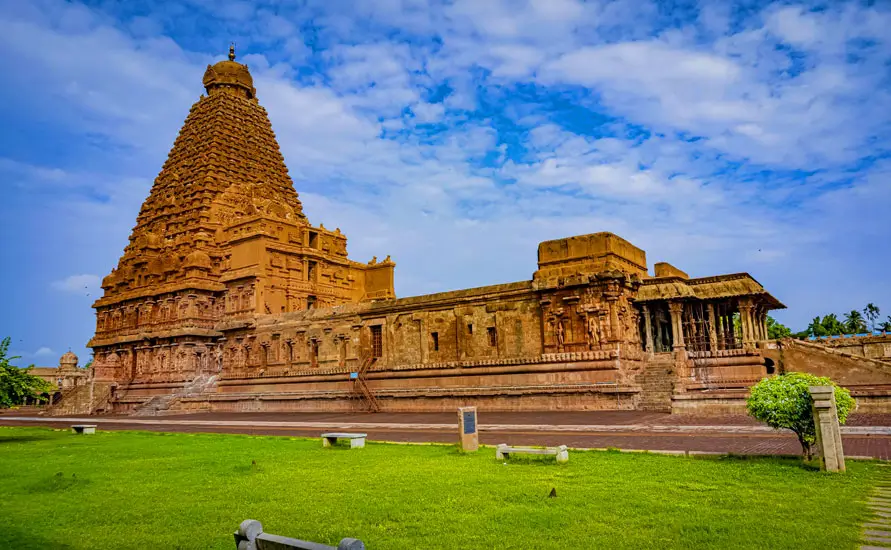
Arrive at the Brihadeeswarar Temple early, when the courtyard is cool and quiet. Rajaraja I dedicated it in 1010, and more than a thousand years later it still dominates the skyline of the old city. Your guide focuses this time on the approach: the two gateways, called the Keralantakan and Rajarajan gopurams, named after the king's victories, and the huge carved guardians beside them. Inside the compound, look at the shrine of Murugan built later by the Nayaks, with fine carvings of dancers and musicians, and the long cloister lined with lingams and old murals.
In the middle of the day, the Thanjavur Palace offers some shade. Its Nayak and Maratha builders left a bell tower, the Sangeetha Mahal music hall designed for its acoustics, and a Maratha durbar hall with painted ceilings. You also visit the Royal Museum, where you can see the personal belongings of the Maratha kings, including clothes, weapons and musical instruments. Your guide explains how the Marathas came to rule this Tamil kingdom in the 17th century, and how Serfoji II became a patron of science, printing and Western medicine as well as music.
Later, visit a studio where artists still make Tanjore paintings, known for their gold leaf and inlaid glass stones. Your guide explains the steps of the process and the symbolism of the deities, and you can watch an artist at work. If time allows, stop at a workshop that makes bronze art plates, another traditional craft of the town. After dark, go back to the Brihadeeswarar Temple to see the tower floodlit, as local families arrive for the evening puja and children run barefoot across the warm stone of the courtyard. Overnight in Tanjore.
Westward along the Kaveri lies Trichy, an important river city with a long history of trade, war and pilgrimage, and a busy railway town today. Your first visit is to Srirangam, the river island where the Ranganathaswamy Temple sprawls across more than 150 acres. This time, your guide leads you to the Sesharayar Mandapa, a hall with pillars carved as rearing horses and riders, one of the most powerful pieces of Nayak sculpture. You also see the White Gopuram, the tall gateway painted white in contrast to the colorful ones elsewhere in the complex.
After lunch, there is time to settle into your Trichy hotel and rest for a few hours. In the late afternoon, the Rock Fort awaits, a granite mass that dominates the old bazaar, with a staircase cut into the stone rising to the Ucchi Pillayar shrine of Ganesha on the summit. Halfway up, the Thayumanavar Temple honors Shiva as the god who became a mother to help a devotee in labor, a story your guide tells along the way. The climb takes about twenty minutes, and the steps are worn smooth by centuries of bare feet.
Up at the summit, the whole city opens out: the river, the green fields beyond and the gopurams of Srirangam on the island. Many visitors stay for sunset, when the light turns the stone gold and the city lights come on below. Coming back down, wander the busy market streets at the foot of the fort, where shops sell bangles, saris, brass lamps and sweets. Dinner can be at a popular vegetarian restaurant in town, serving dosas and South Indian meals, where the waiters refill your plate before you have time to say no. Overnight in Trichy.
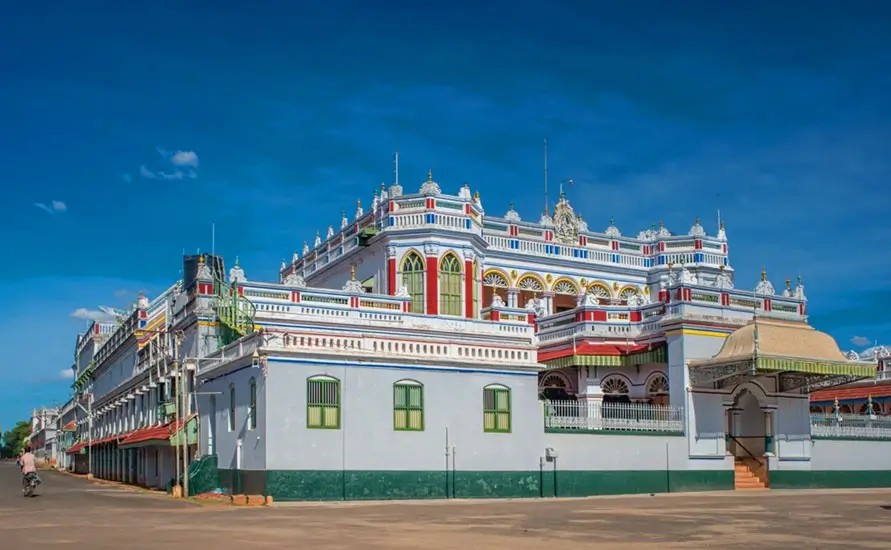
Leaving Trichy, you drive south to Chettinad, a cluster of about seventy-five villages around Karaikudi where the Nattukottai Chettiar families settled, each village planned around a temple and a tank. These merchants and moneylenders built their fortunes abroad during the colonial period, and on the way your guide tells you about their trading network, which stretched from Burma to Malaysia, Singapore and Vietnam, and how much of their wealth was sent home and spent on huge houses, temples and tanks in their villages. Your Chettinad base, booked for both nights, is a restored Chettiar mansion, now a heritage hotel.
After lunch at the hotel, you visit the village of Kanadukathan, home to some of the finest Chettiar mansions. Walking along the quiet streets, you see huge houses with ornate facades, painted walls and heavy wooden doors carved with gods and flowers. Where an owning family agrees, you step inside a private mansion to see the long open courtyards, the pillars made of Burmese teak, the Italian marble floors and the colored glass windows imported from Europe. Many of these homes are opened only for weddings, when relatives fly in from Chennai, Singapore and the United States.
Late in the day, you visit a workshop making Athangudi tiles, the hand-poured floor tiles found in so many Chettiar homes. Artisans fill patterned frames with colored cement on a glass base, back them with a dry mix and leave them to cure under water. In the evening, return to your hotel for a traditional Chettinad dinner served on a banana leaf. Chettinad cooking is known for spice pastes ground fresh each day, built on black pepper, star anise and fennel. Your host will explain the dishes and the customs of the Chettiar community. Overnight in Chettinad.
In the morning you visit the Pillaiyarpatti Temple, a cave temple dedicated to Ganesha, carved into a rock and expanded over the centuries. The main image is believed to be one of the oldest rock-cut Ganeshas in Tamil Nadu. The temple is managed by the Chettiar community and is a key place of worship for them. Your guide explains its history and points out the inscriptions on the walls, some of them more than a thousand years old. Afterwards, you drive to Kottaiyur, another Chettiar village with fine mansions, where you can see more houses and the village tank.
Before lunch, take part in a Chettinad cooking lesson at your hotel or in a local home. You learn how to crush spices on a flat grinding stone and prepare dishes such as chicken or vegetable curry with fresh coconut, pepper fry and kuzhi paniyaram, small round dumplings made in a special pan. After the lesson, enjoy the meal you helped to prepare. The afternoon is free to relax at the hotel, read in the courtyard or take a walk in the village, where you may see children playing in the lanes and women drawing kolam.
Around four, a drive into Karaikudi brings you to the antique dealers' lanes, where traders sell old furniture, brass and copper vessels, glass lamps, wooden carvings and other objects from Chettiar homes. You can also see the handloom kandangi saris, a cotton sari with bold checks and contrasting borders, which Chettiar women used to wear every day. Haggling is normal here, and your guide will help you assess age and condition, and arrange shipping for anything too heavy to carry. Supper is back at the mansion before a quiet night under its high ceilings. Overnight in Chettinad.
After a relaxed breakfast, you drive west to Madurai, the city of the Pandya kings and the setting of the Sangam poetry assemblies described in early Tamil literature. Its music, food and festivals are known across the state. Your Madurai hotel sits within easy reach of the old city. In the afternoon, a walk takes you into the Thirumalai Nayak Palace, raised for King Thirumalai around 1636. Each courtyard column is wider than a person's outstretched arms, and the stucco arches and painted ceilings show how Nayak builders borrowed freely from Indo-Islamic design.
Next, you visit the Gandhi Memorial Museum, where photographs, letters and the blood-marked dhoti from 30 January 1948 tell the story of the freedom movement and its leader, room by room, in clear English captions. The museum is set in a quiet park, and your guide explains Gandhi's links with Madurai, where in 1921 he decided to wear only a simple loincloth after seeing poor farmers in the area. It adds a modern chapter to the long history you have been following, and the quiet gardens outside are a pleasant place to sit afterwards.
In the evening, you drive to Vandiyur's Mariamman Teppakulam, a square reservoir lined with steps, with a pavilion temple on an island at its center, also built under Thirumalai Nayak. Every January or February, during the Teppam festival, Meenakshi and her consort are floated around the tank on a raft lined with lamps. For much of the year the tank holds little water and becomes an open ground where cricket matches run until dark. Dinner tonight might be kari dosa, a Madurai specialty in which a dosa is layered with spiced minced mutton and egg. Overnight in Madurai.
Start the day early at the Meenakshi Amman Temple, the double shrine of Meenakshi and Sundareswarar, her Shiva husband. Fourteen towers rise around its walls, every tier crowded with painted plaster gods. In the morning, the corridors are full of worshippers bringing flowers, coconuts and oil lamps. Entry to the innermost shrines is for Hindus only, and every visitor hands in phones and cameras at the counters before passing the security check. Your guide shows you the Golden Lotus Tank and the thousand-pillared mandapam, which now houses the temple's art museum.
After the temple, walk to the flower market, where traders sell huge piles of jasmine, marigold, roses and other flowers for temples and weddings. Madurai is known for its jasmine, and the scent fills the market. Your guide explains how the flowers are grown, sold and used, and you can watch women stringing garlands at high speed. Next, visit the Pudhu Mandapam, the 17th-century hall facing the eastern tower, where tailors sit at sewing machines between carved columns and can stitch a shirt or dress for you in a few hours.
Keep the afternoon for rest or shopping. Should you want a second look, head back to the Meenakshi Temple around nine for the bedtime ritual in which Sundareswarar travels in a silver palanquin, to drums and pipes, to spend the night in Meenakshi's chamber. Watching it among local families is one of the warmest scenes in South India and a fine way to end your time in Madurai. Dinner is at your leisure, and your guide will happily name a few dependable places near the temple's east gate. Overnight in Madurai.
Eastward from Madurai, the highway runs to Rameswaram, an island town in the Gulf of Mannar, connected to the mainland by the Pamban bridge. The road passes through dry country with palm trees and small villages, and as you come closer to the coast, the air becomes salty and the landscape opens up. Crossing the road bridge, you see the old railway bridge beside it, opened in 1914, and the modern lift-span rail bridge that has replaced it. Fishing boats float in the clear blue water below, and in still weather the coral shallows show as pale patches.
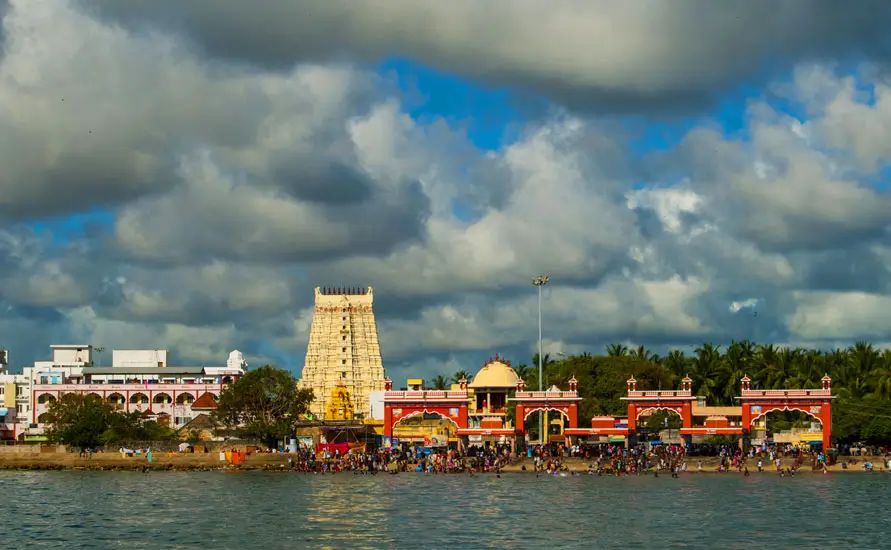
Two nights are booked by the sea, and after lunch the first visit is the Ramanathaswamy Temple, one of the holiest shrines in India, where Rama is believed to have worshipped a lingam of sand to atone after the war in Lanka. The temple is famous for its long corridors, lined with carved pillars, which are among the longest temple corridors in India. Pilgrims bathe in the 22 holy wells inside the temple, each believed to have its own healing power, and you may see them moving from well to well in wet clothes.
In the evening, visit the memorial to Dr. A. P. J. Abdul Kalam, the rocket scientist and former President of India, who grew up in a modest home on this island. The memorial includes a museum with exhibits about his life and work, and many Indian families visit it with their children. Later, stroll along the shore near the temple, where pilgrims take a holy dip in the sea before visiting the shrine. Supper is simple and vegetarian, in keeping with the pilgrim character of the town, either at the hotel or a nearby canteen. Overnight in Rameswaram.
Wake up early for a drive to Dhanushkodi, at the southern tip of Rameswaram island, about 20 km away. A cyclone in December 1964 swept this town away, and only broken walls of its church, station and post office still poke out of the sand. The road ends at a point called Arichal Munai, where the calmer Palk Strait water meets the rougher Gulf of Mannar, and on clear days you can sense how close Sri Lanka is, only about 30 km away. The light in the early morning is soft, and the beach is quiet before the crowds arrive.
Returning toward town, pause at the Kothandaramaswamy Temple, which came through the 1964 storm largely intact. According to legend, this is where Vibhishana, the brother of Ravana, surrendered to Rama. You may also visit the Gandhamadhana Parvatham, a small hill with a temple at the top that holds a footprint said to belong to Rama, and from where you can see the whole island. After lunch at the hotel, stay indoors through the hottest hours, as Rameswaram can be very warm even in winter, and the sand reflects the glare.
Toward evening, go back to the Ramanathaswamy Temple for a second visit, this time walking through the corridors at a slower pace and watching the evening rituals. Alternatively, visit the Agni Theertham, the strip of shoreline facing the temple's east gate, where pilgrims take a holy bath and perform rituals for their ancestors. Your guide explains the importance of Rameswaram as a place of pilgrimage for Hindus from all over India, and how a visit here is traditionally paired with one to Varanasi. Turn in early tonight, since tomorrow brings the longest drive. Overnight in Rameswaram.
Your Journey

N.S. Rathore & Mrs. Omlata Rathore · Managing Director
We still read every enquiry ourselves. Tell us the places you liked and our planners will send a day-by-day route with drive times and a clear price.
Every package can be customised and no pressure to book. A planner from our office replies within 24 hours with a route written for your group.
Fill this in and your planner will send a first draft itinerary.
Explore more
Kerala Backwaters Escape Kerala Backwaters Escape
 Kerala Backwaters Escape
 Kerala Backwaters Escape
 Kerala Backwaters Escape
 Kerala Backwaters Escape
 Kerala Backwaters Escape
 Kerala Backwaters Escape
 Kerala Backwaters Escape
 Kerala Backwaters Escape
 Kerala Backwaters Escape
 Kerala Backwaters Escape
 Kerala Backwaters Escape
 Kerala Backwaters Escape
 Kerala Backwaters Escape
 Kerala Backwaters Escape
 Kerala Backwaters Escape
 Kerala Backwaters Escape
 Kerala Backwaters Escape
 Kerala Backwaters Escape
 Kerala Backwaters Escape Kerala Backwaters Escape Kerala Backwaters Escape