
 Kerala Backwaters Escape

Tamil Nadu Tour Packages
Chennai – Madurai – Rameswaram – Dhanushkodi – Tiruchendur – Kanyakumari – Suchindram – Padmanabhapuram – Trivandrum
At a glance
Three seas, one island temple and a town wiped out by a cyclone sit within a few hours of each other at the bottom of the Indian peninsula. Our Madurai Rameswaram Kanyakumari tour strings them together in eight unhurried days. After a first night in Chennai you take a one-hour flight south to Madurai, the old Pandya capital, then drive east across the sea to Rameswaram, out along a sand spit to the ruins of Dhanushkodi, and down the coast to Kanyakumari, where the land simply runs out into the water.
Pilgrims have walked this circuit for centuries, and you follow the same order: Meenakshi first, then the long pillared corridors and sacred wells of Ramanathaswamy, then the confluence at land's end. Practical choices keep it comfortable. The domestic flight saves a full day of driving, each long stretch on the road is broken with a stop worth making, and you sleep two nights in both Madurai and Rameswaram. Your own chauffeur and cooled car cover everything from Madurai airport to the departure terminal in Trivandrum.
This Rameswaram Kanyakumari tour package works for travelers who want temples with context rather than a checklist. Licensed local guides explain dress codes, where non-Hindu visitors may and may not go and how to read a gopuram. Sea and sky play as big a role as stone: sunrise over the Bay of Bengal, the turquoise shallows of the Palk Strait and a sunset over the Arabian Sea. Departure from Trivandrum, just across the Kerala border, gives easy flight links through the Gulf. Cooler, drier weather runs roughly from October into March.
Touchdown in Chennai is the start of the trip, and someone from our Chennai office stands beyond customs with a printed card bearing with your name. The car to your hotel is private, cool and stocked with drinking water, with the ride downtown taking somewhere between forty and sixty minutes, traffic permitting. Since many overseas flights arrive after midnight, nothing at all is planned before lunch. If you land in daylight, the hotel can often hold your room from the night before when you book an early check-in, which we recommend for anyone arriving before noon.
Once rested, you meet your guide for a gentle afternoon in the oldest part of the colonial city. Fort St. George went up in 1644 as the East India Company's first serious bastion on this coast, and inside its walls stand St. Mary's, counted as the earliest Anglican church anywhere east of Suez, and a small fort museum with coins, uniforms and portraits of early governors. The Tamil Nadu state legislature still meets in the fort, so parts of it are closed to visitors and security checks at the gate are normal. Your guide keeps the visit compact and well shaded.
From the fort you drive to Egmore's Government Museum, founded in 1851. What earns the visit is the bronze gallery: rows of Chola-period figures: a dancing Nataraja, several Parvatis and a line of Tamil poet-saints, cast in the same lost-wax method still used by craftsmen near Kumbakonam. Seeing these bronzes on your first day sets you up well for every shrine still to come, because the same gods will appear in Madurai, Rameswaram and Suchindram. Museum hours and weekly closing days can shift, so we confirm them before your visit. Eat at the hotel tonight, or ask your driver to drop you at a dosa house nearby. Overnight in Chennai.
A morning flight carries you about 460 km south from Chennai to Madurai, a hop of roughly an hour and a quarter that would take most of a day by road. Your driver collects you at Chennai hotel reception and drops you at the domestic terminal in good time, and your Madurai driver and car wait at the arrivals exit on landing. From the air you can watch the green delta give way to the drier red-earth country of the south, dotted with irrigation tanks that the Pandya and Nayak rulers built centuries ago. Hotel check-in follows, then a lazy pause through the hours of harshest sun.
Around four o'clock the guide walks you into the courtyard of the Thirumalai Nayak Palace, the 1636 commission of the ruler who reshaped Madurai into the city you see today. Perhaps a quarter of the first complex is still standing, though what remains is the showpiece: a courtyard ringed by massive round columns, and a throne hall whose domes and arches show how Nayak builders combined Dravidian ornament with Indo-Islamic forms. The stucco work on the ceilings has been restored in places, and your guide points out where the original plaster still shows. An evening sound-and-light show in the courtyard tells the story of the dynasty when it is running.
After dinner you return to the old town for the palliyarai ceremony at the Meenakshi Amman Temple, held around 9 pm each night. Priests carry the festival image of Sundareswarar (Shiva as he is known in Madurai) on a silver litter to Meenakshi's sleeping chamber, accompanied by drums, the nadaswaram pipe and the scent of camphor. Visitors watch from the corridor as the procession passes, and the mood is warm and unhurried. Phones and cameras get checked in at a counter near the entrance; it is simplest to carry almost nothing. Overnight in Madurai.
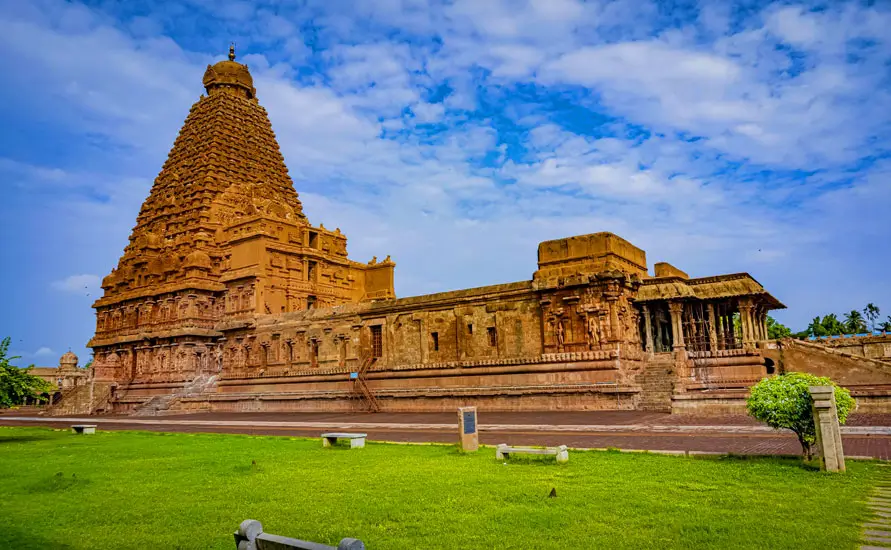
Early morning is the most rewarding time inside the Meenakshi Amman Temple, before tour groups and the midday heat arrive. The complex covers roughly six hectares and is entered through towering gopurams, the tallest on the south side, each layered with hundreds of painted plaster figures. With the guide cross the Aayiram Kaal Mandapam with its forest of columns, where every column carries a carved figure, then out to the Porthamarai Kulam, or Golden Lotus Tank, beside which Sangam-era poets supposedly had their verses judged. Only Hindus may go on into the two inner shrines, a rule the guide covers at the entrance so nobody is caught by surprise.
From the temple you drive to the Mattuthavani flower market, the main wholesale market for the region, where farmers unload gunny bags of malli buds, orange marigold, rose and tuberose. Madurai jasmine, known locally as malli, carries a geographical indication tag, and its scent fills the building long before you reach the stalls. Traders weigh the buds by the kilo and sell them on to garland makers, temples and wedding decorators across Tamil Nadu. It is crowded and wet underfoot, so wear shoes you do not mind getting dirty, and ask before photographing a vendor up close.
Following a siesta, the Gandhi Memorial Museum fills the late afternoon; the building itself was Queen Rani Mangammal's palace in the 1600s. The museum traces India's independence movement in clear panels and holds one of the most personal objects linked to Mahatma Gandhi: the bloodied dhoti from his assassination in January 1948. Madurai also has a direct link to his life, because it was here in 1921 that Gandhi resolved to give up shirt and cap and wear nothing but a short dhoti after seeing local farm workers. Later, the Masi streets ringing the temple are yours to wander. Overnight in Madurai.
Leaving after breakfast, you drive east through Paramakudi and Ramanathapuram, an easy road through cotton fields, palmyra palms and salt flats that grow whiter as the coast gets closer. The last stretch brings the trip's first big moment: the Annai Indira Gandhi road bridge, just over two kilometers long, which lifts you over the sea onto Pamban Island. Your driver stops at the viewpoint on the bridge so you can look down on fishing boats in the blue-green water and, right beside you, the Pamban rail bridge. A new vertical-lift span opened in 2025 next to the 1914 cantilever bridge it replaced.
You reach Rameswaram around midday and check in to your hotel. After lunch comes the Dr. A.P.J. Abdul Kalam National Memorial, a short drive out at Peikarumbu, honoring the scientist and former President who was raised by a boat-owning family on this very island. The memorial mixes Chettinad and Mughal styles and holds models of the rockets and missiles he worked on, along with his letters and a statue of him playing the veena. Kalam's childhood home in the town, now a small museum run by his family, can be added on the way back if you have time and interest.
As the light fades, you walk to the Ramanathaswamy Temple for a first visit when the corridors are lit by oil lamps and electric bulbs. The temple holds one of the twelve jyotirlingas of Shiva, and legend says Rama worshipped here after returning from Lanka. Guides like to say no Hindu temple anywhere has a longer outer corridor than this one, with more than a thousand granite pillars lining a walkway that runs well over a kilometer around the complex. The sanctum is generally reserved for Hindus, and in certain areas men can be told to take off their shirts. Your guide will tell you what applies. Overnight in Rameswaram.
Pilgrims start before dawn at the 22 sacred wells inside the Ramanathaswamy Temple, and you are welcome to join or simply watch. Temple attendants draw water from each well in a bucket and pour it over the heads of the bathers, who move from one well to the next in a fixed order, soaked to the skin and often laughing. Each well is said to have its own taste and temperature. If you take part, bring a change of clothes and leave valuables at the hotel. Non-participants can stand along the corridor and see the ritual, which is one of the most cheerful scenes at any temple in Tamil Nadu.
After breakfast you drive about 20 km to the southeastern tip of the island and Dhanushkodi, once a busy town with a railway terminus, customs post and ferry service to Sri Lanka. On the night of 22 December 1964 a cyclone struck with a storm surge that swept away the town and a passenger train approaching its station. Today the shells of the church, the railway platform, the post office and a few houses stand in the sand, with fishing families living in palm huts beside them. Your guide shares what survivors and later records tell of that night, while the wind carries sand across the old streets.
A paved road built in 2017 continues to Arichal Munai, a sandbar tip where the Palk Strait and the Bay of Bengal touch. A memorial pillar marks the spot, and on a clear day the water is two shades of blue on either side. Sri Lanka's Mannar Island lies roughly 30 km away, out of sight but close enough that local fishermen speak of its lights. Visitors are expected to leave the area before dark, so we plan the outing for the morning or early afternoon. On the way back, a stop at the Kothandaramaswamy Temple, the only building to survive the 1964 storm intact, completes the day. Overnight in Rameswaram.
Six hours of road make this the longest stretch of the week; wheels roll by eight and the sea bridge carries you back to the mainland. The road follows the Gulf of Mannar coast through Sayalgudi and the port town of Tuticorin, famous in earlier centuries for its pearl fishery and now for its salt pans and harbor. Ask for a halt any time you want coffee, fresh tender coconut or a photo of the salt workers raking crystals into white heaps. Along this coast the palmyra palm is everywhere, and roadside stalls sell its fruit, jaggery and a cooling drink called nungu sarbath in the hot months.
Around midday you break the drive at Tiruchendur, a seaside town with one of the six principal abodes of Lord Murugan, the most beloved god among Tamils. Unlike most great temples in Tamil Nadu, which stand inland, this one sits right on the shore, and pilgrims often bathe in the sea before entering. The tower rises above the beach, and on festival days the crowds can be enormous. Your guide explains the legend of Murugan's victory over the demon Surapadman, which is celebrated here every year during the Kanda Sashti festival. A plain vegetarian meal on a banana leaf in town makes a good lunch.
Continuing south past wind turbines and red-sand country around Udangudi, you pull into Kanyakumari around five, with just enough time to go straight down to the shore. Here the coast bends to face two seas at once, so the sun both climbs out of the water in the morning and drops into it at dusk, seen from the same strip of sand. Families gather on the rocks and steps near the Kumari Amman Temple, vendors sell shell jewelry and roasted peanuts, and the sky turns orange behind the bay. Your hotel is a short walk away. Overnight in Kanyakumari.
Set an early alarm and join the crowd on the seafront for sunrise at Kanyakumari, when people of every faith fall quiet as the sun lifts out of the Bay of Bengal. Breakfast done, the state-run ferry shuttles you out to the Vivekananda Rock Memorial, completed in 1970 on the outcrop where the young monk Vivekananda sat in meditation for three days in December 1892. The ferry ride takes only a few minutes, but queues build fast, so going early helps. A footbridge now links the memorial rock to the 133-foot Thiruvalluvar statue, honoring the Tamil poet whose Thirukkural is still taught in every school in the state. Ferry services can be suspended in rough seas.
Ashore again, you call at the Kumari Amman Temple of the maiden goddess Kanya Kumari, whose name the town carries, before a 13 km hop inland to Suchindram. Its Thanumalayan Temple is worshipped as a single shrine to Brahma, Vishnu and Shiva together, and its granite pillars are carved so that striking them gives out musical notes. A tall statue of Hanuman stands in one of the halls. Male visitors normally go bare-chested here, and the guide clarifies which halls are open to non-Hindus. The temple closes for some hours in the afternoon, so it is planned before lunch.
Lunch over, the road slips across the Kerala border to Padmanabhapuram Palace, once home to the Travancore royal family and framed almost entirely in teak and rosewood under steep tiled roofs. Its council chamber has shutters of mica, the floors are polished black with a mix that includes burnt coconut shell and egg white, and the queen's quarters still hold carved beds and Chinese jars. Mondays it stays shut, so on that weekday a different stop takes its place. You arrive in Trivandrum in the early evening, and dinner of Kerala fish curry tastes noticeably different from a week of Tamil cooking. Overnight in Trivandrum.
Your final morning is free until your airport transfer. Hindu travelers may wish to visit the Sri Padmanabhaswamy Temple, where Vishnu reclines on a serpent; entry is restricted to Hindus and a strict dress code applies, with men in a dhoti and women in a sari or long skirt, which can be rented near the gates. Others can walk around the outer streets of the Fort area or stop at a spice and handloom shop. At the time you have agreed, the car is at the hotel door for the quick run to Trivandrum International Airport, usually twenty to thirty minutes.
Trivandrum has frequent flights to the Gulf hubs of Dubai, Doha, Abu Dhabi and Muscat, as well as domestic links to Chennai, Bengaluru and Delhi for onward connections. If your flight leaves late, a day-use room or an extra night at the beach at Kovalam can be arranged at extra cost. Over eight days you have stood beneath Madurai's gopurams, crossed the sea to Rameswaram, walked a town erased by the 1964 cyclone and watched the sun rise where three seas meet. Safe travels, and come back to Tamil Nadu whenever the south calls again.
Your Journey

N.S. Rathore & Mrs. Omlata Rathore · Managing Director
We still read every enquiry ourselves. Tell us the places you liked and our planners will send a day-by-day route with drive times and a clear price.
Every package can be customised and no pressure to book. A planner from our office replies within 24 hours with a route written for your group.
Fill this in and your planner will send a first draft itinerary.
Explore more
Kerala Backwaters Escape Kerala Backwaters Escape Kerala Backwaters Escape Kerala Backwaters Escape