
 Kerala Backwaters Escape

Tamil Nadu Tour Packages
Chennai – Kanchipuram – Mahabalipuram – Pondicherry – Chidambaram – Kumbakonam – Tanjore – Trichy – Chettinad – Madurai – Kanyakumari – Suchindram – Padmanabhapuram – Kovalam – Varkala – Trivandrum
At a glance
Temple touring in Tamil Nadu is rewarding but tiring: early starts, hot stone courtyards, long corridors walked barefoot. Our Tamil Nadu Heritage and Kerala Beach Tour builds the cure into the plan. The first twelve days cover the great sites of the state in an unhurried order, from Pallava Mahabalipuram and French Pondicherry to the Chola heartland around Kumbakonam and Tanjore, the rock temples of Trichy, the mansions of Chettinad and the towers of Madurai. Then the road turns south to the tip of India and over the border into Kerala for four nights by the sea.
Pacing is the point of this route. You spend two nights in Pondicherry, Kumbakonam and Madurai, and most drives last two to four hours, with only the Madurai to Kanyakumari leg running closer to five. Kumbakonam is used as a base for the Chola temples instead of a rushed day trip, which lets you reach Darasuram and Gangaikonda Cholapuram in quiet morning light. After the sunrise at Kanyakumari, the last stretch of the Tamil Nadu heritage and Kerala beach tour slows right down at Kovalam and the red cliffs of Varkala.
Everything is private: a single chauffeur and cooled vehicle from Chennai to Trivandrum, licensed guides at each major site, and hotels chosen for location and character. It suits travelers from Europe, North America and Australia with two and a half weeks to spare, retired couples who prefer fewer hotel changes, and NRI families combining temple visits with a proper rest. Travel between late November and early March, when the sea in Kerala is calm enough for swimming and the temple towns are at their most comfortable.
A member of our Chennai team stands at the international arrivals exit with a card bearing your name, and walks you to the car once your bags are through customs. Reaching a central hotel can take anything from forty minutes at night to well over an hour in office traffic. Because so many overseas arrivals land in the small hours, an early check-in reserved in advance lets you go straight to bed and sleep until lunch. Before leaving you, the representative explains how the next seventeen days are arranged and leaves a contact number that works around the clock.
After lunch, your guide collects you for a short look at the colonial roots of the city. Fort St. George, raised by the English East India Company from 1644, was the first British stronghold in India and still houses the Tamil Nadu legislature and secretariat. Within its walls, St. Mary's Church, consecrated in 1680, stands as the earliest Anglican place of worship in the East, and its marriage register includes the name of Robert Clive. The small Fort Museum displays cannons, coins, uniforms and a fine statue of Lord Cornwallis, giving you the story of how a trading post became the capital of the Madras Presidency.
Late in the afternoon, continue to the Government Museum at Egmore, founded in the 1850s. Its bronze gallery holds an outstanding set of Chola bronzes, a perfect preview before you visit the temples they came from, with Nataraja, Parvati and the poet-saints all displayed in a cool, quiet hall. Since its doors stay shut on Fridays, guests arriving that day get Mylapore and the Kapaleeshwarar Temple in its place. Finish with an early dinner at the hotel and a full night's sleep, because tomorrow the long drive south begins and the first temples open early. Overnight in Chennai.
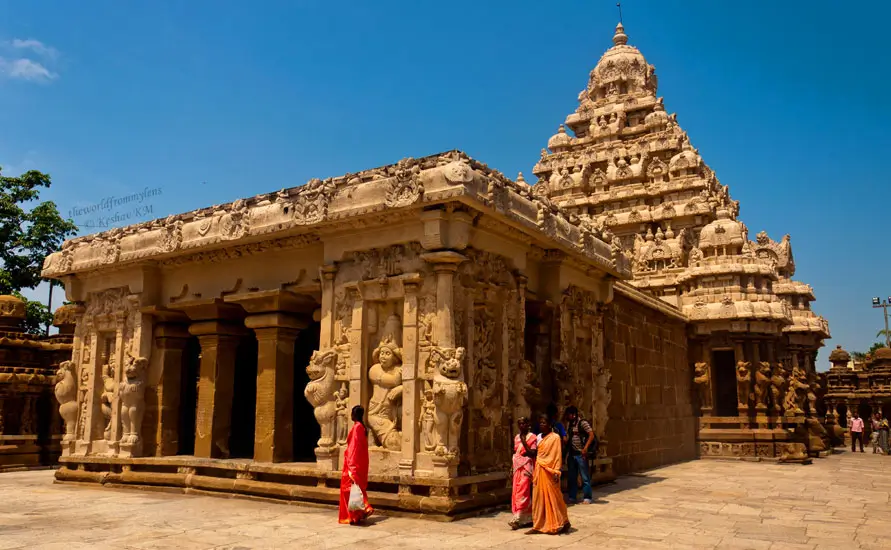
Leave Chennai after breakfast and head west to Kanchipuram, once the royal city of the Pallavas and counted among the seven sacred cities of Hinduism. The town is split loosely into a Shiva half and a Vishnu half, and today your guide focuses on the Vishnu side, starting with the Vaikunta Perumal Temple, built in the 8th century. Its inner corridor carries carved panels that tell the history of the Pallava kings, almost like a stone chronicle, and your guide can read the scenes of coronations, battles and royal ceremonies. Most coaches skip it, which leaves the corridors quiet for you.
Next comes the Varadharaja Perumal Temple, a sprawling Vishnu shrine famous for its hundred-pillared hall carved with horsemen and hunting scenes, and for the stone chain cut from a single block hanging at one corner. Afterwards, visit a weaving family in one of the side streets where looms clatter in front rooms and silk thread is dyed and dried in the lanes. Kanchipuram silk is woven with a heavy border joined to the body by a special interlocking technique, and the weaver can show you how to recognize it. There is no obligation to buy anything.
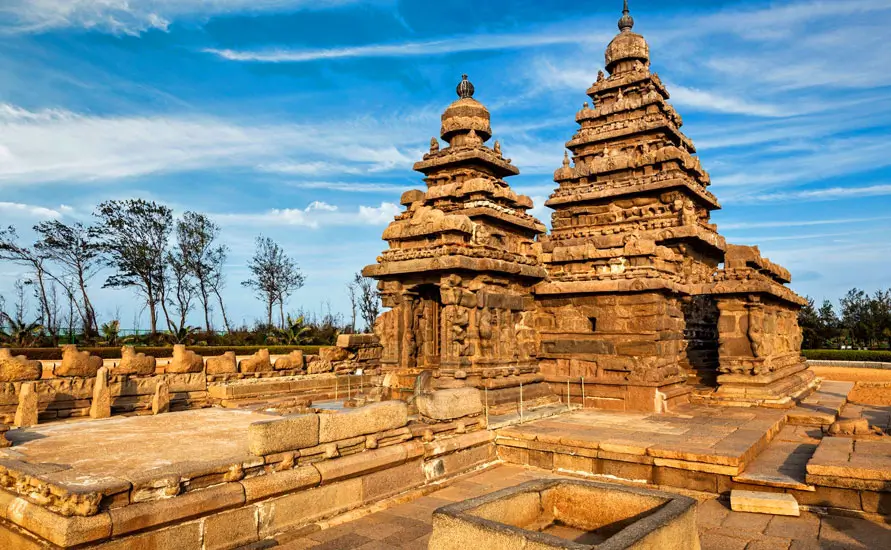
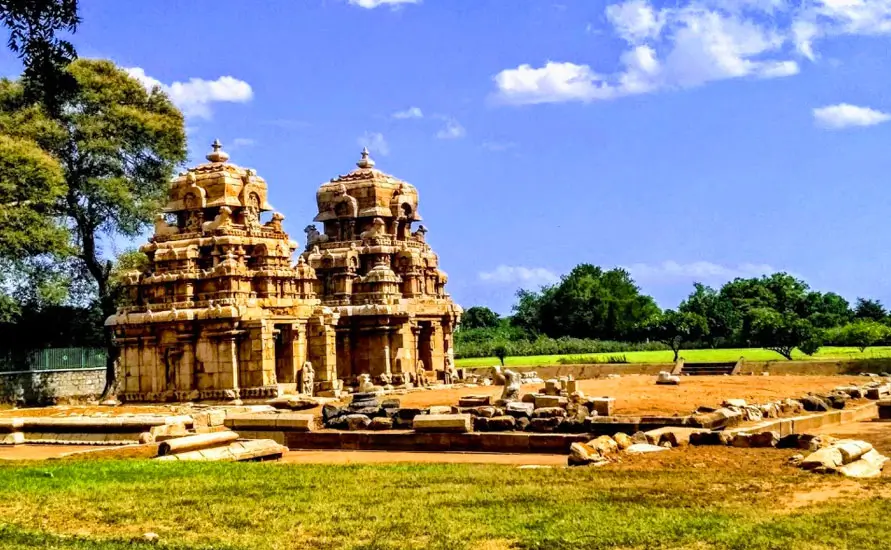
After lunch the car heads for the coast, and ninety minutes later you are checking in at a beach resort in Mahabalipuram. The late afternoon is ideal for the Shore Temple, which faces the sunrise but glows beautifully at the end of the day as well. Raised during the reign of Rajasimha, also known as Narasimhavarman II, it has two towers, one dedicated to Shiva and one to Vishnu, and a reclining Vishnu image lies in a small chamber between them. Later, stroll past the wooden catamarans beached for the night, and enjoy a quiet seafood dinner. Overnight in Mahabalipuram.
In the early morning your guide takes you to the rest of the UNESCO-listed monuments of Mahabalipuram, beginning with the rock-cut cave shrines on the central hill. The Mahishasuramardini Cave holds one of the finest Pallava panels in India, showing the goddess Durga on a lion fighting the buffalo demon, with a peaceful Vishnu sleeping on the serpent on the opposite wall. Nearby, the Varaha Cave depicts the boar avatar of Vishnu lifting the earth goddess clear of the flood on his tusk. The contrast between action and calm in these carvings is something your guide will point out on the way.
From there walk down to the Descent of the Ganges relief, also called Arjuna's Penance, where a natural cleft in the rock once carried rainwater down the middle of the carving. Look for the small details that most visitors miss, like a skinny cat balancing on its hind legs, mimicking an ascetic, with mice gathered around it. Finish with the Five Rathas, carved from a single granite outcrop on the south side of town. Life-size animals stand among them, an elephant, a lion and a bull, all left in place when the sculptors cut away the surrounding granite.
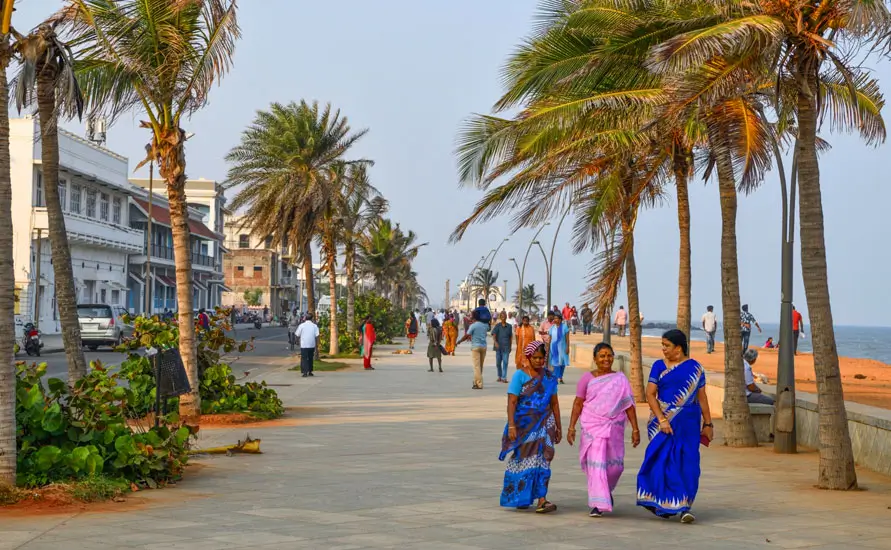
After a light lunch, follow the coastal highway toward Pondicherry, passing the brackish waters of the Kaliveli lagoon and village shrines with large terracotta horses standing guard at their gates. Villagers present these clay steeds to Ayyanar, the guardian god who rides out at night to protect the fields, and a quick photo stop is easy. A boutique hotel inside the old town is booked for two nights, within walking distance of the sea. In the evening, the seaside promenade is closed to traffic and filled with families walking, eating roasted peanuts and watching the waves. Overnight in Pondicherry.
Pondicherry was the center of French India for nearly three centuries, and your guided walk this morning starts at the Pondicherry Museum, whose cases display amphora shards and beads traded through the ancient port of Arikamedu, French furniture and colonial-era maps. Then you walk past the white colonnaded buildings around Bharathi Park, including the old Raj Nivas, now the Lieutenant Governor's residence, and the French Consulate. Your guide tells the story of Dupleix, the French governor whose ambitions in South India brought him into conflict with the British, and shows you the statue of him on the seafront.
Late morning is spent at the Sri Aurobindo Ashram, a quiet place where visitors gather around the shared samadhi of the ashram's two founders, covered daily in fresh blossoms. Silence is observed inside. Lunch can be a long, relaxed affair at one of the cafés in a restored colonial house. In the afternoon, cross into the Tamil part of town to visit the Manakula Vinayagar Temple, whose ceiling and walls are covered with brightly painted Ganesha stories, and then the Sacred Heart Basilica, a Gothic church with unusual stained-glass windows showing the life of Jesus.
Late in the afternoon drive to Auroville, where the visitor center explains the township's founding in 1968 and its experiments in sustainable living, reforestation and alternative education. Afterwards a shaded woodland trail brings you within sight of the Matrimandir, its gilded discs catching the late sun above the lawns. Getting inside depends on an advance reservation with very few daily slots, so mention it when you book the tour. Return to Pondicherry for a relaxed evening, perhaps with dinner in a courtyard restaurant in the old town where Tamil and French cooking share a single menu. Overnight in Pondicherry.
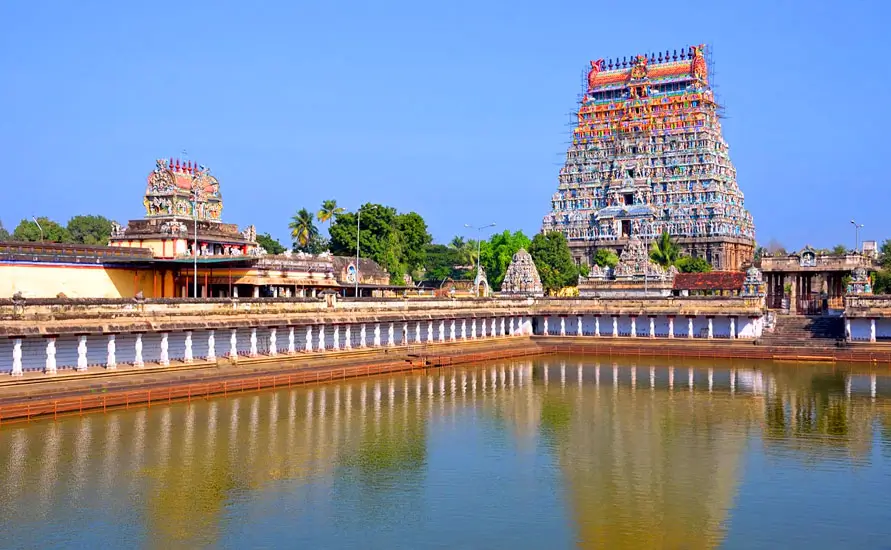
Leaving Pondicherry, the road heads south through Cuddalore and across the Vellar River to Chidambaram, about two hours away through cashew orchards and paddy fields. The Nataraja Temple ranks among Shaivism's holiest sites, being the spot where Shiva is believed to have performed his cosmic dance. The hall of the main shrine has a roof covered with gold plates, and the four gateways carry stone images of the 108 dance poses of the Natya Shastra. Classical dancers gather every year around Maha Shivaratri to perform in the courtyard for the Natyanjali festival.
Inside, the temple is run by the Dikshitar priests, a community that has looked after it for centuries, and you will see them with their distinctive topknots and white dhotis. Visitors are expected to dress modestly, and some inner areas may be closed to non-Hindus. Your guide explains the concept of the akasha lingam, Shiva in the form of the sky or space, which is why there is no stone lingam in the main sanctum. If time allows, also walk to the Sivaganga tank in the temple grounds, where pilgrims bathe before entering the shrine.
In the afternoon you drive another hour and a half west through the Kaveri delta, a flat green region of paddy fields, coconut groves and small canals, to Kumbakonam. This old temple town has dozens of shrines within a few kilometers and was once a center of learning under the Chola kings. Check in to a heritage resort on the edge of town for two nights. In the evening, try the town's famous degree coffee, made with fresh chicory-blended coffee and frothy milk, at one of the old coffee houses near the bus stand. Overnight in Kumbakonam.
Start early with the drive of about 35 km north to Gangaikonda Cholapuram, built by Rajendra Chola I after his armies reached the Ganges in the 11th century. The temple tower has a graceful curve, unlike the straight pyramid at Tanjore, and a large well with a lion-shaped entrance near the gate was, by tradition, charged with Ganges water carried home by the army. Early morning is the best time, when the grounds are empty and the deities carved into the outer niches are lit by soft side light. Your guide explains why the city faded so quickly after the Chola decline.
On the way back, stop at Swamimalai, home of the bronze sculptors of the Kaveri delta. A family of craftsmen demonstrates the lost-wax process, from the wax model to the clay mold baked over a fire, to the moment the molten metal is poured. They follow the same rules of proportion that Chola sculptors used a thousand years ago. Lunch can be in Kumbakonam itself, where small vegetarian restaurants serve full meals with sambar, rasam, kootu, curd and a sweet. After lunch, rest at the resort during the hottest hours.
Once the heat fades, drive five minutes out of Kumbakonam to Darasuram and its Airavatesvara Temple, completing your set of UNESCO Chola monuments. Rajaraja II's 12th-century shrine is crowded with miniature reliefs: musicians, dancers, wrestlers, and even a figure that shows an elephant and a bull sharing one head. Tap the stone balustrade near the entrance steps gently and your guide will explain the musical legend attached to it. End the day in Kumbakonam town with a visit to the Mahamaham Tank, ringed by small shrines, where a great bathing festival is held roughly every twelve years. Overnight in Kumbakonam.
Before leaving Kumbakonam, visit one or two of the town's great temples with your guide. The Sarangapani Temple is a leading Vaishnava center, and its sanctum takes the shape of a stone ratha pulled by carved steeds and elephants. The Adi Kumbeswarar Temple, nearby, gave the town its name, as legend says a pot of divine nectar broke here after a great flood. Kumbakonam is also known for its fresh betel leaves and areca nut, and you can see sellers along the streets folding paan into neat green parcels for customers after lunch.
The drive to Tanjore takes about an hour through rice fields and villages. Check in at your hotel and, after lunch, visit the Thanjavur Palace complex, the later royal seat after the Cholas faded. The palace's Durbar Hall has painted ceilings and walls, and the bell tower offers views over the old town. The Saraswathi Mahal Library, among the oldest libraries in Asia, holds rare manuscripts, maps and drawings. Time permitting, a studio visit for Tanjore paintings follows, where you see artists building up the raised gold-foil designs that make this style unique.
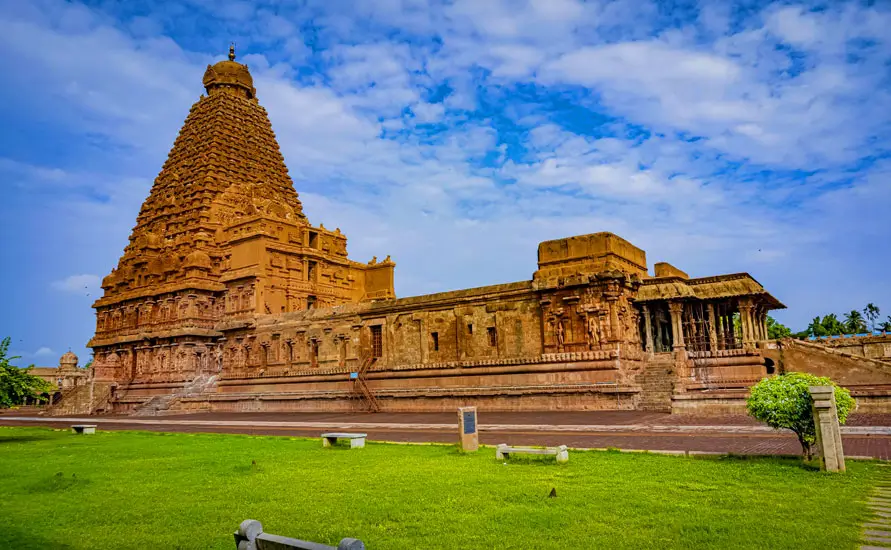
In the late afternoon, walk into the courtyard of the Brihadeeswarar Temple, Rajaraja Chola's masterpiece consecrated in 1010. The great tower over the sanctum is built entirely of granite, though the nearest quarry is far away, and engineers still debate how the heavy capstone was lifted to the top. Watch the stone change color in the evening light, as local families arrive to pray and children play on the lawns. The temple is lit after dark, and the walk back to the car is a good time to see it from a distance. Overnight in Tanjore.
Ninety minutes on the road deliver you to Tiruchirappalli, shortened by everyone to Trichy, a city built on the banks of the Kaveri River. Begin on Srirangam, a river island almost entirely given over to the Ranganathaswamy Temple, a living sacred town in its own right. It is laid out in seven concentric walled enclosures, with streets, homes and shops inside the outer rings. Its southern gateway, the Rajagopuram, finished only in 1987, climbs to about 73 meters. Visitors of any faith may walk the outer courtyards, though only Hindus may approach the innermost shrine.
Your guide leads you through the pillared halls, including the Sesharaya Mandapa, where columns are carved with horses rearing on their hind legs, ridden by warriors. On the way out, visit the nearby Jambukeswarar Temple at Thiruvanaikaval, which represents the element of water among the five great Shiva temples of South India. A small spring in its sanctum keeps the ground damp all year. Lunch in Trichy can be a simple banana-leaf meal at a busy canteen on the island, or you can return to the hotel for a rest in the afternoon.
Late in the day, climb the Rock Fort, a massive rocky outcrop in the middle of the old city. Around four hundred rock-hewn steps, partly roofed, climb past the Thayumanavar Temple to the little Ucchi Pillaiyar Temple, a Ganesha shrine perched on the very top. The climb takes about half an hour at a steady pace, and the view from the top over the Kaveri, Srirangam's towers and the busy streets of Trichy is worth the effort, especially at sunset. Footwear must be left at the bottom, so bring socks. Overnight in Trichy.
The morning drive out of Trichy cuts south across the former princely state of Pudukkottai, which kept its own raja until it joined independent India in 1948. The Government Museum in the town is small but varied, with stone sculptures rescued from abandoned village shrines, old coins, folk instruments and a rather eccentric natural history wing. Look out for the bronze images from the Pudukkottai region, which are less polished than the Chola pieces in Chennai but have a strong local character. The broad avenues of the old town still reflect the planning of its rulers.
About 20 km north of the town, the granite hill of Narthamalai hides one of the earliest stone temples in Tamil Nadu, the Vijayalaya Choleeswaram, built around the 9th century when the Chola dynasty was just beginning its rise. Below it, two rock-cut caves hold rows of life-size Vishnu figures standing in shallow niches. The site is open ground with few facilities and almost no other visitors, and the climb over sloping rock takes about fifteen minutes. Wear shoes with a good grip and carry water. Langur monkeys and peacocks are common around the hillside, especially in the cooler morning hours.
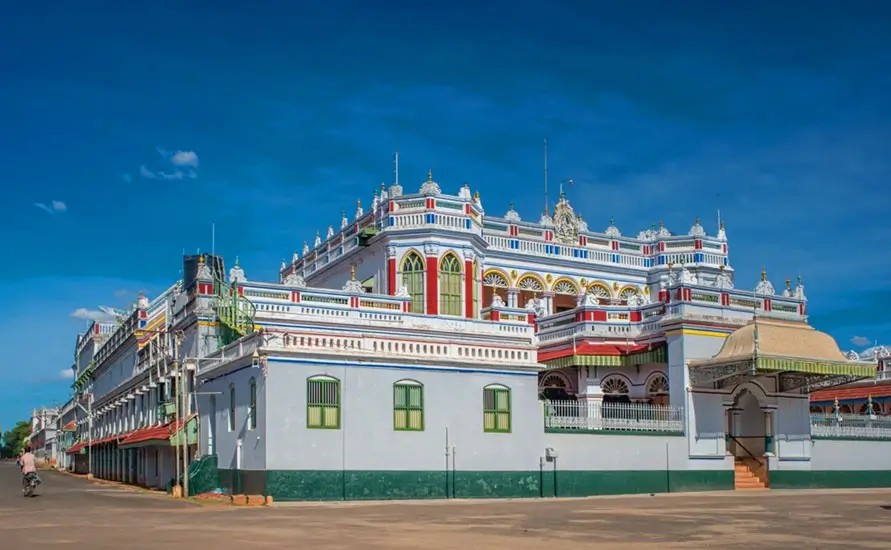
By early afternoon you reach Chettinad and settle into a mansion hotel built for a Chettiar family about a century ago. Lunch is your introduction to Chettinad cuisine, with roasted pepper, fennel and dried chilies driving dishes such as nattu kozhi (country chicken) curry, kuzhi paniyaram and kavuni arisi, a pudding of sticky black rice and coconut. After a siesta, walk with a local guide through Kanadukathan at dusk, peering through tall gates into silent courtyards. Some homes are open to visitors for a small donation, others are locked, and a few have been carefully restored. Overnight in Chettinad.
Spend the morning on the crafts that make this region so distinctive. At Athangudi, a tile maker sits cross-legged on the floor of an open shed, pouring liquid oxide colors into a brass stencil laid on glass, then backing the wet layer with powdered cement and river sand. The tiles are never fired; they cure slowly in water and dry under thatch, which is what gives them their gentle shine. Nearby, the weavers of kandangi saris work in small houses, producing the bold checked cotton fabric worn by Chettiar women for generations. Both visits are short and informal.
Continue to Karaikudi, where the antique quarter around Muneeswaran Kovil Street is piled high with goods salvaged from mansions that families could no longer maintain. You find carved doorframes, Belgian mirrors, enamel tiffin boxes, wooden toys painted in bright colors, and huge brass cooking pots meant for wedding feasts of a thousand guests. Prices are always negotiable, and your guide can help with bargaining or explain the paperwork for shipping larger items. Stop also at the Pillaiyarpatti cave temple on the way out, where a Ganesha image carved straight from the rock is worshipped by Chettiar families.
Two hours of road lead on to Madurai across dry plains of scrub, palmyra and village tanks. Two nights are reserved at a central hotel, and the hot afternoon is for resting. Greek and Roman writers already knew of Madurai as a trading center, and its links with the Sangam literature of early Tamil make it a cultural capital for Tamil speakers. After dark, the Thirumalai Nayak Palace stages its English-language light and sound program, where the giant white columns of the courtyard are lit in changing colors. A late dinner of Madurai-style kari dosa follows. Overnight in Madurai.
Arrive at the Meenakshi Temple while the morning rituals are under way, when nadaswaram pipes, conch shells and bells echo through the halls and priests carry trays of camphor flame between the shrines. Fourteen gopurams covered with painted figures stand around the walls, and your guide begins with the Kambathadi Mandapam, whose pillars show Shiva in his many forms, including the wedding of Shiva and Meenakshi with Vishnu giving away the bride. This wedding is reenacted every April or May during the Chithirai festival. Phones and cameras stay in the lockers outside, and the main sanctums are for Hindus only.
Toward noon, head north over the Vaigai bridge, where Tamukkam, a 17th-century royal pavilion, now holds the Gandhi Memorial Museum. Its galleries take you through India's long struggle for independence with photographs, letters and personal belongings of Gandhi, presented in clear English. Lunch follows at a local restaurant. In the afternoon, step into the Koodal Azhagar Temple, a Vishnu shrine in the old city whose sanctum rises in three levels, each with a different form of the god, standing, sitting and reclining. Then stop at the Puthu Mandapam, a pillared hall full of tailors, where a cotton shirt can be stitched for you in a day.
Evening in Madurai is lively, and the streets around the temple stay busy long after dark. If you have the energy, go back inside at about nine for the palliyarai ceremony, the nightly procession in which a silver palanquin bears Sundareswarar to the goddess for the night, escorted by drummers and chanting priests. Otherwise, rest at the hotel and save energy for the long drive tomorrow. Food stalls near the South Tower serve kothu parotta, chopped and fried on a hot griddle with egg and spices, and the sweet cold drink jigarthanda is sold from carts on almost every corner. Overnight in Madurai.
Today brings the biggest distance of the tour, so set off straight after breakfast. A modern four-lane highway runs south past Virudhunagar, a busy market town for chilies and cotton, and on to Tirunelveli, where the land turns greener as the Thamirabarani River comes down from the hills. Tirunelveli is known across Tamil Nadu for its halwa, a glossy, rich sweet of wheat, sugar and ghee sold warm in small shops. Your driver will stop for a break, and if you wish you can visit the twin Nellaiappar Temple, dedicated to Shiva and Parvati, which has a set of stone pillars that ring when tapped.
South of Tirunelveli, the landscape changes again as you near the very tip of the subcontinent. Rows of wind turbines line the hills near Aralvaimozhi, where the Western Ghats break and strong winds funnel through the gap, making this one of the windiest places in India. Banana groves, coconut palms and paddy fields return, and the air begins to smell of salt. By early afternoon you are at Kanyakumari, settling into a hotel that looks straight out to sea. After a rest, the town's main sights are all within walking distance of the shore, and evenings here are pleasantly breezy.
In the late afternoon, visit the Kumari Amman Temple, which honors the goddess as a young virgin waiting for her marriage to Shiva. Men must remove their shirts at the entrance, and local stories say the diamond nose ring of the goddess once flashed so brightly that ships took it for a beacon. Next, see the Gandhi Mandapam, where an urn of Gandhi's ashes was kept for public viewing in 1948; a hole in the roof lets the sun fall on that spot each 2 October. Then take a seat on the beach steps to watch the sun drop into the ocean. Overnight in Kanyakumari.
An early alarm is worth it here, as Kanyakumari is among very few spots on the Indian mainland where the sun can be watched rising from the water from the mainland tip. Crowds gather on the shore and rooftops well before dawn. After breakfast, join the queue for the ferry to the Vivekananda Rock Memorial, a granite hall built on the islet where Swami Vivekananda meditated before traveling to Chicago. Beside it rises the Thiruvalluvar Statue, 133 feet tall, one foot for each chapter of the Thirukkural, the Tamil classic on ethics, wealth and love. Lines can be long, especially on weekends and holidays.
Driving west, you soon reach Suchindram and the Thanumalayan Temple, where a single sanctum honors the Hindu trinity of Brahma, Vishnu and Shiva together. The temple has an 18-foot statue of Hanuman, painted orange and decorated with butter by devotees, and a set of carved stone pillars that give out musical notes when struck. A short way further, Padmanabhapuram Palace served as the royal home of Travancore before the court moved to Trivandrum in the 1790s. Built mostly of teak and rosewood, with floors polished to a mirror shine with a mix of egg white, lime and burnt coconut shell, it stays closed on Mondays.
After crossing the state border near Parassala, the scenery changes to dense coconut groves and red-tiled houses, and the language on signs turns to Malayalam. Kovalam, a beach town a short way south of Trivandrum, is reached mid-afternoon, with a sea-facing resort booked for two nights. Here the pace of the trip changes completely. Spend the rest of the day by the pool or wander down to Lighthouse Beach, where the red and white tower overlooks a curving bay. In the evening, cafés along the sand put out tables and lanterns and display fresh fish on ice. Overnight in Kovalam.
Nothing is scheduled today, and after two weeks of temples, early starts and long corridors, that is the whole point. Kovalam is made up of three small bays divided by rocky outcrops, each with a slightly different feel: Lighthouse Beach is the busiest, Hawa Beach is lined with small hotels and fishing boats, and Samudra Beach to the north is the quietest. From November to March the water is usually calm in the mornings, and lifeguards watch over the main swimming areas. Follow their whistles and flags carefully, since currents along this coast can shift without warning, especially later in the day.
Kerala's tradition of Ayurveda is a good reason to stay put for a while. Most resorts in Kovalam have a treatment center, and an hour of abhyanga, the classic warm-oil massage, or shirodhara, with herbal oil flowing steadily onto the brow, eases the stiffness left by long car days. Longer programs begin with a consultation with an Ayurvedic doctor. These treatments are optional and paid locally, and we can suggest certified centers. If you want a short outing, the Vizhinjam fishing harbor nearby is busy in the mornings when boats unload sardines, mackerel and tuna.
Late in the afternoon, climb the steps of the Kovalam Lighthouse for wide views over the coast, the bays and the palm-covered hills behind them. The top is narrow and the stairway is steep, but the view rewards the effort. As the light fades, the beach restaurants start to fill up, and waiters show you trays of the day's catch to choose from. Try karimeen pollichathu, pearl spot coated in a masala of shallots and chili, parceled in banana leaf and pan-roasted, or a coconut-based prawn curry with soft appam. Take an easy walk back along the sand afterwards. Overnight in Kovalam.
After a slow breakfast, leave Kovalam and drive north around the edge of Trivandrum toward Varkala, a small coastal town where the land ends in sheer red laterite cliffs above a long beach. The trip takes about ninety minutes. Shortly before arriving, stop at Sivagiri Mutt, the hilltop ashram and resting place of Sree Narayana Guru, a philosopher and social reformer who led a movement for equality and education among communities excluded by caste. His call for equal dignity for every human being still carries weight in Kerala, and his followers come here in yellow robes each December.
Your cliff-top resort is booked for two nights. The North Cliff at Varkala is a narrow path running along the edge of the drop, lined with simple cafés, yoga studios, bookshops and stalls selling textiles and silver jewelry. Long stairways lead down to Papanasam Beach, where families offer rice balls and flowers in memory of departed relatives, guided by priests at the water's edge, and the name of the beach refers to the cleansing of sins. Behind it, the Janardhana Swamy Temple is an old Vishnu shrine whose large bronze bell is linked by local tradition to a grateful European ship's captain.
When the tide is out later in the day, stroll beneath the cliffs, where natural freshwater springs trickle out of the rock face onto the sand. Sunset here is a daily event, and the cliff-top cafés fill with people from many countries as the sky turns pink and gold over the Arabian Sea. Menus range from fresh seafood and Kerala thalis to Middle Eastern, Italian and Tibetan dishes. Swimming at Varkala is possible on calm days, but waves can be strong and there are rip currents, so swim only in the areas marked by lifeguard flags. Overnight in Varkala.
The last full day in India is meant to be easy. Early risers can join a yoga session on an open deck above the sea, offered by most resorts and many small studios along the cliff for drop-in guests. Afterwards, walk north on the cliff path to Black Beach, whose sand is streaked dark with minerals, which is usually quieter than the main beach. The path is flat but has no railings in places, so keep to the inner side and go before the midday heat. Fishermen often haul in shore nets along this stretch in the early morning, and you are welcome to watch.
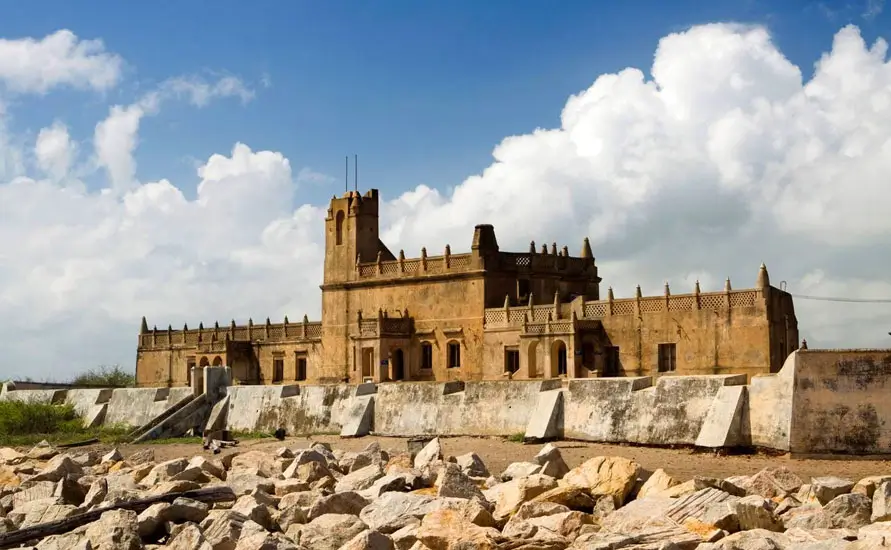
In the afternoon, drive about 20 minutes north to Kappil, where a narrow sand bar separates the open sea from a calm backwater lake fringed with coconut palms. Half an hour in a country boat or pedal boat offers a small taste of Kerala's backwaters without needing a full houseboat trip. On the way back, stop at Anjengo Fort at Anchuthengu, a small laterite fort put up by English traders in the 1690s to guard their pepper warehouses. Its old graveyard holds some of the earliest British tombs on the Malabar Coast, and the lighthouse next door can be climbed.
Return to Varkala for a farewell evening by the sea. Choose a cliff-top table for dinner as the sun goes down, and watch the lights of the fishing boats appear one by one on the horizon. There is time to pack and to pick up last presents from the cliff shops, which sell Kerala spices, coir mats, handloom cotton, sandalwood soap and bottles of Ayurvedic massage oil. If you want a final taste of Tamil Nadu, a few cafés also serve filter coffee, a reminder of the temple towns you saw earlier in the trip. Overnight in Varkala.
Check out after breakfast and drive about ninety minutes south to Trivandrum International Airport. With an evening flight, you can spend an hour at the Napier Museum, an ornate Indo-Saracenic building from the 1880s with Kerala bronzes, ivory carvings and temple chariots, set in the same gardens as the city zoo and art gallery. The famous Sree Padmanabhaswamy Temple nearby admits Hindus only, with a strict dress code of dhoti or sari.
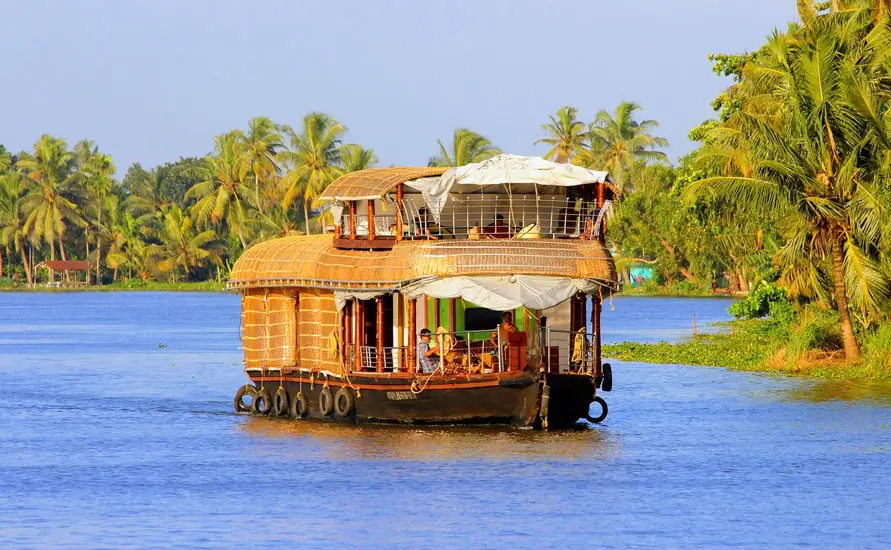
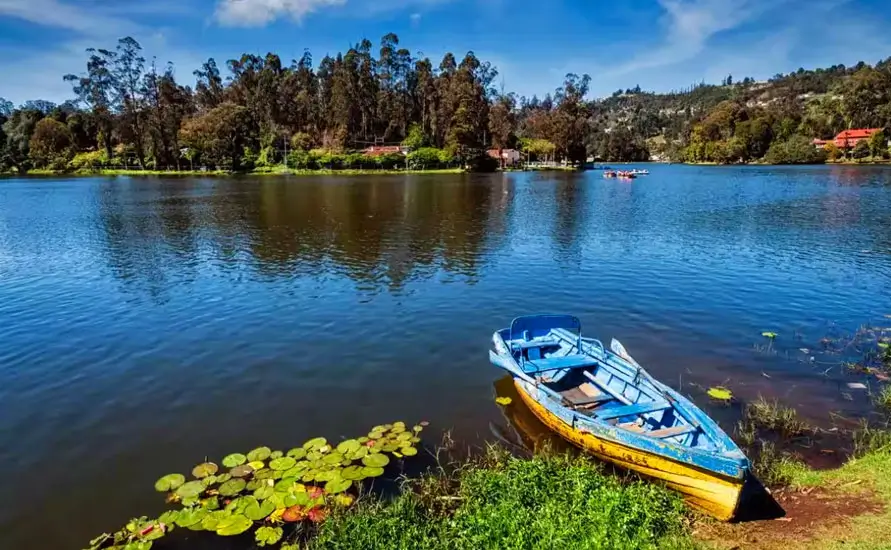
Your driver leaves you at the terminal entrance around three hours before your international flight. Over these seventeen days the route took you from the fort and museum halls of Chennai to Chola towers, Chettiar mansions and the meeting of three seas, and then let the trip wind down slowly on two Kerala beaches. The Nilgiris, the Alleppey backwaters and Kodaikanal remain for another visit, and our team is ready to map that out. Safe travels home.
Your Journey

N.S. Rathore & Mrs. Omlata Rathore · Managing Director
We still read every enquiry ourselves. Tell us the places you liked and our planners will send a day-by-day route with drive times and a clear price.
Every package can be customised and no pressure to book. A planner from our office replies within 24 hours with a route written for your group.
Fill this in and your planner will send a first draft itinerary.
Explore more
Kerala Backwaters Escape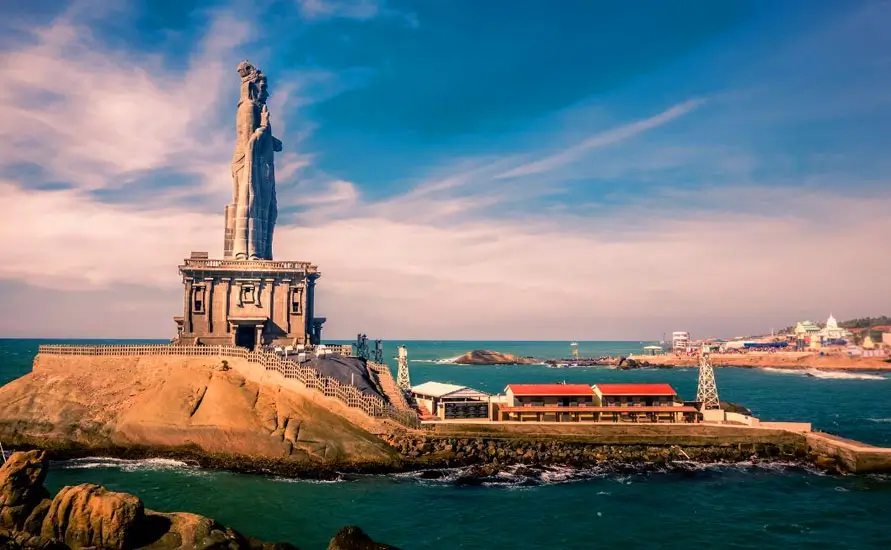 Kerala Backwaters Escape
 Kerala Backwaters Escape
 Kerala Backwaters Escape
 Kerala Backwaters Escape
 Kerala Backwaters Escape
 Kerala Backwaters Escape
 Kerala Backwaters Escape
 Kerala Backwaters Escape
 Kerala Backwaters Escape
 Kerala Backwaters Escape
 Kerala Backwaters Escape
 Kerala Backwaters Escape
 Kerala Backwaters Escape
 Kerala Backwaters Escape
 Kerala Backwaters Escape
 Kerala Backwaters Escape
 Kerala Backwaters Escape
 Kerala Backwaters Escape
 Kerala Backwaters Escape
 Kerala Backwaters Escape Kerala Backwaters Escape Kerala Backwaters Escape