 Kerala Backwaters Escape

Karnataka Tour Packages
Bangalore – Jindal Vijayanagar – Hospet (Hampi) – Chitradurga – Hassan (Belur, Halebidu) – Shravanabelagola – Mysore – Bylakuppe – Coorg – Wayanad – Kozhikode – Kochi – Alleppey
At a glance
Karnataka reads best from top to bottom, and this route follows it that way. The Hampi Mysore Coorg and Kerala Backwaters Tour opens among the granite boulders and ruined bazaars of Hampi, capital of the Vijayanagara kings, then heads south past the hill fort of Chitradurga to the soapstone temples of Belur and Halebidu. A morning climb to the Jain colossus at Shravanabelagola leads on to Mysore and the coffee country of Coorg, so Karnataka gets nine of the fifteen nights before the road crosses into Kerala.
South of the state line the same downhill logic holds. You pass through the forests of Wayanad, wind down a ghat road to the old spice port of Kozhikode, ride the coastal railway to Fort Kochi and close with a night aboard a private houseboat near Alleppey. Most overseas guests land in Bangalore and hop the same day on a short domestic flight to Jindal Vijayanagar, the small airstrip serving Hampi, or to Hubballi; a private road transfer from Bangalore works too. The trip ends at Cochin International Airport, which has good links to the Gulf and beyond.
Sixteen days give the variety of a long tour without a long haul every morning, since most stops last two or three nights. This Hampi Mysore Coorg tour with Kerala attached is designed for visitors from Britain, continental Europe, the Americas and Australia, and for NRI parents who want their children to see where the old southern kingdoms rose and fell. Aim for October to February, because Hampi turns fiercely hot from April. Guides, a private car and driver, and every rail and air ticket on the Hampi Mysore Coorg and Kerala Backwaters Tour are arranged before you land.
Our Bangalore colleague meets you as you exit immigration at Kempegowda International Airport, ready to walk you across to domestic departures for the hop north to Jindal Vijayanagar, a steel-town airstrip roughly an hour's flying time away. Services here are thin and timetables shift with the season, so when the connection does not line up we use Hubballi instead, about three hours by road from Hampi, or send a car from Bangalore for the six-hour run up the highway through Chitradurga. Whichever way you come, one driver picks you up and stays with you through Karnataka.
Forty minutes of road separate the airstrip from your hotel in Hospet or one of the quieter properties near Kamalapura, close to the ruins. Canals fed by the Tungabhadra dam keep the plains green with paddy and sugarcane, and soon the horizon breaks up into piles of honey-colored granite, stacked as if by giants. Once checked in, sleep off the flight; nothing is planned until tomorrow morning. Anyone still awake at dusk can sit in the hotel garden as the rocks change from gold to rose and the first bats come out. Overnight in Hospet.
Two hundred years of Vijayanagara rule, from the 1330s until the defeat at Talikota in 1565, turned Hampi into a royal capital that one Portuguese horse trader, Domingo Paes, likened to Rome in size. After the battle, the victorious sultanates looted it for months and the city never recovered. Your walk opens at the Virupaksha Temple, where priests have carried on daily rituals without interruption since before the empire. Ask your guide to lead you into the small dim chamber near the inner courtyard, where light passing through a narrow gap casts an upside-down image of the great gopuram onto the wall.
Just south, the bare granite back of Hemakuta Hill carries a cluster of early shrines whose stepped roofs look more like small pyramids than South Indian towers. From up there you can trace Hampi Bazaar, a kilometer-long avenue edged with two-story stone pavilions where horses from Arabia and pearls from the Gulf once changed hands. On the way down you meet two seated Ganeshas, Sasivekalu and Kadalekalu, named for the mustard seed and chickpea their bellies resemble, and the nearly seven-meter Lakshmi Narasimha monolith, cut in 1528 under King Krishnadevaraya and still fearsome despite its broken arms.
Midday heat sends everyone indoors, so lunch is back at the hotel with time for a nap. Around four, a footpath along the Tungabhadra leads past bathing steps, a carved reclining Vishnu, and a stretch of riverbed where more than a hundred small lingas were chiseled into the rock, visible only when the water is low. The Kodandarama Temple marks the spot where local tradition says Rama crowned the monkey king Sugriva. Finish back on the slopes near the bazaar for sunset, when the boulder fields burn orange and shadows fill the valleys. Wear sturdy shoes, since the rock is smooth. Overnight in Hospet.
Beat the heat and the coach parties by reaching the Vittala Temple soon after it opens. Battery buggies cover the last stretch from the car park, or you can walk the old market street, now a line of roofless pavilions. In the courtyard waits Hampi's best-known sight, a stone chariot that houses Garuda and copies the shape of a wooden festival car, its wheels carved to look as though they could roll. The great hall's slender musical pillars once rang with different notes when tapped; wear from countless hands led the authorities to rope them off, but your guide describes the sound.
After a cold drink, cross to the Royal Center, where the court lived and governed. Inside the Zenana Enclosure, the Lotus Mahal shows lobed arches and stucco work that, mix Deccan sultanate style with Hindu temple detail; it probably served as a cool meeting hall for the queens. Next door, eleven tall bays under alternating domes housed the king's elephants in what is now called the Elephant Stables. Stop at the Hazara Rama Temple, used by the kings for their own worship; its outer walls show Dasara parades of horses, musicians and soldiers in long bands, then climb the Mahanavami Dibba platform and look down into the stepped tank, which lay buried under soil until excavators dug it out in the 1980s.
Toward four o'clock your driver takes you to the riverbank, where a boatman paddles you over the Tungabhadra in a bowl-shaped coracle of woven bamboo, a craft little changed in centuries. On the far side, Anegundi predates Hampi itself, with whitewashed lanes, a small fort gateway and a women's cooperative making bags and baskets from banana fiber. If your legs are willing, the whitewashed stairway of Anjanadri Hill, close to 575 steps,, leads to a shrine pilgrims honor as Hanuman's birthplace and a wide view of paddy and boulders at sundown. Pack tonight, because tomorrow means an early start. Overnight in Hospet.
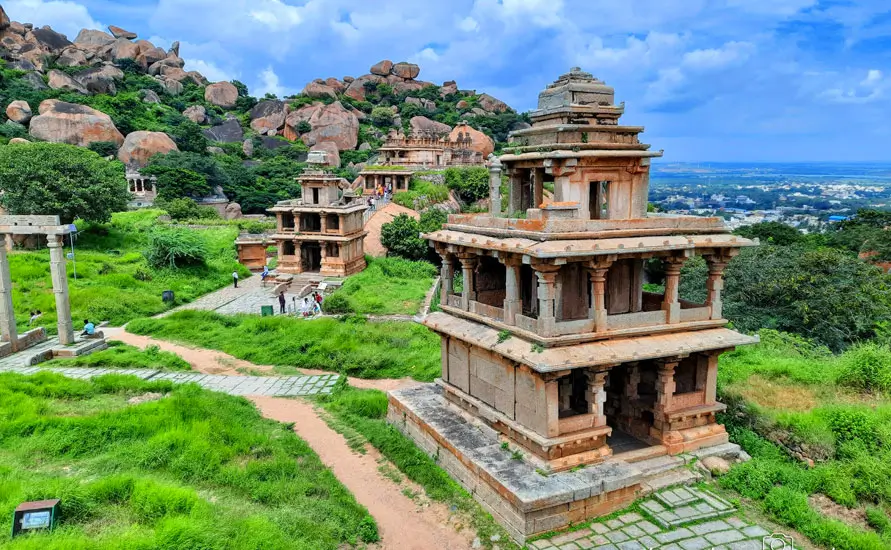
Today's distance is the biggest on the tour, which is why the car rolls out straight after an early breakfast. South of Hospet the land turns dry and open, with thorn scrub, groundnut fields and lines of wind turbines along the ridges, and the highway through Kudligi and Jagalur is in good shape. After about three hours, the boulder-strewn hills of Chitradurga come into view. Your Chitradurga guide joins at the main gate and leads a two-hour walk before lunch in town. Shade is scarce inside the walls, so carry a hat, sunscreen and plenty of water.
Locals call Chitradurga Fort Kallina Kote, the stone fort, and its seven rings of walls snake over a cluster of granite hills. Most of what stands was built by the local Nayaka chiefs in the 17th and 18th centuries, before Hyder Ali seized it in 1779 and added his own bastions. Inside you find temples, oil pits, granaries and rock-cut water tanks that kept the garrison supplied. The favorite story belongs to Onake Obavva, a sentry's wife who, as legend tells, struck down enemy soldiers one by one with a wooden rice pestle as they crawled through a crack in the rocks.
Back on the road after lunch, you continue south-west for roughly three and a half more hours to Hassan, a modest district town from which the Hoysala sites are each under an hour away. The scenery softens on the way, with coconut groves, ragi fields and the first wooded ridges of the Malnad region. You check in by early evening, tired but with the hardest drive behind you. Dinner at the hotel is a chance to try akki rotti, a crisp rice-flour flatbread with dill and onion, alongside saaru, a thin, peppery lentil broth that locals pour over rice. Overnight in Hassan.
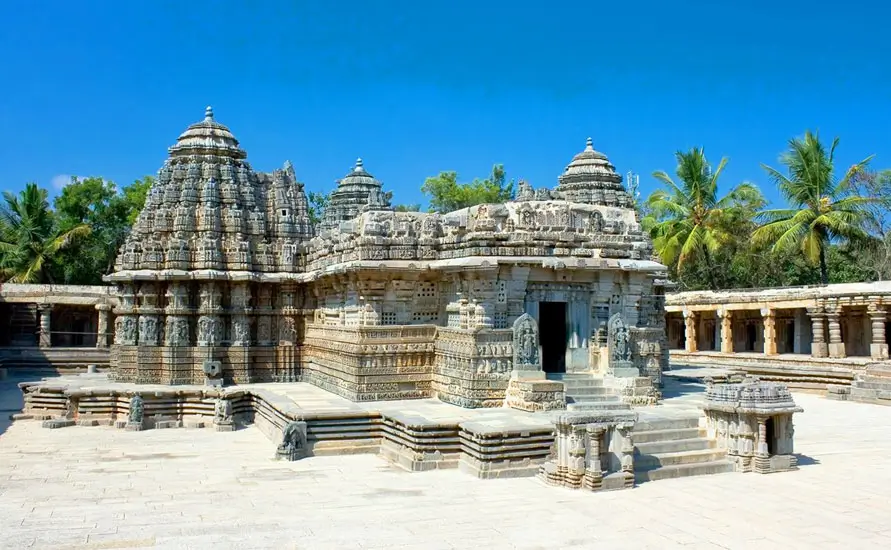
Between roughly 1000 and 1340, the Hoysala dynasty controlled most of southern Karnataka, and its sculptors worked a fine-grained soapstone that let them carve detail as delicate as lace. In 2023 the temples at Belur, Halebidu and Somanathapura entered the World Heritage list together as the Sacred Ensembles of the Hoysalas. Belur, forty minutes from Hassan beside the Yagachi River, is your first stop, and, there the Chennakeshava Temple was raised for King Vishnuvardhana and consecrated in 1117. Priests still perform puja here, so modest clothing is expected and shoes stay with the attendant outside.
Belur's fame rests on its madanikas, the forty-odd bracket figures that tilt out under the eaves: drummers, dancers, a huntress with a bow and, most famous of all, Darpana Sundari, a woman studying her reflection in a hand mirror. Inside the dim hall, pillars that look turned on a giant lathe hold up a ceiling of carved lotus domes, and one of them, the Narasimha pillar, was once said to rotate on its base. Look for the small signatures of individual sculptors carved near some of the panels. Lunch is at a simple vegetarian place in Belur.
Sixteen kilometers on lies Halebidu, the old capital of Dwarasamudra, raided by Malik Kafur in 1311 and again by Delhi forces in the 1320s, then left half empty. Its Hoysaleswara Temple is in fact two Shiva shrines joined side by side, with outer walls wrapped in continuous friezes: a lowest band of elephants, then lions, horsemen, scrolls and finally scenes from the Ramayana and Bhagavata. Two massive Nandi bulls sit in their own pavilions facing the sanctums. Afterwards, walk to the nearby Jain basadis, where black stone columns are polished so smoothly they reflect your face. Overnight in Hassan.
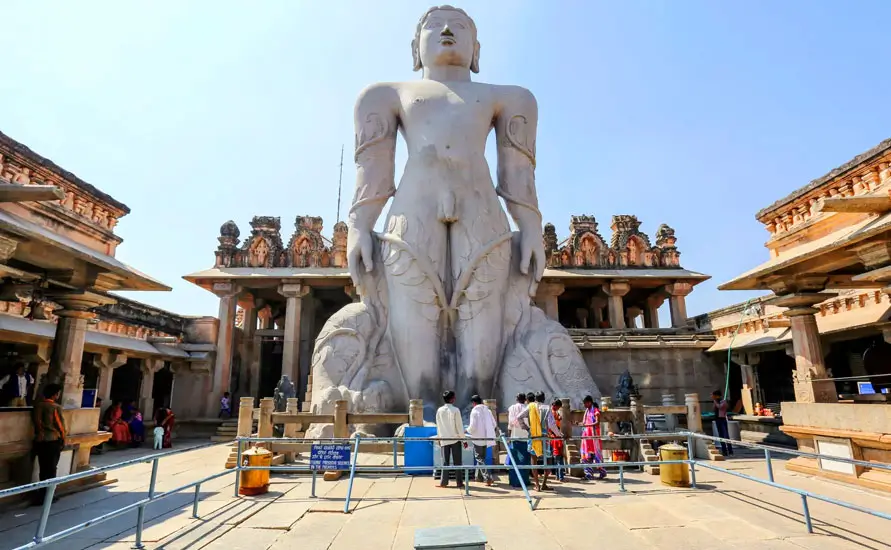
An hour south of Hassan, the pilgrim town of Shravanabelagola sits between two rocky hills, Vindhyagiri and Chandragiri, with a broad temple tank between them. On the summit of the larger hill stands Gommateshwara, also called Bahubali, commissioned around 981 by Chavundaraya, a general and minister of the Western Ganga kings. The naked figure is about 17 meters high and was carved from one block of granite in place on the hilltop, which makes it one of the tallest free-standing monolithic statues anywhere. For Digambara Jains, it is among the holiest images in India.
Getting there means climbing some 600-odd steps hewn into the rock face, and footwear is not allowed, so go early while the granite is cool; plain socks are accepted and make a big difference. Travelers who cannot manage the climb can be carried up in a doli, a chair borne by porters, arranged at the foot of the hill. At the top, notice the creepers carved winding around the statue's legs and arms, a sign of how long Bahubali stood in meditation. Every twelve years or so, pilgrims pour milk, saffron and flowers over the head during the Mahamastakabhisheka ceremony.
Coming down, you have lunch in town before a three-hour drive south through sugarcane and coconut country to Mysore, reaching your hotel by late afternoon. On Sundays, public holidays and Dasara nights, the palace switches on its bulbs from about seven to a quarter to eight, and the crowd in the square is part of the fun. On any other evening, take a slow loop around the streets near the Clock Tower and treat your legs to a light dinner; the local favorite is Mysore masala dosa, its inside brushed with fiery red chutney. Overnight in Mysore.
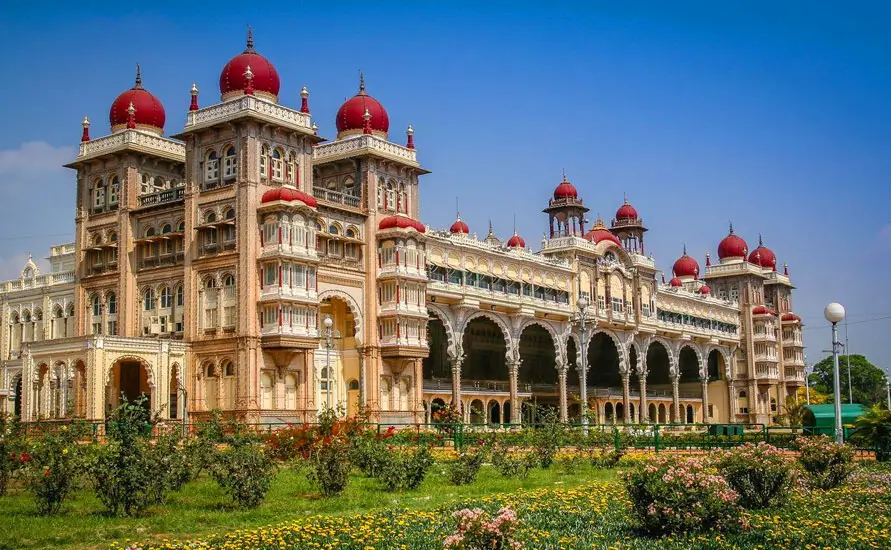
The Wodeyars held Mysore, with a break under Hyder Ali and Tipu, for more than five hundred years, and the city still revolves around their palace. Today's Mysore Palace replaced a wooden predecessor lost to fire in 1897, and took fifteen years to complete, and is now one of India's most visited monuments. Inside, your guide points out the octagonal wedding pavilion with its peacock-glass ceiling, the long Durbar Hall open to the parade ground, and the mural corridors that record every rank of a Dasara procession. Leave shoes at the counter, and expect camera rules indoors.
Just west of the main palace, the Jaganmohan Palace of 1861 served the family while their main home was being rebuilt and now the Jayachamarajendra Art Gallery. Its rooms hold paintings by Raja Ravi Varma, gold-leaf Mysore-school works, old instruments and a mechanical clock on which tiny soldiers parade every hour. After lunch, wander Devaraja Market for jasmine, sandalwood agarbatti and powdered kumkum, then visit the twin-spired St. Philomena's Cathedral. Craft lovers can add the state silk factory, where Mysore silk is woven, or the government sandalwood outlet, both reliable places to buy genuine goods at fixed prices.
Late afternoon is the time to drive up Chamundi Hill, home of the goddess Chamundeshwari, who in local belief killed the buffalo demon Mahishasura and gave Mysore its name. The temple's tall gopuram is crowded on Tuesdays and Fridays, so your guide will plan around queues. Coming down, stop at the black granite Nandi carved into the hillside in the 17th century, nearly five meters tall and garlanded every day. The city's lakes and palace domes spread out beneath you in the evening light. Before bed, buy a box of Mysore pak from one of the old sweet shops on Sayyaji Rao Road. Overnight in Mysore.
Tobacco barns and small brick kilns line the road west through Hunsur, and after about two hours the landscape changes abruptly at Bylakuppe, where Tibetan exiles were granted land in the early 1960s. Prayer flags snap above rooftops, and monks walk the roadside in maroon and saffron. Your stop is the Namdroling Monastery, one of the largest centers of the Nyingma school, whose main hall glows with three towering gilded statues and walls painted with deities and protectors. In the courtyard, young monks sometimes practice debate, clapping loudly to drive home each point. Dress modestly and keep your voice low inside.
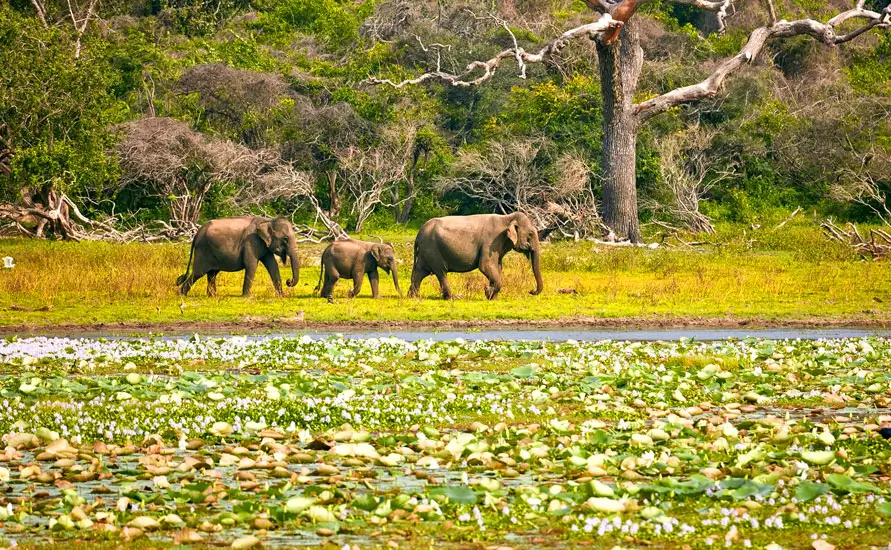
Beyond the settlement, Kushalnagar marks the start of Kodagu. Here a hanging footbridge leads onto Nisargadhama, an island in the Kaveri shaded by bamboo and teak, good for a short walk along the water. A little further downstream, the forest department runs a camp at Dubare for elephants that once hauled timber. You can watch them from the riverbank as mahouts scrub and feed them, but we do not book touching, feeding or bathing sessions, which put stress on the animals. Lunch is a plate of momos or a Kerala-style meal in Kushalnagar.
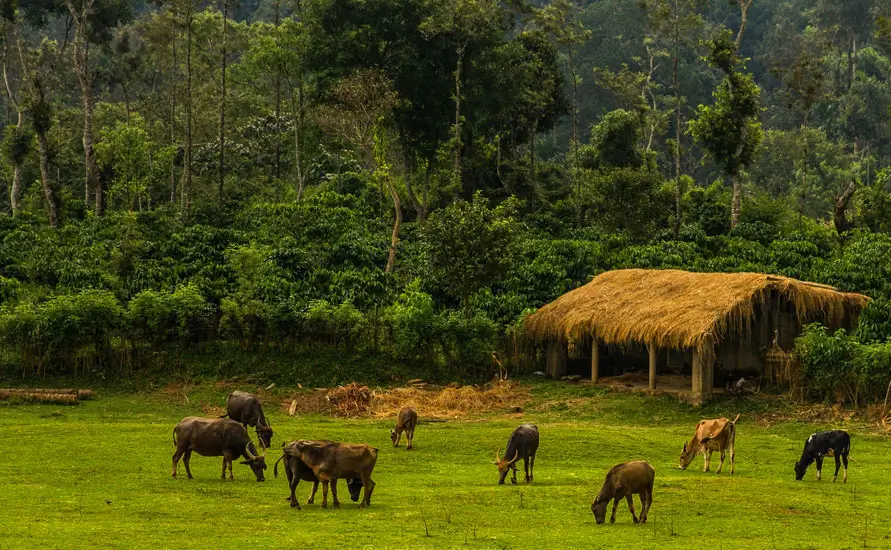
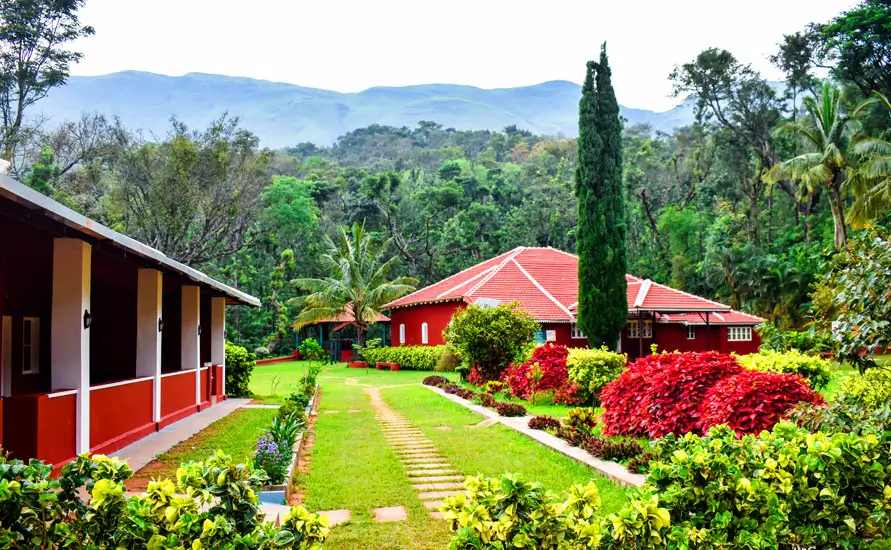
Climbing west, the road enters Coorg proper, where coffee bushes grow under tall shade trees draped with pepper vines, and mandarin orange trees dot the estates. Arrival at your homestay or plantation resort comes by mid-afternoon, leaving the remaining hours for a hot shower, a pot of estate coffee and the view. Kodava families who run homestays are often happy to cook for guests, and dinner might bring pandi curry, kadambuttu rice balls, and noolputtu, steamed nests of thin rice noodles. Ask your hosts about their family's estate history over dessert. Overnight in Coorg.
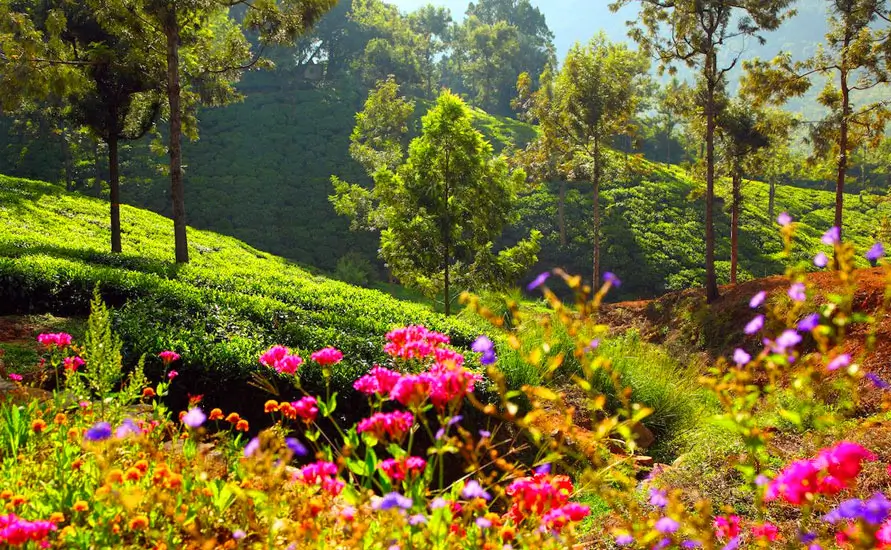
Before breakfast, while the mist is still curling through the estate, a planter takes you along the rows to show how a coffee farm actually works. You learn to tell the larger-leaved robusta from arabica, see how silver oak and jackfruit trees shade the bushes, and how pepper and cardamom add second and third incomes. In the processing yard, beans dry on concrete floors before going for hulling. Visit between December and February and you may see pickers at work; in March or April, a few days of white coffee blossom can follow the first showers. Breakfast is back at the bungalow.
Mid-morning you drive into Madikeri, Coorg's hill capital. Tipu Sultan's engineers replaced the old mud fort with stone, and Kodava and British rulers later modified it, and its old palace now holds district offices and a small museum. On a nearby hillock, the Gaddige tombs of Raja Doddaveerarajendra and his queen sit under onion domes with corner turrets, an Indo-Islamic style that surprises many visitors in a Hindu kingdom. Your guide talks about the Kodava martial tradition, their women's saris pleated at the back, and festivals such as Puthari, the rice harvest celebration in November or December.
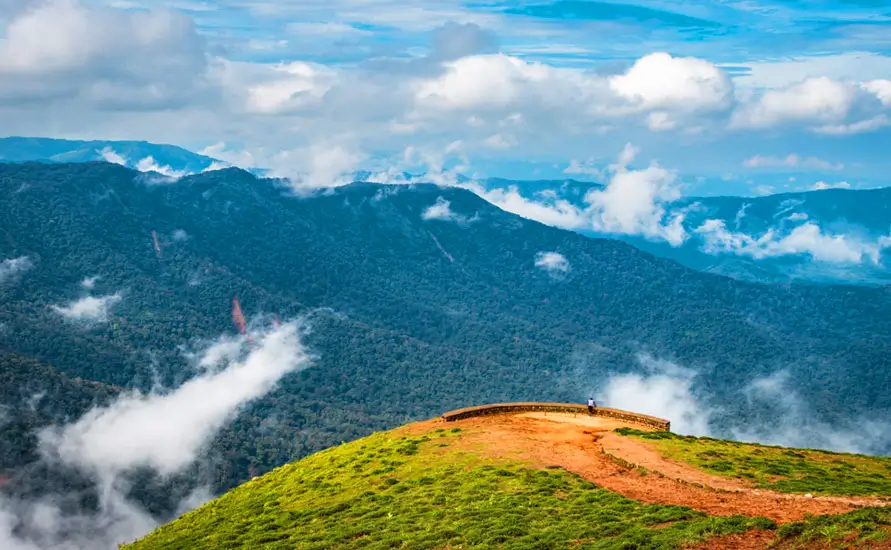
After lunch in town, a short drive and a stepped path take you down to Abbey Falls, a cascade dropping through private coffee and cardamom land. It thunders from July to about November and slows to a few streams by late spring. Toward evening, head to Raja's Seat, a landscaped lookout at Madikeri's western edge where Kodava kings once came for the view, and watch cloud settle into the valleys as the sun dips behind the ridges. Back at your homestay, you can join your hosts for a glass of homemade fruit wine, a Coorg household tradition. Overnight in Coorg.
Kerala begins at the bottom of today's road. Heading south via Gonikoppal and Srimangala, you reach Kutta, Karnataka's last town, where estates thin out and the Brahmagiri forest closes in on both sides. This stretch links Nagarhole with the Wayanad sanctuary, and elephants, gaur and spotted deer sometimes stand at the roadside; your driver slows down, and stopping to feed animals is illegal. Over the border lies Mananthavady, a spice-trading town, where a memorial honors Pazhassi Raja, the local ruler who led a long guerrilla war against the East India Company until his death in 1805.
Late morning brings you to Kuruva Island, a cluster of forested islets in the Kabini River reached by bamboo raft. Walking trails thread through the trees, and the birdlife is rich, with hornbills, kingfishers and drongos. Access can be closed during the monsoon or for conservation reasons, so we confirm before the visit; if it is shut, a tea estate or a walk around a farming village is a fine substitute. Lunch is a Kerala meal of red matta rice, sambar, avial and a crisp pappadam at a small family restaurant, a real change from Kodava food.
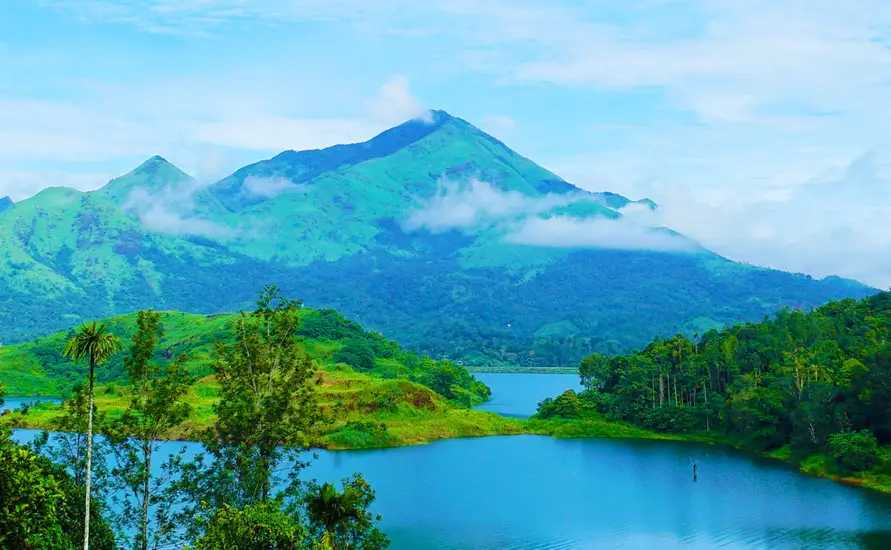
By late afternoon you reach your resort or plantation stay in Wayanad, a high plateau of pepper vines, tea, coffee, paddy and forest. Many properties are built on steep slopes with stilted cottages or tree houses looking over the valleys. After settling in, spend the evening on your balcony as cicadas and tree frogs start their nightly chorus, or ask your host about Wayanad's Adivasi communities, such as the Kurichiya and Paniya, and the spice routes that ran from here to the coast. Dinner is Kerala-style, perhaps chicken stew with appam or a coconut-rich fish curry. Overnight in Wayanad.
Start early for the Edakkal Caves on Ambukuthi Mala near Sultan Bathery. They are not true caves at all, but a deep fissure where a giant boulder wedged itself between two others, creating a high chamber. Its inner walls are covered with engraved human figures, animals and patterns, some of them reckoned by archaeologists to be Neolithic. Reaching the entrance takes about thirty minutes on a steep stepped path, and the last section involves a short scramble. The site is closed on Mondays and admits only a limited number of visitors each day, so we aim to be at the gate when it opens.
Next is Sultan Bathery itself, a town whose name comes from Tipu Sultan's habit of using a local temple as his battery, or ammunition store, during his Malabar campaigns. That Jain Temple still stands, a granite building from around the 13th century with carved pillars and a calm courtyard, a reminder that Jain merchants once traded along these hills. After lunch, a farmer shows you around a working spice garden with pepper, cardamom, nutmeg, clove, cinnamon and vanilla, explaining how each is harvested and dried. Prices are fair here, and the pepper and cardamom are often from this year's crop.
Late in the afternoon, the car takes you to Pookode Lake, a freshwater lake ringed by evergreen forest near Lakkidi, at the top of the ghat road. Pedal boats are available, or a footpath loops the shoreline. Biologists know it for the Pookode barb, a small fish recorded from these waters alone. Evenings in Wayanad can be cool and misty. After dinner, your host can arrange a short visit to a tribal craft cooperative or a talk on traditional farming. Pack your bags tonight, since tomorrow you drop down to the coast. Overnight in Wayanad.
Leaving Wayanad, the car pauses at the Lakkidi viewpoint, among the wettest spots in Kerala, from where the Thamarassery ghat road coils down the slope in nine hairpins. The descent drops several hundred meters to the coastal plain within an hour, and the air turns humid and warm as rubber, coconut and areca groves replace forest. By late morning you are in Kozhikode, the old port known to Europeans as Calicut, whose Zamorin rulers traded pepper with Arab, Chinese and Portuguese ships for centuries. Its name lives on in calico, the cotton cloth once shipped from here.
After lunch you drive south to Beypore, the estuary port of the Chaliyar, where boat builders still assemble the large wooden dhows called uru entirely by hand. They work without written plans, using techniques handed from father to son, and most of the boats are now ordered by buyers in the Gulf. Your guide explains how timber is shaped and joined, and how Beypore served as a shipyard for Arab traders long before European arrival. On the way back, stop at the Mishkal Mosque in Kuttichira, a four-story wooden mosque raised in the 14th century by Nakhuda Mishkal, an Arab trader who owned a fleet of ships.
As the afternoon cools, stroll SM Street, known locally as Mittai Theruvu, the Sweetmeat Street, where shops stack glistening blocks of Kozhikode halwa in green, black, red and orange, alongside banana chips fried in coconut oil. Clothing stores, spice sellers and old-style eateries line the same road. At sunset, walk to Kozhikode Beach and look at the remains of the colonial-era piers. For dinner, order the city's signature dish, Kozhikode biryani, made with short-grain kaima rice, fried onions and chicken or mutton, or a spread of Malabar seafood. Overnight in Kozhikode.
On Kappad Beach, some twenty kilometers north, a modest stone pillar records the arrival of Vasco da Gama's fleet in May 1498, the voyage that opened a direct sea route from Europe to India. The beach itself is quiet, with rocks, a few fishing canoes and local families walking the sand. Back in town, your guide may take you past the Tali Temple, an old Shiva shrine closely linked with the Zamorins, built in Kerala's timber-and-tile style; entry to the inner areas may be restricted for non-Hindus, though the outer architecture can be seen.
Around noon you board an express train south to Ernakulam, roughly four hours along the coast. From your window, rivers, backwater inlets, coconut plantations and small towns with church spires, temple roofs and mosque minarets slide past. Tea, coffee and snacks are sold on board, and we can pack you a Malabar lunch to carry. At Ernakulam our Kerala team collects you for the short ride over the bridges to Fort Kochi. Travelers who prefer the road can drive instead, which takes about five to six hours with stops along the coastal highway.
Evening takes you to the Fort Kochi waterfront for the big cantilevered fishing nets, which teams of five or six men operate with a system of counterweights, lowering each net and hauling it up again every few minutes. Locals gather here after work, and fish stalls set out the day's catch on ice; choose something and a nearby kitchen will fry or grill it for you. Watch the ferries and container ships pass the harbor mouth as the sky turns pink. Dinner could be a karimeen fry or a coconut prawn curry at one of the cafés on the seafront. Overnight in Kochi.
A morning on foot with your guide reveals how Portuguese, Dutch and British rulers each reshaped Fort Kochi. St. Francis Church, begun as a timber chapel in 1503 and rebuilt in stone, sheltered da Gama's remains for some years, who died in Kochi on his third voyage. Nearby, the cream-colored Santa Cruz Basilica hides a richly painted interior behind its twin towers. Between them, you walk past Dutch-era houses with deep verandas, old bungalows of British trading firms and warehouses now converted into galleries and cafés, especially lively during the Kochi-Muziris Biennale years.
Late morning brings you to Mattancherry, the old trading town, and its palace, a 1550s Portuguese present to the local ruler that Dutch traders restored a century later. Its royal bedchamber walls hold murals of Krishna, Rama and Shiva in rich natural colors. Further along, the Paradesi Synagogue, founded in 1568, is paved with willow-pattern porcelain tiles brought from Canton, under a cluster of Belgian glass lamps. Both keep weekly rest days: the palace closes every Friday, and the synagogue on Fridays, on Saturdays and on Jewish holidays, so the order of these two Kochi days is set once your dates are fixed. Allow time for the small museum displays inside the palace.
The streets of Jew Town around the synagogue are packed with antique dealers, spice merchants and small cafés, and the scent of cardamom and pepper drifts from open warehouse doors. The afternoon is free to shop, rest at the hotel or take a harbor ferry for a few rupees to see the port from the water. In the evening, choose an optional Kathakali performance, with its painted faces and wide skirts, arriving early to watch the hour-long make-up ritual, or a Kalaripayattu show of Kerala's ancient martial art, full of leaps and sword work. Overnight in Kochi.
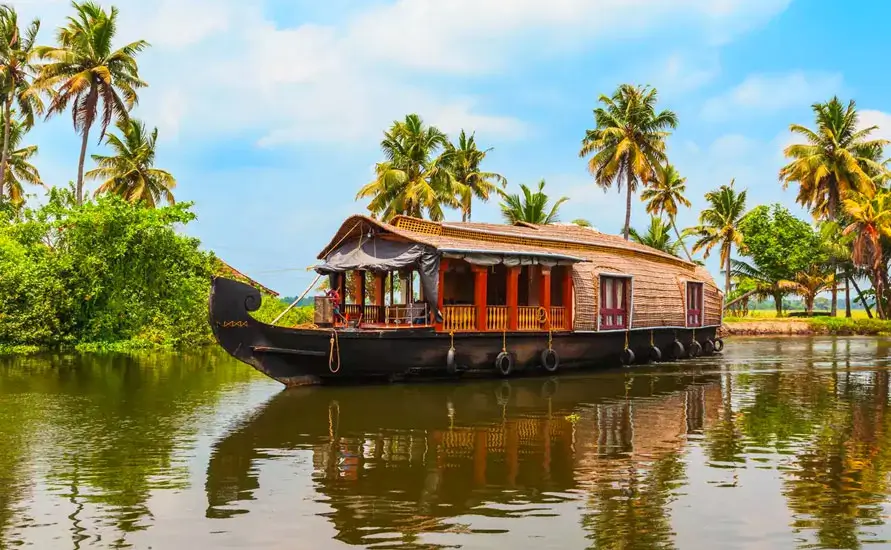
An hour and a half south by road, Alleppey is where most of Kerala's houseboats are moored, and boarding usually begins around noon. Your private boat is a roomy descendant of the kettuvallam, the coir-stitched wooden barge that used to haul rice and spices between farms and ports. Today it carries bedrooms with private bathrooms, a shaded lounge on the front deck and a galley at the stern, and its crew of three looks after everything on board. A tender coconut is usually waiting for you as the captain eases away from the jetty.
Lunch comes as the boat drifts out onto the open lake: red rice, a fish curry with kudampuli, crisp beans with coconut, pickles and buttermilk. Afterwards, the boat turns into the canals of Kuttanad, where paddy is grown below sea level behind earthen embankments, one of very few places in the world farmed this way. On the banks, life goes on at the water's edge: women washing pots, men poling canoes laden with coconuts, children walking to school along the bunds. Kingfishers, purple herons and darters hunt from posts and branches all along the way.
Kerala's regulations halt houseboat traffic by early evening, and the captain moors the boat beside a sleepy hamlet on a side canal. Stretch your legs along the bund with one of the crew for a close look at the rice, or stay on deck with sweet tea and banana fritters as the sun lowers over the water. Dinner is cooked fresh in the galley, heat level and vegetarian options to your taste. Once the sky darkens, mosquito nets are tied down, and the night belongs to frogs and the soft knock of water against the hull. Overnight on the houseboat.
Rise with the light for the backwaters' quietest hour, when cormorants dry their wings on bamboo poles and morning mist lies over the canal. Breakfast is served as the crew motors back toward Alleppey, and you step ashore around nine. Then comes a two-hour drive to Cochin International Airport, leaving a comfortable cushion before your overseas check-in opens. Late flyers can add an airport-side day room or an afternoon at Marari Beach, both charged separately.
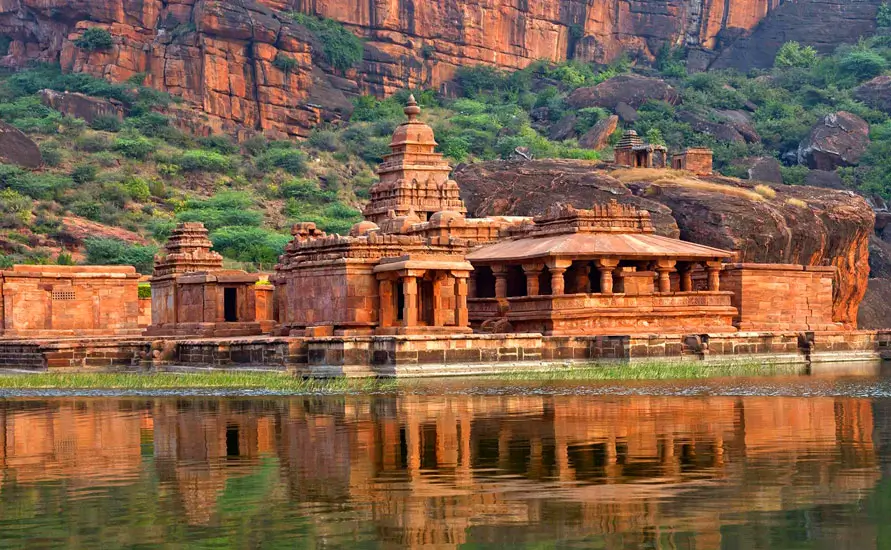
Sixteen days have taken you down the length of Karnataka, from the boulder city of Hampi to the soapstone friezes at Belur and Halebidu, the palace streets of Mysore and the coffee hills of Coorg, then into Kerala's forests, spice ports and lagoons. Northern Karnataka still holds Badami, Aihole and Pattadakal for a future trip, and we will gladly sketch that route when you are ready. Safe travels home, from all of us.
Your Journey

N.S. Rathore & Mrs. Omlata Rathore · Managing Director
We still read every enquiry ourselves. Tell us the places you liked and our planners will send a day-by-day route with drive times and a clear price.
Every package can be customised and no pressure to book. A planner from our office replies within 24 hours with a route written for your group.
Fill this in and your planner will send a first draft itinerary.
Explore more
Kerala Backwaters Escape Kerala Backwaters Escape
 Kerala Backwaters Escape
 Kerala Backwaters Escape
 Kerala Backwaters Escape
 Kerala Backwaters Escape
 Kerala Backwaters Escape
 Kerala Backwaters Escape
 Kerala Backwaters Escape
 Kerala Backwaters Escape
 Kerala Backwaters Escape
 Kerala Backwaters Escape
 Kerala Backwaters Escape
 Kerala Backwaters Escape
 Kerala Backwaters Escape
 Kerala Backwaters Escape
 Kerala Backwaters Escape
 Kerala Backwaters Escape
 Kerala Backwaters Escape
 Kerala Backwaters Escape
 Kerala Backwaters Escape
 Kerala Backwaters Escape Kerala Backwaters Escape