 Kerala Backwaters Escape

Karnataka Tour Packages
Bangalore – Somanathapura – Mysore – Belur – Halebidu – Hassan – Hampi – Badami – Pattadakal – Aihole – Hubballi or Belagavi
At a glance
Indian temple design has its own grammar, and few regions let you read it as clearly as Karnataka. Our Karnataka temple architecture tour is aimed at people who like to know how a shrine is put together: why one tower curves while another rises in tiers, what a star-shaped plinth does to light and shadow, and how a pillar could be turned on a lathe. Over nine days you follow the story backward, from the mature Hoysala work of Somanathapura, Belur and Halebidu to the Vijayanagara halls of Hampi, and finally to Pattadakal and Aihole, where it began.
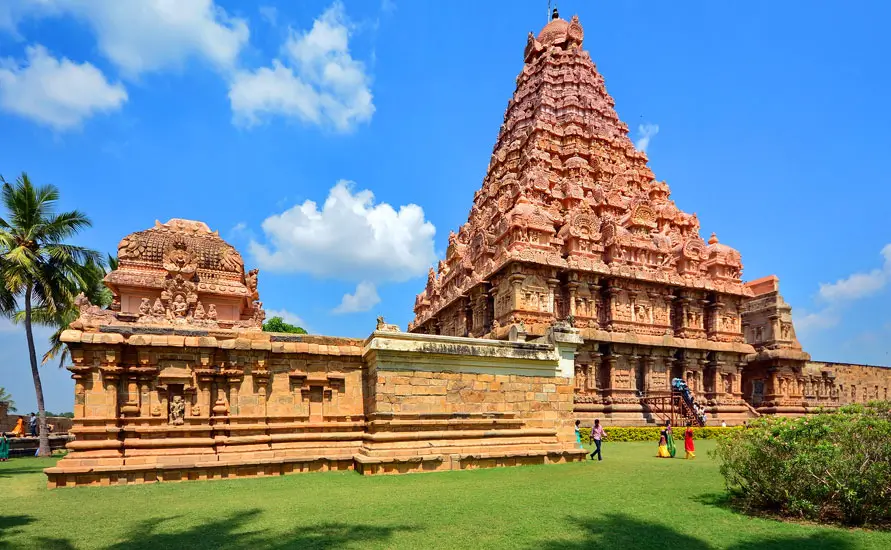
Three vocabularies run through the trip. Nagara is the northern style, with a curvilinear tower and a ribbed crowning stone. Dravida is the southern style, a stepped pyramid of miniature pavilions capped by a dome-like finial. Vesara, a term used loosely by scholars and in old texts, describes the Deccan blending of the two. Your guides, chosen for their knowledge of iconography and building history, point out plans, moldings, ceiling panels and inscriptions, and explain the debates rather than repeating one textbook line. This Karnataka temple architecture tour gives you three nights in Badami to see the early sites properly.
The trip suits architects, art historians, design students and curious overseas visitors of every background, plus NRI visitors who grew up near these temples without ever studying them. Drives are planned so that most sites are reached while the light is still low, either soon after dawn or toward evening, which matters for both photography and comfort. You leave from Hubballi or Belagavi airport, whichever suits your onward flight. November to February is ideal, and every detail, from hotel grade to the length of each site visit, can be adjusted.
Look for your name on a placard as you walk out of Kempegowda International Airport; our staff member there sees the luggage into a private car and makes sure check-in goes smoothly. Long-haul flights often reach Bangalore after midnight, and the first priority is sleep, so the morning is left completely free. Your architecture guide joins you for a short meeting after lunch to hand over a reading list, a simple glossary of terms such as vimana, shikhara, mandapa and garbhagriha, and a sketch map of the route. It is worth flicking through the glossary now, because the same words return every day.
Your first site, late in the afternoon, is the Someshwara Temple in Halasuru, one of the oldest temples in Bangalore. Parts of the shrine are linked by local historians with the Chola period, but most of what you see dates from later Vijayanagara-era expansions, including the tall entrance tower and the pillared halls where horse-riders and yalis rear out of the columns. Your guide uses it as a first lesson in reading a Dravida plan: gateway, open hall, closed hall, vestibule, sanctum, each step a little darker and more private than the last. Remove shoes at the entrance and dress modestly, as this is an active place of worship.
As the light fades you drive to the Vidhana Soudha, the huge granite legislature building finished in 1956. Chief Minister Kengal Hanumanthaiah wanted a building that looked like it belonged to the state rather than to colonial Britain, and the result borrows temple motifs on a giant scale: tiered roofs, bracketed eaves and pillars with lotus capitals. It is not open to the public inside, but on Sunday and holiday evenings lights pick out the facade, and the view from the road is enough. Dinner can be at a long-running South Indian restaurant nearby, with a plate of bisi bele bath. Overnight in Bangalore.
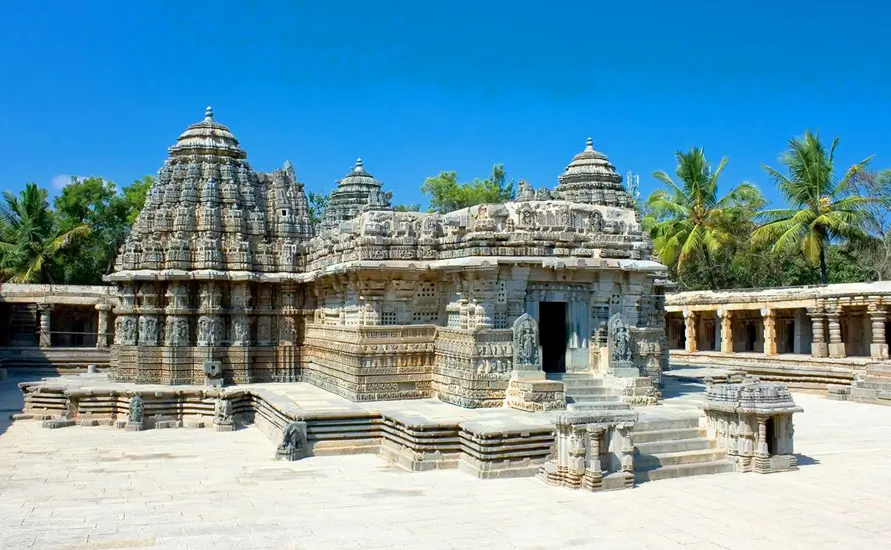
Leaving after breakfast, your driver follows the expressway toward Mysore and then turns off on rural roads past paddy fields and sugarcane to Somanathapura, about three hours from the city. Somanatha, who raised the Keshava Temple here in 1268, was a commander of the Hoysala king Narasimha III, and no other stop on this route shows a Hoysala temple so complete, because its three towers above the shrines are still standing. Belur and Halebidu have lost theirs, so this is the image to keep in mind when you look at those bigger temples in the days ahead.
Your guide starts with the plan. The temple is a trikuta, three shrines opening off one hall, and each shrine sits on a star-shaped base whose points are created by rotating squares around a center. Walk slowly around the outside and notice how the projecting angles catch sunlight on one face and leave the next in shadow, so the wall never looks flat at any hour of the day. The whole building stands on a raised platform, the jagati, which doubles as a walkway for circling the shrine. Above the molding bands, sculptures of Vishnu in his many forms fill the walls between miniature tower models.
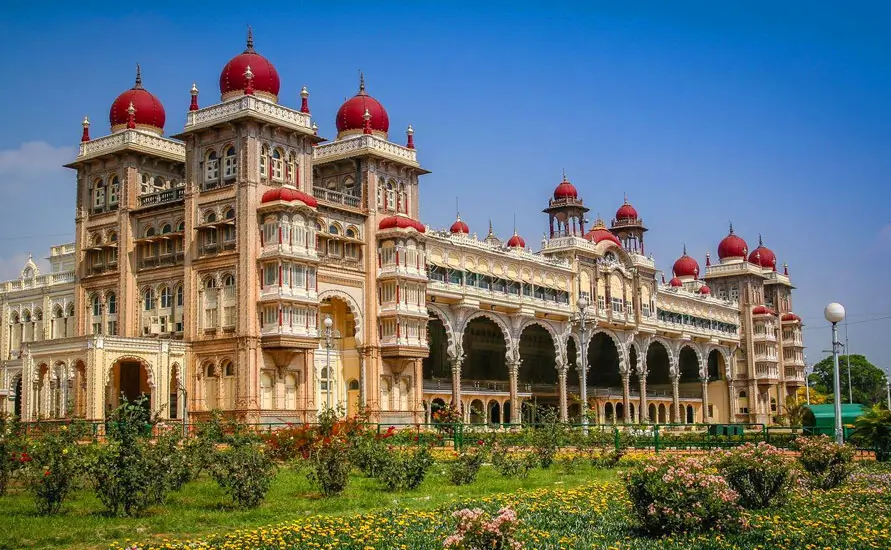
Hoysala towers are often labeled Vesara, and Somanathapura shows why. Their profile is stepped like a Dravida vimana, yet the many projections give them a rounded, almost Nagara silhouette from a distance. Your guide explains why some scholars prefer the term Karnata Dravida instead. Afterward you drive about 40 minutes to Mysore and check in. Should your night here fall on a Sunday or holiday, the Mysore Palace glows under thousands of bulbs from 7 pm for most of an hour; Henry Irwin's Indo-Saracenic design, completed in 1912, makes a deliberate counterpoint to the Hoysala morning. Overnight in Mysore.
An early start takes you north-west through Krishnarajapet and Channarayapatna to Belur, about three and a half hours away. The Chennakeshava Temple was consecrated in 1117 by Vishnuvardhana and is a single-shrine temple with a large hall in front, standing on a broad platform inside a walled courtyard. Its original tower has been lost, and the low roof you see is a later replacement. Compare the shape of the hall with the star plan you saw yesterday: here the hall itself is star-shaped too, opened up with low walls and pierced stone screens so that light filters inside in small patterns.
Inside, your guide shows you why Hoysala pillars are famous. Many were turned on a giant lathe, with the block rotated while craftsmen cut rings, bells and flutes into the soft chloritic schist, before being polished to a dull shine. Others were carved by hand, and the contrast is easy to spot. Above, the central ceiling is a deep dome built from concentric rings of stone, finished with a hanging lotus bud. Outside, the 42 bracket figures under the eaves lean outward at an angle, a structural trick that throws rainwater away from the walls while giving the sculptors a stage for their most graceful work.
Lunch is followed by a 16 km hop to Halebidu, where the Hoysaleswara Temple doubles the formula with two shrines side by side. The real lesson here lies in the horizontal bands at the base, where friezes of elephants, lions, horses, foliage, mythical beasts and narrative panels are stacked one above the other and run without a break around the whole building. There is time too for the smaller Kedareshwara Temple nearby, built in the early 13th century and worth seeing for its compact star plan. In the late afternoon you continue 30 minutes to Hassan for the night. Overnight in Hassan.
Most of the day is spent on the road as you cross from the southern Hoysala heartland to the Vijayanagara capital on the Tungabhadra. After an early breakfast your driver heads north through Arsikere and Chitradurga, where the highway passes the granite ramparts of the hill fort, before running on to Hospet and Hampi. Allow close to seven hours, including stops for tea, fresh fruit and lunch. Your guide suggests using the drive to read about the Vijayanagara Empire, whose builders worked in hard granite rather than soft schist, which changed both their methods and their style.
Arrival at your Hampi or Hospet hotel comes around late afternoon, leaving an hour or two by the pool or on the terrace. As the sun sets, the boulder hills around the hotel turn a deep orange, and the sound of temple bells sometimes drifts across from the nearest village. Your guide meets you briefly before dinner to look at a site plan and set an early start, because tomorrow covers the sacred center, where the main temples stand, before the heat builds. Overnight in Hampi.
Hampi shows the Dravida tradition at the scale of an imperial city, and this morning your guide focuses on how Vijayanagara builders turned the temple into a walled complex. Inside the Virupaksha Temple, where daily rituals continue, you begin at the entrance tower, the gopuram, whose lower story is granite while the upper tiers are brick and plaster, a method that kept the weight down. Inside, notice how later kings added halls, colonnades and subsidiary shrines around the original core, so the temple grew like a small town rather than a single building. Shoes stay at the entrance, and modest dress is expected.
From there you walk along Hampi Bazaar and continue to the Krishna Temple and the Achyutaraya Temple, each set at the end of a long colonnaded chariot street. These streets were part of the design, lined with pavilions for traders and pilgrims, and their scale is easy to sense from the hillside above. Your guide explains the kalyana mandapa, the marriage hall for the deity's annual wedding festival, a building type that became standard in Vijayanagara temples and later spread across Tamil Nadu. Look at the pillars, where sculptors cut whole groups of figures out of a single granite block.
After a lunch break you visit the Vittala Temple, where the composite pillar reaches its most refined form, the type that defines late Vijayanagara work. A central shaft is surrounded by slender colonnettes, some cut so thin that they ring when tapped, which is why they are called musical pillars. Touching them is no longer permitted, to protect the stone. Facing the hall, the stone chariot is in fact a compact Garuda shrine shaped as a processional car, its stone wheels once able to rotate. The final kilometer from the car park is covered by battery buggy. In the late afternoon you can watch the sun set from a hillside near Hampi. Overnight in Hampi.
Before leaving Hampi you spend the morning in the royal center, where the buildings are civic rather than religious and show another side of Vijayanagara design. Inside the walled zenana enclosure, the two-level Lotus Mahal combines cusped arches from the Deccan Sultanates with a Hindu stepped roof. Next door, eleven domed bays make up the Elephant Stables, each roofed differently, with arches that clearly borrow from Islamic architecture. Your guide uses these buildings to show that the Vijayanagara court absorbed ideas from its rivals rather than rejecting them, a point that matters for understanding later Deccan building.
Minutes away by car is the royal chapel, the Hazara Rama Temple; around its enclosure wall run long bands of relief showing processions of horses, elephants, dancers and soldiers. Close by is the stepped tank, a square of green schist steps descending in perfect symmetry, uncovered by archaeologists in the 1980s. After an early lunch you leave Hampi and drive north-west across cotton fields to Badami, about three and a half hours away. The landscape changes as you get close, and ridges of red sandstone rise above the black soil, marking the region where Chalukya builders worked between the 6th and 8th centuries.
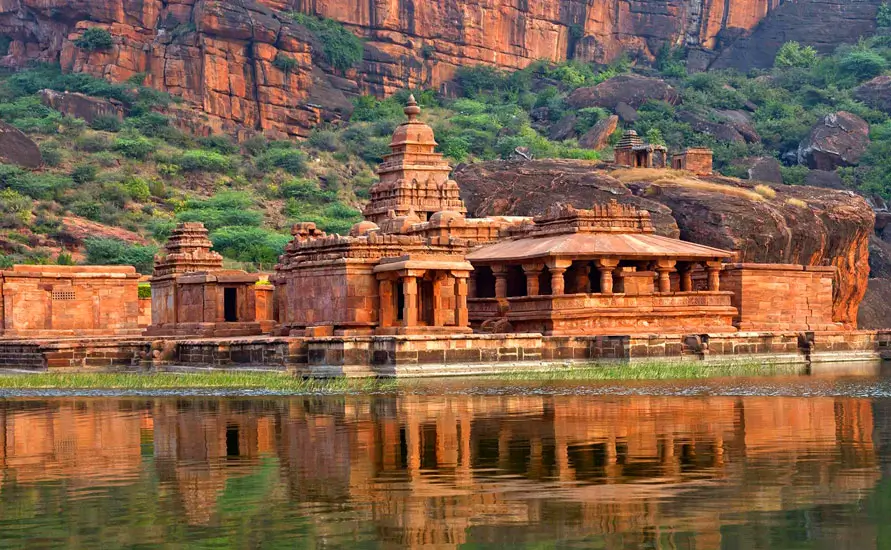
After settling in at your Badami hotel and resting, you set out again in the late afternoon for a gentle introduction to the town. Your guide walks you through the old quarter to the edge of Agastya Lake, where the Bhutanatha group of temples stands at the water's edge, partly built in the 7th century and expanded in later periods. Compare their simple stepped roofs with the soaring gopurams you saw yesterday, and notice how much smaller and plainer early temples were. As the sun sets, the cliffs glow red over the water, a favorite moment for photographers. Overnight in Badami.
Climb to the Badami cave temples early, while the rock-cut steps are still cool. Four main caves are cut into the southern cliff, three Hindu and one Jain, and they record the moment when Chalukya builders were still shaping temples from living rock rather than assembling them from blocks. Your guide points out how each cave copies features of a built structure: square pillars with bracket capitals, beams carved into the ceiling and a raised plinth with dwarf figures. In other words, the masons were already imagining a free-standing temple, and the caves show the ideas they would soon try out in stone.
Next you climb to the Malegitti Shivalaya, perched on a rock above the town, an early free-standing Dravida temple with a small tower of tiered pavilions and a porch with carved door guardians. Seen against the sky, it gives a clear picture of the southern style in its simplest form. After lunch you drive about 30 minutes to Pattadakal, the UNESCO-listed coronation site on the Malaprabha River, where both great tower types stand together. The Galaganatha Temple has a curved Nagara tower, while the Virupaksha Temple next door is a large Dravida temple modeled on Pallava work at Kanchipuram.
Your guide leads you to the Papanatha Temple at the southern end of the compound, often described as a building where the two styles meet, with a Nagara tower over a hall plan closer to southern practice. The Jain Narayana Temple, a short walk outside the main group, adds one more variation. By the end of the afternoon you will be able to name the tower type of each temple from across the lawn, which is a satisfying skill to take home. Return to Badami in the early evening, perhaps stopping for photographs as the sun drops behind the riverbank fields. Overnight in Badami.
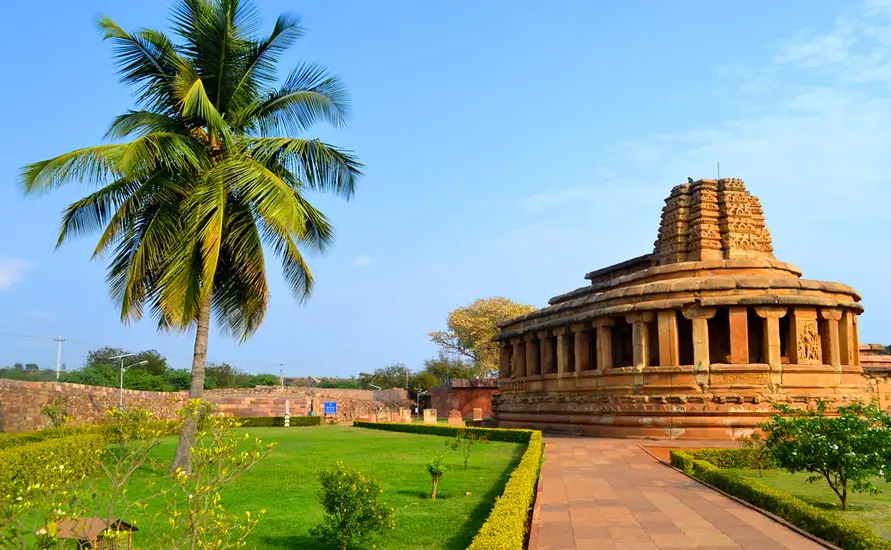
Aihole, about 45 minutes from Badami, is often called the cradle of Indian temple architecture, because more than a hundred temples of different dates and designs stand in and around the village. They range from the 5th or 6th century to the 12th, and scholars still argue about the exact order. Your guide begins at the Durga Temple, the most famous building here, with an apsidal plan that rounds off at the back like a Buddhist chaitya hall and a colonnaded ambulatory circling the outside. Its name comes from a nearby fort, durga, rather than the goddess, a common source of confusion.
Close by stands the Lad Khan Temple, which takes its name from a later resident, and was long believed to be the earliest temple in Aihole. Its square plan, sloping roof and small shrine perched on top look more like a village assembly hall than a temple, which is exactly what makes it interesting for architecture lovers. Your guide shows you the Huchimalli Gudi, one of the early places where a vestibule, the antarala, links the hall and the sanctum, a feature that became standard across India. The site museum nearby holds sculptures from the area and is closed on Fridays.
After lunch, walk up to the Meguti Temple, a Jain shrine on a hilltop whose wall carries an inscription of 634 by the court poet Ravikirti, praising King Pulakeshin II. It is one of the earliest dated stone temples in Karnataka and gives fixed points to a story otherwise built on stylistic guesses. Lower down the slope is the Ravana Phadi cave, a rock-cut shrine with tall figures of dancing Shiva and the river goddesses. Return to Badami in the early evening for a last dinner of north Karnataka food, perhaps jowar roti with brinjal curry. Overnight in Badami.
Breakfast is followed by check-out and the drive to whichever airport you are flying from. Hubballi has the more frequent domestic connections, with flights to Bangalore, Mumbai and other hubs, while Belagavi is a good choice for some routes to Mumbai, Delhi and other cities. We confirm which one fits your onward flight when you book. An afternoon flight leaves time to stop on the way for a short visit to a local market or simply enjoy a slower breakfast in Badami.
Over nine days you have read Karnataka's temples from the finished Hoysala star plans back to the first trials at Aihole, with the Vijayanagara capital in between. Should you wish to continue, the Rashtrakuta caves at Ellora or the Chola temples of Tamil Nadu make natural next chapters, and our team can plan either one. Our team wishes you a smooth trip back.
Your Journey

N.S. Rathore & Mrs. Omlata Rathore · Managing Director
We still read every enquiry ourselves. Tell us the places you liked and our planners will send a day-by-day route with drive times and a clear price.
Every package can be customised and no pressure to book. A planner from our office replies within 24 hours with a route written for your group.
Fill this in and your planner will send a first draft itinerary.
Explore more
Kerala Backwaters Escape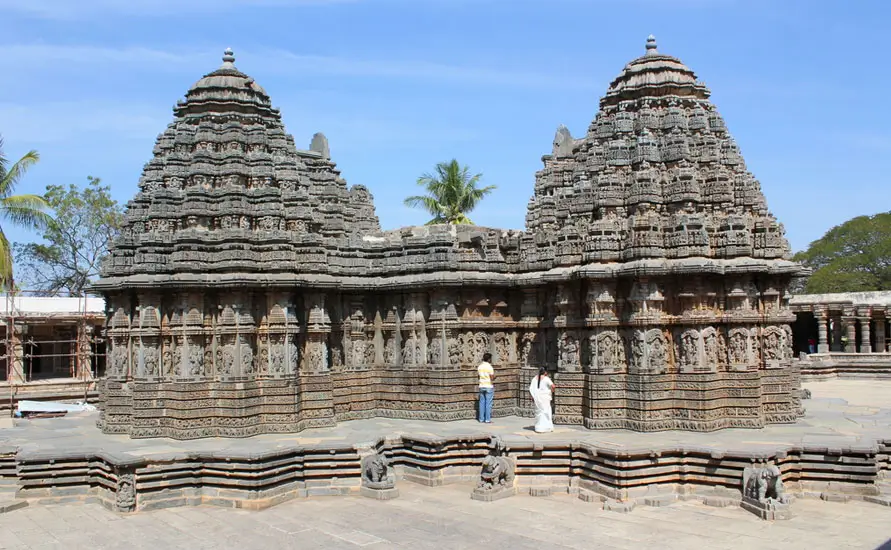 Kerala Backwaters Escape
 Kerala Backwaters Escape
 Kerala Backwaters Escape
 Kerala Backwaters Escape
 Kerala Backwaters Escape