 Kerala Backwaters Escape

Karnataka Tour Packages
Bangalore – Srirangapatna – Mysore – Kabini – Bylakuppe – Coorg – Chikmagalur – Belur – Halebidu – Shimoga – Sakrebyle – Jog Falls – Gokarna – Hubli – Aihole – Pattadakal – Badami – Hampi – Bangalore
At a glance
Most visitors see Karnataka in pieces: a palace weekend in Mysore, a few days of coffee country, a quick dash to Hampi. Our Grand Karnataka Tour 18 Days joins all of those pieces into one continuous loop by road. It starts in Bangalore, swings south to Mysore and the forests of Kabini, climbs through Coorg and Chikmagalur, then crosses the rain-soaked Malnad uplands to Jog Falls before dropping to the Arabian Sea at Gokarna. The final week turns inland to the Chalukya temples of Badami and the ruined capital of Hampi.
What sets this Karnataka tour package apart is the Malnad stretch that shorter itineraries skip. Shimoga district is the wet, forested belt where the Tunga and Sharavathi rivers begin their run, and here you watch the morning routine at the Sakrebyle elephant camp from the riverbank before driving on to Jog, a waterfall that is at its fullest between August and December. No drive on the route is longer than about six hours, and the long jumps are broken with temple stops, coffee breaks or a lunch in a small market town.
Seventeen nights give you room to stay put twice in most regions, which is rare on a 18-day Karnataka itinerary. Your chauffeur and his cooled sedan or SUV remain yours for the entire loop, and at every major halt a licensed guide joins for the sightseeing. We designed the Grand Karnataka Tour 18 Days for overseas visitors with time to spare, including retired couples, return visitors to India and NRI families keen to show their children the whole state rather than one corner of it. October to February suits the full loop best.
Even at three in the morning, someone from our Bangalore office will be waiting beyond the Kempegowda arrivals doors, your surname printed on a white card. Allow roughly an hour for the ride into town, since the terminal lies far to the north and the Bellary Road flyover clogs quickly once office traffic begins. Chat with your chauffeur on the way in, since he will steer every kilometer of the loop; meanwhile our colleague passes across a paper copy of the route, any prepaid SIM you ordered and a helpline number that never goes to voicemail.
Jet lag permitting, the hours after four o'clock belong to the older southern districts of Bangalore. Hyder Ali began Lalbagh Botanical Garden as a private Mughal-style garden, and Tipu Sultan widened it with saplings ordered from Persia, Afghanistan and France. The Victorian-era glass pavilion fills with flower displays every January and August, and the bare hump of gneiss in one corner of the grounds has been dated by geologists to around three billion years. Your guide also points out one of the four watchtowers that Kempe Gowda, the city's founder, is said to have raised to mark its limits.
Ten minutes south lies Basavanagudi, where the Bull Temple shelters a seated Nandi cut from one granite block, its flanks darkened to a glossy black by centuries of butter and oil offerings. The neighborhood holds a groundnut fair each November, a reminder that farmers once grew peanuts on these fields. The final stop is Tipu's Summer Palace, an airy teak pavilion of two floors whose cusped arches still carry traces of floral paintwork. For dinner, ask to be dropped at one of the Indiranagar brewpubs or at an old-style darshini, where crisp masala dosa is eaten standing at steel counters. Overnight in Bangalore.
An eight o'clock departure gets you onto the Mysore expressway before Bangalore's ring roads seize up, and the new tolled highway makes the run far quicker than it used to be. Your first halt is Srirangapatna, a river island in the Kaveri from which Hyder Ali and then Tipu Sultan governed the kingdom of Mysore through the closing decades of the 18th century. The town takes its name from the Ranganathaswamy Temple, where Vishnu reclines on the coils of a serpent, and this shrine is far older than the Muslim rulers who later fortified the island around it. Remove your shoes at the entrance and allow half an hour inside.
Tipu's story dominates the rest of the visit. Daria Daulat Bagh, his summer palace set in a formal garden, is covered inside with murals of his victory over the British at Pollilur in 1780, painted in lively detail down to the uniforms of the soldiers. Your guide then walks you to the spot near the fort walls where Tipu fell during the siege of 1799, and to the Gumbaz, the domed mausoleum he built for his parents and in which he himself was later laid to rest. The polished black pillars and lacquered doors of the tomb are worth a close look before you move on.
Only 20 km separate the island from Mysore, so you are settled into your room well before tea time. Use the late afternoon for a gentle first look at the city, perhaps a stroll around the clock tower and the old government buildings painted in cream and terracotta. Should today be a Sunday or a public holiday, head to the palace lawns for seven o'clock, when nearly a hundred thousand bulbs outline the domes and arches for about forty-five minutes. Supper might be bisi bele bath, the hot, tangy rice-and-dal dish that Mysore households cook on busy weeknights. Overnight in Mysore.
Climb Chamundi Hill by car soon after sunrise, because the line for the Chamundeshwari temple at the summit grows long by mid-morning. The Wodeyar kings regarded her as their family deity, and the Dasara festival each autumn honors her victory over the buffalo demon Mahishasura, whose painted statue stands near the car park. Partway down the slope, a side road leads to a massive Nandi hewn from dark rock in the 1600s, garlanded daily by devotees from the villages below. Clear mornings give you a wide view over the lakes and rooftops of the city.
By late morning you are at the Mysore Palace, the Indo-Saracenic residence raised for the Wodeyars after their earlier timber palace burned down in 1897. Shoes are handed in near the gate and indoor photography is limited, so a quick orientation from your guide outside saves confusion later. Tilt your head back in the marriage pavilion to spot peacocks worked into glass from Glasgow, then move on to the Durbar Hall, whose pillared gallery overlooks the ground where the Dasara elephants line up. Paintings along the corridors show the Dasara procession of the 1930s in remarkable detail.
The afternoon starts in Devaraja Market, a covered maze where vendors weigh out marigold heads, stack betel leaves into green towers and shape kumkum powder into neat pyramids of red and saffron. Sandalwood oil, silk and incense are Mysore's traditional products, and your guide can direct you to a government-run outlet if you want a certified purchase. You end the day at St. Philomena's Cathedral, whose pair of Gothic Revival towers was modeled partly on Cologne Cathedral. Pick up a box of Mysore pak on the way back; local lore credits a royal cook named Kakasura Madappa with inventing the gram-flour sweet. Overnight in Mysore.
Heading southwest out of Mysore, sugarcane fields thin into dry deciduous forest as you near the Kabini River, whose reservoir separates Nagarhole from Bandipur and pulls animals to its shrinking shoreline each summer. Expect two easy hours on narrow rural roads, with bullock carts and tractors setting the pace through each village. You reach your jungle lodge in time for lunch and a short briefing from the naturalist, who explains the park rules, the best clothing colors to wear and the etiquette inside the forest vehicles. Keep binoculars and a light jacket handy, since mornings can be cool even in the dry season.
All game drives inside the reserve are operated by the Karnataka Forest Department, which brought them back to full operation in June 2026 after a pause during 2025. Places in the jeeps and boats are allocated by the department itself, so we request yours the moment you confirm and reconfirm a few days ahead, though availability is never guaranteed. The afternoon drive heads into the Nagarhole side of the reserve, where spotted deer, gaur, langurs and wild boar are common sights, and Asian elephants often gather near the water toward evening. Tigers and leopards do live here, but sightings can never be promised, and the naturalists will tell you honestly what the recent days have brought.
Evenings at a Kabini lodge are deliberately low-key. Many lodges keep lights low so as not to disturb the animals, and you may hear deer alarm calls carry across the water after dark. Dinner is often served outdoors, and the naturalist is usually happy to go through your photographs and help identify birds you saw during the drive, from crested serpent eagles to Malabar pied hornbills. Turn in early, because the morning safari leaves before sunrise and the forest is at its most active in the first hour of light. Overnight in Kabini.
A wake-up knock comes before six, with tea and biscuits ready at the reception before the vehicles set off. The early drive covers a different forest zone from yesterday, and the soft light filtering through the teak canopy makes this the favorite session for photographers. Watch for fresh pugmarks in the sand of the forest tracks, which your naturalist reads as easily as a newspaper, and listen for the barking deer that warns of a predator nearby. Even without a big cat, the morning tends to produce plenty, such as a sloth bear shuffling across a clearing or a pack of dholes, the Indian wild dogs, on the move.
You return for a full breakfast around nine and have the middle of the day free. Some guests sleep, others sit on the lodge deck with a field guide and watch kingfishers dive into the reservoir. Restless guests can ask for a guided stroll inside the lodge boundary, where a staff naturalist talks about butterflies, orb-weaver spiders and forest plants used in village medicine. Kabini also has a small community of Jenu Kuruba people, traditional honey gatherers of these forests, and a respectful visit to their settlement can be requested through the lodge where it is permitted.
Late afternoon brings a change of perspective, with a boat outing on the Kabini backwaters if seats are available through the forest department. From the water you see the shoreline the way the animals use it, and herds of elephants often come down to graze on the exposed grass as the reservoir level drops after winter. Cormorants, darters and river terns crowd the dead trees that stand in the shallows, and marsh crocodiles bask on the mud banks. The boat returns before dark, and the evening is yours for a slow dinner and packing for the hills tomorrow. Overnight in Kabini.
Today the road climbs north out of the reserve toward Kodagu, the coffee-growing hill district that most visitors call Coorg. Two hours in, the scenery shifts without warning at Bylakuppe, where Tibetans who fled after 1959 were granted forest land to clear and farm, building a cluster of camps that now feels like a small Himalayan town dropped into the Deccan. Maroon-robed monks on scooters, prayer flags and momo stalls appear by the roadside, and the contrast with the surrounding Kannada villages is striking. Your driver parks near the Namdroling Monastery, the main center of the Nyingma school, which houses several thousand monks and nuns.
Inside the Golden Temple of Namdroling, three gilded statues of Padmasambhava, Buddha Shakyamuni and Amitayus rise close to eighteen meters above the prayer hall, and the walls are painted with scenes from Tibetan cosmology in deep blues and reds. If you arrive during an afternoon assembly you will hear the deep chanting and horns of the monks, which visitors may watch quietly from the back. Photography is usually permitted in the hall, but your guide will confirm the current rules. A cup of butter tea or a plate of thukpa at a nearby café makes an easy lunch stop before you continue.
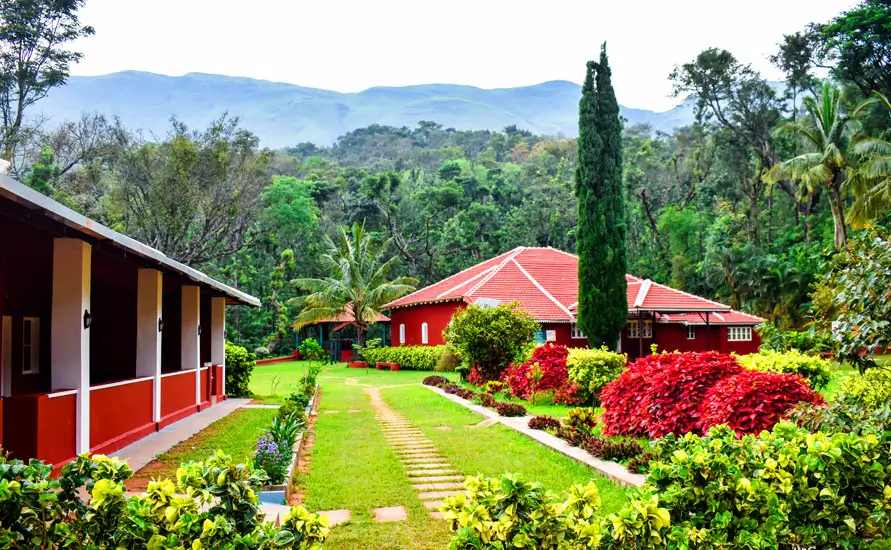
The last hour of the drive winds upward through coffee and pepper plantations shaded by silver oak, and the air turns noticeably cooler as you near Madikeri, the district headquarters. Beyond Madikeri your planter's bungalow waits, and its owners tend to greet guests with coffee picked, sun-dried and roasted on their own slopes just behind the house. The Kodavas are a warrior community with a distinct dress and kitchen, so order pandi curry tonight: pork simmered with kachampuli, a black fruit vinegar, and eaten with steamed rice dumplings called kadambuttu. Overnight in Coorg.
Mist usually sits in the valleys early in the day, and a guided walk through a working coffee estate is the best way to use those cool hours. Walking the rows, your planter shows how arabica bushes favor the cooler heights while hardier robusta covers most of Kodagu, and how black pepper vines climb the silver oaks as a bonus crop. March brings fragrant white flowers to the bushes, the rains swell green cherries, and from December into February teams of pickers strip the ripe red fruit by hand. The walk ends with a tasting of freshly brewed coffee and a look at how the beans are dried and sorted.
Eight kilometers of hairpins bring you to Abbey Falls, which pours off a ledge inside a privately owned coffee and cardamom estate. A flight of steps descends to a suspension bridge opposite the water; the falls roar between July and October and thin to a gentle veil by April. In town, the Omkareshwara Temple of 1820 puzzles first-time visitors: King Linga Rajendra II crowned this Shiva shrine with a central dome and four corner turrets in Indo-Islamic style. The old fort nearby holds a small museum and the former palace of the Kodava rulers.
At dusk you stroll to Raja's Seat, a garden pavilion where Kodagu's kings are said to have taken their evening air, gazing west over fold upon fold of forested hills. On a clear day the layers of hills fade into blue toward the Kerala border. If you have energy for a longer outing, a half-day drive to Talacauvery, the source of the Kaveri River near Bhagamandala, can be added in place of the falls. The evening is free at your plantation, and your host may share a bottle of homemade wine or tell you about the Kodava harvest festival of Puttari. Overnight in Coorg.
Today's long drive crosses the coffee belt from south to north, so you leave after an early breakfast. The road runs through Somwarpet and then past the tea and cardamom slopes around Sakleshpur, a small hill town where your driver stops for a coffee break and a stretch. If time allows, the hilltop Manjarabad Fort, a star-shaped stronghold built by Tipu Sultan in the 1790s, sits just off the highway and takes about forty minutes to visit, including the climb up its stone steps. On clear days its ramparts give a view straight down to the Bisle Ghat and the forests toward the coast.
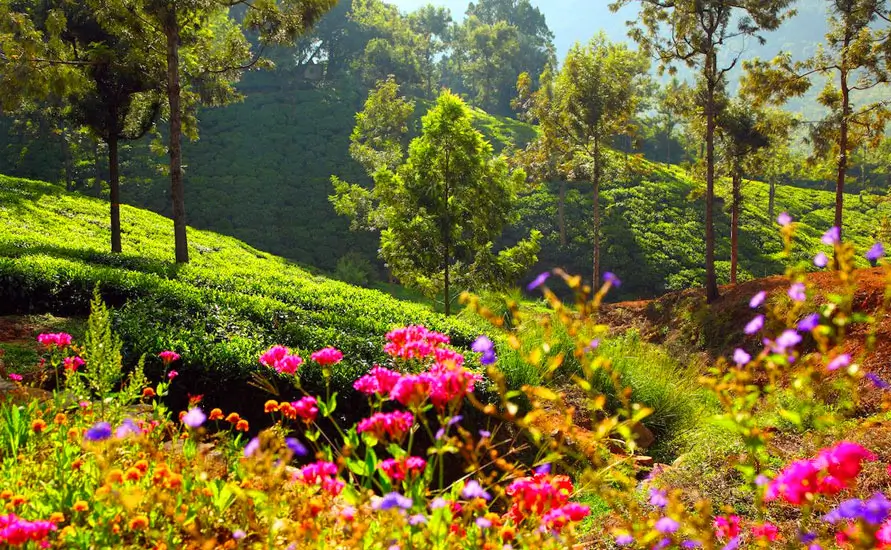
Past Sakleshpur the road descends slightly into the plains around Belur before turning north again toward Chikmagalur, a district whose name means the younger daughter's town. It was the dowry gift of a local chieftain to his youngest daughter, according to one popular story, while a nearby town was named for the elder. Today Chikmagalur is the heart of Karnataka's coffee industry, with estates covering the lower slopes of the Baba Budangiri range and the Coffee Board's research station a short distance away at Balehonnur. You break for lunch at a roadside eatery where rice, sambar and two vegetable sides arrive on a banana leaf.
You reach your estate resort in the hills above town by mid-afternoon and have time to rest after the drive. Most estates offer a short walk through the bushes before dark; otherwise, take a chair outside and watch the Mullayanagiri ridge, tomorrow's goal, turn from green to purple. The climate is mild all year, with cold nights from December to February, so pack a sweater for the evening. Dinner might feature akki rotti, a rice-flour flatbread, with a spicy chutney and a curry of local vegetables cooked in coconut. Overnight in Chikmagalur.
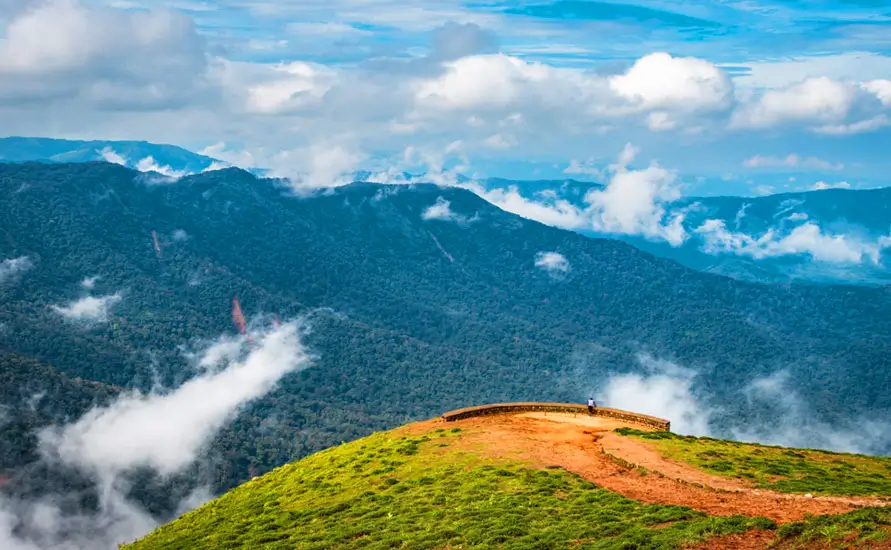
Set the alarm early for Mullayanagiri, the loftiest point anywhere in Karnataka, a little over 1,900 meters above sea level. Its grassy crown is often wrapped in cloud by ten, so the early hours give the best odds of a clear horizon. Cars stop below the top, and the last section is a stepped path to a tiny Shiva temple, from which grassy slopes and dark pockets of shola woodland fall away in every direction. Wind can be strong here, so bring a windproof layer and sturdy shoes. Weekends draw crowds from Bangalore, which is one reason we suggest arriving before eight, when the hills are still quiet and the light is clean.
Continuing along the ridge, you reach Baba Budangiri, named after a Sufi saint whose story is tied to the arrival of coffee in India. Yemen once guarded its coffee monopoly closely, and the popular story holds that the saint smuggled seven seeds home from his Hajj in his beard or waistband and sowed them on this hillside. A cave shrine here is revered by both Hindus and Muslims, who know it as Dattatreya Peetha and Baba Budan Dargah, and your guide explains the shared history and the sensitivities around it. Dress modestly and follow the instructions at the entrance.
In the afternoon you descend to Hirekolale Lake, a small irrigation reservoir whose still water mirrors the very peaks you stood on at dawn. It is a peaceful place for a short walk, with cowherds and fishermen around the edges and few tourists. Driving back, stop at a roastery in town for beans, ground filter blend with chicory and a two-part steel filter to recreate South Indian coffee at home. On chilly nights the staff often build a campfire on the lawn after dinner, a good moment to compare notes on the day's peaks and plan an early night before the Hoysala temples. Overnight in Chikmagalur.
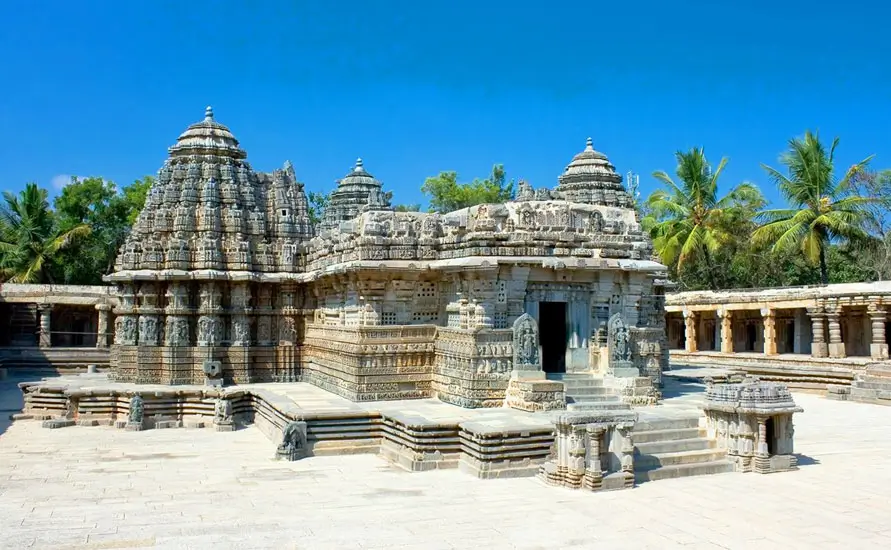
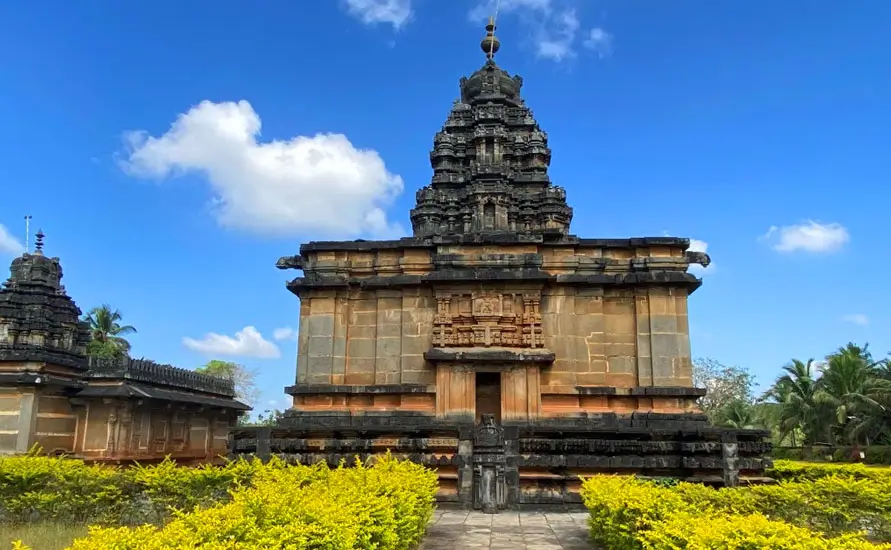
The Hoysala temples lie only an hour from your resort, which lets you reach Belur soon after opening and before tour buses arrive. The Chennakeshava Temple was commissioned in 1117 by King Vishnuvardhana, and work on it continued for more than a century. In 2023 Belur, Halebidu and Somanathapura were inscribed together as a single World Heritage property honoring Hoysala temple building. The greenish-grey schist could be worked almost like wood when freshly cut, so sculptors undercut bangles and fingertips in astonishing depth; watch for the bracket maidens called madanikas, especially Darpana Sundari gazing into her hand mirror.
Sixteen kilometers on lies Halebidu, once the royal city of Dwarasamudra, plundered by Delhi Sultanate forces in the early 1300s and left a ruin. Two Shiva sanctums sit side by side in the Hoysaleswara Temple, and its plinth is ringed by stacked bands of elephants, lions, cavalry and creepers, no two panels alike. Your guide picks out scenes from the Ramayana and Mahabharata on the upper tiers and shows you the two large Nandi bulls in pavilions facing the shrines. A quieter Jain temple complex at Basadi Halli stands a short walk away.
After lunch near Halebidu you begin the longest stretch of the day, heading northwest through Tarikere and the edge of the Bhadra forest toward Shimoga, also written Shivamogga, the main town of the Malnad region. Budget about three and a half hours; every kilometer west brings more rain-fed green, until slender areca palms crowd both sides of the road. Shimoga sits on the Tunga River and is a busy trading town rather than a tourist center, so expect a comfortable business hotel and a straightforward dinner of local dishes, including the akki rotti and spicy chicken sukka popular across the region. Overnight in Shimoga.
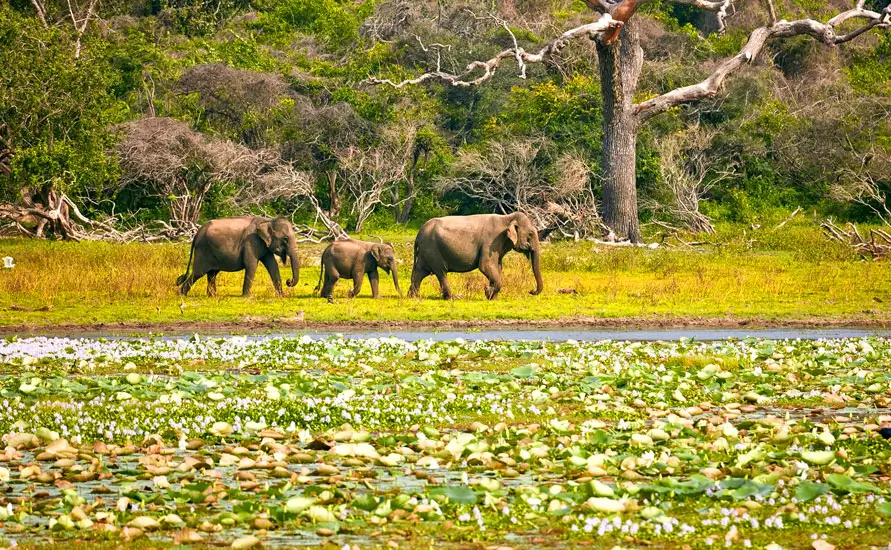
Some of the most rewarding hours of the Malnad region come early this morning at the Sakrebyle Elephant Camp, about 14 km from Shimoga on the backwaters of the Tunga. The forest department keeps working and rescued elephants here, and soon after dawn the mahouts lead them to the river to be scrubbed down before their morning feed. You watch from the bank as a calf splashes in the shallows or an older female stands patiently while her keeper brushes her ears. Visitors are kept at a distance, and we do not include any riding, bathing or hand feeding, which is better for the animals and safer for you.
From Sakrebyle you head northwest toward Sagara, passing the Gajanur dam and an endless succession of areca and banana gardens. A stop at Keladi, a quiet village that was the first capital of the Keladi Nayakas, shows a side of history few visitors see. These rulers controlled much of the coast and the Malnad between the 16th and 18th centuries, and the Rameshwara Temple here is notable for its carved ceiling panels and a small museum displaying palm-leaf manuscripts, coins and weapons. Rani Chennamma of Keladi, who sheltered a Maratha prince against Mughal forces, is still remembered locally as a heroine.
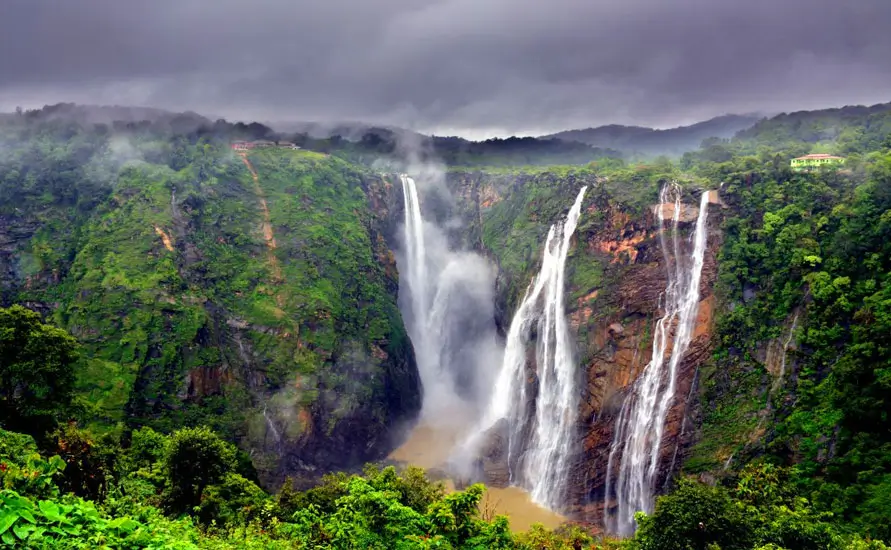
Arrival at Jog Falls comes by mid-afternoon, with a night in a modest lodge close to the gorge or in the market town of Sagara. Here the Sharavathi River plunges about 253 meters over a cliff in four separate streams that locals call Raja, Rani, Roarer and Rocket. The volume depends on the monsoon and on water released from the Linganamakki dam upstream, so the falls are fullest roughly from August to December and can thin out sharply by late spring. The late afternoon light from the main viewpoint is ideal for a first look, while clouds and spray can hide the gorge on rainy days. Overnight at Jog Falls.
Make time for a second visit to the falls in the morning, when the sun is behind you at the main viewpoint and rainbows sometimes form in the spray. Fit travelers can take the stepped path that leads down toward the base of the gorge, well over a thousand steps each way, but it can be closed after heavy rain for safety, and the climb back up is demanding in humid weather. Your driver checks the current status the evening before. Others prefer the quieter viewing points on the opposite side of the gorge, reached by a short drive across the river, which show the four streams side by side.
After breakfast you descend from the plateau toward the coast through thick evergreen forest on the Sharavathi valley road, a winding stretch where lion-tailed macaques are occasionally seen on the treetops. The river reaches the Arabian Sea at Honnavar, where you join the coastal highway north past fishing harbors and coconut groves. A lunch stop here is a good chance to try fresh fish fry dusted with rava and chili or a plate of neer dosa, the thin rice-flour crepe of coastal Karnataka. The highway then runs alongside the shore for most of the final hour.
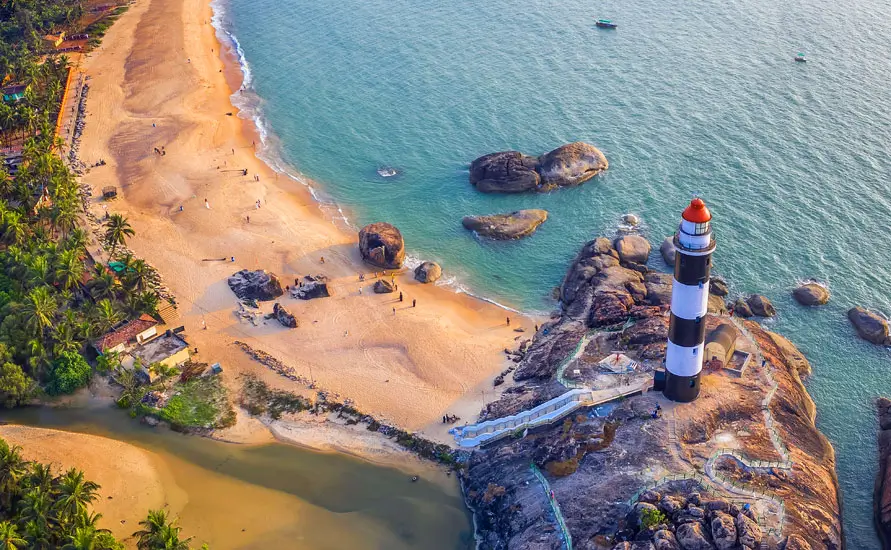
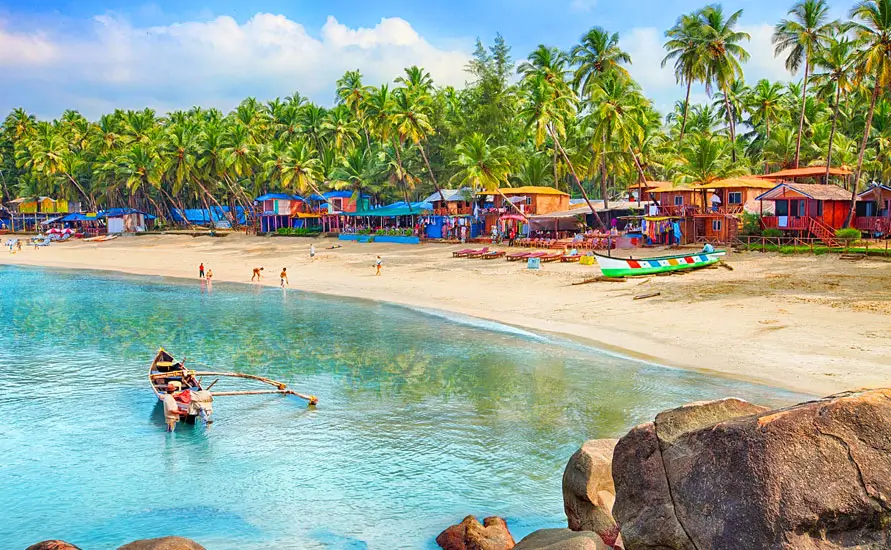
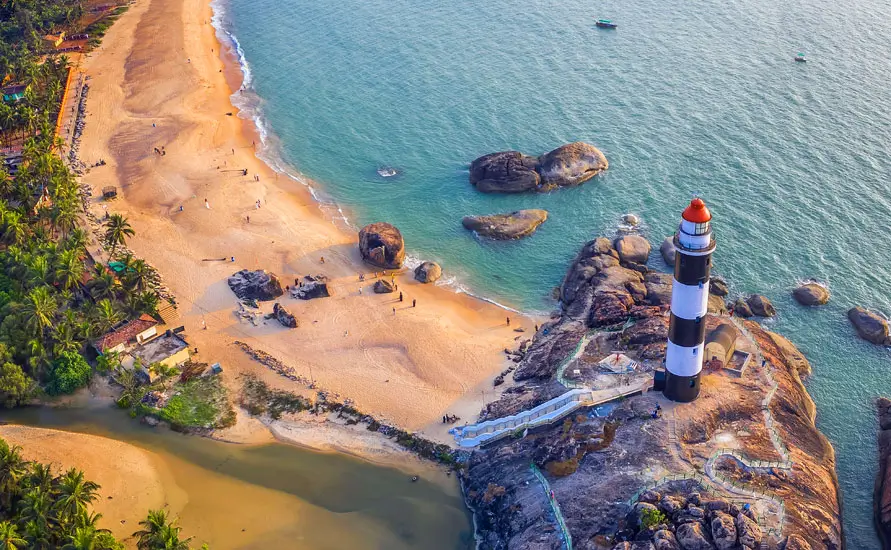
Gokarna is both a pilgrimage town and a relaxed beach destination, and your hotel or beach cottage sits a short distance from the temple streets. The main town beach faces the open sea, while a chain of quieter coves lies to the south, separated by rocky headlands. Before dark, either settle at a beach shack on Kudle with a fresh juice or wander Car Street, where old timber-fronted houses sell brass lamps, prayer beads and pilgrim souvenirs. Dinner can be seafood or a full vegetarian thali in town. Overnight in Gokarna.
Early in the day the town belongs to pilgrims, who bathe in the sea or in the Kotitirtha tank before visiting the Mahabaleshwar Temple. The shrine is believed to hold the Atmalinga, a powerful form of Shiva that, according to legend, was set down here by Ganesha to stop the demon king Ravana from carrying it to Lanka. Dress codes are strict, with men usually required to remove their shirts before entering, and rules for visitors to the inner area can change, so your guide confirms access on the day. The smaller Maha Ganapati Temple nearby honors Ganesha's part in the story.
Around ten you set out on foot along the headland trail that strings the southern beaches together. The trail starts at Kudle, climbs over a laterite headland and descends to Om Beach, named for its curving shape, before continuing to Half Moon Beach over rougher rocks. The whole walk takes about two to three hours at an easy pace, and shacks along the way sell fresh lime soda and grilled fish. Wear proper footwear, carry water and avoid the midday sun. If you prefer, a local boat can take you back from Half Moon to Om Beach, and swimming is only advisable where lifeguards are present, since currents can be strong.
The afternoon is free for rest at your cottage or a quiet hour on the sand. Gokarna is a good place to book an Ayurvedic massage or a yoga class, both offered at many small centers in town as optional extras. Toward evening, walk back into town for the temple chariot area and watch families gather at the main beach as the light fades. Dinner can be at a beach café or in a local restaurant serving Udupi-style dishes, including pathrode, colocasia leaves rolled with spiced rice paste and steamed. Pack tonight, as tomorrow you turn inland toward north Karnataka. Overnight in Gokarna.
Leaving the sea behind, the road turns inland at Ankola and winds up through the Yellapur forests, finally breaking out onto the open Deccan plateau. The change in scenery is dramatic: red soil, cotton and maize fields replace coconut groves, and the air becomes drier and warmer. A tea halt in Yellapur is customary, and bird lovers can request a detour to an overlook above the Kali valley, where great hornbills sometimes flap across in the morning.
Few tourists linger in Hubli, a railway and trading hub joined to university town Dharwad, so the afternoon here is kept deliberately light. A short outing covers the Chandramouleshwara Temple at Unkal, a small Chalukyan shrine opening on all four sides, followed by a lakeside walk at Unkal Lake as the city lights come on. Dharwad is famous for its pedha, a milk sweet that makes a good snack for tomorrow's drive. Overnight in Hubli.
Leaving after breakfast, you drive northeast across flat farmland toward the Malaprabha River and the earliest stone temples in this part of India. At Pattadakal, a UNESCO World Heritage Site, the Chalukya kings held their coronations, and the riverside complex shows both the northern and southern styles of temple towers built side by side in the 7th and 8th centuries. Pattadakal's grandest building, the Virupaksha Temple, was a queen's gift, raised by Lokamahadevi after King Vikramaditya II defeated the Pallavas. Your guide points out panels from the Panchatantra fables carved into its pillars.
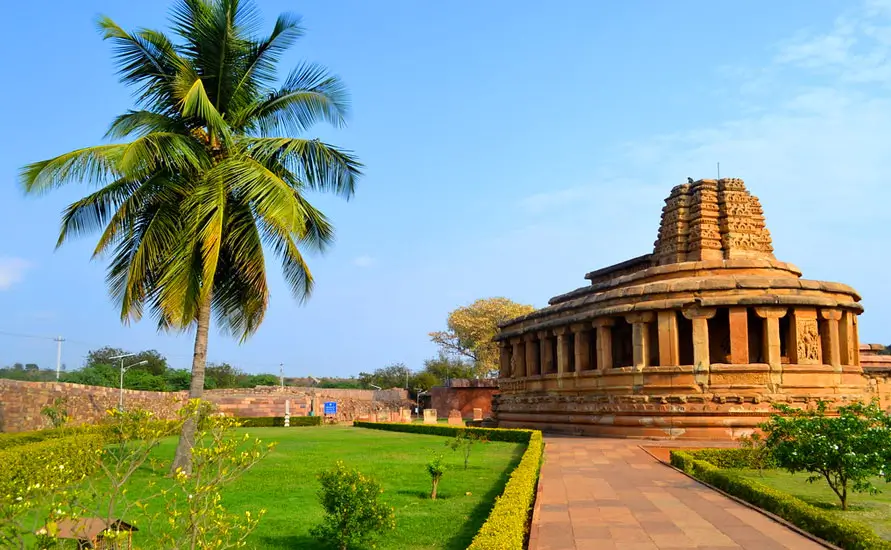
A short drive brings you to Aihole, often called a workshop of temple architecture because builders tested so many forms here, with more than a hundred temples scattered around the village. The Durga Temple is the best known, with an apsidal plan and a columned walkway around the sanctuary, while the Lad Khan Temple looks almost like a wooden village hall turned to stone. On the hill above the village, the Meguti Jain temple carries an inscription from 634 CE composed by the poet Ravikirti, which is one of the earliest dated records in the region. Lunch is a simple meal near the site.
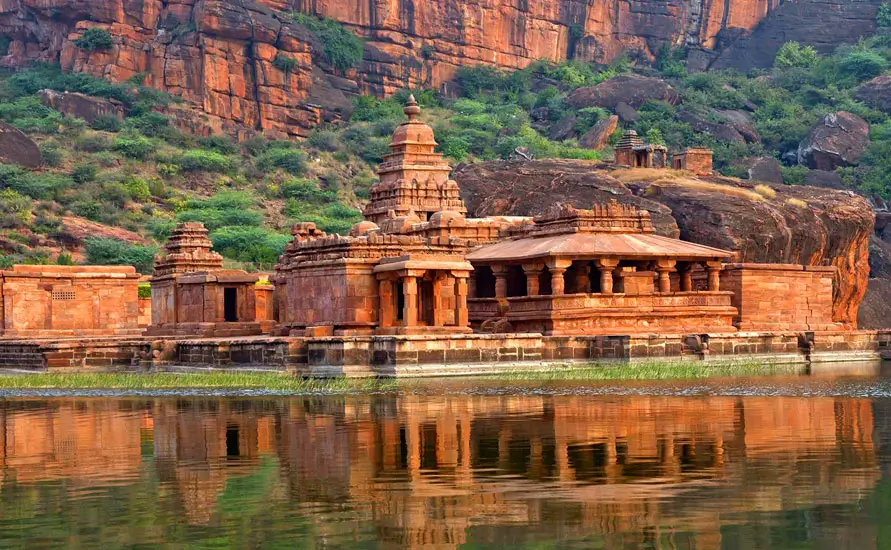
In the late afternoon you reach Badami, the old Chalukya capital of Vatapi, set beside a lake between two sandstone cliffs. After check-in, take a slow walk to the edge of Agastya Lake and watch the light turn the red rocks a deep orange as women wash clothes on the steps of the ghats. The small Bhutanatha temples on the eastern bank make a pretty frame at sunset. For dinner, try the north Karnataka plate: jowar flatbreads slapped thin by hand, stuffed brinjal curry and a dry peanut chutney powder. Overnight in Badami.
Morning is the right time for the Badami cave temples, four sanctuaries cut into the southern cliff between the 6th and 8th centuries. The first cave is dedicated to Shiva and holds a dancing Nataraja with eighteen arms, while the second and third caves honor Vishnu in his forms as the dwarf Vamana and the boar Varaha. The fourth, smaller cave is Jain and contains figures of the tirthankaras. Steps link the caves, and monkeys roam freely here, so keep food and loose items out of sight. From the upper terrace you can look across the lake to the old fort on the northern hill.
After the caves you drive southeast toward the Tungabhadra River, crossing a landscape of rocky outcrops and sugarcane fields that changes as you near Hampi, where huge granite boulders lie piled on top of one another. Allow most of the afternoon's first half for the road, lunch break included. By mid-afternoon you are unpacking at a hotel in Kamalapur or Hospet, both a short ride from the ruins. The old city of the Vijayanagara Empire covers a vast area, and spending two nights here allows a relaxed pace without trying to see every monument in one day.
Late afternoon you climb Hemakuta Hill, a low granite ridge covered with small early temples, for your first view over the town. From the top you see the gopuram of the Virupaksha Temple rising to the north and the river flowing between banana plantations and boulders in the distance. Sunset here is popular with both visitors and local families, so arrive a little early to find a good spot on the rock. Afterwards, walk down to the bazaar street in front of the temple, where small cafés serve banana pancakes, lassi and South Indian thalis. Overnight in Hampi.
For two centuries Hampi ruled most of the peninsula as the seat of the Vijayanagara kings, and Portuguese visitors compared it with Rome before the Deccan sultanates crushed its army at Talikota in 1565 and looted the city. Begin at the Virupaksha Temple, still a living place of worship, where Shiva is honored as the consort of Pampa, the goddess of the river. In a shadowy room at the back, light passing through a narrow slit throws an upside-down picture of the eastern tower onto the stone, and your guide shows you exactly where to stand.
Next you drive to the riverside and walk to the Vittala Temple, the most elaborate structure in Hampi. Facing the hall is the stone chariot, a small Garuda sanctum dressed up as a temple cart, now familiar to every Indian from the reverse of the fifty-rupee note. The slender pillar clusters inside the great mandapa were once struck to produce notes, but touching them is now banned after decades of wear. On the walk back you pass the Tula Bhara, two granite posts and a crossbeam where kings were weighed on special days against gold or grain later given away as charity.
After lunch the focus moves to the palace zone: the Royal Enclosure with the tiered Mahanavami Dibba, where kings watched the nine-night festival, the geometric stepped tank uncovered in the 1980s, and the Lotus Mahal with its scalloped arches. The Elephant Stables, a row of eleven domed chambers, stand nearby. Late afternoon you drive back toward the river for a short coracle ride on the Tungabhadra, when operators paddle the round bamboo boats between the boulders. Life jackets are provided, and rides depend on the water level, which is usually suitable outside the peak monsoon. The evening is free for your final dinner in Karnataka. Overnight in Hampi.
Your last road day heads south to Bangalore, roughly six hours on the national highway via Chitradurga, broken by stops for tea and a meal. Your driver plans the departure time around your international flight so you reach Kempegowda International Airport with at least three hours to spare. Prefer to fly? Jindal Vijayanagar Airport at Toranagallu lies about an hour from Hampi and has had short hops to Bangalore on some days, so we can book that instead when schedules work, or arrange an extra Bangalore night if your international departure is the next day.
Over eighteen days you have crossed Karnataka almost from end to end, from palace cities and tiger forests to coffee hills, Hoysala carvings, the waterfalls of the Malnad, a quiet coastline and the ruins of a great medieval empire. If the Grand Karnataka Tour 18 Days has whetted your appetite, Kerala's backwaters, the temple towns of Tamil Nadu or the beaches of Goa make natural next chapters, and our planners are happy to sketch one out. Our representative sees you to the terminal entrance and wishes you a safe flight home.
Your Journey

N.S. Rathore & Mrs. Omlata Rathore · Managing Director
We still read every enquiry ourselves. Tell us the places you liked and our planners will send a day-by-day route with drive times and a clear price.
Every package can be customised and no pressure to book. A planner from our office replies within 24 hours with a route written for your group.
Fill this in and your planner will send a first draft itinerary.
Explore more
Kerala Backwaters Escape Kerala Backwaters Escape
 Kerala Backwaters Escape
 Kerala Backwaters Escape
 Kerala Backwaters Escape
 Kerala Backwaters Escape
 Kerala Backwaters Escape
 Kerala Backwaters Escape
 Kerala Backwaters Escape
 Kerala Backwaters Escape
 Kerala Backwaters Escape
 Kerala Backwaters Escape
 Kerala Backwaters Escape
 Kerala Backwaters Escape
 Kerala Backwaters Escape
 Kerala Backwaters Escape
 Kerala Backwaters Escape
 Kerala Backwaters Escape
 Kerala Backwaters Escape
 Kerala Backwaters Escape
 Kerala Backwaters Escape
 Kerala Backwaters Escape
 Kerala Backwaters Escape