 Kerala Backwaters Escape

Karnataka Tour Packages
Bangalore – Chitradurga – Hampi – Anegundi – Gokarna – Yana – South Goa (Palolem / Agonda) – Dabolim
At a glance
Some trips work best when the hard sightseeing comes first and the reward waits at the end. Our Hampi Gokarna and Goa Beach Tour is built exactly that way. After two nights in Bangalore you head north to the granite-strewn Vijayanagara capital at Hampi for three full nights, cross the Western Ghats to the pilgrim beach town of Gokarna, and then slide down the coast to a long, unhurried finish of five nights in South Goa, where the beaches are quieter and the villages still run at their own pace.
The pace is front-loaded on purpose. The cultural part fills the first week, with a guide for every major site and a break at Chitradurga fort so the Bangalore to Hampi drive never feels like a slog. Once you reach Goa, the schedule loosens: two short outings are planned, and the remaining days are yours for swimming, reading, massages or a lazy lunch at a beach shack. A private car with air conditioning, driven by one English-speaking chauffeur throughout, covers every kilometer, from the Bangalore arrivals curb to the Dabolim departures hall.
This Hampi and Goa tour is a natural fit for couples and families from abroad, be it London, Munich, Toronto or Sydney, who want both history and a real holiday, plus NRI travelers who already know the big cities and want a different side of the south. The ideal window is November to March, when the Goan sea lies flat for swimming and the Deccan nights turn cool. Hotel category, beach location and the number of Goa nights can all be adjusted, since every part of the Gokarna beach tour is private.
Bangalore's Kempegowda airport sits about 35 km from the center, and you will find our representative by the exit gate holding a sign with your surname. Getting into central Bangalore may be quick in the small hours yet can stretch past ninety minutes in rush-hour traffic, and the driver uses the time to point out landmarks and answer first questions about SIM cards, cash machines and tipping. Most long-haul flights from Europe touch down overnight, so the morning is kept free for sleep. If your plane lands before sunrise, an extra night booked in advance means a bed is waiting the moment you walk in.
Once rested, take a gentle afternoon stroll through Cubbon Park, a green belt of bamboo groves and old rain trees that British engineer Richard Sankey planned in 1870 and which now covers some 300 acres. Early walkers, office staff on lunch breaks and couples on benches fill its lanes, while the red Gothic-style State Central Library and the colonnaded Vidhana Soudha, home to the state assembly, mark its edges. The legislature building is not open to tourists, yet its granite front is impressive from the road. Your driver waits nearby, so there is no need to plan how far you walk; simply turn back when you have had enough.
Bangalore is known across India as a pub and coffee city, and the leafy district of Indiranagar is a relaxed place to see that side of it. Microbreweries here pour their own lagers and wheat beers, and many places serve Karnataka snacks such as akki rotti or mangalore buns alongside the pints. For a calmer first night, a masala dosa and a steel tumbler of filter coffee at one of the city's old vegetarian canteens does the job just as well. When you have had enough, a quick call brings the car around. Overnight in Bangalore.
Following breakfast, a local guide spends the morning with you in the older southern neighborhoods, where the city's oldest markets, temples and gardens sit within a few kilometers of each other. Your first stop is Lalbagh Botanical Garden, a Mughal-style garden that Hyder Ali commissioned and Tipu Sultan later filled with saplings ordered from Persia, Kabul and Mauritius. Its Victorian glasshouse, built in 1889 in iron and glass, which fills with flowers twice a year for the Republic Day and Independence Day shows. Nearby, a huge outcrop of gneiss rock carries a small watchtower built by Kempegowda, the chieftain who founded Bangalore in 1537.
Ten minutes away, Tipu's Summer Palace is a teak pavilion of two floors whose pillars and arches still show traces of floral paint. Tipu finished it in 1791, and wall panels inside follow his four Anglo-Mysore wars up to his death at Srirangapatna in 1799. In Basavanagudi, devotees file into the Bull Temple to see a granite Nandi more than four meters long is coated with butter and coconut oil by devotees. Every November or December, an annual groundnut fair fills the streets outside, a sign of the area's farming past.
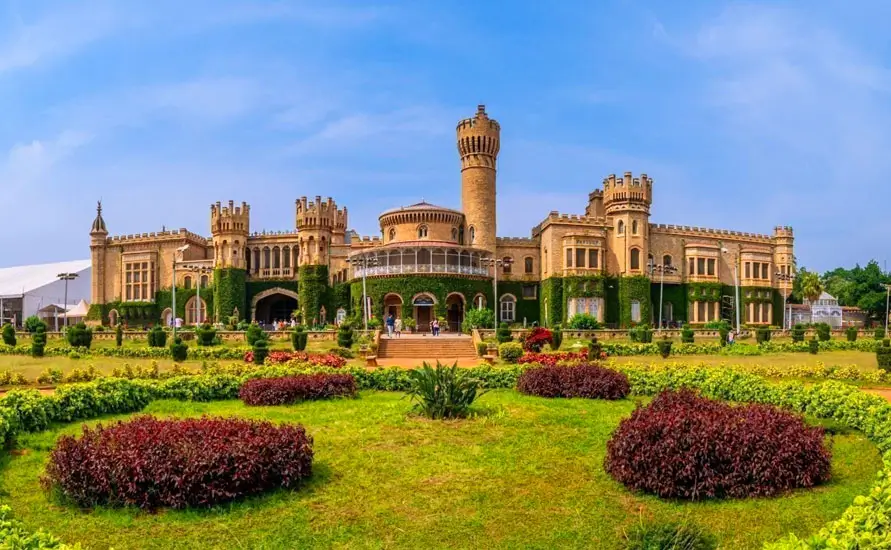
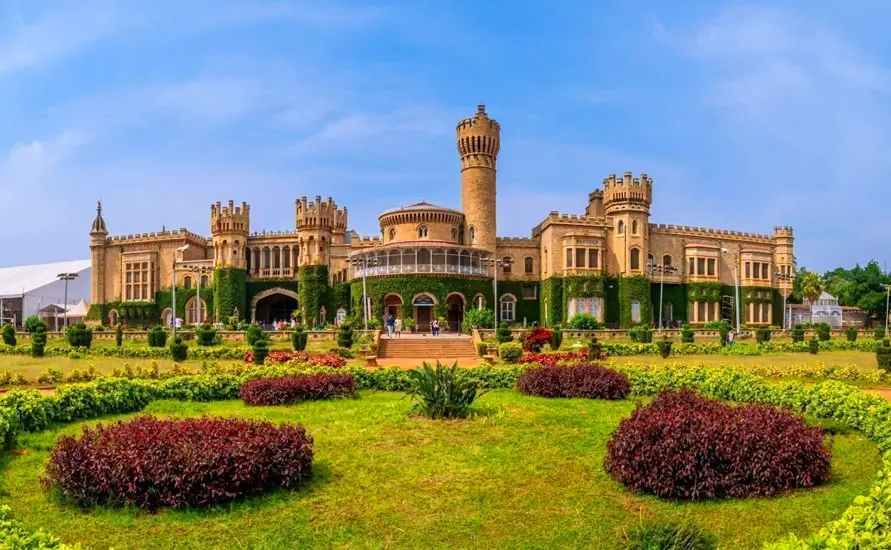
The afternoon is free. Many guests choose the Bangalore Palace, a Tudor-style residence built for the Wodeyar rulers with turrets, a ballroom and hunting trophies, which you can visit with an audio guide. Others prefer the shops of Commercial Street for silk, sandalwood soap and handloom cotton, or a quiet afternoon at the hotel before tomorrow's long drive. In the evening, order a plate of bisi bele bath, rice and toor dal cooked together with tamarind and a house spice powder, and finish with a piece of Mysore pak, the crumbly ghee sweet that Bangaloreans buy by the box. Overnight in Bangalore.
A dawn start gets you out before Bangalore wakes up, and by seven you are on the six-lane highway heading north-west across the Deccan. The landscape opens up quickly into coconut groves, millet fields and wind turbines turning on the ridges. Breakfast can be packed by your hotel or eaten at one of the busy roadside restaurants near Tumakuru, where travelers stop for idli, vada and coffee served at speed. The road is good, and your driver keeps a steady pace with a break every couple of hours to stretch your legs.
Around midday you reach Chitradurga, roughly halfway to Hampi, and visit its huge stone fort with your guide. The fortress climbs over a cluster of granite hills and was strengthened by the Nayaka chiefs and later by Hyder Ali, with seven rings of walls, dozens of gateways, wells, granaries and temples hidden among the rocks. Local people still tell the story of Onake Obavva, a guard's wife who is said to have fought off Hyder Ali's soldiers with a wooden pestle as they crept through a gap in the rocks. Wear sturdy shoes, as the paths are uneven and steep in places.
After a late lunch in town you continue north for about three more hours. Beyond Hosapete the sugarcane fields give way to the first piles of rounded boulders, and you reach your hotel in Hampi or Kamalapura in the late afternoon. Your Hampi guide may drop by to plan the next two days with you, including an early start for sunrise if you are keen. Most restaurants in the village are vegetarian and alcohol is not served in the temple area, so dinner is usually a simple affair of thali, banana lassi or wood-fired pizza at a guesthouse café. Overnight in Hampi.
Set your alarm for well before dawn, because the climb up Matanga Hill takes about thirty to forty minutes on rough rock steps, and the view at first light is the best introduction to Hampi you could ask for. From the small temple on top you see the whole site at once: the Virupaksha tower to the north, the curve of the river, and the ruins spread among paddy fields and banana plantations as far as the haze allows. Your guide leads the climb with a torch and knows the safe path. Bring water and a light layer, as it can be cool at the summit in winter.
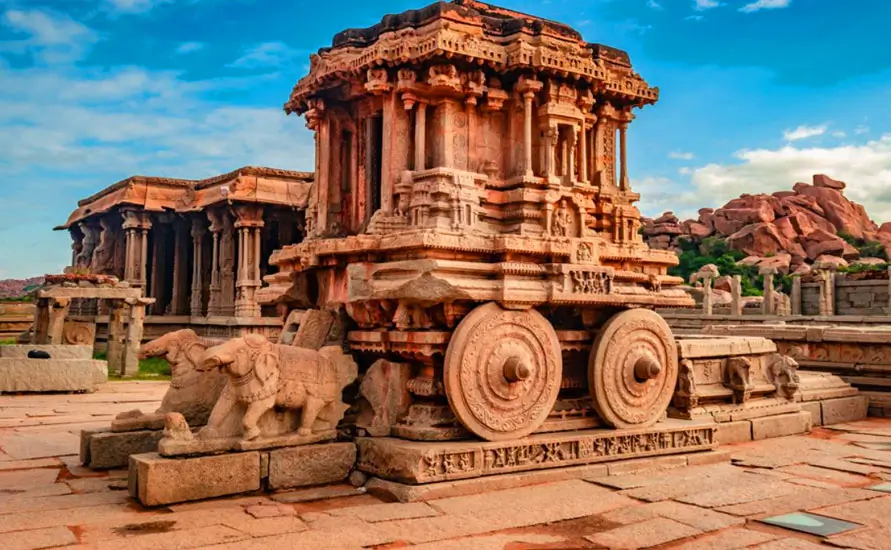
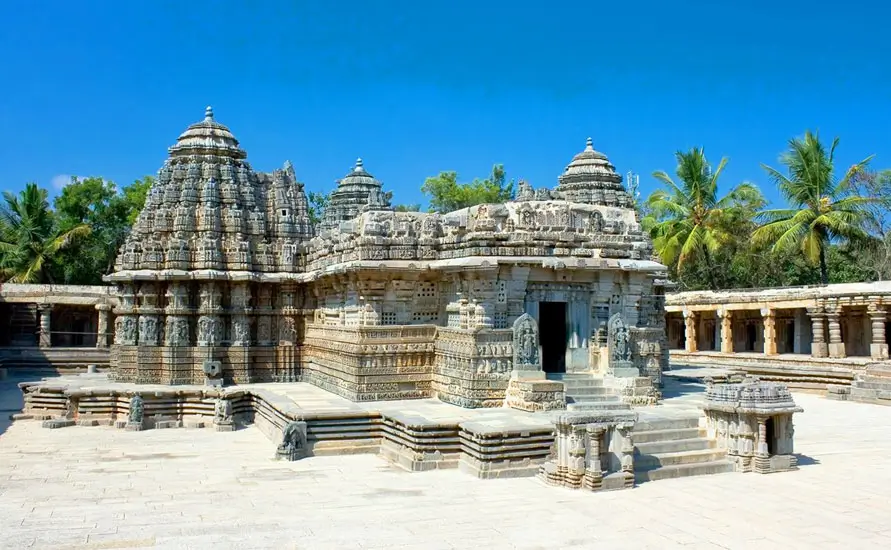
After breakfast you drive to the Vittala temple complex to be at the gate shortly after it opens, before the heat and the day-trippers arrive. Out in the open court stands the stone chariot, in fact a compact Garuda shrine dressed up as a temple car with carved wheels, and the same design appears on the back of India's fifty-rupee note. Your guide walks you through the hall of musical pillars, the kalyana mandapa used for divine weddings, and the long processional street outside, where horse traders once lined up. Battery carts run between the parking area and the temple, saving you the hot walk.
In the afternoon, after a rest, you visit the area around the Royal Enclosure, concentrating on the great stepped tank and the sunken Prasanna Virupaksha shrine, whose floor lies below the surrounding ground and often holds water after rain. A short drive away, the Pushkarani near the Krishna temple and the newly restored stretch of Krishna Bazaar show how the city's temple streets were laid out. End the day on a quiet rock near the Krishna temple, watching the light fade over the boulders, rather than at the busier sunset points. Overnight in Hampi.
Today you cross the Tungabhadra to Anegundi, a village that predates Vijayanagara and is believed to have been its first capital. A small ferry or a short drive over the bridge brings you to a different world from the main site: mud-walled houses with painted doors, banana groves, and a pace of life that has barely changed. A local trust works with village women here to weave bags, baskets and table mats from dried banana stems and local grasses, and the workshop welcomes visitors. The Gagan Mahal, an old palace now used partly as government offices, stands in the village center.
Nearby rises Anjanadri Hill, which many Hindus regard as the birthplace of Hanuman. About 575 whitewashed steps lead to a small temple on top, and the climb takes most people half an hour. Monkeys are everywhere, so keep bags zipped and do not carry food in your hands. From the summit the view stretches over rice paddies, the river and the rock hills of Hampi on the far bank. Many visitors climb it for sunset, but a morning visit is cooler and much less crowded, which is why it is planned early in the day.
After lunch at a farm café on the Anegundi side, you drive to Sanapur lake, a reservoir ringed by granite hills where Hosapete families picnic on Sundays. Swimming is not advised here, as there have been crocodile sightings and drownings, but the shoreline is lovely for a short walk. On the way back, if the water level allows and the boatmen are working, your guide can arrange a short coracle ride near the Anegundi ghat. The last evening in Hampi is free for packing or a final wander through Hampi Bazaar. Overnight in Hampi.
Today is mainly a road day across northern Karnataka toward the coast. Leaving Hampi soon after breakfast, you follow the highway west through Koppal and Gadag district, a flat land of cotton and jowar where the villages are built in stone. Around Hubballi the traffic thickens for a while, and your driver stops for lunch at a reliable highway restaurant serving North Karnataka meals as well as simple dishes for anyone who prefers milder food. Allow six to seven hours in total with stops.
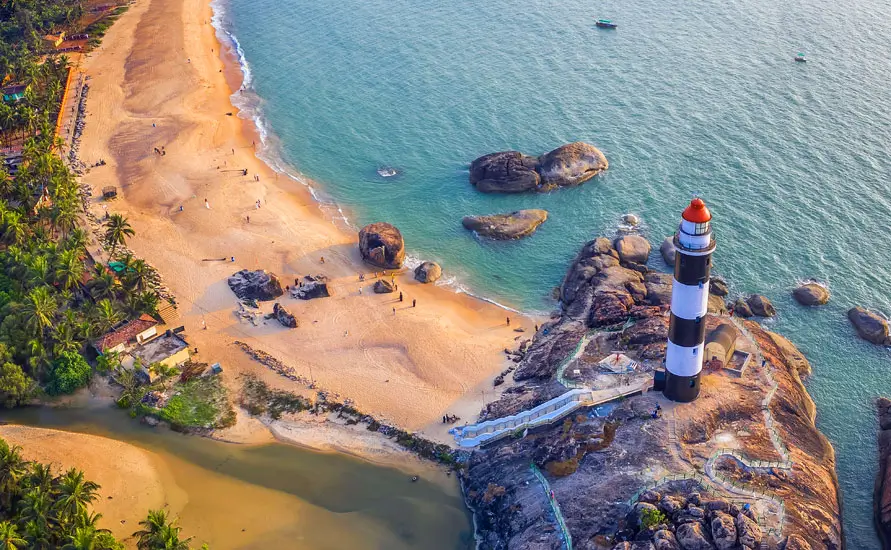
West of Hubballi the road climbs gently and then plunges down the wooded Sahyadri escarpment near Yellapur, where teak, bamboo and wild mango trees close in on both sides. The air turns humid and green as you descend toward Ankola and the coast. By late afternoon you are in Gokarna, where two nights are booked. If there is light left, walk down to the main town beach to see the evening aarti and pilgrims bathing in the sea. Overnight in Gokarna.
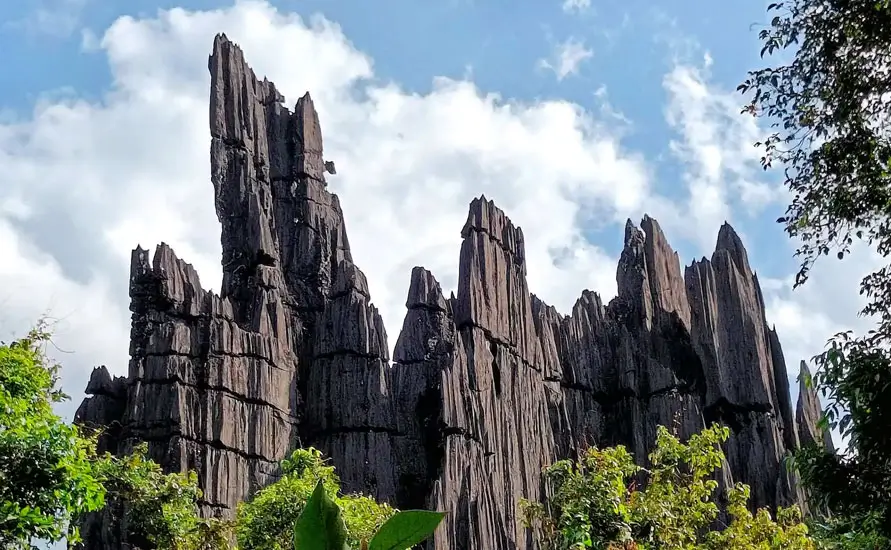
A morning excursion takes you about 50 km inland into the Sahyadri forest to Yana, where two enormous outcrops of black crystalline limestone, Bhairaveshwara Shikhara and Mohini Shikhara, rise straight out of the trees. The final approach is a walk of about twenty minutes on a paved forest path and steps. A cave shrine to Shiva sits at the foot of the larger rock, and water drips onto the linga from the stone above. Footwear is removed near the shrine, so wear sandals you can slip off. The forest is shady and cooler than the coast, and birdsong fills the valley.
You return to Gokarna for lunch and a quick look at the Mahaganapati temple, which stands beside the larger Mahabaleshwar shrine and, by local custom, is visited first. Pilgrims believe Ganesha, disguised as a boy, tricked Ravana into setting down the Atmalinga here, which is why the town became sacred and why the small shrine draws such loyal crowds. The streets around the temples are lined with old tiled houses where priestly families have lived for generations. Shops sell brass lamps, sandalwood and dried fruit for offerings, and the morning bustle quiets down after noon as the town takes its siesta.
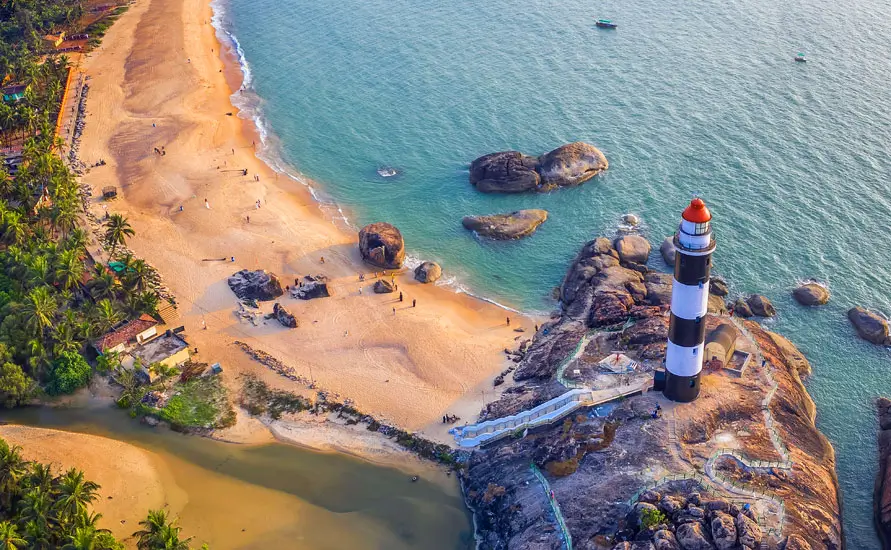
Around four o'clock the car leaves you at Om beach, and from there you follow the coastal path south over the rocks to Half Moon beach and the smaller, wilder cove beyond it. The path is rocky in places and takes about an hour, so carry water and wear proper shoes. Boats wait at both coves to bring you back to Om beach for the car. Watch the sunset from a café terrace above the sand, where fresh fish curry and rice is served on banana leaves. Overnight in Gokarna.
After a lazy breakfast the car heads north along the coast for the short drive into Goa. The route passes through Ankola and Karwar, where the Kali river bridge gives a good view of fishing boats moored in the estuary. You cross into Goa at the Polem checkpost, where your driver shows the vehicle permit, and within half an hour you are in Canacona, the southernmost part of Goa, where coconut palms, laterite cliffs and small whitewashed churches line the road. With barely two and a half hours in the car, you arrive in time for lunch and a long afternoon on the sand.
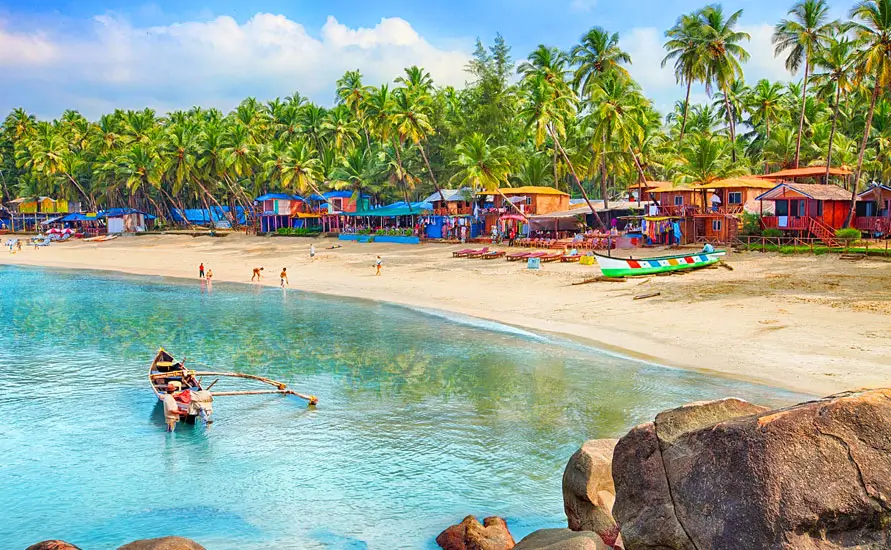
Your base for the next five nights is a beach resort or boutique cottage hotel near Palolem, Agonda or Patnem, chosen to suit your taste. Palolem is a curved crescent of sand with cafés and kayak hire; Agonda is longer and quieter, with olive ridley turtles nesting at one end in some seasons; Patnem sits between the two with a relaxed, family-friendly feel. All three are best for swimming in the dry months, when the sea is flat and clear. Lifeguard towers stand on the main beaches in season; swim between the flags and stay out when red ones fly.
Nothing is planned for the afternoon. Go for a swim, borrow a deckchair or simply walk the length of the beach at low tide, when the firm sand makes for easy going. South Goa shacks serve Goan specialties such as fish recheado, prawn balchão and pork vindaloo, and many lay the morning's catch on ice at the entrance so you can point at a kingfish or a pomfret for the grill. Evenings are calm, and the sound of the surf is often the only noise after dark. Your driver stays on call for any errands. Overnight in South Goa.
There is nothing on the schedule today, and that is the point. After a week of temples and early starts, a day with no plans lets you settle into the rhythm of the coast. Sleep in if you want; most beach hotels keep breakfast going until late morning and serve both Western and Goan dishes, including poi, the local bread, with spicy chouriço sausage or a light vegetable bhaji. If you want to swim, the morning is usually the calmest time, before the afternoon breeze picks up the waves. Keep sunscreen and a hat handy, since the sun on the sand is stronger than it feels.
If you have energy for a gentle outing, rent a kayak in Palolem and paddle out to the small rocky island at the north end of the beach, or join a local boat trip to look for dolphins off the headland. Boatmen leave early in the morning and the trips last about an hour; sightings are frequent in calm weather but never guaranteed. Another option is a yoga class at one of the many shalas along the coast, where drop-in sessions are held most mornings in season. All of these can be booked locally at modest cost.
In the late afternoon, wander along the beach to watch fishermen pulling in their nets by hand, a slow, cooperative effort that often draws a small crowd of helpers and onlookers. As the sun sets, the beach shacks light candles and lanterns on their tables, and the smell of grilled fish drifts across the sand. Silent-disco nights are held at some places in Palolem if you want music, though the rest of the coast stays quiet. Your driver can take you to dinner at a village restaurant inland if you would like a change. Overnight in South Goa.
Today brings one of the two planned outings in Goa, and your guide joins you after breakfast for the drive north to Old Goa, around ninety minutes up the highway. In the 1500s this riverside city governed the whole Portuguese East and was reckoned as populous as Lisbon itself, yet it was largely abandoned after epidemics, and now only its great churches remain among lawns and palm trees. UNESCO inscribed these buildings in 1986. Dress modestly with upper arms and legs covered, and ask before taking photos, since each church sets its own rules.
Pilgrims from all over the world come to the Basilica of Bom Jesus for the tomb of St. Francis Xavier, a Spanish Jesuit who landed here in 1542 and died off the coast of China ten years later. His silver casket is displayed above a marble tomb gifted by a Medici duke, and the body is brought down for public veneration roughly every ten years. On the other side of the main road rises the Sé Cathedral, dedicated to St. Catherine and home to a bell nicknamed the Golden Bell for its deep ring. Last comes the skeleton of the St. Augustine complex on Holy Hill, where only half of a single tower still stands above the foundations.
On the way back south, you stop in the village of Chandor to visit one of the old Goan mansions still owned by the families who built them. Built with fortunes from trade and land, these large houses have long verandas, carved rosewood furniture, Chinese porcelain and ballrooms with Belgian mirrors, and the owners or caretakers often show visitors around in person. A small donation is customary, as they receive no government funding. Back at the coast around five, there is still time for a swim before dinner, and the sea is often at its warmest in the late afternoon. Overnight in South Goa.
A short drive of about forty minutes north from Palolem brings you to Cabo de Rama, where crumbling bastions sit on a cliff high above the waves. The fort was held by Hindu rulers before the Portuguese took it in 1763, and legend links it to Rama, who is said to have stayed here during his exile. Within the ramparts a modest chapel dedicated to St. Anthony holds occasional Mass, and old cannons still point out to sea from the western bastion, with a long view of the coastline in both directions. Mornings are clear and cool, and very few other visitors make the trip.
Below the fort, a steep path leads down to a small rocky beach, best visited only if you are steady on your feet. Afterwards your driver takes you inland to the Cotigao Wildlife Sanctuary, a stretch of moist deciduous forest near the Karnataka border. A short walk on the forest trails or a climb up the watchtower gives you a chance to see birds such as Malabar grey hornbills and woodpeckers, and with luck a giant squirrel leaping between the treetops. The forest department sets opening times, and the walk is gentle enough for most ages.
Lunch is at a small family restaurant in Canacona, where local women cook simple Goan meals of fish curry, rice and vegetables in coconut gravy. The afternoon is free back at the beach, where you can book an Ayurveda massage at your hotel spa, read in the shade or simply rest in a hammock strung between two palms. In the evening many beach cafés bring out a guitarist or a small band, and with no early start tomorrow you can linger over a last drink long after dark. If you prefer quiet, a short walk along the dark beach under the stars is just as pleasant, with the lights of fishing boats on the horizon. Overnight in South Goa.
Your last full day is kept open, with one optional idea for the morning. Small boats from Palolem take visitors to Butterfly beach, a secluded cove north of Palolem that cannot be reached by road. The boat ride takes about twenty minutes and often includes a loop past the headlands to look for dolphins. The cove is backed by forest and has no shops, so take water and snacks. Swimming is best in calm conditions, and the boatman will tell you when it is time to head back. You return to Palolem by late morning.
After lunch, the hours are entirely yours. Some guests use it for a final round of shopping in the small markets of Palolem and Chaudi, where you can find Goan cashews, kokum syrup, feni (the local cashew spirit) and handmade soaps. Others book a Goan cooking class in a village home, where a local cook shows how to make a xacuti curry with roasted spices and coconut. You can also simply lie on the beach and let the afternoon pass. Your driver confirms tomorrow's departure time with you in the evening.
For a farewell dinner, take a table right on the sand and stay for the last light over the Arabian Sea. Just after sundown the water turns copper, the headlands go dark and the outlines of fishing boats rock gently on the water. Many restaurants offer a mixed seafood platter, and the kitchen will happily cook a milder version for anyone who prefers less spice. Packing tonight keeps tomorrow morning calm, and the hotel can store anything you want to wrap carefully, such as bottles of feni or bags of cashews, at reception. Overnight in South Goa.
Once breakfast is finished, the car heads up the coast road to Dabolim airport, roughly ninety minutes from Palolem. For flights from Mopa in the far north, budget closer to three hours; either way we work back from your check-in time and add a buffer. For evening departures, ask us beforehand about keeping your room into the afternoon, so you can keep enjoying the beach until it is time to go.
Thirteen days took you from Bangalore's parks and breweries to the boulders of Hampi, the pilgrim cliffs of Gokarna and a long, easy finish on the Goan sand. Mysore, Coorg and the Kerala backwaters are waiting whenever you come back, and we would be happy to sketch out that next route. Wishing you a smooth flight home and many good memories of the coast.
Your Journey

N.S. Rathore & Mrs. Omlata Rathore · Managing Director
We still read every enquiry ourselves. Tell us the places you liked and our planners will send a day-by-day route with drive times and a clear price.
Every package can be customised and no pressure to book. A planner from our office replies within 24 hours with a route written for your group.
Fill this in and your planner will send a first draft itinerary.
Explore more
Kerala Backwaters Escape Kerala Backwaters Escape
 Kerala Backwaters Escape
 Kerala Backwaters Escape
 Kerala Backwaters Escape
 Kerala Backwaters Escape
 Kerala Backwaters Escape
 Kerala Backwaters Escape
 Kerala Backwaters Escape
 Kerala Backwaters Escape
 Kerala Backwaters Escape
 Kerala Backwaters Escape
 Kerala Backwaters Escape