 Kerala Backwaters Escape

Karnataka Tour Packages
Bangalore – Belur – Halebidu – Doddagaddavalli – Hampi – Badami – Pattadakal – Mahakuta – Hubli
At a glance
Two royal houses, five centuries apart, left Karnataka with its finest temples, and they worked in completely different stone. Our Hoysala and Chalukya Heritage Tour puts them side by side. In the south you see how 12th-century Hoysala sculptors at Belur and Halebidu turned soft soapstone into filigree as fine as jewelry. In the north you stand among the 6th to 8th-century sandstone shrines of Badami and Pattadakal, where Chalukya builders were still testing what a stone temple should look like. Between the two sits Hampi, the later Vijayanagara capital that borrowed from both.
The comparison is the point of the trip, so guides at each site are briefed to link what you see with what came before or after. You will notice how the Chalukyas cut caves into cliffs before they built free-standing towers, and how the Hoysalas, inheriting those lessons through the later Chalukyas of Kalyani, raised star-shaped platforms and covered every surface with carving. By the last day the differences between early experiment and mature ornament become easy to read. This Hoysala and Chalukya heritage tour keeps drives reasonable and gives two nights at each main base.
It is planned for independent travelers from abroad, whether British, European, American or Australian, who care about art and history, and NRI visitors who want a deeper look at Karnataka than the usual palace circuit. It starts in Bangalore and ends at Hubballi airport, avoiding a long return drive. Plan for the cooler months between October and February, since the northern plateau bakes from March onward. Everything is private, so the pace, hotel category and length of each temple visit can be adjusted to suit you.
Once you clear immigration at Kempegowda International Airport, our Bangalore team greets you by name and walks you out to the waiting car, air-conditioned and reserved for you alone. With the airport so far north of the center, reaching a central hotel often takes sixty to ninety minutes in traffic, and your driver has cold water and local SIM card advice ready for the ride. If you land overnight, which is common on flights from Europe and the Gulf, an extra pre-booked night means your bed is ready the moment you arrive, letting you sleep properly before anything else is planned. Your guide calls in later to go over the week ahead and answer any questions about the temples.
Toward late afternoon, drive south to Basavanagudi, an old residential district in south Bangalore laid out around a hillock of bare granite. The Bull Temple here holds a huge seated Nandi carved from a single boulder, usually dated to the time of Kempegowda in the 16th century, and devotees rub it with butter and oil until the stone turns almost black. It is a useful first sight on this trip, because the monolith belongs to the same Vijayanagara period you will meet at Hampi later in the week. Your guide explains how granite, hard and coarse, forced sculptors to work in broad forms rather than fine detail.
Nearby, the Dodda Ganapathi Temple shelters a tall image of Ganesha covered in silver foil and flowers, and the lanes around both temples fill up after dark with snack sellers and families out for a walk. If your visit falls in November or December, you may find the streets lined with peanut sellers for the Kadalekai Parishe, the annual fair that honors the stone bull. Dinner can be at a traditional vegetarian restaurant in the area, where masala dosa and frothy filter coffee come quickly and cheaply. Return to your hotel early, because tomorrow's drive to the Hoysala country starts soon after breakfast. Overnight in Bangalore.
Leaving the city soon after breakfast, your driver heads west on the highway toward Hassan through farmland planted with coconut, sugarcane and finger millet. The drive to Belur needs roughly five hours, including a coffee stop, and your guide uses the time to set the scene. The Hoysalas started as hill chiefs in the Western Ghats and served the Western Chalukyas of Kalyani before breaking away in the 12th century. Their emblem shows a young man named Sala fighting a tiger to protect his teacher, and you will spot it at the entrance of almost every Hoysala temple you see this week.
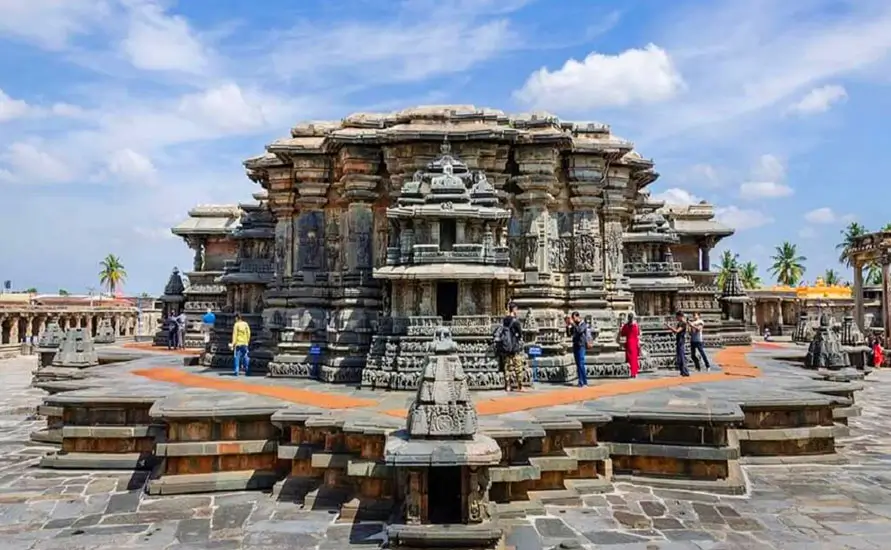
The Chennakeshava Temple at Belur was consecrated in 1117 by King Vishnuvardhana, and tradition links it to his victory over the Cholas at Talakadu. Work on the carving carried on for generations after that date. Look first at the 42 bracket figures, the madanikas, fixed under the eaves at an angle: a dancer, a huntress with her bow, and the famous Darpana Sundari studying her face in a hand mirror. They are cut from chloritic schist, a greenish-gray stone that cuts easily when fresh and toughens over the years, so bangles hang loose on wrists and a fly settles on a fruit without breaking off.
Inside the dim hall, your guide uses a torch to pick out four pillars carved in different patterns, including the Narasimha pillar, which local tradition says could once be turned by hand. Notice how the ceiling domes are made of rings of stone stepping inward, a method that comes straight from older Chalukya practice. Belur remains a living Vishnu temple, and covered shoulders, covered knees and bare feet are expected inside the walls. Afterward you drive 40 minutes to Hassan, a practical base with better hotels and easy access to Halebidu. Nothing more is scheduled, so the evening is yours. Overnight in Hassan.
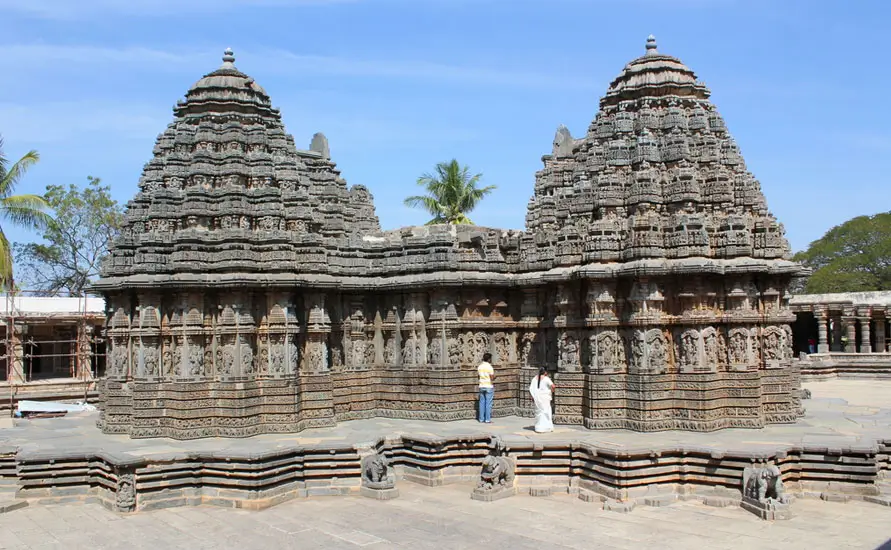
Halebidu means old capital, and the quiet village was once Dwarasamudra, the Hoysala royal city, plundered by Malik Kafur's army from Delhi in 1311. Arrive at the Hoysaleswara Temple in the morning, when low light rakes across the outer walls and throws the carving into sharp relief. Begun around 1121, it has two linked shrines, one named for the king and one for his queen Shantala, each with its own Nandi pavilion facing east. The temple was never completed, and the roofs above the shrines were never built, which makes the walls seem even more dominant.
Your guide reads the walls from the ground up. Bands of elephants, lions, horsemen, scrolling vines, mythical beasts and swans run unbroken around the base, and above them sit panels from the Ramayana, the Mahabharata and the Bhagavata Purana, with Krishna lifting a mountain and Ravana shaking Kailasa. Compare the deep, almost three-dimensional undercutting here with the flatter reliefs you will see at Badami later on, and you understand why Hoysala art is often called a jeweler's style in stone. A small museum on the lawn holds sculptures recovered from the ruined city around the temple.
A short walk away stand the Jain basadis of Halebidu, where the mood changes completely. The Parshvanatha basadi has almost no outer carving, but inside, its black pillars were shaped on a lathe and polished until they reflect your face like dark glass. After lunch you drive a short way to Doddagaddavalli, a farming village where the Lakshmi Devi Temple, built in 1113, shows the Hoysala style before it reached full richness: plain walls, four shrines around a shared hall and two skeletal guardian figures at one doorway. Few visitors make the detour, so you often have it to yourself. Overnight in Hassan.
The longest road day of the tour comes now, as you leave the Hoysala heartland and head north-east across the Deccan to Hampi. Your driver sets off early after breakfast and follows the highway through Arsikere, Chitradurga and Hospet, with regular stops for tea, fresh coconut water and a lunch break at a clean highway restaurant. The scenery shifts slowly from green fields and coconut groves to wide dry plains, windmill ridges and scattered boulder hills. If you would like a short leg-stretch at the Chitradurga hill fort on the way, tell us before the trip and we will build it into the timing.
Expect to check in near Hampi or in Hospet by late afternoon. Rooms and the evening are yours to rest, and there is no sightseeing planned following so many hours on the road. Your guide for the next day calls in to agree a start time, usually soon after sunrise before the heat and the coach groups arrive. Before bed, spend a few minutes with the site map: the ruins spread over many square kilometers along the Tungabhadra, and knowing the layout in advance makes tomorrow far easier to follow. Overnight in Hampi.
On this trip Hampi is read as the link between the two dynasties, so your guide starts at Hemakuta Hill, a low dome of granite above the Virupaksha Temple. Scattered across it are small shrines that predate the Vijayanagara Empire, several built as groups of three around a shared hall, with stepped pyramidal roofs made of horizontal granite slabs. Their plan descends directly from the late Chalukya temples of the 10th and 11th centuries, the same tradition that shaped the early Hoysalas. Standing here at sunrise, with the boulder fields turning gold below you, you can see how older ideas survived into the new capital.
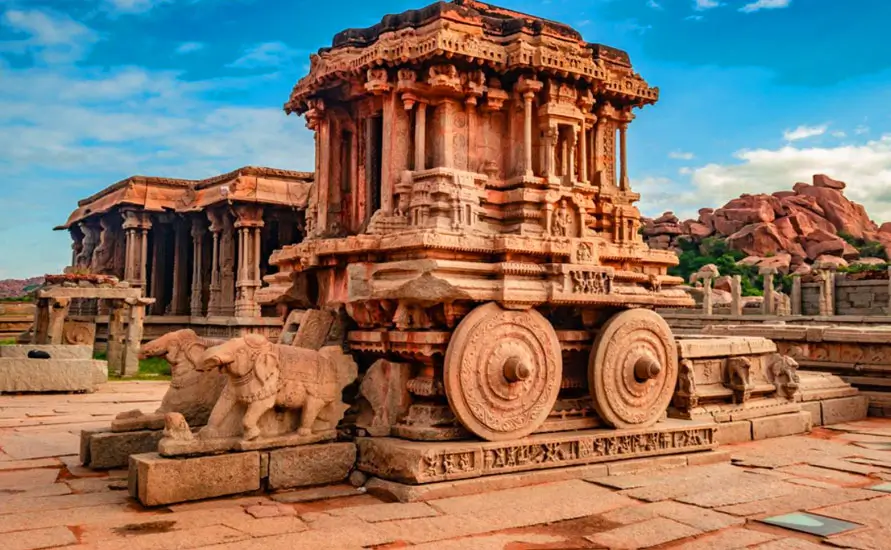
Just below the hill, the Virupaksha Temple has been a place of worship since long before the empire rose, and its core shrine is older than the towering eastern gateway added later. The temple is still busy, with a temple bell, a sacred tank and pilgrims bathing in the river behind it. After a mid-morning break you move on to the Vittala Temple, where Vijayanagara carving reached its peak, where the pillars of the main hall break into slender colonnettes and the famous stone chariot holds a shrine to Garuda. Battery buggies run visitors in from the car park, and tapping the musical pillars is no longer allowed.
Look closely at the Vittala pillars with this week's comparison in mind. Granite is far harder than Hoysala soapstone, so instead of lace-like jewelry the sculptors chose bold rearing horses, yalis and riders cut almost free of the stone. The inspiration, however, is the same courtly love of crowded ornament. Later you can return to the hotel to rest, or, if you still have energy, to the riverbank near the Kodandarama Temple, where coracle boatmen wait for passengers. A short round-basket ride on the Tungabhadra is optional and depends on water levels. Overnight in Hampi.
After breakfast you leave the granite landscape behind and drive north-west to Badami, crossing cotton and sunflower fields on the black soil of north Karnataka. As you approach town the color of the land changes again: long ridges of red sandstone rise around a green lake, and this is the stone the Chalukya builders worked in. Badami was Vatapi, seat of the early Chalukya kings from around 543, and under Pulakeshin II in the 7th century the kingdom stretched across much of the Deccan. You check in, have lunch and rest through the hottest hours.
Late in the afternoon, when the cliff face glows deep red, you climb the steps to the Badami cave temples. There are four main caves, cut one above another, three Hindu and one Jain, and an inscription of 578 in Cave 3 records who paid for it. This is the earliest stage of the story you have been following all week. Builders here did not yet construct temples, they hollowed them out of living rock, with square pillars, carved brackets and big panels of Vishnu as the cosmic boar or striding across the universe, and Shiva dancing with eighteen arms near the first cave's entrance.
Set those panels against the Hoysala walls you saw at Belur. The sandstone is coarser and the figures are larger and calmer, with little surface decoration, yet the sense of movement in the dancing Shiva is just as strong. From the caves you look across Agastya Lake to the Bhutanatha shrines at the water's edge opposite and the North Fort ridge, where the Malegitti Shivalaya sits on a rock ledge. Walk down through the old village, where women still do their laundry on the tank steps, and return to the hotel before dark. Your guide recommends a north Karnataka thali with jowar roti for dinner. Overnight in Badami.
Pattadakal, about 30 minutes from Badami beside the Malaprabha River, was where Chalukya kings were crowned, and its group of 7th and 8th-century temples is listed by UNESCO. What makes it special is that two different ways of building a temple stand here in one compound. Some shrines carry the curved northern tower with a ribbed cushion stone on top, while others rise in the stepped southern pyramid of small roof pavilions. Your guide walks you from the earliest structures to the latest, showing how craftsmen seemed to test both ideas against each other within a single generation.
The largest building is the Virupaksha Temple, commissioned around 745 by Queen Lokamahadevi to celebrate the defeat of the Pallava kings of Kanchipuram by her husband, Vikramaditya II. Inscriptions suggest that craftsmen from the Pallava country worked on it, which explains why it resembles the Kailasanathar Temple in Kanchipuram. Its walls carry scenes from the epics and figures of river goddesses, and the pillars inside are crowded with storytelling panels. The neighboring Mallikarjuna Temple was built by a second queen. Compared with Halebidu, the carving is shallower and the forms simpler, yet the planning of halls and shrines is already the one the Hoysalas inherited.
In the afternoon you drive back toward Badami and turn off for Mahakuta, a cluster of Chalukya temples grouped around a tank fed by a natural spring. Unlike the protected monuments you have seen so far, these shrines are still in active worship, and pilgrims bathe in the green water before visiting the Mahakuteshwara shrine. It is a good place to end the week's comparison, because it shows a Chalukya temple doing what it was built for, with bells, lamps and flowers. Return to Badami for a final evening and a quiet dinner at the hotel. Overnight in Badami.
Check out after breakfast for the final road leg of roughly 150 minutes to Hubballi airport, whose domestic routes link to Bangalore, Mumbai and other hubs for your international connection. Departure is timed to your flight, and an afternoon plane leaves room for an early morning walk to the Bhutanatha temples on the edge of Agastya Lake, when fishermen are already out on the water and the sandstone is still cool.
Over eight days you have followed temple building in Karnataka from rock-cut halls at Badami and the experimental towers of Pattadakal to the dense soapstone carving of Belur and Halebidu, with Hampi in between. For a return visit, Bijapur with its Adil Shahi domes or Aihole with its early temples can be added to a future trip. Safe travels home from all of our team.
Your Journey

N.S. Rathore & Mrs. Omlata Rathore · Managing Director
We still read every enquiry ourselves. Tell us the places you liked and our planners will send a day-by-day route with drive times and a clear price.
Every package can be customised and no pressure to book. A planner from our office replies within 24 hours with a route written for your group.
Fill this in and your planner will send a first draft itinerary.
Explore more
Kerala Backwaters Escape