 Kerala Backwaters Escape

Karnataka Tour Packages
Bangalore – Channapatna – Srirangapatna – Mysore – Bylakuppe – Coorg – Bandipur – Mudumalai – Ooty – Coonoor – Coimbatore – Kochi – Alleppey
At a glance
Plenty of South India itineraries race through Karnataka in two nights. Ours does the opposite. The Karnataka Nilgiris and Kerala Tour gives the state seven of its twelve nights, beginning in the garden suburbs of Bangalore, moving on to royal Mysore and the coffee slopes of Coorg, and finishing with a forest night at Bandipur. Only then do you leave Karnataka, climbing the hairpins to Ooty in the Nilgiri hills, riding a train across the Palakkad Gap to Fort Kochi, and ending aboard a rice-barge houseboat near Alleppey.
Geography sets the order. The dry Deccan plateau rolls into teak forest where Karnataka, Tamil Nadu and Kerala touch, the road then lifts sharply into tea country, and finally a railway line slides you down to the palm-fringed lagoons of the Malabar coast. No single drive goes beyond about four hours, and you unpack for two nights at a time in most towns. Your private car and English-speaking driver cover every road leg, licensed local guides lead the key visits, and the Bandipur safari is reserved through the forest department, subject to availability.
Couples, friends and families arriving from Britain, Europe, the Americas or Australia use this Karnataka tour package as a broad first look at the south, and NRI parents often pick it so children see three states in one go. The kindest weather runs October to March, while Mysore's Dasara festival, held in September or October, fills the palace square with lights and parades. Hotel grades, extra nights in Coorg or Kochi, and the daily pace of the Karnataka Nilgiris and Kerala Tour can all be adjusted before you book.
Long-haul arrivals into Kempegowda International Airport cluster around midnight and sunrise, so day one deliberately holds nothing until after lunch. Look for a placard bearing your surname just beyond customs; it belongs to a colleague from our Bangalore office, who rides along to the hotel, roughly sixty to eighty minutes south on the airport road. Somewhere along that ride you will be handed a folder with vouchers and the full day plan, plus pointers on cash machines, SIM cards and tipping. Learning to say namaskara, the Kannada greeting, earns a grin from almost everyone you meet.
Once rested, ease into the city at Cubbon Park, three hundred acres of shade in central Bangalore where joggers, retirees and office workers on breaks share the paths under rain trees and clumps of bamboo. Red-brick colonial buildings line its edges, among them the State Central Library and the High Court, both painted a deep Pompeian red. Opposite stands the Vidhana Soudha, a grey granite legislature completed in 1956, its pillars and domed roof deliberately modeled on temple and palace forms. Visitors cannot go inside, though the front façade can be photographed from the street.
Evenings reveal why so many young Indians move here for work. A short ride takes you to Church Street, a pedestrian-friendly strip where secondhand bookstores, old Irani-style bakeries and microbreweries trade almost door to door; Bangalore pioneered India's brewpub scene, and several places pour pale ales and wheat beers made on the premises. Non-drinkers can try a tall glass of sugarcane juice or a frothy filter coffee instead. Dinner can be as simple as a crisp masala dosa near your hotel, and an early bedtime helps, since tomorrow starts before the sun. Overnight in Bangalore.
Six o'clock at K.R. Market is worth the alarm. Lorries from the surrounding farms unload sacks of jasmine buds, chrysanthemums and crimson roses beneath the market's arches, and wholesalers bargain at speed while garland makers thread petals with flying fingers. Your guide steers you through the flower floor, down into lanes of curry leaves, plantains and stacked banana leaves, and explains how one city's temples, weddings and household shrines are supplied from this single building. Breakfast follows at a crowded tiffin room where idli, crisp vada and coffee poured between two steel cups are eaten standing at tall counters.
Old Bangalore survives in Basavanagudi, a quarter laid out on land associated with the city's 16th-century founder, Kempe Gowda. Its Bull Temple shelters a seated Nandi roughly four and a half meters tall, cut from one granite boulder and coated black by generations of oil and butter offerings. Nearby, a giant Ganesha carved directly from rock fills the Dodda Ganapathi shrine. Your guide continues to Tipu Sultan's Summer Palace, which the sultan used from 1791 and which is made almost entirely of teak, with carved balconies and faded painted arches; a small exhibit inside covers Tipu and Hyder Ali's wars against the East India Company.
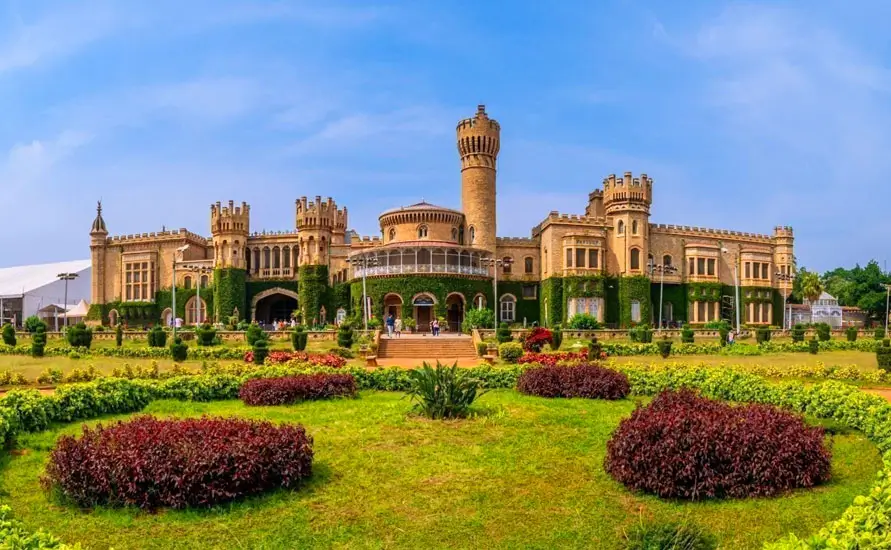
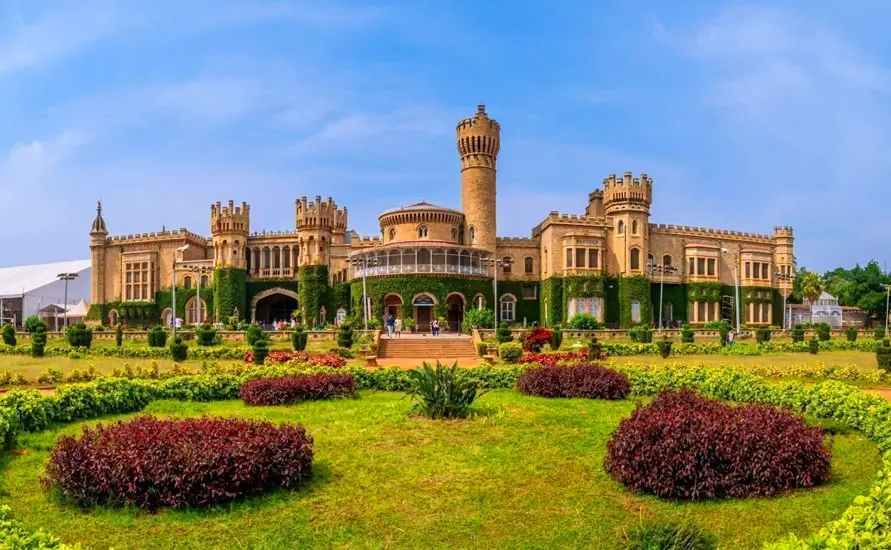
Afternoon belongs to Lalbagh Botanical Garden, which began as a Mughal-style garden for Hyder Ali and later became a research garden run by British botanists. Its iron-and-glass house dates to 1889 and borrows its look from London's Crystal Palace, and a low outcrop of peninsular gneiss inside the grounds is estimated at around three billion years old. On the drive back, you pass Bangalore Palace, built by the Wodeyars in Tudor style with crenellated towers and ivy, and the interior can be added if the group wishes. Your evening is open for wandering or rest. Overnight in Bangalore.
Southwest of the city, a six-lane expressway now links Bangalore and Mysore, and the trip that once took a full morning usually needs about three hours of actual driving. Around the halfway mark lies Channapatna, where artisans have shaped toys from soft ivory-wood for roughly two centuries. In a small family workshop you watch a block spun on a lathe while a stick of colored lac is pressed against it, the friction melting the dye into a glossy coat without paint or chemicals. Spinning tops, rattles, wooden trains and nesting dolls are light to pack and safe for small children.
Late morning brings a bridge over a Kaveri channel and onto Srirangapatna, the river island Tipu Sultan held as his capital until a British assault in the spring of 1799 ended his reign. Start at the Ranganathaswamy Temple, whose reclining Vishnu gives the island its name, then wander through Daria Daulat Bagh, Tipu's teak summer residence set in symmetrical gardens. Every inch of its outer walls carries painted murals, including a vivid panel of the Battle of Pollilur, where Mysore's army routed a British force. The white-domed Gumbaz, where Tipu lies beside his parents, stands at the island's eastern end among cypress trees.
Mysore check-in falls mid-afternoon, giving you a breather before heading out again. Should your stay fall on a Sunday, a public holiday or the Dasara period, be at the palace grounds by about seven, when nearly 100,000 bulbs flick on together and trace every dome and arch for about forty-five minutes. On any other night, wander the shops along Sayyaji Rao Road, the main commercial artery, where sandalwood soap, incense and silk saris are sold. For dinner, order bisi bele bath, a hot, tangy rice and lentil dish finished with ghee and cashews. Overnight in Mysore.
Mysore's guardian goddess, Chamundeshwari, lives on top of Chamundi Hill, and legend says she slew the buffalo demon Mahishasura here, which gave the city its name. Drive up early, before the pilgrim buses, and if your knees allow, descend some of the thousand-odd pilgrim steps on foot. Around two-thirds of the way down sits a black granite Nandi nearly five meters high, carved in 1659 and draped with fresh flowers each morning by the priest. The summit view shows the palace, the racecourse and Karanji Lake laid out like a map below.
Your guide then walks you through Mysore Palace, the third palace on this site, designed by Henry Irwin and completed in 1912 after fire gutted its wooden predecessor. Inside you see the octagonal Kalyana Mantapa under its peacock-patterned stained-glass dome, cast-iron columns shipped from Scotland, and long corridors of oil paintings recording the Dasara procession in detail. Leave shoes at the counter by the gate, and expect cameras to be restricted indoors. The Wodeyar family still lives in a wing of the complex and leads private rituals here during the festival each autumn.
After lunch, lose yourself in Devaraja Market, a covered bazaar dating to the late 19th century where stalls sell cones of kumkum and turmeric powder, heaps of betel leaves, fragrant agarbatti and small yellow Mysore bananas. Ask your guide to find a stall selling genuine sandalwood oil, which the city has traded for generations. A short ride brings you to St. Philomena's Cathedral, whose twin spires rise over fifty meters and draw on the design of Cologne Cathedral. End at a sweet shop for a slab of Mysore pak, a crumbly gram-flour fudge made with plenty of ghee. Overnight in Mysore.
Westbound out of Mysore, the road passes Hunsur and its tobacco fields before reaching Bylakuppe, a Tibetan refugee settlement founded in 1961 on forest land granted by the Mysore state government. Several camps and dozens of monasteries now house tens of thousands of residents, and the change is immediate: prayer wheels at shop doors, signs written in Tibetan script, and young monks in crimson robes riding pillion on motorbikes. Small restaurants along the main road serve thukpa noodle soup and steamed momos, and many visitors stop here for lunch before carrying on to the hills.
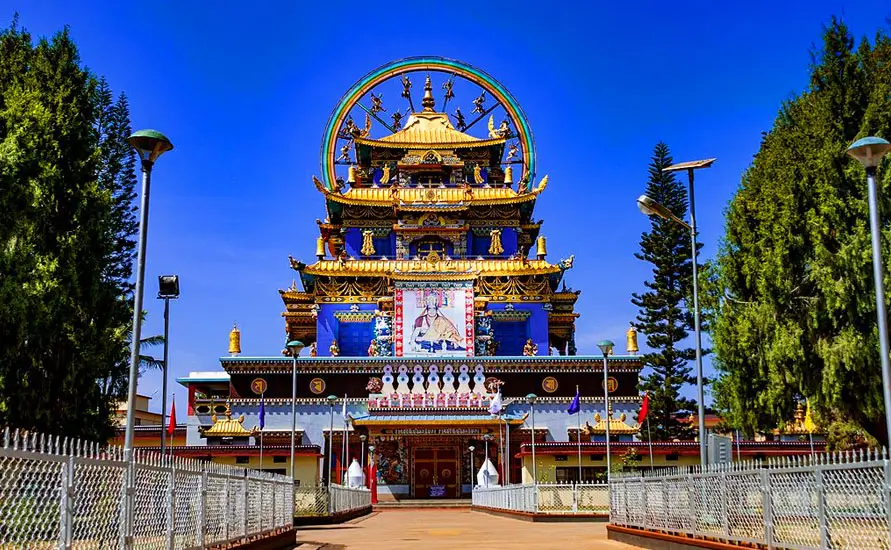
Its largest institution, Namdroling Monastery, is the main teaching center of the Nyingma school in exile and is usually called the Golden Temple because of its gilded interior. Inside the main hall, three statues around eighteen meters tall, of Padmasambhava, Shakyamuni Buddha and Amitayus, look down over rows of cushions where monks gather for prayers. If you arrive in the afternoon, horns, cymbals and low chanting may fill the hall. Keep shoulders and knees covered, remove shoes at the threshold, and take photos only where your guide confirms it is allowed.
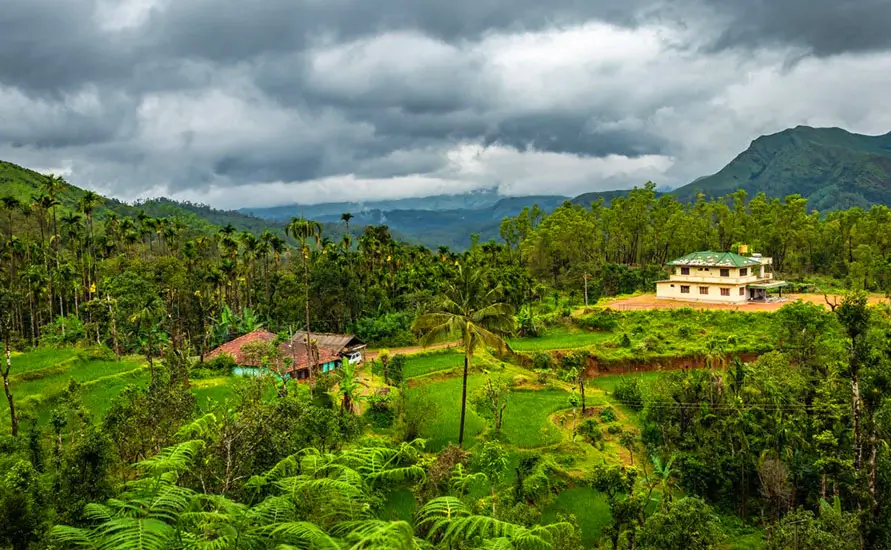
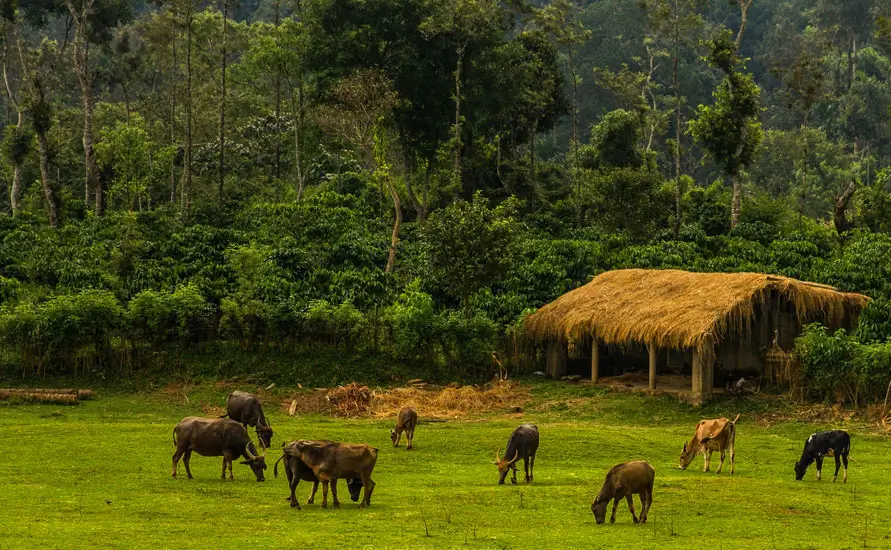
Beyond Kushalnagar, the ground climbs into Coorg, known locally as Kodagu, with steep green hills where coffee has been the main crop for well over a century. Arabica and robusta bushes grow under a high canopy of silver oak, rosewood and jackfruit, often with pepper vines spiraling up the trunks. Your plantation bungalow or hill resort is reached by early afternoon, leaving time to walk the estate paths before dusk. Kodava cooking is the dinner theme: try pandi curry, pork darkened with roasted spices and sharpened with kachampuli, a fruit vinegar from the hills, eaten with rice rotis called akki otti. Overnight in Coorg.
Birdsong and cool air make early morning the right moment for a guided Coorg coffee estate walk. A planter or senior worker leads you along the rows, pointing out the difference between arabica and the hardier robusta, showing how shade trees protect the bushes from heat and how pepper climbs those same trunks as a second crop. Harvest runs from around December to February, when cherries are picked by hand. If you visit in March or April, the first showers can trigger a white coffee bloom lasting only days, with a sweet scent that drifts across the valleys.
Later, drive to Madikeri, the hill capital of the old Kodava kingdom and still the district headquarters. Its fort walls were rebuilt in stone under Tipu Sultan, and inside you find a small museum and a former palace now used as offices. The Omkareshwara Temple, built in 1820, combines a central dome in Islamic style with a sloping Kerala-type roof. Your guide introduces the Kodava community, famous for military service, their own codava takk language, distinctive wedding dress and the right, granted by the British, to carry firearms without a license.
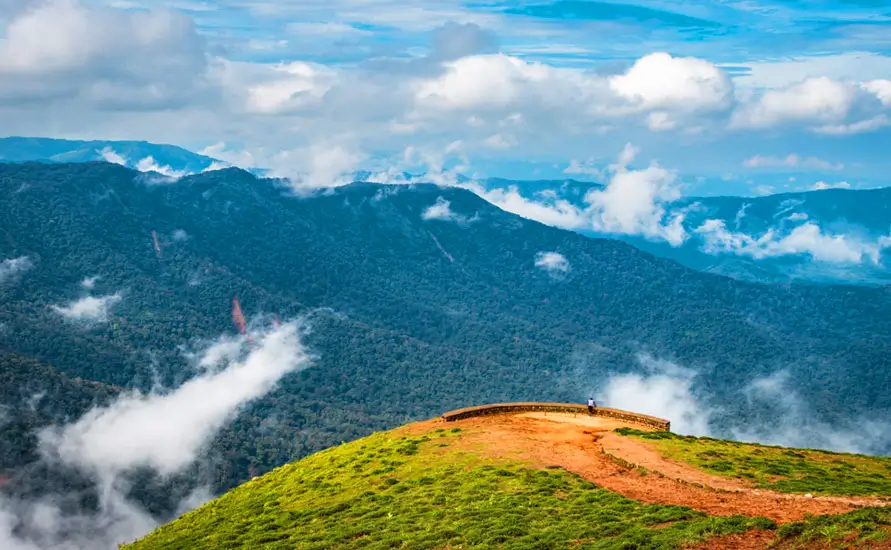
In the afternoon you descend a stepped path through coffee and cardamom to Abbey Falls, where water drops in several streams into a rocky pool. Flow is strongest from August to about November and gentler in the dry months, and a footbridge on the far side gives a straight view. Late in the day you drive to Raja's Seat, a terraced garden with a pavilion on a cliff edge where Kodava royals reportedly came to watch the sunset. Cloud often fills the valleys below by early evening, leaving rows of blue ridges floating in white. Overnight in Coorg.
Early checkout lets you follow the southern Kodagu road through Virajpet and Gonikoppal, small market towns where sacks of coffee and pepper wait outside traders' doors. Leaving the hills, your driver heads east via Hunsur and Gundlupet onto flatter land planted with maize, sunflowers and marigolds, which farmers grow for the flower markets you saw in Bangalore. The drive of around 170 kilometers usually takes about four hours with a pause for tea. Lunch is served at your forest lodge on the fringe of Bandipur, and there is time to rest before the afternoon drive.
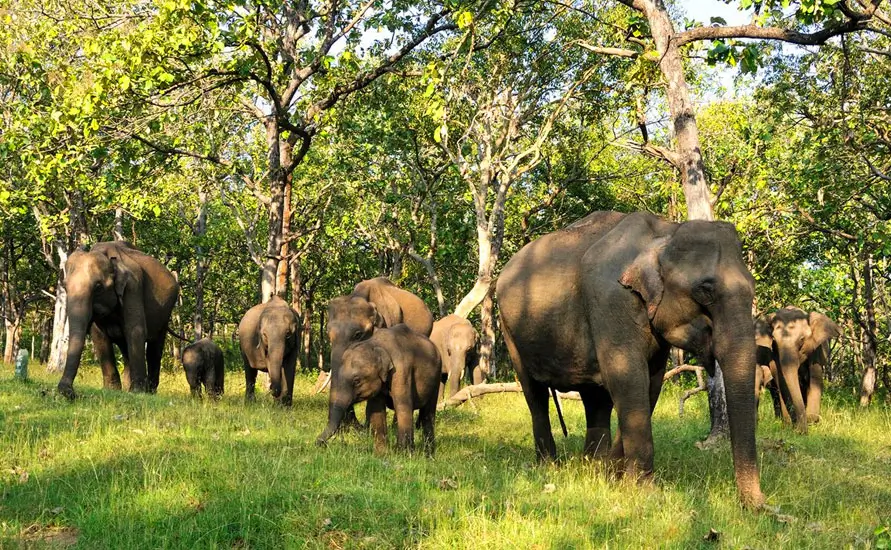
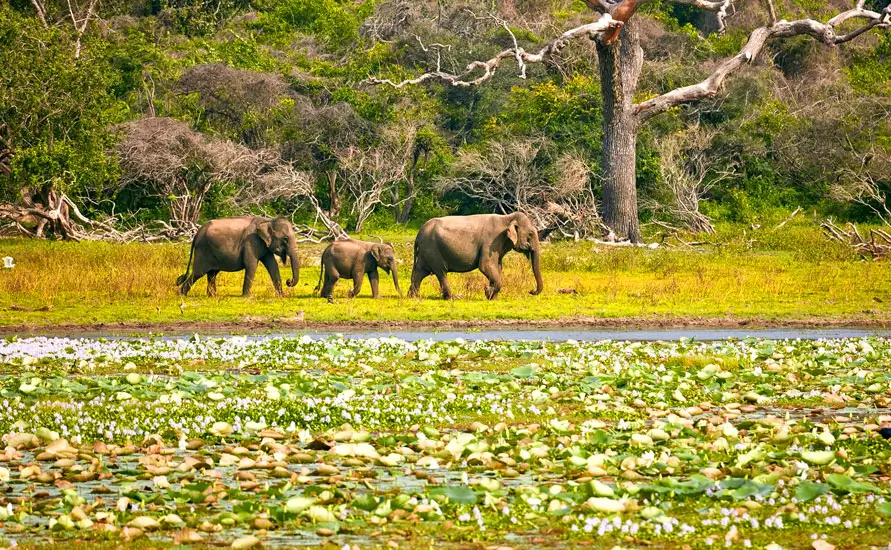
Bandipur Tiger Reserve was the private hunting ground of Mysore's maharajas before it became one of India's first Project Tiger reserves in 1973. Together with Nagarhole, Mudumalai and Wayanad it forms one continuous forest that supports one of the largest wild elephant populations in Asia. Safaris start from the forest department's reception and are booked through the department, subject to availability, in shared canters or jeeps along set routes. Chital, sambar, gaur, wild boar and langur are seen on most drives, while tigers, leopards and dholes are possible but never guaranteed.
After dark, the lodge settles into a slow rhythm. Many forest lodges screen a documentary or invite a naturalist to talk about the reserve's animals, and from the veranda you may hear the barking alarm call of a sambar or the steady chorus of tree frogs. National highways crossing Bandipur close to most vehicles at night to reduce roadkill, so evening activities stay within the property. Dinner is generally a buffet of South Indian and North Indian dishes. If you want to join the dawn safari, ask the lodge to arrange a wake-up call. Overnight in Bandipur.
Dawn brings an optional second safari, which our team requests from the forest department; seats depend on availability on the day. Morning drives are cooler and often livelier for birds: changeable hawk-eagles perch on dead branches, peafowl display in clearings and Malabar grey hornbills call from the canopy. Elephants also tend to move toward the water holes early in the day. A late breakfast at the lodge precedes checkout, and then the car turns south on the forest road, crossing the state line from Karnataka into Tamil Nadu and continuing through Mudumalai Tiger Reserve.
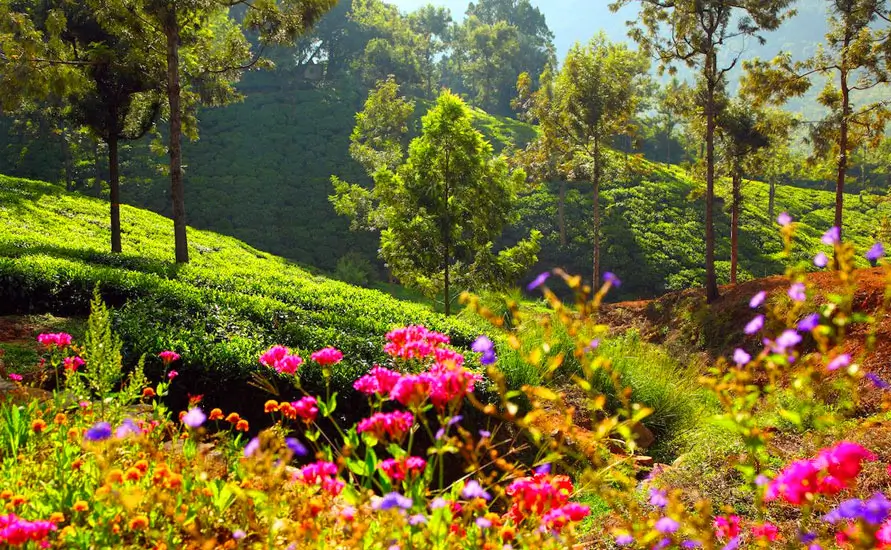
Mudumalai shares the same teak and bamboo forest, and the road passes the Moyar River and the elephant camp at Theppakadu, where trained elephants and their mahouts are housed; we do not include rides or bathing activities. Speeds are low because animals cross the road, and feeding wildlife carries heavy fines. At Masinagudi, your driver takes either the Kalhatti road, with thirty-six tight hairpins up a steep slope, or the longer route through Gudalur, which suits travelers prone to car sickness. Either way, the temperature drops quickly and eucalyptus plantations give way to neat tea terraces.
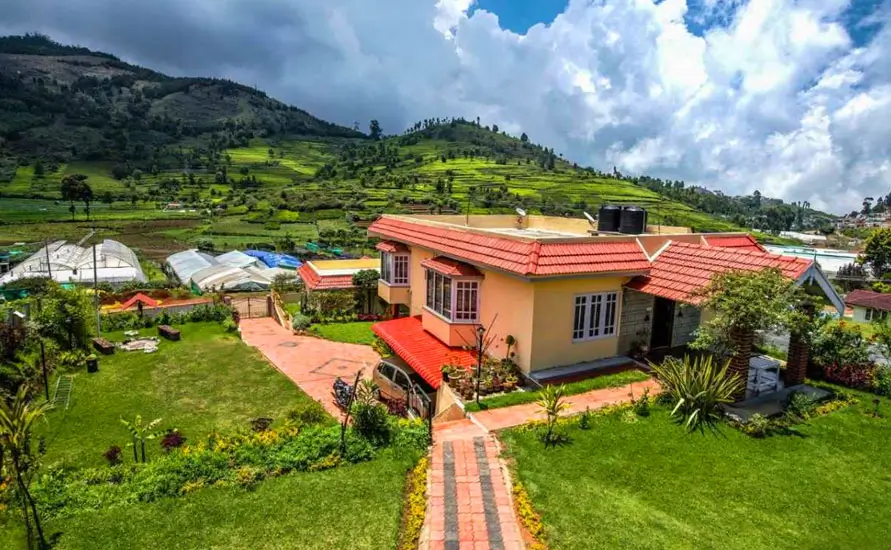
Lunchtime sees you in Ooty, properly called Udhagamandalam, which John Sullivan, then Collector of Coimbatore, began developing in the 1820s; the Madras government later moved up here each summer. After check-in, stroll the sloping lawns of the Government Botanical Garden, planted from 1848, where an Italian-style garden, a fern house and a petrified tree trunk sit among old cypress and monkey puzzle trees. Ooty nights are chilly from November to February, so warm layers help. Homemade chocolate and varkey, a crisp local biscuit, are sold in shops near Charing Cross. Overnight in Ooty.
Steam and diesel engines have climbed these slopes since 1899, and the Nilgiri Mountain Railway, completed to Ooty in 1908, gained World Heritage status in 2005 alongside the Darjeeling line. You board at Ooty station for the descent to Coonoor, a ride of about seventy-five minutes past Lovedale, Ketti and Wellington, with tunnels, viaducts and tight curves along the way. Tickets are reserved ahead because carriages are few, and we request valley-side seats. Watch for tea pluckers on the slopes, and for the porters who still carry luggage on their heads at small stations.
Waiting for you at Coonoor station, your driver takes you around a smaller, quieter hill town than Ooty. Sim's Park, set in a ravine, holds trees planted from many continents, including several Australian species. From the viewpoint at Dolphin's Nose, a rock spur juts over a deep green valley, with Catherine Falls visible on the opposite ridge after rain. Back toward Ooty, a working tea factory shows withering troughs, rollers and dryers in action, and a tasting compares orthodox black, green and white Nilgiri teas, which are lighter and more aromatic than most Assam teas.
Later, the car climbs Doddabetta, the top of the Nilgiris at roughly 2,637 meters, crowned by a telescope house and a small viewing platform. When clouds allow, you can see across plantations to the plains of Karnataka and Tamil Nadu. Your guide talks about the Todas, a pastoral community known for half-barrel huts and shawls embroidered in red and black thread, and about the Badagas, who grow much of the local tea. The evening is free for shopping on Commercial Road or a quiet hour by the hotel fireplace. Overnight in Ooty.
Breakfast is early, because today you trade the hills for the coast. The road drops through Coonoor and a long series of hairpins to Mettupalayam, losing well over 1,500 meters of altitude while the scenery shifts from tea and eucalyptus to areca nut palms, banana groves and coconut farms. The air warms by the minute. In Coimbatore, your driver brings you to the railway station with enough margin for lunch nearby, and our local representative helps you find your reserved seats on the westbound train to Ernakulam.
The line follows the Palakkad Gap, a broad break in the Western Ghats that has long been the main trade route between Tamil Nadu and Kerala. Outside the window, dry fields give way to flooded paddy, tall toddy palms, small temples with copper roofs and houses with red Mangalore tiles. The ride lasts about four hours, and tea and banana chips are sold on board. On arrival at Ernakulam, our Kerala team is waiting by your coach to drive you over the harbor bridges to Fort Kochi, with the evening free to rest. Overnight in Kochi.
Sunrise on the seafront of Fort Kochi shows the waterfront at work: fishing boats unloading, crows circling the auction stalls and crews hauling the large cantilevered nets in and out of the water. From there your guide turns inland, past the overgrown Dutch Cemetery, consecrated in 1724, and along Princess Street and Burgher Street, where some of the earliest European-built houses in the country still stand. You also step into St. Francis Church, founded by the Portuguese around 1503, where da Gama's body rested from 1524 until his family shipped it back to Portugal in the 1530s.
Moving on to Mattancherry, the old trading quarter, you see how Konkani, Gujarati, Jewish and Arab merchant families once shared the same streets. Around 1555 the Portuguese presented the Mattancherry Palace to the Raja of Kochi, and the Dutch later restored it; it, still holds bedchamber murals in ochre, green and red that retell episodes of Rama's story and the life of Krishna. At the end of Synagogue Lane, the Paradesi Synagogue has a floor of willow-pattern tiles from Canton, no two exactly alike. Weekly closures matter here: the palace stays shut each Friday, while worship rules close the synagogue to tourists every Friday and Saturday and during Jewish holidays; if your dates clash, this day trades places with another.
Afternoon is for Jew Town, whose old godowns still see pepper, ginger, turmeric and cardamom cleaned, graded and sacked under high wooden rafters, the smell reaching the street. Many neighboring buildings now hold galleries, craft shops and cafés, and during years of the Kochi-Muziris Biennale they host contemporary art from around the world. Evening options include a Kathakali performance or a display of Kalaripayattu, Kerala's martial art, both optional, or return to the beach for sunset and fresh fish grilled at a seafront stall, choosing your own pomfret or tiger prawns. Overnight in Kochi.
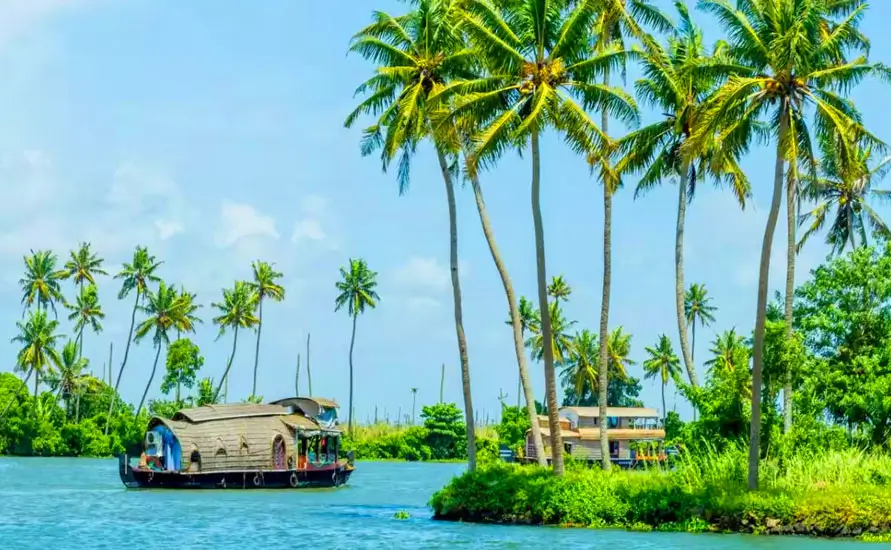
Heading south after breakfast, you follow the coast road through towns of white churches, coir yards and fish markets for about ninety minutes to Alleppey. Check-in on the houseboat is around noon, when the crew carries your luggage aboard and offers fresh coconut water on the front deck. The private Kerala houseboat that waits for you is a reworked kettuvallam, a wooden barge stitched together with coir rope and once used to move rice and spices along the canals, now fitted with bedrooms, attached bathrooms, a sitting area and a kitchen.
From the wide waters of Vembanad, the boat enters the canals of Kuttanad, the low district whose farmland, much of it below sea level, feeds a good part of the state with rice and is protected by mud bunds and pumps. Lunch arrives as you cruise: red rice, fish curry, cabbage thoran, pickle and pappadam are typical. The banks show daily life up close, with women washing pots on stone steps, schoolchildren on footpaths and ducks herded across the water. In August, Punnamada Lake hosts the Nehru Trophy Boat Race, when long snake boats rowed by more than a hundred oarsmen compete.
Following local rules, the boat stops cruising in the early evening and ties up along a quiet canal near a village. Take a short walk on the bund with a crew member, or stay on deck with tea and pazham pori, ripe plantain fried in batter, while egrets and kingfishers fish nearby. Your cook prepares dinner in the galley, vegetarian, mild or spicy to taste. As darkness falls, lights from village houses reflect on the water and the only sounds are frogs and the odd passing canoe. Overnight on the houseboat.
First light on the backwaters is soft and grey, with mist lying low on the canal and fishermen already casting from narrow canoes. Breakfast of appam or puttu is served while the crew steers back toward Alleppey; you step ashore around nine. From the jetty it is roughly a two-hour run north to Cochin International Airport, leaving with enough margin for international check-in. For late-night flights, we can reserve a day room near the airport or add a beach stop at Marari, both at additional cost.
Thirteen days have taken you from the flower market and temples of Bangalore and the Wodeyar palace in Mysore, through planter country in Kodagu, the forest of Bandipur, the Nilgiri toy train and the canals of Kerala. Karnataka still has plenty left for another trip, including the ruins of Hampi, the Hoysala carvings at Belur and Halebidu, and the beaches of Gokarna. Our team is glad to plan that next route with you. Until then, safe travels and a smooth flight home.
Your Journey

N.S. Rathore & Mrs. Omlata Rathore · Managing Director
We still read every enquiry ourselves. Tell us the places you liked and our planners will send a day-by-day route with drive times and a clear price.
Every package can be customised and no pressure to book. A planner from our office replies within 24 hours with a route written for your group.
Fill this in and your planner will send a first draft itinerary.
Explore more
Kerala Backwaters Escape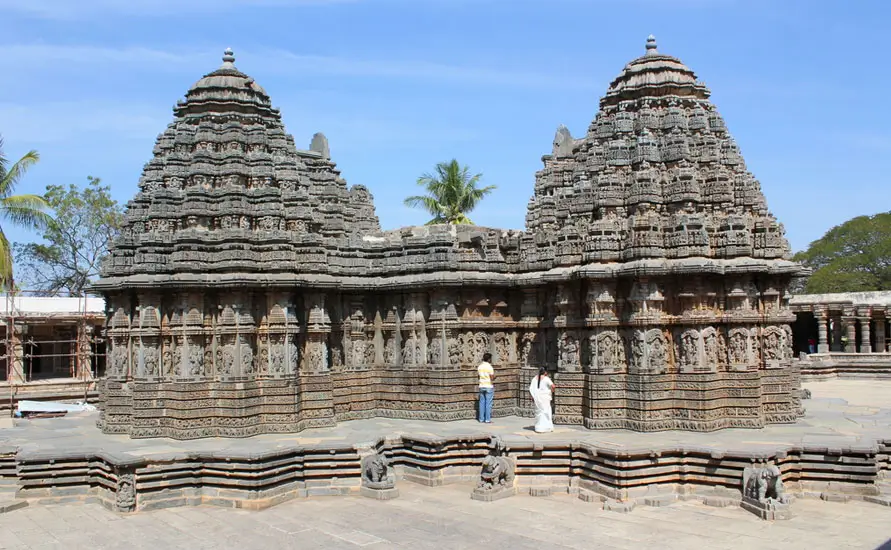 Kerala Backwaters Escape
 Kerala Backwaters Escape
 Kerala Backwaters Escape
 Kerala Backwaters Escape
 Kerala Backwaters Escape
 Kerala Backwaters Escape
 Kerala Backwaters Escape
 Kerala Backwaters Escape
 Kerala Backwaters Escape
 Kerala Backwaters Escape
 Kerala Backwaters Escape
 Kerala Backwaters Escape
 Kerala Backwaters Escape
 Kerala Backwaters Escape
 Kerala Backwaters Escape