
 Kerala Backwaters Escape

Karnataka Tour Packages
Bangalore – Srirangapatna – Mysore – Shravanabelagola – Hassan – Dharmasthala – Moodbidri – Karkala – Udupi – Agumbe – Sringeri – Bangalore
At a glance
Many parents who grew up in Mangalore, Udupi, Mysore or Bangalore now raise children in Dubai, London, New Jersey or Sydney, and those children often know the festivals but not the places behind them. Our Karnataka tour for NRI families links the temples, mathas and Jain hill shrines that shaped the state's Kannada, Tulu and Konkani communities. The ten-day loop starts in Bangalore and Mysore, then heads to Shravanabelagola, Dharmasthala, Udupi and Sringeri, and our guides explain each ritual in plain English, so a ten-year-old raised abroad follows it as easily as a grandparent does.
The pace is built for mixed generations. Drives are kept to about four hours on most days, two-night stops in Bangalore, Mysore and Udupi cut down on packing, and temple visits are timed for the cooler morning and evening hours when the main pujas take place. A private air-conditioned vehicle, sized for your group and luggage, stays with you throughout, and the driver knows the ghat roads of the Western Ghats well. Before each temple your guide briefs everyone on dress codes, queue systems and photography rules, so no one feels lost or embarrassed at the door.
This Karnataka temple tour is not only for families with roots in the state. Gujarati, Tamil, Telugu and Punjabi families living overseas also join it to show their children the Jain monolith at Shravanabelagola, the Madhva tradition at Udupi Krishna Matha and the Advaita seat of Sringeri Sharada Peetham. Grandparents can rest while younger members climb hills, and the menu at every stop can include simple vegetarian food. Families usually pick the cooler, drier months from October through March; between June and September the ghats turn deep green, though downpours can be fierce.
Flights from Dubai, Doha, Frankfurt, London and Newark mostly land at Kempegowda International Airport between midnight and dawn, and our representative stands at the arrivals exit with your family name on a board, whatever the hour. Expect roughly an hour on the road into town, or more once office traffic builds. We book vehicles with enough seats and boot space for families carrying gifts for relatives, and child seats can be arranged if you tell us the ages in advance. Nothing is planned before lunch, so jet-lagged kids and grandparents can sleep as late as they like.
After lunch, your tour manager sits down with the whole family over tea in the hotel lounge. Instead of a list of rules, it is a short conversation about what lies ahead: why Karnataka has so many Jain shrines, what a matha is, how a Shiva temple differs from a Krishna temple, and why some temples ask men to remove their shirts. Children are given a simple printed booklet with the stories behind each place, so they can tick off the gods, saints and kings as they meet them. Parents receive the day plans, local SIM advice and the contact number of the person on call each night.
Around five o'clock you head to Malleswaram, a neighborhood planned in the late 1890s when plague drove residents out of the cramped old town. Its wide streets still hold tiled houses, flower stalls and the small Kadu Malleshwara temple on a rise beneath old trees. Many NRI parents remember these streets from childhood visits to grandparents, and it is a gentle first walk for children who have never seen jasmine sold by the arm's length. Supper is crisp dosa and frothy coffee poured between two steel cups at a crowded neighborhood café. Overnight in Bangalore.
The morning starts in Basavanagudi at the Bull Temple, home to a huge seated Nandi of dark granite, over four meters from nose to tail, in a shrine dating to the time of Kempegowda, Bangalore's 16th-century founder. Local legend says a bull once grazed on the groundnut fields here until farmers promised to build it a temple, and the area still hosts a groundnut fair, the Kadalekai Parishe, in November or December. Your guide uses the story to explain why Nandi always faces Shiva and why devotees whisper prayers into the bull's ear, a detail children tend to remember long after the trip.
A few minutes away is Gavi Gangadhareshwara, a cave temple cut into a rocky hill, with two large stone discs in its forecourt representing the sun and the moon. On the day of Makara Sankranti in January, sunlight passes between the horns of the Nandi outside and falls on the Shiva linga inside, an event that draws large crowds and is shown on local television. The cave passages are low and dim, so tall adults may need to stoop. Afterward the family strolls through Lalbagh, a royal garden that Hyder Ali founded and expanded by Tipu, where a Victorian glasshouse sits near a sheet of ancient gneiss rock.
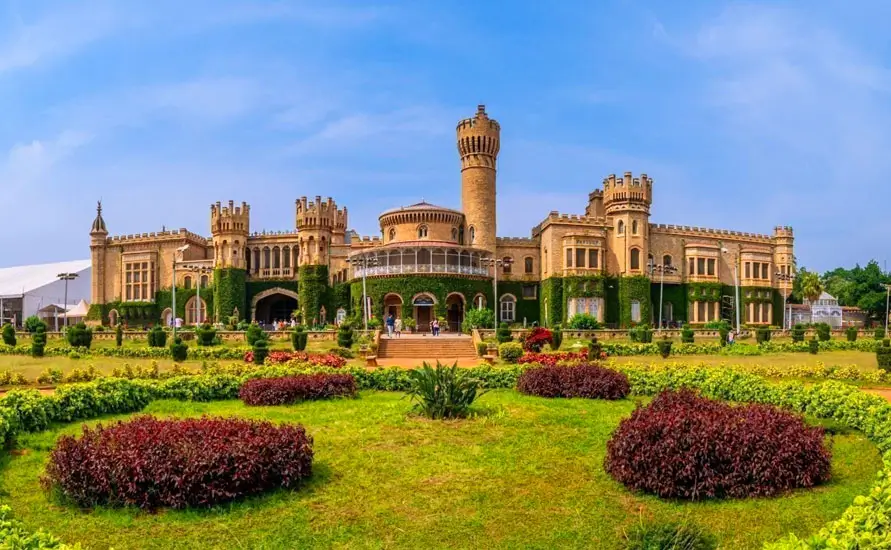
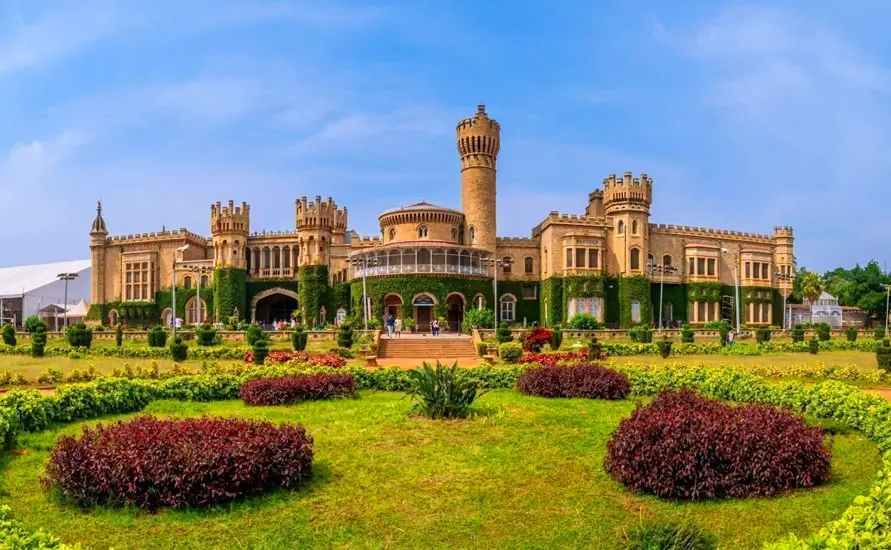
Post-lunch, Bangalore Palace shows the Wodeyar family's taste for Tudor-style towers, wooden ceilings and hunting trophies, a look borrowed from English castles. An audio guide covers the history of the family, and children usually enjoy the painted portraits and the old photographs of royal processions. Time permitting, your guide adds a stop at the teak-pillared summer residence of Tipu Sultan near the old fort, a preview of the Mysore kingdom that tomorrow brings into focus. The evening is free for visiting relatives or shopping for silk on Commercial Street. Overnight in Bangalore.
After breakfast you leave Bangalore on the highway to Mysore, a road that once took most of a day and now runs much faster on the expressway opened in 2023. Roadside stops include stalls in the Channapatna area selling lacquered wooden toys colored with vegetable dyes, a craft said to have been encouraged by Tipu Sultan. Children can watch a toy being turned on a lathe, and a set of spinning tops or stacking dolls makes a light gift to carry home. Your driver plans a filter coffee break at a highway eatery, because the coffee in this part of Karnataka is part of the trip.
Short of Mysore, the car pulls into Srirangapatna, an island where the Kaveri splits in two, and Tipu's seat of power until British troops stormed it in 1799. The Ranganathaswamy Temple here holds a large image of Vishnu reclining on the serpent Adishesha, and your guide explains how the same form is worshipped downriver at Srirangam in Tamil Nadu. Close by, the garden pavilion of Daria Daulat Bagh carries painted murals of Pollilur, the 1780 battle in which Mysore's army beat a British force. Children often ask why a Muslim ruler protected Hindu temples, and the guide gives a balanced answer drawn from local history.
You reach Mysore by mid-afternoon and check in. If your Mysore arrival falls on a Sunday or national holiday, there is a bonus, since Mysore Palace glows under tens of thousands of bulbs between about seven and a quarter to eight, and we move dinner so the family can watch from the lawns. Other evenings stay low-key: a stroll by the clock tower, a Mysore masala dosa lined with red garlic chutney, and a box of soft Mysore pak from a sweet shop that has been frying it for generations. Many NRI families buy the sweet here for relatives back home. Overnight in Mysore.
Early risers can climb the stone steps of Chamundi Hill at sunrise, joining local families who make the walk as a vow to the goddess Chamundeshwari. There are about a thousand steps, so most visitors with younger children or older parents take the car to the top and walk down only part of the way. Halfway down sits the monolithic Nandi, carved in the 17th century and about five meters tall, decorated with stone bells and garlands. At the summit temple, your guide tells the story of Chamundeshwari killing the buffalo demon Mahishasura, a tale that lent Mysore its name and returns every year in the Dasara celebrations.
Mid-morning brings you to Mysore Palace, raised in stone after fire destroyed its wooden predecessor during a royal wedding in 1897. Footwear goes to the shoe counter and cameras stay in bags indoors, so your guide makes sure children notice the peacocks worked into the stained-glass ceiling of the Kalyana Mantapa and the long painted friezes of the Dasara parade. If you are traveling in September or October, the ten-day Dasara festival brings concerts, a torchlight parade and the famous procession of the goddess, and we can plan around the key days if you book early.
After lunch, a guided walk through Devaraja Market shows children a side of India they rarely see on a short holiday. Stalls are stacked with cones of kumkum powder in bright colors, bananas of a dozen kinds, sandalwood incense and the betel leaves that are still offered in temples. On the way back, the twin spires of St. Philomena's Cathedral, modeled on Cologne's great church, show another face of the city's faith communities. Later on, rest at the hotel or browse saris at the showroom of the state-run Mysore silk factory. Overnight in Mysore.
Breakfast is early, then the car heads north through sugarcane and coconut farms to Shravanabelagola, roughly two hours away and among the holiest places for Jains anywhere in India. Two rocky hills face each other across a large temple tank, the belagola or white pond that gives the town its name. Crowning the taller hill, Vindhyagiri, is Gommateshwara, also known as Bahubali, cut out of the living granite around 983 CE for Chavundaraya, a general and minister at the Western Ganga court. At about 17.5 meters, it is one of the tallest free-standing monoliths in the world.
The climb to the top involves more than 600 steps cut into the bare rock, and they must be climbed barefoot, so a morning start keeps the stone cool. Cotton socks are allowed and are a good idea for children and older travelers, and dolis, chairs carried by porters, are available for those who cannot walk. At the summit, your guide tells the story of Bahubali, a prince who won a duel against his brother and then gave up his kingdom to meditate, standing so still that vines grew around his legs. Children like spotting the carved creepers on the statue, which bring the legend into stone.
Once in roughly twelve years, priests on scaffolding pour milk, saffron and sandalwood paste over the statue during the Mahamastakabhisheka, and pictures of the last ceremony in 2018 are shown in the small museum in town. After lunch, anyone with energy left can climb Chandragiri, the lower hill, where tradition holds that the emperor Chandragupta Maurya ended his life as a Jain ascetic. You then drive about an hour to Hassan and check in. The town is a convenient stop between Mysore and the coast and keeps tomorrow's drive across the Western Ghats manageable. Overnight in Hassan.
The route west from Hassan climbs gently through coffee and pepper country before dropping down the Shiradi Ghat, one of the main passes linking the Karnataka plateau with the Dakshina Kannada coast. The road twists through thick forest and past small waterfalls that run strongly after the monsoon, and repair works can slow traffic, so we leave right after breakfast. Children who get car sick should sit at the front, and your driver will take short breaks at viewpoints. As you descend, the air turns warmer and more humid, and the houses start to show the sloping red-tiled roofs typical of the coast.
Lunch is waiting when you pull into Dharmasthala. The Dharmasthala temple is dedicated to Manjunatha, a form of Shiva, yet it is managed by a Jain family whose head carries the title of Heggade, while daily rituals are carried out by Madhva Vaishnava priests. Your guide explains how this arrangement grew over about eight centuries and why it matters to so many families in Tulu Nadu. Visitors know the town for its tradition of free meals, served to thousands of pilgrims every day in a vast dining hall, and families who join a meal there usually say it was one of the most moving moments of the trip.
Dress rules are firmly applied: men take off shirts and vests at the shrine door, and women come in a sari, salwar or ankle-length skirt. The evening queue for darshan moves quickly but can be long on weekends and festival days. Near the temple, a 39-foot statue of Bahubali stands on a hill, and the Manjusha museum holds old palm-leaf manuscripts and bronzes, with a separate collection of vintage cars close by. If your trip falls in November or December, the Lakshadeepa festival fills the town with lamps, processions and a gathering of poets and scholars. Overnight in Dharmasthala.
This day traces the Jain heritage of the Tulu coast, which many visitors do not expect to find so close to the beaches. Your first stop is Moodbidri, about an hour from Dharmasthala, often described as the Jain Kashi of the south. Its best-known shrine, the Saavira Kambada Basadi or thousand-pillar temple, was completed in the 15th century, and no two of its carved granite pillars are said to be exactly the same. Your guide shows children how to spot dancers, musicians, dragons and even a giraffe-like creature in the carvings, and explains the 24 Tirthankaras worshipped by Jains.
A short drive further brings you to Karkala, where a 42-foot statue of Bahubali, set up in 1432, stands on a granite hill above the town. The climb is shorter and easier than at Shravanabelagola, and comparing the two statues gives children a good lesson in how artists of different centuries treated the same figure. Across the road, the Chaturmukha Basadi has four identical doorways facing the four directions, each opening onto images of the Tirthankaras. Karkala is also home to several old Hindu temples, and your guide can point out how Jain and Hindu architecture borrowed from each other on this coast.
Udupi is reached by mid-afternoon, and your hotel here is home for two nights. The town lies a few kilometers from the Arabian Sea and is the birthplace of a style of vegetarian cooking now served in restaurants from Mumbai to Toronto. Tonight's dinner is a full Udupi meal on a banana leaf: rice, saaru (a thin, peppery rasam), a coconut-based huli, crisp vegetable fritters, kosambari salad and a payasa to finish. Your guide explains the order in which the dishes are served and eaten, a small ritual of its own. Grandparents often enjoy telling children which dishes they ate at weddings. Overnight in Udupi.
Seven centuries ago, the philosopher Madhvacharya set up the Udupi Krishna Matha, teaching that God and the individual soul remain forever distinct, the Dvaita school followed by many Tulu and Kannada families. Devotees do not see Krishna through the front door. Instead, they look through the Navagraha Kindi, a silver-plated window with nine openings, and then walk past the Kanakana Kindi on the outer wall, linked to the story of Kanakadasa, a poet from a shepherd community who was refused entry and prayed outside until the image is said to have turned to face him. Your guide uses the story to talk with children about devotion, fairness and how traditions change.
Around the temple square stand the Ashta Mathas, eight monasteries whose heads take turns running the temple for two years each in a cycle known as Paryaya. The handover ceremony is held in January of even-numbered years and fills the town with processions through the night. Morning is the best time for darshan, and you may see the temple's cattle, its huge kitchens and the rows of copper vessels used to cook for thousands. Men are usually asked to remove shirts before entering the inner area, and modest dress is expected for everyone. Cameras are not welcome in several areas, and your guide flags the spots where pictures are fine.
After a simple lunch at the matha or in town, the afternoon heads to Malpe, a fishing harbor and beach about six kilometers away. From October to May, boats run from here to St. Mary's Islands, small islets made of hexagonal basalt columns formed by ancient volcanic activity, a geology lesson children enjoy. In the monsoon the sea is rough and boats do not operate, so we replace the trip with a walk on the beach. Back in town, a stop at a Manipal crafts and heritage village or a gadbad ice cream sundae finishes the day on a light note. Overnight in Udupi.
After breakfast, the road climbs back up the Western Ghats by the Agumbe Ghat, a pass of tight hairpin bends through dense rainforest that receives some of the highest rainfall in South India. Agumbe village, at the top, was the setting for the 1980s television series Malgudi Days, which many parents watched as children, and a few of the old houses still look the same. The forest here is home to the king cobra, and a rainforest research station works on its conservation. Your driver stops at the sunset viewpoint on the way up, which also gives a wide morning view of forest stretching down toward the sea.
Late morning brings you to Sringeri, a quiet town of priests and students beside the Tunga river. Sringeri Sharada Peetham is the first of the four monasteries traditionally founded by Adi Shankaracharya, the 8th-century teacher of Advaita Vedanta. Legend says Shankara chose the spot after seeing a cobra spread its hood to shade a pregnant frog from the sun, a sign that natural enemies lived in peace here. Children enjoy this story, and your guide links it to the teachings about oneness that the matha still passes on through its scholars and Sanskrit schools.
In the afternoon you visit the Vidyashankara Temple, built in the 14th century with help from the founders of the Vijayanagara empire, whose guru Vidyaranya was a head of this matha. Twelve pillars in its hall are linked to the zodiac signs, and the rays of the rising sun are said to fall on the matching pillar in each month. Next door, the Sharadamba Temple honors the goddess of learning, and parents from across the south bring toddlers here for Aksharabhyasa, when a child writes the first letters. In the evening, feed the large fish at the river steps and attend the evening rituals. Overnight in Sringeri.
Once you have said goodbye at the river steps, the car turns east for Bangalore, over the coffee slopes of Chikmagalur district and across the Hassan plains. Because the drive fills most of the day, we stop for lunch at a dependable roadside restaurant and there is a stretch break roughly every two hours. Many international flights from Kempegowda International Airport leave late at night or after midnight, which suits this timing well. If your flight leaves in the morning, we can book an extra night in Bangalore or, for flights to the Gulf, end the tour at Mangalore International Airport, about three hours from Sringeri.
Your driver drops you at the departure terminal with a three-hour margin before any overseas flight. Over ten days, your children will have seen the Jain monoliths of Shravanabelagola and Karkala, the Madhva tradition of Udupi, the shared temple culture of Dharmasthala and the Advaita seat at Sringeri, and they now have stories to tell about each of them. If your family would like to return for a festival such as Dasara, Paryaya or Lakshadeepa, or fold visits to ancestral villages into a later trip, send us a note and our planners will map out the route. Have a safe trip home, and do send us photos of the children at Gommateshwara.
Your Journey

N.S. Rathore & Mrs. Omlata Rathore · Managing Director
We still read every enquiry ourselves. Tell us the places you liked and our planners will send a day-by-day route with drive times and a clear price.
Every package can be customised and no pressure to book. A planner from our office replies within 24 hours with a route written for your group.
Fill this in and your planner will send a first draft itinerary.
Explore more
Kerala Backwaters Escape Kerala Backwaters Escape
 Kerala Backwaters Escape
 Kerala Backwaters Escape
 Kerala Backwaters Escape
 Kerala Backwaters Escape