 Kerala Backwaters Escape

Karnataka Tour Packages
Bangalore – Srirangapatna – Mysore – Somanathapura – Kabini – Bylakuppe – Coorg – Halebidu – Belur – Chikmagalur – Ikkeri – Jog Falls – Kollur – Udupi – Murudeshwar – Gokarna – Hampi – Badami – Pattadakal – Aihole – Bijapur – Hubballi – Bangalore
At a glance
Plenty of travelers cover two or three corners of Karnataka and leave wondering what sat over the next ridge. Our Complete Karnataka Tour 3 Weeks settles that by tracing a single loop through every major region of the state. It opens among the parks and brewpubs of Bangalore, slows down in the Wodeyar royal seat of Mysore, and climbs into teak forest, coffee estates and spice gardens before descending to the Arabian Sea. The last week heads north across the Deccan to Hampi, the sandstone caves of Badami and the Adil Shahi domes of Bijapur.
Twenty-one days lets the pace breathe, so this Karnataka itinerary for 3 weeks keeps deliberate gaps in the calendar. Kabini gets a day with nothing booked, Gokarna gets a beach day with no guide, and Hampi gets three nights instead of the usual two. Road legs mostly run two to five hours, the single long coast-to-plateau climb is split by lunch, and the return from the far north is a short Hubballi to Bangalore flight rather than a punishing nine-hour drive. Your car, air-conditioned and private, keeps one English-speaking driver at the wheel from first day to last.
This complete Karnataka tour is built for guests flying in from Britain, continental Europe, North America or Australia who prefer depth over a sampler, and for NRI parents who would like overseas-raised children to see far more than a single home district. Licensed local guides handle the big sites, from the soapstone Hoysala temples at Belur and Halebidu to the Vittala courtyard at Hampi. The coolest, driest stretch runs from October to February, while Jog Falls flows hardest in the months straight after the rains. Hotel grade, daily rhythm and even the order of regions can be reshaped for you.
Kempegowda International lies a long way north of central Bangalore, so the transfer can take forty-five minutes at night or well over an hour at rush hour. A member of our team stands just beyond the exit doors with your name on a card, sees to the luggage and rides along with you into town in the private air-conditioned car. During the ride you get a bound copy of all twenty-one days, advice on picking up an Indian SIM, and the number of a duty manager who picks up around the clock. Rooms are normally ready after lunch, though an early room can be held if you land before sunrise.
Rest is the main task for this first day, since three weeks on the road go better when the jet lag is gone. When the sun loses its bite toward five o'clock, your driver can run you around Cubbon Park, some three hundred acres of bamboo clumps, rain trees and colonial-era buildings planned in 1870 by the engineer Richard Sankey. Joggers, college students and retired couples all claim their benches here. The rust-red State Central Library sits inside the park, and the granite bulk of Vidhana Soudha, finished in 1956 for the state assembly, faces the gates and can be admired from the pavement only.
Starting the circuit here makes sense, because the state capital shows today's Karnataka before the trip peels back older layers. Mornings in the city revolve around tumblers of frothy filter coffee, and evenings around a craft beer scene with dozens of brewpubs pouring house lagers and stouts in old bungalows and rooftops. Feeling lively? The car can drop you in Indiranagar or near Church Street and return when you call. Feeling flat after the long-haul flight? Order room service, set an alarm for a reasonable hour and let the city wait until morning. Overnight in Bangalore.
Today belongs to the southern quarters, where the city still behaves more like a market town than a software capital. Breakfast done, your guide heads first to the Bull Temple in Basavanagudi, raised in the 16th century under Kempegowda, the local chief remembered as Bangalore's founder. The huge seated Nandi inside was cut from one boulder and has turned almost black under generations of oil and butter. Each November the lanes outside fill with the Kadalekai Parishe, a groundnut fair where growers once offered their first harvest to the bull in thanks.
A ten-minute hop takes you to the teak retreat known as Tipu's Summer Palace, a two-storey pavilion built almost entirely of wood, its pointed arches still showing traces of the bold paint that once covered every surface. Tipu ruled Mysore in the late 1700s and retreated here in the hot months, naming the building Rash-e-Jannat, the envy of heaven. A few streets away, KR Market weighs out jasmine, marigold and rose on brass scales, and the flower floor looks fullest before eleven. Hungry? Your guide knows a stand-up counter nearby where a crisp masala dosa and strong coffee cost very little and arrive within minutes.
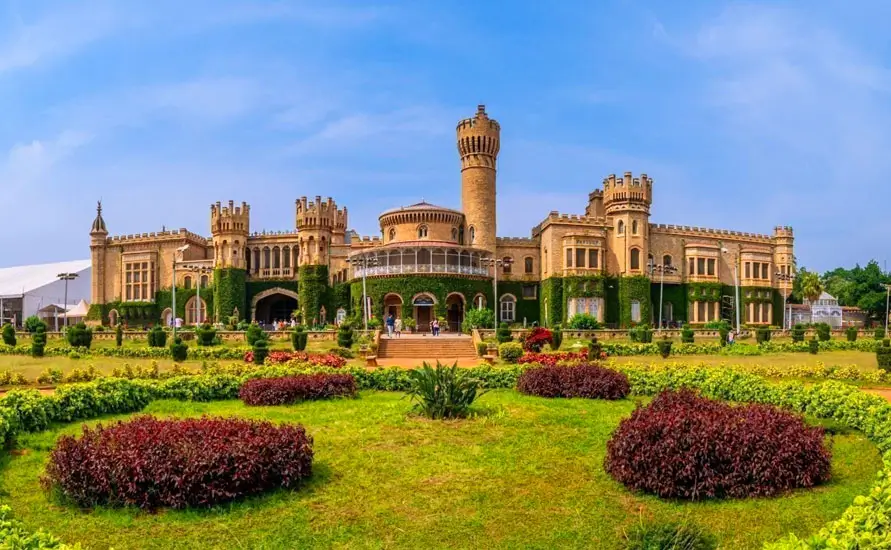
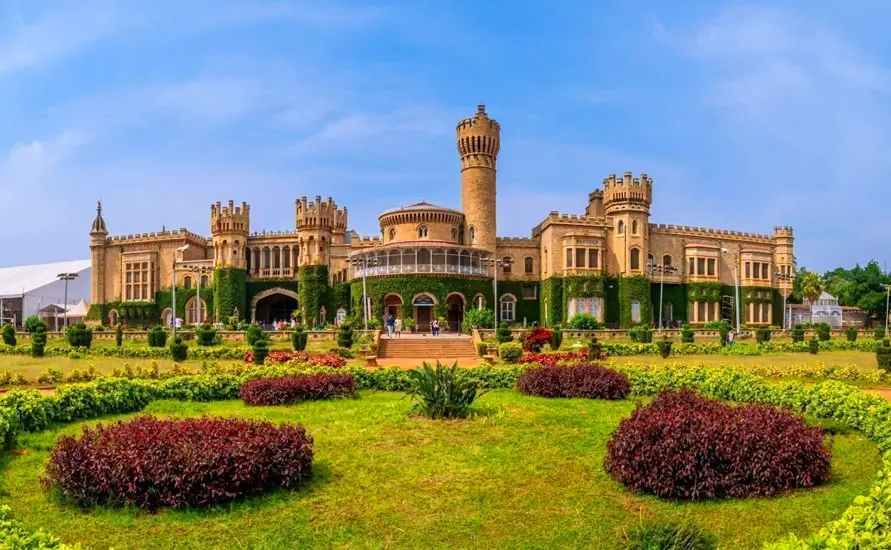
Afternoon is for Lalbagh Botanical Garden, which Hyder Ali laid out in the 1760s and enlarged by Tipu with saplings sent from Afghanistan, Persia and the French colonies. Its Victorian glasshouse, inspired by the Crystal Palace in London, fills with flower displays twice a year around the national holidays in January and August. Walk up Lalbagh Rock, a hump of gneiss reckoned at some three billion years old, to one of the small watchtowers credited to Kempegowda's era. On the drive back, a quick roadside look at the turreted Bangalore Palace rounds off the city. Overnight in Bangalore.
Since the access-controlled expressway opened, the southbound run to Mysore has become a smooth drive, and you roll out after breakfast with plenty of slack. Two and a half hours or so down the road, a bridge carries you onto Srirangapatna, a three-mile sliver of land between forks of the Kaveri that served as Tipu Sultan's walled capital until a British-led assault took it in May 1799. The guide begins at the Ranganathaswamy Temple, home to a reclining Vishnu from whom the island takes its name. Cover shoulders and knees, hand your shoes to the attendant at the entrance, and expect a short queue on festival days.
Within a short drive lies Daria Daulat Bagh, the summer residence Tipu set among lawns and cypress avenues. Every inch of its veranda walls is painted, and the longest panel records the 1780 battle at Pollilur, when Hyder Ali's forces routed a Company army, down to the redcoats' buttons and the panicked bullocks. Close by, the white-domed Gumbaz shelters the graves of Tipu, his father and his mother behind doors inlaid with ivory. Ask the guide to stop at the small obelisk inside the old ramparts that marks where Tipu fell, a corner few tour buses bother with.
Mysore is a twenty-minute hop beyond the river, and you reach the hotel by mid-afternoon. As the light softens, the guide leads you into Devaraja Market, trading under the same roof since the late 1800s. Conical piles of kumkum in scarlet, saffron and purple stand next to betel leaves, incense, jasmine strings and bunches of bananas in more shapes than most visitors knew existed. Buy a packet of Mysore pak, the crumbly gram-flour and ghee fudge that local legend credits to a royal cook. The palace waits until tomorrow morning, when it is cooler and less crowded. Overnight in Mysore.
Make an early climb up Chamundi Hill, the granite rise on the southern edge of Mysore crowned by the shrine of Chamundeshwari, patron goddess of the Wodeyar dynasty. Most people drive to the top, while keen walkers can come down part of the stepped pilgrim trail to the seated Nandi, a 17th-century bull carved straight out of the hillside roughly two-thirds of the way up. From the summit, the whole city lies flat below, with the palace domes catching the morning sun. Weekend crowds at the shrine can be heavy, so we aim for a weekday whenever the dates allow.
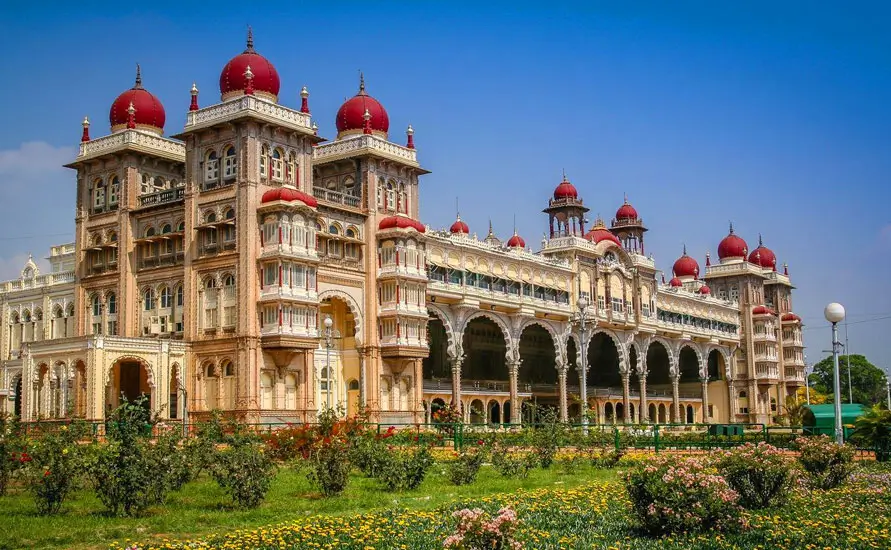
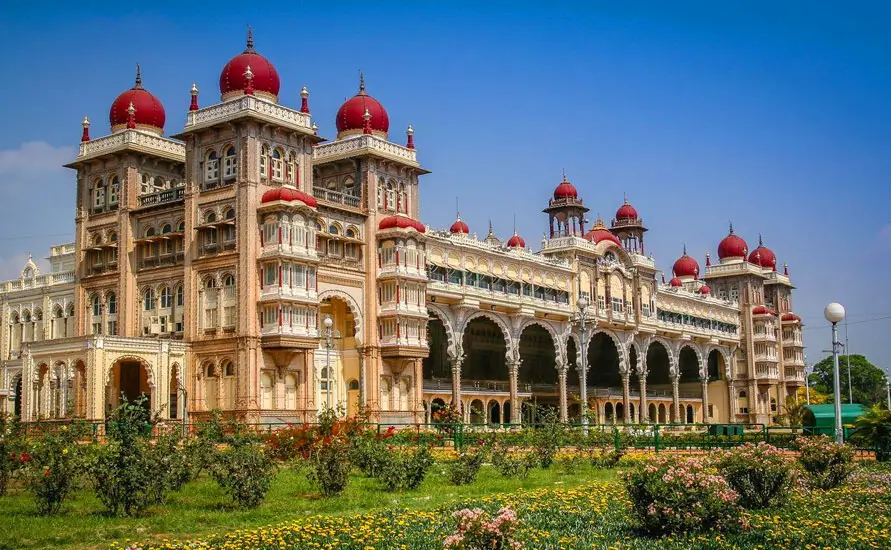
Down in the city, Mysore Palace comes next: the older timber residence burned in 1897 and was replaced by the present Indo-Saracenic building. Henry Irwin, a British architect working for the Mysore state, drew the plans, and the highlights indoors are the peacock-patterned stained glass, iron columns cast in Glasgow and wall paintings of the Dasara procession with every elephant numbered. Footwear goes into a cloakroom at the gate, and cameras stay away from the interiors. The guide explains how the royal family keeps a private wing and still leads Dasara rituals each autumn.
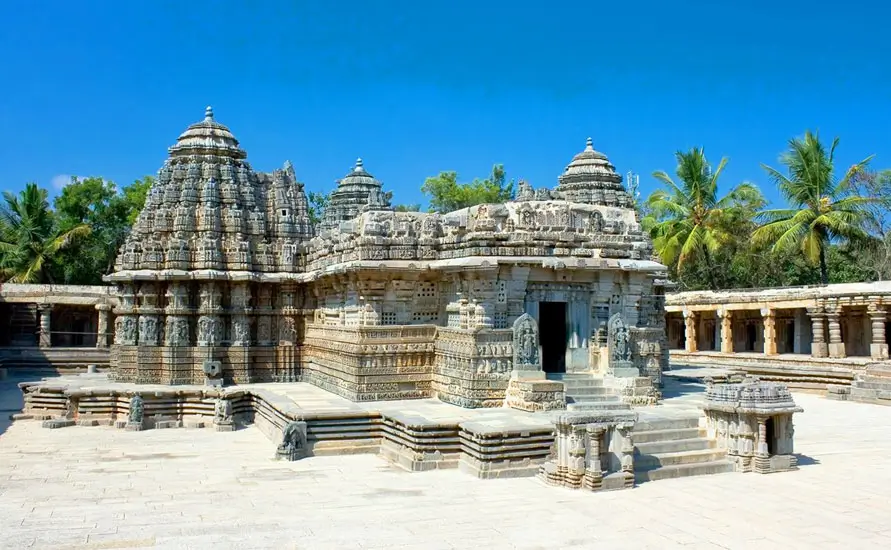
After lunch the car heads about an hour east to Somanathapura, where the Keshava Temple, consecrated in 1268, now forms one of three sites in the UNESCO Sacred Ensembles of the Hoysalas. Its triple shrine rises from a platform cut in the shape of a star, and carved bands of elephants, cavalry and epic scenes wrap the outer walls. The temple sees a fraction of Belur's visitors, which makes it an easy primer for the Hoysala style before the bigger sites later. On a Sunday or public holiday you return in time to see the palace outlined in lights for roughly forty-five minutes from 7 pm. Overnight in Mysore.
Leave the city on a two-lane country road through H.D. Kote, where sugarcane, tobacco and ragi fields alternate with hamlets and the odd bullock cart creaks along the verge. Kabini is around two hours away, and the final stretch hugs the reserve boundary, with trenches and solar fences marking where farms end and wild country begins. You check in to a forest lodge by lunch. Most properties face the Kabini backwaters, a reservoir created by damming the river in the 1970s, and they run meal times around the morning and afternoon safari slots, so the day quickly settles into a routine.
In the afternoon you enter Nagarhole National Park (its official name honors Rajiv Gandhi) on a safari operated by the Karnataka Forest Department. The department sets the vehicles, routes and timings, seats are booked ahead and depend on availability, and you may be allotted a jeep or a canopy bus. The woodland is largely dry deciduous teak and rosewood, and spotted deer, sambar, gaur and wild pigs are regular sights along the tracks. Tigers, leopards and the melanistic leopard that made Kabini famous all live here, though nobody can guarantee a sighting.
Vehicles leave the park by sunset, and the lodge naturalist often holds a slide talk that night covering resident species and how the waterline shifts through the seasons. As the reservoir recedes in the dry months, a band of fresh grass appears along the shore, and that pasture pulls elephant herds out of the forest in large numbers. Dinner is usually a buffet under an open roof, followed by a soundtrack of frogs, nightjars and occasionally a sambar barking a warning somewhere in the dark. Lights go off early at most lodges, so plan for an early night. Overnight in Kabini.
Nothing is fixed today, and that is the reason for a second night by the water. A dawn safari through the forest department is part of your package if you want it, with cool air, long shadows and the best odds of a big cat on the move. Skip it and sleep in if your body prefers, because the program carries no penalty for choosing rest. Breakfast is served once the jeeps return, and the hours after that are yours for reading on the veranda, a swim where the lodge has a pool, or a long session by the shore with binoculars.
Birders hardly need to leave the property. Ospreys patrol the backwater, pied kingfishers hover and drop, and the canopy around the cottages is often noisy with Malabar grey hornbills, coppersmith barbets and green bee-eaters. Several lodges run a guided walk along their own boundary with a naturalist who focuses on pug marks, dung, medicinal plants and spiders rather than headline mammals. Prefer to do even less? An Ayurvedic massage can be booked at extra cost, lunch is a slow affair, and the hottest part of the afternoon is made for a siesta behind drawn curtains.
Toward evening an optional boat outing on the reservoir, where the lodge offers one, shows the forest edge from the water rather than the track. Elephant families sometimes wade into the shallows to drink, deer graze the open banks, and mugger crocodiles lie motionless on mud spits, all watched from a respectful distance. Cormorants and darters spread their wings to dry on drowned tree stumps poking up from the lake. Back on land, a campfire or a cold drink on the deck closes the first of the tour's three planned slow days. Overnight in Kabini.
Heading north through Hunsur, you swap forest for farmland and then for prayer flags at Bylakuppe, home to one of the largest exile Tibetan populations anywhere. The settlement took shape in the early 1960s, when the Mysore state granted forest land to refugees who had crossed the Himalaya after the Dalai Lama. Monks in maroon robes ride scooters past shops selling momos, butter tea and incense, and the contrast with the surrounding Karnataka fields is sudden and slightly surreal. The camps sprawl over a wide area, so the car heads directly to the main monastery near Kushalnagar.
Namdroling, popularly called the Golden Temple, is the largest teaching center of the Nyingma lineage of Tibetan Buddhism in India, with thousands of monks and nuns in residence. Inside the main hall, three gilded figures of Shakyamuni Buddha, Guru Padmasambhava and Amitayus rise roughly six storeys high, and every wall is painted with protector deities, some calm and some ferocious. Visitors may enter in silence after removing shoes and sit at the back during prayers. Arrive in late morning and you may catch long horns, drums and cymbals rumbling through the hall.
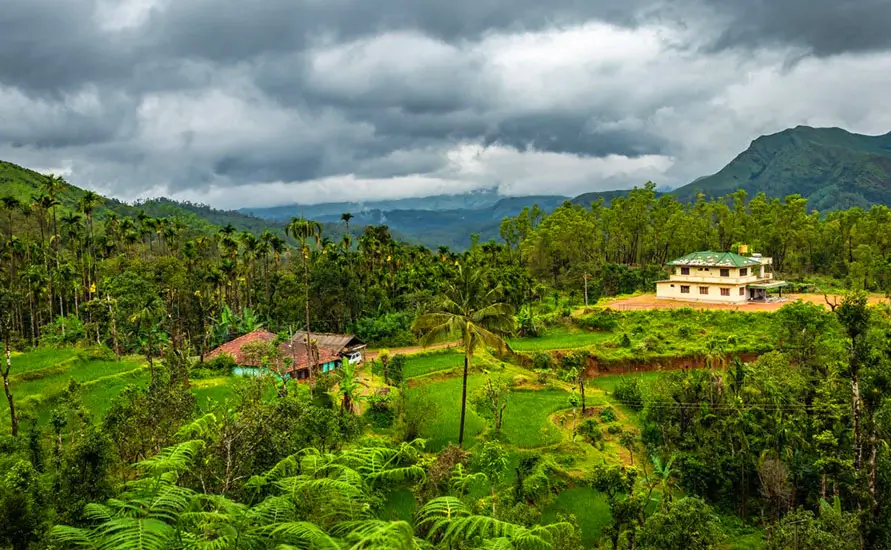
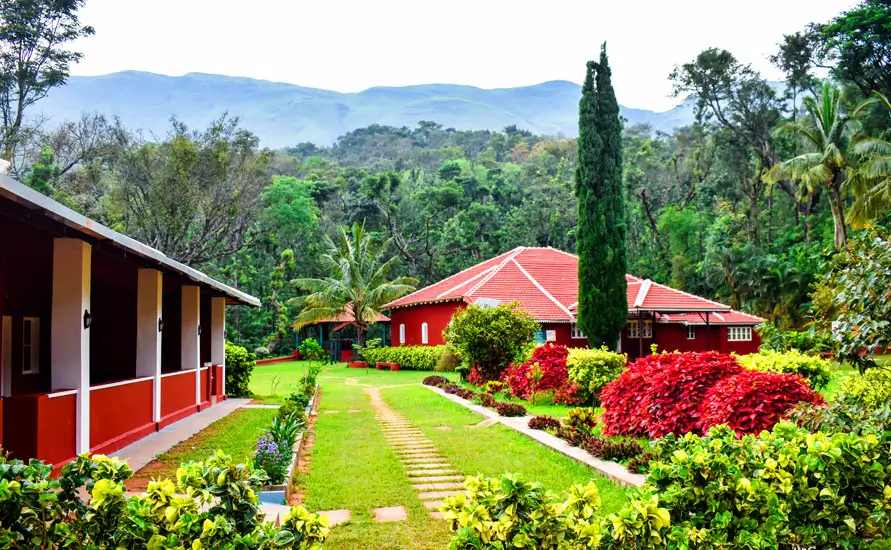
After a bowl of thukpa in a settlement café, the road climbs into Coorg, or Kodagu, through estates where tall silver oaks hold up pepper vines above the coffee bushes. Your next two nights are spent in a plantation bungalow or hill resort outside Madikeri, the district town. The temperature drops as you climb, and from November to February a light sweater is useful after dark. Tonight is the right moment to try Kodava home cooking, with steamed rice balls called kadambuttu alongside pandi curry, pork darkened with kachampuli, a vinegar made from a local fruit. Overnight in Coorg.
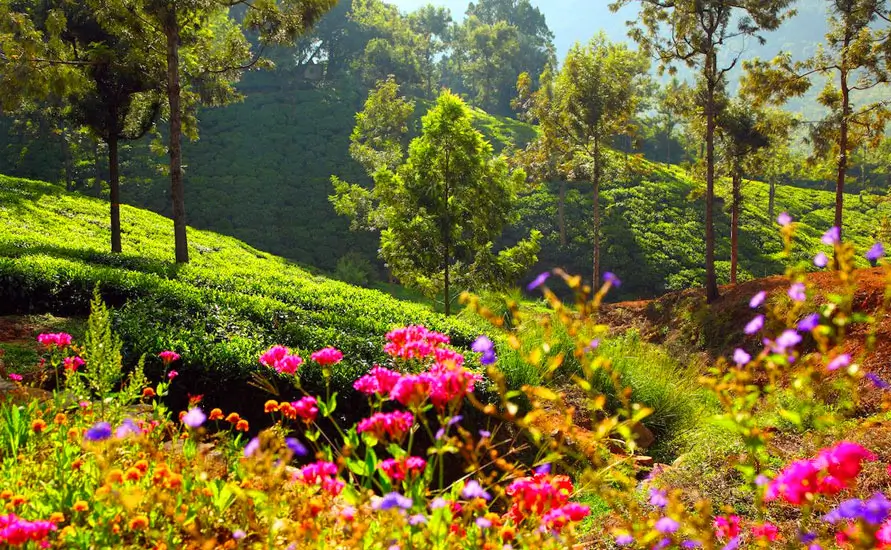
Morning starts between the coffee rows with a planter or estate manager. You learn how the bushes burst into white, jasmine-scented blossom after the first showers of spring, why picking runs from roughly December to February, and how the cherries are pulped, sun-dried and sorted by size. Kodagu produces a big slice of the country's coffee, and many estates grow pepper, cardamom and mandarin oranges in the same plots. A tasting at the end compares a South Indian filter brew with a straight black cup, and packets of freshly roasted beans are on sale for your suitcase.
Later, in Madikeri, you see the fort, its walls later refaced in stone by Tipu and then by local Kodava rajas, and the Omkareshwara Temple, where a Shiva shrine sits beneath domes and corner turrets more typical of Islamic buildings. Your guide introduces the Kodava community, a warrior people with their own tongue, clan houses and distinctive dress, who retain an unusual legal exemption allowing them to own guns without a license. Kodava weddings and harvest festivals keep customs found nowhere else in Karnataka, and the district has sent a striking number of officers to the Indian Army.
Afternoon brings Abbey Falls, reached by a short, steep path down through coffee and cardamom, where a stream tumbles over black rock into a fern-lined gorge. Water volume peaks from July to October and drops to a trickle by April. Finish the day up at Raja's Seat, whose terraced lawns sit on Madikeri's western rim where the Kodava rulers reportedly came to watch the sun sink behind wave after wave of Western Ghats ridges. On many evenings mist pours into the valleys below, and a tiny children's train circles the lawn. Overnight in Coorg.
Expect a fuller day on the road, beginning soon after breakfast through Somwarpet and the cropland surrounding Hassan. Coffee hills give way to flat plains of ragi, maize and sunflower dotted with granite tors and village tanks. After a roadside coffee break, you pull into Halebidu around eleven. Under its old name, Dwarasamudra, this was the Hoysala capital through the 12th and 13th centuries, until raiders from the Delhi Sultanate looted it twice in the early 1300s. What remains is a farming village wrapped around its great temple and an old reservoir.
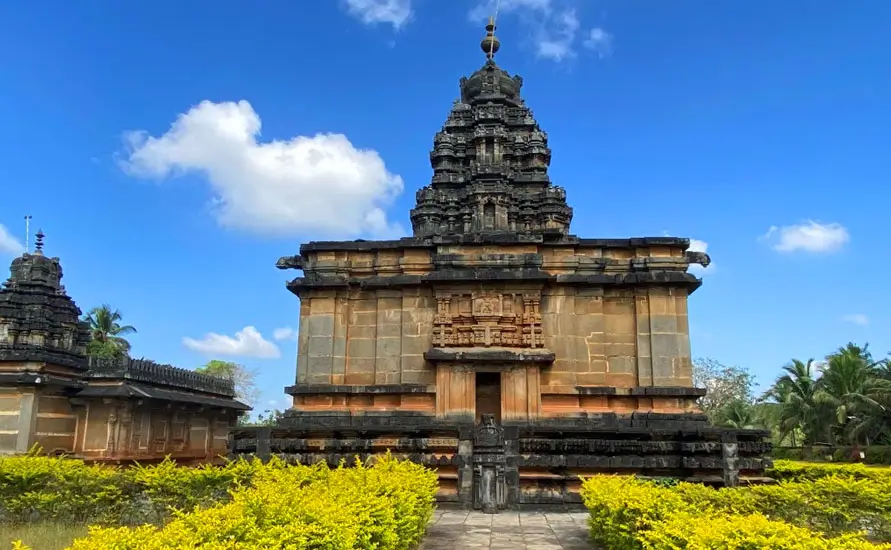
Halebidu's Hoysaleswara Temple is a pair of Shiva shrines cut from chloritic schist, which carvers could work almost like timber while it was freshly quarried. Your guide follows the horizontal friezes around the plinth, where elephants, lions, horsemen and episodes from the epics march in separate bands, no two panels quite alike. Twin Nandi pavilions face the sanctums. UNESCO added Halebidu, Belur and Somanathapura to the World Heritage list in 2023, grouping them as the Hoysala Sacred Ensembles, and an open-air museum on the lawn displays loose sculpture gathered from the area.
Seventeen kilometers on, Belur's Chennakeshava Temple, completed in 1117 for King Vishnuvardhana, still holds daily worship for Vishnu. Look up at the madanikas, bracket figures of dancers, drummers and a woman studying her reflection, tucked under the eaves, then step inside, where guides shine a flashlight onto pillars turned on a lathe until they gleam like metal. A forty-minute drive takes you into the plantation country around Chikmagalur, set higher than Coorg, where dinner awaits at your estate stay after a long but rewarding day of carving and country roads. Overnight in Chikmagalur.
Set off early up the single-track road toward Mullayanagiri, whose crest, close to 1,930 meters, is the loftiest point in Karnataka. The final section is a stiff staircase to a tiny Shiva shrine at the very top, and on a clear day you look across shola woodland, rolling grassland and a quilt of coffee estates far beneath. Cloud tends to swallow the summit before noon, hence the early departure. Your driver takes the hairpins slowly, and because the forest department sometimes caps private vehicle numbers at weekends, we schedule this outing for a weekday.
Following the same ridge you reach Baba Budangiri, named for a Sufi mystic who, so the story goes, slipped seven coffee seeds past the Yemeni authorities in the 1600s and sowed them on these slopes. Those seeds are widely credited as the beginning of Indian coffee cultivation. A cave shrine on the hill draws Hindu and Muslim pilgrims alike, each community with its own name and story for the place. The guide explains the long and sometimes contested history of the shrine, and how a handful of beans grew into one of Asia's main coffee industries.
Afternoons here work best at half speed. Your hotel can set up a walk through a working estate to see how shade trees shelter the bushes and how pepper climbs the same trunks, or you can stay put on the veranda with a novel and a cafetiere of coffee grown a few meters away. The small town has a market and a few shops selling ground coffee and estate honey. For dinner, ask for akki rotti, a flatbread of rice flour and onion that is a staple of the Malnad hills, eaten hot with coconut chutney and a pat of butter. Overnight in Chikmagalur.
Today the route runs north-west by way of Shivamogga into the Malnad, a wet, green strip along the eastern flank of the Western Ghats. Areca palms crowd every valley, and farmhouses wear steep clay-tiled roofs designed to shed the monsoon. Roads are generally decent, and lunch is taken in Shivamogga or the market town of Sagara. A short detour shortly before the falls brings you to Ikkeri, briefly the seat of the Keladi Nayakas, a dynasty that held these hills and parts of the coast once the Vijayanagara empire had collapsed in the 1560s.
Ikkeri's Aghoreshwara Temple, a granite structure from the 16th century, combines elements of Hoysala, Vijayanagara and Kadamba work, with a big stone Nandi on guard and carved elephants flanking the entrance steps. On most days only a handful of visitors turn up, leaving you free to study the details. Your guide tells how the Keladi court later shifted to Bidanur and how Queen Chennamma of Keladi gave refuge to the Maratha prince Rajaram while Aurangzeb's armies hunted him. From here the Jog Falls viewpoints are under an hour away on the Sharavathi.
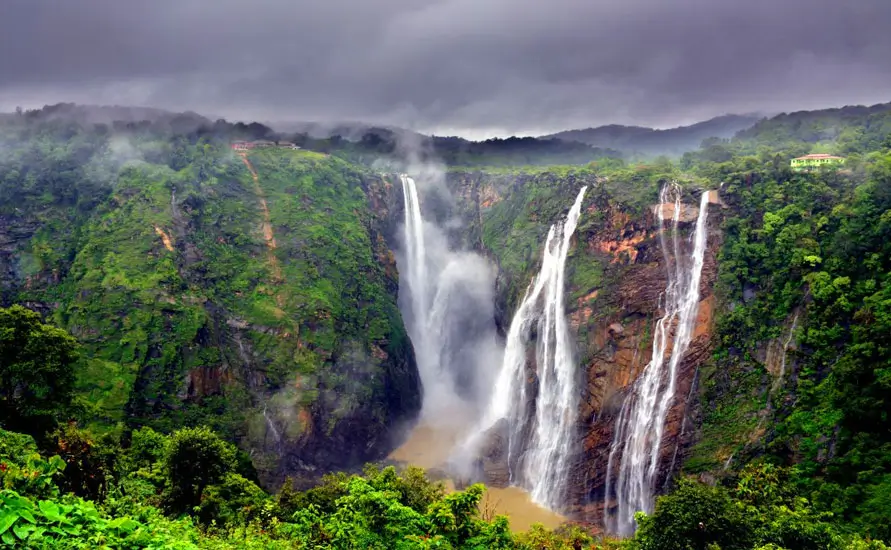
At Jog Falls the Sharavathi River leaps about 253 meters off the plateau in four strands known locally as Raja, Rani, Roarer and Rocket, placing it among the highest plunge falls in the country. How much water you see depends on the monsoon and on releases from the Linganamakki reservoir upstream, so roughly August to December is the window for a full curtain, with late spring often reduced to thin ribbons. Lookouts on opposite sides of the gorge give two very different views, and low afternoon sun can paint rainbows into the spray. Overnight in Jog Falls.
Head back to the railings straight after sunrise, when mist often fills the gorge and only a few locals are about. When conditions allow, a long staircase descends toward the pool at the bottom, a sweaty haul back up that only fit walkers should attempt, and it is usually shut in heavy rain. After breakfast the descent to the coast begins, down the Western Ghats on a winding road through dense evergreen forest, past tiny rivers, seasonal cascades and hamlets where children wave from the roadside. The temperature and humidity both rise noticeably as you lose height.
Partway down you halt at Kollur, a temple town tucked below the Kodachadri range. Its Mookambika Temple, sacred to the goddess Mookambika, pulls pilgrims from all over the south, particularly Kerala families who bring toddlers to trace their first letters in rice for the ritual of Vidyarambham. Men may need to remove shirts in some areas, and cameras are not permitted inside the shrine. The approach lane bustles with stalls of brass lamps, garlands and red kumkum, and plain vegetarian lunch halls nearby serve unlimited rice meals on fresh banana leaves for a very modest price.
Afternoon brings you onto the coast at Udupi, a town known nationwide for its vegetarian cooking and for the Krishna shrine at its center. Coconut palms, paddy and slow brown rivers line the last stretch, and the sea breeze is obvious the moment you open the car door. Check in, take a breather and, if you feel like it, wander toward the temple square as the evening lamps come on. Dinner has only one sensible choice: a full Udupi thali on a banana leaf, with rice, rasam, sambar, several vegetable sides, pickles and a sweet payasam. Overnight in Udupi.
Begin before the crowds at the Udupi Sri Krishna Matha, established in the 13th century by the Dvaita philosopher Madhvacharya. Pilgrims view the deity through the Kanakana Kindi, a small window latticed into nine openings and named for Kanaka Dasa, the poet-saint who was kept outside because of his caste and, in the legend, saw Krishna turn round to face him through the rear wall. Eight monasteries share custody of the temple, rotating control every two years in a handover festival called Paryaya. Modest dress is expected, and men remove shirts in certain halls.
The temple kitchens feed thousands of pilgrims every day, and your guide explains how cooks from Udupi carried their recipes across India through small restaurants, turning dosa and idli into national breakfast staples. In late morning you sit down at a family-run canteen to taste goli baje, puffy fried dumplings of fermented batter, and kotte kadubu, idli steamed inside cups of folded jackfruit leaf. Afterwards the heat of the day is yours to spend in the hotel, with a nap highly recommended before a late afternoon spent beside the sea and the fishing fleet.
At around four you drive to Malpe, a fishing harbor where trawlers unload and women sort mackerel and sardines on the quay. Weather permitting, boats cross to St. Mary's Island from about October to May, where columns of hexagonal basalt, formed by cooling lava millions of years ago, stand in rows along the shore. Swimming around the island is banned because of rocks and currents. Back on Malpe beach, watch the sky color over the water, then order Mangalorean fish curry with soft, lacy neer dosa for dinner. Overnight in Udupi.
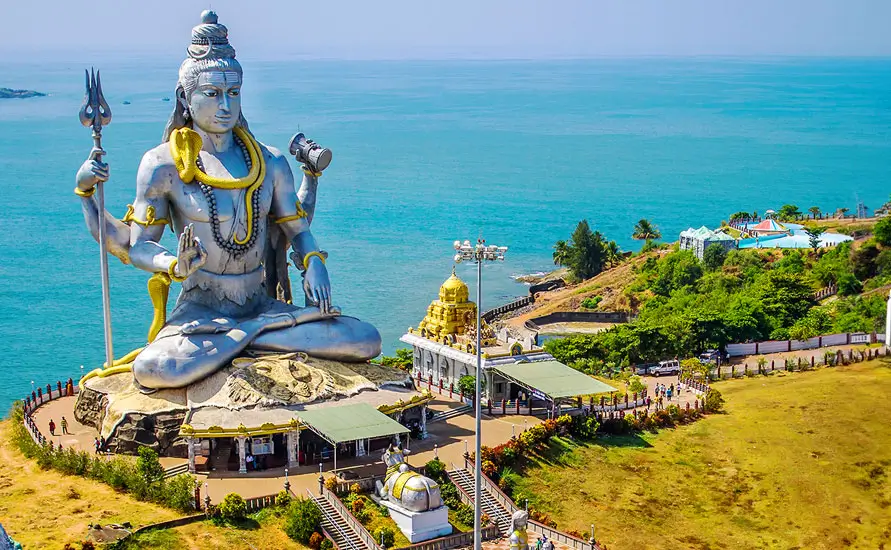
North of Udupi the highway squeezes between the ghats and the shoreline, bridging estuaries where fishermen throw nets from dugouts and passing towns in which a church, a mosque and a temple often share one street. Roughly two and a half hours after setting out you reach Murudeshwar, built on a slim promontory. Long before arrival, a colossal seated Shiva, around 37 meters high, comes into view, staring out to sea from the top of the headland. It ranks among the largest Shiva figures anywhere, painted silver and gold and visible for miles along the coast.
Beneath the statue stands a modern temple with a towering twenty-storey gopuram, and an elevator carries visitors up to a viewing gallery near its top, with the coastline, the fishing fleet and the statue's shoulders spread out below. The guide recounts the legend of Shiva's Atmalinga, a story you will hear again in Gokarna, and how pieces of it supposedly landed at five shrines along this coast. A short stroll along the beach below the headland stretches the legs. Lunch is grilled fish or prawn masala at a simple restaurant facing the water.
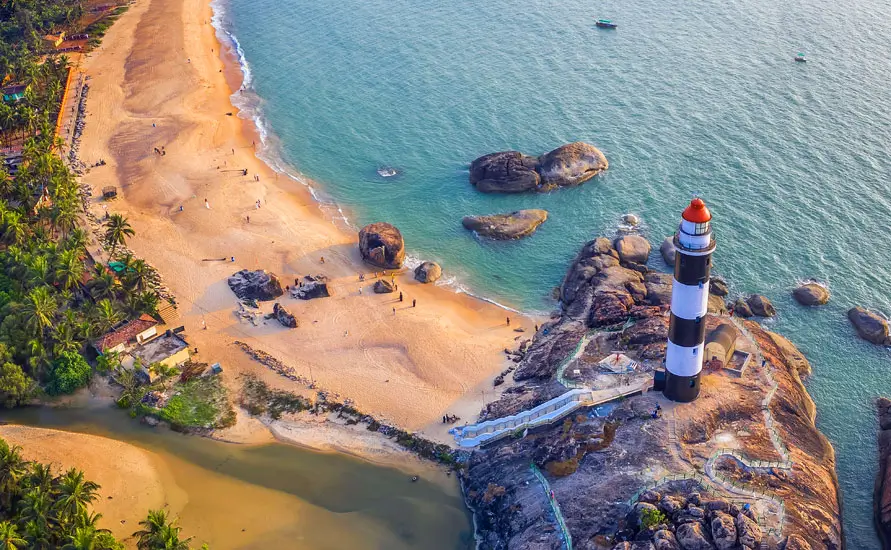
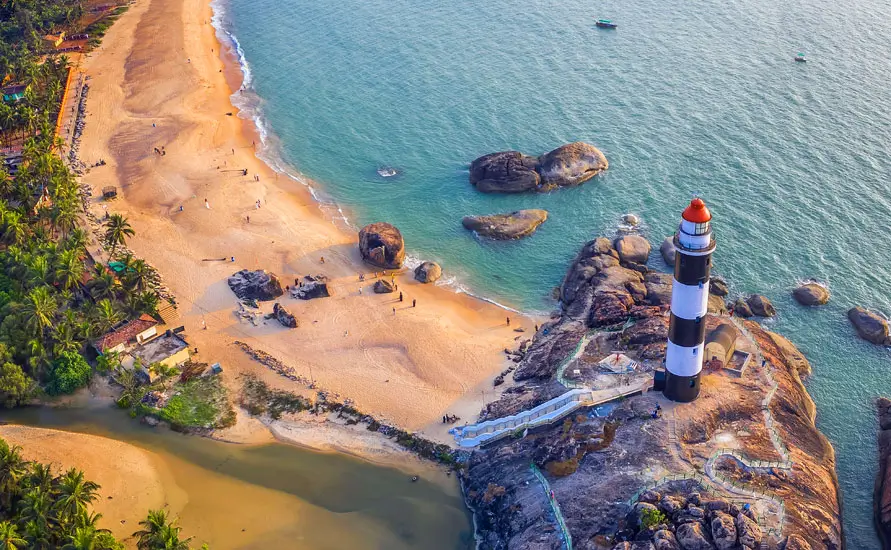
Another ninety minutes north lies Gokarna, a pilgrimage town that also happens to front some of the finest sand on the Karnataka coast. Your hotel or beach resort sits near the old town or above one of the coves, with the remaining hours free for settling in. The mood here is far quieter than nearby Goa, with no big resort strips and a steady flow of pilgrims in the old lanes. At sunset, walk down to the main beach, where devotees take a ritual dip before temple visits and vendors sell tender coconuts and roasted peanuts. Overnight in Gokarna.
Tour rest day number two lands right at the midpoint, just before the big push inland. If a little structure appeals, walk through the old town in the morning to the Mahabaleshwar Temple, where tradition says Ravana was tricked by Ganesha into setting the Atmalinga on the ground, after which it could never be lifted again. Customs around the inner sanctum are traditional, and the guide will tell you beforehand what visitors may see. Outside, the chariot street is lined with timber houses, Vedic schools and stalls selling brass and puja goods to pilgrims from across India.
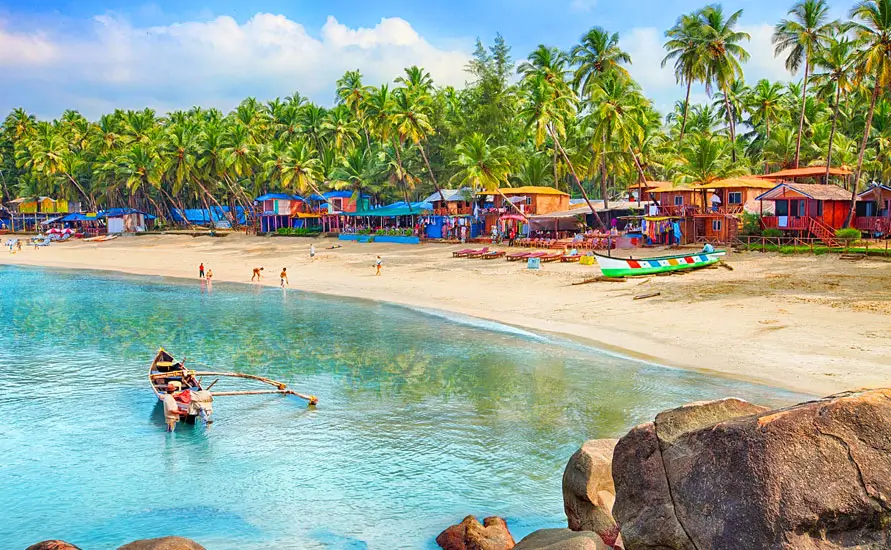
South of town, a coastal footpath links the beaches over rocky headlands. Kudle Beach comes first, then the twin crescents of Om Beach, named because its outline loosely resembles the sacred syllable, and finally little Half Moon Beach, reachable only on foot or by boat. Allow two hours or so with breaks, and start early before the sun climbs. Proper walking shoes beat sandals on the rocky stretches, a liter of water per person is sensible, and sticking to the worn trail matters, because some drops near the edge are steep and have no railing.
Sea conditions vary through the year and rip currents can be powerful, particularly before November, so always check with locals and obey any red flags. Beach shacks at Kudle and Om serve fruit plates, banana pancakes and the day's grilled catch, and a boat can run you back to the main beach if walking the trail twice sounds like too much. The afternoon is open, whether that means a hammock, a swim or a cold lime soda watching the fishing boats come in. The sun sets straight out over the water here, and the sky often glows deep orange. Overnight in Gokarna.
No leg on the route is longer than this one, so plan to roll out soon after breakfast and climb back over the Western Ghats through the forested Yellapur stretch, one of the more scenic ascents in the state. On top, the land changes completely, from damp green valleys to dry, open plains with cotton fields, scattered farms and hills littered with boulders. Comfort stops come whenever you ask, and a lunch halt near Hubballi or Hosapete divides the day. The highway is mostly in good shape, and the shifting scenery keeps the hours moving.
By mid-afternoon the outskirts of Hampi appear, and the first sight of the boulder country stops conversation in the car. Huge granite rocks, some perched on others at improbable angles, rise above banana plantations and rice paddies along the Tungabhadra, with temple towers and ruined pavilions wedged in between. Your hotel lies in Hosapete, Kamalapura or near the ruins, and there is time to rest after the drive. For more than two centuries this was the seat of the Vijayanagara Empire, which held sway across much of the peninsula between 1336 and its defeat in 1565.
If energy remains, the guide can lead you up Hemakuta Hill for sunset, a short scramble over sloping granite to a cluster of early shrines with stepped pyramid roofs, several older than the empire. From the top you see the tall entrance tower of Virupaksha and the long bazaar street that once ran from its entrance, now lined with stone colonnades. The rocks turn orange and then rose as the sun drops, a fitting preview of the next two days. Dinner is at your hotel, where bisi bele bath, a spiced rice and lentil one-pot, is often on the menu. Overnight in Hampi.
The first full day in Hampi opens at the Virupaksha Temple, in continuous worship since before the Vijayanagara kings rose to power. In a small chamber inside the complex, light passing a narrow slit projects an inverted picture of the main gopuram onto the opposite wall, a natural camera obscura the guide is happy to demonstrate. Pilgrims queue for darshan at the inner shrine of Virupaksha, a form of Shiva, while the outer courtyards are open to all visitors. Arrive early, and the morning rituals give a good sense of the temple's daily rhythm.
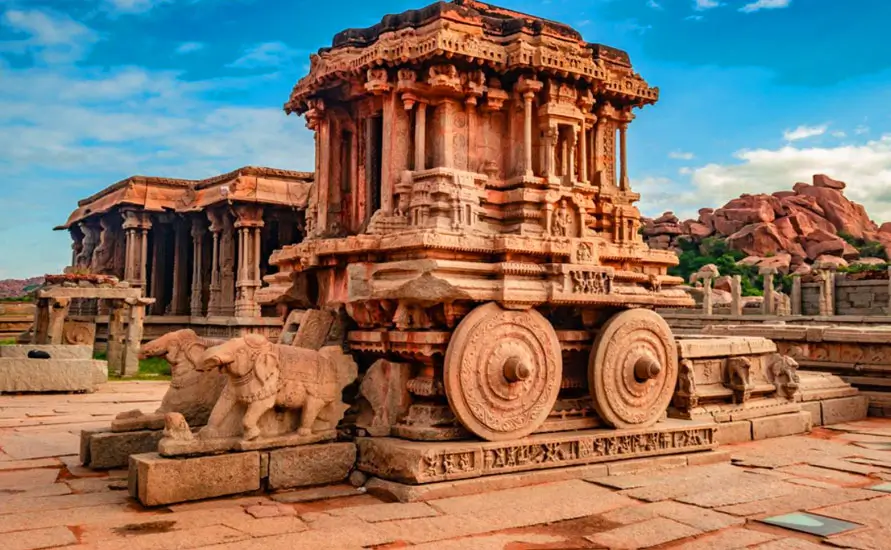
From there you drive or walk along the riverbank to the Vittala Temple, the most refined building the Vijayanagara masons left behind, begun in the 15th century and still unfinished when the city fell in 1565. In its courtyard stands the celebrated stone chariot, a Garuda shrine carved to resemble a wooden processional car and now printed on the Indian fifty-rupee note. Clusters of slim columns in the main hall gave off distinct tones when struck, so the story goes. They are now roped off for conservation, and the guide explains the theories behind the sound instead.
Around five you climb into a coracle, a circular bamboo basket boat sealed with tarpaulin, for a gentle float on the Tungabhadra, which threads between boulders and half-buried temple ruins. The boatmen handle these spinning craft with real skill and may give you a playful twirl mid-stream, and from the water you spot carvings and small shrines on the rocks that are hard to see from the bank. Rides depend on water levels and on local regulations, which can change at short notice. Dinner and an early bedtime follow at the hotel. Overnight in Hampi.
Spend the morning in the Royal Centre, the secular core of the old capital, where kings held court, received envoys and staged festivals. Your guide begins at the Mahanavami Dibba, a massive stepped platform decorated with friezes of hunting parties, dancers and processions, from which the king is believed to have watched the Navaratri festivities. Nearby lies a stepped tank of precisely cut green schist, excavated only in the 1980s, and the Hazara Rama Temple, the private chapel of the kings, its enclosure walls lined with processions of horses, elephants, soldiers and dancers.
Further on, the Zenana Enclosure holds the Lotus Mahal, a two-storey pavilion with cusped arches that mix Hindu and Islamic ideas, and eleven tall domed chambers in a row known as the Elephant Stables. The Queen's Bath, a square building with arched corridors around an open pool, shows how the court combined comfort and design. Once the stone starts radiating heat in late morning, you head indoors for lunch and a lengthy siesta. Three nights in Hampi mean there is never a need to push through the midday sun just to see everything.
Late in the day, cross the river to Anegundi, an older village that predates Hampi and is linked in legend with Kishkindha, the monkey kingdom of the Ramayana. Life here moves slowly, with mud-walled homes and a women's craft cooperative turning banana-stem fiber into mats, baskets and bags. Fit travelers can climb the roughly 570 steps of Anjanadri Hill, which devotees regard as Hanuman's birthplace, for a sunset view over rice paddies and boulders. The climb is steep and the resident monkeys are bold, so bring water, sturdy shoes and nothing edible in your hands. Overnight in Hampi.
Leaving the boulders behind, the car heads north-west over the Deccan toward Badami, seat of the early Chalukya kings between roughly 540 and 757. Fields of sunflower, jowar and sugarcane roll past, and the small market towns on the way fill up on their weekly bazaar days with tractors, goats and stalls of chillies. Then, almost without warning, a wall of rust-red sandstone rises out of the flat plain, and the town appears squeezed into the gap between two cliffs around a green reservoir. Check-in is around lunchtime, followed by a pause in your room while the midday sun is at its fiercest.
Around three, the guide leads you up the cut steps to four sanctuaries known as the Badami cave temples, hollowed out of the southern cliff above Agastya Lake, three for Hindu gods and one for the Jain teachers. Cave 1 is known for a Nataraja with eighteen arms, positioned so that different combinations of arms suggest different dance poses. Cave 3, the grandest, carries an inscription dated 578 and deep panels of Vishnu as the man-lion Narasimha, the boar Varaha and the cosmic giant Trivikrama. Langurs and macaques patrol the stairs, so bags should stay zipped and food out of sight.
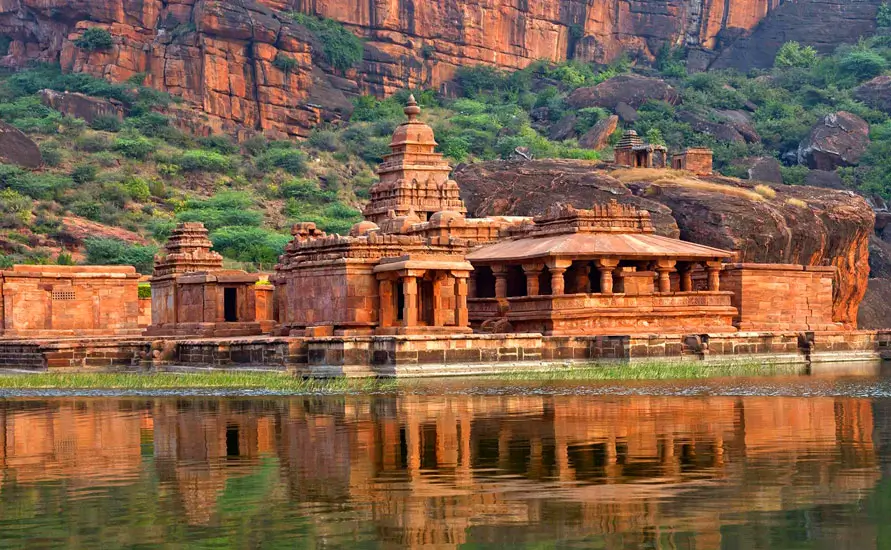
As the cliffs turn copper, take the lakeside path to the Bhutanatha temples, a cluster of sandstone shrines on the eastern shore whose reflections in the still water make the most photographed view in town. The old quarter behind the reservoir is a maze of whitewashed and indigo houses, and women still beat laundry on the stone ghats at dusk. With legs to spare, climb toward the North Fort for a look across the whole bowl of Badami and its two ridges. Dinner is simple and early, since tomorrow covers three historic sites and a long run north. Overnight in Badami.
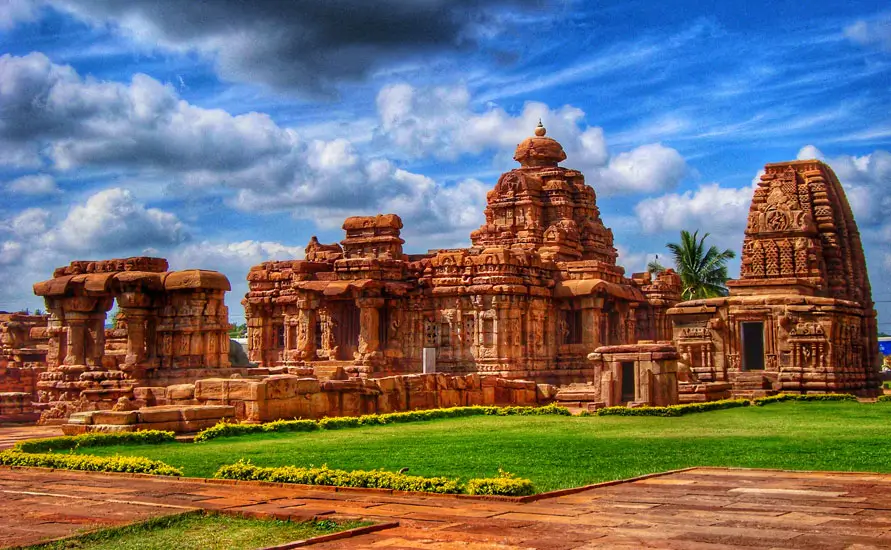
Twenty-two kilometers along the Malaprabha brings you to Pattadakal soon after the gates open, while dew still sits on the lawns. Chalukya rulers held their coronations here, and the riverside complex, inscribed by UNESCO in 1987, places temples with curved northern towers directly beside others with tiered southern roofs, as if two schools of architects were competing on one site. The grandest, the Virupaksha Temple, was commissioned around 745 by Queen Lokamahadevi after her husband Vikramaditya II defeated the Pallavas at Kanchipuram. Look for the narrative panels on its pillars, which read like a stone comic strip of the epics.
About fourteen kilometers further is Aihole, a farming village sprinkled with more than a hundred early temples, which art historians treat as the place where Chalukya builders tried out shapes before settling on a style. The Durga Temple stands out for its rounded, apse-ended plan wrapped in a pillared veranda, and the low, flat-roofed Lad Khan Temple looks more like a village meeting hall than a shrine. A short climb to the Meguti hill temple reveals the Aihole inscription of 634, a poem in Sanskrit praising the king Pulakeshin II. Lunch is a plain thali in a roadside dhaba.
From Aihole you drive about three hours north to Bijapur, renamed Vijayapura, which the Adil Shahi sultans ruled from 1490 until the Mughal conquest of 1686. After checking in, the car takes you to Ibrahim Rauza, built for Ibrahim Adil Shah II and his queen in the early 1600s, where a tomb and a mosque face each other across a raised platform and a reflecting pool. Its proportions are often cited as one of the ideas behind the Taj Mahal, and its stone chains, cut from single blocks, hang from the cornices with astonishing finesse. Stay for the minarets at dusk. Overnight in Bijapur.
Reach Gol Gumbaz at opening time, ahead of the school parties. Mohammed Adil Shah's mausoleum, completed in 1656, supports one of the widest unsupported domes on the planet, and in its upper gallery a whisper against the wall travels clearly to the far side while a single handclap returns as a string of echoes. On the way out, the guide shows you Malik-e-Maidan, a bronze cannon weighing many tonnes on the old bastions. Vijayapura's new airport has been slow to gain regular scheduled flights, so the car then drives west to Hubballi Airport, unless a convenient direct Vijayapura–Bangalore flight runs on your dates.
The hop from Hubballi down to Bangalore is a short economy flight of roughly seventy minutes, and our representative waits at arrivals in Kempegowda International for the final handover. Many long-haul departures to Europe, the Gulf and North America leave close to midnight, so a room near the terminal can be held for the evening at extra cost if you want a shower and a meal first. Three weeks have carried you from Wodeyar palaces through forest, coffee hills and surf to the sultans' domes of the north. It has been a pleasure to show you the state end to end, and our team wishes you a smooth flight home.
Your Journey

N.S. Rathore & Mrs. Omlata Rathore · Managing Director
We still read every enquiry ourselves. Tell us the places you liked and our planners will send a day-by-day route with drive times and a clear price.
Every package can be customised and no pressure to book. A planner from our office replies within 24 hours with a route written for your group.
Fill this in and your planner will send a first draft itinerary.
Explore more
Kerala Backwaters Escape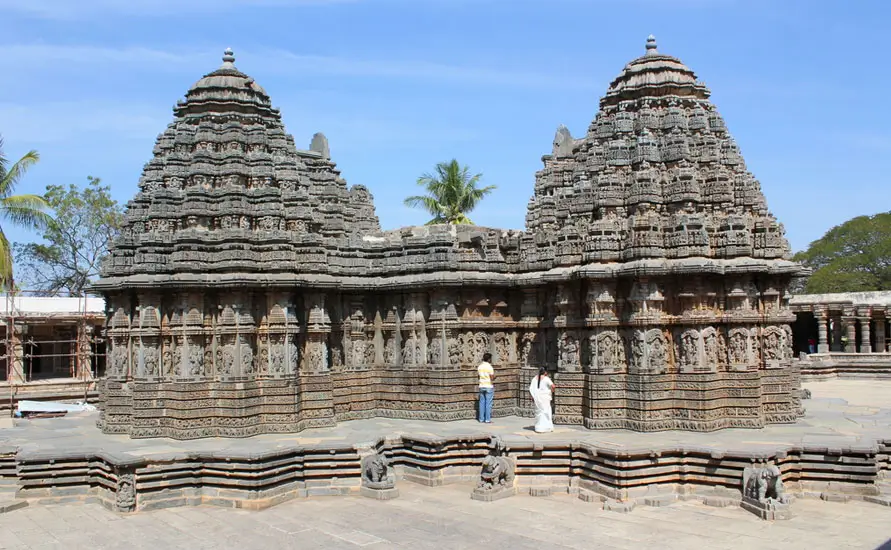 Kerala Backwaters Escape
 Kerala Backwaters Escape
 Kerala Backwaters Escape
 Kerala Backwaters Escape
 Kerala Backwaters Escape
 Kerala Backwaters Escape
 Kerala Backwaters Escape
 Kerala Backwaters Escape
 Kerala Backwaters Escape
 Kerala Backwaters Escape
 Kerala Backwaters Escape
 Kerala Backwaters Escape
 Kerala Backwaters Escape
 Kerala Backwaters Escape
 Kerala Backwaters Escape
 Kerala Backwaters Escape
 Kerala Backwaters Escape
 Kerala Backwaters Escape
 Kerala Backwaters Escape
 Kerala Backwaters Escape
 Kerala Backwaters Escape
 Kerala Backwaters Escape