 Kerala Backwaters Escape

Karnataka Tour Packages
Bangalore – Srirangapatna – Mysore – Bylakuppe – Coorg – Belur – Hassan – Halebidu – Hampi – Hospet
At a glance
Put the question to any Karnataka travel desk and the same three names come back: Mysore for its royal past, Coorg for coffee and cool air, Hampi for the ruins. Our Hampi Mysore and Coorg Tour joins all three in eleven private days, beginning in Bangalore and closing near Hospet. Along the way you meet a Wodeyar palace wrapped in light bulbs, wake on a plantation where pepper vines twist around silver oaks, and spend three full days among the granite hills that once held Vijayanagara, a city foreign envoys compared with Rome.
Most planners struggle with the gap between the southern hills and Hampi, far to the north. Rather than force it in one punishing day, we place a calm night in Hassan, a modest district town close to the Hoysala carvings of Belur and Halebidu. That means the big northbound drive starts fresh, with a temple visit and a fort town lunch to break it. Every other road day stays between two and four hours. Your car, cooled and spacious, and its English-speaking driver stay assigned to your group for all eleven days, while a licensed guide joins at each historic site.
Hampi rewards patience. Its monuments spread over a huge area and look best at dawn and dusk, so three nights in Hospet give you two unhurried days instead of one sweaty dash. This Hampi Mysore Coorg tour package fits couples, friends and NRI families looking for variety at a sensible pace, ideally between October and March. To avoid retracing the whole route, you fly out from the small Jindal Vijayanagar airport near Hospet, with Hubballi airport or a drive back to Bangalore held in reserve if flight timings do not work.
Bangalore's Kempegowda airport lies a fair distance north of the center, and the ride to your hotel normally takes around sixty minutes, longer during the evening rush. Our airport host stands just past the customs hall with a placard bearing your surname, takes charge of the trolley and introduces the driver assigned to your car until the last morning in Hampi. Inside the car you will find a folder with your day plans, useful phone numbers and tips on buying a local SIM. Plenty of overnight flights touch down at sunrise, so ask us to reserve your room from the night before if you would rather sleep straight away.
After some rest, head out in the softer light of late afternoon for a stroll through Cubbon Park, a green lung of roughly 300 acres whose bamboo clumps and rain trees were first planted when Mark Cubbon's successors governed Mysore State. Early risers and dog walkers fill it at dawn, while evenings bring students and young couples. Along its edge rise the red State Central Library and the colossal granite front of the Vidhana Soudha, Karnataka's legislative building, whose columns and domes borrow freely from temple design. Entry is restricted, though the floodlit exterior on Sunday evenings and holidays makes a good first photograph of the city.
Locals will tell you, with some pride, that this is where India's microbrewery scene began, and pubs across Indiranagar and Church Street pour house-made wheat beers and pale ales. Older Bangalore, on the other hand, runs on darshinis, stand-up eateries where a crisp masala dosa and a frothy steel cup of filter coffee arrive within minutes of ordering. Your driver is happy to drop you at one of either kind and fetch you later, or you may prefer room service if jet lag is winning. The next day starts at a relaxed hour with the older southern quarters. Overnight in Bangalore.
Basavanagudi, in the old south of the city, is easiest to enjoy before ten, when the lanes are still calm and the temple bells are loud. Your guide starts at the Bull Temple, raised by the local chieftain Kempegowda in the 1500s around a monolithic Nandi nearly five meters long. Generations of oil and butter offerings have turned the granite almost black. Farmers once believed the bull was growing and grazing on their fields, and the temple was said to calm it. Every November, around the end of the groundnut harvest, the Kadalekai Parishe peanut fair fills the surrounding streets with heaps of fresh nuts.
Next is Tipu Sultan's Summer Palace, a wooden residence finished in 1791, with carved teak pillars, cusped arches and walls that still show traces of floral painting. Tipu called it Rash-e-Jannat, roughly the envy of heaven, and used it when the court moved to Bangalore in the hot months. Downstairs, a modest gallery tells the story of his reign, his famous iron-cased rockets and his long wars with the East India Company, which ended at Srirangapatna, tomorrow's first stop. A short walk away, the crowded lanes of KR Market trade marigolds, jasmine and vegetables in wholesale quantities.
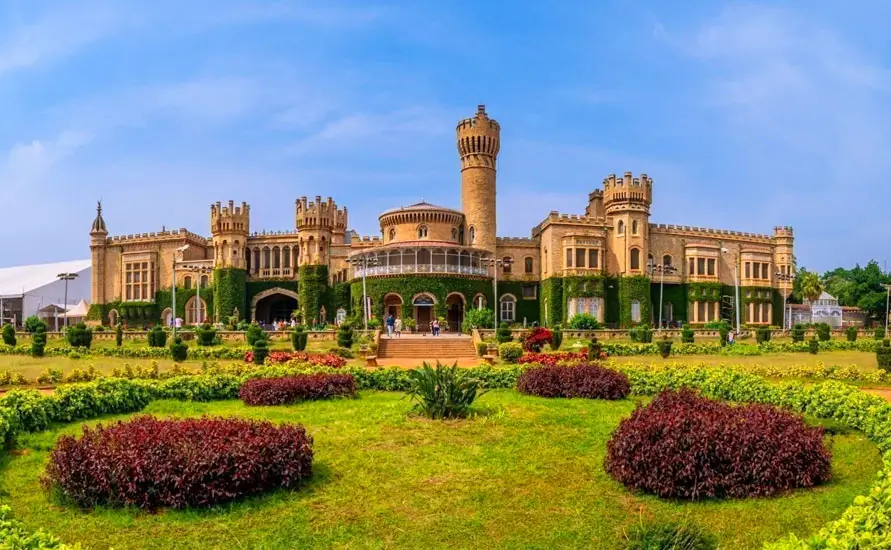
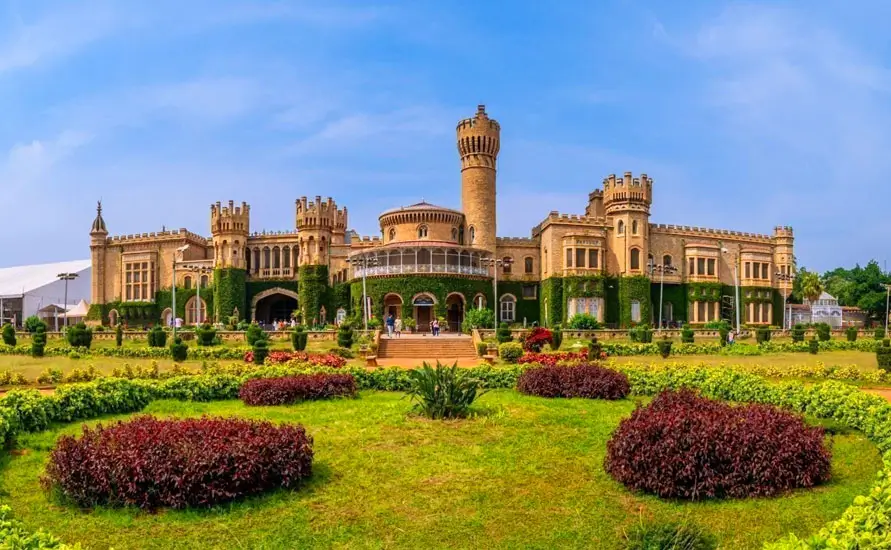
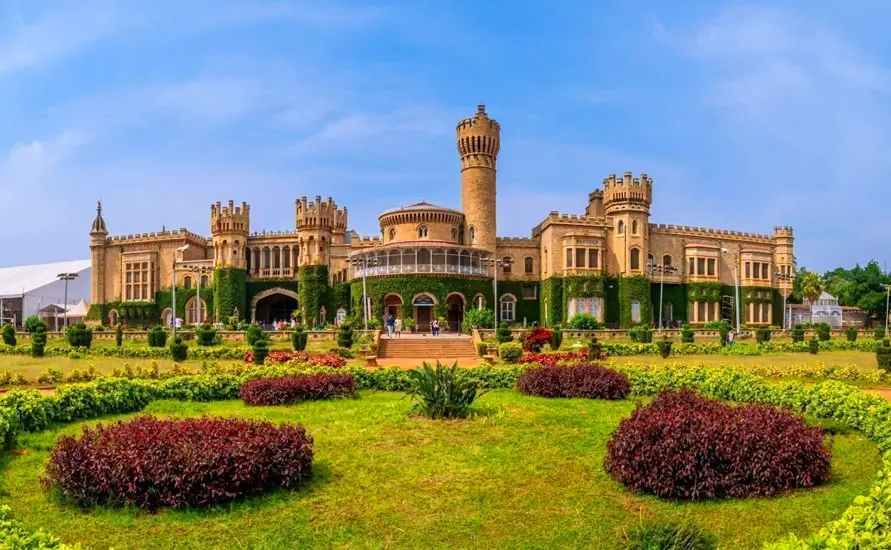
Lunch is a plain vegetarian plate at a busy local canteen before you move on to Lalbagh, the botanical garden that Hyder Ali started in 1760 with plants gathered from across the subcontinent. Its Victorian glasshouse fills with displays twice a year, in January and again in August, and a low hump of bare gneiss in the grounds, dated by geologists to some three billion years, is crowned by a small watchtower from Kempegowda's era. Later, if time permits, visit the turreted Bangalore Palace, whose battlements and Tudor windows were modeled on Windsor for the Wodeyar family. Pack tonight for tomorrow's road south. Overnight in Bangalore.
The ten-lane expressway that now links the two cities has taken a good chunk off the old driving time, though your driver may still pause in Channapatna, a toy-making town where artisans turn and lacquer small wooden animals and spinning tops in bright colors. Roadside counters near Maddur sell the town's flat, crunchy onion vada, a good test of how much spice you can handle. Before reaching Mysore you leave the highway for Srirangapatna, a river island where the Kaveri splits into two arms, still ringed by crumbling walls. Tipu Sultan ruled from here until British troops stormed the fort in May 1799, and a pillar marks the spot where they broke in.
Inside the walled area your guide leads you to Daria Daulat Bagh, a low wooden pavilion where Tipu received guests, set among lawns and cypress trees. Its painted walls are the real draw: soldiers in red coats, cavalry charges, elephants and courtiers, including a lively panel showing the 1780 Mysore victory at Pollilur. A few minutes away the Gumbaz holds the graves of Tipu and his parents under a white dome, its doors inlaid with ivory. The Ranganathaswamy Temple, older than all of this and still busy with pilgrims, gives the island its name; it shuts for a midday break, so we time it accordingly.
Mysore is barely half an hour further, and you check in early enough for a proper afternoon nap. When you feel like moving again, ask to be dropped at the Devaraja Market, a long covered bazaar from the 1880s where traders weigh out flowers by the kilo and sell sticky Mysore pak from glass cases. Cone-shaped piles of kumkum and turmeric powder make the most photographed stalls, and sellers generally pose cheerfully if you ask. Supper could be bisi bele bath, a one-pot Karnataka favorite flavored with tamarind and its own spice powder, finished with ghee and crunchy boondi. Overnight in Mysore.
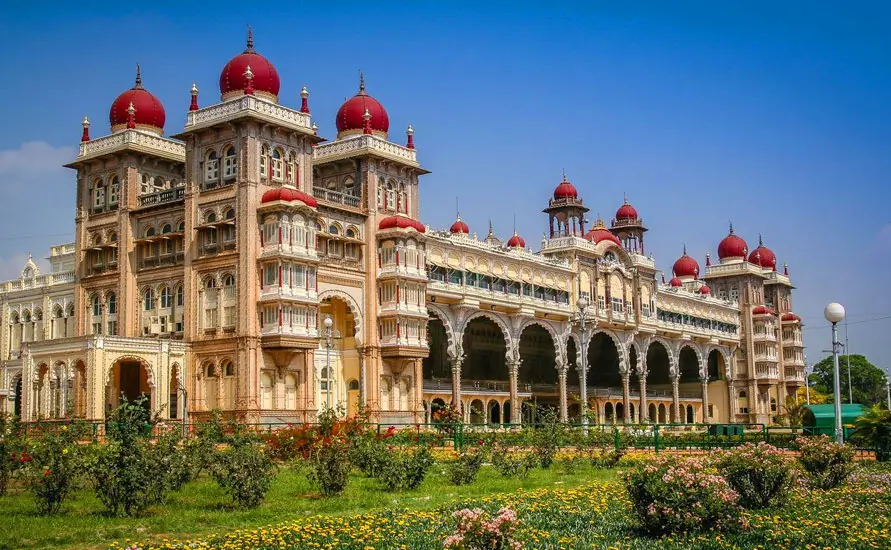
Be at the gates of the Mysore Palace when they open and you will have the painted halls largely to yourself for half an hour. The present building went up between 1897 and 1912 after the earlier timber palace burned during a royal wedding, with Henry Irwin of Madras drawing up plans that combine Hindu, Mughal and Gothic elements. Your guide points out the peacock-patterned stained glass in the octagonal Kalyana Mantapa and the long series of oil paintings that record a Dasara procession in fine detail. Footwear goes in a free locker, and cameras must stay off inside.
Late morning the car climbs the hairpins of Chamundi Hill, home of Chamundeshwari, whom the Wodeyar kings worshipped as their family deity. Mysore takes its name from Mahishasura, the buffalo demon she is said to have slain here, and a garish statue of him greets you at the summit car park. The temple tower is from the 19th century, but the shrine itself is much older. Halfway down, a five-meter Nandi bull, cut in 1659 from the living rock, kneels beside the steps. Energetic visitors can walk the full flight of roughly 1,000 steps down to the base, where the car will be waiting.
After lunch, the spires of St. Philomena's Church come into view above the north of the city, built from the 1930s onward in a design that recalls Cologne Cathedral. Below the altar, a crypt holds a statue and relic of the saint, and the windows depict scenes from the life of Christ. When one of your Mysore evenings is a Sunday or holiday, go back to the palace for the light show just after 7 pm, when tens of thousands of bulbs outline every dome and arch for around three quarters of an hour. During Dasara, in September or October, the palace stays lit every evening. Overnight in Mysore.
West of Mysore the plain slowly gives way to tobacco fields, then to areca palms and the first coffee bushes. Two hours in, the town of Bylakuppe comes as a surprise: maroon robes, prayer flags and Tibetan signboards, the result of a refugee settlement the Indian government set up here in 1961. The Namdroling Monastery, one of the biggest monastic colleges of the Nyingma tradition anywhere, houses several thousand monks and nuns. In its main shrine three gilded figures, the Buddha in the center with Guru Rinpoche and Amitayus on either side, rise almost to the ceiling under walls painted with wrathful guardian deities.
If you arrive during a prayer session you can stand quietly near the entrance and listen to the deep chanting, cymbals and long horns. Shoes come off at the door, and it is polite to ask before pointing a camera at any monk. Across the road, small canteens serve plates of steamed momos and bowls of thenthuk, a hand-pulled noodle soup, a welcome change for lunch. Back on the road you pass Kushalnagar and begin to climb into the hills of Kodagu, the district most visitors call Coorg. Windows can come down here, as the temperature drops by several degrees and the scent of wet earth fills the car.
By mid-afternoon you reach your coffee estate stay near Madikeri, the market town that serves as Coorg's capital. Many such homes are run by Kodava families whose ancestors cleared these slopes, and over tea your hosts may explain the clan system, ancestral houses called ainmanes and the traditional dress of a long black coat with a sash and dagger. The Kodavas are known for military service, and the community has a special exemption to own firearms without a license. Dinner on the veranda will likely feature pandi curry, slow-cooked pork darkened with kachampuli, with kadambuttu, soft dumplings of steamed rice, on the side. Overnight in Coorg.
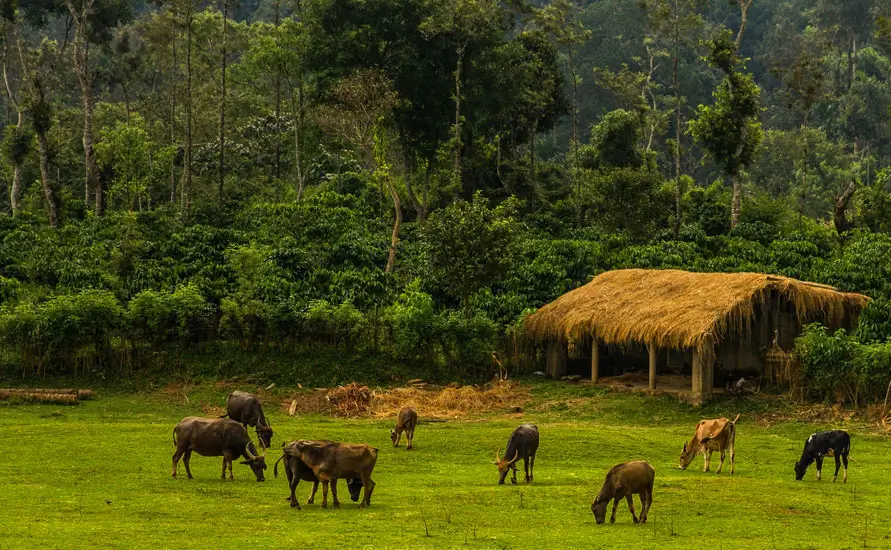
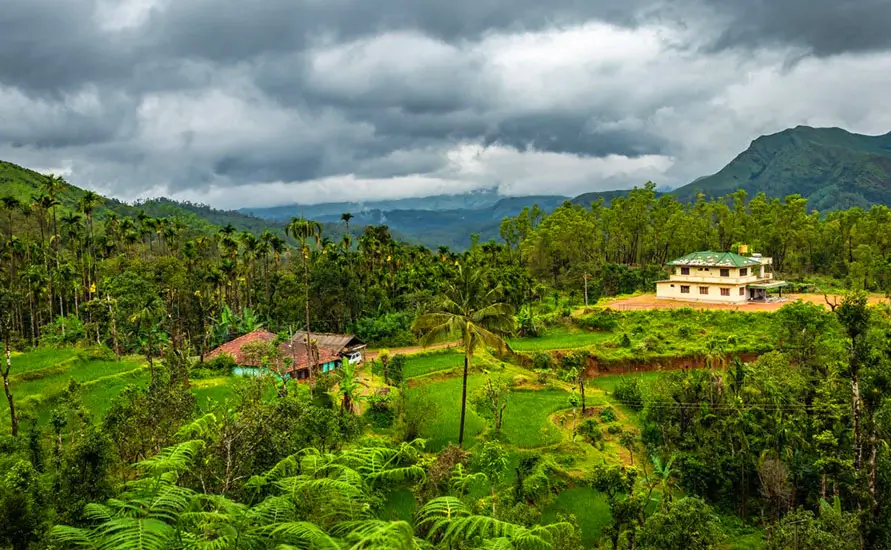
Birdsong usually starts before six, and an early walk among the plantation rows with your host or a staff member is the best way to understand the estate. Arabica bushes grow on the cooler upper slopes, robusta further down, and both shelter under tall native trees that keep the soil cool and support climbing black pepper. Your guide shows you cardamom flowers at ground level, explains why everyone in Coorg prays for blossom showers in March and lets you taste a ripe coffee cherry. During the December to February harvest, families pick by hand and lay the beans to dry on open yards beside the house.
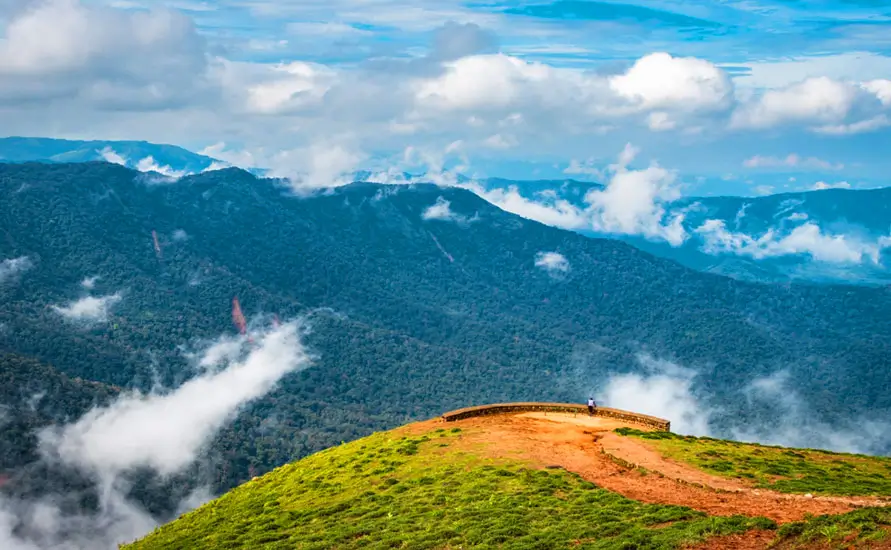
Breakfast over, a ninety-minute drive through forest and paddy brings you to Talacauvery, high on the Brahmagiri range near the Kerala border. Here a small spring feeding a stone tank is revered as the birthplace of the Kaveri, a river that later waters much of southern India. A steep stairway behind the shrine climbs to a hilltop with sweeping views of the Western Ghats. Lower down, at Bhagamandala, the Kaveri meets the Kannike and an underground stream, and the riverside temple there has the steep copper and tile roofs typical of coastal Karnataka. Each October the Tula Sankramana festival draws huge crowds.
In the afternoon a footpath through pepper and coffee leads down to Abbey Falls, which tumbles about 20 meters into a rocky pool and is at its fullest from late monsoon into the autumn. Opposite the cascade a suspension bridge gives the best view, and on warm days its spray feels wonderful. Back in Madikeri, the garden at Raja's Seat was where the old Kodagu kings liked to end their day, and its terrace looks over ridge after ridge of green hills. If time allows, see the Omkareshwara Temple, an 1820 shrine with an unusual Islamic-style dome, and the walls of Madikeri Fort before dinner on the estate. Overnight in Coorg.
No alarm is needed today, since the plan is deliberately slow ahead of the long northbound leg. Enjoy a late breakfast before your driver heads north via Somwarpet and Sakleshpur, a quieter plantation district of cardamom, coffee and tea where the road follows streams through red laterite villages. A tea break at a spice outlet or a roadside stop for pineapple sprinkled with chili and salt keeps the drive pleasant. You reach Belur around lunchtime, and after a simple meal you walk straight into the temple compound, which sits right in the small town center.
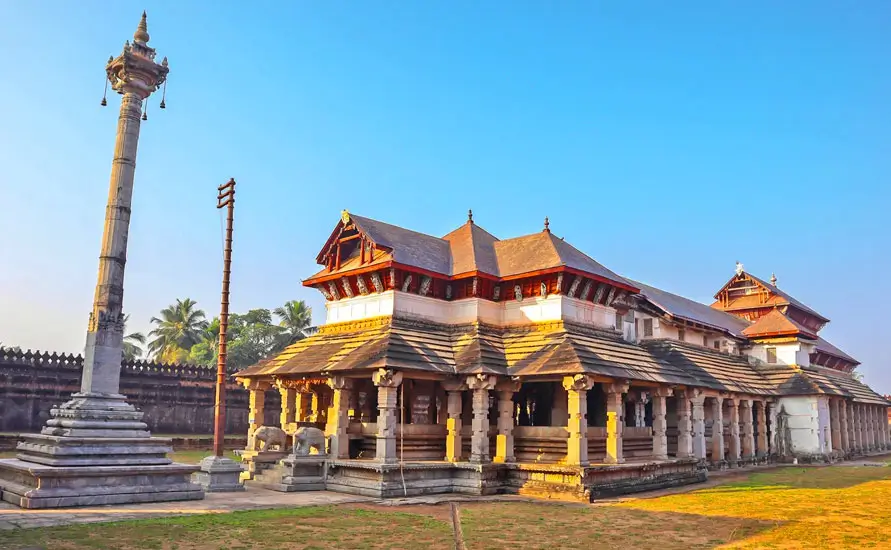
The Chennakeshava Temple honors Vishnu and was built over about a century from 1117, under the Hoysala king Vishnuvardhana. UNESCO added it in 2023, along with Halebidu and Somanathapura, under the joint listing Sacred Ensembles of the Hoysalas. Its builders used chloritic schist, a stone soft enough to carve like wood when fresh, which later hardens in the air. Your guide picks out the madanikas, slender female figures tucked under the roof brackets, one checking her reflection, another drumming, a third shooting a bird with a bow. Inside, polished pillars turned on huge lathes catch the light from the doorway.
From Belur it is a short 40-minute run to Hassan, a district town that offers little to see but a lot to recommend it at this stage of the trip: a comfortable hotel, a pool to cool off in and an evening without obligations. It is the right moment for laundry, charging cameras and going to bed in good time. Your guide can recommend a local place for an Udupi-style thali with rasam, kosambari salad and payasam, or you can simply eat at the hotel. Anyone keen on the giant Jain statue at Shravanabelagola should know it lies close by and fits into an extra half day. Overnight in Hassan.
An early start takes you half an hour north to Halebidu, which was Dwarasamudra, the royal seat of the Hoysalas, until forces from the Delhi Sultanate raided it twice in the 14th century. The town's name literally means old ruined city. Two linked sanctums make up the Hoysaleswara Temple, each watched over by its own kneeling Nandi in a separate pavilion. Bands of sculpture circle the outer walls in strict order: a row of charging elephants at the bottom, then lions, mounted warriors and leafy scrolls, and above them hundreds of small panels that retell episodes from the Hindu epics and Puranas.
You spend about two hours here with your guide, enough to trace a few of the epic scenes and wander over to the nearby Jain temples, whose glossy black pillars are often missed by tour groups. Then you head north on a long but straightforward highway through Arsikere and the flat, dry heart of the state, where millet, maize and sunflower fields take over from plantations. Lunch is planned at Chitradurga, best known for a massive fort of seven concentric walls built over granite outcrops. A short walk inside the first gates is a good way to stretch your legs before the final stretch.
The last two hours pass through iron ore country, with red dust on the roadside and long lines of trucks, before the scenery changes completely. Huge granite boulders, piled as if by giants, start to appear on both sides, a sure sign that Hampi is near. Late in the afternoon you reach Hospet, also spelled Hosapete, and check in. The town sits about 13 km from the main monuments and has the area's best range of hotels. Dinner is at leisure, and your guide stops by to agree on an early pickup, since the ruins are much more comfortable before the midday heat. Overnight in Hospet.
From the mid-1300s until 1565, Hampi was Vijayanagara, the capital of the last great Hindu empire of the south, a city of markets, palaces and irrigation canals that impressed visitors from Portugal and Persia. After defeat at Talikota, raiders spent months stripping it, and today its ruins form a UNESCO World Heritage Site scattered over a vast area. First on the list is the Virupaksha Temple, a working temple still visited by pilgrims, whose main tower soars above the old bazaar street. In a dim corridor inside, light through a narrow slit casts the gopuram upside down on a stone wall, a natural pinhole camera.
Just behind the temple rises Hemakuta Hill, a sloping sheet of granite covered with small shrines and gateways, some built before the empire began. Close to its foot sit two large Ganesha statues, nicknamed Sasivekalu and Kadalekalu after mustard seed and Bengal gram for the shape of their bellies. Minutes away by car sits the fierce Lakshmi Narasimha, Vishnu as half man, half lion, carved from a single boulder almost seven meters tall. Next door the huge Badavilinga, a Shiva lingam, stands in a small chamber permanently flooded by an old canal. Both look their best in the morning light.
Take a break at the hotel or a café through the hottest hours, then continue in the afternoon to the Royal Centre, the area where the rulers lived, held audiences and staged festivals. The tall stone Mahanavami Dibba, decorated with carved processions, was used during Navaratri celebrations, and nearby a stepped tank of perfectly fitted green stone shows how carefully the city managed water. You also see the Queen's Bath, the friezes of the Hazara Rama Temple, the airy arches of the Lotus Mahal and the domed stables built for the royal elephants. End the day on Hemakuta Hill as the sun sets. Overnight in Hospet.
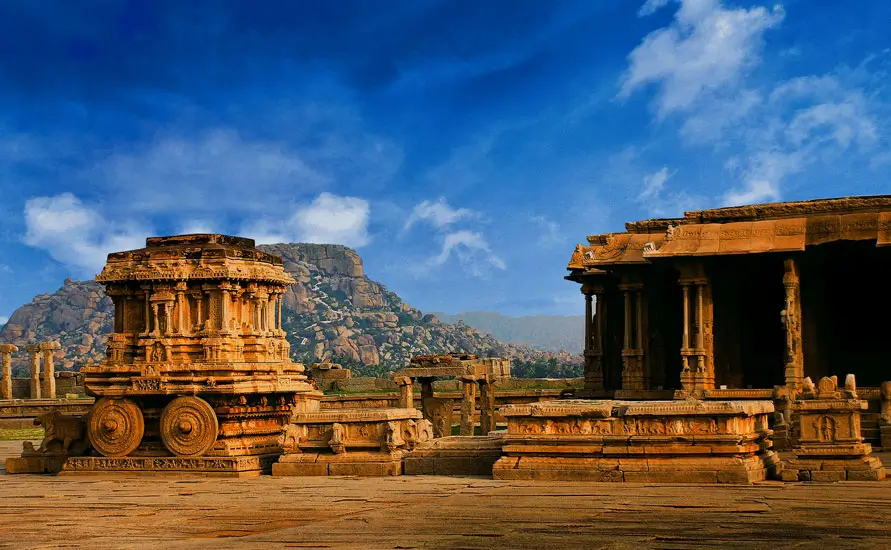
Arrive early at the Vittala Temple, the finest piece of architecture in Hampi and the image printed on the back of India's newer 50-rupee notes. Electric carts carry visitors for the final kilometer from the parking area, though you can also walk the riverside path, where you pass the so-called King's Balance, a granite arch from which rulers were weighed against grain and coins to be given to priests. Your guide talks you through the famous stone chariot, actually a small shrine for Vishnu's eagle Garuda, and the slender musical pillars of the main hall. Barriers now keep hands away from them, though your guide can describe how they once rang.
Later in the morning you walk down to the Tungabhadra for a short trip in a coracle, a round basket boat woven from bamboo and made watertight with a tarred sheet underneath, as it once was with buffalo hide. Your boatman paddles past river boulders carved with lingams and small deities, often turning the coracle in a slow spin for fun. On the far bank you visit Anegundi, the fortified village that existed before the empire grew, with its mud-walled homes, small shrines and a craft collective where village women weave banana-fiber handbags, table mats and baskets. Lunch is a simple local meal.
Late in the afternoon, those happy with a climb can tackle the roughly 575 steps of Anjanadri Hill, which many Hindus consider the birthplace of Hanuman. Monkeys live on the hill and are bold, so keep snacks and sunglasses in a zipped bag. At the top, a small white temple looks over paddy fields, the winding river and the endless boulder hills of Hampi turning gold in the evening sun. A gentler alternative is the Archaeological Museum at Kamalapur, closed on Fridays, with sculptures, coins and a big relief map of the ruined city. Tonight, a farewell dinner before you pack. Overnight in Hospet.
Once you have eaten and settled the bill, the car sets off for Jindal Vijayanagar Airport near Toranagallu, a drive of around one hour from Hospet. This compact airport runs a small number of domestic routes, typically to Bangalore and Hyderabad, from where you continue on an international flight. Its timetable can vary by season, so we confirm the schedule at the time of booking. If the timings do not work, your driver takes you instead to Hubballi Airport, a westward run of three hours or a little more with more flight options, or back to Bangalore by road in roughly six hours.
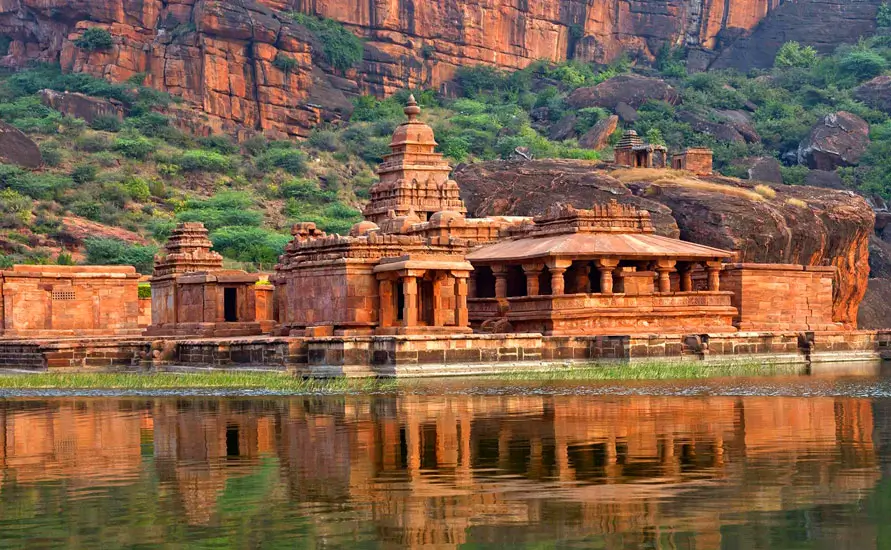
In eleven days you have walked through a royal palace, Tipu's island capital, a Tibetan monastery, a Kodagu coffee estate, two Hoysala temples and the remains of Vijayanagara. That is a wide sweep of Karnataka in one trip, and many guests return later for Badami, Aihole and Pattadakal or the beaches of Gokarna. Our operations desk keeps an eye on your progress until boarding, and your feedback after the trip is always welcome. Thank you for choosing us for this trip, and safe travels.
Your Journey

N.S. Rathore & Mrs. Omlata Rathore · Managing Director
We still read every enquiry ourselves. Tell us the places you liked and our planners will send a day-by-day route with drive times and a clear price.
Every package can be customised and no pressure to book. A planner from our office replies within 24 hours with a route written for your group.
Fill this in and your planner will send a first draft itinerary.
Explore more
Kerala Backwaters Escape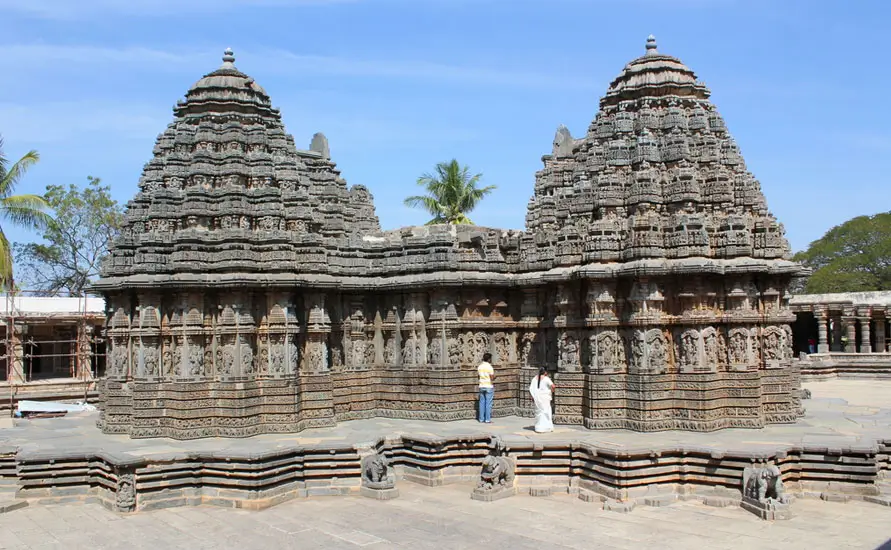 Kerala Backwaters Escape
 Kerala Backwaters Escape
 Kerala Backwaters Escape
 Kerala Backwaters Escape
 Kerala Backwaters Escape
 Kerala Backwaters Escape
 Kerala Backwaters Escape
 Kerala Backwaters Escape
 Kerala Backwaters Escape