 Kerala Backwaters Escape

Karnataka Tour Packages
Bangalore – Hampi – Badami – Pattadakal – Aihole – Bijapur – Gulbarga – Bidar – Hyderabad
At a glance
For a thousand years the Deccan plateau was contested ground, and its rulers left behind temples, palaces, mosques and domed tombs that still stand within a few hours of one another. Our Deccan heritage tour Hampi Badami Bijapur follows both strands of that history. It begins with Hindu kingdoms, the Vijayanagara emperors of Hampi and the Chalukyas of Badami, Pattadakal and Aihole, then crosses into the world of the Deccan Sultanates at Bijapur, Gulbarga and Bidar, before ending in Hyderabad, the last great capital of the region.
These dynasties were not separate stories. They traded, intermarried, hired each other's soldiers and borrowed each other's architects, and in 1565 an alliance of sultans defeated Vijayanagara near Talikota, an event that shaped everything you see on this route. Your guides link the sites together, so the cusped arches of Hampi's royal buildings make sense when you reach the Adil Shahi domes of Bijapur. This Deccan heritage tour gives three nights in Hampi, two each in Badami and Bijapur, and a night in Bidar, so there is time to look properly.
The trip suits history lovers, photographers and repeat visitors to India who have seen the Golden Triangle and want something less traveled, as well as NRI families tracing the story of the Deccan. North Karnataka has fewer tourists than the south of the state, and hotels outside Hampi are simple but comfortable. November to February is the best season, as April and May are very hot. The tour finishes in Hyderabad, which has strong international connections, and an extra night there can easily be added for Golconda and the Charminar.
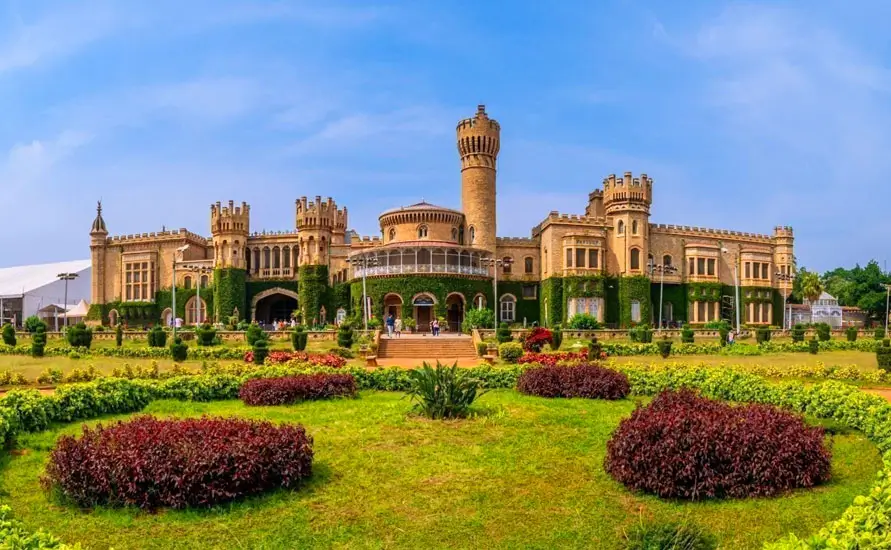
Your trip across the Deccan starts at Kempegowda International Airport, where one of our staff, placard in hand, guides you out to your own air-conditioned vehicle. The drive into town follows the flyover-lined highway past new office parks, and on a clear day you can already see the granite outcrops that dot the plateau. Once you have your room key, sleep off the flight for as long as you need. Later on, our team phones to walk you through the eleven-day plan, confirm meal preferences and explain how the guides will change from region to region along the route.
Toward evening, your guide leads the way to Tipu Sultan's Summer Palace, dated to 1791, in the old market district of Bangalore. Built of teak on two floors, with carved arches, balconies and painted walls, the building is a neat introduction to the theme of the tour. Tipu was a Muslim ruler of a largely Hindu kingdom, and his palace mixes Persian arches with local carpentry. Your guide explains how Mysore, Vijayanagara and the Deccan Sultanates were rival neighbors for centuries, and how their courts copied fashions in building, dress and court ritual from one another.
A short walk away, a surviving stretch of the Bangalore Fort shows the stonework of a mud fort that Hyder Ali rebuilt in stone in the 18th century, with a carved Ganesha shrine inside one of its walls. The nearby Kote Venkataramana Temple, built by the Wodeyars of Mysore, stands right next to Tipu's palace, a reminder that the two sat side by side for generations. In the evening, head for dinner to one of the city's many South Indian restaurants and try ragi mudde or bisi bele bath before tomorrow's long drive north. Overnight in Bangalore.
Bangalore falls behind you soon after breakfast as you head north on a smooth six-hour drive that crosses the plateau through Tumkur, Chitradurga and Hospet. The scenery shifts from city sprawl to red earth, sunflower fields and long granite ridges with wind turbines turning on top. Stops are made for filter coffee and for lunch at a well-kept roadside restaurant. If you prefer to save time, a short flight to the Jindal Vijayanagar airport near Toranagallu can replace most of the drive, subject to schedules, and we can quote for it when you book.
You reach Hampi in the middle of the afternoon and check in to your hotel near the ruins or in Hospet. If you still have energy, your guide can take you up Hemakuta Hill for sunset, an easy climb over smooth rock to a group of small early shrines with a view across the boulders to the Virupaksha gopuram. If not, a quiet evening at the hotel sets you up well for two full days among the ruins. For dinner, a plain rice meal on a banana leaf is easy to find nearby. Overnight in Hampi.
Hampi was Vijayanagara, the city of victory, a royal city that grew to dominate the southern peninsula after it was founded in the 14th century by the brothers Harihara and Bukka. At its height under Krishnadevaraya in the early 16th century, foreign visitors compared it to Rome. The morning opens in the sacred quarter at the Virupaksha Temple, where worship has continued without a break since before the empire, and explains how the god Virupaksha and his consort Pampa, a local river goddess, gave the city its sacred identity. Priests, pilgrims and flower sellers still crowd the courtyard every morning.
From the temple you walk the long stone road of Hampi Bazaar, once a market where traders sold horses, pearls, silk and spices, then climb gently toward the Kadalekalu and Sasivekalu Ganesha statues, two monolithic figures in open pavilions. Before noon you head along the riverbank road to the Vittala Temple, where the pillared halls and the stone chariot represent the peak of Vijayanagara stone carving. Battery buggies link the car park with the temple gate, and the colonnettes once known as musical pillars may no longer be struck, as the stone has been damaged by years of tapping.
In the afternoon, when the light softens, you visit the King's Balance, a stone frame where the ruler was weighed against gold and grain that were then given away, and walk along the river path past small shrines and rock carvings. If the water level allows, a coracle ride across the Tungabhadra brings you close to the cliffs and boulders, and the round bamboo boats spin gently in the current. Your guide closes the day by pointing out how much of the city was built of local granite, a hard stone that shaped the sturdy, broad style of the place. Overnight in Hampi.
Today's theme is the relationship between Vijayanagara and its Muslim neighbors, which shaped the city as much as war did. In the Royal Center, your guide shows you the great Mahanavami platform, where the king watched the nine-night festival that later became Mysore Dasara, and the rows of foundations that mark lost wooden palaces. Nearby, the walled Zenana Enclosure holds the Lotus Mahal, whose arches are cusped in the style of Bijapur and Gulbarga while its upper story keeps a Hindu tiered roof. You will see the same arch shape again in a few days, on buildings put up by the people who destroyed this city.
Vijayanagara employed Muslim cavalry and archers, and an area of the city, sometimes called the Muslim quarter, held mosques and tombs for them. Your guide takes you past the Elephant Stables, with domes in several different shapes, and the Queen's Bath, a plain-walled building with an open pool surrounded by arched corridors, both clearly influenced by Deccan Sultanate design. The Hampi archaeological museum at Kamalapura, closed on Fridays, displays sculptures, coins and a scale model of the site that makes the vast layout easier to understand. It is worth an hour before lunch.
Over lunch your guide tells the story of 1565, when the sultans of Bijapur, Ahmadnagar, Golconda and Bidar joined forces and defeated the Vijayanagara army near Talikota. The capital was looted and burned over months, and most of the damage you see today dates from that time. As the heat drops, your guide leads you to the Hazara Rama Temple, whose wall reliefs record the processions and festivals of the court, and finish at Malyavanta Hill for sunset over the ruined city. Tomorrow you follow the history north toward the earlier Chalukya capital and, beyond it, the sultans' cities. Overnight in Hampi.
A morning drive of around three and a half hours takes you north-west to Badami through farmland and small market towns. Here the story jumps back roughly eight centuries before Vijayanagara. Badami, then called Vatapi, was capital of the early Chalukyas, and in the 7th century King Pulakeshin II stopped the northern emperor Harsha at the Narmada, a victory that kept the Deccan independent of the north for generations. Only a few decades later, the Pallavas of Kanchipuram captured and burned Vatapi, and the Chalukyas later took their revenge. Rivalry on the plateau, in other words, is much older than the sultans.
Once lunch and a rest are over, climb to the Badami cave temples, a set of four sanctuaries hollowed out of the red sandstone cliff above Agastya Lake in the 6th century. Three are Hindu and one is Jain, and their carved panels show Vishnu as a man-lion and as the dwarf who grows to cover the universe, along with a dancing Shiva and a seated Jain tirthankara. On one ceiling, look for the faded remains of painted figures. The steps are steep in places, so wear shoes with good grip, and keep a firm hold on bags and snacks, because the monkeys here are bold and quick.
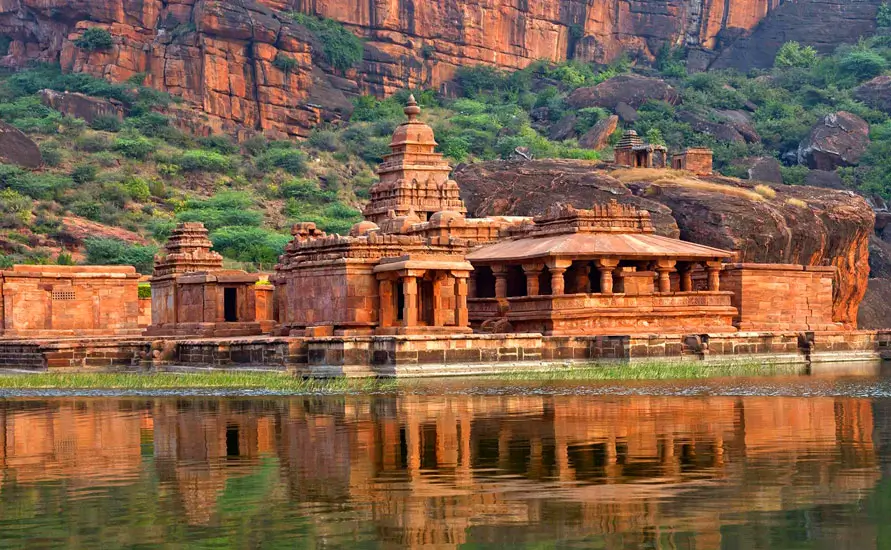
Later in the afternoon, the walk to the North Fort gives you the best view of the town, with the tank, the caves and the red cliffs spread out below. Granaries, watchtowers and gates on the ridge were used and rebuilt by many later rulers, including the Adil Shahis of Bijapur and, in the 18th century, Tipu Sultan and the Marathas, so the fort brings the stories of Hindu and Muslim kings together in a single climb. Coming back down, pause at the Bhutanatha temples at the water's edge for sunset reflections. Dinner can be a north Karnataka meal of jowar roti with spicy chutney powder. Overnight in Badami.
A half-hour drive after breakfast brings you to Pattadakal, where Chalukya kings held their coronations, and where a group of temples on the Malaprabha River is listed by UNESCO. The site shows southern and northern temple towers standing next to one another, a sign that the Chalukyas drew craftsmen and ideas from both directions. The largest temple, the Virupaksha, was built by Queen Lokamahadevi in the 8th century after her husband's war against the Pallavas, and the conquered Pallava city seems to have supplied some of the masons. Notice how its gateway, hall and towers anticipate the layout of later Dravida temples, including those at Hampi.
Your guide also shows you the Papanatha Temple and the Mallikarjuna Temple, along with small shrines built in the curved northern style. The site is compact and flat, which makes it easy to cover in about two hours. Afterward you continue north to Aihole, a village where over a hundred temples have been counted, the oldest among them perhaps dating to the 5th or 6th century. Lunch is a simple meal in a village restaurant or a packed lunch from your hotel, as dining options are limited in this rural area.
In the afternoon you visit the Durga Temple, with its rounded back wall and its gallery of pillars, and the Lad Khan Temple and Huchimalli Gudi, early buildings that show builders trying different plans. Up on the ridge, the Meguti Temple carries the famous Aihole inscription of 634, which records the victories of Pulakeshin II and gives one of the earliest firm dates in Karnataka's history. Your guide connects the day with the theme of the tour: these Chalukya kings were the first to build an empire across the Deccan, the same ground later held by the Bahmanis. Return to Badami in the evening. Overnight in Badami.
Leaving Badami after breakfast, you drive north across the Krishna basin, passing sugarcane fields, grape vines and the backwaters of the Almatti dam, to Bijapur, officially known as Vijayapura. Within three hours you are in a city that looks nothing like the temple towns of the past few days. Domes, minarets and crumbling walls rise above the rooftops, and the city's skyline is defined by tombs rather than temples. Bijapur was the capital of the Adil Shahi sultans from 1489 until 1686, when the Mughal emperor Aurangzeb took the city, and its rulers built some of the finest Islamic monuments in India.
After checking in and a short rest, your guide introduces the dynasty. The founder, Yusuf Adil Khan, was a governor under the Bahmani sultans of Bidar who declared independence as their power weakened, one of five successor states that divided the Deccan. The Adil Shahis were Shia for long stretches, invited Persian and Turkish scholars, and also employed Hindu ministers and Maratha soldiers. Ibrahim Adil Shah II, who ruled from 1580 to 1627, was a poet and musician who wrote songs in Dakhni, praising both Saraswati and the Prophet, and his reign is often seen as the high point of the court.
The day ends at the Ibrahim Rauza, the tomb that Ibrahim Adil Shah II built for himself and his queen, set on a raised platform facing a mosque across a garden. The walls are covered with stone carving fine enough to pass for wood or fabric, with lattice windows, chains carved from single blocks and Quranic calligraphy. Local guides like to say that it inspired the Taj Mahal, built a few decades later, and while that claim is debated, the elegance of the proportions is plain to see. The light at sunset turns the stone a warm golden color. Overnight in Bijapur.
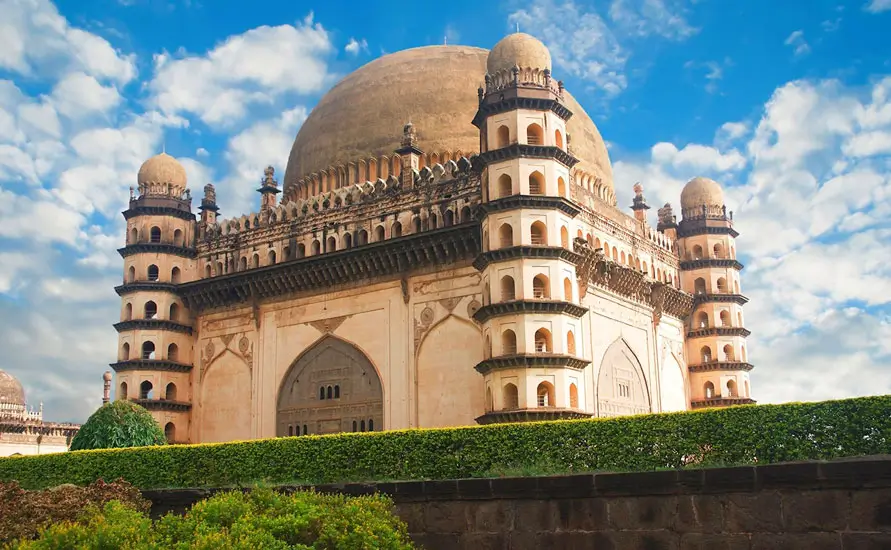
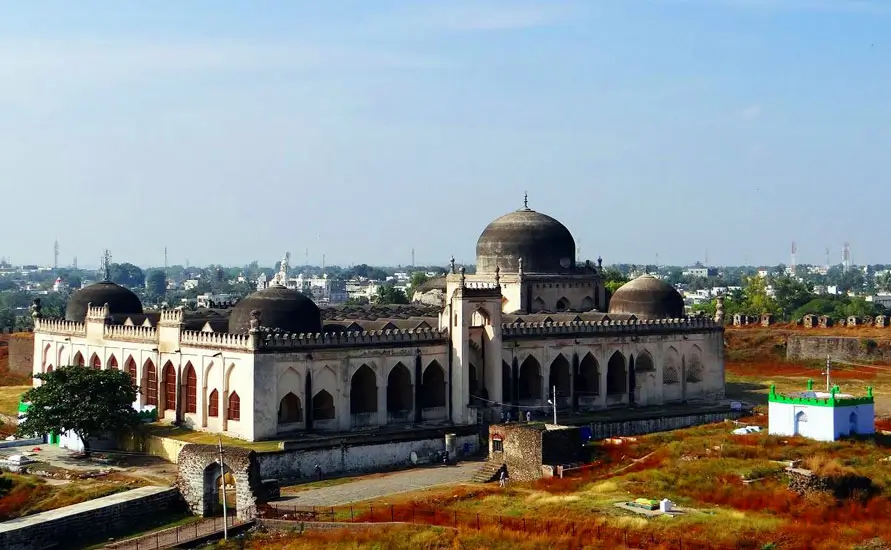
Be at the Gol Gumbaz as soon as it opens, because the famous echo works best before school groups arrive. The tomb of Mohammed Adil Shah, completed in 1656, has one of the largest domes in the world built without internal supports, resting on a square hall with octagonal towers at each corner. Climb the narrow staircase inside one of the towers to the whispering gallery, a circular ledge that runs around the base of the dome. A whisper against the wall carries clearly to the opposite side, and a single clap returns as a series of echoes. Some visitors shout to test it, so early morning is the calmest time.
From the gallery you can also step out onto the roof for a view across the city, with the domes of Bijapur spread out in every direction. Next comes the Jama Masjid, started by Ali Adil Shah I after the victory at Talikota and one of the largest mosques in the Deccan. Its prayer hall has a mihrab decorated with gilded and painted designs, and floor spaces were marked out for individual worshippers. Non-Muslim visitors are welcome outside prayer times, with covered arms and legs, and women should bring a scarf to cover their hair.
Your afternoon begins at the Malik-e-Maidan, the monarch of the plains, a huge bronze cannon cast in 1549 and brought to Bijapur as war booty. It sits on a bastion of the city wall, and its muzzle is shaped like the open jaws of a lion swallowing an elephant. Nearby stand the unfinished arches of the Bara Kaman, the tomb of Ali Adil Shah II, which would have been bigger than the Gol Gumbaz if completed. Your guide finishes at a step well or one of the old water tanks that supplied the city. In the evening, try a Bijapur-style mutton curry with jowar roti. Overnight in Bijapur.
The drive east today follows the history backward from the Adil Shahis to the dynasty they came from. Roughly 210 km on, you arrive in Gulbarga, now called Kalaburagi, which became the first capital of the Bahmani Sultanate in 1347, when Alauddin Hasan Bahman Shah broke away from the Delhi Sultanate. The Bahmanis ruled most of the Deccan for nearly two centuries, fighting Vijayanagara for control of the fertile Raichur area between the rivers, and their kingdom later split into the five sultanates of Bijapur, Golconda, Ahmadnagar, Berar and Bidar. Gulbarga is not a tourist town, and you may be the only foreign visitors.
Inside the walls of the Gulbarga Fort stands its most unusual building, the Jama Masjid, built in the 14th century. Unlike most mosques, it has no open courtyard; the whole space is roofed with rows of small domes on low arches, and the light falls through the side openings in soft, even bands. From the fort you drive across town to the dargah of Khwaja Bande Nawaz, a Sufi saint who died in Gulbarga in the early 15th century and whose shrine still draws pilgrims of many faiths. Visitors should dress modestly and cover their heads, and women may be asked to stay in certain areas of the shrine.
After lunch in Gulbarga the road runs on for some 120 km to Bidar, the second Bahmani capital, on a laterite plateau close to the border with Telangana. The countryside becomes greener and the soil a reddish brown. Check-in at a simple but comfortable hotel comes before dusk. If time allows before sunset, your guide takes you to the Ashtur tombs just outside town, where twelve Bahmani rulers are buried under domed mausoleums, one of them with painted interiors in gold, red and blue. The evening is quiet, and dinner is served at the hotel. Overnight in Bidar.
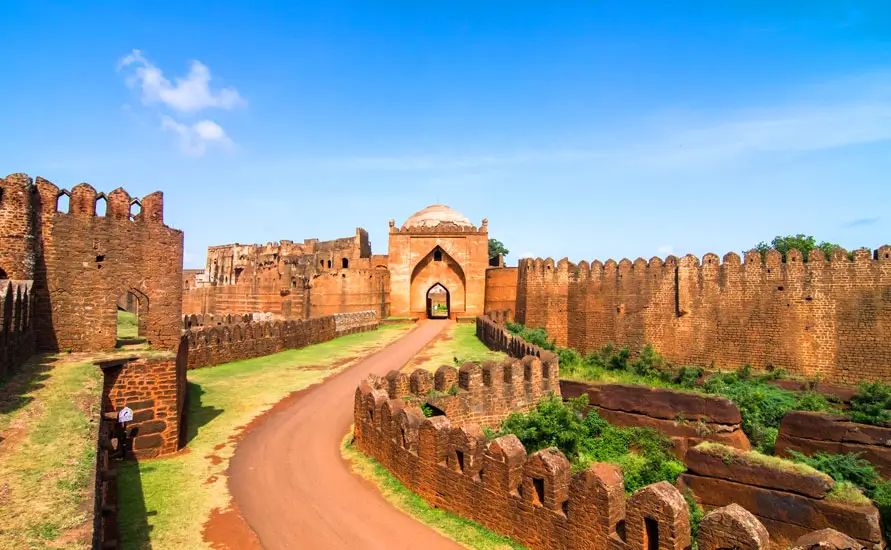
Spend the morning at Bidar Fort, rebuilt in the 1420s when Sultan Ahmad Shah Wali moved the Bahmani capital here from Gulbarga. The walls and moats stretch for several kilometers, and inside you find palaces, mosques and gardens in different states of repair. The Rangin Mahal, or colored palace, has wooden columns and panels of black stone inlaid with mother of pearl, among the finest decorative work of the period. Your guide also shows you the Solah Khamba mosque, with its sixteen columns, and the karez, a system of underground water channels built with Persian techniques to supply the fort.
In the old town, the ruined Madrasa of Mahmud Gawan, built in 1472 by a Persian-born prime minister of the Bahmanis, was once a great center of learning with a library, lecture halls and student rooms. One surviving minaret still carries patches of blue and green glazed tiles, and the facade shows how closely Bidar followed the styles of Iran and Central Asia. Before leaving town you visit a family workshop that makes bidriware, the craft for which Bidar is famous. An alloy of zinc and copper is cast, engraved and inlaid with silver wire, then blackened with a paste made from the soil of the fort.
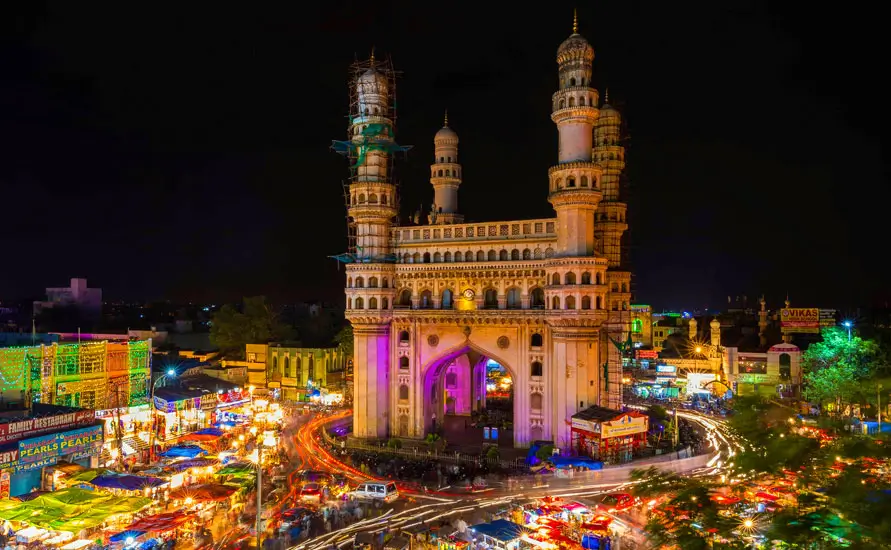
After lunch you drive west to Hyderabad, crossing into Telangana and arriving by around five. Hyderabad was founded by the Qutb Shahis of Golconda, another of the five successor sultanates, and later became the seat of the Nizams, so it is a fitting place to end the tour. If you arrive in time, your guide can take you for an evening walk around the Charminar and the bangle stalls of Laad Bazaar, or you can simply rest at the hotel. A Hyderabadi biryani makes an appropriate last dinner of the trip. Overnight in Hyderabad.
After breakfast, your driver transfers you to Rajiv Gandhi International Airport, about an hour from the city center, in time for your onward flight. Hyderabad has direct connections to the Gulf, Europe and Southeast Asia, so many guests fly home from here without a change in another Indian city. An evening departure leaves room for a morning at Golconda Fort or the domed Qutb Shahi tombs, which complete the story of the Deccan Sultanates you have followed for the past week.
Over eleven days you have crossed the Deccan from the temples of Hampi and the early Chalukya shrines to the domes of Bijapur, the mosques of Gulbarga and the fort and craft workshops of Bidar. Few routes in India show Hindu and Islamic heritage in such close conversation. For a future trip, the rock-cut caves of Ellora and Ajanta continue this Deccan story further north, and our team would be glad to plan them.
Your Journey

N.S. Rathore & Mrs. Omlata Rathore · Managing Director
We still read every enquiry ourselves. Tell us the places you liked and our planners will send a day-by-day route with drive times and a clear price.
Every package can be customised and no pressure to book. A planner from our office replies within 24 hours with a route written for your group.
Fill this in and your planner will send a first draft itinerary.
Explore more
Kerala Backwaters Escape Kerala Backwaters Escape
 Kerala Backwaters Escape
 Kerala Backwaters Escape
 Kerala Backwaters Escape
 Kerala Backwaters Escape
 Kerala Backwaters Escape
 Kerala Backwaters Escape
 Kerala Backwaters Escape
 Kerala Backwaters Escape