 Kerala Backwaters Escape

Karnataka Tour Packages
Bangalore – Ranganathittu – Mysore – Coorg – Chikmagalur – Belur – Halebidu – Hampi – Bangalore
At a glance
Plenty of travelers fly into Bangalore and want to fly out of the same airport, without paying for open-jaw tickets or long backtracking. Our Karnataka tour from Bangalore 12 days is built as a clean loop. It runs south to the royal city of Mysore, west into the coffee and pepper hills of Coorg, north through the high ridges of Chikmagalur, past the carved shrines of Belur and Halebidu, then across the plateau to Hampi and its granite-strewn ruins before bringing you back to the airport you arrived at. No leg repeats an earlier road.
The pace on this Karnataka tour from Bangalore is easy by Indian standards. Each base holds you for two or three nights, so most mornings start without packing, and the drives between them stay mostly between three and four hours. The one long stretch, from the coffee hills to Hampi, is given a day to itself. For the return there are two choices: a road trip of around six hours back to Bangalore, or a short flight from the Jindal Vijayanagar airport near Hampi, which turns the last day into a relaxed morning.
This Bangalore round trip tour suits couples and families flying in from Britain, Europe, the US, Canada or Australia who want both cool green hills and big historic sites in one holiday, and for NRI families returning to the state with children. Private transport, local guides in each region and breakfast every day are included, and everything from hotel style to how much walking you do can be changed. The driest, mildest months are October to February, and the hills look greenest straight after the rains.
Once you have cleared immigration and collected your bags, look for our representative just beyond the arrivals gate at Bangalore's Kempegowda International Airport. Your private car for the next twelve days is waiting outside, and the same driver will usually stay with you for the whole loop, which many guests find reassuring by the end of the trip. The drive to a hotel in the central or eastern part of the city normally takes between sixty and ninety minutes. Our local coordinator checks you in, gives you the trip folder with emergency numbers, and helps you buy a prepaid SIM card if you need one.
After a rest, a gentle first outing takes you to Cubbon Park, a stretch of some 300 acres of lawns, bamboo groves and old rain trees in the middle of the city, planned by the British administration in 1870. Along its edge rise the red-painted Attara Kacheri, which now houses the state High Court, and the granite Vidhana Soudha, where the state legislature meets, completed in 1956 in what its planners called a Neo-Dravidian manner. Photography of the Vidhana Soudha is allowed from the road, and it is floodlit on Sundays and public holidays. Your guide explains how Bangalore grew from a mud fort into a garden city.
In the early evening you head north-west to Malleshwaram, one of the oldest planned neighborhoods of the city, first plotted in 1898, when plague pushed residents away from the cramped old pete. Its grid of streets, quiet bungalows and flower markets still feels very different from the glass towers of the technology parks. The Kadu Malleshwara Temple sits under old trees on a small rise, and the main market street is lined with sari shops and stalls selling jasmine strings. Locals queue at small eateries for dosas, idlis and coffee served in steel tumblers, an easy and inexpensive first dinner in the city. Overnight in Bangalore.
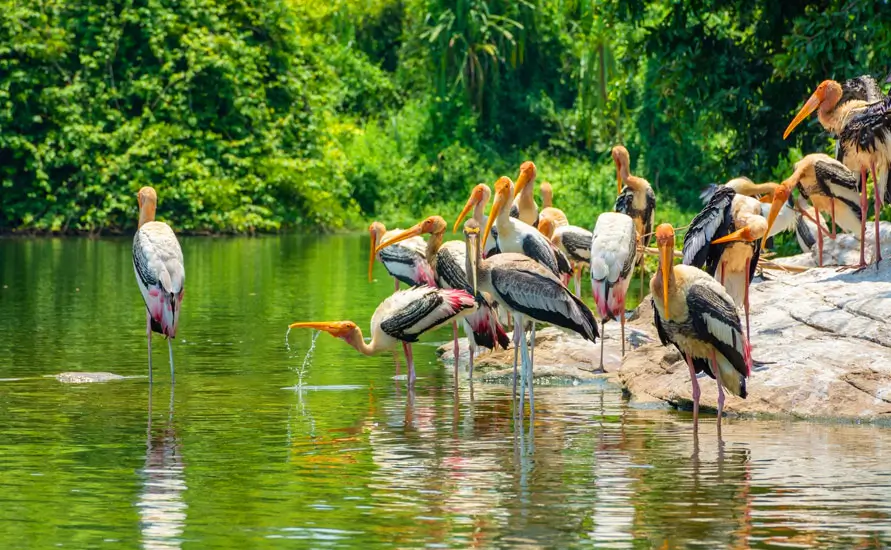
Your loop around the state begins with an early drive south-west on the new expressway, which has cut the trip to Mysore to around three hours on a good day. Just before reaching the city you turn off for Ranganathittu Bird Sanctuary, a cluster of tree-covered islets in the Kaveri that formed downstream of a weir built in the 17th century. Between roughly December and August, thousands of water birds nest on the trees here, including painted storks, Asian openbills, spoonbills, black-headed ibis and great cormorants. Marsh crocodiles bask on the rocks near the banks, keeping a close eye on any chick that falls into the water.
The best way to see the colonies is from one of the small rowing boats that go out along the island edges, with a boatman who knows which nests are active. It is a short, peaceful ride and photographers usually find the morning light best. From the riverside paths you can also watch flocks of pelicans fishing in the shallows and kingfishers diving from overhanging branches. The sanctuary is a reminder that the Kaveri, which you will follow up to its source in Coorg later this week, is the river that waters most of southern Karnataka and the Tamil plains beyond it.
Continue to Mysore and check in around lunchtime. Toward evening you visit St. Philomena's Cathedral, one of the tallest churches in India, whose twin spires rise above the northern part of the city. A crypt below the main altar holds a relic of St. Philomena, an early Christian martyr, while colored glass windows along the nave picture the Nativity, the Last Supper and the Crucifixion. Afterward, take a short walk along Sayyaji Rao Road, the main shopping street, where you can buy pure Mysore silk at the government silk emporium or browse sandalwood carvings at the state handicrafts showroom. Overnight in Mysore.
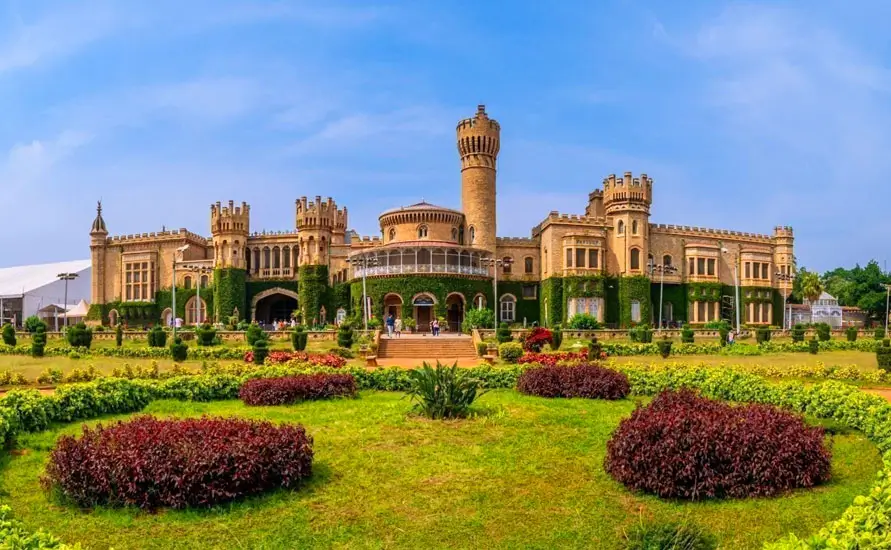
Spend the morning with your guide inside the Mysore Palace, the grand home of the Wodeyar kings in the center of the city. Most visitors rush through in an hour, but it is worth taking your time with the details: rosewood doorways set with ivory inlay, the cast-iron pillars brought from Britain, and the life-size statues of tigers and elephants that guard the stairways. The palace is also the starting point of the Dasara procession each autumn, when caparisoned elephants carry the goddess Chamundeshwari through the city on a golden howdah, watched by vast crowds. Footwear and cameras are deposited at counters before you go inside.
Next you ride up to the summit of Chamundi Hill, roughly a thousand meters up, for a wide view across the city, its lakes and the palace domes. The Chamundeshwari Temple at the top has a tall seven-story gopuram, and a large painted statue of the demon Mahishasura stands nearby holding a sword and a cobra. If you fancy a little exercise, you can walk down part of the stone stairway past the black granite Nandi, a monolith decorated with carved chains and bells. Monkeys gather around the stalls at the top, so keep food and sunglasses out of sight.
After lunch and an afternoon break, your guide takes you into the Devaraja Market, a long arcade where traders sit among mountains of marigolds, rose petals, fresh limes, betel leaves and bright powders used for temple rituals and rangoli. Local women buy jasmine by the arm's length to wear in their hair, and the tobacco and spice sellers are happy to explain what everything is. Nearby you can try a slice of Mysore pak, a crumbly sweet of chickpea flour, sugar and ghee, at one of the old family shops credited with keeping the recipe alive. On a Sunday evening the palace lights are switched on. Overnight in Mysore.
Westward from Mysore, flat farmland slowly gives way to the first folds of the Western Ghats. You pass through Hunsur, known for its tobacco curing barns, and on toward Kushalnagar; just short of it, a side road leads to the Tibetan settlement of Bylakuppe. A stop at the Namdroling Monastery lets you see its tall golden statues and the ornate murals of the main prayer hall, and to watch young monks crossing the courtyard in maroon robes. The canteens nearby serve good Tibetan bread and butter tea, which make a handy break before the final climb.
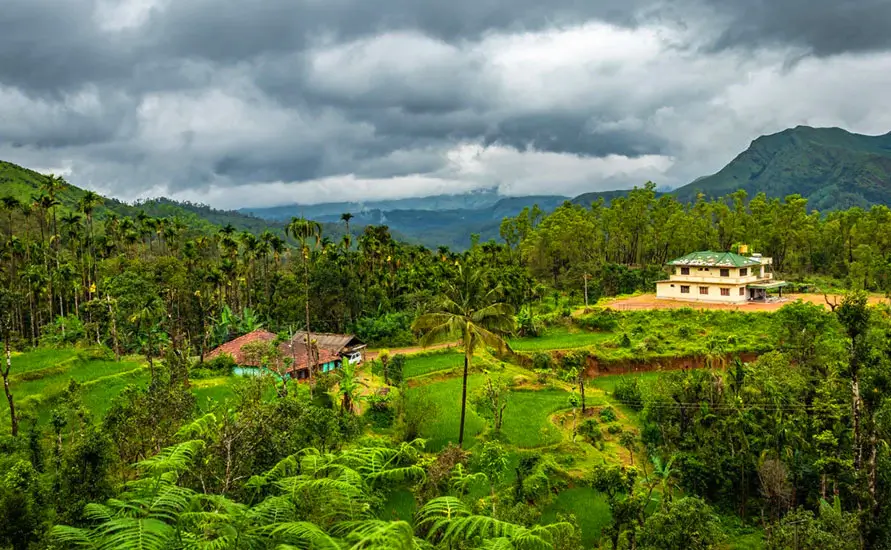
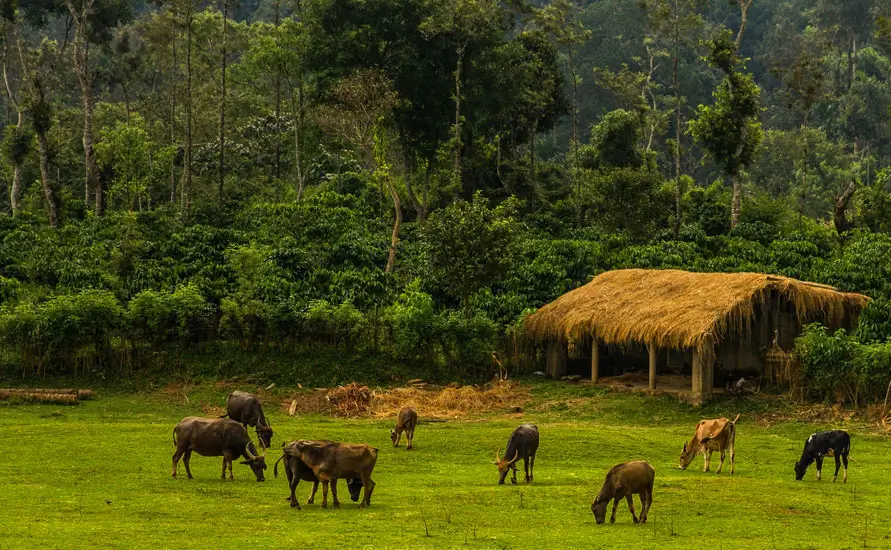
Beyond Kushalnagar the road rises into Coorg, or Kodagu, a district of wooded hills, coffee estates and paddy valleys in the Western Ghats. Rain is plentiful here, and even in the dry season the slopes stay green under the tall trees that shade the coffee. You stay two nights at a homestay or estate resort and will likely wake to the call of hornbills and Malabar whistling thrushes. The Kodavas are known for their martial past, and many families still keep ceremonial guns and swords that come out at festivals, a source of quiet local pride.
In the afternoon your host or estate manager leads a short walk through the coffee rows and explains each stage of the work, from planting and pruning to picking, pulping and drying. You will also see pepper vines, cardamom clumps and fruit trees growing between the coffee, which is typical of the mixed farming in Coorg. Later, enjoy a home-style Kodava dinner, where the table might hold kadambuttu (steamed rice balls), a curry of tender bamboo shoot and pandi curry, often finished with a glass of homemade wine made from local fruit. The evenings in Coorg are cool, so pack a light sweater. Overnight in Coorg.
Ninety minutes of driving through forest and terraced paddy fields brings you to Bhagamandala, the confluence of the Kaveri with the Kannike and the mythical underground Sujyothi. The temple here is built in the Kerala style with sloping tiled roofs and wooden panels, and pilgrims take a dip at the confluence before heading uphill. Continue another 8 km to Talacauvery, the spot on the Brahmagiri hills regarded as the source of the Kaveri. A small tank fed by a spring marks the birthplace of the river, and on the day of Tula Sankramana in mid-October thousands of devotees gather to see the water rise. Steps lead above the shrine to a lookout over the Ghats.
On the way back your guide arranges a visit to an ain mane, a traditional Kodava ancestral house built around an open courtyard, with a raised veranda, carved wooden pillars and a prayer room for the family's ancestors. These homes are the center of the clan, and family members return for weddings, festivals and naming ceremonies. Your host may show you the traditional Kodava dress worn on such occasions, with a long black coat called the kupya, a silk sash and a ceremonial knife, and explain the festivals of Puthari, the rice harvest, and Kailpodh, when weapons are honored.
Later in the afternoon you can choose between a visit to Nisargadhama, a bamboo-covered river island that you reach on foot over a swaying footbridge, or the Dubare camp, where you can watch elephants being bathed and fed by their keepers from the river bank. We recommend watching rather than touching or joining the bathing, which is better for the animals. If you prefer to stay at the estate, a long afternoon on the veranda with a book is a perfectly good use of the time. Dinner is at the homestay or resort, with plenty of choice for vegetarians as well as meat-eaters. Overnight in Coorg.
Once you have said goodbye to your hosts, you head north through Somwarpet and Sakleshpur, a scenic route that follows the line of the Western Ghats through plantations of coffee, cardamom and pepper. Along the way your driver will point out the shade trees, the small drying yards outside village homes and the roadside shops selling estate coffee by the kilo. If the weather is clear, there are views across the green hills toward the Bisle forest. Allow roughly 4.5 hours including stops, with lunch at a plain eatery where rice meals come on a banana leaf.
By mid-afternoon you reach Chikmagalur, a quieter hill district that many Indian coffee lovers consider the true home of coffee in the country. The town itself is small, with a busy main street and a few old churches and temples, but its surroundings are covered with large plantations, many of them run by one family for generations. Your resort or estate bungalow looks out over the valleys, and the air at this height is noticeably cooler than in Mysore. In the dry season you may see the hills dotted with silver oak and the white flowers of coffee blossom after the first showers.
The evening is free; if you like, a plantation guide walks you round the estate who can show you how the cherries are processed using the wet and dry methods that give coffee its different flavors. Some estates offer a tasting session, where you compare a light arabica brewed by pour-over with a strong local filter coffee mixed with milk and sugar. Others have small farm shops where you can buy beans freshly roasted on the property. For dinner, ask the kitchen for akki rotti, a flatbread made from rice flour, served with chutney and a vegetable curry. Overnight in Chikmagalur.
Today you drive into the high ridge north of town, starting at Baba Budangiri, whose name recalls the Sufi saint Baba Budan, said to have carried seven coffee beans back from Yemen in the 17th century, hidden in his beard, and planted them in these hills. It is often cited as the first coffee grown in India. The shrine on the hill, known as Inam Dattatreya Peetha, draws pilgrims from both the Hindu and Muslim communities, and its management has been the subject of long legal debate. Your guide explains the story with care and makes sure you visit respectfully, with shoes removed and modest clothing.
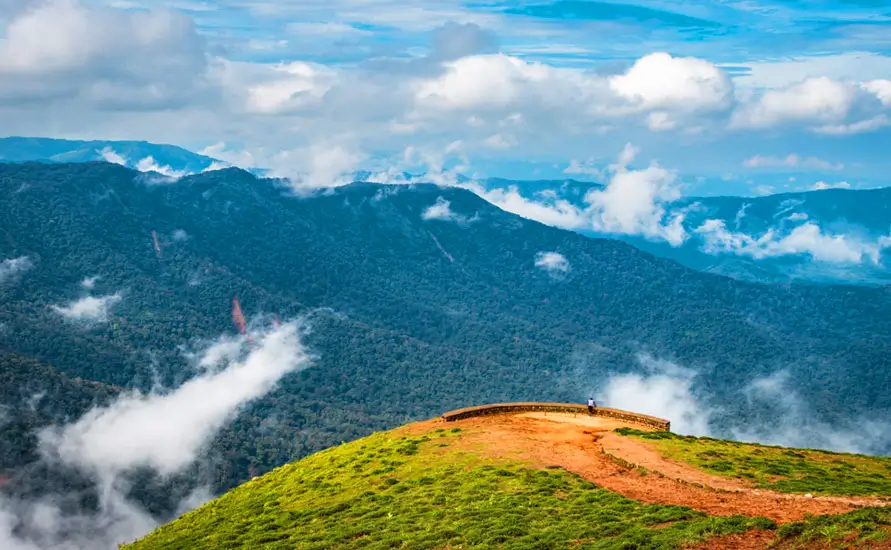
From there a winding road takes you to the base of Mullayanagiri, the highest peak in Karnataka at about 1,930 meters above sea level. The last stretch to the summit is a climb of several hundred steps, steep in places but manageable for most people at a steady pace. At the top a small temple to Shiva stands among grassland that turns gold in winter. On a clear day you see ridges of the Western Ghats in every direction and the plains of the Deccan to the east. It can be very windy and misty at the top, so bring a jacket and be ready to wait a few minutes for the clouds to lift.
On the way back to town, stop at Hirekolale Lake, a reservoir where the hills reflect in the water in the late afternoon and local families come to watch the sunset, often with a paper cone of spiced peanuts from the vendors by the bund. If you would like to buy coffee, your driver knows several small roasters in town that grind beans to order for filter or French press. Dinner at the resort comes early, and on a clear night the stars over the plantations are bright, since there is little light pollution in these hills. Overnight in Chikmagalur.
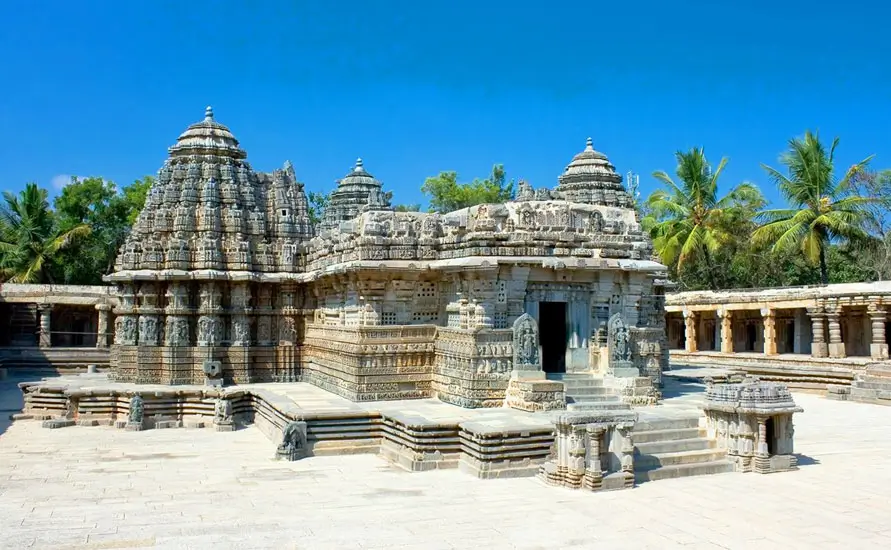
Only around 25 km separate Chikmagalur from Belur, which makes the Hoysala temples an easy day trip from your coffee-country base. The Chennakeshava Temple was built in the early 12th century by King Vishnuvardhana and is still active today. Your guide begins by walking you around the star-shaped platform, explaining how the sculptors used soapstone that was soft enough to carve with fine tools when freshly cut and gradually hardened when exposed to the air. You will see the bracket figures of celestial dancers on the outer walls, including the famous huntress drawing a bow and the woman applying make-up in a mirror.
A short drive of about half an hour brings you to Halebidu, the former Hoysala capital, where the Hoysaleswara Temple stands beside a large tank. Its outer walls are carved in horizontal friezes that stretch around the whole building, beginning with elephants at the bottom and moving up through lions, horsemen and scrolls to scenes from the Hindu epics. Your guide points out panels of Krishna lifting Govardhana hill and Ravana shaking Mount Kailash. The temples of Belur and Halebidu became part of a UNESCO World Heritage Site in 2023, together with the temple at Somanathapura.
Close by, you can also visit the Jain bastis of Halebidu, simpler temples with highly polished black pillars that seem to shine in the gloom. These temples are a reminder that the Hoysala court supported both Jain and Hindu religious life. On the drive back to Chikmagalur, stop at Ayyanakere, one of the oldest lakes in the area, built by a local ruler in the medieval period and surrounded by hills. The car brings you back to Chikmagalur with time for a rest before dinner and an early night, since tomorrow's drive to Hampi is the longest of the trip. Overnight in Chikmagalur.
This is the one long day on the road, so we set off straight after breakfast. The route drops out of the hills through Tarikere and Davangere onto the wide plateau of north-central Karnataka, where the scenery changes to sunflower and maize fields, granite outcrops and windmills along the ridges. Your driver plans regular breaks for coffee, lunch and a stretch of the legs, and Davangere is famous across the state for its butter dosa, a crisp, rich version made with plenty of butter, which makes a good lunch stop on the way.
In the afternoon the road crosses the Tungabhadra River near Hosapete and the first giant boulders of the Hampi landscape come into view, piled into hills that seem to defy gravity. You check in to your hotel around Hampi or Hosapete as the light starts to soften, with nothing else planned. If there is energy left, a short walk to a nearby viewpoint at sunset gives you a first look at the scale of the ruins. Dinner can be a simple thali at the hotel. Overnight in Hampi.
Set the alarm for sunrise on Matanga Hill, which stands taller than any other point among the Hampi ruins. The climb takes about 30 to 45 minutes on uneven rock steps and is best done with your guide, but the reward is a view across the whole site as the first light hits the temple towers and boulder hills. If you prefer an easier option, Hemakuta Hill near the main temple has gentler slopes and a cluster of small early shrines. Either way, by the time you come down the day's heat has not yet arrived, which makes this the most pleasant part of the day to be outdoors in Hampi.
Following breakfast, the day turns to the religious quarter of the old capital, beginning at the Virupaksha Temple on the riverbank, a working temple whose tall gateway faces the long colonnaded Hampi Bazaar. Merchants once traded horses, pearls and spices along this street, and travelers' accounts from the 15th and 16th centuries describe heaps of rubies and pearls on sale. Nearby stand two huge monolithic statues of Ganesha, known as Kadalekalu and Sasivekalu, the first named after a gram seed and the second after mustard for the shape of their bellies.
In the afternoon you follow the riverside path east from the bazaar past the Kodandarama Temple and small shrines carved into the rocks, a route that leads toward the Achyutaraya Temple complex, set in a quiet valley with its own ruined market street. The trail passes many carved boulders, including some showing the ten incarnations of Vishnu, and offers lovely views of the river. Your guide will adjust the length of the walk to suit your fitness and the weather. In the evening, enjoy dinner at your hotel or try one of the rooftop cafés near the bazaar. Overnight in Hampi.
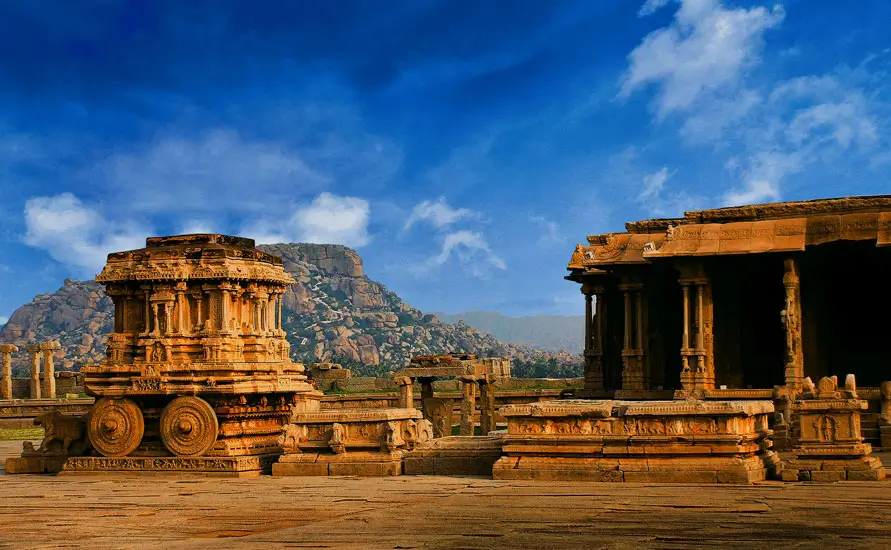
The car drops you near the Vittala Temple, widely judged the high point of Vijayanagara building and the best-known monument at Hampi. Its stone chariot, carved in granite and decorated with small panels of animals and dancers, has become a symbol of Karnataka and appears on the 50-rupee banknote. The main hall is supported by tall pillars carved with musicians and mythical beasts, and your guide explains how some of these pillars produce tones when tapped, although visitors are no longer allowed to touch them. Arrive early to beat the coach groups and enjoy the light on the stone.
After a cool drink, your guide shows you the royal center of Hampi, including the Lotus Mahal, whose upper floor of cusped arches shows the influence of Deccan Islamic builders, the Elephant Stables, with eleven domed chambers for the royal elephants, and the platform used by the emperors during the Mahanavami festival. Nearby, the Hazara Rama Temple is covered with friezes showing royal processions and scenes from the Ramayana. The Queen's Bath, a big square pool inside a plain building with balconies overlooking the water. The guide explains how the city was planned, defended and supplied with water.
Toward sunset you head down to the riverbank once more to board a coracle, a round boat made of bamboo, paddled across the gentle stretch of the Tungabhadra by a local boatman. From the water you see the boulder hills from a new angle, and in season you may spot otters, kingfishers or even a crocodile sunning itself on a distant rock. Back on land, the last dinner is at your hotel before you pack for the trip back to Bangalore. If you are taking the flight option, your driver will confirm the time for the transfer to the airport. Overnight in Hampi.
On the last day you have two options for returning to Bangalore. The first is to drive back on the national highway via Chitradurga, which takes around six hours with breaks and brings you directly to Kempegowda International Airport in time for an evening or late-night international flight. The second is to take a domestic flight from Jindal Vijayanagar Airport at Toranagallu, about an hour from Hampi, to Bangalore, which leaves you with about an hour in the air. We will help you choose the best option based on your flight time and budget.
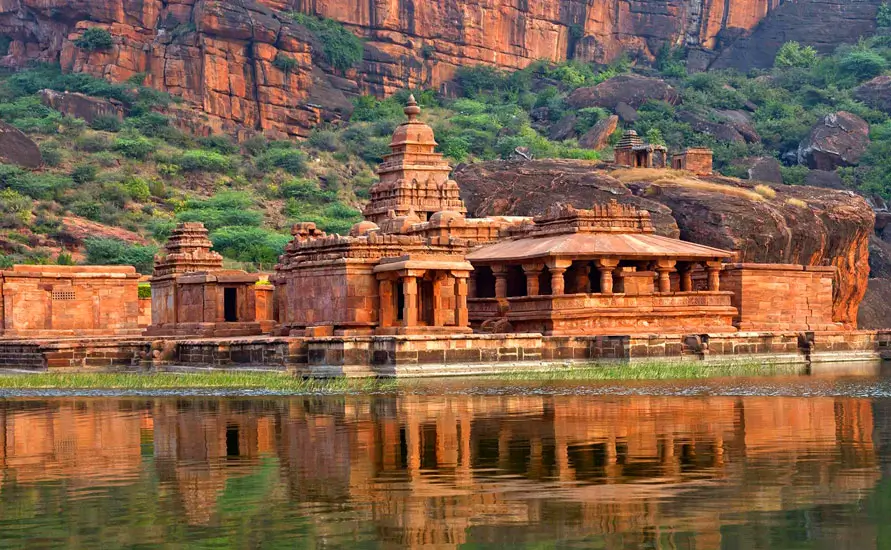
Over twelve days you have traveled a full loop around southern and central Karnataka, from the palace city of Mysore to the coffee hills of Coorg and Chikmagalur, the soapstone friezes of Belur and Halebidu, and the ruins of Hampi, all without retracing a single road. Your driver stays with you until the airport, and our team can be reached by phone right up to boarding. Many guests return for the coastal temples of Udupi and Gokarna or the Chalukya sites around Badami. Have a safe flight.
Your Journey

N.S. Rathore & Mrs. Omlata Rathore · Managing Director
We still read every enquiry ourselves. Tell us the places you liked and our planners will send a day-by-day route with drive times and a clear price.
Every package can be customised and no pressure to book. A planner from our office replies within 24 hours with a route written for your group.
Fill this in and your planner will send a first draft itinerary.
Explore more
Kerala Backwaters Escape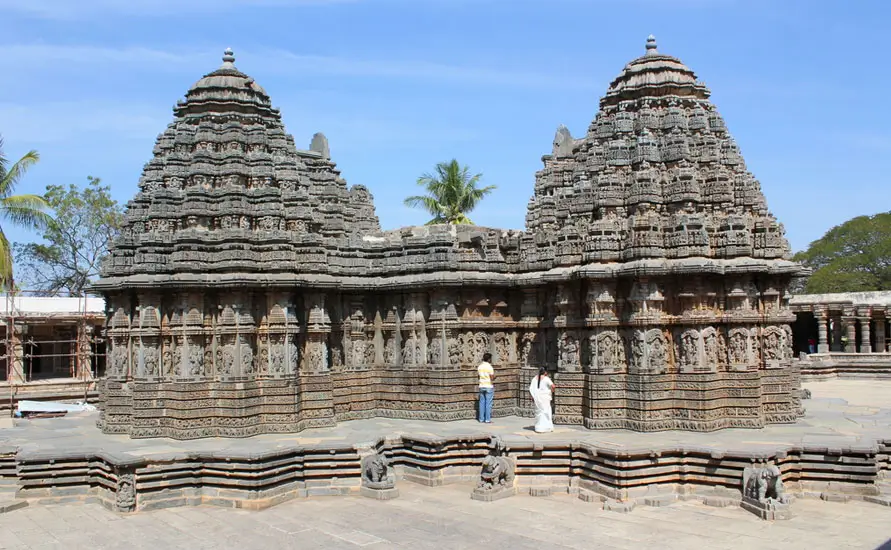 Kerala Backwaters Escape
 Kerala Backwaters Escape
 Kerala Backwaters Escape
 Kerala Backwaters Escape
 Kerala Backwaters Escape
 Kerala Backwaters Escape
 Kerala Backwaters Escape
 Kerala Backwaters Escape
 Kerala Backwaters Escape
 Kerala Backwaters Escape
 Kerala Backwaters Escape
 Kerala Backwaters Escape