


 Kerala Backwaters Escape

South India Tour Packages
Bangalore – Chikmagalur – Belur – Coorg – Mysore – Ooty – Coonoor – Pollachi – Munnar – Kochi
At a glance
Most of the coffee and a large share of the tea grown in India come from a single mountain chain, the Western Ghats and its Nilgiri extension. Our tea and coffee plantation tour South India follows those hills for thirteen days, from the slopes of Chikmagalur, where coffee first took root in India in the 17th century, to the shade-grown estates of Coorg, the high tea gardens of Ooty and Coonoor, and the green ridges of Munnar. The trip ends in Kochi, the port that shipped these crops to the world.
You sleep on working estates where possible, walk the rows with planters and pickers, and see the leaf and the bean move through withering sheds, pulping houses and drying yards. Cupping sessions and tea tastings are built into the plan, and the route also includes the Hoysala temple at Belur, Mysore Palace and the UNESCO-listed Nilgiri Mountain Railway. The long hop from the Nilgiris to Munnar is split with a night in Pollachi, so no road day runs much beyond five hours.
We designed this South India plantation tour for visitors from abroad who are fussy about their morning brew, people with an espresso machine at home or a shelf of loose-leaf tins, as well as NRI families looking for cooler air and an easier pace. November to March is the best period: coffee is harvested from December, and the tea hills are clear and dry. As with all our trips, this tea and coffee plantation tour South India is private, with a car, driver and local guides, and every stay can be adjusted.
Our team is waiting at the arrivals exit of Kempegowda International Airport with a placard bearing your name, ready to load your bags and take you into Bangalore in a private air-conditioned car. The transfer usually takes an hour or a little more, because the airport lies well north of the city. Because many long-haul connections through the Gulf hubs, Frankfurt or Singapore land around daybreak, we keep the first hours free for sleep. Your welcome pack includes a printed itinerary, emergency numbers and a short note on the estates you will stay on, along with tips on dress and tipping on plantations.
Bangalore is a good starting point for a plantation trip, because the city runs on filter coffee. After lunch you head with your guide to the old quarter of Basavanagudi, home to the Bull Temple, built under Kempe Gowda in the 1500s around a giant monolithic Nandi, and to the Dodda Ganapathi temple next door. A pause at a darshini, the quick self-service eateries where locals stand at counters, lets you see filter coffee tossed in a long stream between a steel cup and its saucer-like bowl until it is foamy and cool enough to sip. Your guide explains how chicory came into the blend and why many locals still insist on it.
Later you visit Lalbagh Botanical Garden, where many of the trees were planted in the 18th and 19th centuries, including species brought from abroad by Tipu Sultan and later by British botanists. Among them are tall silver oaks, an Australian tree that planters across South India later adopted as shade for coffee, and your guide explains why it became so popular on the estates. If you are interested in craft coffee, the evening can end at one of Bangalore's specialty roasters, where single-estate beans from the very hills you are about to visit are brewed by pour-over or espresso. Overnight in Bangalore.
Leaving early helps you beat the city traffic on the drive west to Chikmagalur, the district in the Malnad hills of Karnataka where the coffee story of India begins. The highway runs through Kunigal and Hassan, past fields of ragi millet, coconut and arecanut, with breakfast stops at roadside restaurants known for idli and vada. After Hassan the land starts to rise, the air becomes cooler and the first coffee bushes appear on the slopes beneath tall shade trees. Your driver plans a lunch break in a local restaurant, and you reach the district town by mid-afternoon.
Check-in is at a Chikmagalur coffee estate, usually a planter's bungalow or an estate resort set among coffee, pepper and cardamom. Many estates in this area have been owned by the same families for several generations, and the owners or managers often join guests for evening coffee to talk about the crop, the weather and the market. Chikmagalur grows both arabica and robusta, with arabica found mostly at the higher elevations, and the district is home to the Central Coffee Research Institute at Balehonnur, which has worked on coffee varieties and disease control since the 1920s.
Before dark, one of the estate's field staff leads an easy first stroll along the dirt tracks between the blocks of coffee. You see the difference between the tall, open arabica bushes and the bushier robusta plants, learn how the coffee is pruned to keep the plants at a picking height, and spot pepper vines growing up the shade trees. Depending on the season, you may see the white blossoms, the green berries or the ripe red cherries ready for harvest. Dinner is served at the bungalow and often includes Malnad dishes such as akki rotti and spicy chicken curry. Overnight in Chikmagalur.
Legend has it that around the 1670s a Sufi saint named Baba Budan returned from a pilgrimage to Mecca with seven coffee beans hidden in his robes, at a time when exporting fertile seeds from Yemen was strictly forbidden. He planted them on the hills above Chikmagalur, and from that small start coffee spread across South India. This morning you drive about 30 km to Baba Budangiri, the range named after him, where a cave shrine linked to the saint and to the Hindu figure Dattatreya is visited by both Muslims and Hindus. Your guide explains the story and the shared traditions of the site.
From Baba Budangiri the road climbs to Mullayanagiri, at about 1,930 meters the highest peak in Karnataka. The last stretch is a climb of a few hundred steps to a small temple at the top, and the effort is rewarded with views over the grasslands and shola forests of the Western Ghats. The best views are in the early morning before the clouds rise. Wear good shoes and bring a light jacket, as it can be windy at the top. Descending, your driver pulls over at a lookout where the guide points out how patches of plantation sit within the surrounding woodland.
In the afternoon you join a longer walk through the estate with the manager or a senior supervisor, who explains the whole cycle from planting to harvest. If you are visiting in the picking season, you can try hand-picking ripe cherries and then follow them to the processing area, where they are washed, pulped and fermented to make washed coffee, or dried in the sun whole for natural coffee. Many estates in Chikmagalur still dry their beans on large concrete yards, raking them by hand several times a day. Your evening ends with a tasting of the estate's own coffee. Overnight in Chikmagalur.
A short drive of about 25 km brings you to Belur, the old capital of the Hoysala kings and home of the Chennakeshava Temple, built in 1117 to mark a military victory. The temple is part of the Sacred Ensembles of the Hoysalas, which UNESCO listed in 2023, and is famous for its soapstone carvings. Your guide shows you the madanikas, the bracket figures of dancers, hunters and musicians on the outer walls, and the polished lathe-turned pillars inside the hall. Shoes are left at the entrance, and an early visit means fewer crowds and better light for photographs.
From Belur you drive south through Sakleshpur, another coffee and cardamom district, where the road passes through estates growing coffee under very tall forest trees. Your driver can stop at a small coffee shop or a spice store along the way, and your guide explains how coffee estates in Karnataka differ from tea estates, which tend to be much larger and more uniform. Lunch is at a local restaurant along the route. The road then passes through Somwarpet and into Coorg, the district known for its coffee, oranges and pepper, which you reach in the late afternoon.
For the next two nights you have a Coorg coffee estate stay, generally in an old colonial-era bungalow or a small resort on the farm, with deep porches looking out across the rows of coffee. Coorg is the largest coffee-growing district in India, and most of its coffee is robusta, grown under a mix of native forest trees, silver oaks and fruit trees. After check-in you can walk along the estate paths at sunset, when the birds are active and the air smells of pepper and wet earth. Dinner is served at the estate and may include Coorg favorites such as bamboo shoot curry and akki otti, a thin rice flatbread. Overnight in Coorg.
Mornings on a Coorg estate begin early, and after a cup of fresh estate coffee you join the plantation team for a look at the working side of the farm. In the harvest months from December to February, pickers fill sacks with red cherries that are brought to the pulping house, where machines strip off the outer skin before the beans are soaked and washed. Outside the season, you see pruning, shade lopping, mulching and the careful work of managing pepper vines on the shade trees. Your host explains why robusta suits Coorg's lower, warmer slopes and how the estate sells its coffee.
Late in the morning you take part in a coffee cupping session, the method professional tasters use to judge coffee. Hot water is poured over freshly ground beans in small cups, the crust is broken with a spoon, and you smell and taste each sample to compare acidity, body and aftertaste. Your host may set out washed arabica, natural robusta and a monsooned coffee, a style from the Malabar coast where beans are exposed to the moist monsoon winds until they swell and lose their acidity. The tasting helps you understand the differences between the coffees you will see over the coming days.
In the afternoon you drive to Abbey Falls, about 8 km from Madikeri, where a stream drops through coffee and spice plantations into a rocky pool. A short path through the estate and a hanging bridge lead to the viewing point, and the falls are fullest after the monsoon. On the way back you stop in Madikeri, the district town, to visit the small fort museum and the local market, where you can buy Coorg honey, homemade wines, cardamom and fresh coffee powder. Once you return to the plantation, nothing else is planned, so stretch your legs on the estate tracks or sit out with a drink as the light fades. Overnight in Coorg.
Descending from the hills after breakfast, you pass through Kushalnagar and the edges of the Tibetan settlement at Bylakuppe, where a brief stop at the Golden Temple can be added if you wish. The landscape changes quickly as coffee gives way to paddy, sugarcane and coconut, and you reach Mysore by around midday. Mysore was the capital of the Wadiyar kings, and for coffee lovers it has an extra link: the city's markets have traded the produce of the Coorg and Chikmagalur hills for centuries. After check-in at your hotel you have time for lunch and a short rest.
The afternoon is given to Mysore Palace, rebuilt between 1897 and 1912 after a fire destroyed the earlier timber palace. Your guide walks you through the main halls, pointing out the carved rosewood doors inlaid with ivory, the cast-iron pillars made in Glasgow and the large oil paintings of the royal Dasara procession that line the corridors. Shoes must be left at the counter, and photography rules inside are strict. On Sundays and public holidays the palace is illuminated in the evening, from around 7 to 7:45 pm, and we plan your visit around that if possible.
Before dinner you walk through Devaraja Market with your guide, focusing on the spice and produce sections where traders sell cardamom from the Western Ghats, pepper, cinnamon and cloves alongside the usual heaps of flowers and fruits. Mysore is also known for its sandalwood oil, silk and the sweet called Mysore pak, made with gram flour, ghee and sugar, which you can taste at one of the old sweet shops near the market. Your guide can also show you a coffee merchant who still roasts beans to order, which is a nice contrast to the estates. Overnight in Mysore.
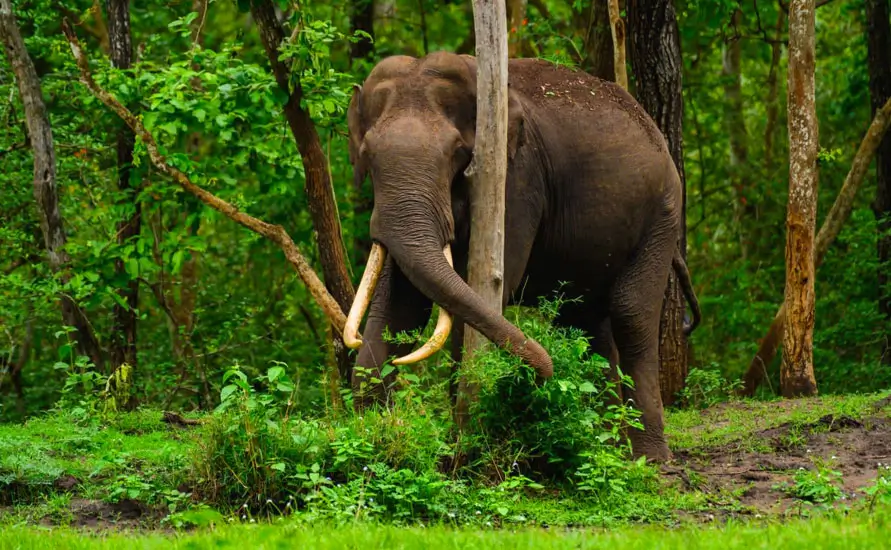
Heading south after breakfast, you drive through farmland to the Bandipur National Park, part of the Nilgiri Biosphere Reserve and one of the best tiger reserves in South India. The highway passes right through the forest, and night traffic is banned here to protect wildlife, which is why this drive is planned for the morning. Spotted deer, langurs and peacocks are common sightings along the road, and wild elephants can sometimes be seen near the forest edge. Stopping is not allowed inside the forest, so your driver keeps a slow, steady pace while you watch from the car.
After crossing into Tamil Nadu and the Mudumalai reserve, the road begins the steep climb up the Kalhatti ghat, with 36 hairpin bends taking you from the plains up to more than 2,000 meters. Small cars handle the road well, but travelers prone to motion sickness should sit in front and take a tablet in advance. As you climb, the forest gives way to grasslands, eucalyptus and the first tea gardens of the Nilgiris. By midday you arrive in Ooty, where your lodging is an older property from the era when British officials moved the Madras government up here every summer.
After lunch your guide takes you to a tea factory on the road toward Doddabetta, at about 2,637 meters the top of the Nilgiris, to follow freshly plucked leaf through the withering troughs, rolling machines, oxidation floor and dryers. You learn why the elevation suits the bushes here, and how the chilly winter weeks give a prized frost tea that brews pale, delicate and floral. After the factory you can taste several teas and buy fresh packets. If energy allows, finish at the Government Botanical Garden, planted on stepped lawns in the mid-19th century, where one of the curiosities is an ancient fossil tree trunk. Overnight in Ooty.
Today you ride the Nilgiri Mountain Railway, a UNESCO World Heritage Site that has run through these hills since the line was completed to Ooty in 1908. The full line climbs from Mettupalayam on the plains to Ooty and uses a rack and pinion system on the steepest section below Coonoor, one of the few such systems still in use in Asia. This morning you take the train downhill from Ooty to Coonoor, a ride of about an hour and a quarter through tea gardens, eucalyptus forests, short tunnels and old stations such as Lovedale and Wellington. Seats are limited and must be booked in advance.
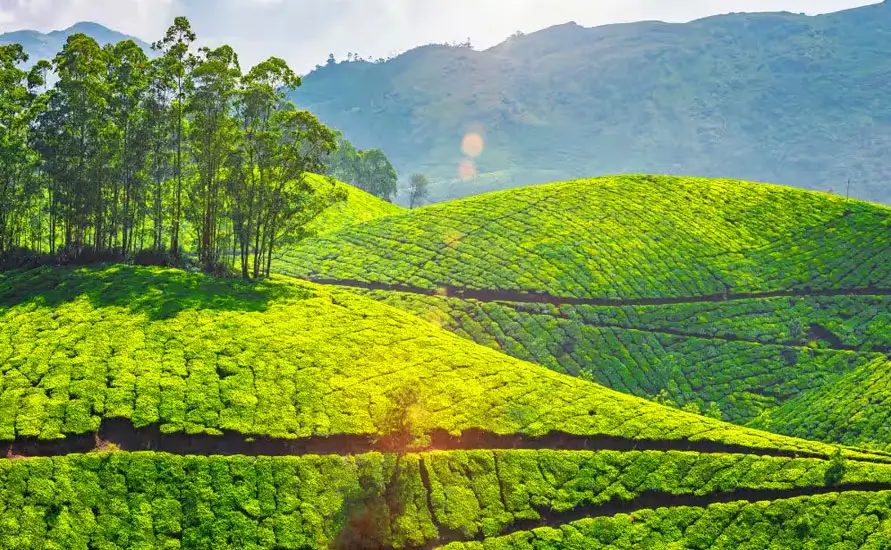
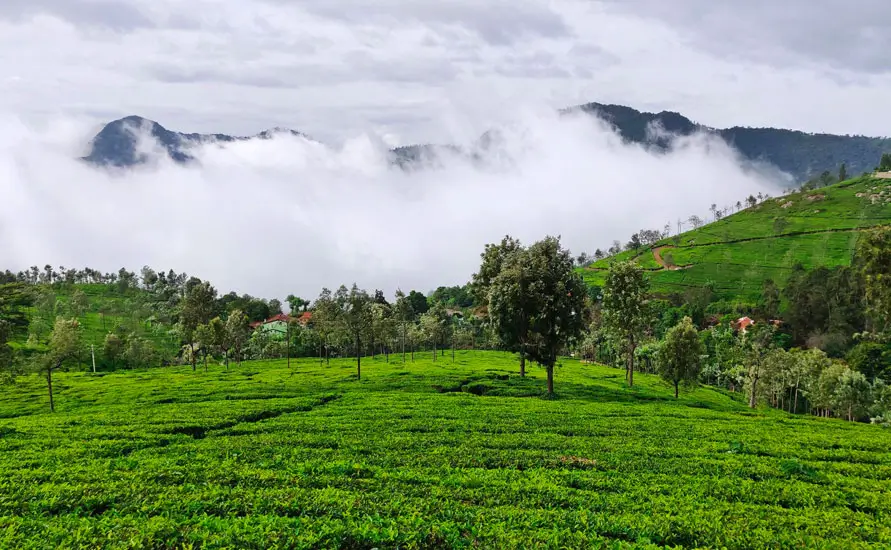
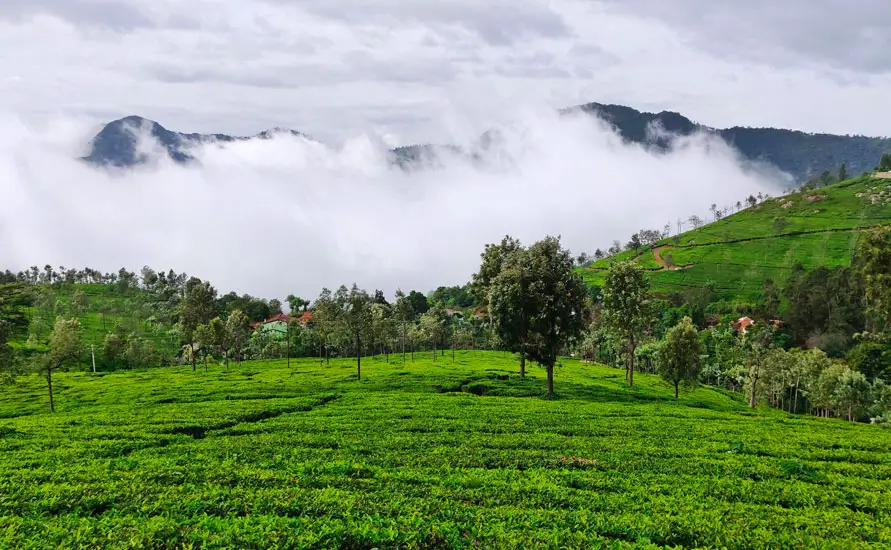
Once you step down onto the platform at Coonoor, your car is waiting, and the hours ahead are given over to Coonoor tea. Coonoor sits lower than Ooty and has a milder climate, and many of the oldest tea estates in the Nilgiris are on the slopes around it. Your guide takes you to a working tea factory where you see the orthodox process, in which leaves are rolled whole rather than cut, and taste green, white and black Nilgiri teas side by side. You also walk through the gardens with a supervisor who shows you how pickers select two leaves and a bud, and how the bushes are kept low and flat for easy picking.
On the way back you take in Sim's Park, a hillside garden of rare trees and shrubs dating from the 1870s, then drive out to Lamb's Rock and Dolphin's Nose, two cliff-edge lookouts above deep valleys of forest and tea. On a clear day you can see the Catherine Falls and, far in the distance, the Coimbatore plains. Your driver takes you back to Ooty by road in the late afternoon, a drive of about 45 minutes, leaving the evening free for a walk around the town's old Charing Cross market area or a quiet dinner at your hotel. Overnight in Ooty.
Leaving Ooty after breakfast, you drive back down through Coonoor, this time by road, with a stop at a small family-run tea estate that sells its leaf directly rather than through the auctions. The owner explains how smallholders in the Nilgiris, many of them from the Badaga community, grow green leaf on a few acres and sell it to bought-leaf factories, and why a growing number now make their own specialty teas. You can taste a hand-rolled oolong or a white tea made from buds alone, styles that have become popular with buyers in Europe and Japan over the last two decades.
Below Coonoor the road plunges through a series of hairpin bends, and the tea gives way to areca palms, banana groves and finally the warm plains around Mettupalayam. Here you can pause at the plains terminus of the Nilgiri Mountain Railway to see the old steam engines that still push the train up the rack section, and the yard where they are serviced. Mettupalayam is also a trading town for the hill produce, and its markets handle vegetables, spices and tea from the slopes above. Lunch is at a local restaurant known for its Kongu-style vegetarian meals.
In the afternoon you drive south across the Coimbatore plains to Pollachi, the coconut capital of Tamil Nadu, with the Anamalai Hills rising along the skyline. Your stay tonight is a farm stay or small resort among coconut palms, a useful pause that splits the long run from the Nilgiris to Munnar. Your host may show you how coconuts are harvested, how copra is dried for oil and how jaggery is made from sugarcane in nearby villages. After two weeks of tea and coffee, a glass of fresh tender coconut water makes a welcome change. Dinner is a home-style Tamil meal at the farm. Overnight in Pollachi.
An unhurried morning at the farm is followed by the drive southwest through Udumalpet, a market town surrounded by groundnut and maize fields, where wind turbines line the ridges and take advantage of the strong breeze funneled through the Palghat gap. The road then enters the Chinnar Wildlife Sanctuary at the Kerala border, a dry rain-shadow forest that feels very different from the wet estates of Coorg. Keep an eye out for the grizzled giant squirrel, a shy, silver-brown animal that lives in the tall riverside trees, and for spotted deer and elephants near the road.
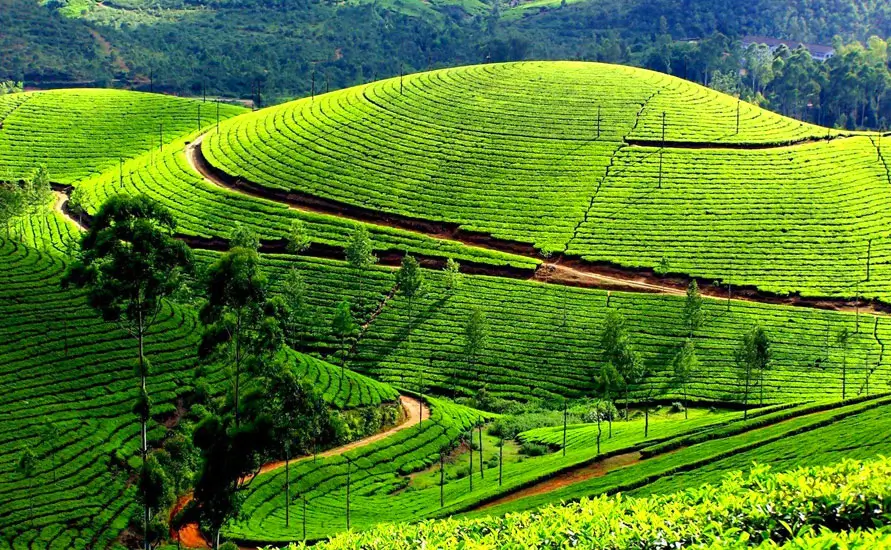
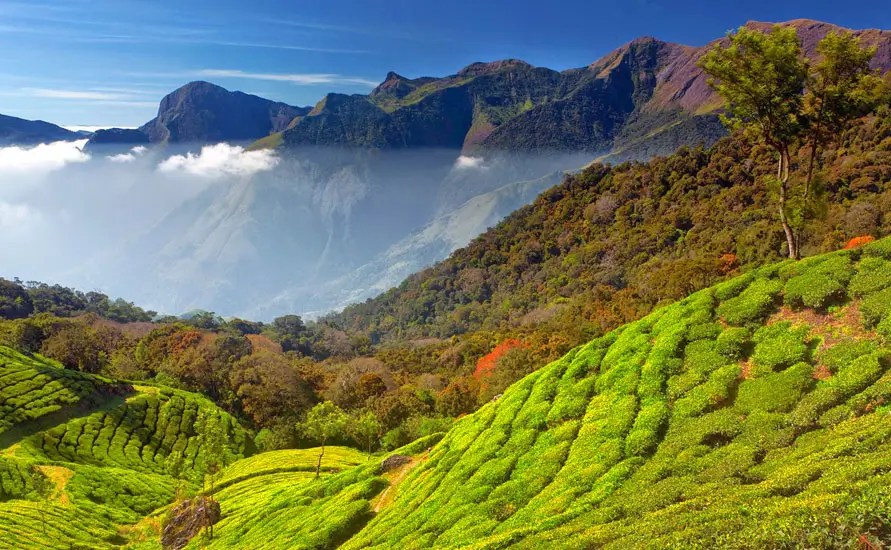
Leaving the sanctuary, the road climbs to Marayoor, a valley famous for its natural sandalwood trees, which are carefully guarded by the forest department. Farmers in this valley also boil sugarcane juice in large iron pans to make dark Marayoor jaggery, and you may be able to stop at one of the sheds to watch. The road continues up through Kanthalloor, where cooler air allows vegetables, plums and even strawberries to grow, before the first tea gardens appear on the hillsides, signaling your arrival on the Kannan Devan Hills estates that surround Munnar.
By early afternoon you are in Munnar, settling into a planter's bungalow or hill resort that is home for the next two nights. In the late afternoon your guide leads a short walk through the nearest tea garden, where you can compare the bushes with those of the Nilgiris: both are pruned flat for picking, but the Munnar estates are generally larger and spread across steeper slopes. If you visit in the drier months, you may see the gardens being pruned back hard, a cycle repeated every few years. The evening is cool, so a fleece or light jacket is useful. Overnight in Munnar.
Before sunrise, a local jeep collects you for the rough track up to Kolukkumalai, often described as one of the highest tea estates in the world at around 2,100 meters. The final section is a bone-shaking ride along a stony road, but the reward is a sunrise over the mountains and the plains of Tamil Nadu far below. The estate still runs a small factory using machinery and methods dating from the early 20th century, and the manager shows you how the leaf is withered, rolled and dried in the orthodox style. A cup of the estate's tea, brewed on the spot, tastes all the better after the climb.
Back in town after a late breakfast, you visit the Tata Tea Museum, which tells the story of the Kannan Devan estates from the forest clearings of the late 19th century up to modern times. Old photographs, a rolling machine, a monorail and personal belongings of the early planters give a good picture of life on the estates in the colonial era, and a short demonstration shows how CTC tea, the strong granular type used in tea bags, is made in contrast to the leaf you saw this morning. The tasting counter lets you try several grades and buy a few packets for home.
In the afternoon you visit Eravikulam National Park, where shuttle buses take you up to a grassy slope frequented by the Nilgiri tahr, a stocky wild goat with curved horns that survives on these ridges and nowhere outside the Ghats. The animals graze close to the path, and your guide explains how the park protects the high grasslands and shola forests that also feed the streams watering the tea estates. The park usually closes during the calving season around February and March, in which case we replace this visit with another estate walk. The evening is free at your bungalow for a final hill sunset. Overnight in Munnar.
Leaving the hills after breakfast, you follow the road down through the Adimali valley, where tea gives way to cardamom, pepper, rubber and coconut as the altitude drops. Your driver stops at the Cheeyappara and Valara waterfalls along the road, which are fullest after the monsoon, and at a spice stall where you can buy fresh pepper and cardamom straight from the growers. The descent is a reminder of the route the plantation crops have taken for centuries, carried down from the Western Ghats by bullock cart, boat and later truck to the warehouses of the coast.
Arriving in Kochi around lunchtime, you drop your bags at a Fort Kochi hotel and set off with a local guide to Mattancherry, the old trading district where spices, tea and coffee were weighed, stored and sold to buyers from around the world. Along Bazaar Road you see warehouses with large wooden doors, where workers still sort pepper, ginger and turmeric by hand, and you may be able to visit a trading office that once dealt in tea auctions. The guide explains how Kochi grew from a small fishing port into one of the major ports for South Indian produce.
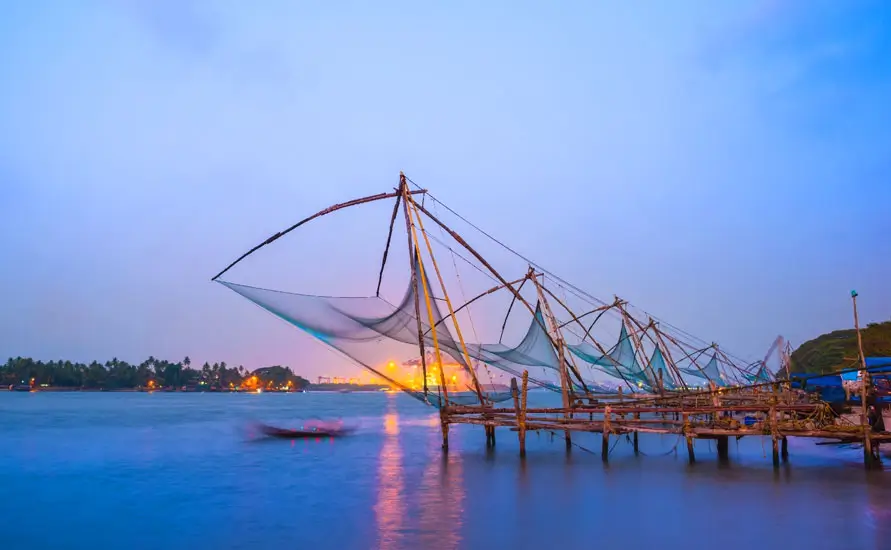
Later you visit the Mattancherry Palace, with its fine Kerala murals of the Ramayana, and walk to the Paradesi Synagogue in Jew Town, the oldest working synagogue in the Commonwealth. Neither opens its doors on a Friday, and the synagogue keeps Saturdays and Jewish holy days closed too, in which case we reorder the afternoon. At sunset, stroll along the Fort Kochi beachfront past the Chinese fishing nets and finish with a farewell dinner at a café that serves single-estate coffee from the very hills you have visited. Overnight in Kochi.
The final morning in Fort Kochi is free, and how you spend it depends on your flight time. Coffee lovers may want to start at one of the small roasteries in the old town for a final pour-over, while tea drinkers can visit a tea shop in Jew Town to buy loose-leaf Nilgiri or Munnar tea to take home. A walk along the seafront at dawn shows the fishing nets being lowered and raised with the morning tide, and the fish market nearby comes to life with traders bidding for the catch. Your guide can join you if you would like company for these last hours.
Remember to pack coffee, tea and spices in your checked bags and to keep invoices for any expensive purchases, as customs officers in your home country may ask for them. Hotel checkout is normally at noon, and if your flight leaves late, we can arrange a day room or late checkout for an extra charge. Around three hours ahead of your flight home, the car leaves for Cochin International Airport, a ride of roughly 90 minutes along the busy Aluva road. Our team checks your flight timings the day before to plan the transfer.
Over the past thirteen days you have followed coffee and tea from the hill where seven beans were planted, through Chikmagalur and Coorg estates, the Nilgiri tea gardens and the high slopes of Munnar, to the port where the harvest was shipped abroad. We hope this tea and coffee plantation tour South India has given you a deeper understanding of what goes into your morning cup, and the people who grow it. When you next brew a South Indian coffee or Nilgiri tea at home, you will know the estates behind it. Your tour ends with the drop-off at the airport.
Your Journey

N.S. Rathore & Mrs. Omlata Rathore · Managing Director
We still read every enquiry ourselves. Tell us the places you liked and our planners will send a day-by-day route with drive times and a clear price.
Every package can be customised and no pressure to book. A planner from our office replies within 24 hours with a route written for your group.
Fill this in and your planner will send a first draft itinerary.
Explore more
Kerala Backwaters Escape Kerala Backwaters Escape
 Kerala Backwaters Escape
 Kerala Backwaters Escape
 Kerala Backwaters Escape
 Kerala Backwaters Escape
 Kerala Backwaters Escape
 Kerala Backwaters Escape
 Kerala Backwaters Escape
 Kerala Backwaters Escape
 Kerala Backwaters Escape
 Kerala Backwaters Escape
 Kerala Backwaters Escape
 Kerala Backwaters Escape
 Kerala Backwaters Escape
 Kerala Backwaters Escape
 Kerala Backwaters Escape
 Kerala Backwaters Escape
 Kerala Backwaters Escape
 Kerala Backwaters Escape
 Kerala Backwaters Escape
 Kerala Backwaters Escape
 Kerala Backwaters Escape
 Kerala Backwaters Escape
 Kerala Backwaters Escape