


 Kerala Backwaters Escape

South India Tour Packages
Bangalore – Srirangapatna – Mysore – Madurai – Rameswaram – Kanyakumari – Suchindram – Trivandrum
At a glance
Many families who left Tamil Nadu, Karnataka or Kerala a generation ago now live in New Jersey, Leicester, Dubai or Singapore, and their children know the old temples only from photos on a grandparent's wall. Our South India tour for NRIs is built for that gap. Over ten days you travel from Bangalore and Mysore to Madurai, Rameswaram, Kanyakumari and Trivandrum, visiting the shrines your parents spoke about, while a guide who is used to curious teenagers explains why things are done the way they are, not only what they are called.
Each stop on this NRI family tour of India was chosen for what it means to the family, not just for its looks. Chamundi Hill and Srirangapatna carry Kannada stories, Meenakshi and Ramanathaswamy hold Tamil ones, and Padmanabhaswamy is the spiritual center of old Travancore. One domestic flight from Bangalore to Madurai removes the longest drive, and a private air-conditioned car with a driver handles the rest. There is room in the plan to add a detour to an ancestral village, a family deity temple or relatives you have not seen in years.
Second-generation children often feel unsure inside a busy temple: when to remove shoes, why people walk clockwise, what the ash on the forehead means. Your guides take time to answer those questions in plain English, and we brief the family in advance on dress codes, including the strict dhoti and saree rule at Padmanabhaswamy. This South India tour for NRIs works best from October to March, and the December holidays and school half-terms are popular, so early booking helps when you want specific temple pujas arranged.
Many overseas connections, routed through hubs such as Dubai, Doha, Frankfurt or Singapore, touch down at Kempegowda International Airport late at night, and whatever the hour, a driver holding a sign with your surname stands just past customs. Expect roughly sixty minutes on the airport highway into central Bangalore, more if you land during the office rush. Your hotel room is ready for check-in from the afternoon, and we can hold it from the night before if you land in the small hours. Use the morning to sleep, eat a simple breakfast of idli and coffee and let the children reset their body clocks.
After lunch your guide takes the family to Basavanagudi, an older south Bangalore neighborhood where grandparents of many Kannada families once lived. The Bull Temple here holds a large granite Nandi, the bull that carries Shiva, carved in the 16th century and darkened by centuries of oil and incense. It is an easy first temple for children, because it is small and open and the guide can show them how a visit works: shoes off at the gate, a slow clockwise walk around the shrine, a few coins in the plate, and a pinch of holy ash or kumkum offered by the priest.
Once the heat eases, stroll the 240 acres of Lalbagh Botanical Garden, a Mysore-era royal garden whose iron-and-glass hall, the venue for big flower shows, takes its design from Victorian England. The rocky outcrop inside the garden carries one of the four watchtowers put up by Kempe Gowda, the chieftain who founded the city in 1537, and it gives a good view over the treetops at sunset. For dinner, your guide can point you toward one of the classic old-style eateries known for masala dosa and filter coffee, a taste many parents will remember from childhood visits. Overnight in Bangalore.
Leave Bangalore after breakfast on the expressway toward Mysore, which has cut the drive considerably compared with the old highway. About two and a half hours later you cross a branch of the Kaveri river onto Srirangapatna, an island town that served as Tipu Sultan's capital in the late 18th century. For Kannada families the Kaveri is far more than a river; she is worshipped as a goddess, and many households still keep a small brass pot of her water at home. Your guide explains why the river holds that place and how the island became the scene of the final siege of 1799.
The Ranganathaswamy Temple on the island is one of three important Vishnu shrines on the Kaveri, where the deity is shown reclining on the coiled serpent Adisesha. It is a good moment to tell children the difference between a Shiva temple and a Vishnu temple, from the namam mark on the forehead to the kind of offerings made. Nearby you visit Daria Daulat Bagh, Tipu's teak-wood summer palace, whose walls are painted with battle scenes, and the Gumbaz, the domed tomb where Tipu, his father and his mother are buried in a quiet garden.
After lunch the road continues another 30 minutes to Mysore, the old royal seat of the Wadiyar kings, and you check in to your hotel by mid-afternoon. If your first evening falls on a Sunday or a public holiday, your guide takes you straight to Mysore Palace for the illumination, when close to one hundred thousand bulbs light up the outline of the building for about 45 minutes. On other days the evening is free; you might wander the stalls around Devaraja Market, where sellers stack jasmine garlands, kumkum powder in bright cones and fresh betel leaves, the same scene many parents remember. Overnight in Mysore.
Mysore owes its name to Mahishasura, the demon slain by the goddess Chamundeshwari, and the morning begins at her hilltop shrine on Chamundi Hill, a short climb by car from the edge of town. Fit families can climb part of the old stone stairway of about a thousand steps, built in the 17th century, and the most rewarding stretch is the one that passes the giant Nandi carved from a single block of black granite. Others drive to the top. At the hilltop temple, your guide explains the role of the goddess as the family deity of the Mysore royals, and why so many local weddings begin with a visit here.
Back in town, Mysore Palace fills the late morning. The current building dates from 1912, after a fire destroyed the older wooden palace, and it combines Indian, Islamic and European styles under one roof. With footwear deposited at the entrance and cameras put away inside the state rooms, younger family members tend to look more closely, picking out peacock motifs in the colored glass above the Kalyana Mantapa, the long murals of the royal Dasara parade and doors faced with silver. Your guide connects these scenes to the ten-day Dasara festival, when the city still parades a decorated elephant through the streets each autumn.
In the afternoon you visit the government silk weaving factory, where the famous Mysore silk saris come off power looms in a process your guide can explain step by step, from cocoon to finished fabric. Families planning a wedding back home often use this stop to buy saris or silk veshtis, and it is a chance for daughters to choose a saree for the Padmanabhaswamy visit later in the trip. Afterwards there is time for a sandalwood or incense shop, or an evening rest at the hotel. If you missed the illumination yesterday and today is a Sunday or holiday, we return to the palace after dark. Overnight in Mysore.
An early breakfast is followed by the drive back to Kempegowda International Airport, about four hours from Mysore with traffic around Bangalore, so we plan a late-morning or early-afternoon flight to keep the day calm. Your driver knows where to stop for a clean restroom and a quick plate of thatte idli, the flat steamed cakes the highway town of Bidadi is known for. On the way, the guide often asks the children what they remember from the last two days, and parents are usually surprised by how many names and stories have stuck: Chamundi, Mahishasura, Tipu, Kaveri.
The domestic flight from Bangalore to Madurai takes about an hour and ten minutes and saves a road trip of more than eight hours. As the plane comes down you will see the dry, flat land of southern Tamil Nadu, dotted with reservoirs and granite hills, quite different from the Deccan plateau you left behind. Our Madurai team meets you outside arrivals and drives you about 30 minutes into the city. For many Tamil families this is the moment the trip feels like a return, as street signs, songs on the radio and conversations at the hotel desk all switch to Tamil.
Around five, your guide walks you over to the Thirumalai Nayak Palace, raised in 1636 for Thirumalai Nayak, a ruler whose patronage also left its mark on the great temple saved for tomorrow. Its central courtyard is lined with huge round pillars, and the scale gives children a sense of how grand the Nayak court once was. On some evenings a sound and light show tells the story of the palace in English and Tamil. Dinner can be a Madurai specialty such as kari dosai or the famous chilled drink jigarthanda, made with milk, almond gum and ice cream. Overnight in Madurai.
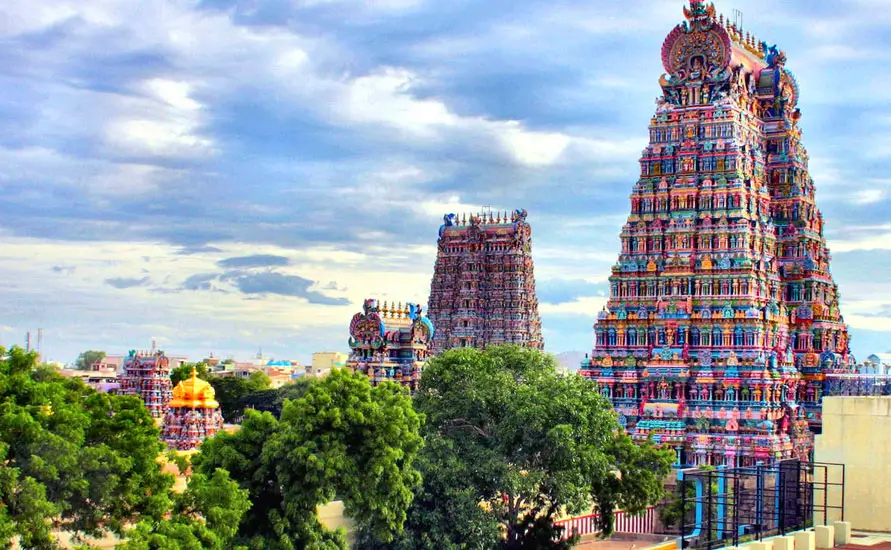
Arrive at the Meenakshi Temple soon after it opens, when lines are short and the stone floors are still cool. Phones and cameras must be deposited at the counters outside, which turns out to be a gift for families: nobody is busy filming, and children watch instead. Your guide explains the story of Meenakshi, the fish-eyed princess of Madurai, and her marriage to Shiva as Sundareswarar, a wedding re-enacted every April in the Chithirai festival. As Hindus, your family can enter the inner sanctums for darshan, and the guide can help arrange an archana with family names and gotra if you wish.
Inside the outer corridors there is plenty to show the younger ones. The Hall of a Thousand Pillars, now a small museum, has carved columns that line up perfectly whichever angle you look from, and a set of musical pillars that ring with different notes when tapped. Tradition links the Golden Lotus Tank with the Sangam academy of early Tamil literature, where, the story goes, manuscripts were tested on the water: good verse stayed afloat, poor verse went under. Teenagers often like the parrots in the Meenakshi shrine corridor, linked to the goddess who holds a parrot in her hand.
The afternoon is free for rest, or for a visit to the Gandhi Memorial Museum, which holds the blood-stained cloth Gandhi wore on the day he was shot in 1948. Once dinner is over, head back to the temple for the nightly palliyarai ritual near 9 pm: priests bear Sundareswarar's festival image in a palanquin to the goddess's bedchamber while drummers and nadaswaram players lead the way. It lasts less than half an hour, and for children it is often the scene they talk about most once they are back home. Your driver waits nearby to take you back to the hotel. Overnight in Madurai.
Today's drive heads east across Ramanathapuram district, a hot, open landscape of palmyra palms, salt pans and small villages where families still sell palm-sugar candy by the roadside. The road is good and the trip takes about four hours with a tea stop. Your guide uses the time to tell the Ramayana story that ties this coast to Lord Rama, who is said to have worshipped Shiva at Rameswaram after his return from Lanka. For children who grew up on animated versions of the epic, seeing the real places named in it brings the story off the screen.
Near the town of Mandapam the land runs out and you cross the sea to Pamban Island on a road bridge more than two kilometers long, with turquoise water on both sides. Running alongside is the railway bridge; a new vertical-lift span has now replaced the cantilever bridge of 1914 that once opened by hand to let fishing boats through. Your driver stops at a safe viewing spot so the family can take photos of the fishing fleets and the rail line. It is one of the most talked-about drives in Tamil Nadu, and many NRI parents remember making the crossing by train as children.
You check in at Rameswaram in the afternoon. Later, your guide takes you to the APJ Abdul Kalam National Memorial at Peikarumbu, built in honor of the former Indian president and rocket scientist who grew up in this town as the son of a boat owner. The exhibits on rockets and missiles are popular with science-minded teenagers, and Kalam's story of rising from a poor island family to the highest office is a good talking point for second-generation kids. You can also see the modest family house in town, now a small museum. Overnight in Rameswaram.
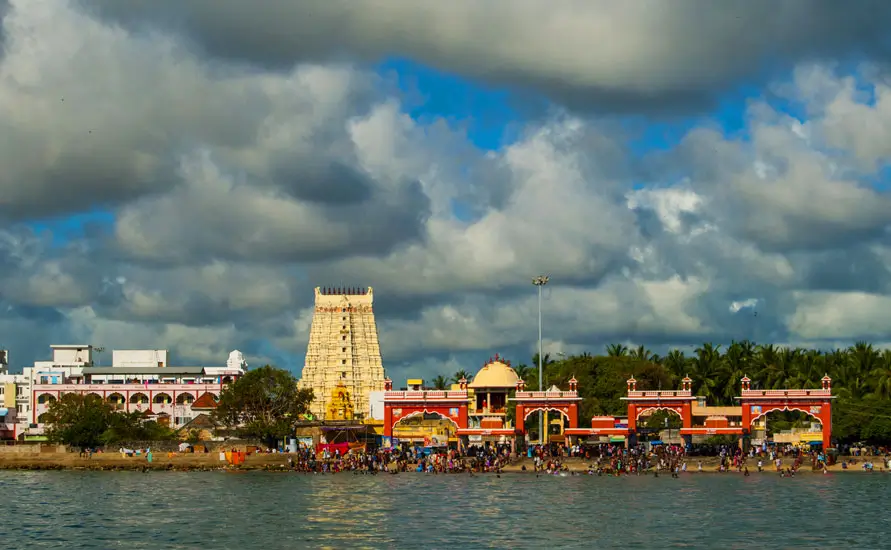
Pilgrims traditionally begin at Agni Theertham, the stretch of calm sea in front of the temple, where they take a dip before entering. Inside the Ramanathaswamy Temple are 22 holy wells, known as theerthams, and an attendant draws a bucket from each one and pours it over your head as you move from well to well. You will be soaked, so wear clothes you do not mind getting wet and bring a change for afterwards; the temple has changing rooms nearby. Your guide explains the belief that each well has its own purifying quality, and children usually treat the bucket ritual as the best part of the day.
After changing, the family walks the temple's long pillared corridors, often described as the longest in any Indian temple. The outer corridor runs for hundreds of meters, lined with more than a thousand carved granite pillars and painted ceiling medallions, and the way the rows of columns narrow toward the far end makes a striking photo spot from outside the restricted areas. Here your guide explains the two lingams of the temple, one said to have been made of sand by Sita and one brought from the Himalayas by Hanuman, and the rule that the second is worshipped first.
In the afternoon you drive about 20 km to Dhanushkodi, a town destroyed by a cyclone in December 1964 that swept away a train and most of the population. The ruins of a church, a railway station and a post office still stand in the sand. A newer road now continues to Arichal Munai, the tip of the island, where the Bay of Bengal meets the Palk Strait and Sri Lanka lies only about 30 km away. Your guide tells the Rama Setu story of the bridge built by the monkey army, a moment that ties together everything the children have heard since Madurai. Overnight in Rameswaram.
It is the longest road day of the trip, so we leave soon after breakfast and break the drive with regular stops. The route follows the southern coast through Ramanathapuram and Thoothukudi districts, past salt pans glittering in the sun, wind turbines and the fishing harbors of the pearl coast, once famous across the ancient world for its oyster beds. Families with roots in the Tirunelveli region sometimes use this day for a detour to an ancestral village or kula deivam temple, and our team can plan the stop if you share the details when booking.
Lunch is at a clean roadside restaurant serving a full Tamil meal on a banana leaf, a good chance to show the children how to eat with the right hand and fold the leaf toward you when finished as a sign of thanks. In the afternoon the land turns greener and the Western Ghats come into view, with rocky hills rising above coconut groves near Nagercoil. Your guide explains how this corner of the country was once part of the Travancore kingdom, which is why Tamil and Malayalam culture overlap here in food, dress and temple styles.
You reach Kanyakumari in the late afternoon, in time to watch the sunset from the seafront, one of the few places in India where the sun can be seen both rising and setting over water. The Kumari Amman Temple, dedicated to the virgin goddess who gave the town its name, is open in the evening; men are asked to remove their shirts before entering, a custom that will come up again in Kerala. Your guide also checks the weather forecast for the morning, so the family knows what time to be on the beach for sunrise. Overnight in Kanyakumari.
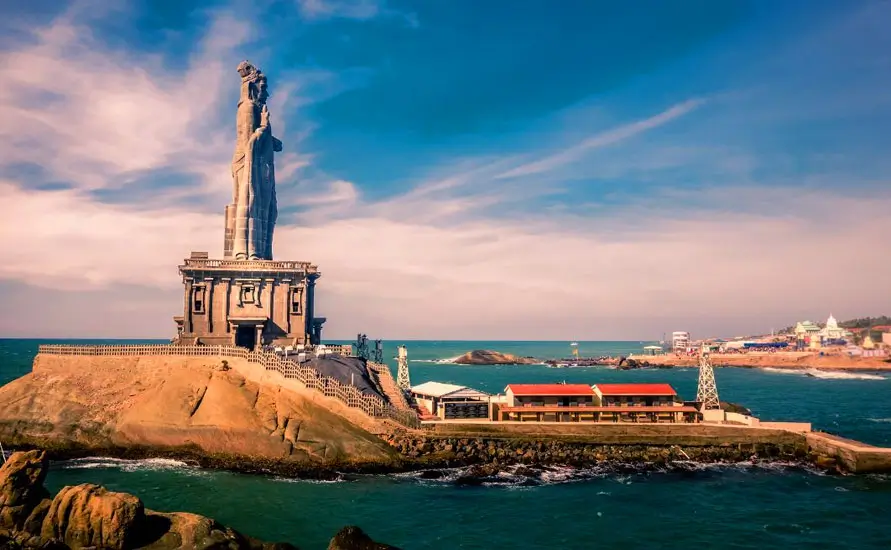
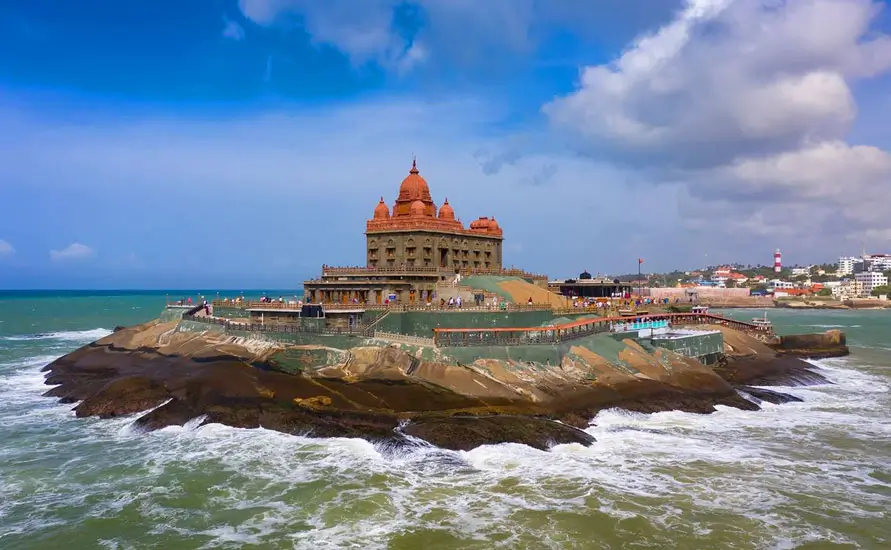
Set the alarm early for the Kanyakumari sunrise, when hundreds of pilgrims and families gather on the shore and on hotel rooftops facing the point where the Bay of Bengal, the Arabian Sea and the Indian Ocean meet. Many people bathe at the ghat after the sun appears. After breakfast you take the first ferries to the Vivekananda Rock Memorial, built on the rock where Swami Vivekananda meditated in 1892 before his famous Chicago address. The neighboring Thiruvalluvar statue, 133 feet tall to match the chapters of the Tirukkural, is now linked to the memorial by a glass-floored footbridge.
Leaving town, you stop at the Thanumalayan Temple in Suchindram, a shrine that honors Shiva, Vishnu and Brahma together in a single lingam, which makes it a good place to explain the Hindu trinity to children. Look for the tall Hanuman statue and the musical pillars carved from single blocks of stone. The road then crosses into Kerala. If the day is not a Monday, there is time for Padmanabhapuram Palace, the old wooden palace of the Travancore kings, with polished black floors made from a mix that included burnt coconut shell and egg white.
You reach Trivandrum in the afternoon and check in near the old city. Your guide holds a short family briefing on tomorrow's temple visit: the Padmanabhaswamy Temple admits Hindus only, and the dress code is strict. Men wear a mundu or dhoti with the chest bare, or a small shawl over the shoulders, and women wear a saree or a long skirt with a blouse. Mundus can be hired or bought near the gates, but most families prefer to bring their own. Phones and bags are left at the cloakroom. The evening is free for the beach at Kovalam or a quiet dinner. Overnight in Trivandrum.
Dressed in traditional clothes, the family arrives at the Padmanabhaswamy Temple early, when the morning darshan lines are shortest. Inside, Vishnu as Padmanabha reclines on the serpent Anantha, a figure so large that worshippers see it in three parts through three separate doors: the face, the body and the feet. Your guide prepares everyone beforehand, because the halls are dim, the crowds move quickly and no explanations are given inside. Family members who are not Hindu can wait at the eastern tower and the temple tank, or visit the Kuthiramalika Palace museum next door with a guide.
After breakfast there is time, depending on your flight, for a walk through the Napier Museum grounds, an old Indo-Saracenic building with bronzes, carvings and Travancore relics, or for some last shopping on Chalai Bazaar, where families often buy Kerala kasavu saris with gold borders, banana chips and halwa to carry home. Children who started the trip unsure in temples are often the ones leading the way by now, removing shoes without a reminder and asking for the prasadam. Parents tell us this change is the main reason they made the trip.
Trivandrum International Airport is about 15 minutes from the old city and has direct connections to the Gulf and Singapore, with onward flights to Europe and North America. For a flight abroad, the car leaves early enough that you walk into the terminal a full three hours ahead. Those with a post-midnight departure can keep a room until evening, or stretch the holiday by one night on the sand at Kovalam. In ten days the family has stood in the shrines of three states and followed a story from Chamundi Hill to the tip of India. We hope the children ask to come back. Have a safe trip home.
Your Journey

N.S. Rathore & Mrs. Omlata Rathore · Managing Director
We still read every enquiry ourselves. Tell us the places you liked and our planners will send a day-by-day route with drive times and a clear price.
Every package can be customised and no pressure to book. A planner from our office replies within 24 hours with a route written for your group.
Fill this in and your planner will send a first draft itinerary.
Explore more
Kerala Backwaters Escape Kerala Backwaters Escape
 Kerala Backwaters Escape
 Kerala Backwaters Escape
 Kerala Backwaters Escape
 Kerala Backwaters Escape
 Kerala Backwaters Escape
 Kerala Backwaters Escape
 Kerala Backwaters Escape
 Kerala Backwaters Escape
 Kerala Backwaters Escape
 Kerala Backwaters Escape
 Kerala Backwaters Escape
 Kerala Backwaters Escape
 Kerala Backwaters Escape
 Kerala Backwaters Escape
 Kerala Backwaters Escape
 Kerala Backwaters Escape
 Kerala Backwaters Escape
 Kerala Backwaters Escape
 Kerala Backwaters Escape
 Kerala Backwaters Escape
 Kerala Backwaters Escape
 Kerala Backwaters Escape
 Kerala Backwaters Escape