


 Kerala Backwaters Escape

South India Tour Packages
Chennai – Mahabalipuram – Pondicherry – Gangaikonda Cholapuram – Tanjore – Darasuram – Chettinad (optional) – Madurai – Thekkady – Kumarakom – Kochi
At a glance
If you had to pick only the essential sights of Tamil Nadu and Kerala, the list would look a lot like this route. Our Highlights of South India tour links the shore carvings of Mahabalipuram, the French streets of Pondicherry, three great Chola temples around Tanjore, the towering gateways of Madurai, the cardamom hills of Thekkady, the lake country of Kumarakom and the old spice port of Kochi. The difference from shorter trips is pace: fifteen days leaves room to sit, look and rest between the famous names.
Two nights in most places means you unpack, settle in and see each stop at the right hour, such as a Chola tower at sunset or a backwater at dawn. Drives are kept to around four hours, with stops at villages, markets and roadside temples so the road becomes part of the trip. One chauffeur and one cooled vehicle are yours for the whole route between the two coasts, while government-approved guides join you at the monuments in each state.
This South India highlights tour suits first-time visitors who want depth rather than speed, couples planning a long holiday, and NRI families showing the south to children or overseas friends. Along the way you see every one of the UNESCO-inscribed Great Living Chola Temples, can detour to the merchant palaces of Chettinad, walk a cardamom and pepper garden, spend a day afloat on Vembanad Lake in your own houseboat and finish with a night of Kathakali dance drama in Kochi. Travel is most comfortable from October to March.
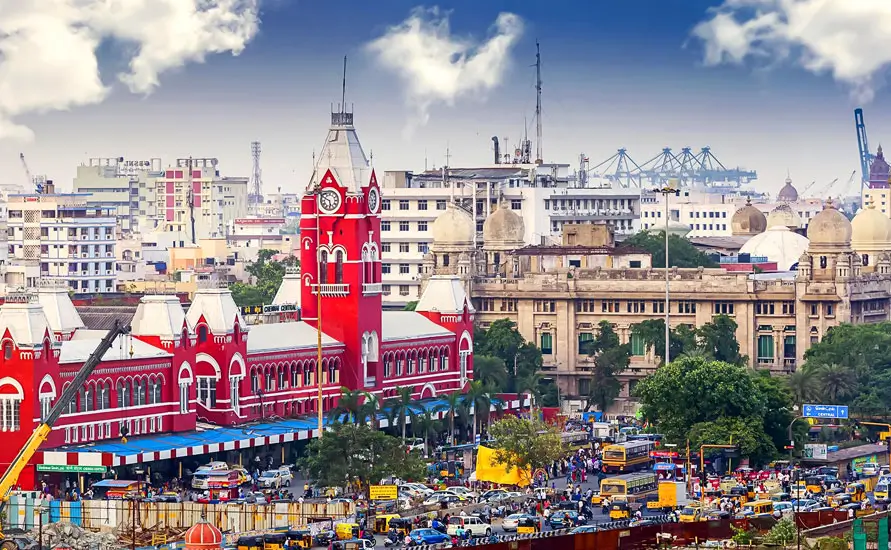
Your Highlights of South India tour opens in Chennai, known as Madras until 1996 and now the state capital. Once you clear customs, look for our staff member with a name board at the exit; he walks you over to the vehicle that carries you all the way to the Kerala coast. Most international flights arrive between midnight and dawn, so the drive to your hotel is quick on empty roads. Rest is the only plan for the morning. For a pre-dawn landing, reserving the room from the evening before means you can sleep the moment you reach the hotel instead of waiting in the lobby.
After lunch and a few hours of sleep, your guide collects you for a gentle introduction to the city. You start where the city itself started, at Fort St. George, the seaside bastion English merchants completed in 1644 and around which fishing hamlets slowly merged into a metropolis. Within its ramparts, St. Mary's Church dates from 1680, and its walls carry marble tablets in memory of Company clerks, army officers, young wives and children lost to fever in the early colonial years. The Fort Museum nearby holds weapons, coins, portraits and uniforms from the colonial period, and gives useful background on how a small trading post grew into a major city.
As the afternoon cools, you continue to Mylapore, a temple neighborhood far older than the fort. The Kapaleeshwarar Temple is busy at this hour with families bringing flowers, coconuts and oil lamps for evening prayers, and your guide explains the customs around offerings, dress and footwear before you go in. Around the temple tank, stalls sell jasmine garlands, brass lamps and bangles. End with a filter coffee at an old Mylapore canteen, brewed from chicory-blended beans and topped with a thick layer of foam, then return to the hotel for a quiet meal and plenty of sleep. Overnight in Chennai.
With breakfast done and bags loaded, you roll south past the IT corridor and the beach suburbs of Neelankarai and Injambakkam. Forty minutes later you pull in at Dakshinachitra, an open-air museum where genuine village homes from across the southern states were dismantled, shipped here and reassembled. Rooms worth lingering in include an Andhra silk weaver's dwelling with its pit loom, a north Karnataka farmer's house of stone and mud, the teak granary of a Syrian Christian family from Kerala and the pillared courtyard of a Chettiar trader. Craft workers often demonstrate pottery, basket weaving or glass painting, and the museum gives a clear picture of how daily life differs between the regions you will visit.
You reach Mahabalipuram in time for a seafood lunch near the beach, then check in at a resort on the coast. The town was the main port of the Pallava kings in the 7th and 8th centuries, and it is still home to many stone carvers who shape granite figures in open workshops along the main road. Your guide later leads you into two or three of these yards, where sculptors rough out a deity with heavy mallets and then finish fine details such as fingers and jewelry with tiny chisels, using skills handed from father to son. Any spare time before sunset can go on a swim or a barefoot stroll along the sand.
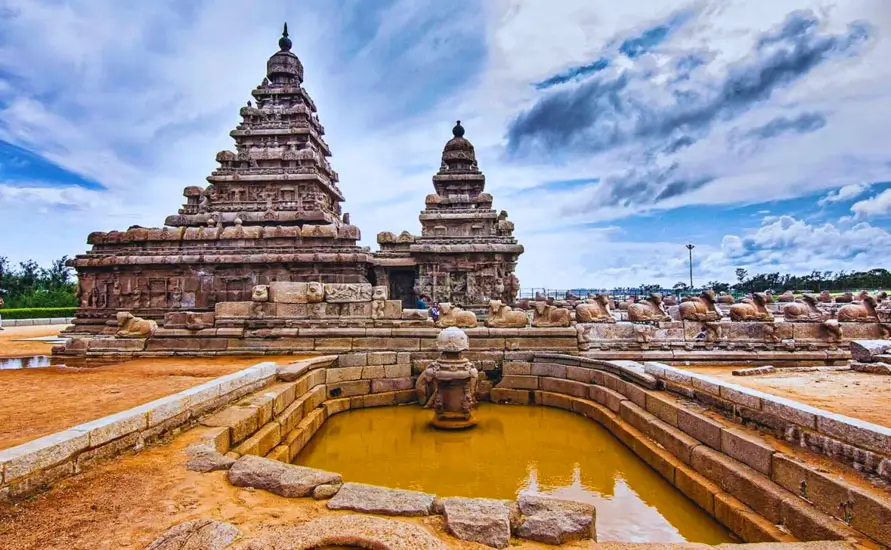
Late in the day you reach the Shore Temple, built under the Pallava king Narasimhavarman II in the early 8th century, its twin towers standing just a few meters from the breaking waves. The light at this hour turns the weathered stone a warm honey color, and the crowds are thinner than at midday. Your guide explains how the temple has survived salt wind for thirteen centuries and points out the rows of carved Nandi bulls along its walls. Back in the village, dinner can be at a beach shack, where the day's catch of prawns, crab or fish is grilled to order. Overnight in Mahabalipuram.
Early morning is the best time to see the rest of the Group of Monuments at Mahabalipuram, which UNESCO lists as a World Heritage Site. You begin at the Pancha Rathas, five temples carved from single outcrops of rock, each with a different roof shape that shows how early builders experimented with temple design. A short walk then brings you to Arjuna's Penance, an open-air rock panel almost 30 meters long, on which life-size elephants, monkeys, ascetics, flying celestials and serpent beings all crowd toward a central cleft. The long natural crack running down its center was probably used to represent the river Ganges.
The walk continues up the low granite hill behind the relief, where you can see several smaller cave temples. Look in the Varaha Cave for the boar-headed Vishnu cradling Bhudevi as he raises her from the sea, and in the Mahishasuramardini Cave for the battle relief in which Durga, mounted on her lion, drives back Mahisha's army. You also pass the famous balancing boulder known as Krishna's Butter Ball and the old lighthouse at the top of the hill, which offers a wide view over the town and the sea. Most visits are complete by late morning, before the sun becomes strong.
After a seafood lunch you set off for Pondicherry, roughly two and a half hours down the coast road, with glimpses of the Kaliveli wetlands, cashew groves and roadside stalls selling tender coconuts. Your room for two nights is in a restored townhouse in the former French settlement, which remained under Paris until the de facto handover of 1954. The evening is free to walk along the seafront promenade, which is closed to traffic at night, and to choose a restaurant for dinner, perhaps one serving Creole dishes that mix French and Tamil cooking. Overnight in Pondicherry.
Pondicherry is a town best seen on foot, and your guide meets you after breakfast for a morning walk through the French Quarter. The streets are laid out in a neat grid, with colonial villas painted in shades of yellow, white and pink, wooden shutters, and bougainvillea spilling over the gates. Landmarks along the route include the consulate of France, the research library of the Institut Français and the colonial town hall, before a pause inside Our Lady of Angels, a Greco-Roman style church from 1855 whose facade is washed in soft peach and cream. The town still has a large French-speaking community, and you may hear French in the shops and cafés.
West of the drainage channel that served as the colonial boundary lies the Tamil Quarter, its terraced homes fronted by thinnai, the built-in stone benches where residents still chat with passers-by in the evening. Your guide shows you the difference in building styles and the way the two communities lived side by side. In the courtyard of the Sri Aurobindo Ashram, devotees lay fresh blossoms on the marble tomb of its founders, and silence is expected. Afterward, the ashram's paper unit on the edge of town shows how cotton rags become colorful sheets, pulped, hand-laid on screens and left on racks to dry. Lunch is at a café or local restaurant of your choice.
After lunch, half an hour north of town, you arrive at Auroville, set up in 1968 as a place where residents of any nationality could live and work together outside ordinary politics and religion. Exhibits and a brief screening at the visitor center tell its story, and a forest footpath then leads to a lookout over the Matrimandir, a huge globe clad in golden discs. Getting inside its meditation chamber takes a reservation made days ahead, with only a few slots each day, and our team will submit the request on your behalf. Your evening back on the coast is unplanned, perhaps a promenade stroll or a meal in a courtyard restaurant. Overnight in Pondicherry.
Breakfast over, your car turns inland, crossing sugarcane fields and cashew country on the way to the fertile Kaveri delta, where Chola power was rooted for some four centuries. Shortly before noon you arrive at Gangaikonda Cholapuram, today little more than a sleepy hamlet, though for over two hundred years it served as the royal seat of the dynasty. Rajendra Chola built a great temple here around 1035 to celebrate his military campaigns, which reached as far as the river Ganges in the north. Today the city has almost disappeared, but the temple still stands in a large green lawn, and it is often almost empty of visitors.
UNESCO added the Brihadisvara Temple at Gangaikonda Cholapuram in 2004, extending the original Tanjore inscription into the group now called the Great Living Chola Temples. Its tower is slightly shorter than the one at Tanjore but has gently curved sides that many visitors find more graceful. Your guide points out the carved panels around the sanctum, including a famous scene of Shiva blessing the devotee Chandesa with a garland, and the huge Nandi bull sitting in the courtyard. There is also a well with a lion-shaped entrance, said to have been filled with water from the Ganges. The temple is still in worship, so dress modestly and leave shoes at the entrance.
After a simple lunch at a local restaurant, you continue south for about ninety minutes to Tanjore, also written Thanjavur, crossing several branches of the Kaveri river and passing through rice fields and coconut groves. Your room should be ready around four. If you still have energy, take an early evening walk in the old town, where shops sell bronze statues, Tanjore paintings decorated with gold foil, and the small musical instrument called the veena, which is still made here by hand. Dinner is at your hotel or a nearby vegetarian restaurant. Overnight in Tanjore.
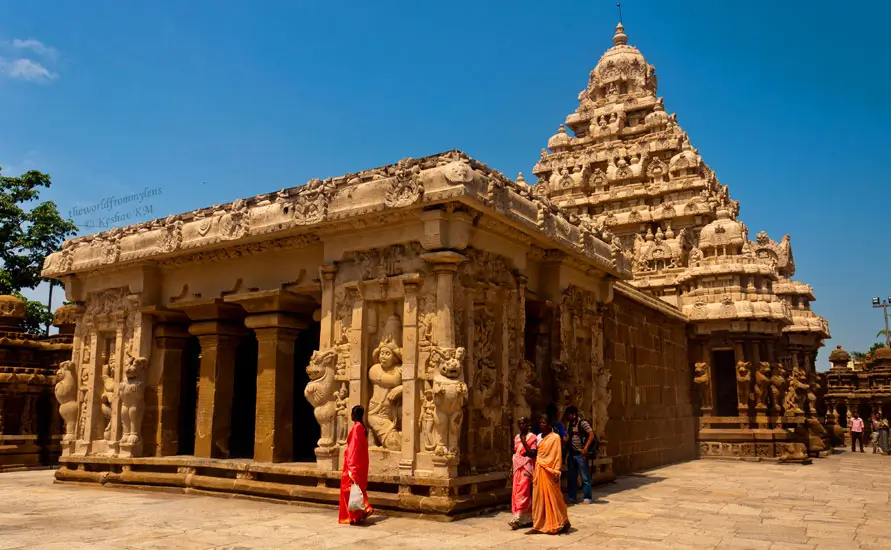
Start the day at the Brihadeeswarar Temple, which Rajaraja Chola consecrated around 1010 AD and which UNESCO inscribed on its own in 1987, years before the other two Chola shrines joined it. Its main tower rises around sixty-six meters above the sanctum and is topped by a capstone of granite estimated to weigh about eighty tonnes, and your guide explains the theories of how it was raised so high. Tamil script runs in long bands around the plinth, listing royal donations of villages, jewels and herds, and even naming the temple dancers and drummers assigned to its service. Visit in the morning, when the granite is still cool underfoot.
By late morning you are on the road again, heading some forty minutes east to Darasuram on the edge of Kumbakonam and its Airavatesvara Temple, which completes your set of Great Living Chola Temples. Rajaraja II commissioned it in the 1100s on a far more modest scale than his ancestor's tower, and its appeal lies in the detail. Bend close to the plinth to find carvings no taller than a hand, of acrobats, drummers, sparring wrestlers and village women, then step back to see the entrance pavilion designed as a temple car pulled by stone horses on carved wheels. Your guide also shows you the musical steps near the entrance, which are said to produce different notes when tapped.
After lunch in Kumbakonam, a busy temple town, you can stop at a bronze casting workshop in nearby Swamimalai, where craftsmen still make temple statues using the lost-wax method followed in this area since Chola times. Each figure starts as a wax model, is covered in clay, heated so the wax melts out, and then filled with molten metal. You return to Tanjore in the late afternoon. Before sunset, consider a visit to the Thanjavur Palace and its Saraswathi Mahal Library, which holds old manuscripts on palm leaf and paper, or simply rest at the hotel. Overnight in Tanjore.
Today's drive to Madurai can be done directly in about three and a half hours, but we recommend a detour through Chettinad, the region of the Nattukottai Chettiar merchant families. Moneylending and trade in Burma, Ceylon, Malaya and Saigon made them wealthy between roughly 1850 and 1940, and the profits were poured into vast family mansions back in some seventy dusty villages. The detour adds about an hour of driving and some time on foot, and it gives you a look at a side of Tamil Nadu that few short tours include. Let us know when booking if you want to skip it.
In the village of Kanadukathan, your guide takes you inside one of the restored mansions open to visitors. The houses are built around a series of courtyards and halls, with columns made from Burmese teak, floors laid with tiles from Italy and the local village of Athangudi, and mirrors and glass from Belgium. Many families still return for weddings and festivals, when the homes are opened, cleaned and filled with relatives. Lunch in Chettinad is the main reason many visitors stop here: the local cooking uses fennel, black pepper and dried chili, served in many small dishes on a banana leaf.
After lunch a two-hour drive west brings you to Madurai, a city praised by Greek and Roman writers and the center of Tamil poetry academies more than two millennia ago. There is time for a rest at the hotel, then an evening stroll through the lanes ringing the temple walls, where jasmine vendors, steel-pot shops and tailors work late under bare bulbs. Energy permitting, return with your guide at about nine for the palliyarai, a nightly bedtime procession in which the deity Sundareswarar is escorted to the goddess's private shrine. Overnight in Madurai.
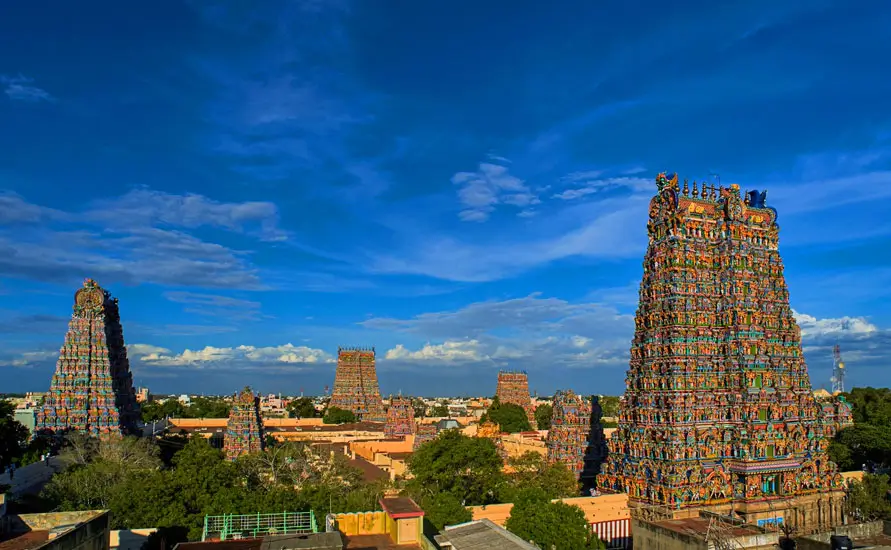
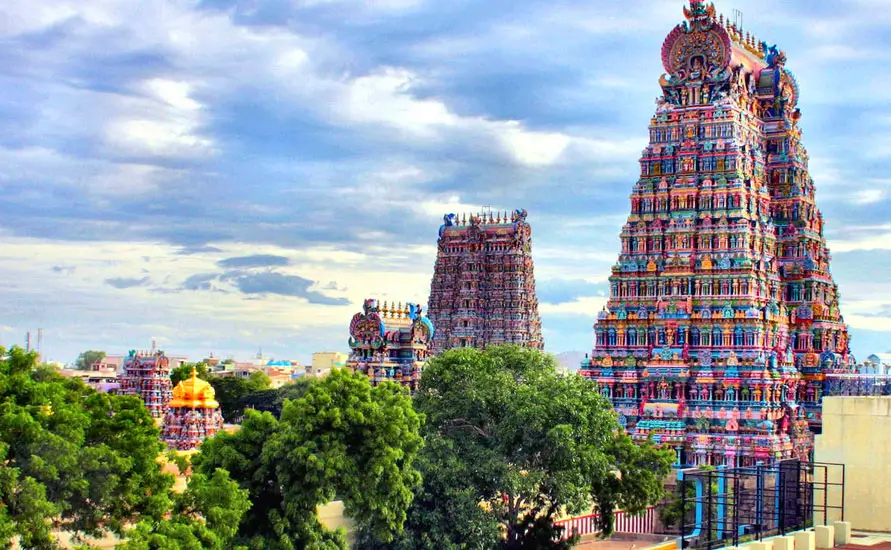
Your guide meets you early for a full morning at the Meenakshi Temple, before the heat and the biggest crowds arrive. Meenakshi, the fish-eyed goddess, shares the sacred site with her consort Sundareswarar, and their walled precinct of around fourteen acres is entered through towering gateways painted in every shade imaginable. Before going through security you check in your mobile and camera at a cloakroom; inside, everyone may wander the mandapams and corridors, but the two main shrines are open to Hindus only. Your guide steers you to the colonnaded steps of the Golden Lotus Tank and then into the thousand-pillared mandapam, now a museum, in which no two columns carry the same sculpted character.
Lunch and a rest come first; later your guide leads you through the Thirumalai Nayak Palace, a royal residence of the 1630s in Indo-Islamic style raised by Madurai's most ambitious Nayak ruler. Only part of the original complex still stands, but its main courtyard, with giant white pillars and arches supporting a domed ceiling, gives a clear idea of the scale. Then comes the Gandhi Memorial Museum, whose galleries trace the freedom struggle through photographs and letters and preserve the garment the Mahatma was wearing when he was killed in Delhi. Your guide fills in the history of both places and answers your questions.
Toward sunset, drive out to Vandiyur Mariamman Teppakulam, a square reservoir of granite steps around a central islet temple; in the Tamil month of Thai, usually late January or early February, decorated rafts carrying the deities are floated across it. Families gather on its steps in the evening, and children play cricket on the dry floor when the tank is empty. For dinner, your guide can recommend a local restaurant serving Madurai specialties such as kari dosa or the cool milk drink called jigarthanda. Tomorrow you leave Tamil Nadu and drive up into the hills of Kerala, so an early night is a good idea. Overnight in Madurai.
Leaving the plains behind, the car heads west after breakfast through Theni, a market district known for bananas, coconuts and cardamom trading, toward the line of blue hills that marks the Kerala border. The flat country gives way to vineyards in the Cumbum valley, where grapes grow on overhead trellises and are sold by the roadside in small baskets for most of the year. Your driver can stop for photos or for a glass of fresh grape juice at a farm stall. The climb begins after the town of Cumbum, with a ghat road of tight bends winding up through forest to about 900 meters.
At the top of the pass you cross into Kerala at Kumily, the small town next to Thekkady and the entrance to the Periyar Tiger Reserve. The air is noticeably cooler, and shop fronts now display bags of cardamom, pepper, cinnamon bark and homemade chocolate instead of Tamil silk and brass. You check in at a hill resort surrounded by trees for two nights, in time for a late lunch of Kerala dishes such as appam with vegetable stew or fish cooked in a clay pot with kudampuli, a sour fruit used in place of tamarind. The afternoon is kept free for rest after the long run of temple days.
Toward evening, Kumily offers two popular shows, and your driver can drop you at either. Kalaripayattu, the old martial art of Kerala, is performed in a sunken arena where fighters leap, roll and clash using bamboo staffs, curved swords and round shields, and finish with a display of fire rings; the energy and speed surprise most visitors. The other option is a short Kathakali program, though you will see a full performance in Kochi later in the trip, so many guests prefer the martial art here. Tickets are sold at the door and seats near the front fill early. Dinner is at the resort, where nights in the hills can be cool. Overnight in Thekkady.
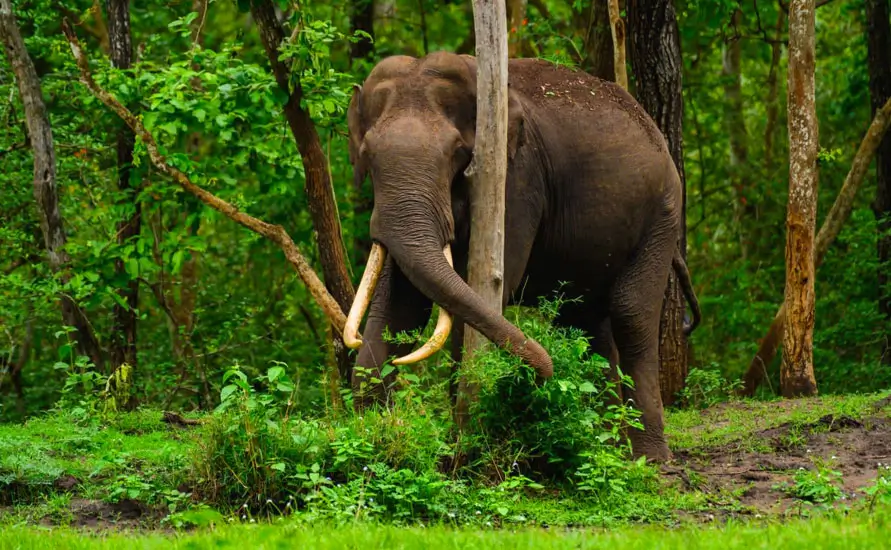
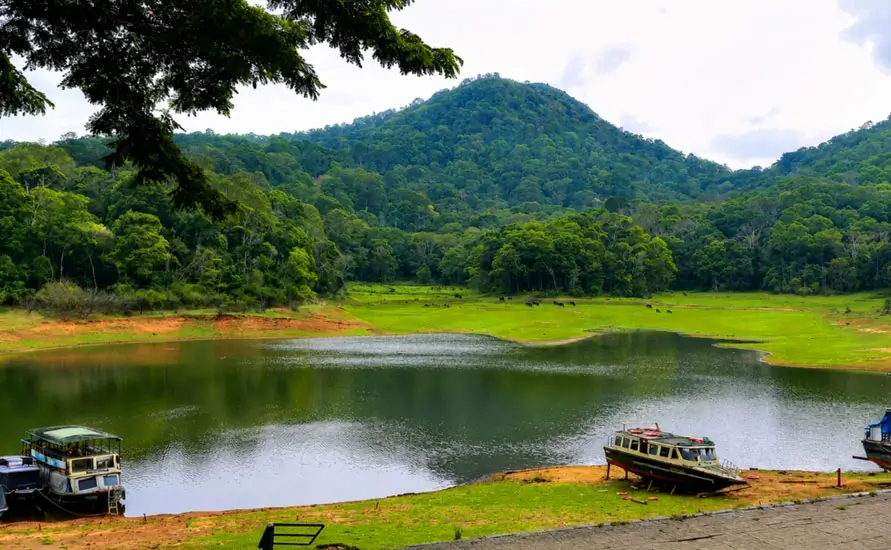
Wildlife is most active in the first hours of daylight, so the morning begins at the boat jetty inside the Periyar Tiger Reserve. Periyar Lake only came into being in 1895, after the engineer John Pennycuick threw a dam across the Periyar river, and the drowned tree trunks still stand in the water as perches for cormorants and darters. From the deck of the forest department boat you scan the banks for herds of elephants coming down to drink, gaur, sambar deer and wild boar. A tiger sighting is possible in theory, yet very few visitors ever get one. Boat tickets are limited and sell out quickly, so our local team helps you queue early.
If you prefer to stay on foot, the forest department also runs guided nature walks of about three hours, led by trained trackers from tribal communities who once lived inside the forest. Groups are small, and you walk quietly along trails through bamboo thickets and evergreen woods, looking for Malabar giant squirrels, Nilgiri langurs, hornbills and the tracks of animals that passed in the night. Leech socks are handed out in the wet months and are worth wearing. Both activities need booking a day ahead, and your guide will advise which one suits the season. By late morning you are back at the resort, ready for an early lunch and a quiet hour.
Once the afternoon heat eases, a plantation owner or his manager leads you around a family-run spice plantation on the slopes outside Kumily. Cardamom grows low under the shade of tall trees, its pods hidden near the base of the plant, while black pepper vines climb up silver oak and jackfruit trunks. You also see nutmeg with its red lacy mace, cloves drying on mats, vanilla orchids that must be pollinated by hand, and cinnamon trees whose bark is peeled in thin strips. Smell and taste are encouraged, and the walk usually ends with tea and a chance to buy fresh spices at farm prices. The evening is free in town. Overnight in Thekkady.
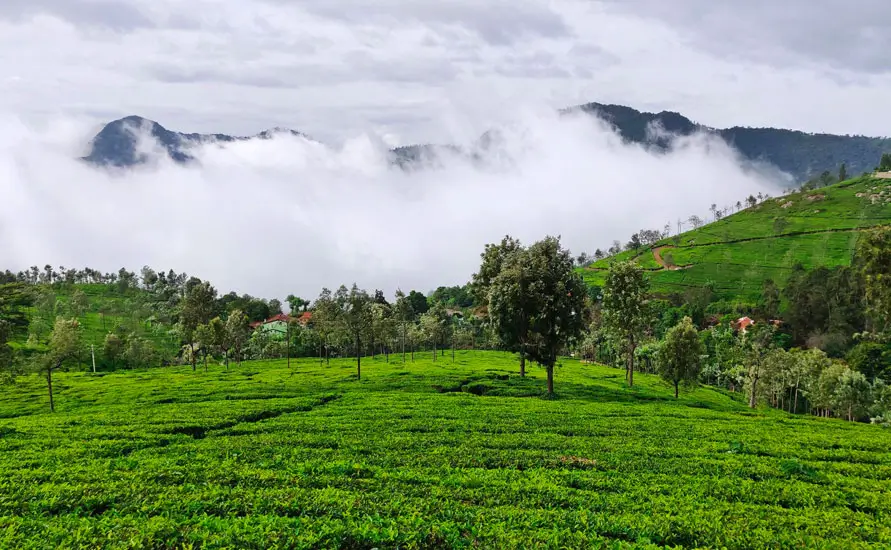
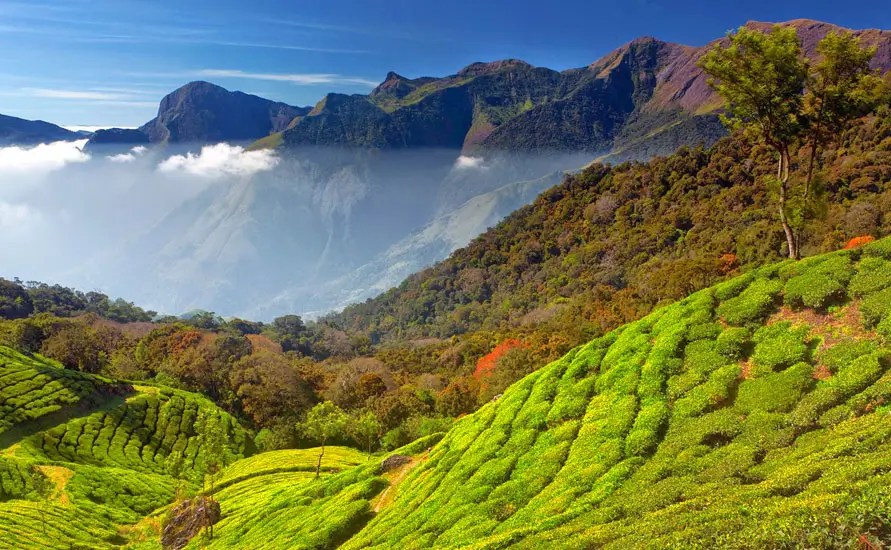
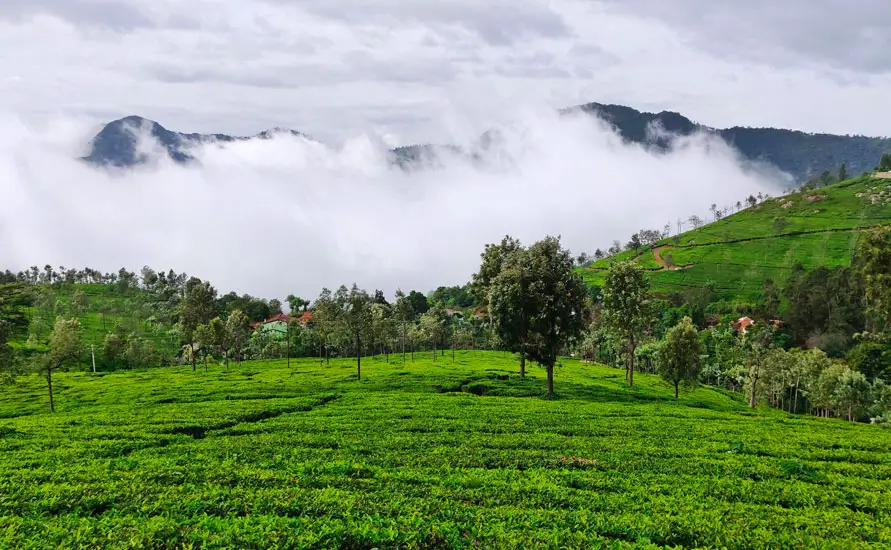
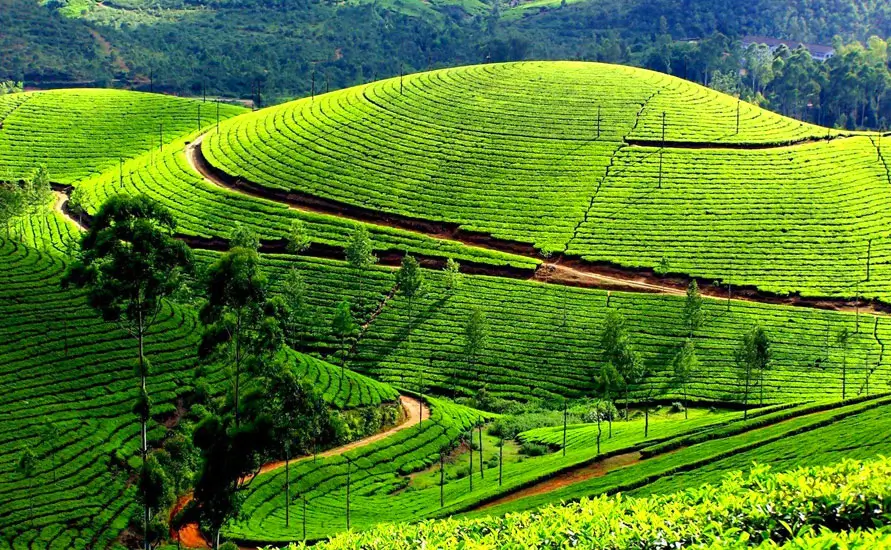
Breakfast is unhurried before the descent from the cardamom hills. The road runs through Vandiperiyar and the tea country around Peermade and Kuttikanam, where neat rows of bushes cover the slopes and pickers move between them with baskets on their backs. A tea factory along the way may allow a short visit to see the leaf withered, rolled, fermented and dried, depending on the season and the estate. Near Kuttikanam the old summer palace of the Travancore royal family stands among the trees, and there are viewpoints where the hills drop away toward the coastal plain. The air warms steadily as you lose height.
Below the ghats, rubber plantations take over, with cups tied to the trunks to collect white latex, and the road passes the church towers and busy junctions of Kottayam, a town known for its early printing presses, newspapers and high literacy. Christianity reached this coast very early, and the Saint Thomas Christians trace their faith back almost two thousand years, which explains whitewashed churches on almost every hill. Half an hour west of Kottayam the road ends at Kumarakom, a cluster of villages and resorts where the land meets Vembanad Lake, India's longest body of inland water. You check in at a lakeside resort for two nights and have lunch overlooking the water.
The rest of the day belongs to the lake. Most resorts here have their own canals, swimming pools and Ayurveda centers, so you can book a massage, swim, or simply sit on the lawn watching fishing canoes and passing houseboats. Toward sunset, a walk along the narrow paths between the paddy fields and canals shows village life at close range: men casting nets, women washing pots at the stone steps, and ducks herded home along the water. Kumarakom sits partly below sea level, and the fields are protected by earthen dikes. Dinner can include karimeen, the pearl spot fish of the backwaters, fried in spices. Overnight in Kumarakom.
Early risers can join a naturalist at the Kumarakom Bird Sanctuary, fourteen acres of mangrove and wooded land on the lake shore that once belonged to an estate owned by an English planter family. A trail of about two kilometers loops through the trees, and in the first hours after dawn you may spot kingfishers, egrets, night herons, darters and, in winter, migrant waterbirds from further north. Binoculars are useful, and the guide often knows where nesting colonies are. After a shower the trail turns to sticky mud, so leave sandals behind. You return to the resort by mid-morning for a relaxed breakfast on the lawn.
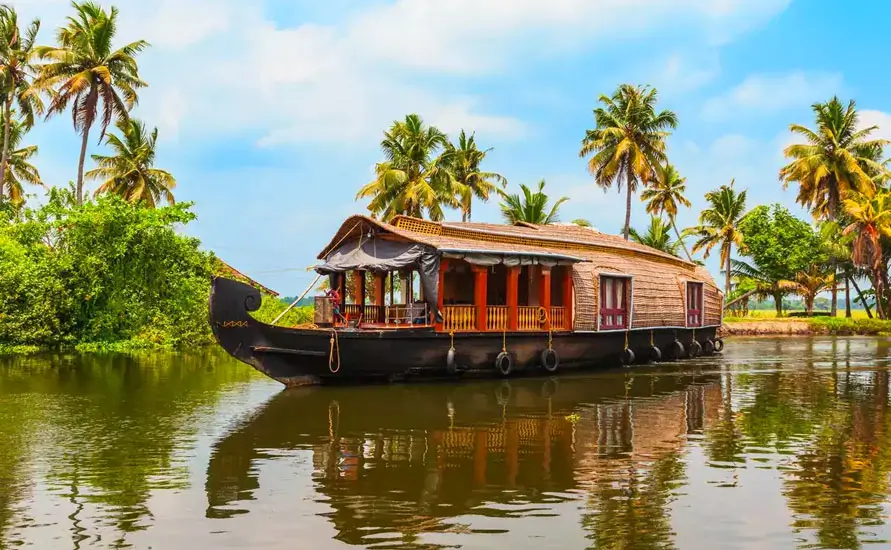
Around eleven, your private Kerala houseboat pulls up at the resort jetty or a nearby landing for a day cruise. These boats, called kettuvallam, were once used to carry rice, coconut and spices to the port of Kochi, and their curved hulls are still built from jackfruit wood planks joined with coir rope rather than nails. A captain, a deckhand and a cook look after you. The boat moves slowly across the open water of Vembanad Lake and then turns into narrower channels, where you pass churches, small temples, toddy shops and houses built along the banks, with children waving from the steps.
Lunch is cooked on board and served on the open deck: rice, sambar, a vegetable thoran with grated coconut, fish curry and fried fish, with fresh fruit to finish. Afterward the boat drifts past paddy fields lying below the water level, and you can ask the captain to stop at a village landing for a short walk or to buy fresh prawns, which the cook will prepare for you. Afternoon tea comes with banana fritters as the light softens over the lake. The cruise ends around five, before the evening rule that houseboats must stop moving, and you are dropped back at your resort for dinner. Overnight in Kumarakom.
The last proper road transfer of the trip is a short one. After breakfast and a final look at the lake, you leave Kumarakom and follow the road north through Vaikom, home of an old Shiva temple and the site of a famous 1924 protest for the right of all castes to use the roads around it. The route then runs past coconut groves, canals and fishing villages to Kochi, the busy port city of central Kerala. Your base for the last two nights is a heritage hotel in Fort Kochi. Many of these hotels occupy restored Dutch or Portuguese-era bungalows, with high ceilings and wooden floors.
The afternoon is yours to settle in, have lunch at one of the cafés along Princess Street, or walk the waterfront at your own pace. Fort Kochi is compact and flat, and many of its lanes are shaded by huge rain trees planted in the colonial period. You will see the main sights with your guide tomorrow, so there is no pressure today. A short walk takes you to the beach promenade, where families gather in the evening, vendors sell roasted corn and ice cream, and large cargo ships slide past toward the harbor entrance. Save some energy, though, because the evening program starts early.
Around five you head to a small theater in Fort Kochi for Kathakali, the classical dance drama of Kerala that grew out of temple arts in the 17th century. Arriving early lets you watch the actors prepare, but the more useful part for first-time viewers is the introduction before the play, when a performer demonstrates the hand gestures called mudras and the eye and eyebrow movements used to show love, anger, fear and wonder. Then the chenda and maddalam drums start, a singer narrates the story, and the actors bring a short episode from the Mahabharata or Ramayana to life without speaking a word. Overnight in Kochi.
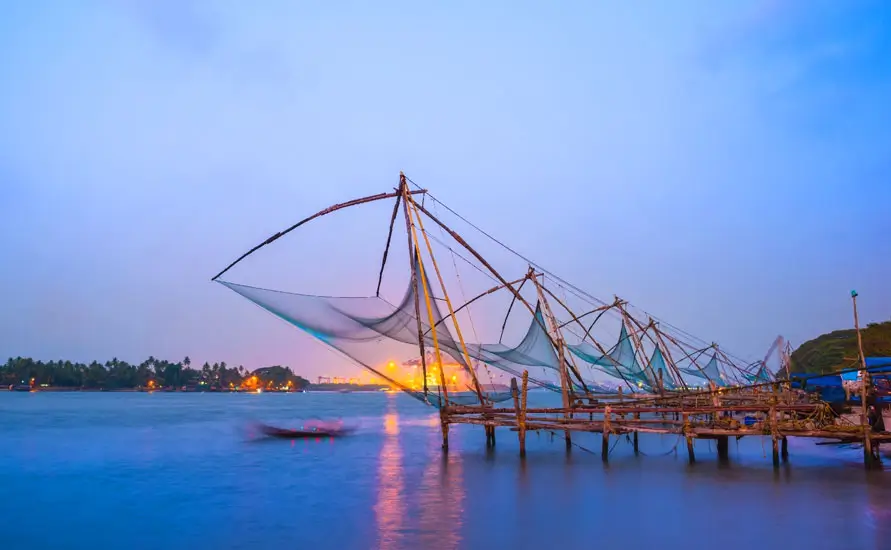
A morning at the waterfront starts the last full day of your Highlights of South India tour. The Chinese fishing nets at the tip of Fort Kochi are large cantilevered frames of teak and bamboo, balanced by stones hung on ropes, and a crew of several men walks along the beam to lower and raise each net. Local tradition links them to Chinese merchants who sailed here in the 14th century, although nobody can prove it. Fishermen often invite visitors to help pull the ropes for a small tip. Nearby stalls sell the catch, and some cafés will cook what you buy.
On foot with your guide, you then walk through the old colonial quarter. St. Francis Church, first built by the Portuguese in 1503, is the oldest European church in India, and Vasco da Gama was buried here in 1524 until his son had the body shipped home to Lisbon about fourteen years later. The Santa Cruz Basilica nearby has a painted ceiling and stained glass. Your guide also points out Dutch and British houses, the old cemetery and Princess Street. A short ride south brings you to Mattancherry, whose so-called Dutch Palace, actually a Portuguese gift to the local Raja that the Dutch later restored, keeps fine murals from the Ramayana. It is closed on Fridays.
A few lanes away lies Jew Town, where the Paradesi Synagogue of 1568 has a floor of hand-painted blue and white tiles from Canton and a collection of Belgian glass lamps. The synagogue does not open on Fridays or Saturdays, nor on Jewish holidays, and when your date clashes with one of those we swap this program with the free afternoon of Day 13. The street outside is lined with antique shops, spice warehouses and ginger traders, and the smell of dried ginger and pepper hangs in the air. Later you are free to shop for souvenirs or return to the hotel to pack. A farewell dinner of Kerala seafood rounds off the trip. Overnight in Kochi.
The final morning of your South India highlights tour depends on your flight time. If you leave in the afternoon or evening, there is time for one more walk along the Fort Kochi seafront, a visit to the Indo-Portuguese Museum with its church silverware and altar pieces, or a cheap round trip on the public ferry to Ernakulam on the mainland, which costs very little and gives fine views of the port. Hotel checkout is usually at noon, and if your flight is late at night we can arrange a room for the extra hours at a supplement, so you can shower and change before leaving.
Packing for the flight home takes a little care after two weeks of shopping. Spices, tea and coffee are allowed in checked luggage, but many countries have rules on bringing seeds, fresh food or plant material, so check with your airline and customs office before you buy. Pack any jars of pickle or bottles of coconut oil in your checked bag, never in the cabin. Antiques older than one hundred years cannot be exported from India without a certificate, and reputable dealers in Jew Town will explain the paperwork. Our team will call during the morning to confirm the pickup time and make sure nothing has been left behind.
At the hour fixed the evening before, your bags go into the car for the last run, out to Cochin International Airport at Nedumbassery, around forty kilometers from Fort Kochi. Allow at least an hour and a half, as traffic through Ernakulam can be heavy, and plan to reach the terminal three hours before an international departure. Large solar fields beside the runway supply the terminal with much of its electricity. Saying goodbye to the driver who has carried you from Chennai across two states is often the hardest part of the day. We hope the temples, hills, lakes and kitchens of the south stay with you, and that you return soon.
Your Journey

N.S. Rathore & Mrs. Omlata Rathore · Managing Director
We still read every enquiry ourselves. Tell us the places you liked and our planners will send a day-by-day route with drive times and a clear price.
Every package can be customised and no pressure to book. A planner from our office replies within 24 hours with a route written for your group.
Fill this in and your planner will send a first draft itinerary.
Explore more
Kerala Backwaters Escape Kerala Backwaters Escape
 Kerala Backwaters Escape
 Kerala Backwaters Escape
 Kerala Backwaters Escape
 Kerala Backwaters Escape
 Kerala Backwaters Escape
 Kerala Backwaters Escape
 Kerala Backwaters Escape
 Kerala Backwaters Escape
 Kerala Backwaters Escape
 Kerala Backwaters Escape
 Kerala Backwaters Escape
 Kerala Backwaters Escape
 Kerala Backwaters Escape
 Kerala Backwaters Escape
 Kerala Backwaters Escape
 Kerala Backwaters Escape
 Kerala Backwaters Escape
 Kerala Backwaters Escape
 Kerala Backwaters Escape
 Kerala Backwaters Escape
 Kerala Backwaters Escape
 Kerala Backwaters Escape
 Kerala Backwaters Escape