 Kerala Backwaters Escape

South India Tour Packages
Chennai – Kanchipuram – Mahabalipuram – Pondicherry – Kochi – Alleppey
At a glance
Planning a first trip to South India usually begins with one honest question: where do you start? Our South India tour for first-time visitors answers it with a route that keeps travel time low and variety high. In eight days you move from the temple streets of Chennai and the Pallava stone carvings of Mahabalipuram to the French-era lanes of Pondicherry, then fly west to Kochi and finish on a private houseboat in Alleppey. Two states, two coastlines and two very different food cultures fit into one well-paced South India tour package.
Every day has a clear plan, yet none of them feels rushed. Road transfers stay under four hours, the Chennai to Kochi leg is covered by a short domestic flight, and you sleep in the same hotel for two nights in both Pondicherry and Kochi, so you are not packing a suitcase every morning. A private air-conditioned car with an English-speaking driver stays with you on the road, and licensed local guides walk you through the main sights in each city.
The 8-day South India itinerary suits couples, families and solo travelers flying in from the UK, Europe, North America or Australia, as well as NRI families bringing overseas-born children to India for the first time. Hotels, sightseeing and the Kerala backwater cruise are all private, so dates, hotel category and daily pace can be adjusted to suit you. October to March brings the most comfortable weather on both coasts.
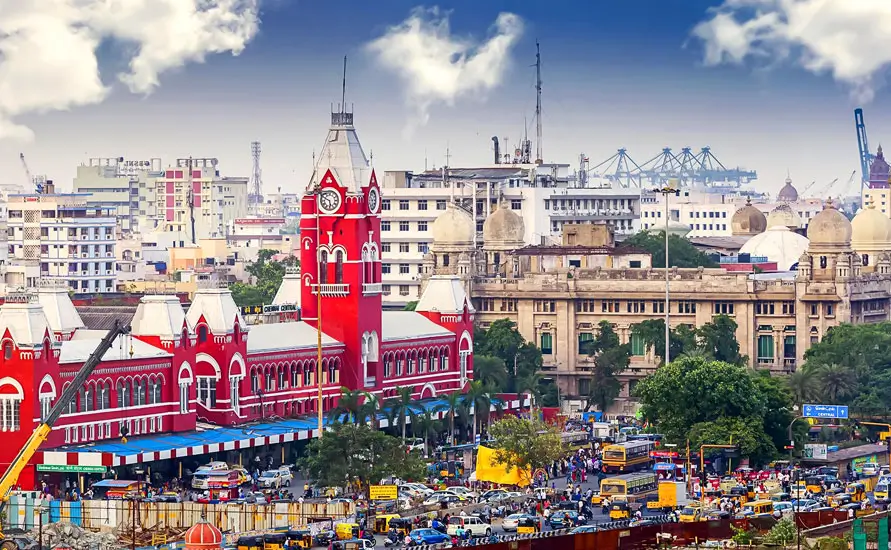
Our representative meets you outside the arrivals hall at Chennai International Airport with a name placard, helps with your bags and drives you to your hotel in a private air-conditioned car. Most flights from Europe and the Gulf land late at night or in the early hours, so the first part of the day is left free for sleep, a shower and time to adjust to the warm coastal air. Standard hotel check-in is at 2 pm, and an early check-in can be booked in advance if you land before sunrise. On the way, our team hands over your travel documents and a printed day-by-day plan, and answers any questions about money, phone connections and local customs.
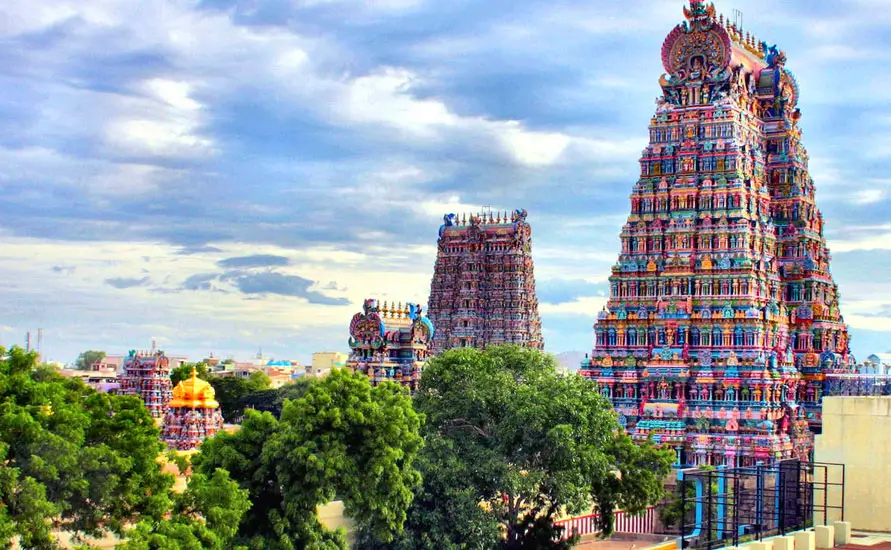
Late in the afternoon, when the heat starts to ease, you head to Mylapore, one of the oldest parts of Chennai and still the city's main temple district. The Kapaleeshwarar Temple stands at its center, with a tall gopuram covered in brightly painted figures of gods, sages and animals. Your guide explains the legend of Parvati worshipping Shiva here in the form of a peahen, which gave Mylapore its name, and talks you through visitor etiquette such as leaving shoes outside and keeping shoulders and knees covered. The streets around the temple tank are packed with flower sellers, brass lamp shops and small eateries serving strong filter coffee in steel tumblers.
A short drive brings you to San Thome Basilica, a white neo-Gothic church built over the tomb traditionally linked to St. Thomas the Apostle, who is believed to have reached India in the first century. From there you continue to Marina Beach, one of the longest urban beaches in the world, where local families gather in the evening to fly kites, buy roasted corn and sit by the water. Swimming is not advised here because of strong currents, but a walk along the sand at sunset is a simple way to watch everyday Chennai life. You return to your hotel for dinner and an early night. Overnight in Chennai.
After breakfast you check out and drive west to Kanchipuram, about two hours from Chennai and one of the seven sacred cities of Hinduism. The town served as the capital of the Pallava kings, who ruled this part of Tamil Nadu between the 6th and 9th centuries and built some of the earliest stone temples in South India. Kanchipuram is also famous across the country for its handwoven silk saris, and many Tamil families still buy one for every wedding in the family. The drive itself is a good introduction to rural Tamil Nadu, with paddy fields, roadside tea stalls and village houses painted in bold colors.
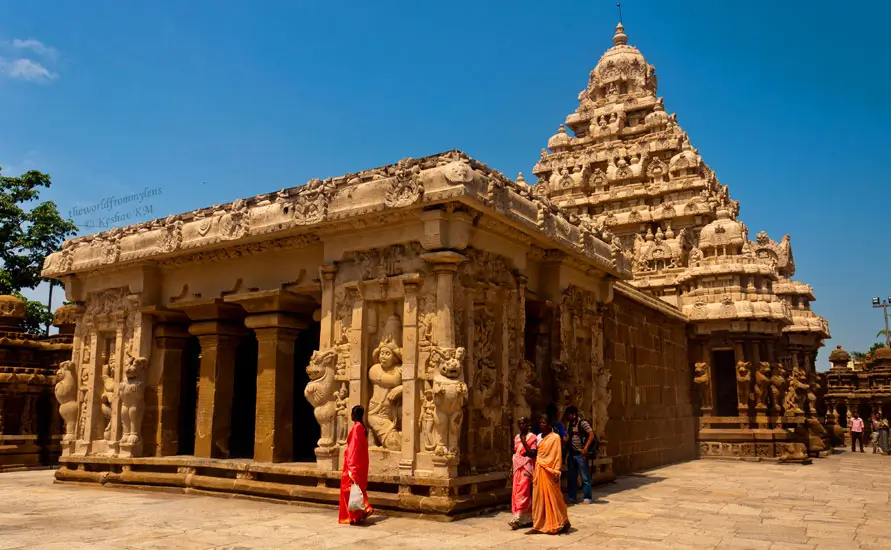
Your first stop is the Kailasanathar Temple, built in sandstone by the Pallava king Rajasimha in the early 8th century. Unlike the busy temples in the town center, it is quiet and compact, and its walls are lined with small shrines carved with Shiva, Parvati and rearing lions. Your guide then takes you to the Ekambareswarar Temple, one of the largest temple complexes in the city, where a mango tree in the inner courtyard is tied to the legend of the temple's founding. Most temples here close their doors in the early afternoon, so both visits are planned for the morning hours.
Before leaving town you stop at a family-run weaving unit to watch a sari being made on a traditional pit loom, a slow craft that can keep one weaver busy for several days or even weeks on a single piece. There is no pressure to buy, and your guide can show you how to check for pure silk and genuine zari thread if you do want to shop. After lunch at a local restaurant you drive south-east to Mahabalipuram, about 65 km away, and check in to your beach hotel by late afternoon. The evening is free for a walk on the sand or a seafood dinner at one of the small restaurants on Othavadai Street. Overnight in Mahabalipuram.
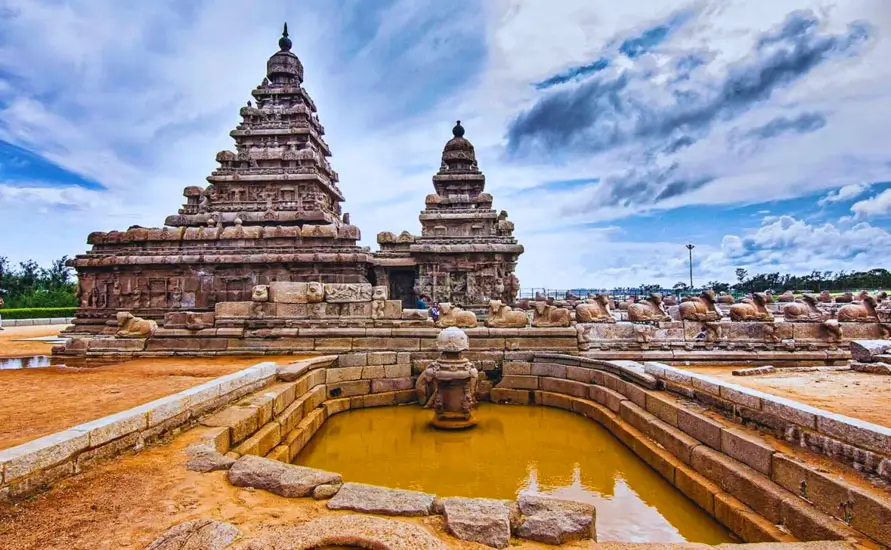
An early start pays off in Mahabalipuram, because the soft morning light falls straight onto the carvings and the sites are still quiet. The rock-cut temples and reliefs here, made by Pallava sculptors mainly in the 7th and 8th centuries, are listed together by UNESCO as the Group of Monuments at Mahabalipuram. Your guide begins at the Shore Temple, a pair of granite shrines facing the Bay of Bengal that have stood up to more than 1,200 years of salt wind and waves. When the 2004 tsunami pulled the sea back from this shore, older carved rocks briefly appeared on the seabed, and your guide can tell you what archaeologists found afterwards.
Next comes Arjuna's Penance, a huge open-air relief carved across two granite boulders and filled with more than a hundred figures of gods, people and animals, including a life-size pair of elephants. Historians still argue over whether it shows Arjuna praying for a divine weapon or the descent of the river Ganges, and your guide points out the details that support each reading. A short walk away sits Krishna's Butter Ball, a giant round boulder resting on a slope that looks ready to roll at any moment. You finish at the Pancha Rathas, five monolithic temples cut from single rocks, each in a different architectural style and each named after the heroes of the Mahabharata.
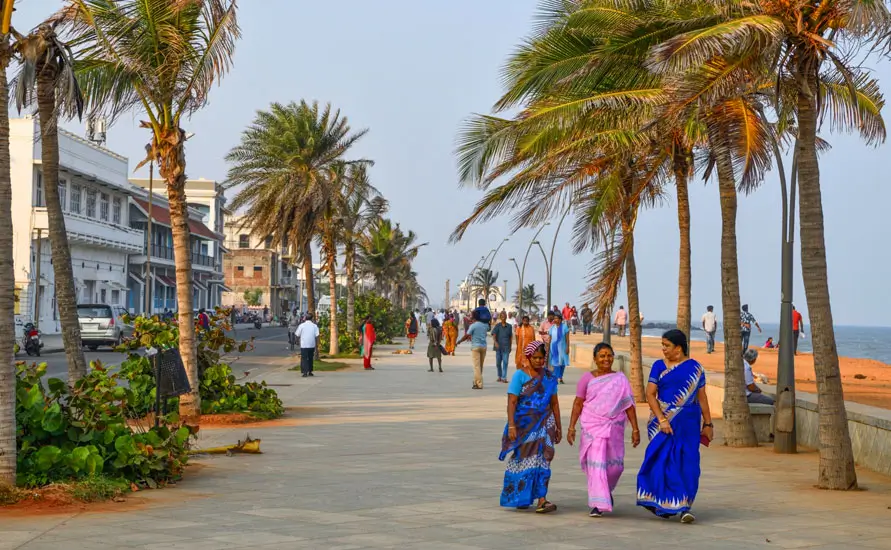
After lunch you drive south along the East Coast Road, an easy two-and-a-half-hour route past fishing villages, salt pans and casuarina groves. You reach Pondicherry in the afternoon and check in to a heritage or boutique hotel in or near the French Quarter. In the evening, take a slow walk along the Promenade, the seafront road that closes to traffic every evening, and watch local families gather near the Gandhi statue and the old lighthouse. Dinner can be at one of the nearby restaurants serving French, Creole and Tamil dishes, often on the same menu. Overnight in Pondicherry.
Pondicherry remained the capital of French India until 1954, and its old town still looks and feels different from anywhere else in Tamil Nadu. A morning walking tour with your guide covers the Pondicherry French Quarter, also called White Town, where colonial villas with mustard-yellow walls and white shutters sit behind gates heavy with bougainvillea. Street signs are still written in French and Tamil, and many old houses now hold cafés, bakeries, small hotels and the French consulate. You also stop at the Basilica of the Sacred Heart of Jesus, known for its Gothic façade and the stained-glass panels that show scenes from the life of Christ.
The walk continues to the Sri Aurobindo Ashram, founded in 1926, where visitors can sit quietly beside the flower-covered samadhi of Sri Aurobindo and the Mother. Silence is expected inside and photography is not allowed, so your guide will brief you before you go in. Nearby is the Manakula Vinayagar Temple, dedicated to Ganesha, with walls and ceilings covered in painted panels that tell the god's stories. Lunch is at your own pace, and your guide can suggest a café for crêpes and wood-fired pizza or a local place for a full South Indian thali served on a banana leaf.
In the afternoon you drive about 12 km north to Auroville, the international township founded in 1968, where residents from dozens of countries live and work together. A short film at the visitor center explains the idea behind the project, and a footpath through the woodland leads to the viewing point for the Matrimandir, the large golden sphere at the center of the township. Entry to the inner meditation chamber needs a separate advance booking at the visitor center and places are limited, so let us know early if you would like to try for a slot. You return to Pondicherry for a free evening in town. Overnight in Pondicherry.
After an early breakfast you check out and drive back up the coast to Chennai International Airport, a trip of roughly three and a half hours depending on traffic. Your driver times the departure around your flight and leaves extra margin for the busy roads on the edge of Chennai. The domestic flight to Kochi takes about an hour and a quarter and carries you across the width of the peninsula, from the dry plains of Tamil Nadu to the green, rain-fed coast of Kerala. Our Kerala team meets you at Cochin International Airport and drives you to your hotel in Fort Kochi, about an hour and a half away.
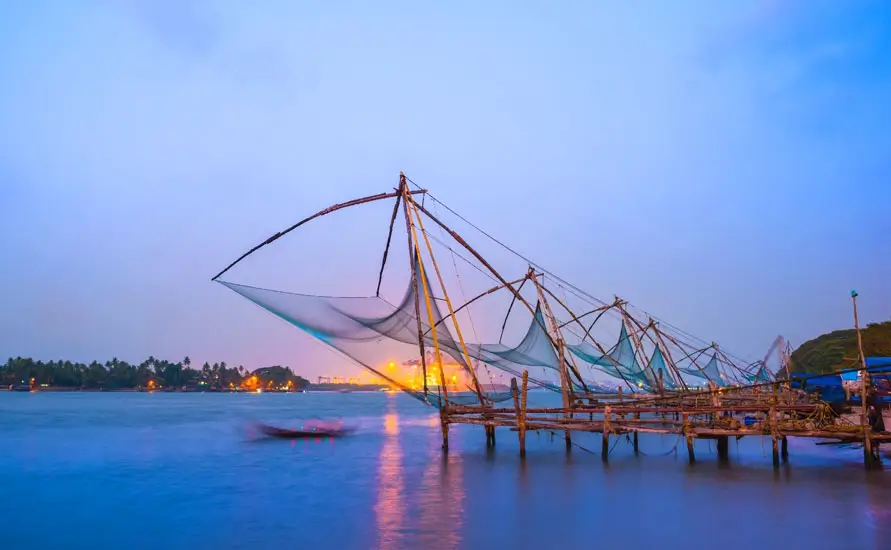
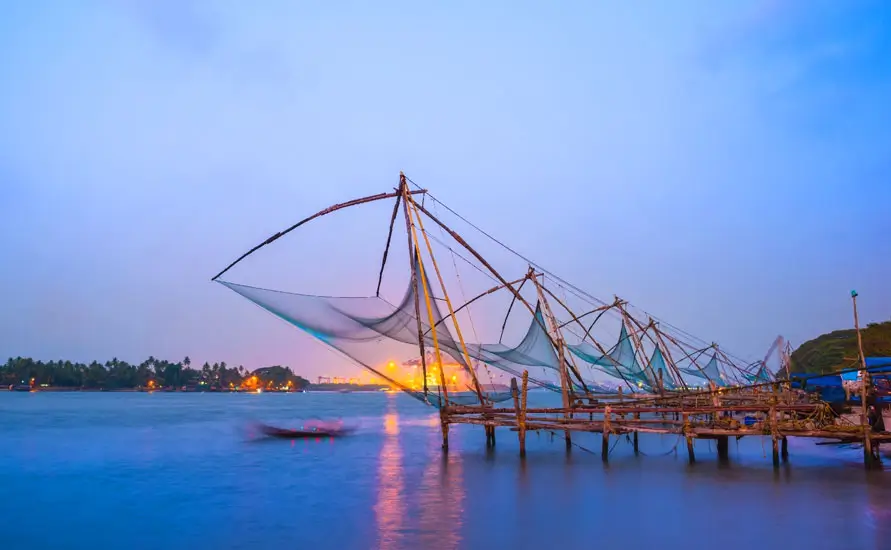
Fort Kochi is a compact old port town, and the hour before sunset is the best time to see its most photographed sight, the Chinese fishing nets along the waterfront. Local tradition says these large cantilevered nets arrived with traders from the court of Kublai Khan, and teams of four to six fishermen still raise and lower them using ropes and stone counterweights. If the crew invites you, you can lend a hand on the ropes and see what the net brings up. Fish sellers set up stalls nearby, and small kitchens behind them will cook your chosen catch for a modest fee.
In the evening you attend a Kathakali performance, Kerala's classical dance-drama in which performers tell stories from the Ramayana and Mahabharata through facial expressions, hand gestures and drum rhythms. Arrive early, because the artists apply their elaborate green, red and black make-up in front of the audience, a process that takes more than an hour and is just as interesting as the show. A short talk before the performance explains the key gestures, so you can follow the story without knowing Malayalam. You return to your hotel afterwards for dinner. Overnight in Kochi.
Today's walking tour packs four centuries of trade and colonial history into a few square kilometers. You start at St. Francis Church, built by the Portuguese in the early 1500s and one of the oldest European churches in India, where Vasco da Gama was first buried in 1524 before his remains were shipped back to Portugal. The route then passes old Dutch and British bungalows, the former parade ground and quiet lanes lined with rain trees. You also stop at the twin-spired Santa Cruz Cathedral Basilica, whose painted ceilings and stained-glass windows are worth a few minutes inside.
After a coffee break you drive to Mattancherry for the Mattancherry Palace, also known as the Dutch Palace. The Portuguese built it around 1555 as a gift for the Raja of Kochi, the Dutch later repaired and extended it, and today it holds some of the finest Hindu murals in Kerala, with large Ramayana panels painted in natural pigments. Close by in Jew Town stands the Paradesi Synagogue, built in 1568 and known for its hand-painted blue and white Chinese floor tiles and Belgian glass chandeliers. The palace is closed on Fridays, and the synagogue on Fridays, Saturdays and Jewish holidays, so we arrange the order of visits around your travel dates.
The lanes of Jew Town are full of antique shops, art galleries and spice warehouses, and the smell of pepper, ginger and cardamom drifts out of old godowns where traders still sort and pack spices by hand. The afternoon is free for shopping, a coffee in a converted warehouse café or simply resting at your hotel. If you have energy left, an optional sunset cruise around Kochi harbor shows you the working port, the islands and the backwaters right next to the city. Dinner tonight could be a plate of fish moilee or prawn curry at a waterfront restaurant in Fort Kochi. Overnight in Kochi.
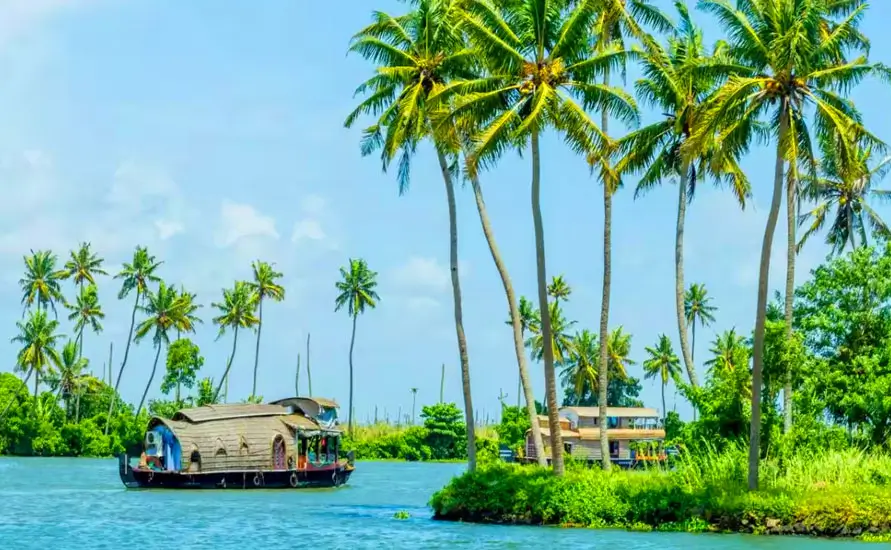
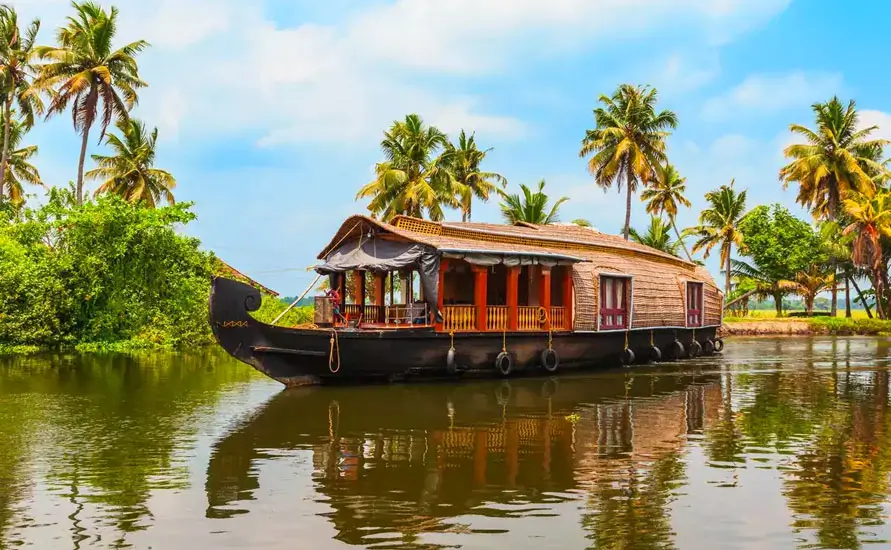
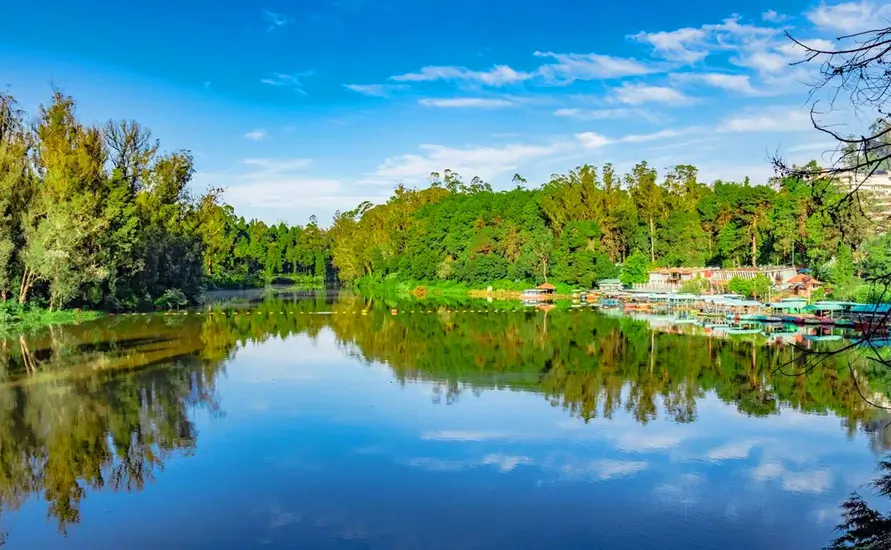
After breakfast you drive south to Alleppey, also written Alappuzha, the main base for houseboat cruises on the Kerala backwaters. The road follows the coast through towns full of churches, fish markets and coconut groves, and you reach the boat jetty around noon. Your private Kerala houseboat is a modern version of the kettuvallam, the wooden rice barge once used to carry paddy and spices along these canals, built from jackwood planks and topped with a curved roof of bamboo and woven palm. The crew, usually a captain, a cook and a helper, welcomes you on board with a glass of fresh coconut water.
The cruise starts after lunch, which is served on deck and usually includes Kerala rice, sambar, a vegetable thoran, fried karimeen (pearl spot fish) and a sweet payasam. The boat moves slowly from the open water of Lake Vembanad into narrow canals where village life happens right at the water's edge. Women wash clothes on stone steps, children paddle small canoes, and farmers herd flocks of ducks along the banks from their country boats. On both sides you can see paddy fields of the Kuttanad region lying below sea level behind mud embankments, a farming system found in very few places in the world.
Local rules require houseboats to stop cruising in the early evening, so the boat anchors for the night beside a quiet village or along the edge of a paddy field. You can take a short walk on the embankment with a crew member, watch the sunset over the water and enjoy tea with banana fritters on deck. Dinner is cooked fresh on board, and the cook is happy to adjust the spice level or prepare a mild menu for children. The night is calm, with only the sound of frogs and the odd passing canoe. Overnight on the houseboat.
Wake up early to see the backwaters at their quietest, when a light mist hangs over the water and fishermen are already out in their canoes. Breakfast of appam with egg curry or idli and chutney is served on board while the boat cruises back toward the jetty. Disembarkation is usually around 9 am, and the crew helps carry your luggage to the waiting car. It is a good moment to thank the team, and if you were happy with the service, a tip for the crew is customary and always appreciated.
The drive to Cochin International Airport takes about two hours, and the departure time is planned to give you a comfortable margin, since check-in for international flights usually opens three hours before take-off. Along the way your driver can stop at a roadside stall for fresh fruit or at a spice shop if you want to take home pepper, cardamom or Kerala tea. If your flight leaves late at night, we can book a day-use hotel room near the airport or add an extra night at a beach resort in Marari at an additional cost. Our representative stays with you until you reach the terminal entrance.
Cochin International Airport is known as the first airport in the world to run fully on solar power, and it connects to major hubs in the Gulf and Southeast Asia for onward flights to Europe, North America and Australia. Over eight days you have seen Pallava temples, a French colonial town, a spice-trading port and a night on the backwaters, which gives you a solid first look at South India. Many of our guests return for a longer trip that adds Madurai, Munnar or the Chettinad region, and we would be glad to plan that with you. We wish you a safe flight home.
Your Journey

N.S. Rathore & Mrs. Omlata Rathore · Managing Director
We still read every enquiry ourselves. Tell us the places you liked and our planners will send a day-by-day route with drive times and a clear price.
Every package can be customised and no pressure to book. A planner from our office replies within 24 hours with a route written for your group.
Fill this in and your planner will send a first draft itinerary.
Explore more
Kerala Backwaters Escape Kerala Backwaters Escape
 Kerala Backwaters Escape
 Kerala Backwaters Escape
 Kerala Backwaters Escape
 Kerala Backwaters Escape
 Kerala Backwaters Escape
 Kerala Backwaters Escape
 Kerala Backwaters Escape
 Kerala Backwaters Escape
 Kerala Backwaters Escape
 Kerala Backwaters Escape