

 Kerala Backwaters Escape

South India Tour Packages
Chennai – Mahabalipuram – Pondicherry – Thanjavur – Karaikudi (Chettinad) – Madurai – Thekkady – Kochi – Kumarakom
At a glance
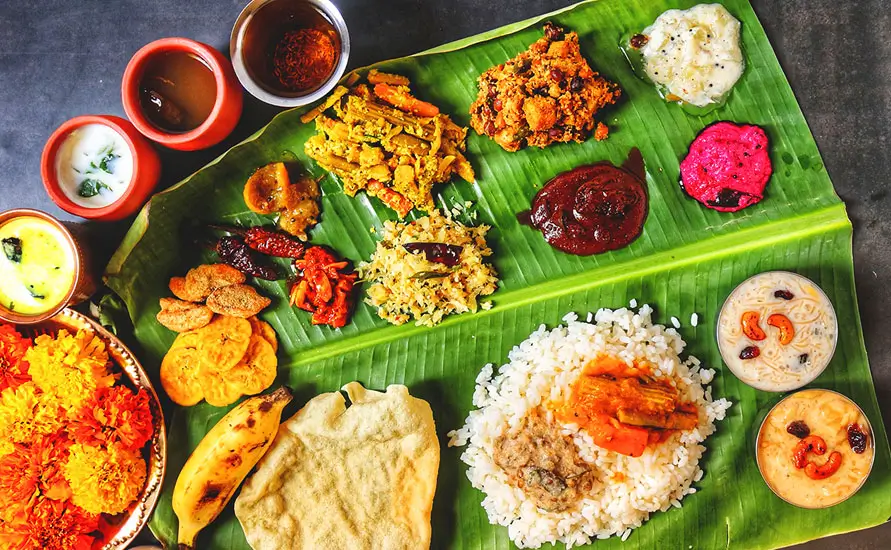
Most visitors to India arrive knowing butter chicken and naan, then find that the south cooks in a completely different language. Our South India food and culture tour follows that language across two states over twelve days. It starts with crisp dosas and frothy filter coffee in Chennai, moves through the Franco-Tamil kitchens of Pondicherry and the pepper-heavy mansion cooking of Chettinad, stays up late for Madurai street food, and ends with coconut, seafood and toddy-shop style fish curry in Kerala. Every meal comes with the story of who cooks it and why.
Food is the thread, but culture fills the gaps between meals. You watch Kathakali actors paint their faces in Kochi, see Kalaripayattu fighters train at dawn, stand under the gopurams of the Meenakshi Temple and walk through tiled Chettiar mansions built with trade money from Burma and Malaya. On this South India food tour there are hands-on sessions in three kitchens, guided walks with tastings in four cities, and enough free evenings to try restaurants on your own.
The trip is private, so your car, driver, guides and cooks work around your appetite rather than a group schedule. Vegetarians, vegans and travelers avoiding gluten, nuts or very hot chili are easy to look after, because South Indian cooking already offers a wide meat-free menu. The Chettinad cooking class and the Kerala cooking class in Kumarakom can be adjusted for spice level. Weather is kindest between October and March, though a rainy-season trip has its rewards, such as jackfruit, monsoon fish and the herbal rice gruel Kerala families cook during the Karkidakam month of July and August.
A member of our Chennai team waits for you just beyond the customs exit with your name on a placard, takes charge of the luggage trolley and walks you to a private air-conditioned car. The ride into the city takes forty minutes to an hour, depending on traffic and which neighborhood your hotel sits in. Long-haul flights from London, Frankfurt or the Gulf tend to land in the middle of the night, so we keep the morning completely empty and suggest you sleep through it. If you would rather walk straight into a room at dawn, ask us to reserve early check-in when you confirm the booking.
Around lunchtime, a light first meal helps your stomach adjust. Ask the hotel for curd rice, a cooling mix of rice and yogurt tempered with mustard seeds and curry leaves, which Tamil families eat at the end of almost every meal and give to anyone feeling unwell. Our representative then sits down with you to go through the food plan for the coming twelve days, note any allergies or dislikes, and explain a few useful table habits, such as eating with the right hand, folding the banana leaf toward you when you have finished, and never refusing a second helping too firmly.
Toward sunset your driver takes you to Elliot's Beach in Besant Nagar, a smaller and calmer stretch of sand than Marina Beach, popular with young couples and families from the south of the city. Vendors sell sundal, a warm salad of boiled chickpeas with coconut and green chili served in a paper cone, and slices of raw mango dusted with chili powder and salt. Dinner is at a well-known vegetarian restaurant nearby, where a full South Indian meals plate gives you a first taste of sambar, rasam, kootu and poriyal side by side. Overnight in Chennai.
Chennai runs on what locals call tiffin, the light meals eaten at breakfast and in the late afternoon, and your day starts at a busy old darshini where the menu has hardly changed in fifty years. Your Chennai food guide orders a spread of fluffy idli, ghee roast dosa, medu vada and pongal, a soft rice and lentil dish seasoned with black pepper and cumin. Coffee arrives in a steel tumbler set inside a small bowl called a dabarah, and the waiter pours it back and forth from a height to cool it and build a light froth. It is made with chicory-blended filter coffee and boiled milk, sweet and strong.
The guided Mylapore food walk then winds through the lanes around the Kapaleeshwarar Temple, one of the city's oldest neighborhoods. You taste crisp murukku fresh from the fryer, a palm-sugar sweet at a shop run by the same family for three generations, and a glass of sugarcane juice pressed with ginger and lime. Your guide explains why the temple tank is the center of daily life here and leads you into the temple courtyard, where you can watch priests and families at prayer. Shoes stay outside, and shoulders and knees should be covered, so a light scarf is useful.
Lunch is at a traditional mess, a small canteen-style restaurant where rice is served without limit on banana leaves and the waiters keep returning with buckets of kuzhambu, buttermilk and pickles until you raise a hand to stop them. After a rest at your hotel, the afternoon brings a visit to the Government Museum in Egmore, whose Chola bronze gallery is one of the best in India and gives useful background for the temples ahead. In the evening, optional extras include a Carnatic music concert in season or a rooftop dinner of coastal Chettinad dishes, a preview of later meals. Overnight in Chennai.
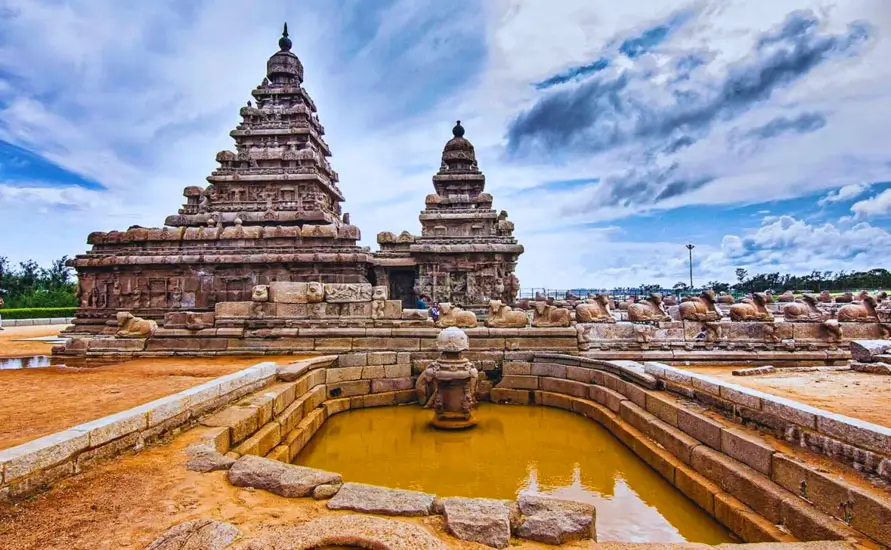
Breakfast done, your car heads out of Chennai along the coastal highway, keeping the Bay of Bengal on your left as casuarina plantations and boat-lined fishing villages slip past. About ninety minutes out of the city you stop at Mahabalipuram, the old Pallava port whose 7th and 8th century carvings are protected by UNESCO. A short guided loop covers the seaside Shore Temple and the huge carved boulder known as Arjuna's Penance, where your guide points to details most people walk past, like the ascetic cat balancing on one leg to fool the mice clustered below it. The visit takes about two hours.
Lunch here is all about the sea. Small family restaurants near the beach display the morning catch on ice, and you choose your fish, prawns or squid before it goes to the kitchen. A common local preparation is a thick coating of red chili, turmeric, ginger and garlic paste, followed by a quick fry on a flat iron pan. Your guide helps with ordering and explains the difference between the seer fish, pomfret and red snapper on display. Ask for a plate of lemon rice on the side, as it balances the heat of the masala without hiding the flavor of the fish.
The second half of the drive takes about two hours and brings you into Pondicherry by late afternoon. After check-in at a heritage hotel in the old town, take a slow walk along the seafront road that closes to cars in the evening, and stop at a gelato bar or one of the old bakeries that still make baguettes and croissants each morning, a reminder that French rule here lasted until 1954. Dinner is at a restaurant serving Pondicherry Creole cooking, the mixed kitchen of French and Tamil households, which you will learn more about tomorrow. Overnight in Pondicherry.
An early start takes you to Goubert Market, the main covered market of Pondicherry, while the fish auction is still running. Women traders sit behind baskets of sardines, crabs and silver mackerel, and they call out prices in a fast mix of Tamil and the odd word of French. Your guide shows you the vegetable aisle, where you can see drumsticks, snake gourd, plantain flowers and the small, sharp Indian shallots used in almost every curry, as well as the spice stalls selling ready-mixed powders. You buy a few ingredients together for the cooking session that follows, and stop for a tumbler of coffee at a stall by the gate.
Late morning you are welcomed into a family home for a Franco-Tamil cooking session, run by a cook whose family has lived in Pondicherry for generations. Dishes vary with the season but often include an assad, a mild coconut-based meat or vegetable stew, a fish curry with tamarind, and something seasoned with vadouvan, a local spice blend of sun-dried shallots, garlic, fenugreek and curry leaves that French chefs later adopted in Europe. You help grind, temper and stir, then sit down to eat what you have cooked with the family. The conversation usually turns to how French and Tamil customs mixed in their kitchens.
After a rest, the afternoon walk covers the grid of streets known as White Town, with its colonial villas, painted shutters and street names in French and Tamil. Along the way you can step quietly into the Sri Aurobindo Ashram courtyard, where the samadhi is covered each day in fresh flower patterns, and look into the Manakula Vinayagar Temple, its interior walls painted with dozens of forms of Ganesha. Your guide adds stops at a chocolatier, a cheese maker supplied by Auroville dairies and a seafront café for a lemon tart. The evening is yours, and the staff at your hotel can recommend a crêperie or a Tamil Muslim biryani house in the old Tamil quarter. Overnight in Pondicherry.
No other day on this route covers as many kilometers, which is why a temple visit and an unhurried lunch sit in the middle of it. An early breakfast gets you on the road across the Kaveri delta, Tamil Nadu's main rice-growing country, a flat green patchwork of canals, paddy, plantain plots and hamlets with a roadside shrine at nearly every junction. Your driver stops wherever you want for photos or a roadside coconut, and can point out the tall stacks of drying rice straw and the brick kilns along the way. After about three and a half hours you arrive in Thanjavur, the old capital of the Chola kings who ruled much of the south a thousand years ago.
At the Brihadeeswarar Temple, completed by Rajaraja Chola around 1010 and listed by UNESCO, a local guide shows you the massive granite tower above the sanctum and the huge monolithic Nandi bull that faces it. The temple was once fed by a vast kitchen and land grants that supplied rice, ghee and lentils for daily offerings, and records carved on its walls list the quantities. Lunch afterwards is at a simple restaurant serving a Thanjavur-style meal, often with a vegetable kootu made with lentils and coconut, and a sweet called asoka halwa, a rich mix of moong dal, ghee and sugar.
The final ninety minutes of driving bring you south into Chettinad, a cluster of about seventy villages that were home to the Nattukottai Chettiars, a merchant community that grew wealthy trading and banking in Burma, Ceylon, Malaya and Singapore during the 19th and early 20th centuries. You check in to a restored mansion hotel near Karaikudi, where high ceilings, Burma teak pillars and pale Italian floor tiles show where that money went. Dinner is a first Chettinad meal served on banana leaves, with dishes spiced with black pepper, fennel, dried red chili and kalpasi, a dark lichen known locally as stone flower. Overnight in Karaikudi.
Morning light is best for the mansion streets of Kanadukathan, a short drive from your hotel, where long walls of whitewashed houses stand along wide, quiet roads. Many of these homes are locked for most of the year because their owners now live in Chennai or abroad, but your guide arranges a visit inside one or two that are open to visitors. You walk through a series of courtyards, each built for a different purpose, from receiving guests to cooking and storing rice. The detail is remarkable: carved wooden doors, egg-white plaster that stays cool in summer, and stained-glass windows brought by ship from Europe.
Next is the village of Athangudi, known for its handmade cement floor tiles. At a small family workshop, the tiles are made one at a time by pouring colored cement into a metal stencil on a glass plate, adding a dry layer to absorb moisture, and leaving each tile to cure in water for several days. No kiln is used. Your guide explains how these patterns, once copied from European tiles, became a local style found in mansions across the region. You can try making one yourself under the workers' supervision, and tiles can be bought in small quantities if you have room in your luggage.
The afternoon is given to the hands-on Chettinad cooking class, held in the kitchen of your mansion hotel or a nearby family home. The cook shows you how to dry-roast and grind a fresh spice paste for chicken or mushroom Chettinad, how to make kuzhi paniyaram in a dimpled cast-iron pan, and how to prepare a peppery rasam and a dry vegetable fry with grated coconut. The spices include star anise, marathi mokku and stone flower, so the flavors are deep rather than simply hot. Dinner is the meal you cooked, and the recipes are yours to take home. Overnight in Karaikudi.
Before leaving Chettinad, stop at the antique and salvage street in Karaikudi, where dealers sell the contents of old mansions: brass oil lamps, enamel tiffin carriers, wooden cooking boxes, glass chandeliers and stacks of Burmese lacquerware. Even if you buy nothing, browsing here shows how these families cooked, stored and served food a century ago. There is time for a last coffee and a snack of seepu seedai, a crunchy comb-shaped savory made only in this region, before the drive west. The road to Madurai runs through dry scrub country and small farming towns and takes about two hours.
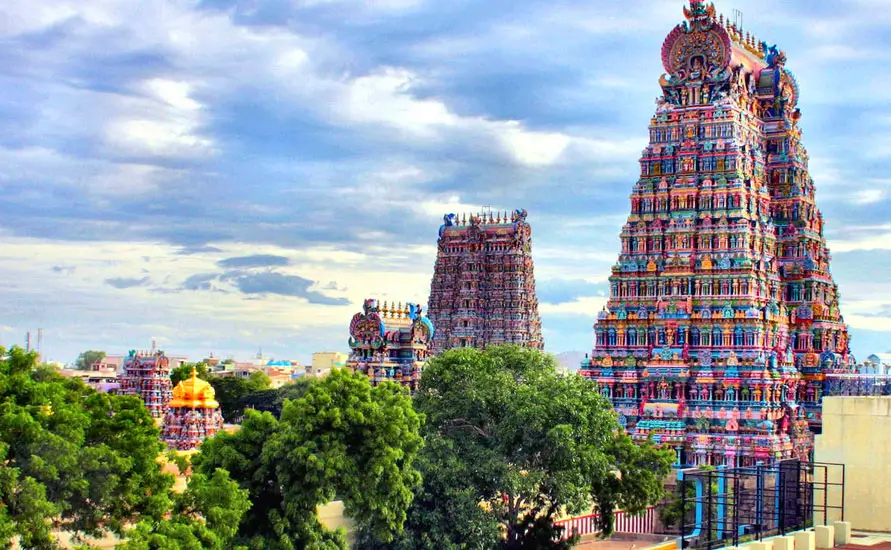
Lunch and a siesta at the hotel carry you through the midday heat, and around five o'clock you set out for the Meenakshi Temple, just as the stone cools and Madurai families come in for their evening worship. The temple covers a vast area in the old city, and its fourteen towers are crowded with thousands of painted figures. Phones and cameras are not allowed inside and must be left at the counters near the gates, while non-Hindus may visit the halls and corridors but not the inner sanctums. Your guide leads you through the Hall of a Thousand Pillars and the Golden Lotus Tank, explaining the legend of Meenakshi's marriage to Sundareswarar.
The temple has a kitchen side too. Your guide takes you through the narrow streets around the east tower, where shops sell temple prasadam, brass pots and the small rice flour and jaggery sweets offered to the goddess. Night owls can wait for palliyarai at about 9 pm, a short, noisy procession of drummers and nadaswaram players escorting the god Sundareswarar in his palanquin to spend the night with his consort. Dinner can be a quiet one at the hotel, since tomorrow night is the main food evening in Madurai. Overnight in Madurai.
Madurai wakes early, and so does its food. Start with breakfast at a popular idli shop where the idlis are steamed in batches of several hundred, served with three chutneys and a thin, tangy sambar that you are expected to pour over everything. From there your guide takes you to the wholesale Mattuthavani flower market, where jasmine buds from surrounding villages are weighed and sold by the kilo and woven into garlands by quick-fingered sellers. Madurai jasmine is prized across India for its strong scent, and you will see it in women's hair throughout the day.
Late morning is set aside for the Thirumalai Nayak Palace, built in the 17th century by the ruler who also funded much of the Meenakshi Temple. What stands today is a fraction of the king's residence, but the main audience hall still makes visitors stop and look up: giant round pillars, scalloped arches and stucco domes show Nayak builders mixing temple craft with Indo-Islamic ideas. Ten minutes away by car, the Gandhi Memorial Museum keeps the dhoti stained with his blood from the evening of his assassination in January 1948. After lunch at a local place serving Madurai-style mutton or vegetable biryani, the afternoon is free for a nap, since tonight's food walk runs late.
The Madurai night food walk starts after dark, when the city's streets come alive with stalls and small restaurants. Your guide orders kari dosa, a thick dosa topped with egg and spiced minced mutton, and bun parotta, a soft, layered bread torn up with salna gravy. You also try mutton chukka, a pepper-dry fry, and finish with jigarthanda, Madurai's famous cold drink of milk, almond gum, sarsaparilla syrup and ice cream. Vegetarians are well covered with paruthi paal, a warm cottonseed milk, and paniyaram with chutney. The walk ends near midnight for those who keep going. Overnight in Madurai.
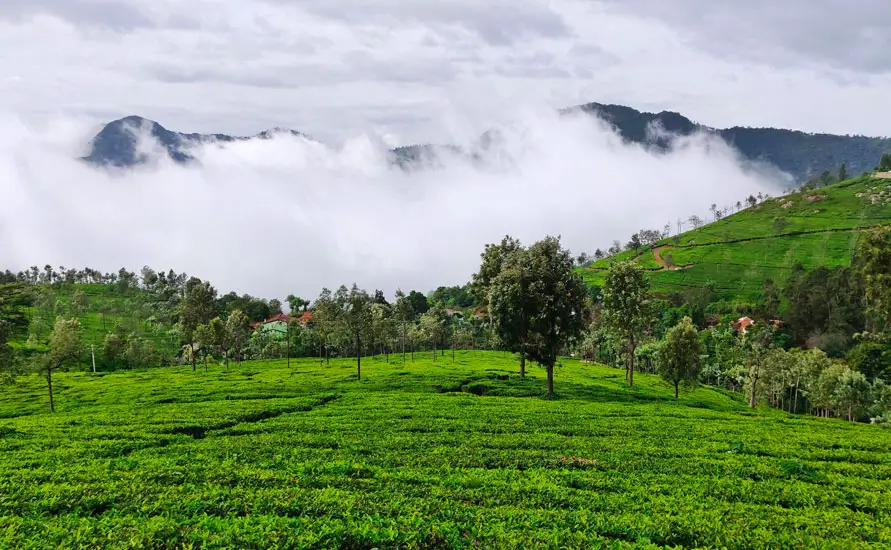
The crossing from Tamil Nadu into Kerala is long but rewarding, and we break it into two easy stages rather than flying via Chennai, which would take most of the day anyway. Leaving Madurai after an early breakfast, the road passes through vineyards and coconut farms around Cumbum, where Tamil Nadu grows much of its table grapes, before climbing a series of hairpin bends into the Western Ghats. The air cools, the vegetation thickens, and after about three and a half hours you reach the Kerala border town of Kumily, at the edge of the Periyar Tiger Reserve.
Near Thekkady a family-owned spice plantation hosts you for a walk and lunch. A guide from the estate shows you how cardamom pods grow at the base of the plant, how black pepper vines climb tall shade trees, and how nutmeg fruit splits to show the red mace wrapped around the seed. Lunch is a simple Kerala spread made with spices grown on the estate, often including a pepper chicken or vegetable stew, red rice and a fresh banana. Spices sold at the estate shop are usually fresher than those in city stores, and are a good gift to take home.
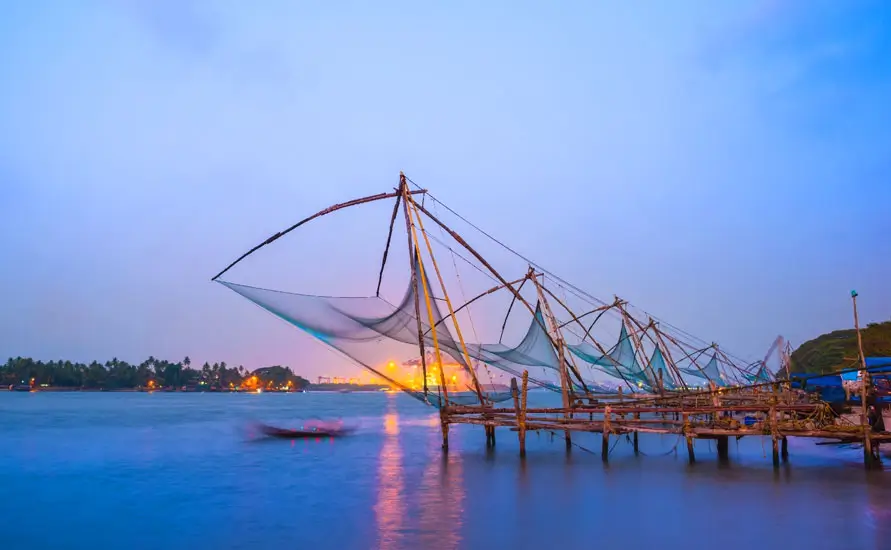
The afternoon drive to Kochi takes about four hours and drops steeply through rubber plantations, small hill towns and church villages before reaching the coastal plain. Your driver stops for tea and banana fritters along the way, and to stretch your legs whenever you like. By about six you pull up at your restored colonial guesthouse in Fort Kochi, a short walk from the waterfront. Dinner tonight is easy: grilled fish and a cold drink at one of the waterfront restaurants, or room service if the day's travel has worn you out. Overnight in Kochi.
Kochi has fed traders from Arabia, China, Portugal, Holland and Britain, and the city's kitchens still show it. A morning walk with your Kochi food guide begins at St. Francis Church, where Vasco da Gama was originally buried, and passes old Dutch houses and warehouses. You stop at a bakery serving plum cake and egg puffs, a Moplah snack stall for unnakai, a sweet stuffed plantain dumpling, and a tea shop where Kerala chai is pulled between two cups. Your guide checks the calendar in advance, because the Mattancherry Palace has its weekly closure on Friday and the Paradesi Synagogue locks its doors every Friday and Saturday plus Jewish festival days.
Lunch is the center of the day. A Syrian Christian family welcomes you into their home to share dishes that belong to one of the oldest Christian communities in Asia, said to trace back to the apostle Thomas. Expect lacy appam with a mild coconut stew, duck roast with black pepper and shallots, and meen pollichathu, a fish fillet coated in spicy paste, wrapped in banana leaf and slow-cooked on a pan. Your hosts may also serve a Moplah dish, such as fried mussels or pathiri rice flatbread, from the Muslim community of the Malabar coast. The talk at the table is as valuable as the food.
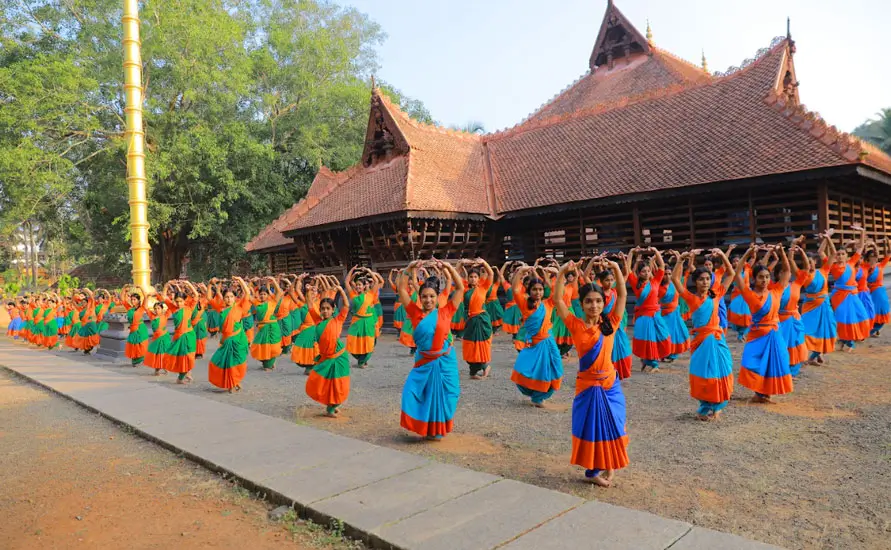
Late afternoon is free to rest or browse the spice shops of Jew Town. In the evening you head to a small cultural center in Fort Kochi for Kathakali, Kerala's classical dance-drama. Come at least an hour early to watch the actors lie still on the floor while their faces are built up with rice paste and colored pigments, and to see how the different colors indicate heroes, villains and demons. A short introduction explains the eye movements and hand gestures, known as mudras, so you can follow the story. Dinner afterwards is at a seafood restaurant near the waterfront, where prawns and crab are cooked in Kerala style. Overnight in Kochi.
Kalaripayattu, one of the oldest martial arts still practiced in India, is traditionally taught at dawn, and today you rise early to watch a training session in a kalari, a low, earth-floored training pit. Students warm up with flexible kicks and leaps, then move on to sticks, short swords and shields, and the teacher corrects their stances with a word or a touch. Your guide explains how the art is linked to Ayurvedic massage and the treatment of injuries, which is why many kalari teachers also run small healing clinics. Breakfast afterwards is back at your hotel, with puttu and kadala curry on the menu if you ask.
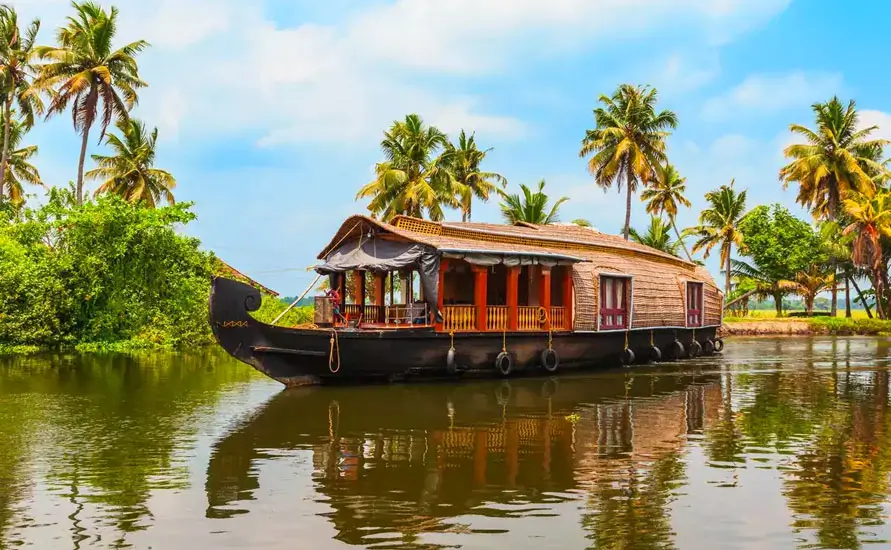
After checking out, you drive south-east to Kumarakom, a village on the eastern shore of Vembanad Lake, the largest lake in Kerala. Your lakeside resort sits among coconut palms and narrow canals, and the change of pace is noticeable straight away. In the afternoon a local guide takes you by country boat to a nearby village, where a family welcomes you into their kitchen for a Kerala village cooking session. You grate coconut by hand, grind spices on a stone, and prepare a fish curry with kudampuli, a smoky souring fruit, along with a cabbage thoran and steamed red rice.
In the evening, dinner follows the spirit of a Kerala toddy shop, the small roadside eateries that serve fresh palm toddy with some of the spiciest food in the state. The menu usually includes kappa, boiled tapioca mashed with turmeric and coconut, a fiery red fish curry, karimeen fry and beef or duck dishes. Fresh toddy is optional, as it is mildly alcoholic and very much an acquired taste. The resort's kitchen or a well-run local place will prepare these dishes in a clean setting, and the chef can adjust the heat if needed. Overnight in Kumarakom.
Make the most of your last morning with a short canoe ride or a walk along the lake shore at sunrise, when the water is still and fishermen are casting nets from small boats. Birders can spend an hour in the Kumarakom Bird Sanctuary, where herons, egrets, cormorants and kingfishers feed along the mangroves, especially between November and February. Breakfast is a final South Indian spread, and if you have not yet tried it, ask for idiyappam, delicate string hoppers made from rice flour, served with a coconut milk stew or a sweet mix of coconut and sugar.
Your driver collects you from the resort at a time planned around your flight, allowing roughly two and a half hours to Cochin International Airport and a comfortable margin for check-in, which usually opens three hours before international departures. Along the way there is time for a final stop at a banana chip shop, where thin slices of plantain are fried in coconut oil in large cauldrons, or a grocery for packets of Kerala coffee, tea and the spice mixes you used in class. Guests on a midnight departure often like to book a room for a few hours close to the terminal, which we can reserve for a supplement.
Over twelve days you have eaten your way from Tamil tiffin halls to Chettiar courtyards, from Madurai's night streets to a Syrian Christian dining table and a lakeside village kitchen. You have also watched temple rituals, dance-drama and martial art that grew up alongside those cuisines. Many of our guests tell us that cooking a Chettinad curry back home becomes their favorite souvenir. Should your appetite call you back, the biryanis and seafood of Kozhikode on the Malabar coast or the pork curries of the Kodava estates in Coorg make a natural second chapter, and our planners can build either around your dates. Until then, travel well, and keep cooking.
Your Journey

N.S. Rathore & Mrs. Omlata Rathore · Managing Director
We still read every enquiry ourselves. Tell us the places you liked and our planners will send a day-by-day route with drive times and a clear price.
Every package can be customised and no pressure to book. A planner from our office replies within 24 hours with a route written for your group.
Fill this in and your planner will send a first draft itinerary.
Explore more
Kerala Backwaters Escape Kerala Backwaters Escape
 Kerala Backwaters Escape
 Kerala Backwaters Escape
 Kerala Backwaters Escape
 Kerala Backwaters Escape
 Kerala Backwaters Escape
 Kerala Backwaters Escape
 Kerala Backwaters Escape
 Kerala Backwaters Escape
 Kerala Backwaters Escape
 Kerala Backwaters Escape
 Kerala Backwaters Escape
 Kerala Backwaters Escape
 Kerala Backwaters Escape
 Kerala Backwaters Escape
 Kerala Backwaters Escape
 Kerala Backwaters Escape
 Kerala Backwaters Escape
 Kerala Backwaters Escape
 Kerala Backwaters Escape
 Kerala Backwaters Escape
 Kerala Backwaters Escape
 Kerala Backwaters Escape
 Kerala Backwaters Escape