



 Kerala Backwaters Escape

South India Tour Packages
Kochi – Munnar – Thekkady – Madurai – Trichy – Tanjore – Darasuram – Pondicherry – Mahabalipuram – Chennai
At a glance
Cochin International Airport has some of the best flight links in South India from the Gulf and Southeast Asia, which makes it a sensible place to land. Our South India tour from Kochi uses that advantage and then heads east, climbing from the spice port of Kochi into the tea country of Munnar and the forests of Thekkady, before crossing the Western Ghats into Tamil Nadu. From there the route runs through the temple cities of Madurai and Tanjore to Pondicherry and Chennai, so you start on the Arabian Sea and finish on the Bay of Bengal.
Crossing the peninsula in one direction means you never retrace your steps, and each drive brings a new landscape: backwaters, misty tea slopes, cardamom forest, the vineyards of the Cumbum valley and the flat rice plains of the Kaveri delta. Drives run about four to five hours at most, and the longer ones are broken with sightseeing stops along the way. Your own vehicle with air-conditioning and a driver who speaks English handles every road from the Kerala coast to Chennai, and in each major city a licensed guide who lives there takes over the sightseeing.
A Kerala and Tamil Nadu tour like this suits travelers from the UK, Europe, the US, Canada and Australia who want both the green hills of Kerala and the great Dravidian temples of Tamil Nadu in one trip, as well as NRI families planning a longer visit. October to March gives the best weather on both sides of the ghats. Because the South India tour from Kochi ends at Chennai airport, there is no need for a return domestic flight, and every stop can be changed to suit your dates.
Landing at Cochin International Airport, you are met just outside the arrivals hall by our Kerala representative, who will guide you to your private air-conditioned car. Allow roughly ninety minutes for the transfer to Fort Kochi; the route runs past the malls and office blocks of Ernakulam before hopping over a chain of harbor bridges onto the old peninsula. Most international flights from the Gulf land in the early morning, so you can rest at your hotel until lunch. If you land at night, an early check-in can be arranged in advance so your room is ready on arrival.
In the afternoon you take a slow first walk around Fort Kochi with your guide, who uses the old street names to tell the story of the town. Princess Street, one of the oldest roads in the area, has Portuguese and Dutch houses with tiled roofs and wooden balconies, now turned into cafés and craft shops. On Burgher Street you see buildings where Dutch traders lived in the 1700s, and your guide points out the cemetery where gravestones in Dutch and Portuguese date back to the 18th century. The pace is relaxed, and stops for coffee or fresh lime soda are easy to fit in.
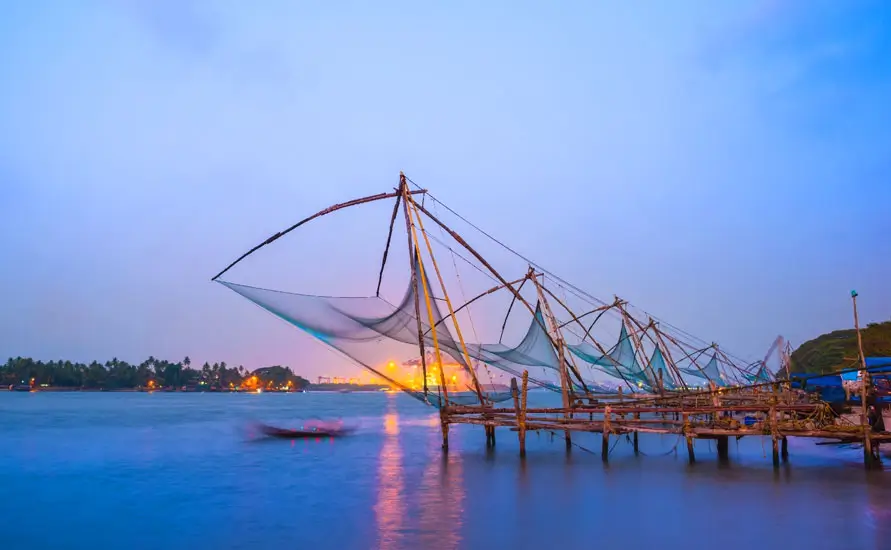
Toward sunset you reach the waterfront, where the Chinese fishing nets stand in a row against the evening sky and the ferries cross to Vypeen Island. This is also a good hour to watch families from Ernakulam walking along the shore, buying fried snacks and ice cream from carts parked under the trees. Dinner could be a Kerala seafood meal at one of the small restaurants near the beach, where prawns and fish are cooked in coconut, tamarind and kokum. Your guide will brief you on the next day's plan before you return to your hotel. Overnight in Kochi.
Nearly everything in Kochi's past comes back to pepper, so it makes sense to begin in Mattancherry, where traders still run warehouses filled with ginger, turmeric and black peppercorns. Inside one working godown, laborers weigh and stack jute sacks while your guide describes how the spice trade pulled in merchants from Arabia and China long before the Portuguese and Dutch arrived. The Mattancherry Palace is the next stop, known for its Kerala murals in red, ochre and green showing scenes from the Ramayana and the life of Krishna. The palace is closed on Fridays, so we plan this day around that closure.
A few minutes' walk away is Jew Town, where the Paradesi Synagogue has stood since 1568. Your guide explains the history of the Cochin Jews, who lived here for many centuries before most of the community moved to Israel after 1948. The synagogue is known for its blue and white floor tiles brought from Canton and its clock tower, and it is closed on Fridays, Saturdays and Jewish holidays. Around the synagogue, the lanes are lined with antique shops, art studios and small cafés, and your guide can recommend places for buying spices, textiles or old wooden furniture to ship home.
Once you have rested at the hotel through the hottest hours, the evening brings a Kathakali recital at a small theater. This time, try to notice the music as much as the dancers: the chenda and maddalam drums and the two singers who give voice to the story while the actors stay silent. The actors' eye movements are trained over years, and some performers practice by following a lamp flame with their eyes in the dark. A short explanation before the show covers the main gestures, and you can take photos of the make-up being applied beforehand. Overnight in Kochi.
The coast falls behind quickly once you set off east toward the Western Ghats after breakfast. The first part of the route passes through Kothamangalam and rubber plantations, where you might see tappers collecting white latex in small coconut-shell cups. As the road climbs, the air cools and the views open up over forested valleys. Your driver makes a short stop at the Cheeyappara Waterfalls, which fall in several steps right beside the road, and at the Valara falls a little further on. After the monsoon months these falls are at their fullest, while in the dry season they run lower but are still pretty.
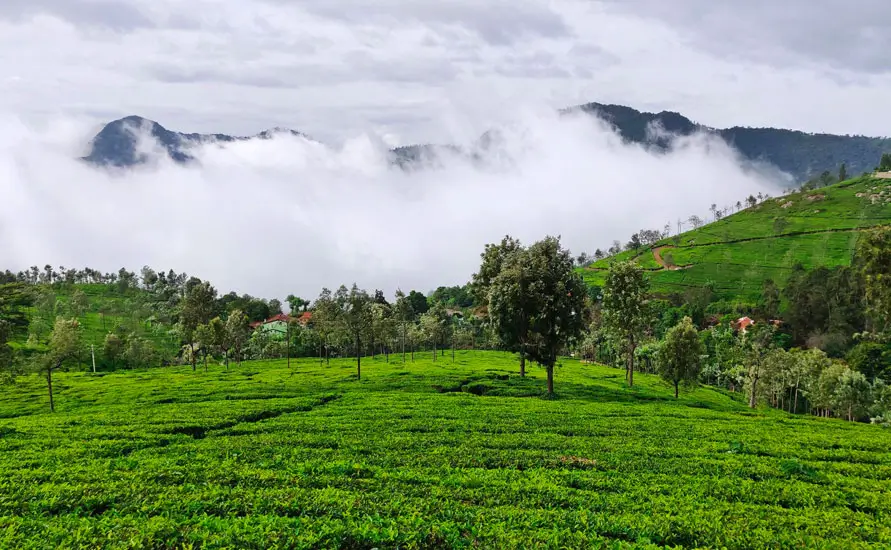
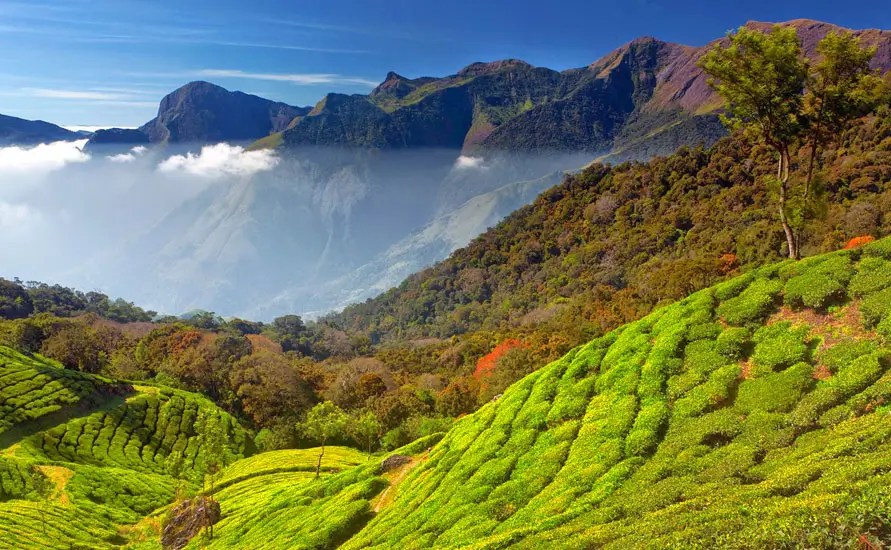
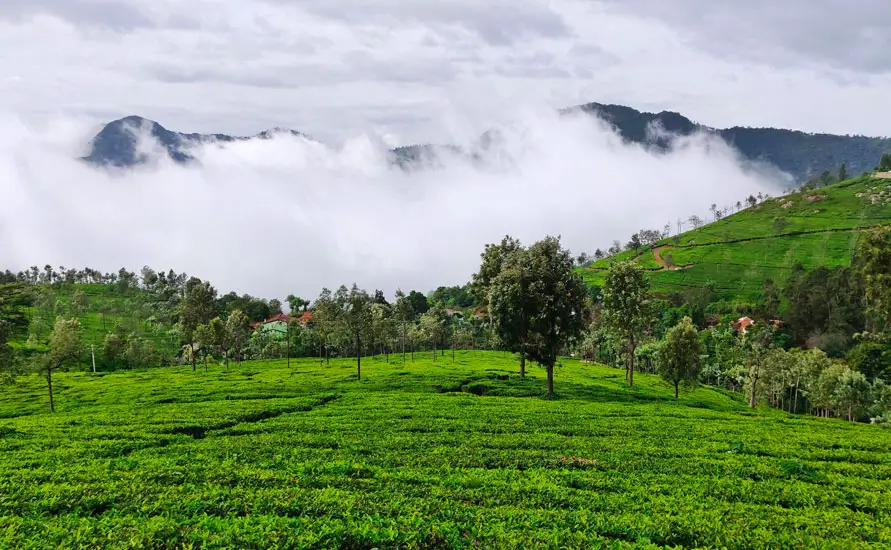
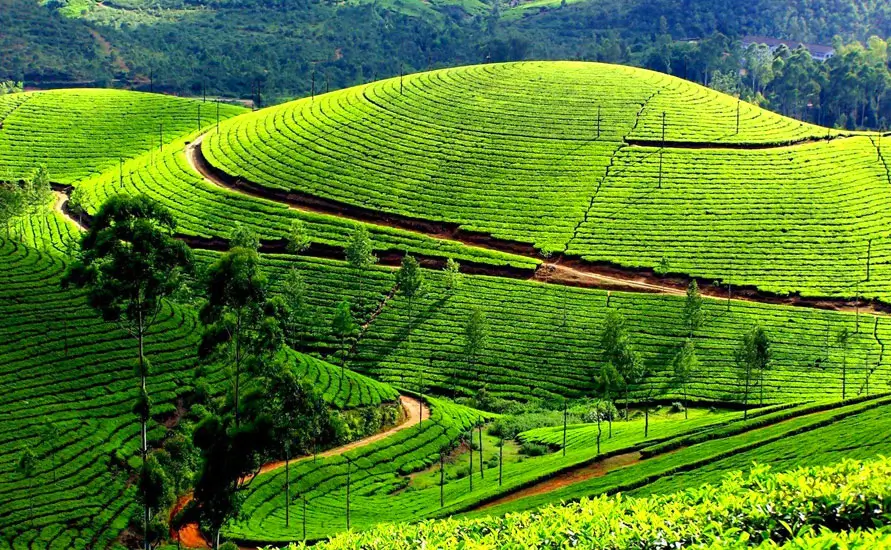
Above Adimali the first Munnar tea gardens appear, row after row of neatly clipped bushes covering the hills right up to the ridge lines. British planters cleared these slopes for tea from the 1880s onward, and big plantation companies still run most of the estates, whose valleys hold labor lines, small schools and village churches. Ask your driver to pull over at one of the lookouts by the road, where the bushes drop away beneath you and pluckers often move along the rows with collection bags slung behind them. You may also stop at a spice garden on the way to see vanilla, cocoa and cinnamon growing.
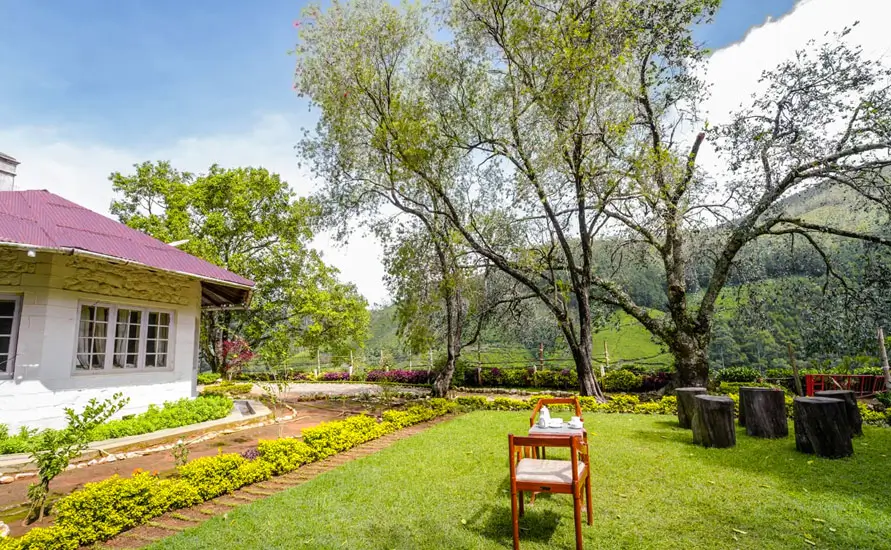
You reach Munnar by mid-afternoon and check in to a tea estate resort or a hill hotel with views over the plantations. Munnar sits at about 1,600 meters, so evenings can be cool, especially between December and February, and a light jacket is useful. The rest of the day is free to take a walk along the estate roads or enjoy a cup of locally grown tea on your balcony as clouds drift across the hills. In the evening your hotel may offer a small campfire or a talk on the history of tea planting in the High Range. Overnight in Munnar.
Clouds tend to roll in by late morning, so you set off soon after breakfast for Eravikulam National Park, a high grassland and shola forest reserve about 15 km from town. A forest department bus takes visitors up from the entry point to the Rajamala section, where you walk along a paved path on the slopes below Anamudi, the highest peak in South India. Its best-known resident is the Nilgiri tahr, a wild goat that lives nowhere outside the Western Ghats, and the herds here are so used to people that they often feed within a few meters of visitors. The park usually closes for a few weeks between February and March during the tahr calving season, so we confirm dates before your trip.
After the park, your guide takes you to the Tata Tea Museum in Nallathanni, where old machines, photographs and planters' equipment show how tea was produced in the High Range over the last century. A short demonstration follows the leaf from withering and rolling to fermentation and drying, and you can taste several grades of tea at the end. Your guide explains the difference between orthodox and CTC tea and why Munnar tea is mostly used in blends. The museum shop sells fresh packets, and it is the best place in town to buy tea to take home.
In the afternoon you drive out to Mattupetty Dam, about 13 km from Munnar, a reservoir surrounded by tea gardens and forest where pedal boats and speedboats run on the water. Nearby, the Kundala Lake and the Echo Point are popular with Indian families on holiday, and you may see wild elephants near the water's edge in the late afternoon. On the way back, the Top Station road gives views across the border into Tamil Nadu if the weather is clear. Later, you return to your hotel for a quiet dinner and an early night ahead of tomorrow's drive. Overnight in Munnar.
Leaving Munnar after breakfast, you drive south along the ridge through Pooppara and Kumily, a scenic route through cardamom hills and small farming towns. This part of Kerala is known as the Idukki district, where cardamom grows in the shade under tall forest trees and pepper vines climb the trunks. Short breaks are easy to fit in, perhaps at a lookout above the Anayirangal reservoir or at a village stall serving milky tea with pazhampori, the Kerala plantain fritter. The road winds a lot, so travelers who get carsick may want to sit in the front and take short breaks.
You arrive in Thekkady around lunchtime and check in to a forest lodge or spice plantation resort near the Periyar Tiger Reserve. Later your guide leads a stroll around a spice plantation: cardamom pods cluster at the foot of each shrub, peppercorns ripen on the vines from green to red, and the grove also shelters cinnamon, clove, nutmeg and allspice. The plantation owner explains how cardamom is harvested by hand every few weeks during the season and dried in heated sheds. You can buy fresh spices directly from the farm at the end of the tour, which is often cheaper than in city shops.
In the evening you have the choice between a Kalaripayattu martial arts show or a Kathakali performance in Kumily town, both of which run at small local theaters. If you prefer to rest after the drive, you can spend the evening at your hotel instead, some of which offer Ayurvedic massages at an extra cost. The town of Kumily is also good for shopping, with spice shops, tea stalls and handicraft stores along the main road. Dinner might include a Kerala vegetable stew with appam or a spicy Syrian Christian beef fry, a local specialty in these hills. Overnight in Thekkady.
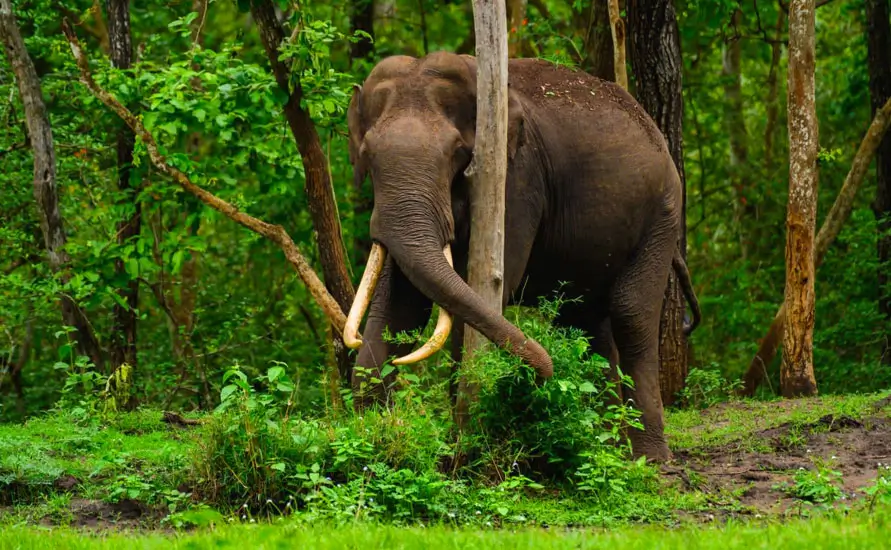
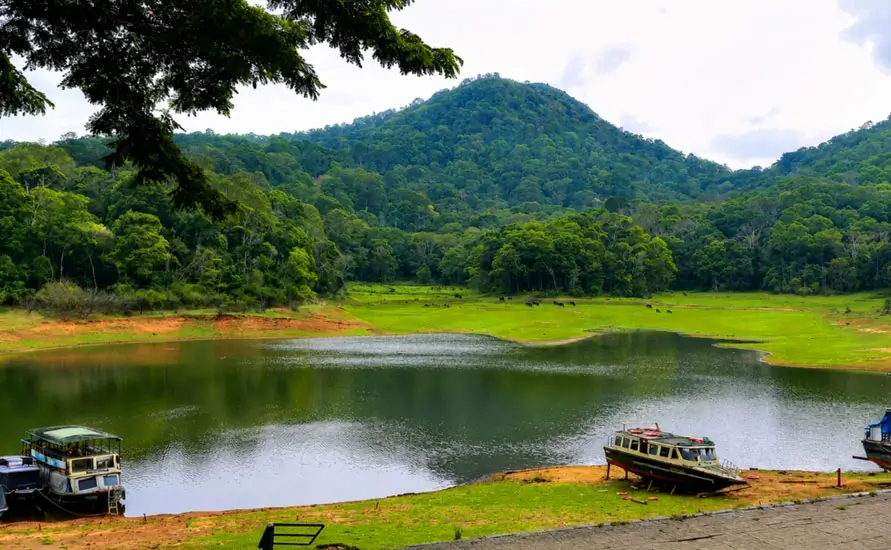
An early Periyar boat ride is the best way to see the lake inside the Periyar Tiger Reserve, which was formed when the Mullaperiyar dam was built in 1895 and flooded the forest valley. The first boat of the day usually leaves soon after dawn, when the water is calm and animals come to the banks to drink. From the deck you may see wild elephants, gaur (Indian bison), sambar deer, otters and many water birds, while dead tree trunks stand out of the water from the old forest. Tigers live in the reserve but are very rarely seen, and the boat ride lasts about 90 minutes.
After breakfast you check out and cross the state border at Kumily into Tamil Nadu, where the road drops steeply down the eastern side of the Western Ghats. In a few kilometers the landscape changes from wet forest to the drier plains of the Cumbum valley, a farming area known for its grape vineyards, coconut groves and fields of beans and onions. Your driver can stop at a vineyard where grapes are grown on overhead trellises and sold fresh by the road. You will notice the change in language, food and temple architecture as you leave Kerala and enter Tamil Nadu.
Beyond Theni and Usilampatti the road reaches Madurai by early afternoon, a city that has been lived in without a break for more than two millennia. Once you have checked in and rested, your guide leads you to the Thirumalai Nayak Palace, a 17th-century royal residence whose courtyard of giant pillars and scalloped arches mixes Dravidian craftsmanship with Islamic forms. An evening sound and light show on the palace's history is held most days in the courtyard. For dinner, try something Madurai does better than anywhere else, perhaps kari dosa or a tall glass of jigarthanda, a chilled mix of reduced milk, almond gum, syrup and a scoop of ice cream. Overnight in Madurai.
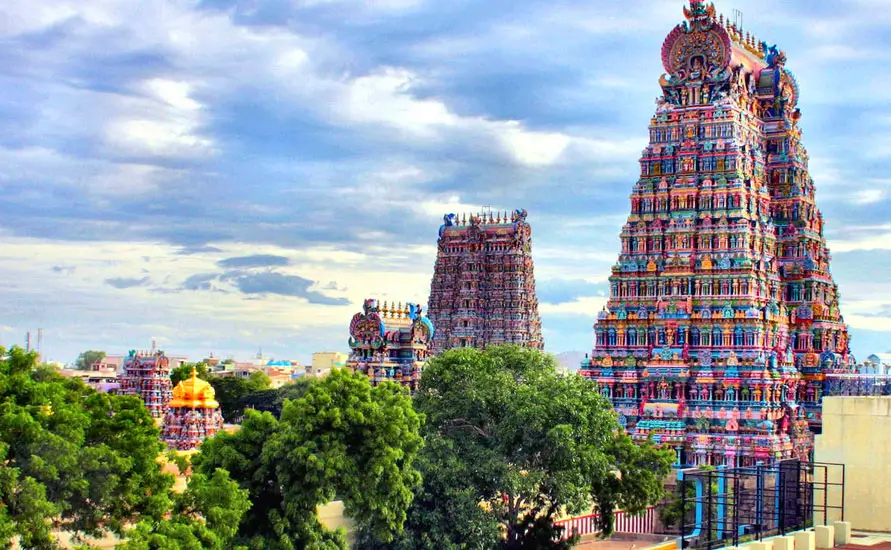
Madurai has been built around the Meenakshi Temple for centuries, and the city's streets are laid out in concentric squares around its walls, named after the Tamil months in which festivals pass along them. Your guide meets you in the morning for a long visit to the temple complex, which covers about 14 acres and has 14 gopurams, the tallest of them about 50 meters high. The outer halls and corridors are open to everyone, but only Hindus may enter the two sanctums, and since phones and cameras have to be deposited at the gate counters, it is easiest to bring very little.
Inside, your guide shows you the Hall of a Thousand Pillars, where each carved pillar is different, and the Golden Lotus Tank, where poets of the old Tamil Sangam academy are said to have tested their verses. You may also see the musical pillars, which ring with different notes when tapped, and the shrines of the temple bulls and attendants. Lunch is followed by the Gandhi Memorial Museum, set inside a 17th-century palace once used by Rani Mangammal of the Nayak dynasty; among its letters and photographs is the bloodstained garment Gandhi had on when he was assassinated.
Come nightfall you go back to the temple for palliyarai, the bedtime ritual held at about 9 pm, when priests bear Sundareswarar's image to Meenakshi's chamber so the divine couple can spend the night side by side. The procession is accompanied by drums, nadaswaram pipes and priests chanting, and devotees crowd the corridors to watch. Your guide stays with you and explains each stage of the ritual. After the ceremony, the market streets outside the temple are still busy with flower sellers and shops, and you return to your hotel by car. Overnight in Madurai.
Heading north-east after breakfast, you take the highway to Trichy, also called Tiruchirappalli, a city on the banks of the Kaveri about two and a half hours from Madurai. Your first stop is the Rockfort, a temple complex on top of a large rocky outcrop that rises about 80 meters above the old town. Around 400 steps cut into the rock lead past the Thayumanavar Shiva shrine to the small Ucchi Pillayar Ganesha temple at the summit, from which you get a wide view of the river, the town and the Srirangam temple towers. Shoes are left at the foot of the hill, so socks can help on hot stone.
A short drive across the Kaveri brings you to Srirangam, one of the largest functioning Hindu temple complexes in the world. The Ranganathaswamy Temple has seven concentric enclosures with 21 gopurams, and people live and run shops inside the outer walls, making it more like a small town than a single temple. Your guide leads you through the outer courtyards to the carved horse pillars of the Sesharaya Mandapa. Non-Hindus can visit the outer courtyards, but the inner sanctum is reserved for Hindus, and you can climb to a rooftop viewpoint for a view of the gopurams.
After lunch in Trichy you continue for about an hour to Tanjore, also known as Thanjavur, the capital of the Chola kings, and check in to your hotel. In the late afternoon your guide takes you to the Brihadeeswarar Temple, built by Rajaraja Chola I and completed around 1010. The vimana over the sanctum climbs to roughly 66 meters, and its crowning granite block is estimated at about 80 tons, which makes the achievement of the Chola builders hard to grasp even today. The temple is part of the UNESCO World Heritage Site of the Great Living Chola Temples, and the golden evening light makes its sandstone-colored walls glow. Overnight in Tanjore.
Before leaving Tanjore, you visit the Thanjavur Royal Palace, built by the Nayak rulers and later used by the Maratha kings who took over the city in the 17th century. The palace includes the Saraswathi Mahal Library, which holds rare palm-leaf manuscripts and old books in Tamil, Sanskrit, Marathi and European languages, and an art gallery with one of the finest collections of Chola bronze statues in India. Your guide explains how these bronzes were made using the lost-wax method, a technique still used by craftsmen in the nearby village of Swamimalai.
On the way east you stop at Darasuram, a small town near Kumbakonam, to see the Airavatesvara Temple, built by Rajaraja Chola II in the 12th century and also part of the Great Living Chola Temples UNESCO site. Smaller and quieter than the temple in Tanjore, it is famous for its detailed carvings, including the front hall shaped like a chariot with stone wheels pulled by horses, and the musical steps at the entrance. Your guide points out panels showing scenes from the Puranas and the lives of the Shaiva saints. Few tour groups stop here, so you can usually take your time.
After lunch near Kumbakonam, you drive about three hours through the farmland of the Kaveri delta to Pondicherry, passing rice fields, small temple towns and fish markets along the way. Pondicherry comes into view toward evening, and your room is at a restored colonial property inside the French Quarter. Afterwards the time is your own: stroll the seaside promenade of Goubert Avenue or pick a neighborhood café for supper. Pondicherry's food mixes French, Creole and Tamil cooking, and you might try a fish curry in the Pondicherry style, or crêpes and a glass of wine. Overnight in Pondicherry.
An early morning walk is the best way to see Pondicherry while the streets are quiet and the light is soft. Your guide starts in the French Quarter at Rue Romain Rolland and Rue Suffren, where old villas painted in pastel shades house government offices and small schools. In the Tamil Quarter across the old canal, you will see houses with carved wooden doors, verandas and decorated pillars, built in the Tamil style. You also visit the Our Lady of Angels Church, built in 1855 with a pink and cream façade, and stop at a café for a coffee and a croissant.
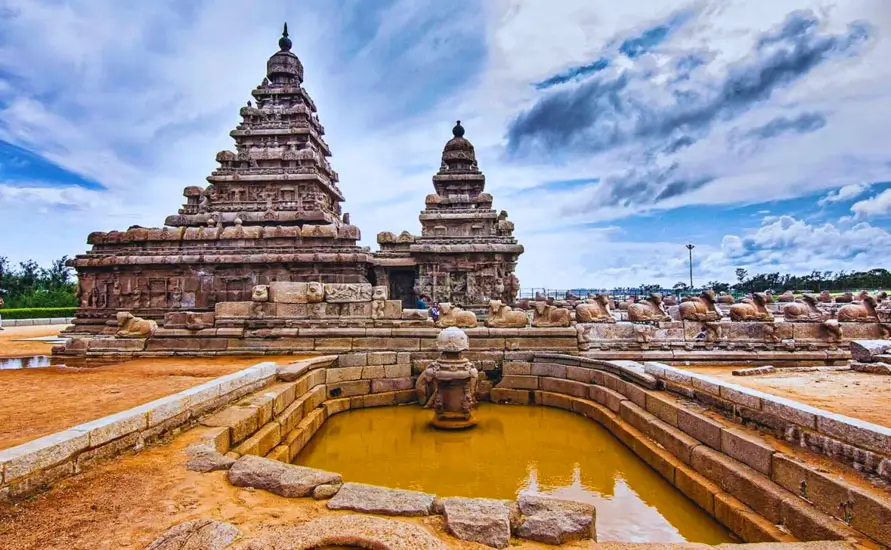
Late in the morning you leave Pondicherry and drive north along the East Coast Road, a route that runs between the sea and lagoons. After about two hours you reach Mahabalipuram, the ancient port of the Pallava kings, where your guide shows you the main monuments of the UNESCO site. Instead of following a fixed loop, this visit focuses on the lesser-known rock-cut halls, such as the Varaha cave with its relief of Vishnu raising the earth goddess from the ocean, and the Krishna Mandapa with its carved herds of cows. You also stop at the Shore Temple and the Pancha Rathas.
After lunch in Mahabalipuram you drive about an hour and a half to Chennai, the capital of Tamil Nadu, and check in to your hotel. Later, if you have energy left, Elliot's Beach in Besant Nagar on the city's southern side makes a relaxed spot for a stroll, with local families on the sand and carts selling roasted corn and juice. Alternatively, you might visit a local restaurant for a Chettinad dinner, a spicy cuisine from the Tamil merchant community, featuring dishes like pepper chicken and kuzhi paniyaram. Your guide will help you plan your last morning according to your flight time. Overnight in Chennai.
Depending on your flight time, you start the morning with a short tour of Chennai, a city that grew from a British trading post founded in 1639. The morning begins at Fort St. George, the earliest British stronghold in India, where you can see St. Mary's Church, consecrated in 1680 and often called the oldest Anglican church east of Suez, and the Fort Museum with its collection of coins, uniforms and colonial-era portraits. The fort area is still used by the Tamil Nadu government, so some sections are not open to visitors, but your guide will show you around the parts that are.
If time allows, you can visit the Government Museum in Egmore, which has a famous collection of Chola bronzes, including the dancing figure of Nataraja, and a gallery of Amaravati Buddhist sculptures. Another option is a visit to a Carnatic music school or a craft shop selling Kanchipuram silk and Tanjore paintings. You might also have time for a final South Indian meal at a vegetarian restaurant, where dosas, vadas and filter coffee are served quickly and cheaply. Your driver will plan the route back to the airport to avoid traffic and give you plenty of time.
Chennai International Airport has direct connections to the Gulf, Singapore, Kuala Lumpur, Colombo and several European cities, so it is easy to fly home without going back through Kochi. Over eleven days you have crossed South India from the Arabian Sea to the Bay of Bengal, from tea estates and wildlife reserves to Chola temples and a French colonial town. If you would like to return, our team can plan a trip to Karnataka's palaces and coffee hills, or a beach stay in Kerala or the Andaman Islands. Before you walk through the departure doors, our representative says goodbye and checks that your bags and papers are in order.
Your Journey

N.S. Rathore & Mrs. Omlata Rathore · Managing Director
We still read every enquiry ourselves. Tell us the places you liked and our planners will send a day-by-day route with drive times and a clear price.
Every package can be customised and no pressure to book. A planner from our office replies within 24 hours with a route written for your group.
Fill this in and your planner will send a first draft itinerary.
Explore more
Kerala Backwaters Escape Kerala Backwaters Escape
 Kerala Backwaters Escape
 Kerala Backwaters Escape
 Kerala Backwaters Escape
 Kerala Backwaters Escape
 Kerala Backwaters Escape
 Kerala Backwaters Escape
 Kerala Backwaters Escape
 Kerala Backwaters Escape
 Kerala Backwaters Escape
 Kerala Backwaters Escape
 Kerala Backwaters Escape
 Kerala Backwaters Escape
 Kerala Backwaters Escape
 Kerala Backwaters Escape
 Kerala Backwaters Escape
 Kerala Backwaters Escape
 Kerala Backwaters Escape
 Kerala Backwaters Escape
 Kerala Backwaters Escape
 Kerala Backwaters Escape
 Kerala Backwaters Escape
 Kerala Backwaters Escape
 Kerala Backwaters Escape