

 Kerala Backwaters Escape

South India Tour Packages
Chennai – Mahabalipuram – Pondicherry – Gangaikonda Cholapuram – Tanjore – Chettinad – Madurai – Periyar – Alleppey – Kochi
At a glance
Traveling alone through India can be rewarding, but many people would rather share the long drives, the temple mornings and the dinners with others. Our South India small group tour keeps every departure to a maximum of 12 travelers, led by one tour leader who stays with you from the first evening in Chennai to the last morning in Kochi. In thirteen days you cross Tamil Nadu from the Pallava shore temples and French-era Pondicherry to the Chola capital of Tanjore and the temple city of Madurai, then climb into the hills of Periyar and drift down to the Kerala backwaters.
The size of the group shapes the whole trip. Twelve people fit in one comfortable air-conditioned coach with room to spare, can all hear the guide in a crowded temple, and can sit at one long table for meals. A welcome dinner on the first night breaks the ice, and shared moments are built into the route: a dawn cycle ride through Pondicherry, a Chettinad lunch in an old mansion, a cooking session in Madurai and an evening together on the houseboats. Free afternoons are kept as well, for anyone who needs time alone.
A typical departure of this small group tour of India brings together people traveling on their own, usually aged somewhere between 30 and 65, who fly in from Britain, Ireland, Germany, the Netherlands, the US, Canada or Australia, with the odd pair of friends or a couple mixed in. Solo travelers can choose to share a twin room with a same-gender roommate or pay a single supplement for a private room. Departures run on set dates between October and March, the most comfortable months on both coasts, and each date confirms once a small minimum is reached. Hotels are good-quality three and four-star properties chosen for location and character.
Flights land at Chennai International Airport at all hours, so each traveler is met individually by our representative and driven to the group hotel, about 40 minutes away. Rooms are available from the afternoon, and anyone landing overnight can arrange an early check-in in advance. If you arrive before others, the day is yours to rest by the pool or take a short walk in the neighborhood. Your tour leader is based at the hotel from midday, so you can drop by the lobby, introduce yourself and ask about money, SIM cards or anything that worried you on the flight.
At around 6 pm the group meets for the first time in a private room at the hotel. Your tour leader goes through the plan for the coming days, the rhythm of early starts and free afternoons, and practical points such as dress codes in temples, drinking water, tipping and how to deal with street sellers. Name tags are handed out, which helps on the first day, and a WhatsApp group is set up so everyone can share photos and find each other in crowded places. Questions are welcome; many people have the same ones, so asking for the room is always appreciated.
The welcome dinner follows, served as a long table meal of South Indian and Chettinad dishes, with the tour leader explaining what each one is and how spicy it will be. For solo travelers this first evening is often the moment the trip starts to feel easy, as conversations move from where people live to where they have traveled before. It is a relaxed evening and nobody is expected to stay late, because jet lag catches up quickly. Breakfast tomorrow is at a sensible hour, with a short Chennai tour before leaving for the coast. Overnight in Chennai.
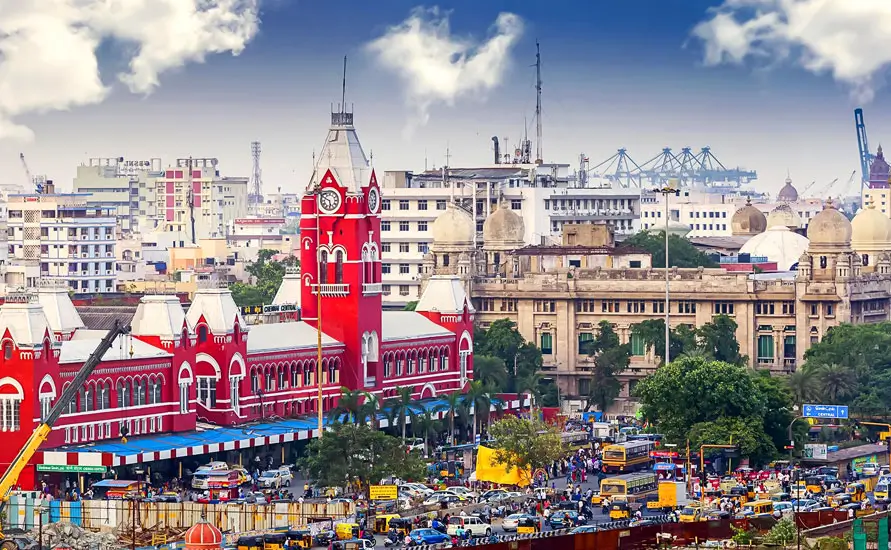
A morning walk with your local guide shows the group the older side of Chennai in Mylapore, a neighborhood that predates the British city by many centuries. The walk starts at the Kapaleeshwarar Temple, where you watch morning offerings and learn how a Dravidian temple is laid out, from the tall towers at the entrance to the inner shrine. Then you wander along the tank and into the side streets, where brass shops, music schools and old houses with carved wooden pillars line the road. Walking in a small group makes it easy to stop, ask questions and try a cup of filter coffee together at a corner stall.
The group then moves on to Egmore and the Government Museum, where a dedicated hall of Chola metalwork displays some of the best-known Nataraja images, Shiva poised mid-dance. Seeing them early in the trip helps later, because the same gods and poses appear again and again in the temples of Tanjore and Madurai. Your guide shows you how to recognize each deity by the objects in its hands. After a group lunch at a vegetarian restaurant, the coach leaves Chennai and heads south along the East Coast Road, past fishing villages and long sandy beaches.
Around four o'clock the coach pulls up at a seaside hotel in Mahabalipuram, and keys are handed out in the lobby. Before sunset, the group climbs the low hill behind the town to the old lighthouse and the small Olakkanesvara Temple, a Pallava shrine perched on the rock. From the top you look out over the coast, the town and the boulders scattered with carvings you will see in the morning. For dinner, the tour leader books a spot at a fish shack by the sand for those who fancy company, though joining is entirely up to you. Others prefer a quiet evening at the hotel. Overnight in Mahabalipuram.
Start early at the Group of Monuments at Mahabalipuram, a UNESCO site carved by Pallava artists more than 1,200 years ago. With a group of twelve, the guide can lead everyone into the narrow rock-cut halls together. One wall of the Varaha Cave Temple carries the boar-headed Vishnu rescuing Bhudevi from the waters, while the Mahishasuramardini Cave shows Durga mounted on her lion and charging the buffalo-headed Mahisha. These panels are less crowded than the famous open-air reliefs, and the guide takes time to explain each figure in turn while everyone gathers close.
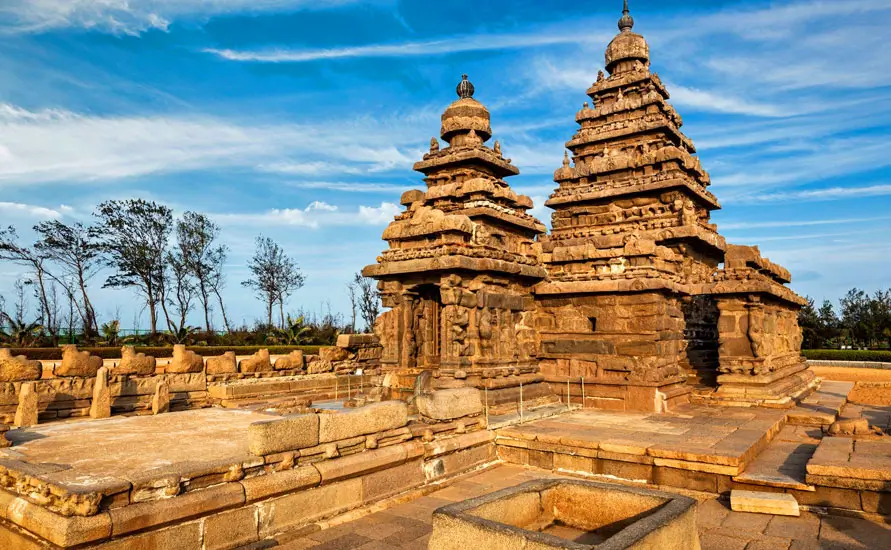
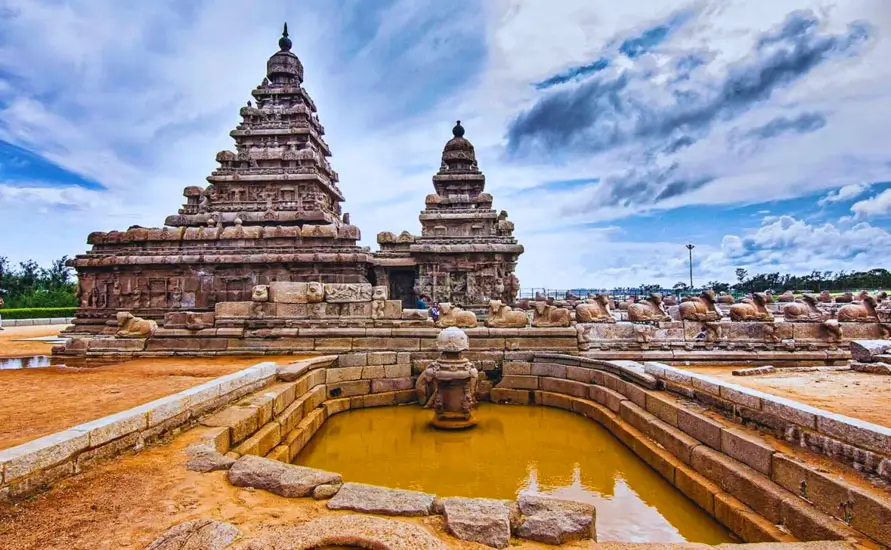
After the caves, the group walks through the boulder park to Arjuna's Penance and then on to the Shore Temple by the sea. A good game to play here is to count the animals in the great relief, from elephants and monkeys to snakes and tortoises; most groups find well over fifty. There is time for coffee and shopping in the stone-carvers' street before lunch. Sculptors work right on the pavement here, and you can watch them shape granite figures with hand tools, something the group often stops for longer than planned.
In the afternoon the coach takes the coast road south to Pondicherry, a pleasant two and a half hours with a stop for tender coconut at a roadside stall. You check in to a hotel near the French Quarter, and the rest of the afternoon is free. Many travelers use it to find their bearings, walk to the seafront or sit in a café. In the evening the tour leader leads an easy walk along the Promenade, closed to traffic at night, to a restaurant for an optional group dinner of Franco-Tamil dishes such as fish curry with crusty bread. Overnight in Pondicherry.
The group meets at sunrise for a cycle ride through Pondicherry, a relaxed two-hour loop on sturdy city bikes with a local guide at the front and the tour leader at the back. Streets are almost empty at this hour, and the route crosses the old canal from the French Quarter into the Tamil Quarter, where houses with deep verandas and painted pillars line narrow lanes. You stop at a market where fish, flowers and vegetables are being unloaded and at a bakery for warm croissants. Helmets are provided, and anyone who prefers not to cycle can join the walk version with the guide.
Once everyone has eaten and freshened up, the guide takes the group into the quiet courtyard of the Sri Aurobindo Ashram, where devotees lay fresh petals on the samadhi, and then along the colonial streets to Notre Dame des Anges, a pastel church looking out over the Bay of Bengal. The late morning is free, which suits a small group: some people head to the boutiques for handmade paper and cotton clothing, others sit with a book on a café terrace. Your tour leader stays available by phone and suggests places for lunch, from crêpes to a South Indian thali, depending on what people feel like.
In the afternoon the coach drives about 12 km to Auroville, the experimental township founded in 1968. An introductory video sets out what the founders hoped to build, after which a forest trail of roughly a kilometer brings you to the lookout over the gold-plated Matrimandir. Visits to the inner chamber need advance booking with limited places, so ask the tour leader early if you want to try. The group then meets an Auroville resident over tea, for a candid chat about daily life in the community. Back in town, nothing is scheduled after dark, so dinner plans are your own. Overnight in Pondicherry.
Leaving Pondicherry after breakfast, the coach heads inland across the farmland of the Kaveri delta, a landscape of rice fields, canals and coconut palms. A seat rotation keeps things fair, so everyone gets a turn in the front rows with the best view. On the way, the tour leader tells the story of the Chola dynasty, the kings who ruled this region between the 9th and 13th centuries and sent fleets as far as Southeast Asia. Bronze and stone made in this period still define how South Indian temple art looks today, and the next two stops show why.
Mid-morning the coach stops at Gangaikonda Cholapuram, the city Rajendra Chola I founded to celebrate a northern campaign that carried his troops to the banks of the Ganges in the 1020s. Hardly a trace of the royal capital survives, yet the temple remains, rising alone above the fields and sharing UNESCO status with Tanjore and Darasuram. Its tower has gently curved sides, a softer outline than the one you will see in Tanjore. The site is rarely crowded, so the group can walk around the courtyard at leisure and look at the carved panels, including one of Shiva crowning a devotee with a garland.
After a simple lunch in the nearby town, you continue to Tanjore and check in by mid-afternoon. Late in the day the group walks through the gateways of the Brihadeeswarar Temple, the great royal shrine Rajaraja I dedicated to Shiva in 1010. The light in the late afternoon turns the granite tower warm and golden, and the shadows bring out the frescoes and carvings around the courtyard. Your guide explains how the huge capstone may have been raised to the top. In the evening an optional visit to a Tanjore painting workshop shows the gold-leaf technique used for portraits of gods. Overnight in Tanjore.
First on the list is the Thanjavur Maratha Palace, built by the Nayak and later Maratha rulers, where the Saraswathi Mahal Library keeps palm-leaf manuscripts and old maps, and the art gallery holds Chola bronzes found in the region. Afterward the coach drives south to the Chettinad region, about two hours away, home to the Nattukottai Chettiar trading community who grew wealthy from banking in Burma, Malaya and Ceylon in the 19th and early 20th centuries. They spent their fortunes on huge mansions, and many still stand in the villages around Karaikudi.
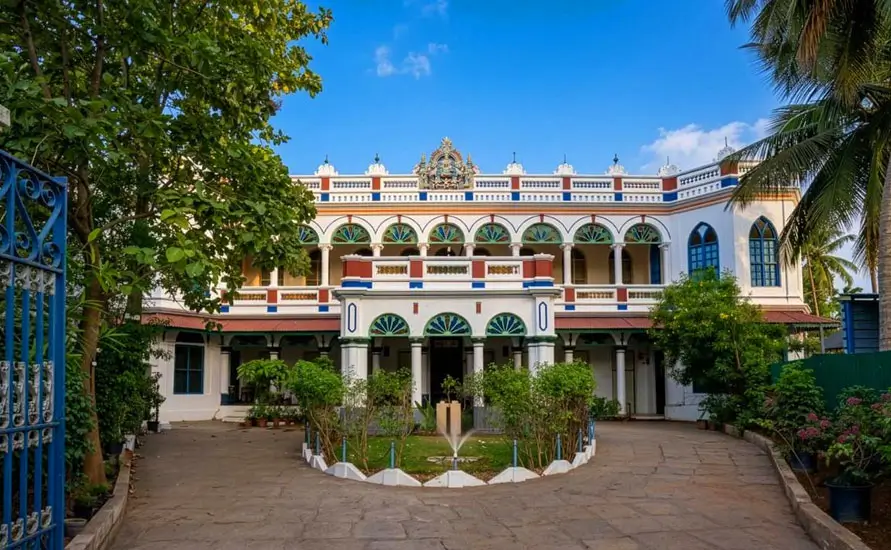
In the village of Kanadukathan, the group visits one of these mansions with its long courtyards, Burmese teak pillars, Italian marble floors and colored tiles brought from Europe and Japan. Then comes a highlight for many travelers, a long lunch together in a restored Chettinad house, where the cooks serve a set meal of local dishes on banana leaves: pepper chicken, spicy kuzhambu, vegetable poriyal and sweet paniyaram. Your tour leader explains the spices and the custom of eating by hand, and anyone who would rather use a spoon will be given one.
After lunch there is a short stop at a workshop making Athangudi tiles, the handmade cement floor tiles found in many Chettinad homes, where you watch the colors being poured into molds and set onto glass. The coach then drives about two hours to Madurai and reaches the hotel in the early evening. With the feast from Chettinad still fresh in mind, most travelers settle for soup or a dosa later and an early night. If anyone is keen, the tour leader can take a small group for a short evening walk through the lit-up streets around the temple. Overnight in Madurai.
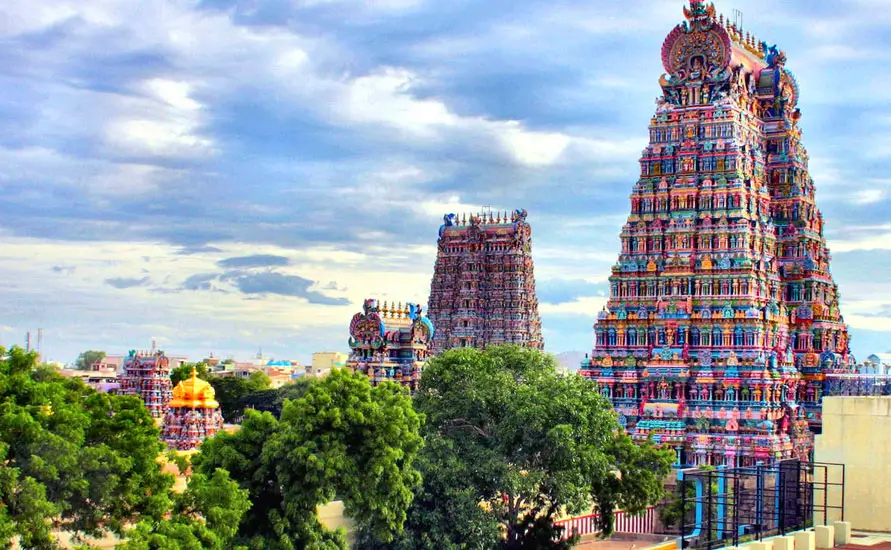
Early in the morning your local guide leads the group into the Meenakshi Temple, a city within a city, with fourteen entrance towers covered in thousands of painted figures. Because mobiles and cameras go into lockers at the gate, the visit becomes a morning of looking rather than snapping photos. Non-Hindus can walk the corridors, the halls and the Golden Lotus Tank, while the inner sanctums are reserved for Hindus. Your guide explains the marriage of Meenakshi and Sundareswarar, the role of the many pillared halls, and the meaning of the many offerings carried by pilgrims.
Mid-morning the group heads to the home of a local family for a cooking session, where a Madurai home cook shows you how to make dishes such as sambar, a coconut chutney, a vegetable poriyal and crispy dosa on a cast-iron pan. Everyone gets a turn at the stove, so expect plenty of laughter as first attempts at dosa come out in odd shapes. The session ends with lunch around the family's dining table, eating what the group has cooked. Recipes are shared afterward, so you can try them at home.
Nothing is fixed after lunch; a nap is popular, while the curious can hop in an auto-rickshaw to see the vast columns of the Thirumalai Nayak Palace or the displays on the freedom struggle at the Gandhi Memorial Museum. Group members who want a second look can return with the tour leader after dinner for the palliyarai rite, the nightly procession around 9 pm in which Shiva, as Sundareswarar, is taken by palanquin to rest beside Meenakshi to the sound of drums and nadaswaram pipes. It takes less than half an hour and is a fine way to close the Tamil Nadu part of the trip before heading into the hills of Kerala tomorrow. Overnight in Madurai.
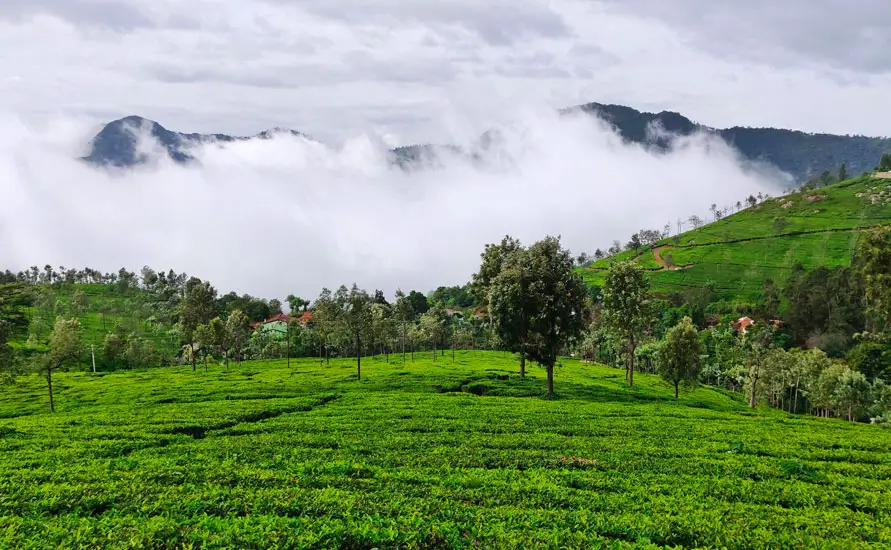
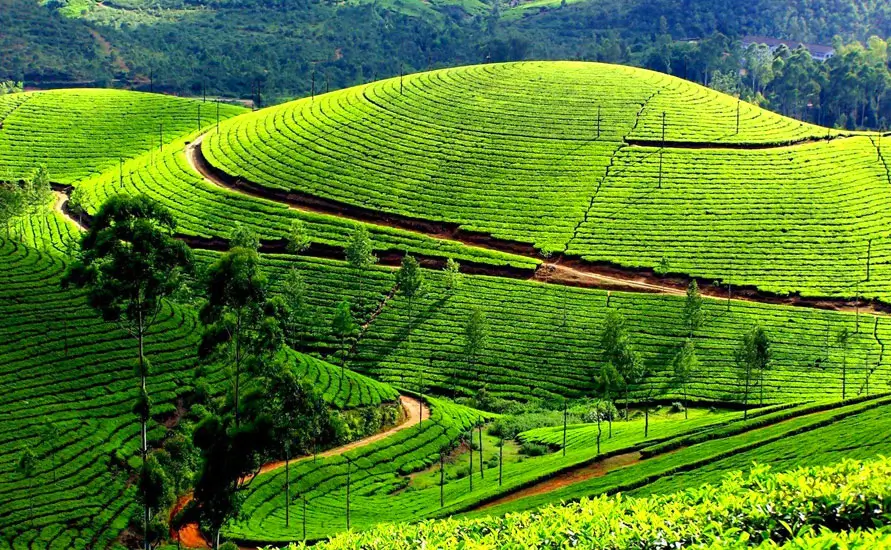
Hill country is the goal today: the coach heads for the Western Ghats, the long mountain range that runs down the western side of the peninsula. The route crosses cotton fields and banana groves near Theni before it starts to climb, and as the coach winds up the hairpin bends toward the Kerala border, the temperature drops and the views open out. The group stops at a hillside viewpoint to look back across the plains and to stretch legs. Crossing the border at Kumily, you notice that signs switch from Tamil to Malayalam and the landscape turns greener, with cardamom shrubs growing under tall shade trees.
You check in to a hill resort near Periyar, close to the town of Thekkady. After lunch the group joins a guided walk through a spice garden, where a local farmer shows you pepper vines climbing up silver oak trees, cardamom flowering near the ground, and nutmeg, cinnamon and cocoa growing side by side. You can crush leaves and taste seeds as you go. The farmer explains how prices for cardamom and pepper have shaped the fortunes of the hill families here, and why so many young people now combine farming with tourism.
After dark the group takes seats around a sunken pit to watch Kalaripayattu, the centuries-old fighting discipline of Kerala, demonstrated by a Thekkady team. Fighters leap, spin and fight with sticks, swords and shields, and the group often sits together in the front rows to watch the action up close. Dinner at the resort is optional, and many people join the tour leader at a long table for a relaxed meal with Kerala dishes. After a week of Tamil Nadu heat, the cool air and the forest sounds make for an easy night's sleep. Overnight in Periyar.
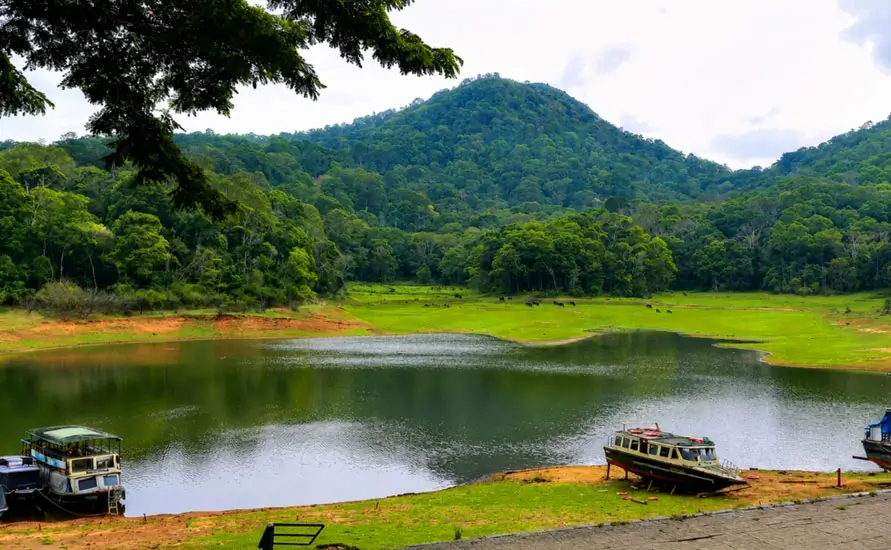
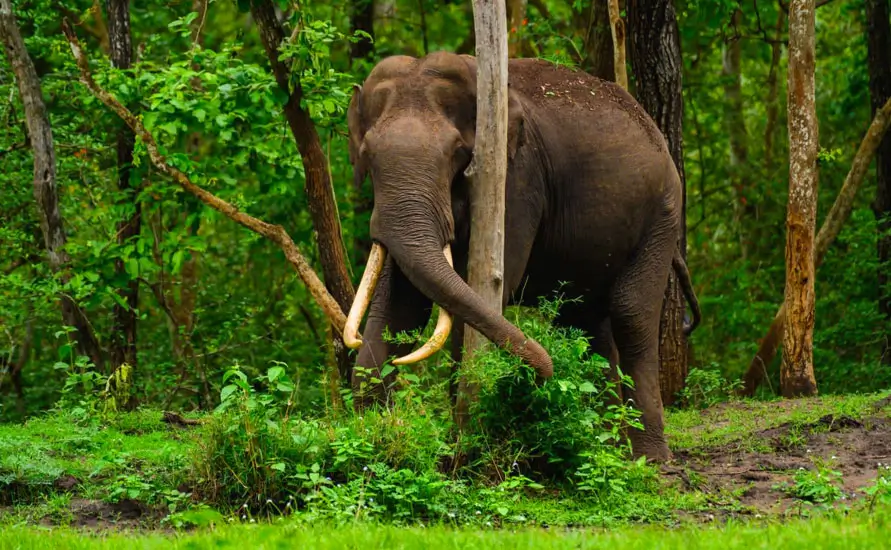
An early wake-up call gets the group to the boat jetty inside Periyar Tiger Reserve for one of the first sailings of the day, when the forest is cool and animals are most active along the water. The tour leader collects the tickets in advance, so the twelve of you can board together and take seats on the upper deck. Over about ninety minutes the boat follows the arms of Periyar Lake, a reservoir formed in the 1890s, where bleached stumps of drowned trees still rise from the surface. Sharp-eyed travelers usually spot sambar deer, wild boar and gaur first, and the whole deck turns as one when a herd of elephants appears.
Back at the resort for a late breakfast, the group has a chance to compare photos and sightings before splitting up for the rest of the day. Some travelers sign up for an optional nature walk in the forest led by trackers from the local forest communities, who point out hornbills, giant squirrels and fresh pugmarks along the trail. Places on these walks are limited, so the tour leader asks for names a day ahead. Others prefer a cooking demonstration of Kerala dishes at a homestay in Kumily, or simply a swim and a book by the pool.
The afternoon in Thekkady is completely free, which many solo travelers welcome after eight busy days. Kumily's main street is easy to walk, with spice shops selling fresh cardamom, pepper and vanilla, small tea stalls and plenty of places offering Ayurvedic massage; the tour leader can recommend reliable centers. Around sunset, those who want company meet in the lobby for an optional walk to a local restaurant serving Kerala thali on banana leaves. Tomorrow brings a long drive to the coast, so most of the group heads to bed early. Overnight in Periyar.
Bags go into the coach straight after breakfast for the descent from the hills to the lowlands of central Kerala. The road winds down past rubber estates near Kottayam, where you may see tappers cutting thin grooves in the bark to collect white latex, and then reaches the flat delta of paddy, canals and coconut groves. The tour leader uses the drive to explain how the backwater villages work, how rice is grown below sea level on land reclaimed from the lake, and what to expect from a night on the water. A short coffee stop breaks the drive halfway.
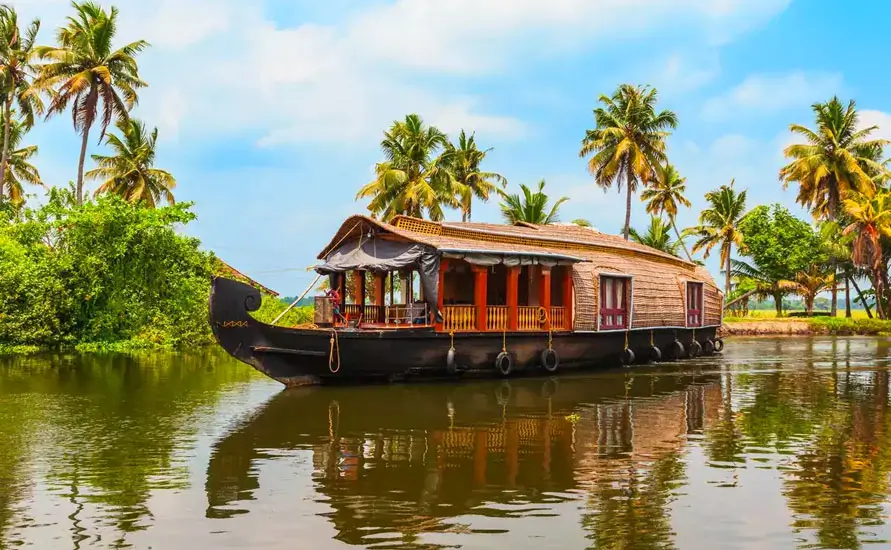
Around noon the coach reaches the jetty at Alleppey, where the group boards several neighboring houseboats, each with private cabins, a lounge deck and a crew of three who steer, cook and look after you. Couples and roommates share a boat, while solo travelers with a single supplement may be paired on a two-cabin boat with a separate room each. The boats cruise in convoy across the Kerala backwaters, so you can wave across the water, swap places at lunch stops or join friends on a neighboring deck. Lunch of rice, fish fry, vegetable curries and pickle is served on board as the boats head out.
In the afternoon the boats drift through narrow canals and across open stretches of Vembanad Lake, past rice fields, small churches and village homes where people wash clothes and fish at the water's edge. A tea stop with banana fritters comes in the late afternoon. As evening falls the houseboats stop cruising and moor side by side for the night, as required by local rules, which gives the group a chance to gather on one deck for a sunset drink and a chat about the trip so far. Dinner is cooked on each boat by its own crew. Overnight on the houseboat.
Morning on the backwaters begins quietly, with kingfishers on the wires, ferries carrying schoolchildren and the smell of breakfast drifting from the boat kitchens. After a breakfast of appam, egg roast and fresh pineapple, the boats cruise back to the jetty, since checkout is around 9 am. The group says goodbye to the crews, who are usually happy to pose for a final photo, and the coach is waiting for the drive north to Kochi. The highway follows the coast through towns where churches, temples and mosques sit side by side, a mix that is typical of Kerala.
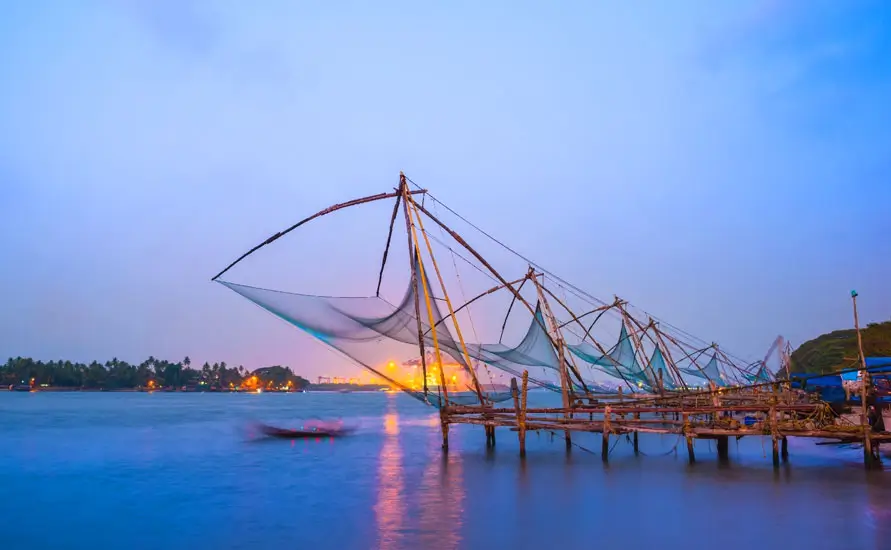
By late morning the coach pulls into Fort Kochi, and the group checks in to a hotel in the old quarter, which is home for the final two nights. After lunch your local guide leads a short orientation walk to the seafront; there the Chinese fishing nets are worked by teams of fishermen pulling on ropes weighted with stones. The guide also points out the vendors who cook the fresh catch for you at small stalls nearby. Walking as a group makes it easy to cross the busy lanes and get your bearings before tomorrow's full city walk.
The rest of the afternoon is free for resting, shopping or wandering the leafy streets of Fort Kochi, full of art galleries, cafés and old colonial houses. In the early evening the tour leader takes anyone interested to a Kathakali theater, where the group can watch the performers paint their faces in bright green and red before the show, then sit through an hour of storytelling through hand signs and eye movements. Seats are booked as a block, so the group sits together. Afterward many travelers stop for seafood near the beach. Overnight in Kochi.
Today's walk with a local guide covers the layers of history that make Kochi so different from the Tamil towns earlier in the trip. You start at the St. Francis Church, a plain Portuguese-era building where Vasco da Gama was once buried, then walk past the Dutch-built bungalows of Princess Street and the Santa Cruz Basilica, with its painted ceiling and tall white towers. A small group can stop wherever something interesting appears, from a spice merchant sorting ginger to a tailor stitching in a doorway. The guide answers questions along the way and keeps the pace easy.
Later in the morning the coach drives the group to Mattancherry, where the Mattancherry Palace, a 16th-century royal residence later restored under Dutch rule, holds some of the finest mural paintings in Kerala, showing scenes from the Ramayana. Nearby, the narrow streets of Jew Town lead to the Paradesi Synagogue, built in 1568, with Belgian chandeliers and a floor of blue Chinese tiles. Both sites stay closed on Fridays, and the synagogue is also shut on Saturdays and Jewish holidays; in that case the tour leader may switch this program with yesterday's free afternoon. Free time for lunch and antique shopping follows.
In the evening the group gathers for a farewell dinner at a harborside restaurant in the old town, with a menu of Kerala seafood such as karimeen pollichathu, the pearl spot fish baked in banana leaf, alongside vegetarian dishes and a cake to mark the end of the tour. The tour leader often shares a few stories from the trip, and travelers exchange contacts so that the WhatsApp group stays alive long after everyone flies home. For many, this is the moment they realize how much easier and richer the trip felt with others. Overnight in Kochi.
The final morning is relaxed, as departures are spread across the day and no group activity is planned. Early risers can take one last walk along the seafront to see the fishing nets lowered into the water at dawn, or take the cheap public ferry across the harbor to Ernakulam and back for a view of the port. Others prefer to linger over breakfast with the travelers who have become friends over the past two weeks, swapping addresses and travel plans. The tour leader is at the hotel until the last guest leaves, ready to help with packing questions or bills.
Each traveler is transferred separately to Cochin airport at Nedumbassery, about 90 minutes north of Fort Kochi, with timing set by the tour leader according to your flight. Most international flights to Europe and the Gulf leave in the early morning or late at night, so if your flight is late, you can keep your room until midday and use the hotel lounge or pool afterward. A day room can be booked for a supplement if you need a shower before the flight. Remember to pack spices and tea in your checked luggage.
Thirteen days ago you arrived as a stranger among strangers in Chennai; now you leave with shared memories of temple towers, Chettinad feasts, early cycle rides, spice gardens and a night on the backwaters. That is what a South India small group tour offers: the comfort of company, a tour leader who handles the details, and enough free time to travel on your own terms. We hope to welcome you on another of our group departures, perhaps to Karnataka or the Nilgiris, in the future. Your tour ends with your transfer to the airport.
Your Journey

N.S. Rathore & Mrs. Omlata Rathore · Managing Director
We still read every enquiry ourselves. Tell us the places you liked and our planners will send a day-by-day route with drive times and a clear price.
Every package can be customised and no pressure to book. A planner from our office replies within 24 hours with a route written for your group.
Fill this in and your planner will send a first draft itinerary.
Explore more
Kerala Backwaters Escape Kerala Backwaters Escape
 Kerala Backwaters Escape
 Kerala Backwaters Escape
 Kerala Backwaters Escape
 Kerala Backwaters Escape
 Kerala Backwaters Escape
 Kerala Backwaters Escape
 Kerala Backwaters Escape
 Kerala Backwaters Escape
 Kerala Backwaters Escape
 Kerala Backwaters Escape
 Kerala Backwaters Escape
 Kerala Backwaters Escape
 Kerala Backwaters Escape
 Kerala Backwaters Escape
 Kerala Backwaters Escape
 Kerala Backwaters Escape
 Kerala Backwaters Escape
 Kerala Backwaters Escape
 Kerala Backwaters Escape
 Kerala Backwaters Escape
 Kerala Backwaters Escape
 Kerala Backwaters Escape
 Kerala Backwaters Escape