


 Kerala Backwaters Escape

South India Tour Packages
Goa (Panjim – South Goa) – Kochi – Alleppey – Marari – Varkala – Kovalam – Trivandrum
At a glance
When the days in Europe turn short and grey, the Konkan and Malabar coasts of India settle into their dry season, with blue skies and sea temperatures close to 28 degrees. Our South India beach and backwaters tour is built for exactly that window. It starts in Goa, where Portuguese churches and a Latin quarter in Panjim sit a short drive from palm-lined sands, then moves south by air to Kochi and the Kerala coast. From there you spend a night on the Alleppey backwaters and work your way down a string of beaches at Marari, Varkala and Kovalam.
Sightseeing is kept light and spaced out, so the trip feels like a holiday rather than a tour. Old Goa's UNESCO-listed churches, the Fontainhas quarter and the old port of Fort Kochi each get an unhurried half day or so, and the rest of the time belongs to the sea, a book and long lunches. Most beach stops last two nights or more, giving you at least one full day with nothing planned. An Ayurveda massage, a cooking class or a boat trip can be added wherever you feel like it, and every extra is optional.
This South India beach and backwaters tour suits couples, friends traveling together and retired travelers from the UK, Germany, Scandinavia and the Netherlands who want warmth without long road days. The only flight is the short hop from Goa to Kochi, and Kerala drives stay mostly under four hours. Every road leg is covered by a dedicated vehicle and chauffeur, and your last ride is a short one, since Trivandrum's airport lies barely half an hour from Kovalam. November to March is the best time, with calm seas and low humidity, and Christmas and New Year dates should be booked well ahead.
Goa has two airports, Dabolim near Vasco da Gama and the newer Manohar International Airport at Mopa in the north, and our driver meets you at whichever one your flight uses. Charter and scheduled flights from the UK, Russia and the Gulf usually arrive in the morning or late at night. After a warm welcome and a cold bottle of water, you drive to Panjim, also spelled Panaji, the small and easygoing capital of Goa on the banks of the Mandovi River. The transfer takes about 45 minutes from Dabolim and a little over an hour from Mopa, depending on traffic and the time of day.
Your hotel for the next two nights is a heritage property or a riverside hotel in or close to Panjim, chosen so that the old quarter and Old Goa are both within easy reach. Rooms in Goa are normally handed over after lunch, so on a dawn arrival it is worth reserving the room from the previous night and going straight to bed. Goa was a Portuguese colony from 1510 until 1961, much longer than any part of India was under British rule, and its food, music, faith and architecture still show it. Many older Goans speak Portuguese or Konkani alongside English, and Sunday mass remains an important part of local life.
Once you feel ready, take a gentle stroll along the riverside promenade of the Mandovi, where locals gather at sunset and casino boats sit anchored in the river. The whitewashed Church of Our Lady of the Immaculate Conception, with its zigzag staircase, overlooks the main square and makes a good first landmark. For dinner, your driver can drop you at a family-run Goan restaurant serving fish curry rice, prawn balchão or pork vindaloo, the Goan dish whose name comes from the Portuguese words for wine and garlic. A glass of local feni, made from cashew fruit or coconut, is optional. Overnight in Panjim.
About ten kilometers upriver from Panjim lies Old Goa, once a city said to rival Lisbon in size, before cholera and malaria emptied it in the 17th and 18th centuries. What remains is a group of grand churches and convents set on wide lawns, listed by UNESCO as the Churches and Convents of Goa. Your guide starts at the Basilica of Bom Jesus, completed in 1605, whose plain laterite front hides a richly gilded interior. A silver casket inside holds the body of St. Francis Xavier, the Jesuit missionary who died in 1552, and every ten years it is brought down for public viewing in a large festival.
Across the road stands the Se Cathedral, one of the largest churches in Asia, dedicated to St. Catherine of Alexandria, and home to the Golden Bell, whose sound once carried across the old city. Next to it, the Church of St. Francis of Assisi has painted wall panels and a carved wooden altar, and the former convent behind it houses the Archaeological Museum, with portraits of the Portuguese governors and stone sculptures from older Hindu temples. Expect the museum to be shut if your visit lands on a Friday. Mass is still said in these buildings, so pack a light scarf or long trousers to cover shoulders and legs, and speak quietly once through the doors.
Back in town after lunch, you return to Panjim for a walk through Fontainhas, the old Latin quarter named after a natural spring at the foot of Altinho Hill. Its narrow lanes are lined with houses painted in ochre, blue, green and deep red, many with tiled roofs, carved balconies and oyster-shell window panes. Your guide shows you the small Chapel of St. Sebastian, which holds a large crucifix brought from the Palace of the Inquisition, and points out the azulejo tile name plates on many front doors. A few old bakeries here still sell bebinca, a layered coconut and egg pudding. Overnight in Panjim.
After a lazy breakfast you check out and drive inland into the green hills of Ponda, the part of Goa where many Hindu families moved their temples during Portuguese rule. You stop at the Shri Manguesh Temple, dedicated to a form of Shiva, which has a bright white lamp tower and a temple tank in front, and whose design mixes Hindu, Portuguese and Islamic details in an unusual way. The landscape here is very different from the beaches, with rice fields, cashew orchards and forested slopes. Your driver keeps the pace easy, as the whole day involves no more than about 150 minutes of driving.
Midday brings you to a spice plantation near Ponda, where a guide walks you through the shaded farm and shows you how pepper, cardamom, nutmeg, cinnamon, vanilla and cloves grow, often in a single small patch of land. You can crush leaves to smell them, taste fresh fruit in season and learn how the family uses each plant in cooking and in traditional remedies. Lunch is a Goan vegetarian or mixed buffet served on banana leaves or plates in an open-sided dining hall. Many farms finish with a splash of cool water poured down your back by a staff member, an old welcome custom you may decline.
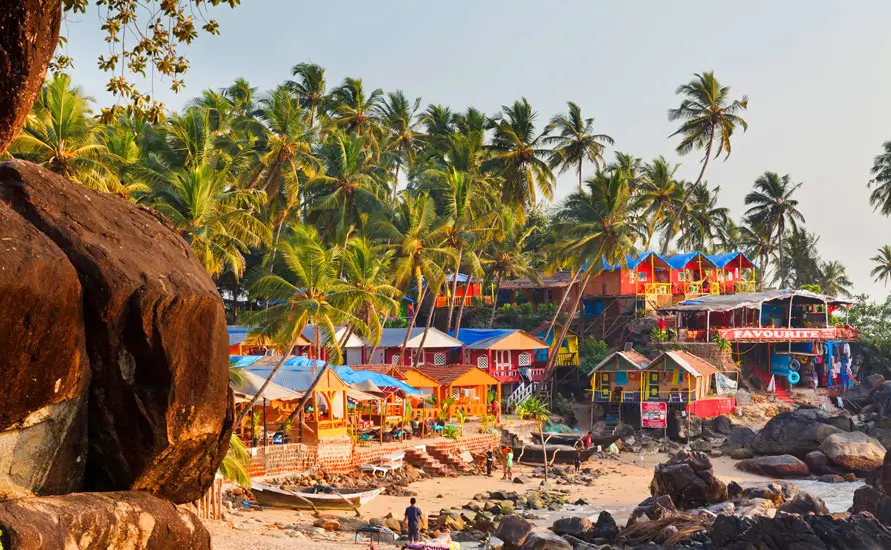
From Ponda the road runs south through Margao and quiet villages to South Goa, where you check in to a beach resort for the next two nights. South Goa has wider and less crowded beaches than the north, with fewer clubs and more fishermen's boats drawn up on the sand. Depending on your preference, we book a resort near Benaulim or Varca, with long sandy shores, or farther south near Agonda and Palolem, where coves are smaller and lined with palm trees. Nothing else is planned, so take a late-afternoon dip and then order grilled pomfret or crab at a table on the sand while the sky turns orange. Overnight in South Goa.
Nothing is scheduled for today, so you can spend the hours as you like on the sand, by the pool or under a palm tree with a book. Your car and driver remain available for a few hours if you want to go out, which is included in the package. Early morning is the nicest time on the beach, when local fishermen haul in their nets and sort the catch while dogs and crows wait close by. The sea in South Goa is usually calm between November and March, but red flags do appear on some days, and lifeguards patrol the main beaches during daylight hours.
A popular short outing is the old fort of Cabo de Rama, about an hour south of Benaulim. According to local legend the hero Rama stayed here during his exile, and the fort passed through Hindu, Muslim and Portuguese hands. Today a small whitewashed chapel stands inside the ruined walls, and the cliffs look out over a wide sweep of the Arabian Sea. Returning north, ask your driver to pause at Cola, where a small river lagoon sits just behind the sand, or at the long, empty curve of Agonda. The drive passes through rice fields and cashew groves, and roadside stalls sell cashews roasted in many flavors.
If you prefer to be on the water, an optional morning boat trip from Palolem takes you out to look for humpback dolphins, which are often seen in the bay, and past Butterfly Beach, a small cove reachable only by boat or a forest path. For the evening, many resorts in South Goa offer a short Ayurveda massage or a yoga session, which can be booked locally. Shacks along the beach serve grilled kingfish, calamari and cold beer, and some hold live music on weekends. If you want to buy souvenirs, Margao market is a good place to look for Goan sausages, spices and cashews. Overnight in South Goa.
A final morning swim, then breakfast, and it is time to leave Goa: the hop south to Kochi is a direct flight of roughly 75 minutes. From South Goa, Dabolim is the closer airport, about 45 minutes away, while Mopa is roughly two hours to the north, and we plan the departure time so you have plenty of margin. The flight follows the coastline south over the Western Ghats and the long sandy shores of Karnataka and northern Kerala. On landing at Cochin International Airport, our Kerala team meets you with a sign and drives you to Fort Kochi, which takes around an hour and a half.
Home for the next two nights is a heritage hotel or a small boutique property in Fort Kochi, often set inside an old merchant house with high ceilings, teak floors and a shaded courtyard. Fort Kochi is a quiet and walkable place, with old trees shading its streets and very little heavy traffic. After you have settled in, take a short walk to Vasco da Gama Square on the waterfront, where cafés and street food stalls face the harbor entrance. Large container ships and small ferries pass close to the shore here, and on clear afternoons you can see across to Vypeen Island on the other side of the channel.
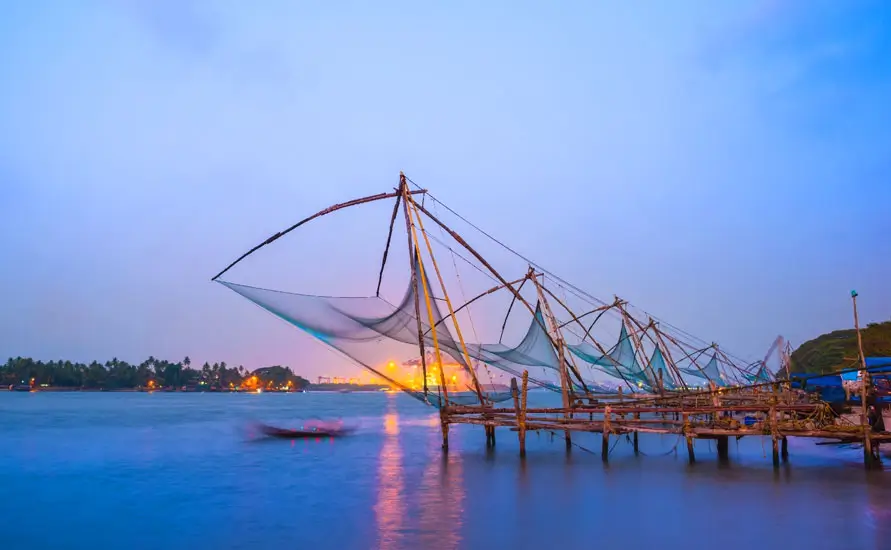
As evening falls, sit at a seafront café and watch the fishing nets lifted against the orange sky while families stroll on the promenade. For dinner, Kerala cooking offers plenty of seafood, from prawns in coconut gravy to pearl spot fish wrapped in banana leaf and cooked over a slow fire, known as karimeen pollichathu. If you would like to learn some of these dishes yourself, a home cooking class with a local family can be arranged for the next day. The streets around Princess Street have small art galleries, bookshops and craft stores that stay open into the evening. Overnight in Kochi.
Instead of a long tour, today's sightseeing is a relaxed half day on foot and by car with your Kochi guide. First comes St. Francis Church, which held the Portuguese navigator's remains for some years after he died in Kochi in 1524, and from there a short stroll leads to the Bastion Bungalow, a tiled-roof colonial residence of the Dutch period standing where one of the fort's bastions once stood. Your guide explains how the small port of Kochi rose in 1341, when a great flood on the Periyar River silted up the older harbor at Muziris and opened a new channel here. Along the way you pass old colonial clubs, a cricket ground and large mansions now used as homestays and art cafés.
Next you drive to Mattancherry Palace, where the bedroom murals show scenes from the Ramayana in reds, yellows and greens made from plants and minerals. On Fridays the palace does not open, and the substitute is the Kerala Folklore Museum, a three-story building in traditional style filled with theater masks, ritual costumes, old instruments and carved woodwork gathered from many southern states. A few minutes' walk away, the Paradesi Synagogue, dating from 1568, keeps its hand-painted Chinese floor tiles and Belgian glass lamps; it does not admit visitors on Fridays, Saturdays or Jewish holidays. The ginger and pepper warehouses along the waterfront remind you that Kochi grew rich on the spice trade with Arab, Chinese and European merchants.
Free hours follow, to be enjoyed at a slower pace. You might book a lesson in Kerala cooking, rest by the hotel pool, or treat yourself to a first Ayurveda massage at a recognized center, where therapists use warm herbal oils and long, rhythmic strokes. For early evening, an optional short boat trip around the harbor gives you a look at the old Dutch Palace waterfront, Bolgatty Island and the working shipyard. Fort Kochi is also good for shopping, with handloom cotton, spice packs, antiques and wooden elephants for sale, and your guide can recommend shops with fair prices. Overnight in Kochi.
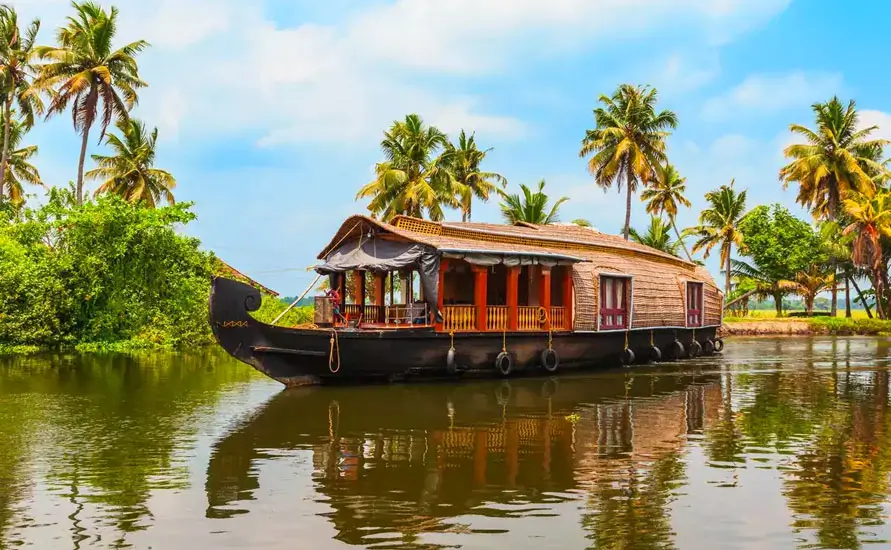
Your morning starts without a rush, since the drive to Alleppey takes only some ninety minutes and houseboats usually board around noon. Your driver follows the coastal highway south through small towns full of churches and fish stalls, and you reach the boat jetty in good time. Your private Kerala houseboat is a long, slow boat built of wood and woven palm on the lines of the old cargo barges, now fitted with bedrooms, bathrooms, a lounge and a sun deck. A crew of three looks after you for the next 21 hours, and the cook will ask about any food preferences as you board.
Once lunch is cleared away, settle on the upper deck and watch the backwaters drift by. Birdlife is one of the quiet pleasures here, with white-throated kingfishers diving from the palm fronds, cormorants drying their wings on poles and purple herons standing in the shallow fields. The captain may stop at a small village where families twist coconut fiber into coir rope by hand, once the main industry of this coast. You also pass a few small temples and mosques built right at the waterside. The slow pace and the gentle hum of the engine make it easy to doze off for an hour in the afternoon.
Toward the end of the afternoon the crew serves tea with banana fritters, and you can watch the light turn gold over the rice fields as the sun sets on the horizon. Local regulations keep the boats off the open channels after early evening, so the captain ties up beside a paddy dyke or a village path, and you can step ashore for a short walk before dark. Dinner is cooked on board and may include Kerala chicken stew, fried fish and fresh vegetables cooked with coconut. Without the light of towns, on clear nights the sky over the backwaters fills with stars. Overnight on the houseboat.
Rise early if you can to catch the first light over the paddy fields, when the water is still and the only sounds are birds and the splash of a fisherman's paddle. Breakfast of appam and egg curry is served while the boat motors back, and you step off at the landing at about nine o'clock. Your next stop is very close, because Marari Beach lies only about 15 km north of Alleppey, a drive of roughly half an hour. Along the way you pass through quiet villages where coconut palms grow almost to the water's edge and small wooden boats sit on the sand. You can check in early if the room is ready, or leave your bags and go straight to the beach.
Marari is a fishing village first and a beach resort second, which gives it a calm and local feel. Most resorts here are low-rise cottages set among coconut groves, often with gardens that grow vegetables and herbs for the kitchen. The beach is wide and golden, and in the morning you will see fishermen in teams pushing their boats into the waves and pulling in nets by hand. Swimming is possible in calm weather, but currents can be strong on some days, so always check the flags and ask the resort staff before going in. The sand is quiet for long stretches, with few vendors.
Spend the afternoon by the pool or on a beach lounger, and later walk along the shore to watch the fishing boats return and the women of the village buy fish straight from the catch. Marari is a good place for a longer Ayurveda program, and many resorts here have their own doctors and treatment rooms where you can book an oil massage, a herbal steam bath or a head treatment called shirodhara. A bicycle ride through the village lanes is another gentle option, past houses, churches and small shops. Dinner at the resort often features fresh catch cooked in Kerala spices. Overnight in Marari.
A whole day at Marari with nothing booked is the reward for the early houseboat start yesterday. Many guests begin with a bicycle from the resort, usually free or at a small charge, and ride slowly along the sandy lanes behind the beach before the sun gets strong. The paths wind between coconut palms, small ponds covered in water lilies and simple houses with tiled roofs, where women sweep the front yards and children wave on their way to school. You pass a village church, a small Bhagavathy shrine and coir sheds where fiber is soaked and beaten, and the people here are used to visitors and happy to say hello.
Late morning is a good time for a swim if the flags allow it, or for an hour in the shade with a book while fishermen mend nets nearby. Those who want to keep busy can book a short Kerala cooking demonstration in the resort kitchen, where the chef shows how to grind fresh coconut, temper mustard seeds and curry leaves in hot oil, and cook a fish moilee in a clay pot. Lunch is usually light and local, perhaps a thali on a banana leaf or a plate of fried mussels. The heat peaks in the early afternoon, so a nap in your cottage is part of the local rhythm.
From late afternoon the beach comes alive again, as villagers come down to the shore and the light turns soft over the Arabian Sea. This is the ideal moment for an optional Ayurveda session, which many Marari resorts run with a qualified doctor who first asks about your health and then suggests a treatment. Abhyanga, a full-body massage with warm medicated oil, is the most common choice for first-timers, and it is usually followed by a herbal steam bath. Treatments are booked and paid for locally. After sunset, dinner by the pool or on the sand rounds off a slow and easy day. Overnight in Marari.
Leaving Marari after breakfast, you head south on the coastal highway through Alleppey town and then through the long chain of fishing villages, churches and temple festivals that line this part of Kerala. The road runs close to the sea for much of the way, with backwater channels on one side and glimpses of the beach on the other. Your first pause comes near Thottappally, where a spillway lets the backwaters drain into the sea during the monsoon, and the narrow strip of land between water and ocean gives a clear picture of how fragile this coast can be. Tea and banana chips at a roadside stall make a good stop.
Next comes Kollam, once known to foreign traders as Quilon and one of the oldest ports on the Malabar Coast, mentioned by Arab and Chinese writers more than a thousand years ago. The town now sits at the southern end of the great backwater system, on the shore of the wide Ashtamudi Lake, whose name refers to its eight arms. Your driver can stop at the lake front for a view of the fishing boats and the cashew warehouses, as Kollam has long been the center of the cashew processing industry in India. A simple Kerala lunch at a local restaurant here breaks up the drive nicely.
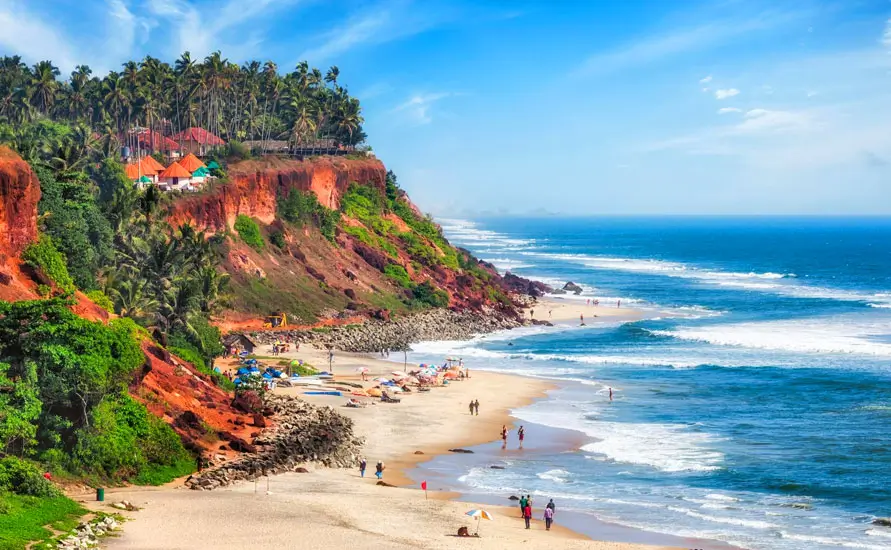
The last stretch of about an hour brings you to Varkala, where the coast changes character entirely. Instead of flat sand, red and ochre laterite cliffs rise straight from the beach, and the guesthouses, cafés and yoga schools sit along the top of the North Cliff. You check in to a cliff-top hotel or a quiet resort for the next two nights, and after settling in you can walk along the narrow cliff path to watch the sunset over the Arabian Sea. The cafés along the edge serve seafood, fresh juices and good coffee, and evenings here are relaxed and sociable. Overnight in Varkala.
Early morning, before the heat builds, is the best time for a walk along the full length of the Varkala cliff. The path runs for a couple of kilometers past cafés that are only just opening, small shops selling handloom cotton and Tibetan jewelry, and wooden platforms where yoga classes are already under way. Below, the waves roll in steadily, and from several points you can see the natural springs that seep out of the cliff face, said by locals to have healing properties. Geologists value this coast too, since sedimentary cliffs of this kind are rare along the western shore of the country.
Steps lead down from the cliff to Papanasam Beach, whose name means the destroyer of sins, and where Hindu families come to perform rites for departed relatives at the water's edge, especially at the new moon in the month of Karkidakam, in July or August. A short walk inland leads to the Janardhana Swamy Temple, a Vishnu shrine said to be about two thousand years old and a major pilgrimage site in Kerala. Non-Hindus are usually not allowed inside the main temple, but you can see the outer walls, the old bell said to have been given by a Dutch captain, and the temple tank. Please dress modestly here.
Lunch can be at one of the cliff-top cafés, many of which serve the catch of the day grilled or curried, along with Israeli, Italian and Kerala dishes. In the afternoon, swim at the main beach where lifeguards are on duty, but note that the current can be strong at Varkala and you should stay inside the flagged zone. Optional extras include a surfing lesson for beginners, a yoga class, or an Ayurveda treatment at one of the many centers along the cliff. For a quieter view, walk north to Odayam or Kappil, where the sand is empty and a lagoon meets the sea. Overnight in Varkala.
A final morning on the cliffs gives you time for one more swim or a last coffee at a favorite café, and there is no need to rush checkout. The drive south to Kovalam is one of the shortest of the trip, taking about ninety minutes past Attingal and the edges of Trivandrum, the state capital, also known as Thiruvananthapuram. On the way, your driver can make a detour to the Anjengo Fort, built by the British East India Company in the 1690s on a narrow strip of land between the sea and a lagoon. The small fort, with its old cemetery and lighthouse, was one of the first British trading posts on this coast.
Kovalam's coastline is made up of three crescent beaches separated by rocky headlands, and you will see the red-and-white striped Vizhinjam lighthouse standing on the southern point. Your resort for the last two nights sits either on the cliffs above the bays, with views out to sea, or slightly back in the coconut groves, away from the main strip. Kovalam was one of the first beach resorts in India to attract foreign visitors in the 1970s, and today it offers a good choice of hotels, restaurants and Ayurveda clinics, while the bays remain sheltered enough for comfortable swimming.
Lunch is ready soon after you arrive, and nothing else is fixed for the afternoon. A walk along the promenade of Lighthouse Beach in the late afternoon leads past shops selling batik prints, spices and cashews, and small restaurants that lay out the day's seafood on ice so you can choose your fish. Climbing the lighthouse itself is possible for a modest fee, and the view over the bays and fishing harbor of Vizhinjam is worth the steps. As dusk falls, the beach fills with families and couples watching the sun drop into the Arabian Sea. Dinner on a terrace above the sand is a fine way to start the final stop. Overnight in Kovalam.
Your last full day can be as lazy or as active as you wish. Many travelers stay at the resort, rotating between the pool, the sea and a lounger, perhaps fitting in one final Ayurveda massage before the long flight home. The bays at Kovalam are generally calm in the morning, and the lifeguards place flags to show the safest swimming areas. Fishermen still launch their long wooden boats from Hawa Beach, the central bay, and on most mornings you can watch the teams haul nets onto the sand. If you prefer some shade, a shaded table at a beach café with fresh lime soda makes a good place to watch the life of the beach.
For those who want a little culture, your car and driver can take you into Trivandrum for a half-day tour with a local guide, about thirty minutes away. The city's main landmark is the Padmanabhaswamy Temple, where Vishnu lies on the coils of the serpent Ananta; entry is restricted to Hindus who follow a strict dress code, but the seven-story gopuram can be seen from the outside. Nearby, the Kuthiramalika Palace, also called the Puthenmalika, was built by the royal family of Travancore in the 1840s and has 122 carved wooden horses along its eaves. The Napier Museum, with its striped Indo-Saracenic building, holds bronzes, carvings and old royal artifacts.
Back at Kovalam in time for the late afternoon, you can still pick up presents to take home, such as Kerala spices, coffee, banana chips, cashews or the traditional cream-and-gold kasavu sarees and shawls. In the evening, many guests choose a farewell dinner at a beach restaurant, with grilled lobster, tiger prawns or a full fish platter served by candlelight. A few resorts also host short Kathakali or Mohiniyattam performances on certain nights. Before going to bed, check your flight details with our team and confirm the pick-up time for tomorrow, as we will plan the transfer around your departure. Overnight in Kovalam.
Your trip ends at a slow pace, as the airport lies only about half an hour from Kovalam. With an afternoon or evening departure, there is time for one more swim at sunrise, a last walk along the beach and a long breakfast on the terrace. Many flights to the Gulf and onward connections to Europe leave Trivandrum at night, so a late checkout is often useful, and we can request it in advance or book a day room for the afternoon. Your bags can also stay with the reception while you spend a final few hours on the sand, by the pool or at the spa.
When it is time to go, your driver meets you at the lobby and loads the car for the short transfer to Trivandrum International Airport. The route runs past the fishing harbor at Vizhinjam and through the southern edges of the city, with coconut palms and church spires lining the road. The airport sits close to the sea at Shanghumukham, and on some days you can glimpse the beach from the road. For international flights, plan to arrive about three hours before departure, as check-in and immigration can take time during the busy winter months. Domestic connections through Mumbai, Delhi or Bengaluru need about two hours.
Saying goodbye to your driver at the terminal closes two weeks of easy travel along the western coast of South India. Your South India beach and backwaters tour began among the whitewashed churches of Old Goa and the painted houses of Fontainhas, moved to the quiet sands of South Goa and the spice warehouses of Fort Kochi, and spent a night drifting on the Alleppey backwaters before the beach days of Marari, Varkala and Kovalam. We hope you leave rested and warm, with sand still in your shoes and plans to come back. If you would like help with a return trip, our team is always happy to help.
Your Journey

N.S. Rathore & Mrs. Omlata Rathore · Managing Director
We still read every enquiry ourselves. Tell us the places you liked and our planners will send a day-by-day route with drive times and a clear price.
Every package can be customised and no pressure to book. A planner from our office replies within 24 hours with a route written for your group.
Fill this in and your planner will send a first draft itinerary.
Explore more
Kerala Backwaters Escape Kerala Backwaters Escape
 Kerala Backwaters Escape
 Kerala Backwaters Escape
 Kerala Backwaters Escape
 Kerala Backwaters Escape
 Kerala Backwaters Escape
 Kerala Backwaters Escape
 Kerala Backwaters Escape
 Kerala Backwaters Escape
 Kerala Backwaters Escape
 Kerala Backwaters Escape
 Kerala Backwaters Escape
 Kerala Backwaters Escape
 Kerala Backwaters Escape
 Kerala Backwaters Escape
 Kerala Backwaters Escape
 Kerala Backwaters Escape
 Kerala Backwaters Escape
 Kerala Backwaters Escape
 Kerala Backwaters Escape
 Kerala Backwaters Escape
 Kerala Backwaters Escape
 Kerala Backwaters Escape
 Kerala Backwaters Escape