


 Kerala Backwaters Escape

South India Tour Packages
Chennai – Mahabalipuram – Pondicherry – Chidambaram – Tanjore – Madurai – Munnar – Kochi
At a glance
Ten days is the length most of our overseas guests settle on for a first proper look at the south, and this South India tour package 10 days is designed to make each of those days count. It begins on the Tamil coast at Chennai and Mahabalipuram, spends time in French-flavored Pondicherry, then heads inland through the great Chola temple town of Tanjore to Madurai, where the Meenakshi Temple holds its nightly ceremony. The final stretch climbs into the tea country of Munnar before ending at the old spice port of Kochi on the Arabian Sea.
Value here means getting the big sights of two states without wasting hours in a car. The long inland leg from Pondicherry to Madurai is split with an overnight stop in Tanjore, so no single drive goes much beyond five hours, and the hill road from Madurai to Munnar is planned for daylight. You stay two nights in Pondicherry and Munnar, giving you at least one unhurried day in each. One English-fluent driver covers every road leg of the 10-day South India itinerary in a cooled car kept for you alone, and licensed guides lead the big sites.
Grown-up travelers flying in from London, Paris, Toronto, New York or Sydney get the most from this South India private tour, and it suits NRI couples or groups of friends who know the north well and now want the southern states. Comfortable three-star, four-star or heritage hotels can be chosen for each stop, and the order of sightseeing is adjusted to temple timings and weekly closing days. The best weather runs from October to March. April and May are hot on the plains, though Munnar stays pleasant, and the monsoon months bring green hills and lower hotel rates.
Whatever hour your flight lands, a member of our team is waiting outside the arrivals exit at Chennai International Airport with your name on a card. The drive to your hotel takes around forty minutes, and the morning is yours to rest, since most flights from Europe, the Gulf and Southeast Asia arrive overnight. Rooms are normally ready from 2 pm; landing at dawn and wanting sleep straight away means reserving the room from the night before, which we can arrange when you book. Your welcome pack includes the full itinerary, the names of your guides, and tips on money, local SIM cards and what to wear at temples during the trip.
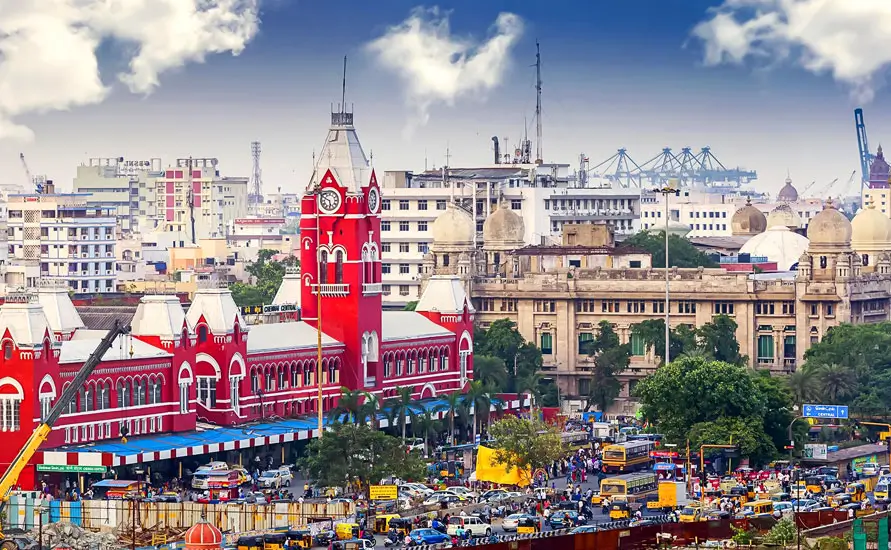
In the afternoon your guide takes you to Fort St. George, the first English fortress in India, founded by the East India Company in 1644 and the seed from which the city of Madras grew. Inside the walls stand the Tamil Nadu Legislative Assembly and the Fort Museum, where old coins, uniforms, weapons and portraits of the early governors tell the story of British trade on this coast. A few steps away is St. Mary's Church, consecrated in 1680, which has tombstones and memorials that read like a who's who of colonial Madras, including the marriage record of Robert Clive.
On the way back you drive past the red Indo-Saracenic buildings of the Madras High Court and Ripon Building, then along Marina Beach, a wide stretch of sand that runs for several kilometers beside the Bay of Bengal. Stop near the lighthouse to watch evening crowds buying sundal, a spiced chickpea snack, and families paddling at the water's edge, though the currents make proper swimming unsafe. Dinner tonight could be a Chettinad meal, the peppery cooking of a merchant community from southern Tamil Nadu, which your guide can suggest. Return to the hotel for a good night's sleep. Overnight in Chennai.
Leaving the city after breakfast, you drive south on the East Coast Road, which runs beside the sea with beaches, fishing hamlets and coconut groves on one side. Halfway along, stop at DakshinaChitra, an open-air heritage museum where traditional houses from Tamil Nadu, Kerala, Karnataka and Andhra Pradesh have been taken apart and rebuilt piece by piece. You can walk through a Chettiar merchant's home with carved wooden pillars, a Kerala house with a sloping tiled roof and a weaver's cottage with a working loom. Craftspeople often demonstrate pottery, basket making and puppetry. The museum usually closes on Tuesdays, so we adjust the order if needed.
You reach Mahabalipuram in time for lunch and check in to a beach hotel. The town was the main seaport of the Pallava dynasty, and its granite monuments, carved mostly in the 7th and 8th centuries, form a UNESCO World Heritage Site. After a rest, your guide leads a quieter visit to the Tiger Cave at Saluvankuppam, a short drive north, where a shrine is framed by a ring of carved lion-like heads. Then visit the Mahishasuramardini Cave on the hill, where a large panel shows the goddess Durga riding a lion into battle against the buffalo demon, a scene of real movement and energy.
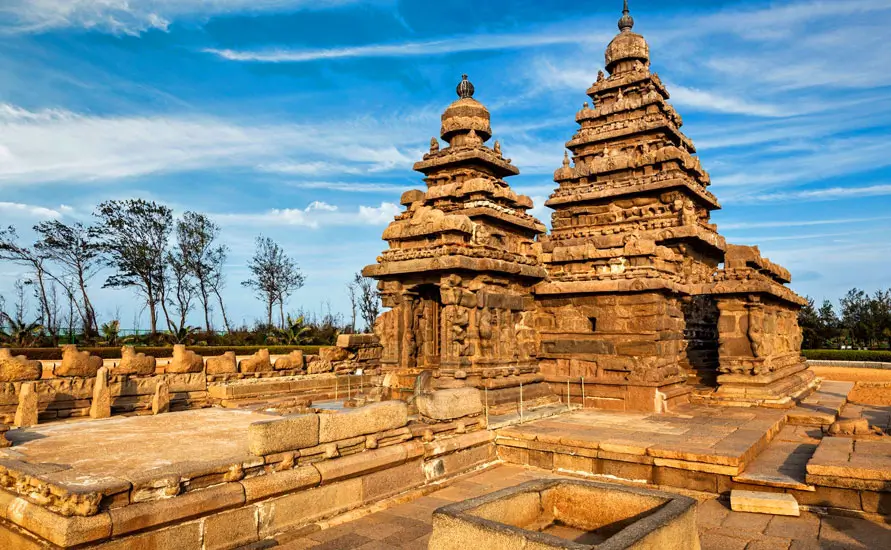
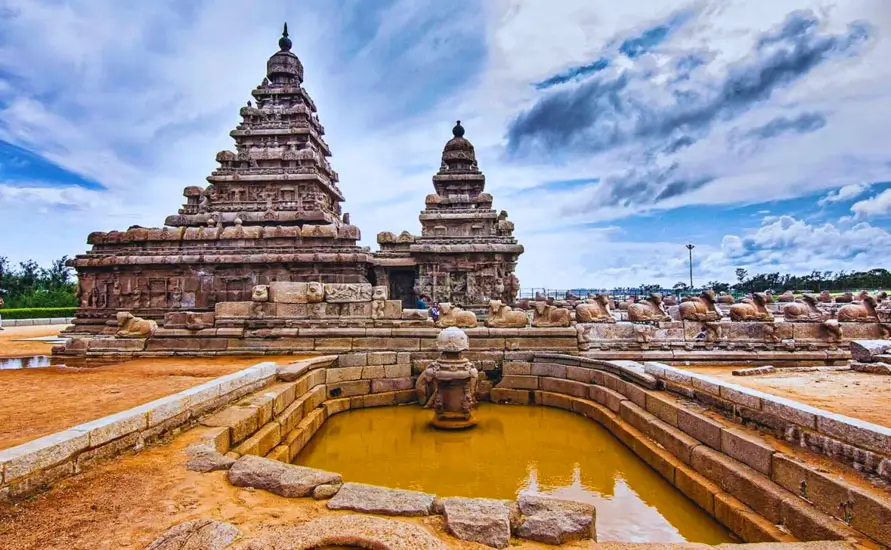
As the light softens toward evening, walk down to the Shore Temple, one of the earliest structural stone temples in South India, built in the early 8th century under King Narasimhavarman II. Its two towers face the sea and are best seen in the last hour of daylight, when the eroded granite glows a warm brown. Your guide explains how the temple was protected from the waves by a breakwater and how lines of small Nandi bulls once ringed its compound. Later, the town's beach cafés serve grilled fish, prawns and calamari caught the same day. Overnight in Mahabalipuram.
Start shortly after sunrise at Arjuna's Penance, the great carved rock face that is usually the busiest site in town by mid-morning. Arriving early lets you study details that crowds hide later: a cat standing on one leg in mock prayer while mice dance around it, a family of monkeys grooming one another, and the cleft in the rock where water once flowed down to represent a sacred river. Nearby, the Krishna Mandapam shows Krishna lifting Govardhan Hill to shelter cowherds and cattle from a storm, with a cow licking her calf as she is milked, one of the gentlest scenes in Indian sculpture.
Next on the list are the Pancha Rathas, five temples cut directly from a single sloping outcrop of granite, together with life-size carvings of an elephant, a lion and a Nandi. Each ratha shows a different roof style, and your guide explains how these small models set the pattern for the much larger temples built later by the Cholas and others in Tamil Nadu. Before leaving town, you can stop at one of the stone-carving workshops on the main road, where sculptors still shape deities in granite using hand tools and the same proportions their ancestors followed many centuries ago.
Lunch done, the coast road carries you onward for roughly two and a half hours, and your base in Pondicherry is a small heritage property a few minutes' walk from the French Quarter. Pondicherry was the main French settlement in India for close to three centuries, and the townscape still shows it. Once you have settled in, take an easy stroll along Goubert Avenue, the seafront promenade, where traffic is held back in the evening and locals come out to walk, jog and chat. The old French war memorial and the former lighthouse are along the way, and cafés nearby serve good coffee and pastries. Overnight in Pondicherry.
A morning walk with your guide begins in White Town, the former French quarter laid out on a neat grid between the canal and the sea. Rue Romain Rolland, Rue Dumas and Rue Suffren are lined with colonial houses in shades of ochre, cream and rose, many now restored as hotels and galleries. Pondicherry also has a lesser-known Tamil quarter on the other side of the canal, where houses with wooden verandas, carved doors and front platforms called thinnai show how local merchants lived. Seeing both sides gives you a clear picture of how the French and Tamil communities shaped the town together.
Mid-morning you visit the Sri Aurobindo Ashram, where visitors may sit in silence by the flower-strewn tomb of Sri Aurobindo and the Mother in the central courtyard. From there it is a short walk to the Pondicherry Museum, which holds Chola bronzes, French colonial furniture and finds from the Roman trading site at Arikamedu just outside the city, proof that Mediterranean merchants reached this coast two thousand years ago. Before lunch, look in at the Church of Our Lady of the Angels, built by the French in the 1850s, with a pale pink facade facing the sea. Lunch is at a café of your choice.
Twelve kilometers north of the city lies Auroville, an experimental township founded in 1968 where people from around the world try to live beyond nationality and religion. Visitors first watch a brief video on how Auroville began in 1968, then follow a walkway under trees to a lookout facing the Matrimandir, its huge golden globe rising from the central gardens. Visits to the inner chamber need a separate booking made in advance, with limited slots, so tell us early if you are interested. Shops at the visitor center sell handmade paper, incense, pottery and organic food products. Overnight in Pondicherry.
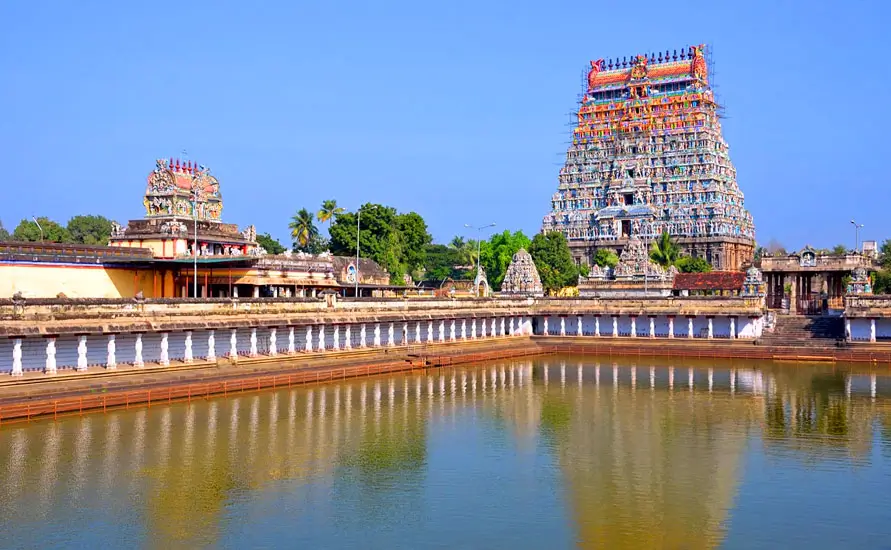
Today you leave the coast and head into the Kaveri delta, the rice bowl of Tamil Nadu and the heartland of the Chola dynasty. About ninety minutes south of Pondicherry you stop at Chidambaram, where the Thillai Nataraja Temple is dedicated to Shiva as the cosmic dancer. Its inner hall has a roof covered in gold-plated tiles, and four tall gopurams carry carved panels showing the 108 classical dance poses described in the Natya Shastra. Priests here belong to a hereditary community called the Dikshitars, recognizable by their distinctive hair tied at the front of the head. Dress modestly, and be ready to leave your shoes at the gate.
The road continues through paddy fields and past villages with small shrines and huge clay horses guarding their boundaries. If time allows, your driver can stop at Gangaikonda Cholapuram, built by Rajendra Chola in the 11th century to celebrate his army's march to the Ganges, which is now part of the UNESCO-listed Great Living Chola Temples. Its quiet lawns and graceful tower make a calm contrast to the busier temples of the delta. Lunch is at a simple vegetarian restaurant serving meals on banana leaves, where staff keep refilling rice, sambar, rasam and curd until you wave a hand to stop.
By around four o'clock the car pulls into Tanjore (Thanjavur on official maps), leaving time to settle into your room before evening. If you still have energy, walk to the Brihadeeswarar Temple at sunset, when the granite tower turns gold and local families gather in the large courtyard. The temple was completed around 1010 by Rajaraja Chola I, and its tower, rising about 66 meters, was among the tallest structures in the world at that time. The huge Nandi in the front pavilion is carved from a single stone. Tomorrow morning brings a full guided visit in daylight, so this evening is simply a first look. Overnight in Tanjore.
Daylight brings out far more detail, so your guide returns after breakfast for a closer look at the Brihadeeswarar Temple. Inside the inner corridor, faded Chola-era frescoes were found beneath later Nayak paintings, and they show dancers, musicians and royal processions in soft reds and ochres. The outer walls carry inscriptions listing donations to the temple, from gold and jewels to the names of hundreds of dancers and musicians attached to its service. Afterward, visit the Thanjavur Palace complex, where the art gallery has a fine collection of Chola bronzes, and the Saraswati Mahal Library holds old palm-leaf manuscripts written in several languages.
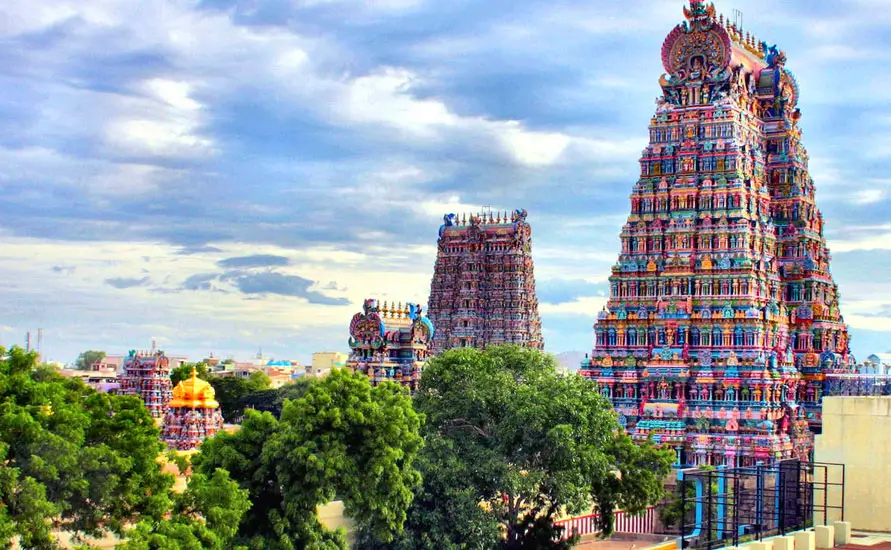
Around 11 am you set off for Madurai, a four-hour drive south-west through farmland and small market towns. Madurai is one of the oldest continuously inhabited cities in India and was the capital of the Pandya and later the Nayak kings. After checking in and resting, your guide leads you into the Meenakshi Temple in the late afternoon, entering through one of the four giant gopurams covered in thousands of painted figures. Non-Hindus may walk the corridors and halls but are not permitted in the inner sanctums. Phones and cameras must be left at the counters before you enter, so take only what you need.
Inside, the Hall of a Thousand Pillars is filled with carved figures of musicians, dancers and mythical beasts, and the Golden Lotus Tank was once the place where Tamil poets presented their work for judgment. After dinner nearby, return around 9 pm for the palliyarai ceremony, when priests carry the image of Sundareswarar (Shiva) in a silver palanquin to the bedchamber of his consort Meenakshi, accompanied by drums, pipes and lamps. Visitors watch respectfully from the side, and the music, oil lamps and chanting give the temple a very different mood from the daytime. The ceremony is short, and you return to your hotel afterward. Overnight in Madurai.
Before leaving Madurai, spend an hour at the Thirumalai Nayak Palace, built in 1636 by the Nayak king who also expanded much of the Meenakshi Temple. Only part of the original complex survives, but its courtyard is lined with massive white columns rising to scalloped arches, a mix of Dravidian and Islamic styles. The throne room has a high domed ceiling with no visible beams, a remarkable piece of engineering for its time. On the way out of the city, your driver can stop at the flower market near Mattuthavani bus stand, where heaps of jasmine, marigolds and roses are traded by weight each morning.
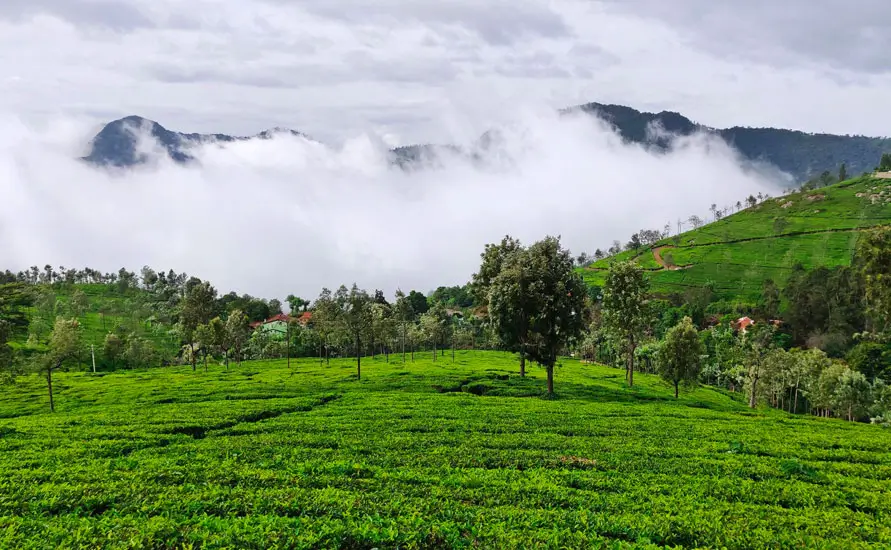
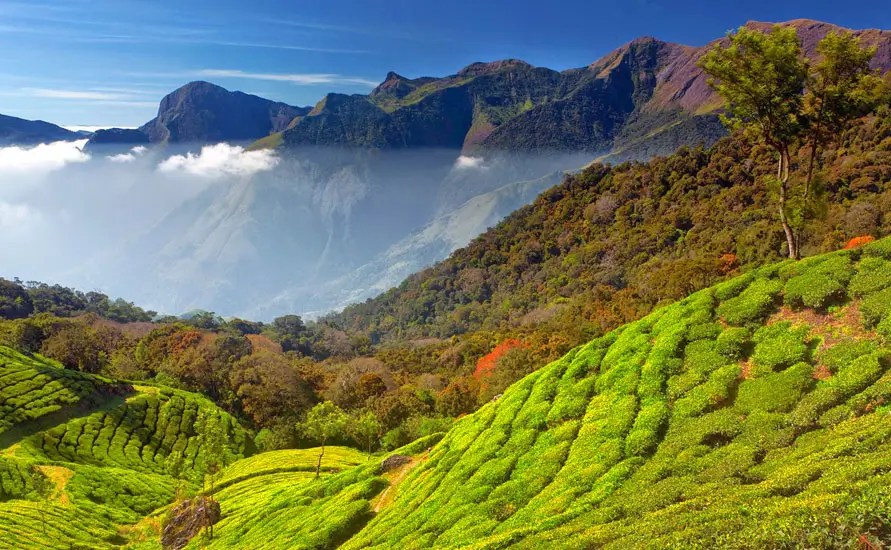
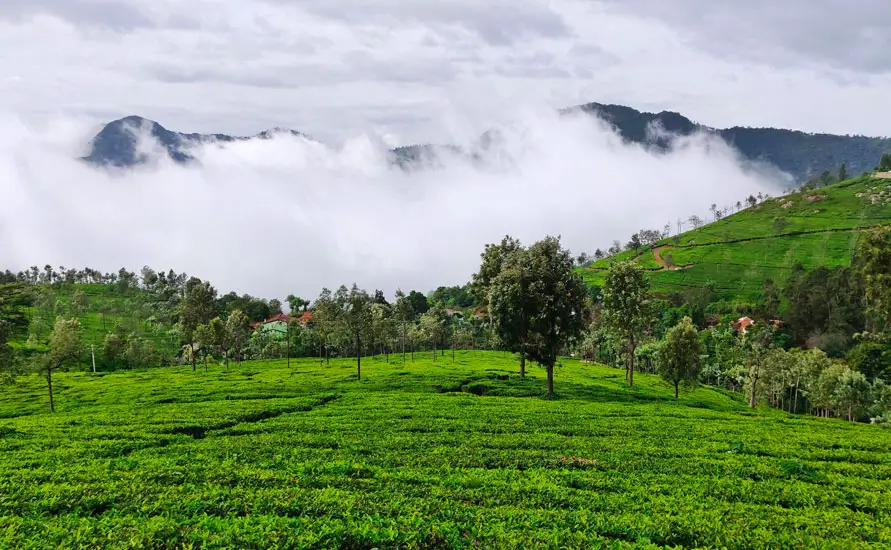
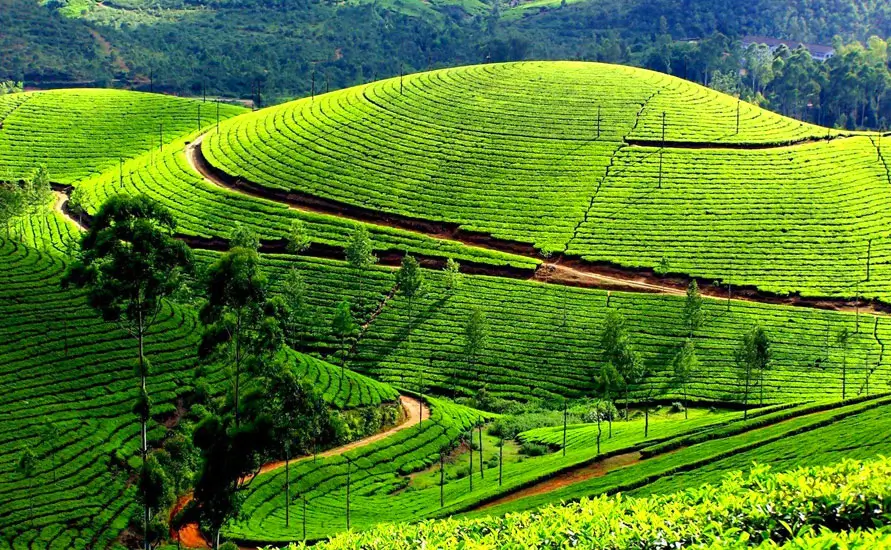
The road west crosses the fertile Cumbum valley, where vineyards, coconut farms and cardamom gardens give way to the foothills of the Western Ghats. You cross from Tamil Nadu into Kerala at the Bodimettu pass, and the climb is steady, with hairpin bends and wide views back over the plains. Stop for lunch on the way and take breaks whenever you want photos of the valley below. As you gain height, the weather cools and the slopes become covered with tea bushes, often trimmed so neatly that they look like green carpet laid over the hills. Car sickness tablets are wise if you are sensitive.
By mid-afternoon you pull into Munnar and check in at a hill resort or tea estate bungalow, where views over the valleys are part of the stay. Munnar sits around 1,600 meters above sea level at the meeting point of three mountain rivers, and its name in Malayalam means three rivers. British planters began clearing land here for tea in the late 19th century, and much of the land is still farmed by large tea companies today. The evening is free; bring a light jacket, because temperatures can fall sharply after dark. Dinner is at the resort, which often serves Kerala-style fish curry. Overnight in Munnar.
An early start gets you to Eravikulam National Park before the crowds and the midday clouds roll in. Private vehicles stop at the entrance, and park buses carry visitors up to the Rajamalai tourist zone, where a paved path leads along grassy slopes and rocky crags. This is the best place in the world to see the Nilgiri tahr, a mountain goat found only in the Western Ghats, and they often graze quite close to the path. The park usually closes for several weeks around February and March during the tahr's calving season, so we check the dates and plan around them if needed.
Back in town, visit the Tea Museum at the Nallathanni estate, run by one of the main tea companies in the area. Old photographs, machinery and a short film trace the history of tea planting in Munnar, from the first clearings in the 1880s to the present day. A guided demonstration shows each stage of processing, from withering and rolling to fermenting, drying and sorting, and you finish with a cup of fresh tea. Lunch is at a local restaurant or back at your resort, and Kerala parottas, layered flatbreads served with spicy curries, are a favorite here.
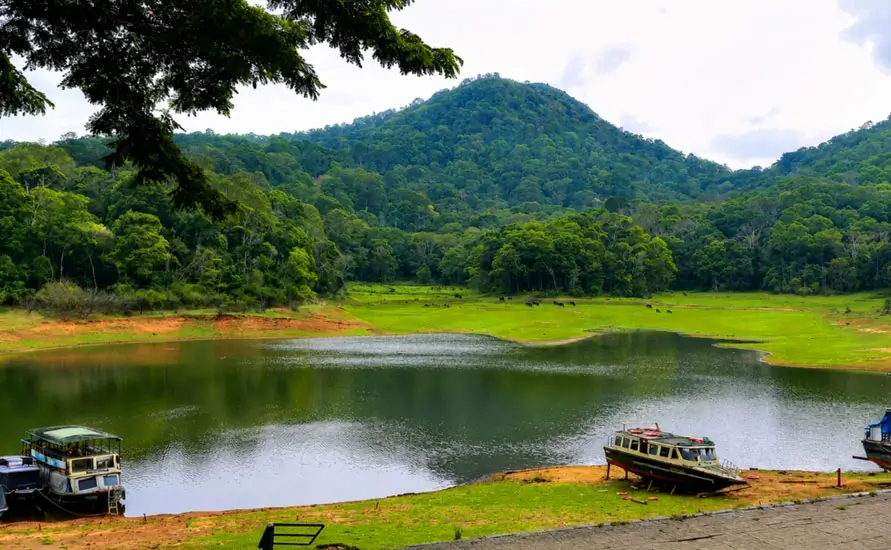
The afternoon takes in some of Munnar's scenic viewpoints. Your driver can head to Mattupetty Dam, with its reservoir set among tea estates and forest, and continue to Echo Point, where your call bounces back across the lake. Along the way you pass the Indo-Swiss dairy farm and tea pickers carrying bags of leaves on their heads, especially active during the main picking season. If you prefer walking, ask your guide for a short trek along estate paths through the tea bushes, with chances to chat with pickers and see spice gardens. Return to the resort for an early dinner. Overnight in Munnar.
Leaving Munnar after breakfast, the road descends through tea estates, cardamom plantations and patches of thick forest. Stop at the Cheeyappara and Valara waterfalls, which tumble down beside the highway and are at their fullest after the monsoon. Further down, rubber plantations appear, and you may see workers tapping trees and collecting milky latex in coconut-shell cups. The road flattens out as you reach the Kerala plains, and roadside shops sell pineapples, jackfruit and bunches of small sweet bananas. The total drive to Kochi takes around four hours, with a lunch stop on the way at a good local restaurant.
After checking in to your hotel in Fort Kochi, your guide leads a walk through the quiet streets near the waterfront. You visit St. Francis Church, where Vasco da Gama's original grave can still be seen, and pass the old Dutch Cemetery, one of the oldest European burial grounds in India. Many buildings here mix Portuguese, Dutch and British styles, with wide verandas, tiled roofs and wooden shutters. On Princess Street, colorful shop fronts and small cafés line the lane, and you can pick up souvenirs or simply enjoy watching daily life in this old port neighborhood.
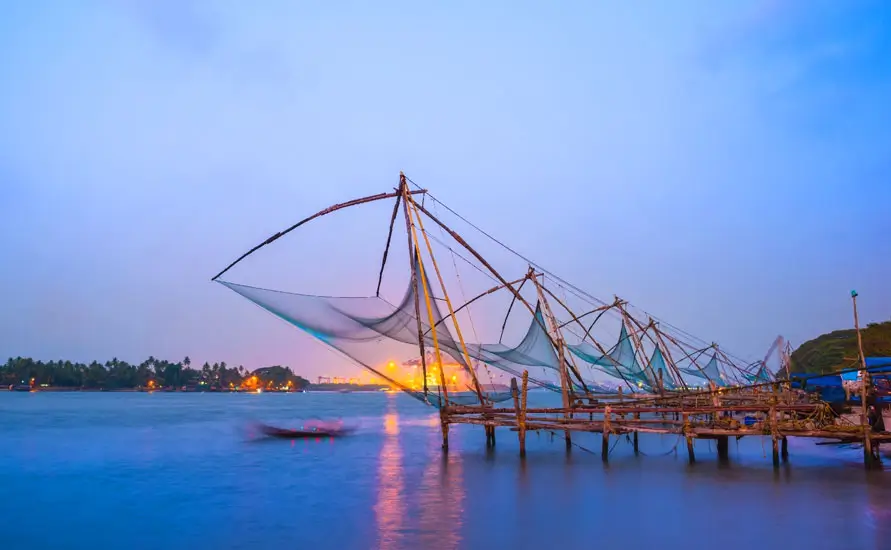
Toward sunset, walk to the beach near the Chinese fishing nets, where the sea breeze cools the air and fishermen bring in the last catches of the day. This is a good time to watch the nets rise and fall against the setting sun. In the evening, you can attend an optional Kathakali performance at a local theater or simply relax over dinner at a restaurant serving Kerala seafood, such as fish moilee cooked in coconut milk. Your guide can recommend options that suit your taste, from simple family-run places near the waterfront to quieter garden restaurants in the old Dutch bungalows. Overnight in Kochi.
Your final morning starts in Mattancherry, the old trading quarter of Kochi. Visit the Mattancherry Palace, built by the Portuguese in the 16th century and later renovated by the Dutch, with murals showing scenes from the Ramayana and Hindu legends. Nearby is the Paradesi Synagogue, with its blue and white floor tiles and chandeliers. Should your last day fall on a Friday, neither building opens, and a Saturday or Jewish holiday also rules out the synagogue, so the order of this last morning is fixed against your flight day. If either site is closed, your guide adds the Indo-Portuguese Museum or a spice warehouse visit instead.
Walk through the lanes of Jew Town, where antique shops, spice traders and art galleries fill old warehouses. The scent of ginger, pepper and cardamom is strong here, and you can buy spices directly from traders who pack them for travel. Your guide can explain how Kochi became one of the most important ports for the spice trade, attracting Arabs, Chinese, Portuguese, Dutch and British merchants over the centuries. Lunch can be at a café in Jew Town before your driver takes you to Cochin International Airport, about ninety minutes away, with time to spare before your flight.
Over ten days, this South India tour package 10 days has taken you from the colonial forts of Chennai and the shore carvings of Mahabalipuram to French Pondicherry, the Chola temples of the Kaveri delta, the evening rituals of Madurai, the cool tea hills of Munnar and the spice port of Kochi. It is a solid overview of two states and their very different landscapes, food and traditions. If you want to return, we can plan trips to the Kerala backwaters, Hampi, Mysore or the beaches of Kovalam and Varkala. Our team wishes you a safe and comfortable flight home.
Your Journey

N.S. Rathore & Mrs. Omlata Rathore · Managing Director
We still read every enquiry ourselves. Tell us the places you liked and our planners will send a day-by-day route with drive times and a clear price.
Every package can be customised and no pressure to book. A planner from our office replies within 24 hours with a route written for your group.
Fill this in and your planner will send a first draft itinerary.
Explore more
Kerala Backwaters Escape Kerala Backwaters Escape
 Kerala Backwaters Escape
 Kerala Backwaters Escape
 Kerala Backwaters Escape
 Kerala Backwaters Escape
 Kerala Backwaters Escape
 Kerala Backwaters Escape
 Kerala Backwaters Escape
 Kerala Backwaters Escape
 Kerala Backwaters Escape
 Kerala Backwaters Escape
 Kerala Backwaters Escape
 Kerala Backwaters Escape
 Kerala Backwaters Escape
 Kerala Backwaters Escape
 Kerala Backwaters Escape
 Kerala Backwaters Escape
 Kerala Backwaters Escape
 Kerala Backwaters Escape
 Kerala Backwaters Escape
 Kerala Backwaters Escape
 Kerala Backwaters Escape
 Kerala Backwaters Escape
 Kerala Backwaters Escape