


 Kerala Backwaters Escape

South India Tour Packages
Chennai – DakshinaChitra – Pondicherry – Mahabalipuram – Madurai – Kochi – Kumarakom
At a glance
Travelers in their sixties, seventies and beyond often tell us the same thing: they want to see South India properly, just not at the speed of a standard group tour. Our South India tour for senior travelers is built around that wish. Over sixteen days you stay three nights in each of five places, Chennai, Pondicherry, Madurai, Kochi and a lakeside resort in Kumarakom, so you unpack only five times. Sightseeing starts after a relaxed breakfast, afternoons stay free for rest, and the longest drive of the trip is about three and a half hours.
Comfort details are settled before you leave home. We ask every hotel for a ground-floor room or one close to a lift, remind you to request airport wheelchair assistance through your airline, and match you with guides who walk at your speed and know where the shaded benches are. Mahabalipuram becomes an easy day trip from Pondicherry instead of another hotel change, and the hop across Tamil Nadu to Madurai is covered by a one-hour domestic flight. For every transfer you have the same cool, roomy vehicle to yourselves, with a driver who speaks English and helps with bags at each stop.
The slow-paced South India tour suits retired couples, friends traveling together and NRI parents returning to the region with time to spare. Each city on the route has large private hospitals with English-speaking doctors, and your driver always knows the nearest pharmacy. Any sightseeing day can be shortened or skipped without upsetting the rest of the plan, and steps or uneven ground are flagged in advance. For senior travelers, November to February brings the mildest weather, with cooler mornings on the east coast and lower humidity in Kerala.
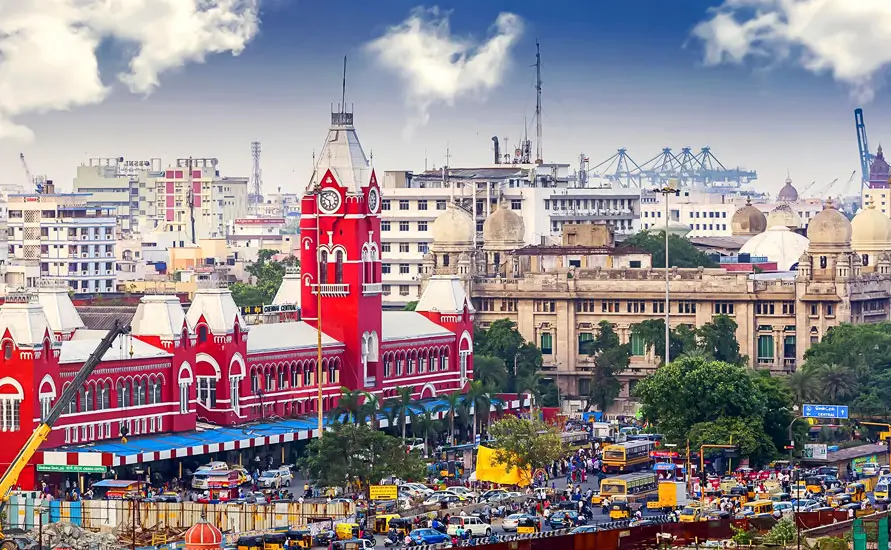
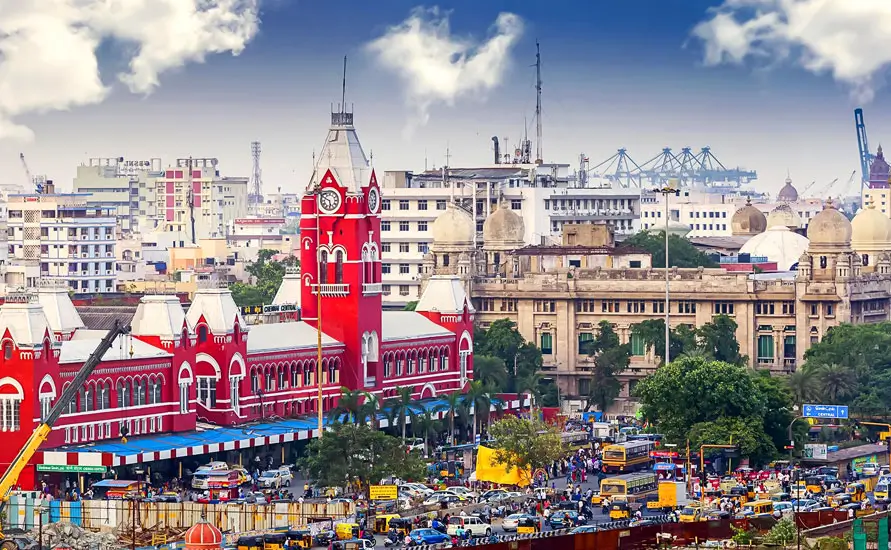
Your arrival at Chennai International Airport is planned so that you have as little to do as possible. If you would like a wheelchair from the aircraft door to the arrivals hall, we remind you to request it through your airline when you book or check in online, since the service is handled by airline and airport staff rather than by tour companies. Once you clear immigration and collect your bags, our representative waits just outside the exit with a name card and helps with the luggage trolley. The drive to your hotel takes thirty to forty-five minutes, depending on the hour and the traffic on the Grand Southern Trunk Road.
Hotels on this tour are asked well ahead for a room on a low floor or close to a lift, with a walk-in shower or grab rails where the property has them, and on the quieter side of the building away from the street. Many long-haul flights reach Chennai between midnight and dawn, so we can reserve your room from the previous night if you want to go straight to bed on arrival; simply share your flight details when you book. Nothing is scheduled for the rest of the day. Sleep, have a late breakfast and give your body time to adjust to the time difference and the warm coastal air.
In the late afternoon your tour coordinator visits the hotel for a short briefing over a pot of tea. You receive a printed plan, local phone numbers and advice on drinking water, mild food choices and carrying medicines. Chennai, Pondicherry, Madurai and Kochi all have large private hospitals with English-speaking doctors, and most good hotels can call a doctor to your room at short notice. Bring your prescriptions listing the generic names of your medicines, and a travel insurance policy with full medical cover. Dinner is at the hotel, where the kitchen will happily cook with less chili if you ask. Overnight in Chennai.
Sightseeing begins at around ten o'clock, once the morning rush on Chennai's roads has eased. Your guide meets you in the lobby, and the car heads first to Fort St. George, the earliest fortress the British East India Company built in India, completed in 1644. Much of the fort now houses the Tamil Nadu government, so some areas are closed to visitors, but the open sections are compact and mostly level. Within the walls you step into St. Mary's Church, which dates from 1680 and is regarded as the oldest surviving Anglican church in India. Its walls carry memorial tablets to soldiers, merchants and their families, and the cool, quiet nave has pews where you can sit and listen.
Close by, the Fort Museum occupies an 18th-century building that first served as a public exchange for merchants. Its coins, uniforms, weapons and portraits give a clear picture of early colonial Madras, although some galleries are on an upper floor, so your guide tells you what is where before you decide how much to see. Rather than walking the George Town streets, you then see the domes and red brick of the Madras High Court and the colonial post office building through the car window, with your driver slowing down so you can take photos. Lunch is at a restaurant known for gentle, home-style South Indian vegetarian cooking.
The afternoon is yours to rest at the hotel, a rhythm that repeats on most days of this tour. When the sun drops, you can join your driver for a gentle ride along Marina Beach, stopping where the promenade is level and benches face the sea. Families arrive in the evening to fly kites and buy sundal, a warm snack of spiced chickpeas sold in paper cones, and there is plenty to watch without walking far. Crowds not your thing? Elliot's Beach, farther south in Besant Nagar, is quieter and more compact, and a coffee or a cone of ice cream from one of the shops facing the sand makes a pleasant end to the day. Overnight in Chennai.
Around half past nine the dawn crowd of devotees has thinned out in Mylapore, yet the granite paving is still cool underfoot, and that is the window your guide aims for. The Kapaleeshwarar Temple is dedicated to Shiva, and although its present buildings date mostly from the 16th century, worship on this site is far older. Rather than covering every shrine, the visit focuses on the main courtyard and the large stepped tank beside the temple, where you can sit on a shaded ledge and watch priests, flower sellers and families come and go. Shoes are left with an attendant at the gate, and your guide carries a small towel for your feet afterwards.
Next comes Egmore and the Government Museum, a mid-19th-century institution whose campus also includes a grand red Indo-Saracenic museum theater. What you come for is the bronze hall, where dancing Nataraja figures and gentle seated pairs of Shiva and Parvati, many over a millennium old, stand in long glass cases. While you look, your guide describes how the metal was poured into clay molds around wax models, and how these deities once rode out on decorated temple carts at festival time. The museum spreads across several buildings, so the visit covers just the bronze hall and the nearby sculpture rooms, with time to sit down in between.
You are back at the hotel by early afternoon for lunch and a long rest. In the evening, Chennai offers a full calendar of Carnatic music and Bharatanatyam dance in its sabhas, the small cultural halls of the city, especially during the December and January music season. Your coordinator checks what is on during your dates and can book aisle seats for an optional performance. Another easy choice is a stop at a well-known coffee house, where filter coffee is poured back and forth between a steel tumbler and a bowl to cool and froth it. Pack a light overnight bag, as tomorrow you move to Pondicherry. Overnight in Chennai.
Check-out is set for around half past nine, so there is no need for an alarm clock. The car follows the East Coast Road, a coastal highway that is usually quieter and smoother than the inland route, and your driver pulls over whenever you would like to stretch your legs or use a restroom. Your first stop, under an hour from the city, is DakshinaChitra, a living-history museum whose old homes were dismantled piece by piece in villages across four southern states and reassembled here by the sea. It is a relaxed way to see how South Indian families lived a century ago, away from the heat and noise of a crowded town.
Seeing every building would be tiring, so the visit is limited to a small selection, for example a trader's townhouse from Chettinad full of carved timber, a steep-roofed Kerala home and a modest cottage where a weaver's loom sits in a pit dug into the floor. The paths are mostly flat but partly sandy, and covered verandahs give you places to sit while the guide talks. Craftspeople are often at work on site, shaping pots, weaving baskets or painting, and you can watch without any pressure to buy. After a light lunch nearby, you continue south past salt pans, fishing hamlets and long rows of casuarina trees planted to shelter the coast.
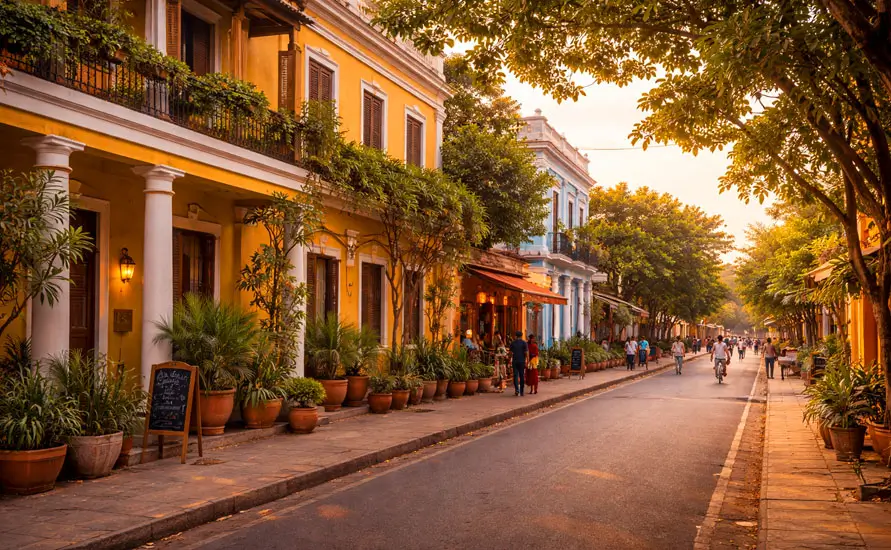
By about four you pull up in Pondicherry, where your hotel for the next three nights has been picked with mobility in mind: depending on your taste, a restored colonial house offering rooms at street level or a newer building with elevators. Many old buildings in the French town have steep wooden staircases, so we confirm your room type before you arrive. After a rest, the seafront Promenade is only a few minutes away by car. Traffic is kept off the road in the evening, and the wide, smooth pavement with benches every few steps makes it one of the easiest walks in South India. Dinner can be French or Tamil, whichever appeals. Overnight in Pondicherry.
The old French town is small and laid out on a neat grid, which makes it well suited to a short guided stroll. Setting off on foot with the guide once breakfast is over, you know the car is trailing close by and can pick you up at any corner the moment your legs have had enough. You wander along Rue Romain Rolland and Rue Suffren, lined by mustard and white villas with shuttered windows, bougainvillea over the gates and street signs still written in French. Along the way the guide explains how local builders mixed Tamil and French ideas, using shaded porches, lofty rooms and open central courtyards to beat the heat in an age without air-conditioning.
A visit to the Sri Aurobindo Ashram follows. Visitors file quietly past the samadhi, a marble shrine covered every day with fresh flower patterns, and there are spots to sit along the courtyard wall. Silence is kept inside, so your guide tells the story of the philosopher Sri Aurobindo and his French-born collaborator Mirra Alfassa, known as the Mother, before you enter. A few streets away, the ashram's handmade-paper unit sells notebooks and cards, an easy souvenir to pack. By lunchtime you are back in your room, keeping the strongest sun of the day at a distance, which is the pattern on nearly every afternoon of this itinerary.
Late in the afternoon, a twenty-five-minute ride north reaches Auroville, a planned community started in 1968 by the Mother, now home to residents of many nationalities working in schools, farms and workshops. The visitor center has a small exhibition, a short film and a café, and it is the only part of Auroville most day visitors need. To see the golden globe of the Matrimandir, you follow a flat track under trees to a public viewpoint, roughly a quarter of an hour's gentle walk in each direction. If that feels too far, the visitor center alone gives a fair picture of the project. The inner chamber requires advance booking with limited slots, and we can try for one on request. Overnight in Pondicherry.
After a leisurely breakfast the car leaves at around nine for the drive north along the coast to Mahabalipuram, the old Pallava seaport whose rock-cut temples and sculptures are listed by UNESCO. Two hours is the longest drive of this week, and your driver plans a tea stop halfway at a clean roadside restaurant. Taking the town as a day trip means no packing and unpacking, and you return to the same room tonight. Wear a sun hat and comfortable flat shoes with a good grip, as the granite around the monuments can be smooth in places, and carry a light scarf to cover your shoulders from the midday sun.
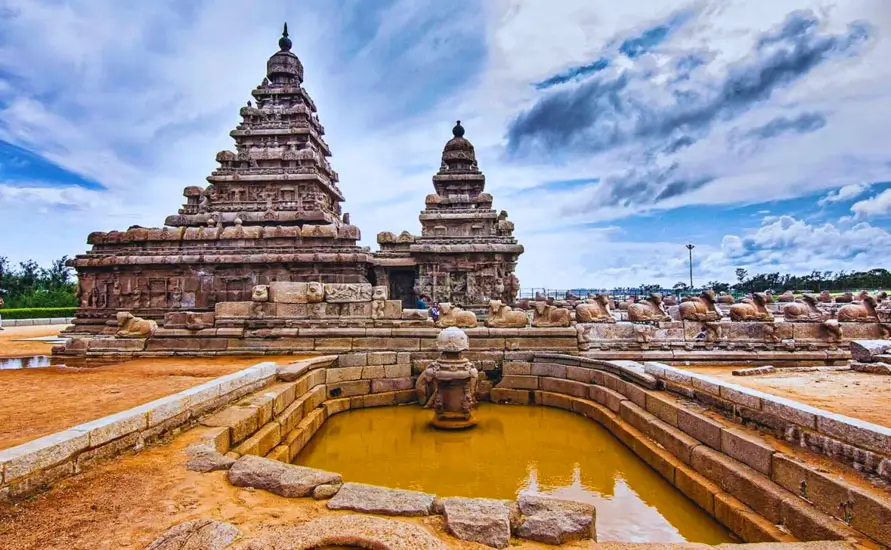
Your guide plans the order around the shortest walks and the best shade. Arjuna's Penance comes first, because the car can stop close to the great carved rock face and you can study it from the roadside or a bench. Look for the small cat standing on its hind legs in mock prayer while mice play at its feet, a humorous detail most visitors miss among the gods and elephants. Next is the Shore Temple, reached by a paved path of a few hundred meters from the gate. Between its two shrines lies a reclining Vishnu, and the temple's soft, sea-worn carvings show how long it has faced the salt wind.
The Pancha Rathas, five temples cut from single boulders, sit on sandy ground a short drive away. You can walk around one or two of them or simply view the group from the shaded edge of the site, and your guide explains how each copies a different style of timber building in stone. Lunch is at a quiet seafood restaurant with fans or air-conditioning, where grilled fish, prawns or a vegetable thali can be ordered mild. By mid-afternoon you are on the road back to Pondicherry, arriving in good time for a rest before dinner. Overnight in Pondicherry.
We book a flight leaving close to midday or a little after, so breakfast is never rushed on the longest transfer of the opening week. Allow roughly three and a half hours on the road north to Chennai International Airport, including one break, and expect your driver to build in spare time because traffic on the city outskirts is hard to predict. If you asked for wheelchair assistance, airline staff can meet you at the check-in counter and take you through security to the gate. Your driver helps unload the luggage and waits until you are safely inside the terminal.
Barely more than sixty minutes in the air, the hop south to Madurai passes over a brown inland plain broken by boulder hills and shining irrigation tanks. Domestic baggage allowances on Indian airlines are often lower than on international tickets, usually around 15 kg for checked luggage in economy, so we send you the exact limit for your ticket in advance and can help you leave extra bags at your Chennai hotel if needed. On arrival our Madurai representative meets you in the arrivals area, and the drive to your hotel in the city takes about thirty minutes. Check-in is arranged ahead so that your room is ready on arrival.
Ancient Tamil poetry already sang of Madurai as the Pandya capital, and its old streets still run in squares around the temple at the center. Nothing else is planned for the afternoon, so you can simply rest. Several hotels in the city have rooftop terraces with a view of the painted temple towers, and as the light fades you may hear the evening drums and bells carry across the rooftops. Your guide calls in the evening to confirm tomorrow's start time and explain what to wear. Dinner is at the hotel, where the chef can prepare South Indian dishes with gentle spice or familiar continental options. Overnight in Madurai.
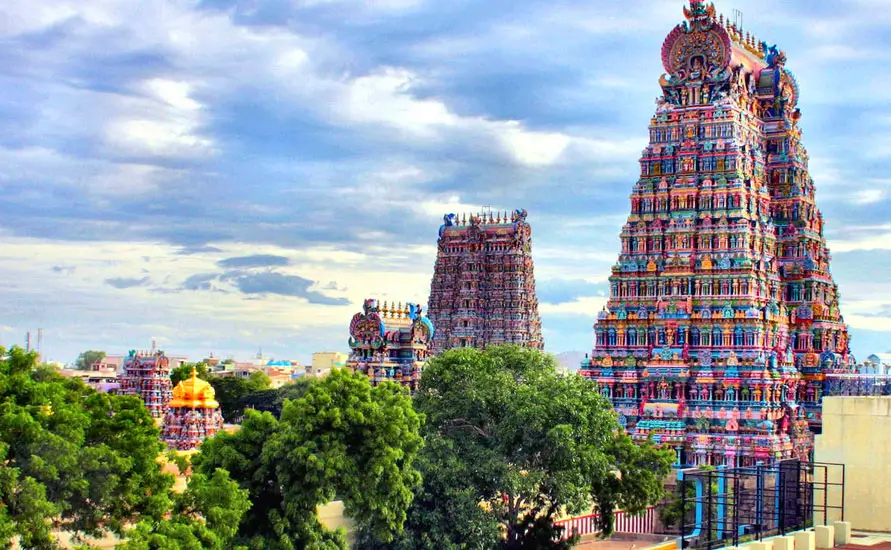
Your guide collects you after breakfast, and the visit to the Meenakshi Amman Temple begins while the air is still mild and the stone floors are comfortable for bare feet. Phones, cameras and bags are not allowed inside, so they are deposited at a counter near the entrance, and your guide or driver keeps an eye on anything you do not want to leave. Loose trousers or a long skirt and a top with sleeves are the right clothes for the visit. Non-Hindu visitors may walk the corridors, halls and courtyards but cannot enter the inner sanctums, which still leaves a vast area to see. Here the goddess, Meenakshi, takes the lead role, while Shiva is worshipped beside her as Sundareswarar, the beautiful lord she married.
Rather than trying to walk the whole complex, your guide picks out a handful of places with seating nearby. You can sit on the broad steps of the Golden Lotus Tank while the guide recounts the legend that a poem was judged worthy only if it floated on the water. In the Hall of a Thousand Pillars, which now serves as the temple's art museum, carved figures of dancers, hunters and deities line the aisles, and a few display cases show old bronzes. Elsewhere your guide shows you a set of pillars that ring with different musical notes when tapped. The corridor ceilings are painted with bright lotus designs and colorful scenes from temple legend.
You return to the hotel by lunchtime for a long afternoon rest. Close to nine each evening, priests close the day with the palliyarai ritual, bearing Sundareswarar in a palanquin to his consort's bedchamber while nadaswaram pipes play and oil lamps flicker. It is a moving ritual, but it means standing for a while in a crowded corridor late in the evening, so it is entirely optional; your guide can take you if you feel up to it, and bring you back to the hotel by car straight afterwards. Otherwise, an early dinner and a quiet night prepare you for tomorrow's palace visit. Overnight in Madurai.
A later start suits today's plan, since yesterday's temple visit asked a good deal of your legs. At around ten your guide drives you to the Thirumalai Nayak Palace, which went up in the 1630s by the Nayak ruler who also enlarged the Meenakshi Temple. Only a part of the original royal complex survives, yet the main courtyard alone is enormous, ringed by round white pillars so thick that two people can hardly link arms around them. The ground here is level and paved, and the arcades give constant shade, so you can move slowly from one side to the other and rest on the low ledges whenever you wish.
Inside the throne hall, look up at the lofty dome held aloft without any visible beams, with stucco work in ivory and gold tones that has been restored in places. Your guide explains how Hindu builders of the period borrowed arches and domes from the Islamic world and combined them with Dravidian pillars and brackets. A small gallery shows sculpture and stone pieces collected from the region. Just ask, and the car comes round to the gate the moment you are ready to leave. A light lunch follows at a clean, air-conditioned restaurant serving Chettinad and Madurai dishes, with milder versions of the famous peppery curries on request.
Later, when the heat has eased, you visit the Gandhi Memorial Museum, housed in a 17th-century palace that once belonged to the queen Rani Mangammal. Clear English panels follow India's long campaign for independence, and visitors usually fall silent in a dim side room holding the dhoti Gandhi had on when an assassin fired at him in January 1948. The grounds are green and quiet, with benches under old trees, and most visitors find an hour is enough. Back at the hotel, pack your bags in the evening, because tomorrow you fly west to the coast of Kerala. Overnight in Madurai.
There is no direct air link between the two cities on most days, so we book a connecting flight through Chennai or Bengaluru that leaves at a civilized hour, never at dawn. Your driver takes you to Madurai Airport, a small terminal about thirty minutes from the hotel, where check-in queues are short and wheelchair help, if you requested it through your airline, is easy to arrange. The total travel time is usually four to five hours including the connection, and we choose itineraries with a comfortable layover so you never have to hurry between gates. A packed snack and water are worth carrying for the transfer.
Once you leave the baggage hall at Cochin International Airport, a member of the Kerala team greets you, and a fresh car and driver take over for the rest of the trip. Reaching the old harbor district of Fort Kochi needs roughly seventy-five minutes, crossing the backwater channels and the busy mainland town of Ernakulam before reaching the islands at the mouth of the harbor. Your hotel for the next three nights is a quiet property in the old quarter, either a converted colonial bungalow with rooms at garden level or a modern building with a lift, confirmed with you when you book.
Once you have settled in and taken a cup of tea, your driver can take you the short distance to the Fort Kochi waterfront in the early evening, when a breeze comes off the Arabian Sea. A paved walkway runs along the shore beneath rain trees, with benches facing the harbor mouth, where container ships, ferries and fishing boats pass close enough to watch the crews on deck. Snack stalls sell fried banana fritters and fresh lime soda, and street lights come on as the sky turns orange over the water. Dinner can be fresh Kerala fish cooked in coconut milk, ordered as gentle as you like. Overnight in Kochi.
Fort Kochi is flat and compact, and its leafy lanes are best seen in the first half of the morning. Your guide meets you at the hotel and the car takes you first to St. Francis Church, a plain, whitewashed building put up by Portuguese settlers soon after 1500 and counted among the first churches Europeans built anywhere in the country. The navigator Vasco da Gama died in Kochi in 1524 and was buried here, and although his remains were taken back to Portugal some years later, the original gravestone still lies in the floor. The church has pews, a smooth entrance and a calm interior where you can sit for as long as you like.
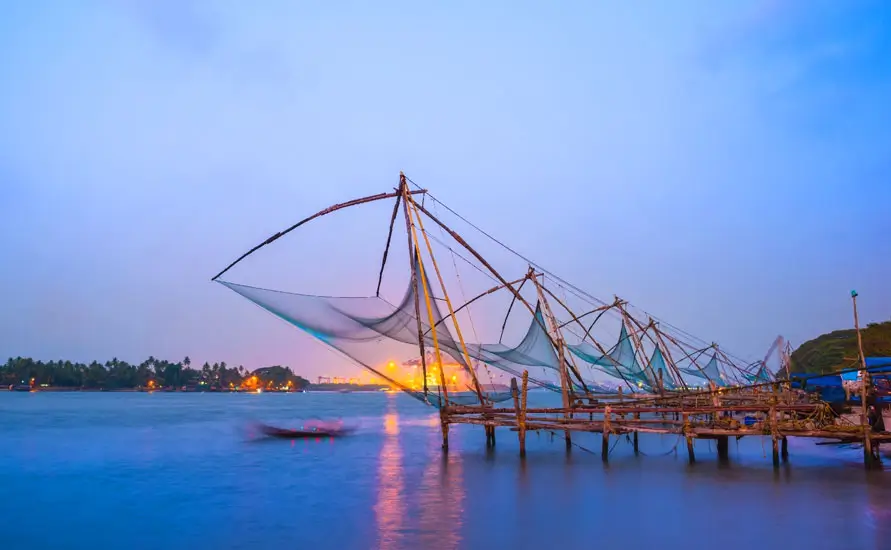
Barely five minutes away by car, Santa Cruz Cathedral Basilica offers a complete contrast, with twin white spires outside and a bright interior full of painted ceilings and stained glass. From there the car drops you near the beach end of the waterfront to watch the Chinese fishing nets, the great cantilevered frames of teak and bamboo that line the harbor entrance. Rather than the busy evening hour, you see them at mid-morning, when the crews haul in the late tide's catch and sell it to buyers waiting on the sand. Several fish stalls nearby will cook what you choose at a small café table.
After lunch the afternoon is set aside for rest, a welcome pause in the warm, humid air of the coast. For the early evening there are two optional ideas, both seated and close to the hotel. The first is a Kathakali performance at a small theater in the old town, where you can arrive early to see the actors apply their green and red face paint before the story begins; ask for seats near the front, since the hall is small and the gestures are subtle. The second is simply a slow drive past the Dutch cemetery and the colonial bungalows of the Parade Ground, followed by dinner in a garden café. Overnight in Kochi.
Both main sights today keep weekly closing days, which we plan around: Mattancherry Palace is shut on Fridays, while the Paradesi Synagogue stays shut on Fridays, Saturdays and Jewish holidays; this day is swapped with Day 11 if needed. The palace, often called the Dutch Palace, was built by the Portuguese in the mid-16th century as a gift to the Raja of Cochin and was later repaired by the Dutch. Its real wealth lies in the wall paintings of scenes from the Ramayana and the Puranas, rendered in deep reds, ochres and greens. The galleries sit on the first floor, reached by a staircase with a rail, and your guide describes the main panels if you prefer to stay downstairs.
A short walk, or a two-minute drive if you prefer, leads along Synagogue Lane to the small Paradesi Synagogue, built in 1568 by Jewish families whose ancestors had settled on this coast long before. The floor is laid with hand-painted blue and white tiles brought from Canton, and glass lamps and chandeliers hang from the ceiling. Visitors are asked to leave shoes outside and cover shoulders and knees, and photography is not permitted inside. The surrounding lanes of Jew Town are lined with antique dealers, spice warehouses and small shops selling textiles, and the street is level enough for an unhurried browse with plenty of cafés for a break.
From lunchtime onward the day is entirely free. Many guests are glad of an afternoon to read in the hotel garden, catch up on postcards or sleep through the hottest hours. If you have energy left, your driver can take you to a spice market or a shop for good Kerala cotton and handloom, or arrange a short Ayurvedic foot or head massage nearby. Another option is a gentle sunset harbor cruise from the jetty, where the boat has seating and shade. Pack your bags this evening, because tomorrow is a short drive to the lakeside resort in Kumarakom for the last three nights of the trip. Overnight in Kochi.
Check-out is at your own pace this morning, and the car leaves once you are ready, typically around ten. The road to Kumarakom runs south through the outskirts of Ernakulam and then along narrower country roads lined with coconut palms, paddy fields and canals where ducks paddle in long lines. Two hours is a realistic estimate with traffic, and a halt at a village tea stall for sweet, milky Kerala chai is easy to fit in. It is one of the most restful drives of the trip, with green views on both sides and no mountain bends to cope with.
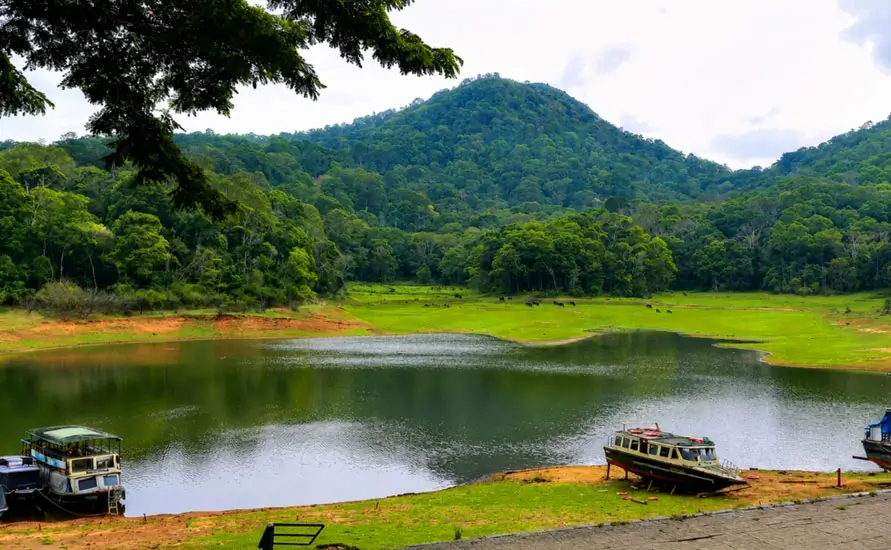
Your home for the final three nights is a Kumarakom lake resort facing the water on the east side of Vembanad Lake, the biggest body of water in the state. We choose a property with flat garden paths, rooms or cottages near the main building and the restaurant, and a lakeside lawn with shaded chairs. Some resorts here have traditional Kerala-style cottages with steps at the entrance, so we confirm a room with level access for you before arrival. Lunch can be taken at the resort's restaurant, where local fish such as karimeen, pearl spot cooked in banana leaf, is a specialty, along with plenty of mild vegetarian dishes.
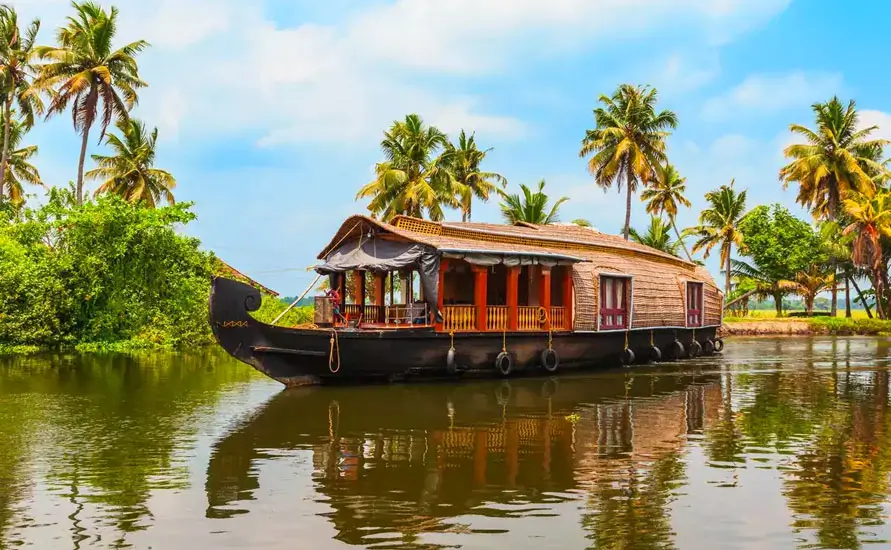
Spend the afternoon resting in your room or sit by the water and watch the lake traffic pass, from small canoes carrying grass for cattle to slow-moving houseboats heading for their evening anchorages. Most resorts have a swimming pool with steps and a handrail, and some offer gentle yoga or stretching sessions in the late afternoon. When the sun goes down, the frogs and crickets start up and lights appear along the far shore. Dinner is served on the lawn or in the restaurant, and the resort staff can arrange a buggy or an escort along the path at night. Overnight in Kumarakom.
No sightseeing is planned for the morning, so take a slow breakfast on the terrace and watch the cormorants and kingfishers working the water's edge. Many guests enjoy simply sitting by the lake with a book, while others take a short walk around the resort gardens, where staff are often happy to point out the fruit trees and spice plants. If you would like company, your coordinator can arrange a local naturalist to join you for an hour in the gardens. Lunch is at the resort, and an afternoon rest leaves you fresh for the highlight of the day, a boat trip in the soft light of evening.
At around four your private sunset cruise on Vembanad Lake departs from the resort jetty or a landing nearby. We use a covered boat with cushioned seats and a flat boarding platform, and the crew helps you on and off by the hand. The cruise lasts about two hours and follows the shoreline and the wide open water, passing small islands of mangroves, coconut-lined bunds that hold back the paddy fields, and fishermen casting nets from wooden canoes. Tea, coffee and fried banana snacks are served on board, and life jackets are provided, along with a cushion if you would like extra support.
As the sun sinks, the lake turns copper and then pale violet, and flocks of herons and egrets fly low over the water toward their night roosts. Houseboats must stop cruising and anchor in the early evening, so you see many of them moored along the banks with their lamps lit as you head back. The boat returns to the jetty before dark for safety, and you are back in your room in good time to freshen up. Dinner at the resort tonight could be a traditional Kerala meal, with rice, curries and pickles served on a banana leaf. Overnight in Kumarakom.
An early start is optional this morning for keen bird watchers, since the Kumarakom Bird Sanctuary is liveliest in the first hours after sunrise. The sanctuary lies on the lake shore close to most resorts, and a flat dirt path winds through mangroves and rain trees with occasional benches. Your guide carries binoculars and helps you spot darters, purple herons, kingfishers and, in winter, migrant waders that arrive from the north. The paths can be muddy after rain, so sturdy flat shoes are best, and you can turn back at any point and return to the car parked near the entrance.
After a late breakfast, a gentle village walk shows daily life on the backwaters at close range. Your guide leads you along level footpaths beside canals where women wash clothes on stone steps, men tap toddy from coconut palms and children cycle to school. You may stop at a small coir-making unit to see coconut husk twisted into rope, or visit a family home where tea is offered on the verandah. The walk is short, around an hour with plenty of stops, and the car is never far away. Lunch is at the resort, followed by a quiet afternoon.
For the afternoon, many resorts in Kumarakom run a well-regarded Ayurveda center, and a gentle oil massage is a pleasant way to ease muscles after two weeks of travel. Treatments are optional and paid locally; tell the therapist about any medical conditions, and for longer therapies a consultation with the resort's Ayurvedic doctor is advised first. If massage is not for you, spend the final evening by the lake, settle bills at the resort desk and pack at leisure. Your coordinator calls to confirm the departure time and checks if you would like wheelchair assistance at the airport. Overnight in Kumarakom.
Your last morning on the lake begins at a pace that matches the rest of the tour. Breakfast is taken without a clock in sight, and the departure time is calculated backward from your flight, allowing two and a half hours for the drive and at least three hours at the airport for international check-in. Should your plane take off close to midnight, as many long-haul departures from Kochi do, we can arrange a late check-out or a day room at the resort, subject to availability, so you can rest and shower before the road trip to the airport.
The road to Cochin International Airport runs north past Kottayam's rubber plantations and through the busy towns of central Kerala, and your driver plans a comfortable break at a clean restaurant midway. On arrival he helps you unload the bags and find a trolley, and if you requested wheelchair assistance through your airline, staff can meet you at the terminal entrance or the check-in counter. Remember that liquids, such as coconut oil or pickles bought as gifts, must go in checked luggage, and keep your passport, printed ticket and e-Visa copy within easy reach.
Sixteen days at an unhurried pace leaves time to reflect on all you have seen, from the old church inside Fort St. George and the painted temple towers of Madurai to the harbor nets of Kochi and the quiet waters of Vembanad Lake. We hope that the three-night stays, short drives and free afternoons let you enjoy South India in comfort and in good health. Our team stays reachable by phone until your flight has left, and we welcome your thoughts on the tour so we can keep improving it for future senior travelers. Safe travels home, and we look forward to having you with us in India once more.
Your Journey

N.S. Rathore & Mrs. Omlata Rathore · Managing Director
We still read every enquiry ourselves. Tell us the places you liked and our planners will send a day-by-day route with drive times and a clear price.
Every package can be customised and no pressure to book. A planner from our office replies within 24 hours with a route written for your group.
Fill this in and your planner will send a first draft itinerary.
Explore more
Kerala Backwaters Escape Kerala Backwaters Escape
 Kerala Backwaters Escape
 Kerala Backwaters Escape
 Kerala Backwaters Escape
 Kerala Backwaters Escape
 Kerala Backwaters Escape
 Kerala Backwaters Escape
 Kerala Backwaters Escape
 Kerala Backwaters Escape
 Kerala Backwaters Escape
 Kerala Backwaters Escape
 Kerala Backwaters Escape
 Kerala Backwaters Escape
 Kerala Backwaters Escape
 Kerala Backwaters Escape
 Kerala Backwaters Escape
 Kerala Backwaters Escape
 Kerala Backwaters Escape
 Kerala Backwaters Escape
 Kerala Backwaters Escape
 Kerala Backwaters Escape
 Kerala Backwaters Escape
 Kerala Backwaters Escape
 Kerala Backwaters Escape