


 Kerala Backwaters Escape

South India Tour Packages
Chennai – Madurai – Kanyakumari – Trivandrum – Kochi – Coimbatore – Mettupalayam – Coonoor – Ooty – Mysore – Bangalore
At a glance
Indian Railways carries millions of passengers every day, and some of its finest routes run through the south. Our South India tour by train links them into one 17-day trip, from the old terminus buildings of Chennai to the southern tip of the country at Kanyakumari, north along the Kerala coast to Kochi, then up the steep rack line of the Nilgiri Mountain Railway to Ooty before finishing in Mysore and Bangalore. Trains do most of the long-distance work, while a private air-conditioned car meets you at every station, so you never haul a suitcase through a city.
The South India rail tour is planned around daytime services, which means you watch the scenery instead of sleeping through it. Depending on the route, you travel in AC First, AC 2-tier or the air-conditioned chair car found on fast day trains such as the Shatabdi and Vande Bharat services. We book the best class available on each leg, explain how each one works before you board, and send a guide or driver to meet you on the platform. Train tickets in India open a fixed number of days ahead and are always subject to availability, so early booking helps.
Railway enthusiasts will find plenty to enjoy, from the Swiss-built steam locomotives of the UNESCO-listed Nilgiri Mountain Railway to the heritage coaches at the Mysore Rail Museum. Partners who care less about trains still get the main sights, including the Meenakshi Temple, Fort Kochi, the Ooty hills and the Mysore Palace, all with licensed local guides. Nights are spread across nine towns, with two or three nights in most of them. October to March offers the most comfortable weather, and the Nilgiri line is at its greenest just after the monsoon.
Welcome to Chennai, the starting point of your South India tour by train and the place where Indian Railways began its work in the south more than 150 years ago. Once you clear customs in Chennai, look for the placard bearing your surname; the person holding it is from our team and leads you out to the parking area where your driver and car are ready. The airport sits right beside a suburban railway station, and the drive into the city runs parallel to the busy commuter tracks, so the first electric trains you see may well be packed to the doors. Your hotel is about forty minutes away, depending on the time of day and the traffic.
Since overseas arrivals into Chennai tend to touch down around midnight or shortly before sunrise, nothing is scheduled until the afternoon. Standard check-in falls in the early afternoon, so if your plane lands in the small hours, ask us to reserve the room from the night before and you can go straight to bed. During the afternoon our tour coordinator drops by to hand over your documents, including printed copies of every train ticket on the trip. Each ticket carries a ten-digit PNR number, which you can use to check your coach and berth or seat number in railway apps. Keep your passport handy on every train ride, because ticket inspectors may ask for the photo ID used to book.
Your coordinator also explains the different AC train classes you will use. AC First has lockable cabins with two or four berths and is the most private option. AC 2-tier has open bays of four berths with curtains, plus two side berths along the aisle, and clean bedding is provided on overnight runs. On fast day trains such as the Shatabdi and Vande Bharat, you sit in an air-conditioned chair car with reclining seats, and meals or snacks are often served at the seat. The evening is free for dinner near your hotel and an early night after the long flight. Overnight in Chennai.
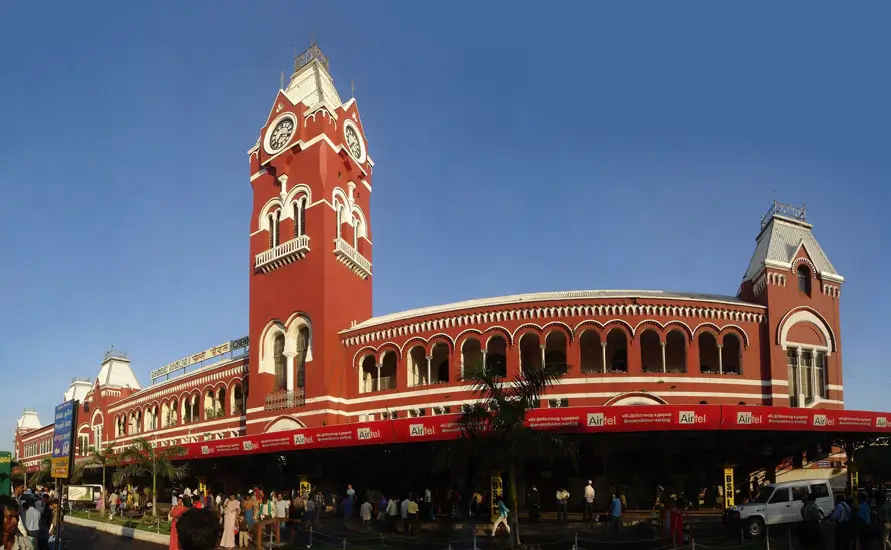
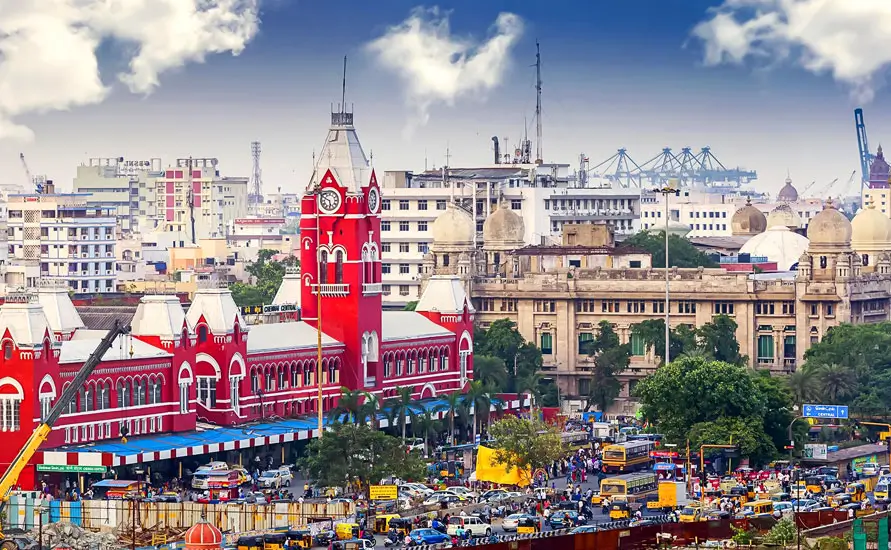
A guided city tour begins at Chennai Central, the main railway terminus for trains heading north and west. Its red-brick Gothic Revival building, finished in 1873, is topped by a tall clock tower that has become a symbol of the city. Your guide takes you onto the concourse to show how things work here: the large electronic boards listing trains and platforms, the reservation charts, and the porters in red shirts with numbered brass badges on their arms, who carry bags for a fixed fee. Standing near the platforms for a few minutes, you see sleeper trains arriving from Delhi, Mumbai and Kolkata after runs of a day or more.
From there you drive a short distance to Chennai Egmore, the second terminus, from which most trains to the south of Tamil Nadu depart, including your train to Madurai tomorrow. It is a handsome Indo-Saracenic building with domes and arches, and your guide shows you the entrance, the waiting rooms and where to find the coach position boards, so the morning departure is easy. The tour continues to Fort St. George, the first British fort in India, and the small museum inside. Lunch is at a vegetarian restaurant serving a full South Indian meal on a banana leaf, with rice, sambar, rasam, curd and crisp papad.
In the afternoon you visit Mylapore and the Kapaleeshwarar Temple, where a tall painted tower rises above the old streets and the temple tank. Your guide explains how Tamil temples are laid out and what visitors should know about dress and behavior. The day ends at Marina Beach, a long stretch of sand where the city comes out to stroll after dark. Back at the hotel, pack a small day bag for tomorrow with water, snacks, a light shawl for the air-conditioned coach and anything you need during the ride, since large suitcases go on the luggage rack above your seat. Overnight in Chennai.
Your driver collects you after an early breakfast and brings you to Chennai Egmore around forty-five minutes before departure. The coach number for your seats is printed on the ticket, and at larger stations a digital board above the platform shows where each coach will stop, so you can wait in the right place. A porter or your driver helps you board and lift your bags onto the rack. On this route we try to book an air-conditioned day train, using the chair car where a fast service exists or an AC 2-tier berth on a longer train, depending on what is available for your date.
The line runs south-west across the Tamil plains, past green rice paddies, sugarcane fields and towns with temple towers rising above the rooftops. At major stations vendors walk along the platforms selling tea, coffee and snacks such as vada and bajji, while on some trains a pantry car or catering staff serve meals ordered in advance. Your coordinator can help you order a meal through the railway's e-catering service, or you can carry a packed lunch from the hotel. Keep your shoes and valuables close, and use the washrooms near the coach doors; those in AC classes are generally cleaner, although bringing tissues and hand gel is wise.
You arrive at Madurai Junction in the afternoon. Our representative waits on the platform near your coach and leads you through the station to your car, and the hotel is a short drive away. Once you have had a shower and a cup of coffee, your guide leads an easy stroll around the outer temple streets at dusk, past tailors stitching at their machines inside centuries-old pillared halls, jasmine garlands being knotted by hand and stalls stacked with brass oil lamps. There is no temple visit tonight. The aim is simply orientation in the old Pandya capital, a city praised in Tamil poetry since the Sangam period, before a dosa supper at a well-loved local eatery. Overnight in Madurai.
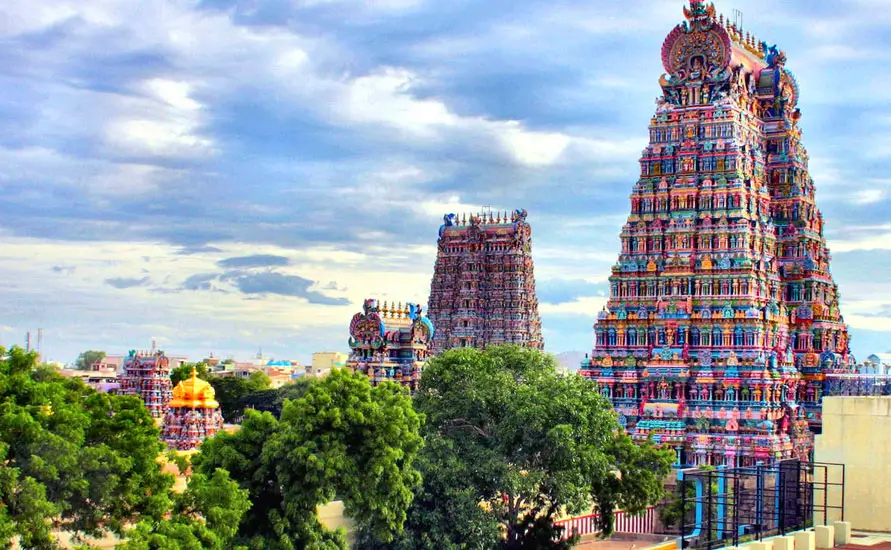
Your guide collects you early for the Meenakshi Amman Temple, a walled complex covering roughly fourteen acres whose gopurams are crowded with brightly painted gods, demons and animals. Before going in, hand over your phone and camera at the deposit counter near the gate, because neither is permitted beyond it. Non-Hindu visitors can walk through the long corridors, open courtyards and pillared halls but are not allowed into the inner sanctums. Highlights within the walls include the stepped Potramarai Kulam, or Golden Lotus Tank, and the Thousand Pillar Mandapam, now a modest museum of bronze images and carvings. Clothing that covers both shoulders and knees is expected, and slip-on footwear saves time at the shoe stand.
Your car covers the short distance from the temple to the Thirumalai Nayak Palace, whose patron was the same ruler who funded many of the temple's mandapams. What stands today is roughly a quarter of the original complex, yet the central courtyard still impresses, ringed by massive white columns and scalloped arches finished in fine stucco, a blend of Dravidian and Islamic ideas rarely seen this far south. Your guide explains how the Nayak rulers governed Madurai after the decline of the Vijayanagara Empire. The afternoon is yours: rest at the hotel, or head to the Gandhi Memorial Museum in the old Tamukkam Palace, where one exhibit is the bloodied dhoti Gandhi wore at the moment of his assassination in January 1948.
Rail enthusiasts may want to spend a little time at Madurai Junction in the late afternoon, watching express trains from Chennai, Bangalore and the Kerala coast arrive and depart. The station sits on a meeting point of several lines, and your guide can point out the different types of locomotives and coaches. After dinner there is an optional return to the temple around 9 pm for the palliyarai, the nightly bedtime ritual in which priests escort Sundareswarar, the form of Shiva worshipped here, in a silver litter to the goddess's bedchamber while nadaswaram pipes and drums play. Your guide accompanies you, and your driver parks close by so the return trip takes only minutes. Overnight in Madurai.
After breakfast your driver takes you back to Madurai Junction for the morning train south to Kanyakumari. This leg usually runs in AC chair car or AC 2-tier, depending on which train fits the day, and your guide or driver sees you to your coach before departure. The line runs through the far south of Tamil Nadu, where the land becomes drier and red-earth plains alternate with palmyra palms, windmills and scattered granite hills. Near Tirunelveli the wind farms become dense, as this is one of the windiest parts of the country and an important area for wind energy in India.
As the train nears the coast, the Western Ghats appear on the right, a line of green hills that marks the border between Tamil Nadu and Kerala. Kanyakumari station is a terminus, the southernmost railhead in mainland India, and many trains on the network carry boards showing their long routes from northern cities to this point. Our local representative meets you on the platform and drives you to your hotel, which is chosen for its sea views where possible. The afternoon is at leisure, and many guests wander down to the rocks below town, where three seas converge: the Indian Ocean straight ahead, with the Arabian Sea on one side and the Bay of Bengal on the other.
Before dark your guide drives you to a west-facing sunset point, since Kanyakumari is among the rare spots in the country where the sun can be watched both rising out of the sea and dropping back into it. Pilgrimage is the town's main business, and by evening the seafront fills with Indian families picking through shell trinkets and paper cones of roasted peanuts sold from carts. You also call at the Kumari Amman Temple, the shrine of the young goddess Kanya Kumari after whom the town is named. Male visitors are normally required to go in bare-chested, and your guide runs through the other entry customs beforehand. Overnight in Kanyakumari.
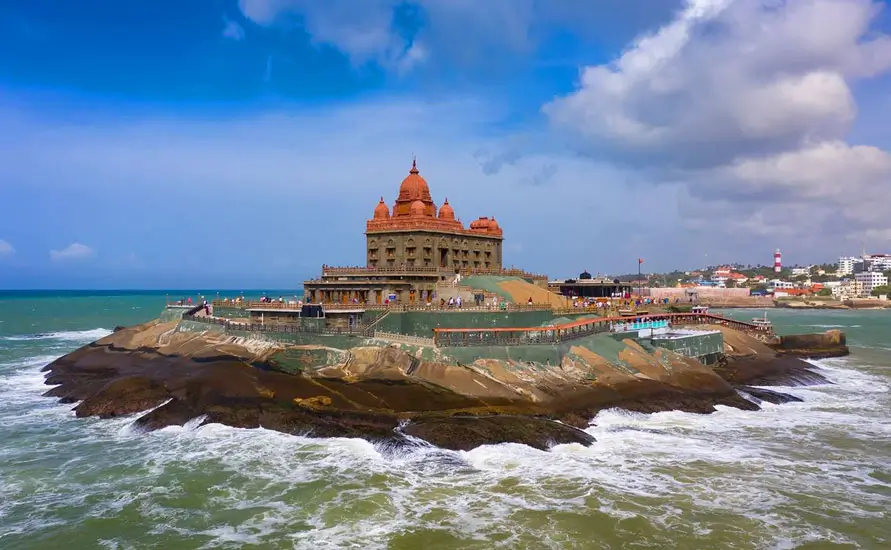
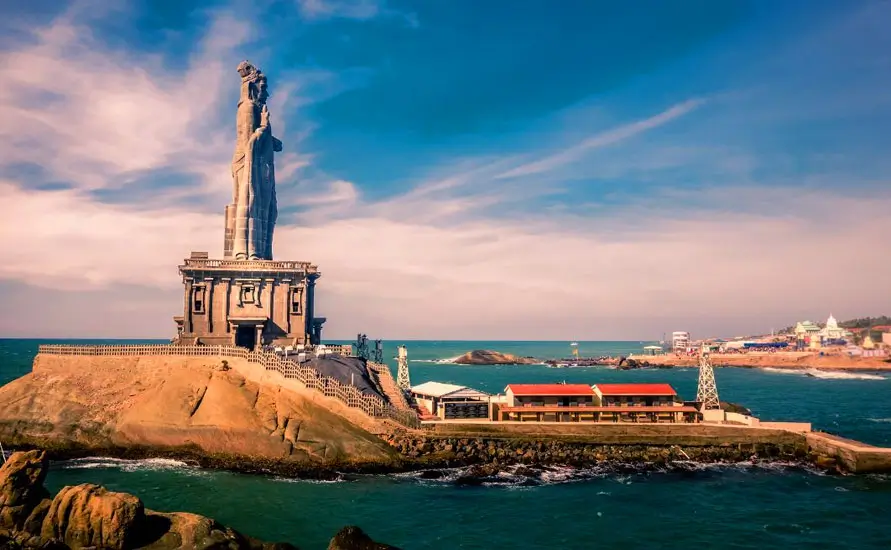
An early start rewards you with sunrise from the shore at Kanyakumari, as hundreds of pilgrims gather in silence for the moment the sun rises from the sea. After breakfast, you take the public ferry to the Vivekananda Rock Memorial, built in 1970 on the rock where the Hindu philosopher Swami Vivekananda is said to have meditated in 1892. The ferry crosses in a few minutes, but queues can be long in holiday seasons, so your guide plans the timing carefully. On the neighboring rock rises the Thiruvalluvar Statue, a 133-foot stone figure of the Tamil poet, linked to the memorial by a footbridge in recent years.
Back on the mainland, you have time for lunch before your driver takes you to the station for the short afternoon train to Trivandrum, also known as Thiruvananthapuram. This leg is usually in AC chair car on a day express, and the ride takes about two hours. The line crosses into Kerala almost at once, and the change is visible from the window: rice fields give way to coconut palms, houses become smaller with sloping tiled roofs, and church spires appear among the temples. Nagercoil, a busy junction just after Kanyakumari, is where trains to the north split from the coastal line toward Kerala.
Trains pull into Trivandrum Central, a large station near the old city, and our Kerala representative meets you on the platform. The drive to your hotel is short, and the evening is free to settle in. Trivandrum is Kerala's capital and a calmer city than most Indian state capitals, with green neighborhoods and old government buildings in Kerala style. Ask your guide about a good place for local seafood; one Kerala favorite is prawn roast, cooked down with shallots, curry leaves and black pepper until almost dry, often eaten with soft, lacy appam. Tomorrow is a sightseeing day, so there is no early train to catch. Overnight in Trivandrum.
A morning tour of Trivandrum starts in the old fort area around the Sree Padmanabhaswamy Temple, dedicated to Vishnu reclining on the serpent Anantha. Entry to the temple is limited to Hindus and requires a strict traditional dress code, so non-Hindu visitors view its tall seven-tiered gopuram and the large tank in front from outside. Along the way you hear the story of the Travancore kings, who formally handed their realm to Padmanabha in the 18th century and from then on governed it in his name. Nearby, the Kuthiramalika Palace is a fine example of Kerala wooden architecture, with carved brackets shaped like 122 horses supporting the roof.
Late morning you visit the Napier Museum, a 19th-century building with a striking mix of Kerala, Mughal and Gothic styles, painted in bright patterns of red, black and cream. It houses bronzes, wood carvings and a temple chariot, and in the same park you find the Sree Chitra Art Gallery, which displays paintings by Raja Ravi Varma, the Kerala artist famous for his realistic portraits of gods and Indian women. Lunch is a Kerala meal, possibly a vegetarian sadhya served on a banana leaf with many small dishes. The afternoon is free to rest, or you can take a short drive to Kovalam Beach, about half an hour south.
In the evening your guide gives a short briefing on tomorrow's coastal train ride to Kochi. Two railway lines link Trivandrum and Ernakulam: one runs inland via Kottayam, and the other follows the coast via Kollam and Alappuzha, passing lagoons, backwater channels and fishing villages. We aim to book your seats on a train that uses the coastal route, subject to availability on your travel date. Your driver will collect you at the hotel for the morning departure. Pack your luggage tonight so that you can enjoy a quiet breakfast before leaving for Trivandrum Central. Overnight in Trivandrum.
Your train to Ernakulam leaves Trivandrum Central in the morning, and from the first hour the Kerala coastal line shows why it is one of the most attractive rides in the south. The track runs through a green landscape of coconut palms, banana plantations and small paddy fields, with churches, mosques and temples standing close together in every village. After about an hour you pass Kollam, once an important port on the spice route, and soon the line skirts the edge of Ashtamudi Lake, a large, branching backwater dotted with Chinese fishing nets and fishermen in narrow wooden boats.
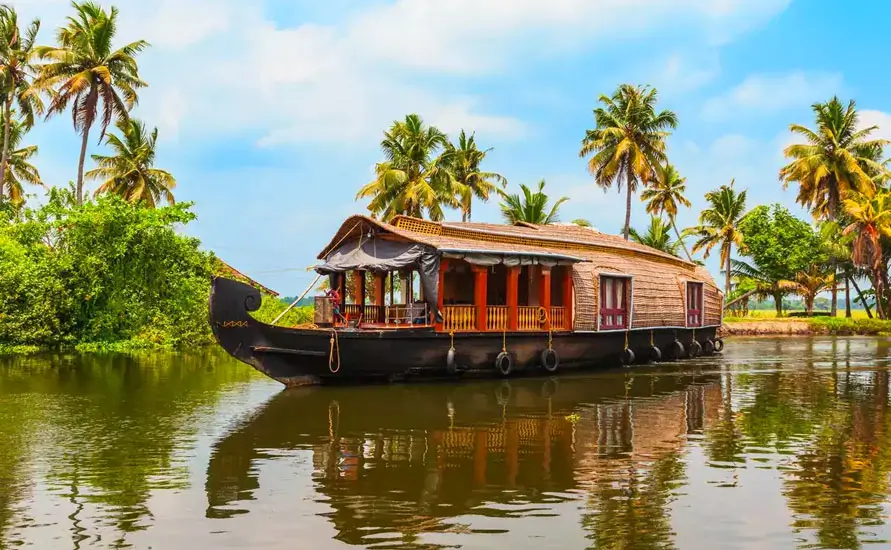
Beyond Kollam the line continues north to Alappuzha, the center of Kerala's houseboat industry, and you may catch glimpses of the canals and long rice barges near the station. On some stretches the railway runs only a few hundred meters from the Arabian Sea, and between stations you see fishermen's huts, coir-making yards where coconut husk is twisted into rope, and children waving from the level crossings. Tea and coffee sellers walk through the coaches regularly, and Kerala trains often have vendors offering banana chips, fried snacks and fresh fruit. The ride takes roughly four to five hours, depending on the train.
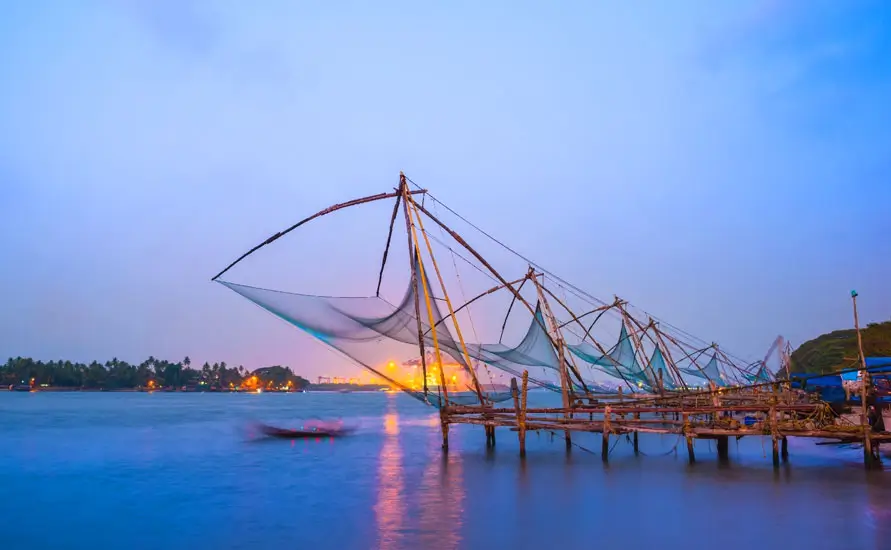
You arrive at Ernakulam Junction, the main station for Kochi, where our representative meets you at your coach. The drive to your hotel in Fort Kochi, on the peninsula across the harbor, takes about forty-five minutes. After checking in, spend the late afternoon walking along the waterfront near the Chinese fishing nets, watching ferries and container ships move through the channel. Later, an optional ticket gets you into a short Kalaripayattu show, where performers demonstrate the leaps, kicks and sword-and-shield drills of Kerala's traditional fighting art. Tomorrow is given over to the old lanes of Fort Kochi and Mattancherry before the trip heads east toward the Nilgiris, so there is no need to set an alarm. Overnight in Kochi.
The Chinese fishing nets are busiest in the first hours of daylight, which is why your guide meets you on the Fort Kochi beachfront soon after breakfast. Teams of four or five men lower each cantilevered net into the channel and then raise it again by walking along the beam, using large stones tied to ropes as counterweights. Fish sellers set out the catch on the pavement nearby, and restaurants across the road will cook what you buy. From here you walk past St. Francis Church, India's oldest European-built church, where da Gama lay for some years before his bones went home to Portugal, and on through quiet lanes of Dutch and British bungalows.
Late morning your car takes you to Mattancherry Palace, a gift from the Portuguese to the Raja of Kochi and later renovated by the Dutch, which is why it is often called the Dutch Palace. Its main draw is the series of mural paintings from the Ramayana and Mahabharata, done in natural pigments on the walls of the royal bedchamber. Because it shuts every Friday, we schedule Kochi so that your sightseeing day avoids it. Just down the lane is the Paradesi Synagogue, dating from 1568, where the floor is covered in hand-painted Cantonese tiles, each with a slightly different pattern, and old glass chandeliers hang overhead. It shuts on Fridays, Saturdays and Jewish holidays, and visitors are asked to cover their legs and shoulders.
After lunch you stroll among antique dealers, spice brokers and dim godowns where workers still sort and sack ginger, pepper and turmeric by hand. For the rail fans, your guide can point out Willingdon Island across the water, an artificial island built from harbor dredgings in the 1920s and 1930s, which once had its own railway terminus serving the port. Regular passenger trains no longer run there, but the story shows how closely the railway and the spice trade were linked. Your evening is free, and tomorrow's train leaves from Ernakulam Junction, so we will confirm the pickup time tonight. Overnight in Kochi.
Allow about an hour for the drive from Fort Kochi to Ernakulam Junction, because the bridges to the mainland can be slow in the morning. Your driver handles the luggage, and a porter carries the bags to your coach, where you settle into an air-conditioned seat or berth, depending on the train available on your date. This leg leaves the coast behind and heads inland across central Kerala, past Aluva and the town of Thrissur, known for its huge temple festival. The fields get larger here, and teak and rubber plantations appear between the villages. You will notice that Kerala stations are often small, tidy and painted in cheerful colors.
Past Thrissur the track turns east toward the Palakkad Gap, a natural break about thirty kilometers wide in the long wall of the Western Ghats. For centuries this pass was the main trade route between the Malabar coast and the plains of Tamil Nadu, and today it carries the railway, the highway and strong winds that blow through the gap for much of the year. From the window you see the hills close in on both sides before falling away again. Palakkad Junction is the last big stop in Kerala, and after it you cross back into Tamil Nadu, where the landscape turns drier and palm groves give way to cotton and coconut farms.
Coimbatore Junction is the station where you get off, and our representative meets you near your coach and drives you to your hotel. Coimbatore is a busy textile and engineering city, often called the Manchester of South India, and it is a practical base for tomorrow's early start rather than a sightseeing stop. Anyone still feeling lively could visit a big handloom showroom for cotton shirts and silk saris, or try a simple local restaurant serving Kongunadu-style food. Go to bed early tonight, as the drive to Mettupalayam begins before dawn. Overnight in Coimbatore.
The highlight of every South India tour by train starts in darkness, with a drive of roughly an hour from Coimbatore to Mettupalayam, the foothill station where the Nilgiri Mountain Railway begins. The toy train runs once a day in each direction on this section, and seats are limited, so tickets are booked well ahead and are always subject to availability. Your driver drops you at the station with time to spare and then takes your main luggage by road to Ooty, leaving you with only a light day bag. Before boarding, look at the steam locomotive being prepared at the head of the blue and cream coaches.
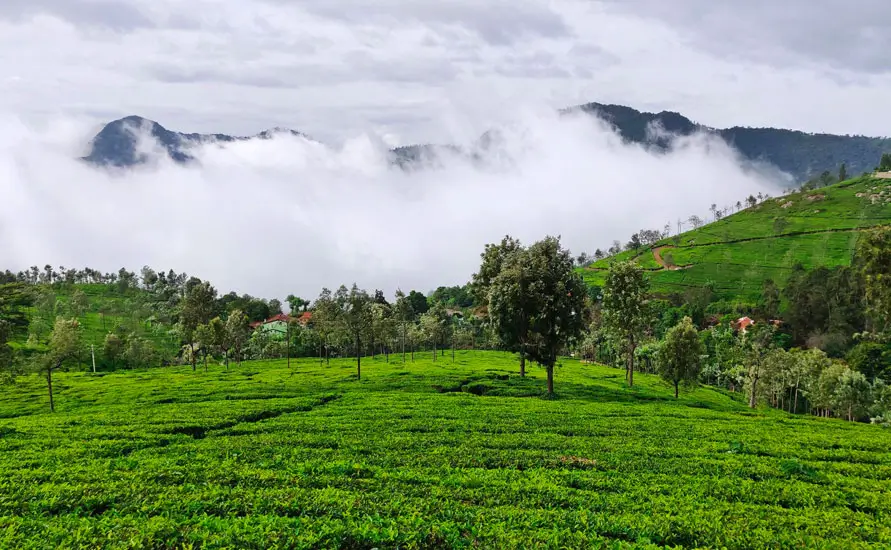
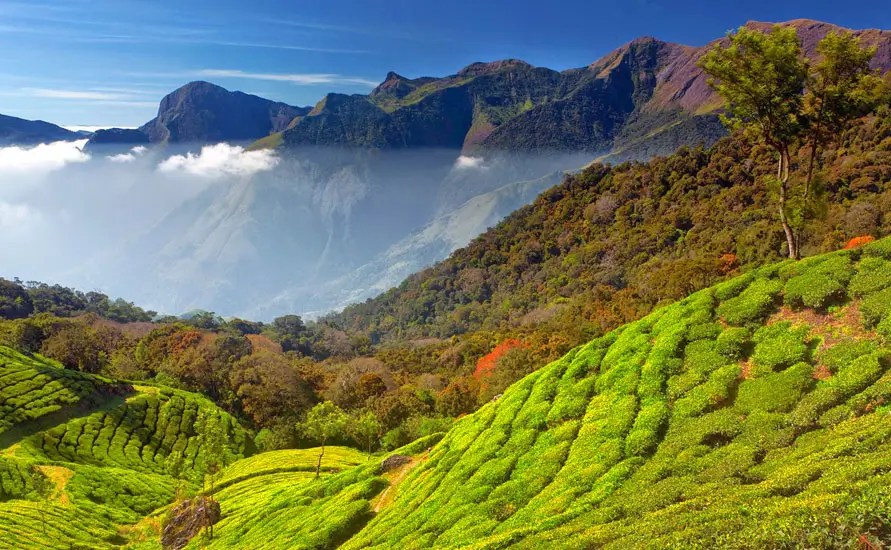
Between Mettupalayam and Coonoor the line climbs steeply through forest, using a rack-and-pinion system: a toothed rail laid between the running rails engages a cogwheel under the engine to pull the train up gradients that would be too steep for ordinary track. This is the only rack railway in India, and it was opened in 1908. The train stops at small stations such as Hillgrove for water and a short break, and you climb through tunnels, over tall bridges and around tight curves, with views over the plains below. Watch for langur monkeys, tea gardens and the moment the air suddenly feels cool.
At Coonoor the steam engine is usually replaced for the gentler run onward, and the train continues past Wellington and Lovedale through eucalyptus trees and terraced vegetable plots. UNESCO lists the line among the Mountain Railways of India, a group it shares with the Darjeeling and Kalka–Shimla lines. You reach Ooty station around midday or early afternoon, depending on the day's running, and your driver waits there with the car and your bags. After checking in at your hill hotel, rest for the remainder of the afternoon, as Ooty sits above 2,200 meters and evenings can be chilly. Overnight in Ooty.
Called Udhagamandalam on official maps, Ooty was developed by the British as the summer capital of the Madras Presidency, and a guided morning tour shows what remains of that period. First comes the Government Botanical Garden, planted in the 1840s on terraced slopes, where old conifers, a fern house, seasonal flower beds and a petrified log kept behind a rail fill the grounds. Next is the Doddabetta Peak, at roughly 2,637 meters the highest point in the Nilgiris, where a viewing tower looks over the hills toward the plains on clear mornings. Clouds often roll in by late morning, so we go early.
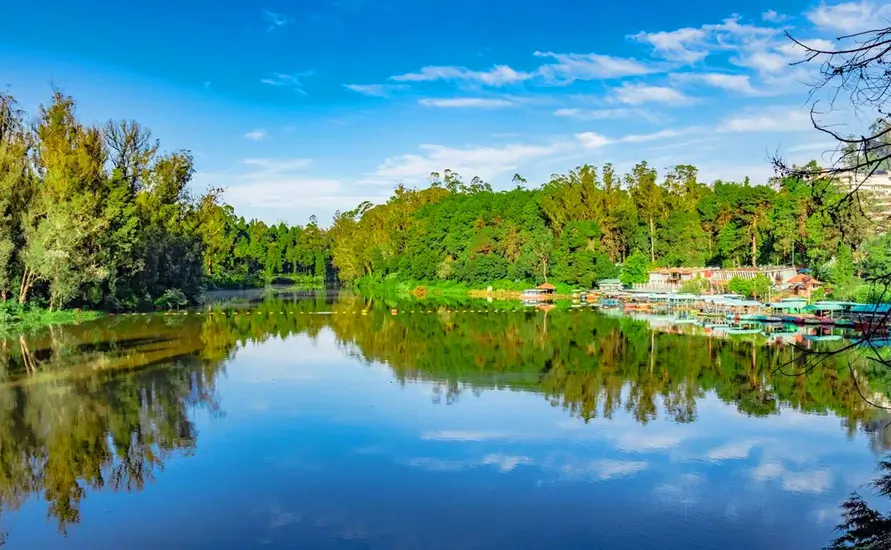
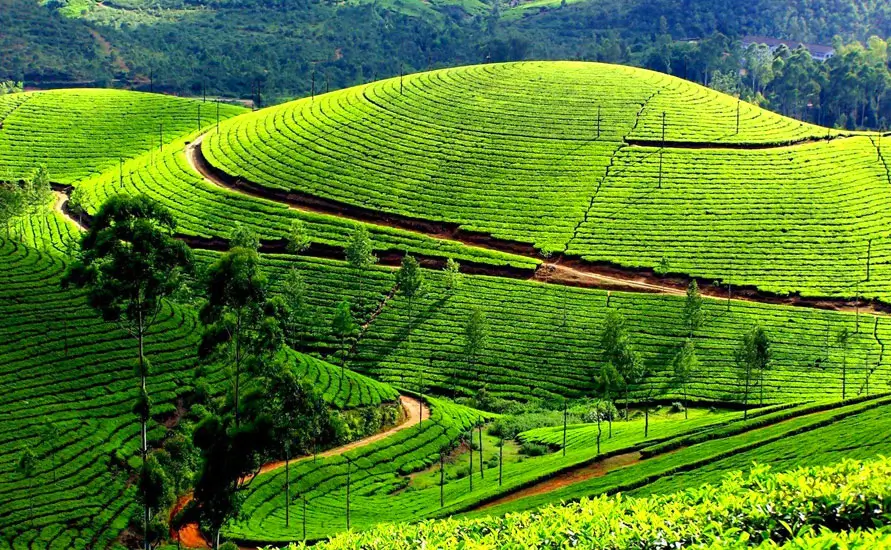
Coming down from the summit, you pause at a working tea factory, where staff show each stage from fresh green leaf to finished black tea, and you sample several grades of the light, aromatic Nilgiri brew. Later you visit St. Stephen's Church, one of the oldest buildings in the hills, and walk around the market streets, where vendors sell homemade chocolates, eucalyptus oil and woolen caps. Lunch can be at a colonial-era club or a simple local restaurant. In the afternoon there is an optional boat ride on Ooty Lake, an artificial lake created in the 1820s, though it can be crowded with Indian holidaymakers in summer and on weekends.
Late in the day your guide takes you back to Ooty station for a closer look at the railway, now that you have ridden it. The station building is small and charming, with a tiled roof and wooden fittings that have changed little in a century, and you can watch the diesel engine and coaches being turned around for the run back down. If tickets are available, rail fans can take a short optional ride on the local service between Ooty and Ketti or Lovedale. Dinner is at the hotel, where a fire may be lit on cold evenings. Tomorrow you leave the hills and drive down to Mysore. Overnight in Ooty.
No train links the Nilgiris with Mysore, so today your private car takes over. After breakfast you leave Ooty and head down toward the Karnataka border, taking either the Kalhatti ghat road, known for its thirty-odd numbered hairpins, or the gentler but longer road through Gudalur. Your driver chooses the road depending on traffic and the rules in force on the day, since restrictions sometimes apply to the steeper road. Either way, the scenery changes quickly from tea gardens and eucalyptus to dry deciduous forest, and the temperature rises with every bend as you come down from the hills toward the plains.
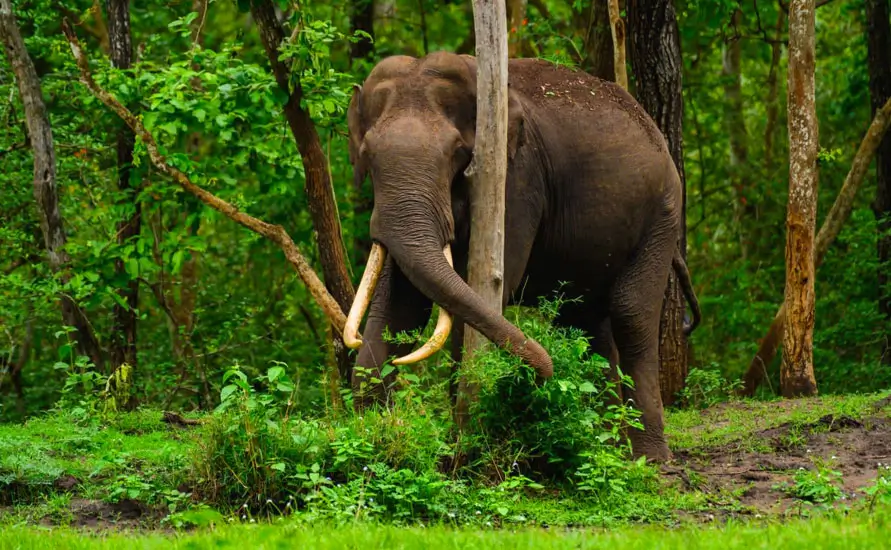
At the bottom of the ghat the road enters Mudumalai National Park in Tamil Nadu and then crosses into Bandipur National Park in Karnataka. Together they belong to the Nilgiri Biosphere Reserve, India's first biosphere reserve, and the highway cuts straight through both parks. Spotted deer, langurs, peacocks and wild boar are seen often, and wild elephants sometimes cross the road. Stopping inside the forest is not allowed, so watch from the car. The highway through Bandipur closes to traffic at night, which is one reason we leave Ooty in the morning. A tea stop at the forest edge breaks up the drive.
After the forest you drive across the farmland of southern Karnataka, past fields of sugarcane, sunflowers and coconut trees, and reach Mysore by mid-afternoon. Your hotel is chosen for easy access to the palace and the old city. Mysore was the capital of the Wodeyar kings, and it is still a calm and well-planned city, known for silk, sandalwood, incense and yoga schools. In the evening you can walk to a nearby café or try a classic Mysore masala dosa, served with a layer of red chutney inside. Your guide meets you briefly to plan the next two days around the palace lighting schedule. Overnight in Mysore.
Your sightseeing in Mysore begins at Chamundi Hill, about thirteen kilometers from the city center, where the Chamundeshwari Temple honors the goddess who, according to local legend, killed the buffalo demon Mahishasura, from whom the city takes its name. Halfway down the hill your car halts beside the huge Nandi statue, a kneeling bull cut from the living rock in the 17th century, its neck hung with sculpted bells and chains. If your knees are up to it, you can descend the old pilgrim staircase on foot, roughly a thousand steps, and meet the car at the foot of the hill. The views of the city and the palace are clearest in the morning.
Late morning you enter the Mysore Palace, home of the Wodeyar kings, which the British architect Henry Irwin rebuilt in Indo-Saracenic style after the older timber palace burned in 1897. Inside, your guide leads you through the marriage hall with its stained-glass ceiling, the Durbar Hall with its carved pillars, and the galleries of royal paintings. Footwear goes into a free shoe store at the gate, and the rules on cameras indoors are enforced firmly, so check with your guide before taking any pictures. The palace is lit with thousands of light bulbs on Sunday and public holiday evenings for about 45 minutes, so if your stay includes a Sunday, we will plan to return then.
Later on you wander through Devaraja Market, a covered 19th-century bazaar heaped with cones of colored kumkum powder, bunches of small bananas, jasmine and marigold garlands, betel leaves and fresh vegetables. It is a good place for photos, as long as you ask before taking pictures of vendors. After the market you can visit a government silk emporium or a sandalwood and incense shop, where products carry official quality marks. Dinner is free, and your guide can suggest a restaurant that serves Karnataka thali, with ragi balls, saaru and holige. Overnight in Mysore.
Rail fans tend to look forward to the Mysore Rail Museum more than any other stop on this trip, and it opens your morning. Set close to Mysore station, the open-air museum was founded in 1979 and displays steam, diesel and electric locomotives, along with old signals, lamps, bells and station equipment. The star of the collection is the Maharani's saloon, a royal carriage from the early 20th century with a kitchen, dining area and private toilet, built for the Mysore royal family. A small battery-operated train gives children and adults a short ride around the grounds. Check the opening days with your guide, as the museum has a weekly closing day.
Leaving the museum, you drive roughly half an hour north to Srirangapatna, set on an island in the Kaveri and once the seat of Tipu Sultan, who fought four wars with the East India Company before his fall. You visit the Daria Daulat Bagh, Tipu's summer palace, made of teak and decorated with colorful wall paintings of battle scenes, set in a well-kept garden. Close by, your guide shows you the broken ramparts and the marked spot where Tipu fell during the final siege of 1799. Your guide also takes you to the Ranganathaswamy Temple, one of the oldest and most important Vishnu shrines in the region, which gives the town its name.
Before returning to Mysore, you stop at the Gumbaz, the domed tomb of Tipu Sultan and his parents, with its black granite pillars and ivory-inlaid doors set in a cypress garden. The return drive to Mysore takes about forty-five minutes, depending on traffic. An optional evening outing heads to the terraced Brindavan Gardens at the foot of the KRS dam, where crowds of Indian families gather for the musical fountain show after dark, and the lights on the water make a cheerful end to a long day. Otherwise, take a quiet evening at your hotel and pack for tomorrow's train to Bangalore. Overnight in Mysore.
Your final train ride is a short one: from Mysore Junction to Bangalore, about two to three hours on a fast day express. We aim to book an air-conditioned chair car seat on one of the quicker services, subject to availability. The double-track line runs across the flat Karnataka plateau, past paddy fields, sugarcane farms and towns such as Mandya, known for its sugar mills, and Channapatna, famous for its lacquered wooden toys painted in bright colors. Look out for the toy stalls near the station at Channapatna, and keep your camera ready for the occasional granite outcrop rising from the fields.
You arrive at KSR Bengaluru City Junction, the main station in the city, where our driver waits on the platform and helps with your bags. Known as India's tech capital, Bangalore is a fast-growing city of glass office towers and heavy traffic, yet it keeps many parks and older buildings. After lunch, the city tour begins at Lalbagh Botanical Garden, started by Hyder Ali in the 18th century and enlarged by Tipu Sultan, where a Victorian glass house stands near an outcrop of very old gneiss rock topped by a small watchtower.
Your next stop is the teak-built summer residence of Tipu Sultan, with its painted arches and balconies, followed by a drive past the granite Vidhana Soudha, seat of the state legislature, seen only from the road. If time allows, your guide also shows you Bangalore Palace, built in a style inspired by Windsor Castle, with Tudor-style towers and turrets. The evening is free for a farewell dinner, and Bangalore has an excellent restaurant scene, from traditional South Indian cafés to modern microbreweries. Tonight your coordinator confirms tomorrow's airport transfer time based on your international flight, so you can pack without worrying about the details. Overnight in Bangalore.
The last day of your South India rail tour is at leisure until the transfer to the airport. Guests on evening or late-night flights can spend the morning in Cubbon Park, where joggers and dog walkers share shady paths with the red-painted Attara Kacheri, now the High Court of Karnataka. Rail fans may prefer a ride on the Namma Metro, whose trains run both on raised viaducts above the traffic and in tunnels beneath the old center, the city's modern rapid-transit system, which shows a very different side of rail travel in India from the steam engines of the Nilgiris.
Rooms normally have to be vacated by midday; when your flight is late we can arrange a late checkout at an extra charge, subject to availability, or keep your luggage safe at the hotel while you go out. Lunch is free, and many guests choose a final South Indian meal of dosa, idli and filter coffee served in a steel tumbler and saucer. Your driver collects you at the agreed time for the drive to Kempegowda International Airport, about 35 kilometers north of the city. The drive usually takes one to one and a half hours, but traffic can be heavy, so we leave plenty of time.
At the airport, your driver helps you with your bags to the terminal entrance, where only passengers with tickets and passports are allowed inside. In seventeen days you have ridden express trains across Tamil Nadu and Kerala, the coastal line beside the backwaters, the steam-hauled rack section of the Nilgiri Mountain Railway and the plateau line between Mysore and Bangalore, and seen the temples, palaces and hill stations they connect. We hope you return home with good stories and photos, and with a fresh appreciation for the railways of India. Our team would be happy to plan a northern rail trip for you in the future.
Your Journey

N.S. Rathore & Mrs. Omlata Rathore · Managing Director
We still read every enquiry ourselves. Tell us the places you liked and our planners will send a day-by-day route with drive times and a clear price.
Every package can be customised and no pressure to book. A planner from our office replies within 24 hours with a route written for your group.
Fill this in and your planner will send a first draft itinerary.
Explore more
Kerala Backwaters Escape Kerala Backwaters Escape
 Kerala Backwaters Escape
 Kerala Backwaters Escape
 Kerala Backwaters Escape
 Kerala Backwaters Escape
 Kerala Backwaters Escape
 Kerala Backwaters Escape
 Kerala Backwaters Escape
 Kerala Backwaters Escape
 Kerala Backwaters Escape
 Kerala Backwaters Escape
 Kerala Backwaters Escape
 Kerala Backwaters Escape
 Kerala Backwaters Escape
 Kerala Backwaters Escape
 Kerala Backwaters Escape
 Kerala Backwaters Escape
 Kerala Backwaters Escape
 Kerala Backwaters Escape
 Kerala Backwaters Escape
 Kerala Backwaters Escape
 Kerala Backwaters Escape
 Kerala Backwaters Escape
 Kerala Backwaters Escape