 Kerala Backwaters Escape

South India with Sri Lanka and Maldives
Kochi – Munnar – Alleppey – Colombo – Kandy – Dambulla – Sigiriya – Polonnaruwa – Galle – Colombo
At a glance
Few combinations in Asia work as neatly as Kerala and its island neighbor, and this Kerala and Sri Lanka tour brings together the best-known sights of both in two weeks. The Indian half covers the port city of Kochi, the tea-planted slopes of Munnar and a night aboard a private houseboat in Alleppey. A short flight from Kochi to Colombo then opens the Sri Lankan half: the hill capital of Kandy, the cave temples of Dambulla, the rock fortress of Sigiriya, the ruined city of Polonnaruwa and the walled Dutch town of Galle.
The order of the stops is chosen to keep each day reasonable. You rise into the cool hills before coming down to the backwaters in Kerala, and in Sri Lanka you move from the hill country to the Cultural Triangle in the north before ending on the south coast. Typical road legs run two to four hours, with a single longer stretch from Sigiriya to Galle on good expressways. In each country the same private vehicle and driver remain at your disposal, and licensed guides lead the main visits, including five sites on the UNESCO World Heritage list.
We designed this Kerala Sri Lanka tour package for first-timers flying in from London, Dublin, Amsterdam, New York, Vancouver or Melbourne who want a first, broad look at both places, and for NRI families who know Kerala but have not yet crossed to the island. Aim for the months from December through March, when rain is least likely on either side. Every part of the Kerala and Sri Lanka tour is private, so we can add a beach night in Bentota, a wildlife safari or a hill-country train ride to suit your interests.
Welcome to Kochi, the old trading port of central Kerala and the start of your fourteen days. Once you clear customs at Cochin International Airport, our local representative steps forward, who loads your bags and introduces your driver for the Kerala part of the tour. The road from the airport to Fort Kochi crosses the mainland city and the backwater channels of the harbor, normally a ninety-minute ride, longer at rush hour. During the ride you get your trip documents, any local phone SIM you requested and a quick briefing about money, tipping and the climate on the coast.
Rooms are generally handed over after lunch, so if you land at sunrise, tell us in advance and we pay for an extra night so the key is ready, or simply doze in the lounge. When you feel fresh, take a slow walk on the shore road toward Vasco da Gama Square, where teams of four or five men dip the Chinese fishing nets by walking along the beam and shifting their weight. Local tradition credits Chinese sailors of the 14th century with bringing the design, although no record proves it. Late in the day the light behind the nets turns soft, and plenty of local people come to watch the boats returning to harbor.
For dinner, Fort Kochi has a good range of small restaurants in old colonial houses, many with courtyards shaded by mango and frangipani trees. Kerala food leans heavily on coconut, curry leaves and black pepper, and a first meal of fish moilee, a mild coconut-milk curry, with soft appam rice pancakes is a gentle introduction for tired travelers. If you are vegetarian, ask for avial, a mixed vegetable dish in coconut and yogurt. Ask your driver for any help you need tonight, then rest well, as the old town takes up the whole of tomorrow. Overnight in Kochi.
After breakfast a licensed guide collects you for a walking and driving tour of the two historic districts at the center of the port. In Fort Kochi you visit St. Francis Church, a modest whitewashed building that served Catholic, Dutch Reformed and finally Anglican worshippers in turn, and the Santa Cruz Basilica, a tall Gothic-style cathedral with painted ceilings and stained glass. The guide connects the two buildings to the story of Kochi's four colonial periods: Portuguese, Dutch, British and finally the princely state, which ruled the area until Indian independence in 1947.
Ten minutes by car brings you to Mattancherry, where the Dutch Palace, presented by Lisbon's traders to the local ruler and later restored under Dutch rule, holds coronation robes, royal palanquins and some of the finest Kerala murals in the state. Next door lies Jew Town, a narrow street of antique shops ending at the Paradesi Synagogue, where a small community still keeps the prayer hall in use. Neither building opens on Friday, and the synagogue adds Saturday and Jewish festivals to its closed list, which is why the morning order depends on the date. Spice warehouses line the lanes nearby.
In the afternoon you have free time for lunch, a rest or a visit to one of Fort Kochi's many art galleries. At dusk you take your seats in a compact theater for Kathakali, a temple art form born in the 17th century. Arrive early and you can watch the dancers apply their elaborate make-up, made from rice paste and natural pigments, which can take more than an hour. The performance itself is usually shortened for visitors to about an hour, with an English explanation of the hand gestures and facial expressions before the story begins. Dinner follows back at the hotel. Overnight in Kochi.
Leaving the coast behind, you set out after a filling breakfast for Munnar, the best-known hill resort of Kerala, set where three mountain streams meet in the Western Ghats at roughly 1,600 meters. For the first two hours the road crosses flat farmland, rubber plantations and small towns, then it starts to wind upward through forest, bend after bend. Two roadside cascades, Cheeyappara and Valara, make natural photo stops, both at full flow from late summer into autumn. The temperature drops noticeably as you climb, so keep a light sweater within reach for the afternoon and evening.
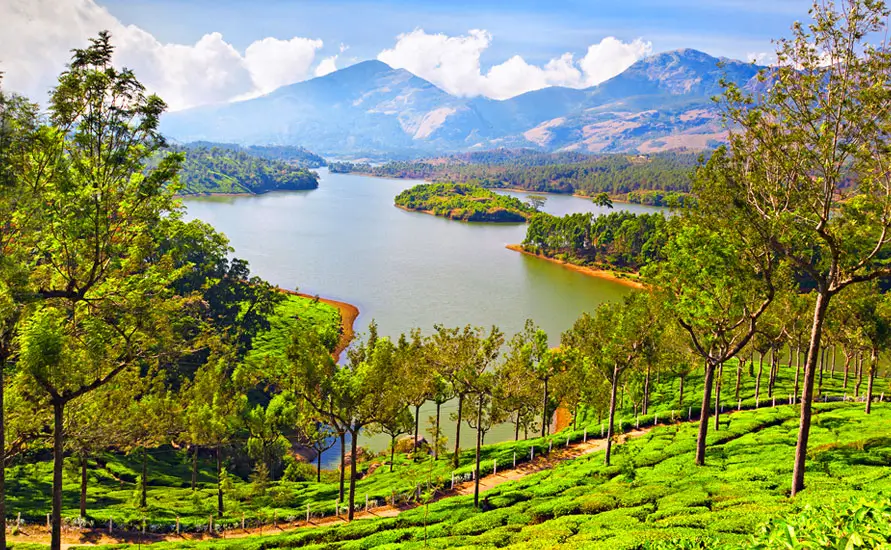
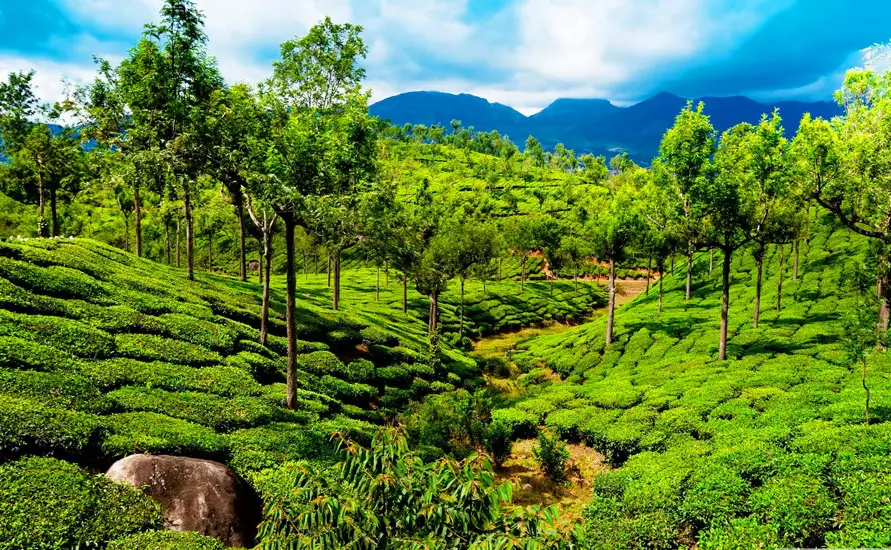
Above the forest belt the landscape changes completely. Tea bushes clipped to waist height cover almost every slope, cut through by thin footpaths for the women who pluck the leaf, with tall silver oak trees left standing to give shade. Planting began here in the last decades of the 1800s under European managers, and many estates are still run by large tea companies today. Spice plantations growing cardamom, pepper and cloves also appear on the lower slopes, and some offer short guided walks for a break from the car before reaching town. Lunch is at a restaurant with a view over the valley.
By mid-afternoon you are at your hotel or resort on the edge of Munnar, often set among tea gardens. The bazaar area is compact and lively, with a market selling vegetables, spices and homemade chocolate, and it is worth a short walk with your driver before dark. Evenings in Munnar are cool all year, and from December to February nights can be quite cold, so many hotels light fires in the evening. Dinner is at your hotel. In the hills, early mornings tend to be clear before cloud builds up later in the day, so it helps to go to bed in good time. Overnight in Munnar.
First on the plan is Eravikulam National Park, a protected plateau of rolling grassland where the largest surviving herd of Nilgiri tahr grazes, a wild goat whose numbers fell to a few hundred before protection began. Visitors cannot drive in their own cars, so a forest department bus carries you up to the visitor zone at Rajamalai, where a road and path lead along the hillside. The animals are used to visitors and often feed only meters away. Each year the park shuts for several weeks in early spring while the young are born, and on those dates a guided tea estate walk takes its place.
Before lunch you stop at the Nallathanni Tea Museum, opened by the largest plantation firm in the district, where vintage rollers, planters' photos and a documentary trace a century of cultivation. A working mini-factory shows green leaf turning into black tea step by step, and the visit closes in the tasting room, where fresh grades from fine dust to whole leaf are poured side by side. The museum does not open on Mondays. Heading back, there is time for a viewpoint overlooking the valley or at a small shop selling cardamom, pepper and local tea to take home.
After lunch you drive half an hour to Mattupetty Dam and its lake, surrounded by eucalyptus and tea hills, where an Indo-Swiss livestock project once bred dairy cattle. Boats can be hired on the lake if you want a short ride. Continue to Echo Point a little further on, where your voice comes back off the opposite hillside, and on to Top Station if the weather is clear, though the view is best in the morning and the drive takes longer. Return to Munnar by late afternoon for a quiet evening in the cool air. Overnight in Munnar.
An early start is needed today, because the houseboats in Alleppey begin their cruise around midday. Following an early meal you wind down out of the hills on the same road, with views back over the tea estates and forested ridges as you go down. Once on the plains, the route turns south through the towns of central Kerala, past churches, temples and roadside stalls selling bananas and fresh pineapple. The drive takes about five hours, and your driver will plan a short break halfway for coffee and stretching. You reach the houseboat jetty around midday, in time for boarding.
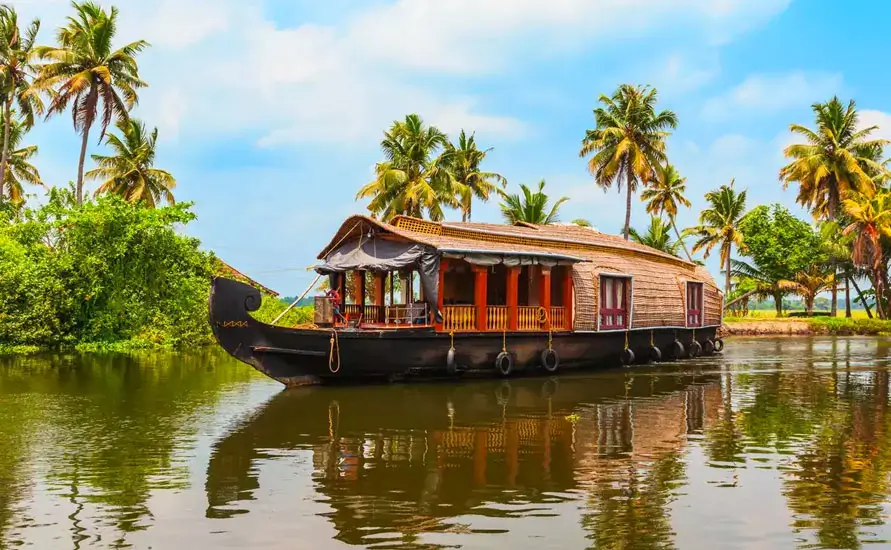
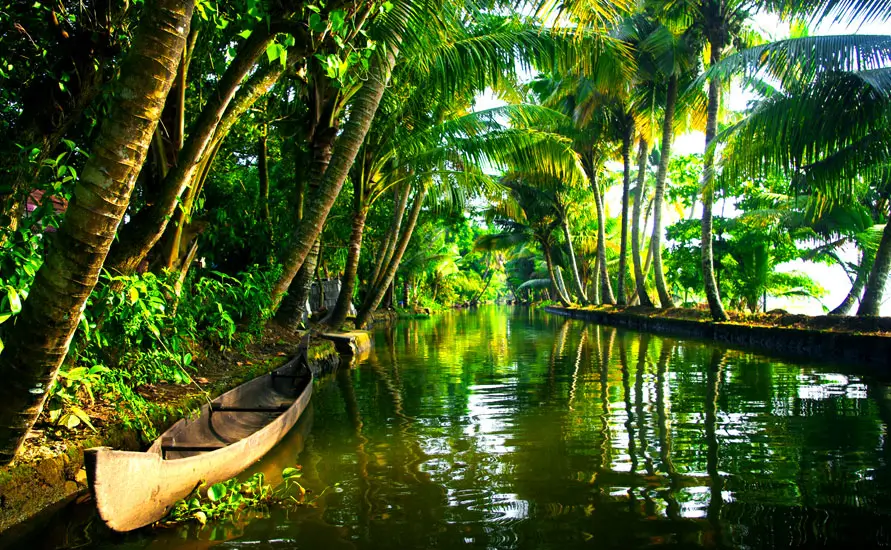
Your private Alleppey houseboat, called a kettuvallam in Malayalam, is a long wooden boat with a curved thatched roof, once used to carry rice and spices along the backwaters. These days it carries en-suite cabins and a shaded front deck, plus a crew of a pilot, a cook and a deckhand. The first meal comes out within an hour of casting off, often featuring fish fried with spices, vegetables cooked in coconut and red rice. The boat moves slowly along the wide canals and lakes of the Kerala backwaters, giving you time to watch daily life along the banks.
Through the afternoon you pass rice fields lying below the water level, small villages, churches and temples, and families going about their work at the water's edge. Kingfishers, cormorants and herons are common sights. Regulations require all houseboats to halt and drop anchor in the early evening; your boat is tied up along a quiet bank. Hot chai and fried plantain arrive while the light fades, and dinner is cooked in the galley a little later. The night on the water is quiet apart from the sounds of insects and frogs, and cabins are fitted with screens or nets against mosquitoes. Overnight on the houseboat.
You eat breakfast on the deck as the boat returns, and you are back on land by around nine. The car then heads north for around two hours to Cochin International Airport, where a flight of little over an hour carries you to Colombo. Well before departure our team confirms what Sri Lankan entry permit your passport needs, as the island's online authorization rules shift from time to time. Remember that houseboat crews appreciate a tip if you were happy with their service.
On landing at Bandaranaike International Airport, our Sri Lankan chauffeur-guide is waiting to take you into Colombo, usually under an hour on the airport expressway. If you arrive with time to spare, a short evening drive takes in Galle Face Green, the seafront promenade where families gather at sunset, and the restored British-era offices nearby. Dinner at the hotel or a nearby restaurant ends the day, and you prepare for the drive into the hills tomorrow. Overnight in Colombo.
Before leaving the capital, you spend the early morning on a short tour of Colombo. Your chauffeur-guide drives you past the Old Parliament building and the lighthouse clock tower in the Fort district, then into Pettah, where crowded streets are arranged by trade and the striped brick Red Mosque rises above the market. You also stop at Gangaramaya, a sprawling temple where gifts from devotees, from old cars to elephant tusks, crowd a museum beside the shrine rooms. The nearby Seema Malaka meditation pavilion, designed by Geoffrey Bawa, stands on a small lake.
By late morning you head inland toward Kandy, seat of the final island kingdom, which held out against European colonial powers until 1815. The road climbs slowly from the coastal plain, past rice fields, rubber estates and small towns, with the forested hills appearing ahead. Worth a halt en route is the Kadugannawa pass, where a monument marks the old road built by the British, and where a viewpoint looks out over the valley. Midday food is at a roadside place where rice comes with half a dozen bowls of curried vegetables, dhal and coconut sambol.
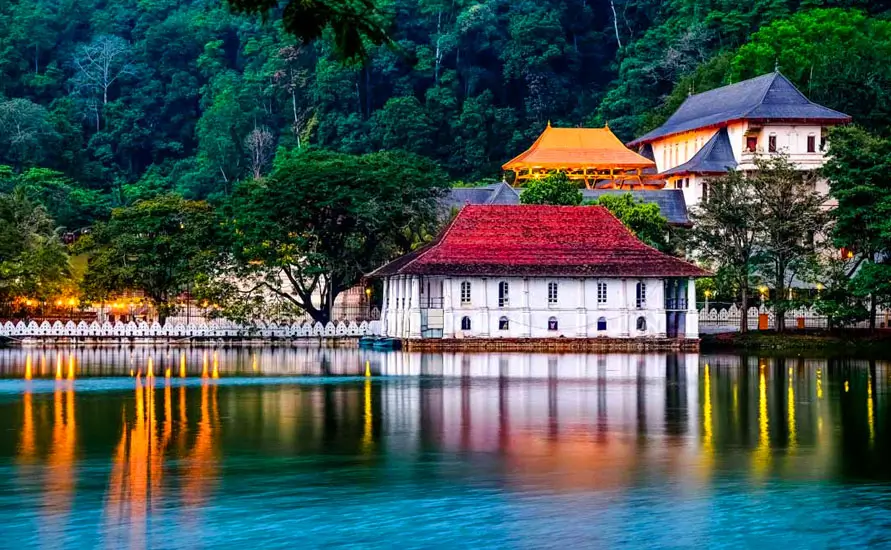
Afternoon brings you to Kandy and a hotel, typically on a slope above the lake. In the early evening, you might attend a short show of Kandyan dance, with drummers, fire walkers and dancers in silver headdresses performing traditional steps once seen at royal festivals. Afterwards your guide takes you for a first look at the Temple of the Tooth at evening prayer time, when drums sound and the crowds of white-clad worshippers fill the corridors. Clothing must cover shoulders and knees, and footwear goes into a supervised rack. Tomorrow you return for a longer guided visit. Overnight in Kandy.
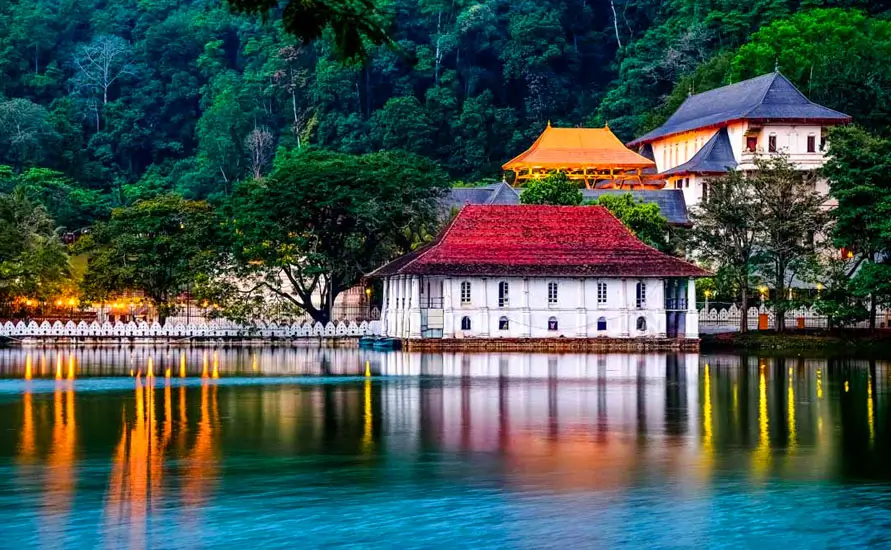
Return to the Temple of the Tooth in the morning, when the crowds are lighter, for a full guided visit. The temple complex, part of the UNESCO-listed sacred city of Kandy, sits beside the royal palace of the Kandyan kings and guards the sacred tooth relic, which the chronicles say reached Sri Lanka from Kalinga in India some 1,600 years ago. Your guide explains why the relic became a symbol of royal power, walks you through the painted corridors and the museum, and shows you the hall where the relic is kept during the morning ritual. Photography is allowed in most areas, though never with your back to the Buddha.
Around mid-morning the car heads into the green countryside west of the city to visit three temples from the 14th century, often called the Three Temples Loop. Embekke Devale is famous for its wooden pillars carved with dancers, wrestlers, birds and animals; Lankatilaka, high on a rock outcrop, combines Buddhist and Hindu shrines inside one building; and Gadaladeniya is built of stone in a style that shows South Indian influence. The roads are narrow and quiet, and the loop takes about three hours including stops. Lunch is at a village restaurant on the way back.
The afternoon is free to enjoy Kandy at your own pace. You might take a walk on the path around Kandy Lake, visit the busy central market for fruit and spices, or browse shops selling batik, handloom and wooden masks. If you prefer some green space, the Royal Botanic Gardens at Peradeniya lie only 15 minutes from the center and can be added to the day, with the famous avenue of royal palms and a large orchid house. Tonight you can dine at the hotel or try hoppers and kottu at a local spot your guide likes. Overnight in Kandy.
After breakfast you leave Kandy and drive north into the dry zone. The first stop is a spice garden near Matale, where a guide shows you cinnamon, nutmeg, cocoa and pepper vines, and explains how they are used in cooking and in local herbal medicine. Further north lies the Aluvihare Rock Temple, a group of cave shrines set among huge boulders, where Buddhist monks wrote the teachings of the Buddha onto palm leaves in the 1st century BC. A monk or caretaker often shows visitors how the old palm-leaf manuscripts were made. Both stops are short, so you reach Dambulla by late morning.
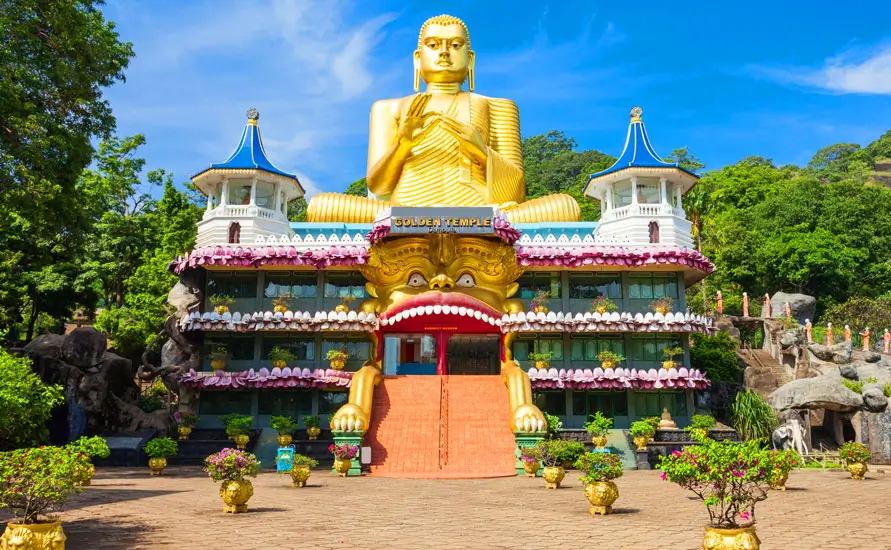
The Dambulla Cave Temple, a UNESCO World Heritage Site, sits on a great rock above the plains, reached by a stepped path that takes about twenty minutes to climb. The five caves hold over a hundred and fifty Buddha images, some of them carved from the living rock, and ceilings painted with dense murals of the Buddha's life and Sri Lankan history. The oldest paintings and statues are linked to royal patronage over many centuries. Shoes stay at the bottom of the hill, hats come off, and shoulders and knees must be covered. Watch out for monkeys near the entrance.
From Dambulla it is a short drive of about 30 minutes to the village of Sigiriya, where you check in to your hotel, many of them set among forest and lakes with views of the rock. You then have the afternoon for a nap or the pool. As evening falls, a local naturalist can lead a short walk through the scrub forest and villages around the hotel, where peacocks, monitor lizards and toque macaques are common, and wild elephants are sometimes seen along the roads at dusk. Dinner is at your hotel. Tomorrow begins early, so it helps to sleep in good time. Overnight in Sigiriya.
Set off early to climb Sigiriya, the rock fortress that rises about 200 meters above the surrounding forest. The site opens at around 7 am, and an early start avoids the heat and the largest crowds. According to the chronicles, King Kashyapa built his palace on the summit in the 5th century, with water gardens and moats at its base. Climbing, you pass the Mirror Wall and a sheltered gallery of frescoes showing women carrying flowers, then reach the Lion Gate, where two giant stone paws remain. The full climb involves about 1,200 steps and some exposed stairways, so allow two to three hours for the visit.
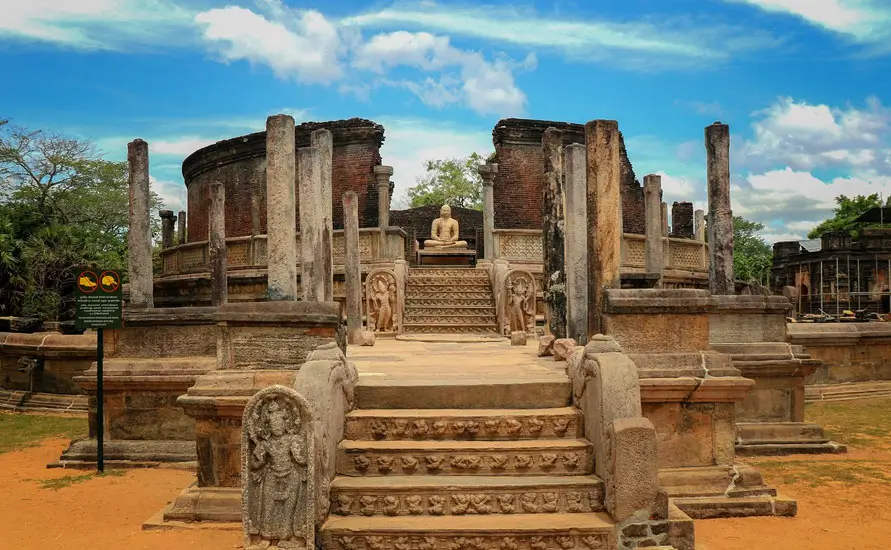
After a rest and a late breakfast you drive about an hour east to Polonnaruwa, the second capital of the ancient Sinhalese kingdom and another UNESCO World Heritage Site. The ruins, mostly from the 11th and 12th centuries, cover a wide area beside a huge reservoir known as the Parakrama Samudra. Highlights include the brick shell of the Royal Palace, the circular relic house called the Vatadage, and the Gal Vihara, four large Buddha figures carved from one granite face, including a reclining Buddha about 14 meters long. You can visit by car or rent bicycles for part of the site.
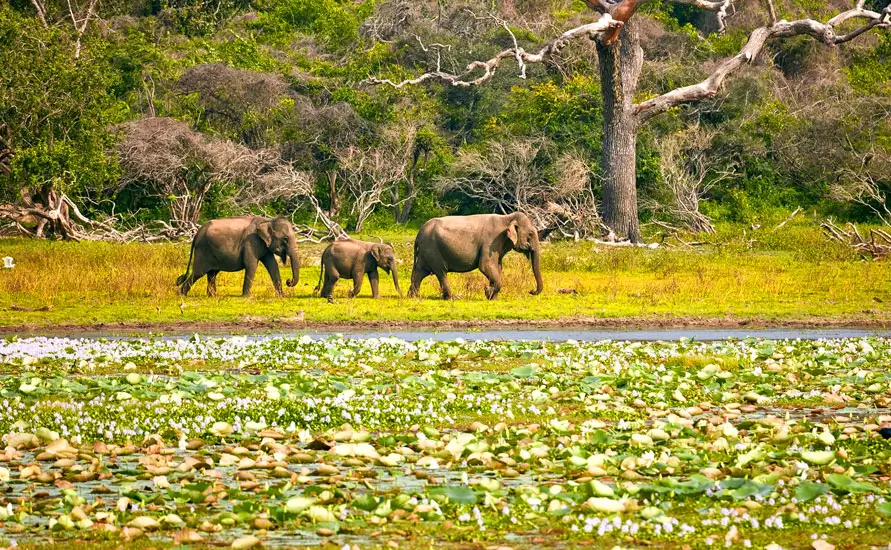
Polonnaruwa is hot and exposed in the middle of the day, so carry water, a hat and sunscreen, and wear light clothes that cover your shoulders and knees for the temple areas. Shoes must be removed at several shrines, and the stone can be very hot underfoot, so thick socks are useful. The visit takes about three hours, and you return to Sigiriya in the late afternoon. If you would like to see elephants, an optional jeep drive in the Minneriya or Kaudulla reserves can be added in the late afternoon, depending on the season and where the herds are grazing. Overnight in Sigiriya.
No other day of the tour has as many kilometers, crossing Sri Lanka from the dry northern plains to the southern coast. After an early breakfast you follow the roads south through Kurunegala and onto the expressway network, which bypasses Colombo and joins the Southern Expressway toward Galle. Your chauffeur-guide builds in a coffee halt and a lunch break, and the total road time is normally close to six hours, depending on traffic near the capital. If you prefer to split the day, a lunch stop at a beach town such as Bentota can be added.
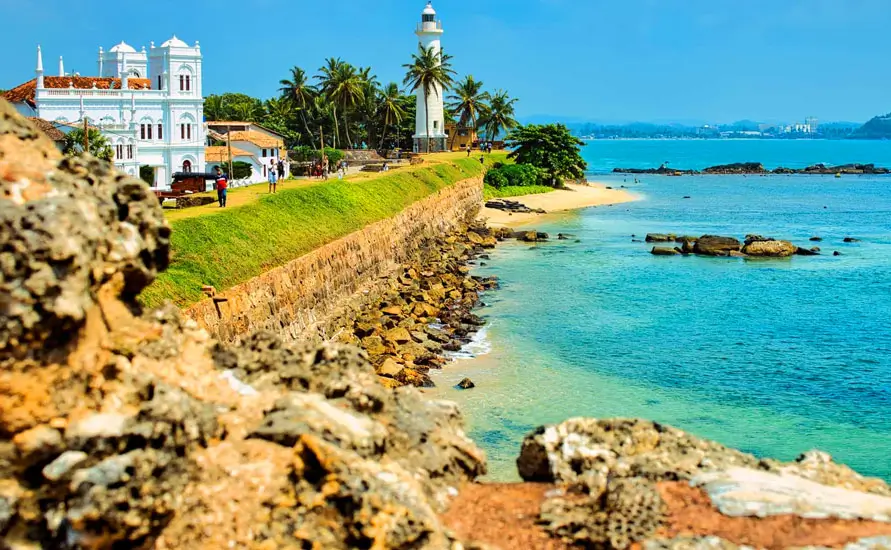
Late in the day you reach Galle, where your hotel stands either inside the ramparts or on the coast just outside. If you still have energy, walk up onto the ramparts at sunset, where local families, couples and cricket-playing children gather on the grass as the sea turns gold. The old town is lit softly in the evening, and many restaurants and cafes stay open late within the walls. Tomorrow is a guided walk of the fort, so take tonight easy and enjoy dinner close to your hotel. Overnight in Galle.
This morning a local guide leads a walking tour of Galle Fort, built first by the Portuguese in the late 16th century and greatly enlarged by the Dutch in the 17th century. It holds UNESCO status and is still home to a living community of families, shopkeepers and artists. You begin at the Main Gate and walk along the ramparts past the clock tower and the Moon, Sun and Star bastions, with views of the harbor on one side and the Indian Ocean on the other. The guide explains how the fort withstood the 2004 tsunami, which caused heavy damage in the town outside the walls.
Within the ramparts, street plans drawn by Dutch engineers remain almost untouched. You see the Dutch Reformed Church, paved with the gravestones of VOC officials, the former warehouse that now houses the National Maritime Museum, the All Saints' Church and the old Dutch Governor's house. The white lighthouse near Point Utrecht bastion and the nearby Meeran Mosque make a good photo stop together. Many old merchant houses have been restored as boutique hotels, cafes and galleries. Lunch is at your choice of the many restaurants in the fort, and your guide can suggest local favorites.
The afternoon is free for shopping or a rest. Galle is well known for handmade lace, wooden crafts, handloom textiles and jewelry set with Sri Lankan sapphires and moonstones. Buy from reputable shops and ask for certificates when buying stones of high value. Toward evening, consider the Historical Mansion Museum, a privately run collection of antiques, or simply sit at a cafe and watch life on the streets. At sunset, many visitors gather at Flag Rock, the southern point of the ramparts, for the last light over the ocean. Overnight in Galle.
After two weeks of sightseeing, today is a day to choose your own pace. One easy option is the beach at Unawatuna, about 15 minutes from Galle, a curved bay with calm water in the dry season and a row of small restaurants along the sand. From there a short path leads up to the Japanese Peace Pagoda on Rumassala hill, a white stupa built by Japanese Buddhist monks, with a fine view over Galle harbor and the fort. Below the hill lies Jungle Beach, a small sheltered cove that is good for swimming and snorkeling when the sea is calm.
If you prefer something different, your driver can take you east along the coast to a tea estate in the hills behind Galle, where tea grows at low altitude and produces strong, dark leaves. Some estates offer guided tours of the factory and tastings of black and white teas. Another choice is a boat ride on Koggala Lake, a large lagoon dotted with small islands, one of which holds a Buddhist temple and another a cinnamon farm. Between roughly November and April, keen wildlife fans can head out at dawn to see blue whales off Mirissa, an hour east of Galle.
Late in the day, return to Galle for your farewell evening. Your guide can help you choose a restaurant for a final Sri Lankan dinner, perhaps a seafood curry with coconut sambol and string hoppers, or a rice and curry spread with a dozen small dishes. It is a good time to settle any bills, sort out souvenirs and pack for the drive to the airport tomorrow. Make sure liquids and items such as spices and tea are packed in your checked luggage, and check your flight time with our team. Overnight in Galle.
After breakfast your chauffeur-guide drives you north along the Southern Expressway to Bandaranaike International Airport, north of Colombo, usually under three hours on a clear road. Pick-up is timed so you reach check-in three hours before take-off. For a late-evening flight, a hotel room near Negombo for the afternoon or a lunch stop in Colombo can be arranged at extra cost.
In fourteen days you have seen the spice port and tea hills of Kerala, spent a night on the backwaters, climbed the rock fortress of Sigiriya and walked the walls of Galle, covering the classic highlights of two neighboring lands. If you want to return for a deeper trip, perhaps with Thekkady, the hill-country train to Ella or a safari in Yala, our team is happy to help. Thank you for traveling with us.
Your Journey
N.S. Rathore & Mrs. Omlata Rathore · Managing Director
We still read every enquiry ourselves. Tell us the places you liked and our planners will send a day-by-day route with drive times and a clear price.
Every package can be customised and no pressure to book. A planner from our office replies within 24 hours with a route written for your group.
Fill this in and your planner will send a first draft itinerary.
Explore more
Kerala Backwaters Escape Kerala Backwaters Escape
 Kerala Backwaters Escape
 Kerala Backwaters Escape
 Kerala Backwaters Escape
 Kerala Backwaters Escape
 Kerala Backwaters Escape
 Kerala Backwaters Escape
 Kerala Backwaters Escape
 Kerala Backwaters Escape
 Kerala Backwaters Escape
 Kerala Backwaters Escape
 Kerala Backwaters Escape
 Kerala Backwaters Escape
 Kerala Backwaters Escape
 Kerala Backwaters Escape
 Kerala Backwaters Escape
 Kerala Backwaters Escape
 Kerala Backwaters Escape