 Kerala Backwaters Escape

South India with Sri Lanka and Maldives
Chennai – Kanchipuram – Chidambaram – Darasuram – Tanjore – Srirangam – Madurai – Chennai – Jaffna (Nallur, Nainativu, Keerimalai) – Trincomalee – Dambulla – Kandy – Colombo
At a glance
Tamil Shaiva worship did not stop at the shoreline. The same hymns sung in the great Chola temples of the Kaveri delta were sung in Jaffna and on the cliffs of Trincomalee more than a thousand years ago, and the poet-saints who composed them praised shrines on both coasts. Our Tamil Nadu and Sri Lanka Temple Tour follows that shared tradition over fourteen days, from the towers of Kanchipuram, Chidambaram, Tanjore and Madurai across the strait to Nallur, Koneswaram and finally the Buddhist Temple of the Tooth in Kandy.
In India you travel south by road in short hops, the longest of them around four and a half hours, and stand inside each of the three Chola shrines that UNESCO lists together. From Madurai you fly via Chennai on the daily direct service to Jaffna, a short hop that lands you in the Tamil north of Sri Lanka. Three nights in Jaffna allow time for temple rituals, the island shrine of Nainativu and the springs of Keerimalai before you cross the island to the east coast and the hill capital of Kandy.
This Tamil Nadu temple tour with a Sri Lanka extension suits Hindu travelers and NRI families tracing roots in the Jaffna or Tamil Nadu diaspora, as well as anyone curious about South Indian sacred architecture. All transport and guiding are private, Tamil-speaking guides can be arranged, and your guides explain etiquette at each shrine, from shirt removal for men at Nallur to rules on cameras at Madurai. Temple festival dates can be built in on request, and November to March is the most comfortable season.
Once you clear immigration at Chennai, you will find our Chennai representative waiting past the exit doors with a printed card showing your surname. Most long-haul services reach Chennai before sunrise, which is why no sightseeing appears on the plan until late in the day. Before your guide leaves you to rest, they hand over a folder with the full temple calendar for your dates, notes on dress at each shrine and contact numbers for our teams in India and Sri Lanka, which you will want to keep handy throughout the next two weeks.
Around four o'clock the car takes you to Triplicane and the Parthasarathy Temple, a Vishnu shrine sung about by the Alvar poet-saints well over a thousand years ago. Here Krishna is worshipped as the charioteer of Arjuna, and the main image bears marks on the face said to recall the arrows of the Kurukshetra battle. The temple shows how Vaishnava and Shaiva devotion grew side by side in Tamil country, an idea that will recur throughout your trip. Your guide explains the basics of a darshan, from buying a small archana ticket to receiving the sacred ash or tulsi water afterward.
Next comes Kapaleeshwarar Temple in Mylapore, the city's best-loved Shiva temple and one of the 275 shrines praised by the Nayanmar saints in the Tevaram hymns. Those same hymns, your guide points out, also praise Koneswaram and Naguleswaram in Sri Lanka, which you will visit later. At dusk the lamps in front of the shrines are lit and the tank behind the temple fills with reflections. A coffee in a steel tumbler at one of the old Brahmin cafés nearby rounds off the evening before a quiet dinner at your hotel. Overnight in Chennai.
Leaving Chennai after an early breakfast, you reach Kanchipuram in about two hours. The town was the seat of the Pallava dynasty and later a center of learning for Shaiva, Vaishnava, Jain and Buddhist scholars, and it remains one of the seven holy cities for Hindus. First you visit the Ekambareswarar Temple, one of the five Pancha Bhoota shrines, where Shiva is worshipped as the earth element. Its southern tower rises close to sixty meters, and in the inner courtyard an old mango tree marks the spot where Parvati is said to have performed penance with a lingam of sand.
Later the guide walks you into Kamakshi Amman Temple, where Parvati is worshipped seated in yogic posture, a shrine closely linked to the teaching tradition of Adi Shankaracharya and the Kanchi Kamakoti Peetham nearby. Then you drive to the Vaishnava side of town for the Varadharaja Perumal Temple, whose pillared mandapam is alive with carved cavalry, musicians and hunting scenes. Its famous wooden image of Athi Varadar spends forty years at a time under the temple tank and was last brought out for devotees in 2019. Temples here generally close from around noon to four, so lunch and a rest fit neatly into the middle of the day.
Once the shrines reopen, head for the Kailasanathar Temple, a Pallava foundation of around 700 AD that predates every Chola tower on your route by some three centuries. Its small cells around the courtyard still show traces of the original painted plaster. Afterwards, a silk-weaving family on a back street shows how a Kanchipuram sari is made with mulberry silk and zari thread, a craft sold all over the Tamil diaspora from Jaffna to Toronto. Kanchipuram is quiet after dark, and you stay at a simple but comfortable hotel in town. Overnight in Kanchipuram.
The drive south passes Tindivanam and the outskirts of Pondicherry before joining the coastal plain near Cuddalore, roughly four and a half hours with a break for tea and dosa at a highway restaurant. Your guide uses the time to introduce the Nayanmars, the sixty-three Shaiva saints whose devotional songs shaped Tamil Hinduism from the 6th century onward, and the Tirumurai, the canon that collected their work. Many of these saints are portrayed in bronze on temple walls, and once you know their stories you will start to recognize them at nearly every shrine on the route, including later in Sri Lanka.
In Chidambaram the god takes the form of Nataraja, dancing within a ring of fire, at the Nataraja Temple that dominates the town. It is also the Pancha Bhoota shrine for space, the akasha element, and the so-called secret of Chidambaram is a curtained, apparently empty niche that stands for Shiva without form. Rituals are performed by the Dikshitars, hereditary priests who wear their hair knotted at the front of the head and have served the shrine for generations. Gilded roof plates cover the Chit Sabha where the dancing image stands, and on the eastern gateway carved panels illustrate the 108 karanas, the classical dance movements described in the Natya Shastra.
After check-in and rest, you return in the evening for the ardha jama puja, the last ritual of the day, held around 9 pm. Priests bear the god's padukas, his sacred sandals, to Sivakami's chamber for the night, accompanied by nadaswaram pipes, drums and ringing bells. For the inner precinct male visitors usually go bare-chested, and a simple white veshti from a shop near the temple is useful here and again in Jaffna. No photographs may be taken near the shrines. Supper afterwards is a banana-leaf meal at a small eatery on East Car Street. Overnight in Chidambaram.
Today is about the Chola emperors who carried Tamil temple building to its height between the 10th and 12th centuries. An hour's drive west of Chidambaram leads to Gangaikonda Cholapuram, a capital named for the Chola conquest reaching the Ganga, built by Rajendra I to celebrate a northern campaign. It is quieter and more graceful than its better-known cousin in Tanjore, with a curved tower that some visitors prefer. Your guide shows you a relief in which Shiva places a garland on the devotee Chandesha, along with the plastered brick Nandi that gazes at the sanctum from the lawn.
From there you continue to the temple town of Kumbakonam for lunch and a short visit to the Mahamaham tank, where every twelve years enormous crowds gather for a sacred bath. A few kilometers on, Darasuram holds the Airavatesvara Temple, the last of the trio on the UNESCO list. Rajaraja II commissioned it, and although compact, its sculpture is the most delicate of the three, from the stone steps said to produce musical tones to the mandapam shaped like a wheeled car pulled by carved horses. Miniature friezes of dancers and the saints' lives run along the base.
Less than an hour later you pull into Tanjore, or Thanjavur, the royal seat of Rajaraja and Rajendra, later ruled by Nayak governors and then a Maratha line until the British period. You check in to a heritage-style hotel and have the evening at leisure. If you are not too tired, the Brihadeeswarar complex is lovely after dark, when its tower is floodlit against the night sky, and the courtyard is cooler and quieter than in daytime. Your guide sets tomorrow's timings to coincide with the morning puja, and suggests an early night after a long, rewarding day on the road. Overnight in Tanjore.
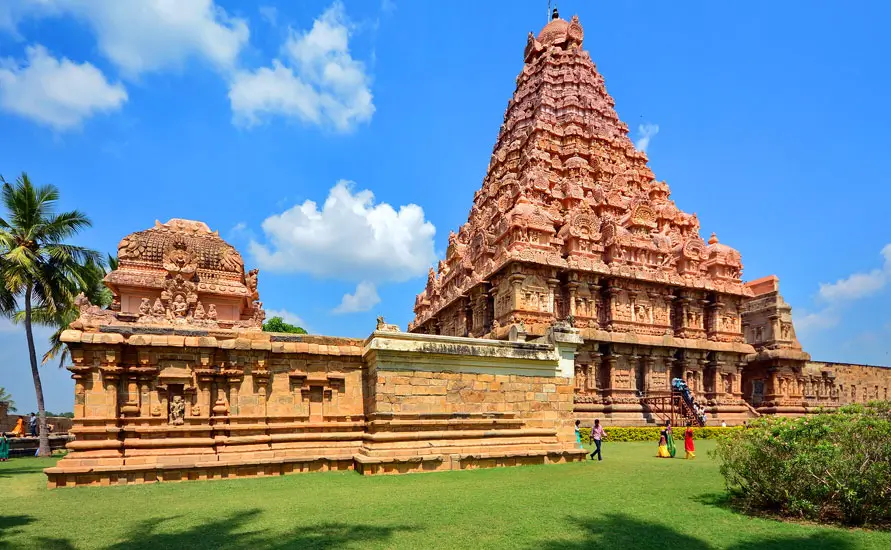
Go to the Brihadeeswarar Temple while the sun is low, because the granite turns warm gold before nine; Rajaraja I consecrated it in 1010, and puja has continued ever since. Its vimana climbs some 66 meters, an astonishing feat given that every block had to be hauled in from quarries well outside the flat delta. Shiva's bull, resting in its own pavilion before the entrance, is a monolith of imposing size. Inside the sanctum stands a lingam over three meters high. Your guide shows you the Chola frescoes in the corridors around the sanctum, revealed when later Nayak paintings over them were carefully removed.
By late morning you reach the Thanjavur Royal Palace, a rambling Nayak and Maratha complex whose art gallery displays a superb roomful of Chola-era bronze images. Seeing Nataraja, Parvati and the saints in bronze here makes sense of what you saw in the shrines yesterday, because many of these images were carried in temple processions for centuries. In the same compound, the Saraswati Mahal Library preserves thousands of manuscripts and early printed books, many collected by the scholarly Maratha ruler Serfoji II. Among them are Tamil and Sanskrit works on medicine, music and temple ritual, some of which are shown in glass cases.
After lunch you can watch craftspeople making Tanjore paintings, with their raised gesso, gold leaf and glass-stone details, or the bobble-headed dolls that every Tamil child knows. Families from the Sri Lankan Tamil diaspora often buy a small painting of Murugan or Ganesha here for the home shrine. In the late afternoon you might visit the Schwartz Church inside the palace grounds or simply rest before an evening puja back at the big temple. Ask about a dinner of Thanjavur Maratha cooking, a court cuisine mixing Marathi and Tamil flavors that is hard to find outside the delta. Overnight in Tanjore.
Sixty minutes west, the Kaveri splits around the island of Srirangam, nearly all of it taken up by the Ranganathaswamy Temple, a living temple town rather than a single building. Its seven enclosures wrap around residential lanes and market stalls, and the white southern gateway, completed only in 1987, is among the tallest in Asia. Vishnu reclines on the serpent Adisesha in the inner sanctum, which only Hindus may enter. Highlights include the vast pillared hall used during festivals and the Sesharaya mandapam, where warriors on rearing horses spring out from monolithic columns.
Across the river in Tiruchirappalli, the Rock Fort rises over the old town. Steps cut through the rock lead past the Thayumanaswamy Shiva temple, closed to non-Hindus, to the small Ucchi Pillayar Temple of Ganesha at the summit. Roughly 400 steps take twenty minutes or a little more, barefoot from the entrance, so avoid the hottest part of the day. Monkeys live on the rock, so keep snacks out of sight. The summit view takes in the wide riverbed and, on a clear day, the gopurams you visited this morning. Lunch is in town before the drive south.
South to Madurai is under three hours on a four-lane highway, crossing arid land broken by irrigation tanks and palmyra groves. After check-in, a short meeting covers the next morning, especially where to leave mobiles and cameras at the Meenakshi entrances. Madurai is a lively place in the evening, and a stroll along the streets around the temple, past jasmine sellers and shops selling brass lamps, gives a sense of a city that has lived around its goddess for over two thousand years. If you are hungry later, the night stalls near the temple fry fresh parottas and kothu until well after ten. Overnight in Madurai.
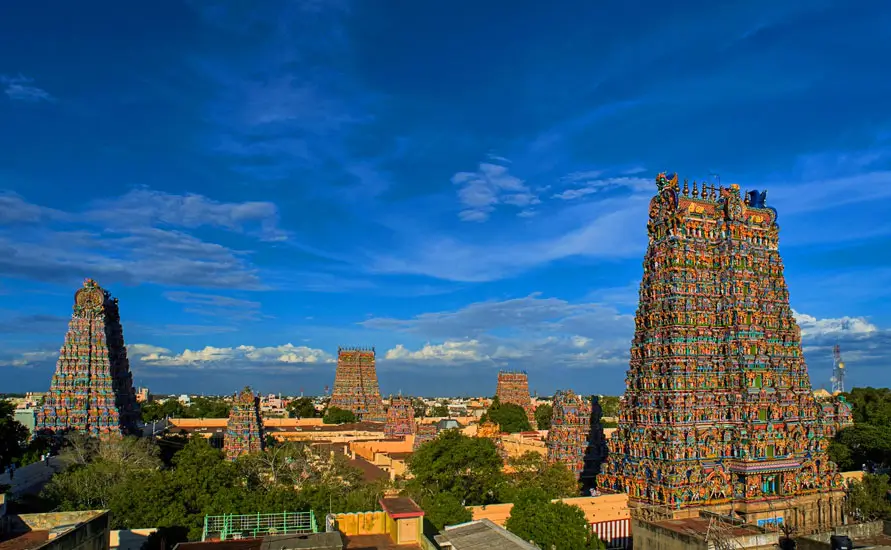
Be at the gates of the Meenakshi Amman Temple around six, when bells announce the first rituals and crowds are lighter. No phones or cameras pass the gates, so these stay at the counters; Hindus can join the darshan queues for the goddess and for Sundareswarar, while any non-Hindu companions wait in the outer corridors in the company of the guide. Notice the green parrot always shown on Meenakshi's hand, the entrance hall where eight forms of Shakti are carved on the pillars and the carved stone columns that give off notes. The marriage of Meenakshi and Shiva is re-enacted every spring in the Chithirai festival, and your guide tells the story in full.
Later you drive about 8 km to Thiruparankundram, the first of the six sacred abodes of Murugan, the Arupadai Veedu. The temple is cut into a granite hill, and here Murugan is said to have married Deivanai after his victory over the demon Surapadman. For anyone heading to Jaffna, this visit is a natural prelude, because the Nallur Kandaswamy Temple you will see there is dedicated to the same god, and Murugan devotion is at the center of Sri Lankan Tamil Hindu life. Your guide explains the vel, the spear that is the god's emblem.
After lunch you may rest or see the palace of King Thirumalai Nayak, with its towering stucco columns, where an evening light show narrates the city's past. Late tonight, at about nine, the temple holds palliyarai, the ritual of putting the divine couple to bed with lamps and music, a moving farewell to Tamil Nadu and a fitting last memory before the flight north. Your guide waits with you and walks you back to the car afterwards. Pack tonight for Sri Lanka, keeping passports, printed tickets and your Sri Lanka entry approval in your hand luggage. Overnight in Madurai.
A morning domestic flight from Madurai links to the daily direct IndiGo departure from Chennai to Jaffna, a hop of little more than an hour. The ferry between Nagapattinam and Kankesanthurai has run only on and off since 2023, so we use flights for a reliable connection; if the Tiruchirappalli–Jaffna service is operating on your date, we may route you that way instead. Sri Lanka's entry paperwork has changed repeatedly, so we confirm which ETA or visa applies to your nationality when we issue your final documents.
Jaffna's small airport at Palaly is about 30 minutes from town, and our Sri Lanka chauffeur-guide meets you outside with an air-conditioned car. The north of the island looks very different from the hill country, flat and sandy with palmyra palms, limestone wells and tidy homes behind painted gates. After check-in, an evening walk around the old town and a first plate of Jaffna crab curry or a vegetarian thali at a local restaurant help you settle in. Tamil is the main language here, so NRI guests from Tamil Nadu often feel at home at once. Overnight in Jaffna.
Jaffna's spiritual center is the Nallur Kandaswamy Temple, dedicated to Murugan and famous across the Tamil diaspora. The current temple dates from the 18th century, built on the site of earlier shrines destroyed during Portuguese rule, and its golden-colored towers dominate the area. Puja times are strictly kept, and devotees arrive minutes ahead because the doors open to the second. Men must remove their shirts before entering, and women should wear a sari, long skirt or salwar. Your guide takes you to the morning puja, when the deity is presented with fire lamps and music.
Each August or September the temple hosts a 25-day festival that draws hundreds of thousands of pilgrims, including many from abroad, with chariot processions and acts of devotion. If your dates fall within it, we will plan your days around the main events. After the puja you visit the Jaffna Fort, first built by the Portuguese and rebuilt by the Dutch in a star shape, then the Jaffna Public Library, a white Indo-Saracenic building that was burned in 1981 and later rebuilt. Your guide treats this painful history with care and answers questions honestly.
After lunch the Jaffna market is worth a wander for palmyra crafts, local mangoes and the day's catch, followed by a scoop at one of the old ice-cream parlors near the bus stand. NRI families with roots in Jaffna can use this time to visit a home village or family temple; let us know in advance so your guide can help with directions and introductions. In the evening many devotees return to Nallur for the last puja of the day, and the courtyard fills with families. Dinner might be a spicy Jaffna-style meal of string hoppers and curry. Overnight in Jaffna.
An early drive across the causeways of the Jaffna islands brings you to the Kurikadduwan jetty, where a passenger boat crosses to Nainativu in about 20 minutes. The island holds the Nagapooshani Amman Temple, revered as one of the Shakti Peethas, places linked with the body of the goddess Sati. Its tall, colorful gopuram faces the sea, and inside, a cobra image beside the goddess recalls the island's name. Close by stands Nagadeepa Vihara, a Buddhist shrine connected to a tradition of the Buddha's visit, so Hindu and Buddhist pilgrims share the same boats.
Boat timings depend on the weather, and seas can be choppy, so your guide will check before departure and carry life jackets. After returning to the mainland and lunching in Jaffna, you head north to Keerimalai, where freshwater springs flow into a sea-walled bathing pool next to the ocean. Pilgrims take a ritual bath here, particularly on Aadi Amavasai, the new moon in July or August when rites for ancestors are performed. Separate pools exist for men and women. The water is cool and fresh, and many visitors simply sit by the edge and watch the waves.
Beside the springs stands the Naguleswaram Temple, one of the Pancha Ishwarams, the five ancient Shiva shrines of Sri Lanka. Like Koneswaram, which you will see tomorrow, it was praised in Tamil devotional literature, and it was rebuilt after damage during the civil war. Your guide explains the connections between this shrine and the Shaiva temples you visited in Tamil Nadu, and between the Keerimalai rites and the sea bath at Rameswaram on the Indian coast. You return to Jaffna in the late afternoon for a free evening. Overnight in Jaffna.
Leaving Jaffna after breakfast, you cross the Elephant Pass causeway and drive south through the Vanni region, a sparsely populated area of lagoons, scrub and rebuilt villages. The road then turns east toward the coast and Trincomalee, a natural deep-water harbor fought over by the Portuguese, Dutch, French and British. Count on five hours or so, breaks included. Your guide can point out the Kanniya hot wells on the way into town, where seven small wells of different temperatures are linked by local legend to Ravana, and you can splash water from them if time permits.
In the late afternoon you enter Fort Frederick, the old Dutch and British fort that still serves as a military base, and walk up to Swami Rock at the tip of the headland. Here stands the Koneswaram Temple, one of the Pancha Ishwarams and praised in hymns by Tirugnanasambandar in the 7th century. In 1622 the Portuguese tore down the original temple and threw its stones into the sea; the present shrine was built in the 1950s after some of the old images were recovered. A statue of Shiva and the cliff called Lovers' Leap look out over the ocean.
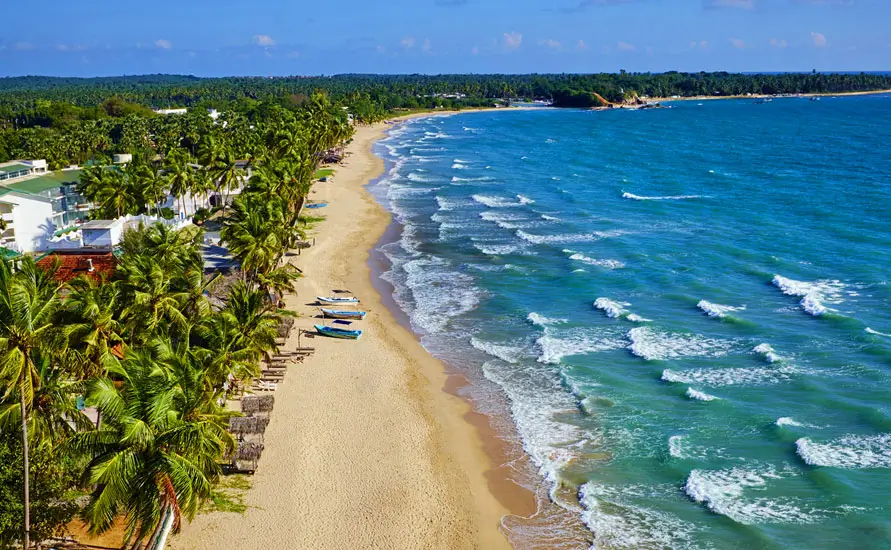
Spotted deer wander freely inside the fort, and in season you may see dolphins or even whales offshore from the cliff. Please dress modestly and remove footwear before the shrine. After the evening puja, you drive to your beach hotel at Uppuveli or Nilaveli, north of town, for dinner. If you wish, your guide can arrange a visit tomorrow morning to the Pathirakali Amman Temple in town, a colorful goddess shrine popular with local Tamil families. The east coast is driest between May and September, while the north-east monsoon brings rain later in the year. Overnight in Trincomalee.
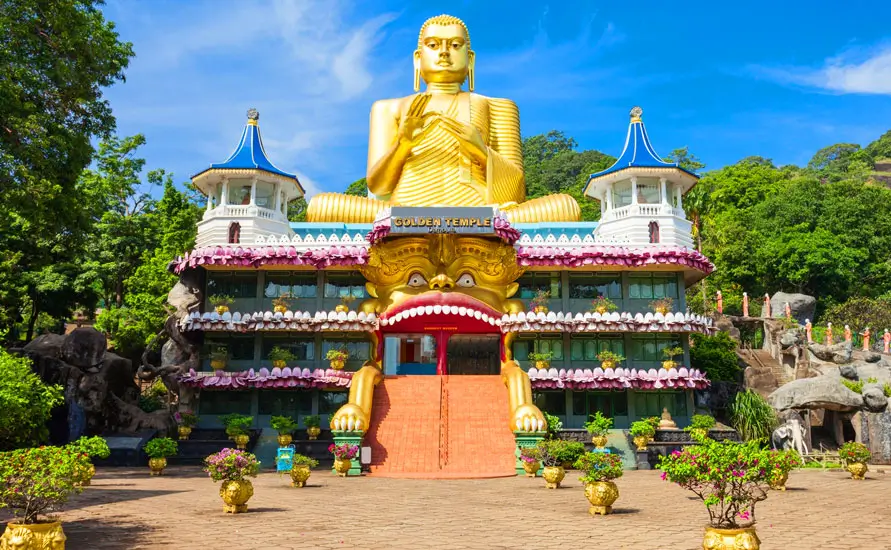
Turning away from the sea, the road crosses scrub jungle, reservoirs and rice land of the dry zone toward the middle of Sri Lanka. At Dambulla, a UNESCO-listed cave temple sits high on a granite outcrop, reached by a climb of about 20 minutes. Its five caves hold more than 150 Buddha images and walls and ceilings covered with paintings, some dating back many centuries. Hindu deities such as Vishnu and Ganesha also appear inside, a sign of the long overlap between the faiths. Cover arms and legs and leave footwear and hats at the cave entrances.
From Dambulla the road climbs gradually to Kandy, passing spice gardens near Matale. The Sri Muthumariamman Temple in Matale, with a tall gopuram crowded with figures, is a good stop for a short darshan and makes a fine Tamil Hindu counterpoint before the Buddhist shrines of Kandy. Many of the plantation workers who came over from Tamil Nadu under British rule settled around Matale, and shrines like this were their community centers. Kandy comes into view by late afternoon, and your room looks over the lake from the ridge above it.
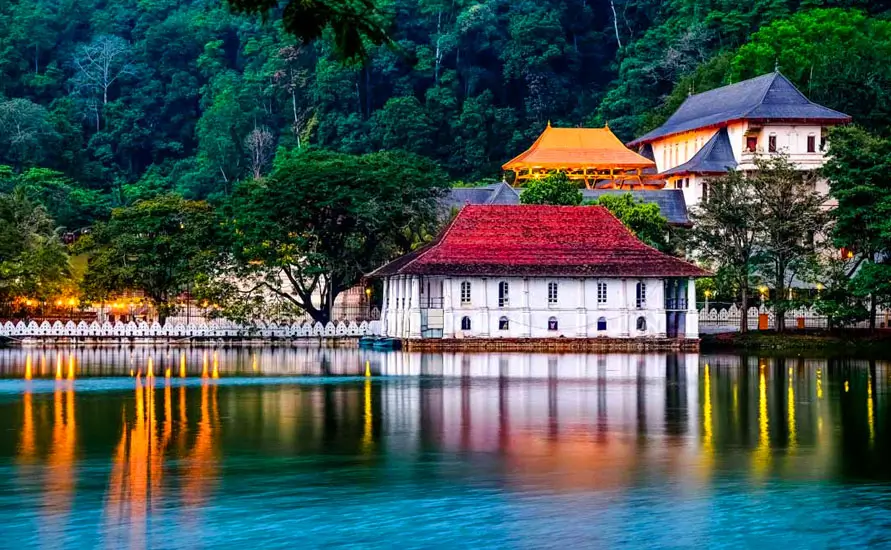
After dark comes a very different sacred site, the Buddhist Temple of the Tooth, Sri Dalada Maligawa, home of the island's holiest relic. The evening puja features drummers and a queue of devotees with flowers passing the chamber of the relic. White or pale clothing that covers shoulders and knees is appropriate. Nearby are the Natha and Vishnu Devales, shrines to gods respected by both Buddhists and Hindus, which round off a day of shared sacred spaces. Back at the hotel, dinner is served on a terrace where you can hear the temple drums carry across the water. Overnight in Kandy.
Before leaving Kandy you might take a short walk around the lake or visit the Peradeniya Royal Botanic Gardens just outside the city, with their avenue of royal palms and an orchid house. Expect close to four hours on the road to Colombo, descending through rubber estates and rice fields, with lunch at a rest stop near Kegalle. Your guide talks about modern Sri Lankan Tamil Hindu life, from the large diaspora in Canada, the UK and Australia to the role temples play in keeping language and music alive among young people born abroad.
In the afternoon you visit two of Colombo's main Hindu shrines. The Sri Ponnambalavaneswarar Temple in Kotahena is built entirely of South Indian granite, with carvings modeled on Tamil Nadu temples, and was rebuilt in the early 20th century by the family of Sir Ponnambalam Ramanathan. On Galle Road, the Sri Kathiresan temples, dedicated to Murugan, are the starting point of the annual Vel procession, when a silver chariot carries the god's spear through the streets. Both shrines bring together the threads of the past two weeks, from Chola stonework to Jaffna-style ritual.
For contrast, you end at the Gangaramaya Temple, a Buddhist complex that combines Sri Lankan, Thai, Indian and Chinese styles and holds a small museum of gifts from devotees, followed by a sunset walk on Galle Face Green. Your farewell dinner can be at a Tamil restaurant in Wellawatte, where Jaffna dishes and South Indian tiffin are served side by side. Your guide will confirm airport timings for tomorrow and help you organize temple prasad, vibhuti packets or any religious items for carrying home in your luggage. Overnight in Colombo.
Timed around your departure, the last drive heads north on the expressway to Bandaranaike International Airport at Katunayake, normally less than an hour from the city unless the morning rush slows things down. Check-in for international flights generally opens three hours before departure. For a midnight departure, a paid room near the airport for a few hours is easy to add, and the Negombo fish auction and the old Dutch canal are close enough to fill the waiting time.
Across two weeks you have followed one of the oldest living devotional traditions in the world, from Pallava and Chola granite in Tamil Nadu to the Murugan temples of Jaffna and the clifftop shrine of Koneswaram. May these two weeks have brought you darshan at these sacred places and a better feel for how Tamil Hindu culture lives on in two countries. Our team remains available if you wish to plan a return visit for a festival such as Nallur or Chithirai. Have a safe flight home.
Your Journey
N.S. Rathore & Mrs. Omlata Rathore · Managing Director
We still read every enquiry ourselves. Tell us the places you liked and our planners will send a day-by-day route with drive times and a clear price.
Every package can be customised and no pressure to book. A planner from our office replies within 24 hours with a route written for your group.
Fill this in and your planner will send a first draft itinerary.
Explore more
Kerala Backwaters Escape Kerala Backwaters Escape
 Kerala Backwaters Escape
 Kerala Backwaters Escape
 Kerala Backwaters Escape
 Kerala Backwaters Escape
 Kerala Backwaters Escape
 Kerala Backwaters Escape
 Kerala Backwaters Escape
 Kerala Backwaters Escape
 Kerala Backwaters Escape
 Kerala Backwaters Escape
 Kerala Backwaters Escape
 Kerala Backwaters Escape
 Kerala Backwaters Escape
 Kerala Backwaters Escape
 Kerala Backwaters Escape
 Kerala Backwaters Escape
 Kerala Backwaters Escape