 Kerala Backwaters Escape

South India with Sri Lanka and Maldives
Madurai – Devipattinam – Rameswaram – Dhanushkodi – Colombo (Kelaniya) – Kandy – Ramboda – Nuwara Eliya (Sita Eliya) – Divurumpola – Ella – Colombo
At a glance
For many Hindu families the Ramayana is not a book on a shelf but a story heard at home, recited at festivals and acted out each autumn at Dussehra. Our Ramayana Trail Tour India and Sri Lanka follows that story to the places tradition links with it, on both sides of the Palk Strait. You begin in Madurai, cross the Pamban channel to Rameswaram, where Rama is said to have worshipped Shiva, and stand at the sandy tip of Dhanushkodi, where the shoals of Rama Setu run out toward Sri Lanka.
A short flight from Madurai to Colombo (direct on most days, or via Chennai) then carries you to the island the epic calls Lanka. At Kelaniya the Vibhishana shrine recalls the coronation of Ravana's brother, the Hanuman temple at Ramboda faces the waterfalls of the central hills, and the Sita Amman Temple at Sita Eliya stands beside the stream where Sita is believed to have bathed during her captivity. The trail ends around Ella with Divurumpola and Ravana Falls before you drive back to Colombo for your flight home.
This Ramayana tour of Sri Lanka and South India is written for pilgrims and for overseas Indian parents hoping their sons and daughters will see the epic as living devotion rather than a cartoon. Sites are presented as local tradition and belief, with time for puja, abhishekam and quiet prayer where you wish. Transport and guiding are reserved for your group alone, Tamil- or Hindi-speaking guides can be requested, vegetarian meals are easy to arrange, and the pace leaves room for early-morning temple rituals. December to March suits the plains and hills best.
Welcome to Madurai, the old Pandya capital on the banks of the Vaigai river and a fitting starting point for a pilgrimage in the south. Madurai airport receives international flights from the Gulf, Singapore and Colombo as well as domestic connections from Chennai, Mumbai and Delhi, so most guests arrive here without needing a night in a big city first. A member of our Madurai team waits just outside customs, helps with luggage and drives you in an air-conditioned vehicle to the hotel. The rest of the day until late afternoon is free for rest, a bath and a light vegetarian lunch.
Toward five in the afternoon you set off with your guide for the Meenakshi Amman Temple, where the fish-eyed goddess is worshipped together with Sundareswarar, the handsome Lord, who is Shiva in his bridegroom form. Fourteen gopurams rise above the old city, each layered with hundreds of stucco deities painted in strong colors. Phones and cameras are not permitted inside, so you leave them at the counters at the gate, and modest clothing covering shoulders and knees is expected. Hindu visitors may enter the inner sanctums for darshan, while non-Hindu members of a mixed family can stay with the guide in the outer prakarams, beside the sacred tank with its gilded lotus and inside the hall of a thousand columns.
Families who keep energy for the late evening can stay for the palliyarai ceremony, held around 9 pm, when the image of Sundareswarar is carried in a palanquin to the bedchamber of the goddess with music, lamps and chanting. It is a moving close to the first day and gives children a clear picture of how a South Indian temple lives through its daily routine. Your guide also explains how this trip will connect the stories of Shiva and Rama, since Rameswaram, your next stop, is where those two traditions meet. A pure-veg restaurant near the east tower makes an easy supper stop. Overnight in Madurai.
Start before breakfast with a return to the Meenakshi temple, because the early rituals look and sound very different from the evening crowds. Priests open the shrines with bells and lamps, devotees carry flowers and coconuts, and the corridors are cool and quiet. Back at the hotel after breakfast, your guide sketches the history of the city: the Tamil Sangam poets of two thousand years ago, the Pandya kings, and the Nayak rulers of the 16th and 17th centuries who gave the temple most of the form you see today. The day is gentle on purpose, since tomorrow brings a longer drive to the coast.
Later you cross town to the Thirumalai Nayak Palace, home of a 17th-century king whose name it still carries. Much of the royal compound vanished long ago, though the courtyard with its huge round pillars and the arched dance hall show the blend of Dravidian and Islamic styles favored by the court. A short ride away is Koodal Azhagar Temple, dedicated to Vishnu and much older than most visitors expect, with a three-tiered sanctum where the deity appears seated, standing and reclining on different levels. For a Ramayana pilgrimage it is a useful reminder that Vishnu, of whom Rama is an avatar, has been worshipped in this city for many centuries.
Post-lunch hours are yours to rest, or to see the Gandhi Memorial Museum, where one room keeps the dhoti the Mahatma had on at his assassination in 1948. In the late afternoon the flower market behind the bus stand is worth a short stop, with heaps of jasmine and marigold sold by weight for temple garlands. If you would like to sponsor a small archana or abhishekam at any temple on this trip, tell your guide today so that the right priest can be contacted in Rameswaram ahead of time. The evening is free for shopping for cotton saris or brass lamps. Overnight in Madurai.
After breakfast the road runs east across the flat, palm-dotted plains of Ramanathapuram district toward the sea. Two hours in, a short detour leads to Devipattinam, also called Navapashanam, where nine stone pillars stand in shallow water a few meters from the shore. Local tradition holds that Rama installed them to worship the nine planetary deities before beginning the war against Ravana, and families still come to perform navagraha prayers here, walking out along a small causeway. Your guide can arrange a priest if you wish to perform a short puja, which takes about half an hour including the walk.
Not far from Ramanathapuram you can also stop at Thiruppullani, where the Adi Jagannatha Perumal Temple marks the spot where Rama is said to have lain on darbha grass for three days, praying to the ocean god for a way across. Then the landscape opens up as you approach the Pamban channel. Driving over the long road bridge gives a clear view of the new vertical-lift railway bridge that replaced the old cantilever span, and of the fishing boats anchored in the turquoise water of the Gulf of Mannar. Your driver will stop at the viewpoint on the bridge for photographs if traffic allows.
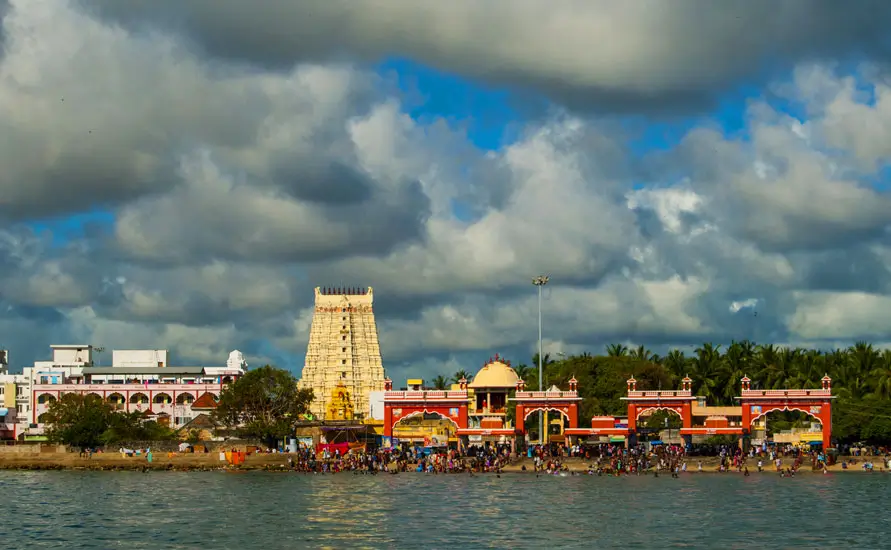
You reach Rameswaram by mid-afternoon and check in close to the temple. Once the heat fades, your guide escorts you to the Ramanathaswamy Temple. Its third prakaram, a colonnade running roughly 1,200 meters around the shrine, has rows of painted pillars that appear to converge at a vanishing point far ahead. Tradition says Rama, returning from Lanka, wished to atone for killing Ravana and worshipped Shiva here through a lingam that Sita shaped from sand. Only Hindus may approach the sanctum, and cameras are restricted within the walls. Tomorrow begins early, so dinner is simple and close by. Overnight in Rameswaram.
Pilgrims traditionally start their day in Rameswaram with a dip in the sea at Agni Theertham, the calm stretch of water in front of the eastern gopuram. Your guide meets you at dawn, and after the sea bath you walk straight into the temple, still in wet clothes as custom requires, for the ritual of the 22 theerthams. These are wells spread across the temple complex, each believed to hold different sacred waters, and at each one an attendant draws water and empties it over you before you walk on to the next. Carry a dry set of clothes in a bag; changing rooms and lockers are available near the temple.
After a change, a hot breakfast and some rest, you drive a few kilometers to Gandhamadhana Parvatham, the highest point on the island, where a small two-storied shrine holds a stone believed to bear Rama's footprints. From the top you can see across the whole of Pamban island, with the sea on every side, which helps everyone understand the geography of the epic. Next you visit the Panchamukhi Hanuman Temple, where floating stones are kept in a water tank. Devotees see them as remnants of the bridge built by Rama's army, and children are always allowed a long look.
The afternoon includes the Lakshmana Theertham and Rama Theertham tanks, and, for families interested in modern India, the memorial to former President A. P. J. Abdul Kalam, who grew up in Rameswaram, at Peikarumbu. Your guide shares stories of the island's Muslim, Christian and Hindu fishing families who have lived side by side here for generations. Evening is free; you may wish to return to the temple for the night puja, when the corridors are lit and noticeably cooler. If you have arranged an abhishekam, it is usually scheduled for the early morning or evening slot. Overnight in Rameswaram.
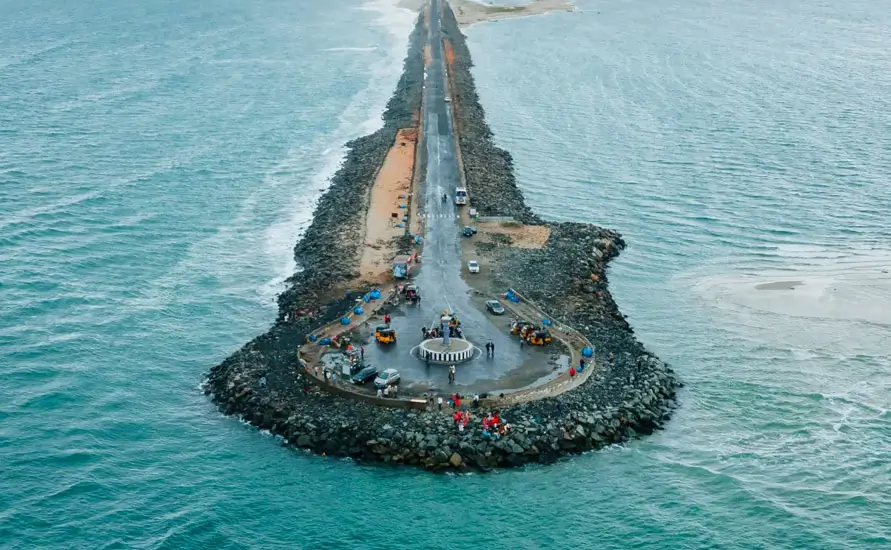
An early start takes you about 20 km along a narrow strip of land to Dhanushkodi, at the south-eastern tip of the island. Until December 1964 it was a busy railway and ferry town with a church, a school and a post office, until a cyclone and storm surge destroyed it in a single night. The ruins of the church and railway station still stand among the dunes, and a small number of fishing families live here in palm-leaf huts. The name itself refers to the end of Rama's bow, and tradition holds that Rama marked the place where the bridge to Lanka should begin.
A paved road now reaches Arichal Munai, the final point of land, where the calmer Palk Bay on one side and the rougher Gulf of Mannar on the other wash against a single sandbar. On clear days the line of shoals called Rama Setu, or Adam's Bridge, can be traced in the color of the water heading toward Mannar island in Sri Lanka, only about 30 km away. Returning, you pause at Kothandaramaswamy Temple, which tradition says came through the 1964 cyclone, where Vibhishana is believed to have come to Rama asking for refuge. Its images show Rama crowning Vibhishana.
After a late breakfast in Rameswaram you check out and drive back across the Pamban bridge toward Madurai, roughly four hours of road, broken for a meal at Ramanathapuram or Paramakudi. Returning to Madurai tonight keeps tomorrow's international flight easy and stress-free, since the airport is a short drive from most hotels. The evening is free for packing and a quiet dinner, and your guide can collect any prasad or theertham water you wish to carry home in sealed bottles suitable for the flight. Please keep your passport, Sri Lanka entry approval and printed tickets in your hand luggage. Overnight in Madurai.
This morning you are dropped at Madurai airport for the hop across the Palk Strait to Colombo, around seventy minutes in the air when the direct service runs. If the direct flight does not run on your date, we route you via Chennai with a same-day connection. Colombo's arrival formalities have shifted often lately, so a few weeks before you fly our team checks which ETA or visa your particular passport needs right now. Our Sri Lanka team meets you at Bandaranaike International Airport, and your chauffeur-guide, who stays with you for the rest of the trip, loads your bags for the drive south.
Late in the afternoon you visit the Kelaniya Raja Maha Vihara, about 10 km from central Colombo on the bank of the Kelani river. For Sri Lankan Buddhists the site is sacred because of a tradition that the Buddha visited it, and its image house has fine 20th-century murals. For Ramayana pilgrims, Kelaniya is linked with Vibhishana, Ravana's righteous younger brother, who is believed to have been crowned king of Lanka here after the war. A shrine to Vibhishana stands within the temple grounds, and Sri Lankans of both faiths still bring offerings to him as a guardian deity.
White or light-colored clothing covering shoulders and knees is appropriate, and shoes and hats are removed before entering. On full-moon poya days the temple is very busy with families in white, which makes a fine sight, though parking and walking take longer. After the visit you drive into Colombo and check in to your hotel. If time permits, a short evening drive along Galle Face Green, where locals gather by the sea with snacks and kites, is a relaxed introduction to the capital. Dinner can be at a South Indian vegetarian restaurant in Wellawatte, the Tamil neighborhood. Overnight in Colombo.
After breakfast you leave Colombo for the hill city of Kandy, climbing gradually from the humid coastal belt through rubber plantations, rice paddies and villages selling cashews and pineapples at the roadside. Your chauffeur-guide uses the drive to explain the shape of Sri Lankan Ramayana tradition, which local Hindus and many Buddhists know as a story of their own island, with places named for Sita, Hanuman and Ravana scattered across the hills you will cross in the next days. A stop at a spice garden near Matale or a roadside tea break can be added if you wish.
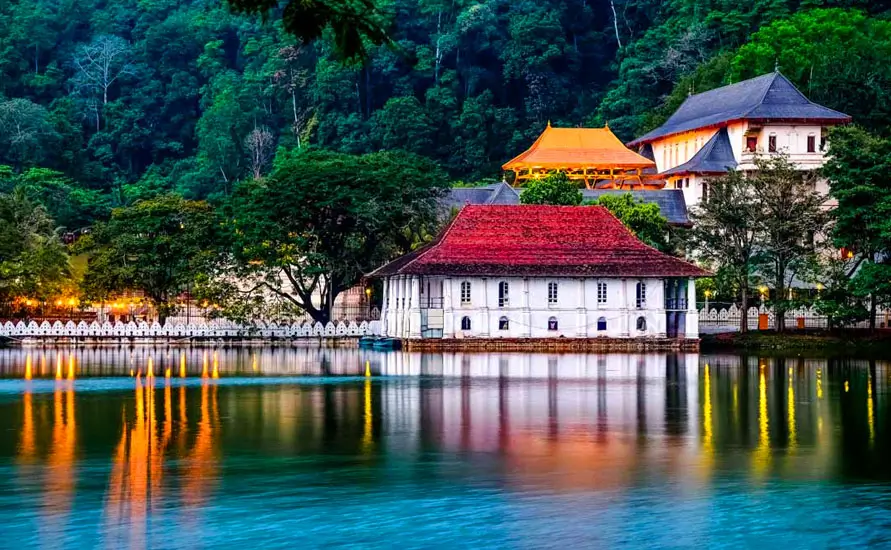
Sinhala royalty ruled from Kandy until 1815, and in the afternoon you visit the Temple of the Sacred Tooth Relic, Sri Dalada Maligawa, a UNESCO-listed site that houses a tooth relic of the Buddha. Although it is not part of the Ramayana story, it is the most important shrine in the country and a respectful stop for any visitor to the island. Time your visit for the evening puja, when drummers play in the courtyard and devotees queue with lotus flowers to pass the chamber where the relic is kept in a golden casket. Light clothing covering shoulders and knees is required here.
After the puja you can walk along the shore of Kandy Lake, built in the early 19th century by the last king of Kandy, or attend a short Kandyan dance show in town, where performers in silver headdresses dance to drums and finish with a fire-walking display. Many Hindu visitors also look in at the small Kataragama Devale and Natha Devale near the Tooth temple, shrines to deities shared by Buddhists and Hindus, a good example of how faiths overlap in Sri Lanka. Your evening meal is served back at the hillside hotel, with the lake lights below. Overnight in Kandy.
The road south from Kandy climbs into tea country, with hairpin bends, waterfalls and neat rows of tea bushes covering the slopes. About two hours out you reach Ramboda, where the Sri Bhakta Hanuman Temple stands on a hillside run by the Chinmaya Mission. Tradition in this area holds that Hanuman searched these hills for Sita, and the temple's tall orange image of Hanuman looks out across the valley toward Ramboda Falls. The temple is calm and well kept, and on Saturdays devotees offer betel leaves and vadai garlands. A cup of tea at the small canteen next door is a simple pleasure.
Below the temple, a tea factory in the Ramboda area welcomes visitors for short tours that follow the leaf from the plucking bags through the withering troughs, rollers and drying ovens to the sorting tables where grades of Ceylon tea are separated. The workers in these estates are mostly Hill Country Tamils, whose ancestors were brought from South India in the 19th century, and many temples in the hills belong to their community. Your guide can explain this history, which many NRI guests find a moving link with Tamil Nadu. You then continue the last hour to Nuwara Eliya, which sits at around 1,900 meters.
Nuwara Eliya was a British hill station and still has a red-brick post office, a racecourse and mock-Tudor bungalows with rose gardens. After dark the temperature drops sharply, especially in the winter months, so pack a warm layer or shawl. After check-in you can walk beside Gregory Lake or visit the busy local market for warm socks and hill vegetables. Tomorrow is devoted to the most significant Ramayana sites in the hills, so your guide reviews the plan with you tonight and suggests the best order to avoid crowds at the Sita temple. Overnight in Nuwara Eliya.
About 5 km from Nuwara Eliya on the road to Hakgala lies Sita Eliya, home of the Sita Amman Temple. Tradition says that this is part of the Ashoka Vatika, the garden where Ravana held Sita captive, and that she bathed in the stream flowing beside the temple. Marks in the rock by the water are shown as the footprints of Hanuman. The present temple is small and colorful, with images of Rama, Sita, Lakshmana and Hanuman, and morning is the quietest time. Many families perform an archana here and sit by the stream for a while before moving on.
Next door, the Hakgala Botanical Garden spreads over a steep hillside of roses, ferns and old trees, with views across the valley to the lowlands. Local belief connects the rocky peak above it with Hanuman, who is said to have dropped part of a mountain here while carrying healing herbs back for Lakshmana. Botanists and pilgrims alike enjoy the garden, and the walking paths can be as short or as long as you like. Your guide points out the variety of plants on the slopes, which some see as fitting for a mountain said to have arrived full of medicinal herbs.
After lunch you drive about an hour toward Welimada to Divurumpola, a Buddhist temple in a peaceful rural setting that tradition identifies as the place of Sita's agni pariksha, the trial by fire that proved her purity. The name is often explained as place of oath, and even today local people come here to settle disputes by swearing before the shrine, a custom accepted in village life. Please keep voices low and dress modestly, since this is an active Buddhist temple. You return to Nuwara Eliya by late afternoon where a pot of local tea waits before supper. Overnight in Nuwara Eliya.
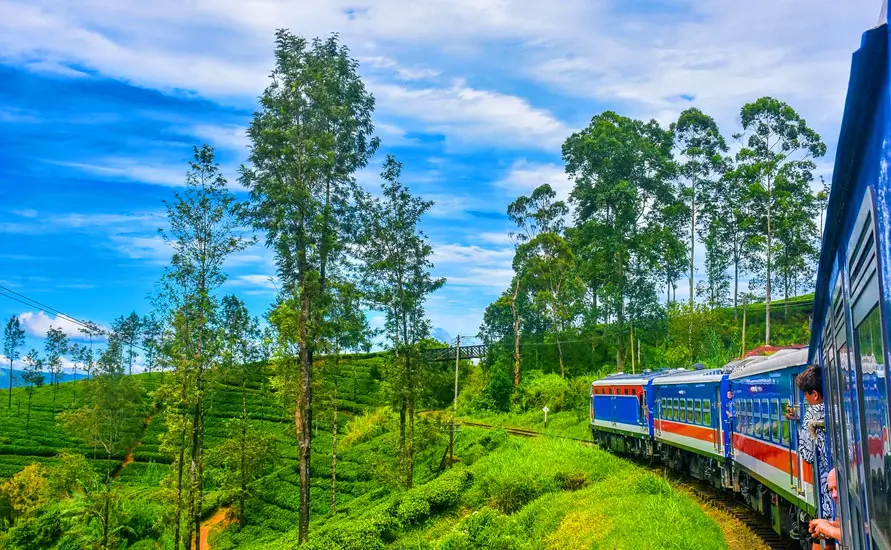
A short drive brings you to Nanu Oya station for one of the most scenic railway rides in South Asia. Allow around three hours or a bit more for the ride to Ella, which passes tea estates, eucalyptus forest, tunnels and the high station of Pattipola before descending toward Ella. Reserved seats go quickly, so our team secures them the moment your dates are fixed, while your car with your luggage drives ahead to meet you. Sitting on the right-hand side generally gives the better valley views, and the train is often a little late, so pack snacks and water.
After lunch comes a short but steep outing to the Ravana Cave near Ella, reached by a steep flight of steps cut into the hillside above the town. Tradition holds that Ravana hid Sita in caves in this area, and some believe tunnels once linked them to other sites. The climb takes about 20 to 30 minutes, and the cave itself is simple, but the story attached to it makes it significant for pilgrims. Wear good shoes, take a torch, and come down before dusk, since the steps are uneven. Older guests can skip the climb and enjoy the view from below.
Ella is a small, relaxed town where backpackers, Sri Lankan families and pilgrims mix in the same cafés along the main road. You check in to a hillside hotel with views down the Ella Gap toward the southern plains, which on a clear evening seem to stretch all the way to the sea. Dinner might be rice and curry with seven or eight vegetable dishes, a good contrast with the tiffin food of Tamil Nadu and a chance to compare spices and coconut use on both sides of the strait. Your guide plans tomorrow's walks around the weather. Overnight in Ella.
Set out soon after sunrise for Little Adam's Peak, an easy climb of about 45 minutes each way through tea bushes to a grassy ridge with wide views over Ella Rock and the valleys around it. The path is wide and well used, and you can stop as often as you like. At the top, small prayer flags and a white Buddha statue look down across the hills, and your guide may point out the rock formations that local storytellers tie to Ravana's kingdom, which in Sri Lankan folk belief included the hill country around Ella.
Later you walk to the Nine Arches Bridge, a stone-and-brick railway viaduct built in the early 20th century and set in a curve between forested hills and tea fields. Local legend says it was finished without steel when supplies were diverted during the First World War. Your guide checks the train timetable so you can be at the bridge when a blue or red train crosses, which is the moment everyone waits for. Paths around the bridge can be muddy after rain, so walking shoes are better than sandals. A small café on the slope serves tea and king coconut.
The afternoon is free for rest, an Ayurvedic oil massage or a cooking demonstration of Sri Lankan curries at one of the guesthouses in town. Use the quiet hours, too, for a family conversation about the trail you have followed: Rameswaram, Dhanushkodi, Kelaniya, Sita Eliya, Divurumpola and Ella, each telling a different part of the story through local memory. Your guide can help you prepare a short written record or map of the places for children to keep. Make the most of a final cool evening up here, because tomorrow the car leaves early for the long descent to the coast. Overnight in Ella.
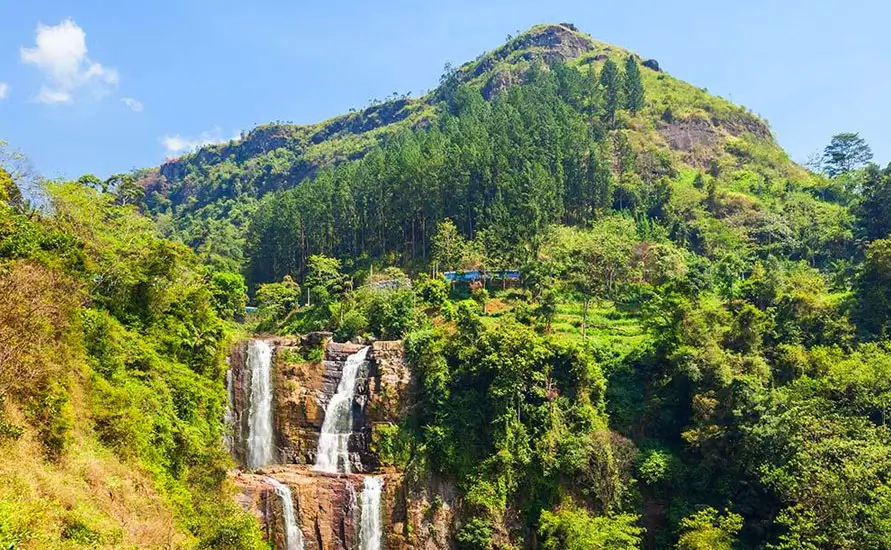
After an early breakfast you leave Ella on the road toward Wellawaya and stop after about 6 km at Ravana Falls, a tiered waterfall dropping beside the highway. Local belief says Sita bathed in the pool below it and that Ravana's caves lie in the cliffs nearby. Water levels swell after heavy rain and shrink in dry spells, but they make a fitting last stop on the Ramayana trail. From here the drive to Bandaranaike International Airport near Colombo needs about six to seven hours including rest stops, using the expressway for the final stretch, so this day suits evening or night flights.
If your flight leaves early in the day, we recommend adding a night in Colombo or Negombo, or using a day room near the airport, both available at extra cost. At the terminal your chauffeur-guide says goodbye at the door and can help with sealed bottles of theertham water or tea bought in the hills. We hope the trail from Madurai to Ella has given your family both a pilgrimage and a deeper sense of how one story is held in two countries. Have a safe flight home, and do send us your photographs.
Your Journey

N.S. Rathore & Mrs. Omlata Rathore · Managing Director
We still read every enquiry ourselves. Tell us the places you liked and our planners will send a day-by-day route with drive times and a clear price.
Every package can be customised and no pressure to book. A planner from our office replies within 24 hours with a route written for your group.
Fill this in and your planner will send a first draft itinerary.
Explore more
Kerala Backwaters Escape Kerala Backwaters Escape
 Kerala Backwaters Escape
 Kerala Backwaters Escape
 Kerala Backwaters Escape
 Kerala Backwaters Escape
 Kerala Backwaters Escape