
 Kerala Backwaters Escape

South India with Sri Lanka and Maldives
Chennai – Kanchipuram – Mahabalipuram – Pondicherry – Chidambaram – Gangaikondacholapuram – Tanjore – Darasuram – Trichy – Madurai – Colombo – Kandy – Matale – Sigiriya – Dambulla – Bentota – Colombo
At a glance
Tamil kings and Sinhalese kings fought, traded and married across the Palk Strait for well over a thousand years, and this Tamil Nadu and Sri Lanka tour traces that long rivalry and kinship from one shore to the other. Nine nights go to the temple country of Tamil Nadu, where the Dravidian style was born and perfected: Pallava shrines in Kanchipuram and Mahabalipuram, the Chola masterpieces of Tanjore, Gangaikondacholapuram and Darasuram, and the towering gopurams of Srirangam and Madurai. A short flight then crosses to Sri Lanka, where the Cultural Triangle and the south-west coast fill the final six nights.
The pace is steady rather than rushed. Each base on the Indian side gets two nights, apart from a first night in Chennai, and the longest drives come with temple stops that break the road into sensible pieces. From Madurai (or Trichy, depending on the flight schedule) you fly to Colombo, and a Sri Lankan driver-guide takes you up to Kandy, on to Sigiriya and the Dambulla caves, and finally down to the palm-lined beaches of Bentota before your flight home from Colombo.
This Tamil Nadu and Sri Lanka tour is planned for guests from Britain, mainland Europe, the US, Canada and Australia with a real interest in architecture, living religion and food, and NRI families keen to show children the Tamil links that run deep into Sri Lanka. Everything is private: car, driver, local guides and hotel choice, from heritage properties to comfortable beach resorts. November to March is the most reliable window for both Tamil Nadu and the Bentota coast. An Indian e-Visa is required, and because Sri Lankan entry rules have changed several times lately, our team checks the current requirement for your passport before you book flights.
Chennai is where most long-haul flights into Tamil Nadu land, and our representative waits beyond customs with a name board, at any hour of the day or night. Expect forty-five minutes to an hour on the road from Meenambakkam airport to the hotel, depending on traffic. On the way you receive a welcome folder with your vouchers, flight details for the Sri Lanka leg and phone numbers for our India and Sri Lanka teams. Guests landing before dawn can sleep through the morning, because the hotel room can be held from the previous evening, sparing you a wait in the lobby until the regular afternoon check-in.
After lunch, a local guide meets you in the lobby for a first look at old Madras, as the British knew it. Fort St. George, raised in 1644 as a fortified trading post for English merchants, still houses the Tamil Nadu state assembly, and inside its walls stands St. Mary's Church, whose stone walls and bomb-proof roof date from 1680, making it one of the earliest British churches anywhere in Asia. Marble plaques inside remember young clerks, officers and their wives who never sailed home again. The small fort museum holds old coins, uniforms and a portrait gallery, and it gives useful context for the colonial chapter of the trip.
Late in the afternoon you drive into George Town, the dense trading quarter that grew up just north of the fort. The lanes here are organized almost by trade, with streets of brass vessels, wedding cards, spices and dried fish, and the wholesale flower market is a riot of jasmine and marigold heaped on burlap sacks. Your guide leads you on foot and points out old Armenian and Portuguese church fronts tucked between the shops. For dinner, a light meal at the hotel is usually the wise choice on the first evening, with a proper Tamil thali saved for later in the week. Overnight in Chennai.
Breakfast is early, because Kanchipuram lies about two hours west and its temples shut their doors around noon. Under the Pallava dynasty this was a royal capital and a center of Sanskrit and Tamil learning, and the town is still dotted with dozens of shrines. Your guide sets out the plan for the trip in the car: you will follow the story of Dravidian temple building from these early Pallava works, through the Chola peak in the Kaveri delta, to the later Nayak cities of Srirangam and Madurai, and then across the water to Sri Lanka.
The Kailasanathar Temple, raised around 700 CE, is the place to see how Pallava sculptors worked in soft sandstone before the age of soaring gateways. Its low walls are crowded with tiny cells, each holding a carved form of Shiva, and traces of original painted plaster survive in a few corners. From there you drive across town to the Varadaraja Perumal Temple, a large Vishnu shrine whose pillared mandapa shows horsemen, hunters and musicians in fine granite. Ask your guide about Athi Varadar, a fig-wood figure of the god that rests submerged in the temple tank and is raised for devotees only at intervals of four decades.
Kanchipuram silk is woven in hundreds of homes, and a short stop at a weaving family's workshop shows the jacquard punch cards and the heavy gold-thread borders that make a sari last for generations. Lunch is at a vegetarian restaurant in town, and then a ninety-minute run south-east brings you to the shore temples of Mahabalipuram. By late afternoon you are settled into a hotel close to the sea. The evening is free, and many travelers like to stroll past the stone carvers' workshops along the main road, where carvers keep tapping at granite blocks well into the night under bare electric bulbs. Overnight in Mahabalipuram.
A full day in one place means you can see Mahabalipuram properly, starting with the cave temples rather than the famous seafront. Pallava sculptors cut these shallow halls into the granite ridge in the 7th century, and inside the Mahishasuramardini Cave is a panel many scholars rank as the best on the hill: Durga, mounted on her lion, charging the buffalo-headed Mahisha, with the figures leaning and twisting as if caught mid-fight. In the neighboring Varaha Cave, Vishnu takes the shape of a giant boar and lifts Bhudevi clear of the flood. Your guide explains how these carvings were left unfinished in places, giving clues to how the artists worked.
On the ridge above stands the old lighthouse and the small Olakkannesvara Temple, which once served as a beacon for ships, with wide views over the town and the sea. Walking down, you reach Arjuna's Penance, and your guide points to small jokes hidden in the crowd of figures, among them a skinny cat posing as an ascetic while mice dance around it unafraid. After a short drive you reach the Pancha Rathas, five chariot-shaped shrines hewn from one long boulder, and the morning ends at the Shore Temple, whose weathered towers face straight out to the Bay of Bengal.
The afternoon is unhurried. After lunch and a rest, you can visit the Tiger Cave a few kilometers north at Saluvankuppam, an open-air shrine whose entrance is ringed by eleven snarling yali heads, which sees far fewer visitors than the main monuments. Back in town, the government sculpture college and private workshops welcome visitors, and carvers will show you the tools used to shape anything from a small Ganesha to a temple pillar. Shipping can be arranged if you buy something heavy. At dusk, the fishing boats lined up on the beach beside the Shore Temple make a fine last photograph of the day. Overnight in Mahabalipuram.
The East Coast Road takes you south in about two and a half hours, past backwater creeks, salt pans and small temples painted in candy colors for local festivals. Your driver can stop at the shoreline at Alamparai, where the ruins of an old fort sit by an estuary, for a ten-minute break by the water. You reach Pondicherry around midday and check in to a heritage hotel. The former French colony is best taken in by foot and by bicycle, and its compact size means you will rarely need the car until the drive south the day after tomorrow.
Pondicherry's old canal once divided the colonial town from the Tamil town, and this afternoon you cross it into the Tamil Quarter with your guide. Here the houses are built in a local style, with raised thinnai platforms beside the doors, heavy teak lintels and shaded porches where neighbors once sat to talk in the evening. Several have been restored by local heritage groups, and the guide explains how French and Tamil building traditions borrowed from each other. You also walk through the busy Goubert Market, where fishmongers, flower sellers and fruit vendors trade under one long roof.
Close to sunset, a stop at the Manakula Vinayagar Temple is easy to fit in, a much-loved Ganesha shrine wedged between French-era streets, whose painted ceilings show the god's many forms. The evening is free for the sea-facing promenade, where traffic stops after dark and locals gather to walk and chat. Pondicherry has a wide choice of restaurants, and a Creole meal mixing French technique with Tamil spices is a good choice for a first night here. Ask your guide about Arikamedu, a few kilometers south, where archaeologists found Roman pottery that shows trade with the Mediterranean two thousand years ago. Overnight in Pondicherry.
Morning light is the best time to photograph the French Quarter, when the yellow, pink and white villas are lit from the east and the streets are still quiet. Your guide walks you along Rue Romain Rolland and Rue Dumas, past the French Institute, the old lighthouse and the stately Hôtel de Ville. At the southern end of the seafront, the Greco-Roman front of Notre Dame des Anges, finished in 1855 with a lime plaster said to contain egg white, looks straight out at the Bay of Bengal. Street names, police caps and the bread in the bakeries all hint at the 280 years when this was a French town.
Inside the Sri Aurobindo Ashram, a quiet tree-shaded yard holds the samadhi of the thinker Sri Aurobindo and Mirra Alfassa, the Mother, its marble covered each day with fresh flower patterns. Footwear stays outside and phones go silent. Afterwards, a short visit to the Ashram's handmade paper workshop shows how paper is pressed, dyed and marbled by hand, and its shop sells notebooks and cards that pack flat for the trip home. Lunch is free, with a choice of French cafés, South Indian canteens and plenty of vegetarian options in the old town.
After lunch the car takes you about 12 km up the coast road to Auroville, launched in 1968 and now home to residents from roughly fifty nations. Following the introductory film at the visitor center, a path through replanted forest ends at a spot from which you can see the Matrimandir and its skin of golden discs. The inner meditation room can only be visited with a reservation that the visitor center issues ahead of time, and since spaces are few, please flag it with us at booking time. Auroville's boutiques sell hand-thrown pottery, natural incense and organic produce, and a short stop on the return drive is easy. Overnight in Pondicherry.
Expect a long day in the car, though the stops along the way rank among the finest temples in the south. First comes Chidambaram, ninety minutes down the coast, whose Nataraja Temple honors Shiva in his dancing form. At its center stands the Chit Sabha, a hall roofed with gilded tiles, and the temple is also known for its link to the element of space, represented by an empty sanctum hung with golden leaves. Parts of the inner enclosure may be closed to non-Hindus, and your guide will explain what can be seen. Dress modestly, and leave shoes with the attendants at the gate.
From Chidambaram you continue inland to Gangaikondacholapuram, founded around 1025 by Rajendra I, who named his new capital after the river his armies had reached in a long northern campaign. Little remains of the palace city, but the great Brihadisvara temple still stands alone among fields, its tower curving more gracefully than the one his father built at Tanjore. Look for the panel of Shiva placing a garland on the devotee Chandesha, which many art historians count among the best Chola sculpture. This was the same Rajendra whose fleets raided Sri Lanka and Southeast Asia, a thread you will pick up again across the water.
After a late lunch in Kumbakonam, the road runs past rice fields, coconut groves and wide irrigation channels fed by the Kaveri. You arrive in Tanjore, also called Thanjavur, around 5 pm and settle in for two nights. The evening is free, though many guests take a first look at the floodlit tower of the Big Temple, which is lit up after dark and makes a fine sight from the outer courtyard. Thanjavur meals in town come with tangy rasam and crisp poriyal, though the hotel restaurant is fine after a long drive. Overnight in Tanjore.
The Brihadeeswarar Temple was consecrated in 1010 CE by Rajaraja I, under whom Chola power reached its first great peak, and it remains one of the tallest temple towers in India at around 66 meters. Visiting in the early morning brings soft light on the granite and fewer crowds in the courtyard. Your guide shows you the monolithic Nandi bull facing the shrine, the inscriptions on the base listing the dancers, musicians and lamp-lighters paid by the king, and the covered gallery around the courtyard, where rows of lingams sit beneath murals added centuries later by Maratha rulers. Rajaraja also sent his navy to Sri Lanka and took Anuradhapura, which makes this temple a fitting starting point for the second half of the tour.
By late morning you move to the Thanjavur Maratha Palace, a rambling complex enlarged first by Nayak governors and then by the Maratha dynasty. Its art gallery displays bronzes of extraordinary quality, including dancing Natarajas and graceful figures of Parvati cast by the lost-wax method. The Saraswati Mahal Library, part of the palace complex, keeps tens of thousands of manuscripts on palm leaf and paper, and a few are laid out in glass cases for visitors. Nearby, you can watch a craftsman at work on a Thanjavur painting, the local style of devotional art with raised gesso and gold leaf, or on a bobble-headed dancing doll.
Darasuram, on the edge of Kumbakonam, is roughly forty minutes away, and its Airavatesvara Temple, commissioned by Rajaraja II some 150 years after the Big Temple, completes the trio of UNESCO-listed Chola shrines. It is smaller than its relatives, but its carvings are among the most delicate of the period, with tiny panels of dancers, acrobats and scenes from the lives of Shaiva saints. The entrance steps are carved to give a musical note when tapped, though visitors are asked not to strike them today. Return to Tanjore in time for a quiet evening at your hotel. Overnight in Tanjore.
About sixty minutes west, the Kaveri splits in two at Trichy (Tiruchirappalli) and wraps around the holy island of Srirangam. Here the Ranganathaswamy Temple spreads across seven nested enclosures, and the outer rings are really a town, with homes, stalls and small restaurants. Its main gateway, about 73 meters tall, was completed only in 1987, while much of the rest dates from the Chola to the Nayak periods. Non-Hindus cannot enter the inner sanctum, but a small fee buys a climb to a roof terrace with a view of the gilded vimana, and your guide also leads you through the great pillared hall with its rearing horse sculptures.
Above the city rises the Rockfort, a huge outcrop topped by a small Ganesha shrine and reached by a covered stairway of about 400 steps cut into the stone. Shoes are left at the bottom, so carry socks if the steps are warm. Halfway up, Pallava cave shrines are carved into the rock face, and from the summit you can see the river, the Srirangam towers and the patchwork of rooftops below. After lunch in town, Madurai is reached in under three hours on a good highway past granite hills and dry farmland.
Greek and Roman writers knew Madurai as the seat of the Pandya kings, which makes it one of the longest-lived cities on the peninsula. You reach your hotel around teatime and stay two nights. If energy allows, a stroll along the Chithirai streets that encircle the Meenakshi Temple gives a first sense of the place: tailors working on pavements, flower sellers threading jasmine and pilgrims arriving in family groups. Before saying goodnight, the guide runs through the temple rules for the morning, such as where to hand in phones and cameras. Overnight in Madurai.
Start early at the Meenakshi Temple, before tour groups arrive, while morning worship is in progress and the granite underfoot has not yet heated up. The complex is ringed by tall gopurams covered in thousands of painted plaster figures, and the inner halls hold carved pillars of mythical lions and yalis. Cameras and phones go into the deposit counters at the gates, and the sanctums of the goddess and of Sundareswarar are open to Hindus only. You still see plenty: the Porthamarai Kulam tank, the corridor of musical pillars and the Ayiram Kaal Mandapam, now a museum of bronzes and painted panels.
Before lunch you cross the old town on foot to the Thirumalai Nayak Palace, King Thirumalai's 1630s residence, where white columns as thick as tree trunks carry arches in an Indo-Islamic style. Much of the original palace has vanished, but the scale of the main hall gives a good idea of Nayak ambition. The afternoon begins at the Gandhi Memorial Museum, whose home is a Nayak-era building associated with Queen Mangammal, where the freedom struggle is told in photographs and letters, and the cloth Gandhi was wearing at his assassination in 1948 is kept behind glass. Shady lawns outside make a good place to wait out the afternoon heat.
Toward evening your driver heads east to the Vandiyur Mariamman Teppakulam, a great stepped reservoir with an island pavilion, where illuminated floats bear the temple images around the island at the annual Float Festival around January or February. After dinner, you can return to the Meenakshi Temple at around 9 pm for the palliyarai ritual, when priests bear Sundareswarar in a silver palanquin to rest beside Meenakshi. The procession is short but intense, with oil lamps, conch shells and drumming in the dim halls, and few travelers forget it. Overnight in Madurai.
Today you leave India, flying from Madurai, or from Trichy if that schedule suits your date better, to Colombo; depending on the day the service is direct or makes one stop. Flying time across the strait is around an hour, and you leave India with an e-Visa exit stamp and enter Sri Lanka under the entry rules we will have confirmed for your passport before departure. At Bandaranaike International Airport, our Sri Lanka team meets you outside arrivals and hands you over to the Sri Lankan chauffeur-guide who will drive you all the way to the departure gate in six days.
The road climbs from the coastal plain through rubber and coconut country into the central hills, and reaching Kandy takes roughly three and a half hours, or four with traffic, with a stop for king coconut water at a roadside stall. Sinhalese kings held out here until the British took the city in 1815,, and its lake, temples and green hills make a calm first base. You check in for two nights and have the evening free, perhaps for a short walk along the lakeshore before dinner. Overnight in Kandy.
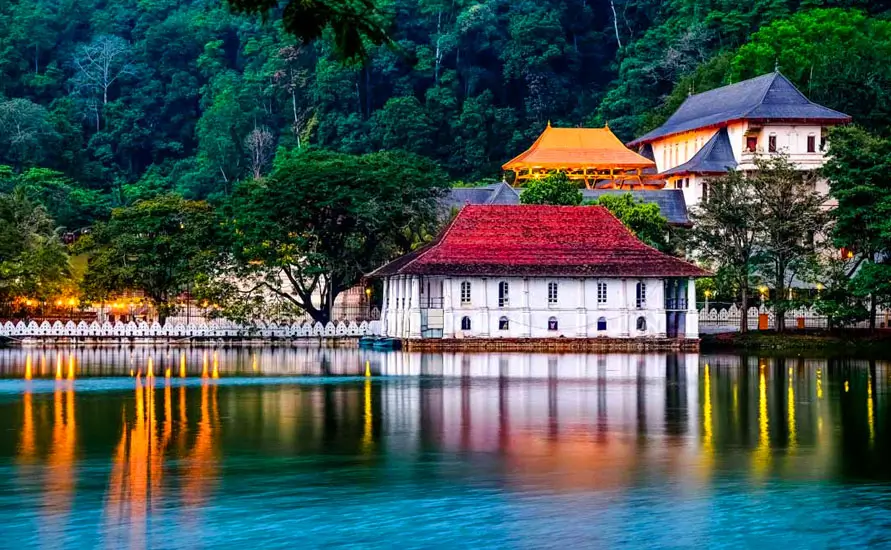
Sri Lanka's most revered Buddhist shrine, the Temple of the Tooth, stands beside the lake and guards a relic venerated as the left canine of the Buddha, which tradition says a princess carried hidden in her hair when she sailed from India in the 4th century. Morning puja is accompanied by drumming and long trumpets, and the doors of the upper chamber open so worshippers can glimpse the gold casket. Wear pale clothing that covers knees and shoulders, remove hats, and check your shoes in before the security gate. Your guide explains why the relic was so closely tied to royal power that whoever held it could claim to rule the island, and the museum halls in the complex add more detail.
Twenty minutes west of town, the Peradeniya botanic gardens are wrapped on three sides by a curve of the great river that drains much of the hill country. Its avenues of royal palms and cabbage palms, the orchid house and an enormous Java fig tree with spreading roots are the main sights, and trees planted by visiting statesmen carry small name plaques. Fruit bats hang in their hundreds in some of the tall trees. For lunch, try Sri Lankan rice and curry: a plate of red rice surrounded by five or six bowls, from dhal and jackfruit curry to coconut sambol.
Around 5 pm you take your seats for Kandyan dance, the highland school of Sri Lankan classical dance, with drummers, acrobatic male dancers in silver headdresses and a closing fire-walking display. Running for roughly sixty minutes, the program gives a lively sense of the costumes and rhythms you would see during the Esala Perahera procession in July or August. On the way back, the road to Arthur's Seat lookout gives a final view of the lake as the lamps come on around it. Eat early tonight, since tomorrow the route turns north toward the Cultural Triangle. Overnight in Kandy.
North of Kandy the road drops toward Matale, a spice-growing town with a sizable Tamil community, and here the tour makes a striking link back to the first half of the trip. The Sri Muthumariamman Temple has a tall gopuram covered in painted figures much like those you saw in Madurai, and its priests follow rites that would be familiar in any Tamil village. Your guide explains how Tamil merchants, plantation workers and earlier settlers shaped this part of Sri Lanka, and how Hindu and Buddhist worshippers often visit each other's shrines. Dress and footwear rules are the same as in Tamil Nadu.
A few kilometers further, the Aluvihare Rock Temple sits among huge boulders, with cave shrines and painted walls. Tradition holds that Buddhist monks gathered here in the 1st century BCE to write down the teachings of the Buddha on palm leaves for the first time, and a small library shows how the leaves are still prepared and inscribed with a stylus. Later, at a Matale spice garden, a staff member points out cinnamon bark, pepper vines, cardamom pods and nutmeg fruit on the living plants. There is often a sales pitch for oils and creams at the end, and you are free to say no politely.
The final hour of driving passes through dry-zone forest and paddy fields to Sigiriya, where your hotel lies within sight of the great rock. Two nights are reserved, and you arrive in time for tea. Spend the evening on the terrace or take a short walk with a local guide to look for birds such as hornbills, bee-eaters and peacocks around the village tanks. Sigiriya is surrounded by jungle, and wild elephants sometimes move through the area at night, so walks after dark should be with a guide. Tomorrow's climb starts early, so dinner is best taken at the hotel. Overnight in Sigiriya.
Start at the gate when it opens around 7 am, before the heat builds and the tour buses arrive. The Sigiriya rock fortress, listed by UNESCO, was the 5th-century palace of King Kashyapa, who built it on top of a sheer granite outcrop about 200 meters above the plain. The climb involves roughly 1,200 steps, with iron stairways near the top, and takes most fit travelers about an hour up. Along the way are the restored water gardens, the boulder gardens, a spiral staircase leading to the famous frescoes of celestial women, and the polished Mirror Wall covered in ancient visitors' verses.
Halfway up, a terrace holds the giant stone paws of the lion that once formed the entrance to the summit, and from there the final staircase climbs the bare rock face. At the top lie the foundations of the palace, a large rock-cut cistern and views over forest and lakes in every direction. Photography of the frescoes is not allowed with flash, and in some seasons hornets nest on the rock, so guides may advise quiet voices on the higher sections. After the descent, the small museum near the entrance explains how the gardens worked, before lunch and a siesta back at your hotel.
In the cooler afternoon you drive about 25 minutes to the Dambulla Cave Temple, also listed by UNESCO, set high on a rock outcrop above the town. A walk of around fifteen minutes up a stone path brings you to five caverns holding over 150 Buddha images, including a reclining figure carved from the rock, and ceilings painted with dense patterns and scenes from Buddhist stories. King Valagamba is said to have taken shelter here in the 1st century BCE and later turned the caves into a temple. Cover up to the knee and elbow, and leave footwear with the attendant at the gate. Overnight in Sigiriya.
The cultural part of the trip gives way to the coast today, so breakfast is early and the drive is planned with a few short breaks. If you are up for it, your driver can take you before dawn to Pidurangala Rock, next to Sigiriya, for a sunrise climb of about 40 minutes with a final scramble over boulders and a view straight across to the lion rock. Otherwise, you set off after breakfast through Kurunegala and the newer expressway sections, passing coconut estates, rice paddies and roadside fruit stalls.
The road skirts Colombo and joins the Southern Expressway, and by mid-afternoon you reach Bentota, a resort town where a river meets the Indian Ocean. Check in for two nights and spend the late afternoon in the pool, on the beach or with a fresh lime soda on the terrace at dusk. The sea is calmest between November and April; from May to October the monsoon winds churn up the sea on this coast, so follow the lifeguard flags and hotel advice. Overnight in Bentota.
Fifteen minutes south of Bentota lies Balapitiya, on the banks of the Madu River, a wide wetland of mangrove channels and more than a dozen small islands. A boat ride of about two hours takes you through tunnels of mangrove roots, past monitor lizards sunning on the banks and kingfishers perched over the water. On one of the islands, a family shows how cinnamon is cut and peeled by hand into thin quills, and you can buy some directly from them. Another island holds a small Buddhist temple, reached by a short walk through the trees, and your boatman can explain the fishing methods used on the lagoon.
In the afternoon you drive inland to Brief Garden, the hillside estate of the landscape designer Bevis Bawa, elder brother of the famous architect Geoffrey Bawa. Over several decades he turned a rubber plantation into a series of terraces, ponds and garden rooms filled with sculpture and tropical plants, and the old house holds murals and paintings by his friends. It is a quiet place to wander for an hour or so, and the caretakers often share stories about the visitors Bevis entertained here. Lunch can be at a roadside rest house or back at the beach.
Nothing is scheduled for this last evening on the island, and you can fill it however you please. Bentota's river mouth is a good spot for an optional sunset boat ride, while the beach itself is lined with small cafés serving grilled fish and devilled prawns. If you are interested in sea turtles, several hatcheries along this coast take in eggs from nesting beaches; standards vary, so we recommend those that release hatchlings promptly and avoid handling animals for photos. Your driver will confirm tomorrow's departure time based on your flight, and our team can reconfirm your seats or arrange a late check-out if one is available. Overnight in Bentota.
Take a slow breakfast, check out, and ride the Southern Expressway north to Colombo, roughly ninety minutes away. Guests with an evening flight can fit in a short city tour: the eclectic Gangaramaya Temple with its museum of gifts from devotees, the Seema Malaka meditation pavilion floating on Beira Lake, the red-brick and whitewashed offices of Fort and the sea breeze on Galle Face Green. The Dutch Hospital shopping arcade is a good last stop for tea, spices or batik.
The airport lies north of the city at Katunayake, about 45 minutes away on the expressway, and departure is timed so you are at the terminal three hours before take-off. For a flight close to midnight, we can add an extra night in Negombo or a day-use room for a supplement. From Pallava caves to Sigiriya's summit, this route has followed temple builders and kings across the narrow sea between Tamil Nadu and Lanka, and we hope it gives you plenty to talk about on the way home. Safe travels.
Your Journey

N.S. Rathore & Mrs. Omlata Rathore · Managing Director
We still read every enquiry ourselves. Tell us the places you liked and our planners will send a day-by-day route with drive times and a clear price.
Every package can be customised and no pressure to book. A planner from our office replies within 24 hours with a route written for your group.
Fill this in and your planner will send a first draft itinerary.
Explore more
Kerala Backwaters Escape Kerala Backwaters Escape
 Kerala Backwaters Escape
 Kerala Backwaters Escape
 Kerala Backwaters Escape
 Kerala Backwaters Escape
 Kerala Backwaters Escape
 Kerala Backwaters Escape
 Kerala Backwaters Escape
 Kerala Backwaters Escape
 Kerala Backwaters Escape
 Kerala Backwaters Escape
 Kerala Backwaters Escape
 Kerala Backwaters Escape Kerala Backwaters Escape Kerala Backwaters Escape Kerala Backwaters Escape