
 Kerala Backwaters Escape

South India with Sri Lanka and Maldives
Bangalore – Srirangapatna – Mysore – Shravanabelagola – Hassan – Belur – Halebidu – Chitradurga – Hampi – Bangalore – Colombo – Yapahuwa – Anuradhapura – Mihintale – Aukana – Sigiriya – Polonnaruwa – Dambulla – Kandy – Colombo
At a glance
Empires leave their clearest marks in the cities they abandon, and the Karnataka and Sri Lanka Heritage Tour is built around exactly those places. In southern India you follow the line of Kannada kingdoms: Kempe Gowda's Bangalore, Tipu Sultan's island fortress at Srirangapatna, the Wodeyar palaces of Mysore, the Hoysala capitals at Belur and Halebidu, and finally the vast boulder-strewn ruins of Hampi, once the seat of the Vijayanagara emperors. Across the sea, the Sinhalese capitals of Anuradhapura, Polonnaruwa, Sigiriya and Kandy carry the story on for another two thousand years.
Nine nights are spent in Karnataka and seven in Sri Lanka, with no base used for fewer than two nights except the arrival night in Colombo. On the Indian side a private driver and air-conditioned vehicle stay with you throughout, including one long but rewarding run from Hassan to Hampi broken at Chitradurga fort. From Hampi a domestic flight returns you to Bangalore to connect onto a flight to Colombo, where a Sri Lankan chauffeur-guide takes over for the circuit north through the Cultural Triangle and back down to the hills.
The Karnataka and Sri Lanka Heritage Tour appeals to history lovers flying in from the UK, the European mainland, the US, Canada and Australia, and to NRI families who would like the next generation to learn that South Asia's past is bigger than any one border. Every guide, vehicle and hotel is private, and the pace allows time to sit and look rather than tick sites off. Between November and March the heat in Hampi and the Cultural Triangle stays manageable and rain is rare. You need an Indian e-Visa, and we confirm the current Sri Lankan entry requirements for your nationality before you travel.
Kempegowda International Airport lies well outside the city, and since long-haul arrivals tend to come in near midnight, a member of our team will be waiting in the arrivals hall to greet you with a name card and walk you to the car. The drive in to a central hotel takes about an hour, or a little more if you arrive in the morning rush. In the car you receive a folder holding your day-by-day plan, the domestic and Colombo flight tickets and contact numbers for our Karnataka and Sri Lanka offices. Breakfast is included on the first morning if your room has been reserved from the night before.
Bangalore today is better known for software parks than for history, yet its story begins in 1537, when the chieftain Kempe Gowda, a vassal of the Vijayanagara emperors, built a mud fort here and marked out the town's limits. That link to Hampi, which you reach later in the tour, gives the city a natural place at the start of the trip. After some rest, a gentle afternoon walk through Cubbon Park, some 300 acres of lawns and woodland planned in the colonial era, shows the leafy side of the city, with bamboo groves, old rain trees and early-morning joggers replaced by students and families later in the day.
Facing the park is the Vidhana Soudha, a huge granite parliament building completed in the mid-1950s, its domes and pillars borrowing freely from temple and palace design. It can only be admired from the street, and on some evenings it is lit up from end to end. The red Gothic State Central Library and the colonnaded High Court sit close by and can be seen from the park's paths. Return to the hotel for an early dinner and a full night's sleep, since tomorrow brings a proper look at the old town Kempe Gowda founded. Overnight in Bangalore.
The morning starts in Basavanagudi, one of Bangalore's oldest residential districts, at the Bull Temple, where a granite Nandi nearly five meters long sits inside a shrine commissioned by Kempe Gowda. According to a local story, a wild bull used to raid the groundnut crop in these fields, and farmers still hold a groundnut fair each autumn to thank it. A short drive away, the Gavi Gangadhareshwara Temple is cut into a natural cave, and on the festival of Makar Sankranti in mid-January the setting sun is said to shine through the twin stone discs in the courtyard to touch the lingam inside. Your guide explains the astronomy behind the belief.
From there you head into the Pete, the old market district that grew up within Kempe Gowda's walls. Its lanes are still named after the trades once carried on in them, and the K.R. Market hall heaves with flowers, fruit and vegetables from before dawn until late morning. Nearby are the remains of Bangalore Fort, whose mud walls Hyder Ali replaced with stone in 1761; a small Ganesha shrine still sits inside the surviving Delhi Gate. Around the corner is the sultan's Bangalore retreat, known as Tipu's Palace, an airy two-level pavilion of carved teak with scalloped arches dating from 1791, where the sultan escaped the heat.
After lunch comes the Bangalore Palace, a Tudor-style mansion that the Mysore royal family put up in the 1880s, its design often compared with Windsor Castle. Its turrets, wood-paneled halls and old hunting trophies give a sense of how the royal family lived as the British Raj ended. An audio guide is available, and there is a separate fee for photography inside. Later you are free to browse Commercial Street or stop for coffee in an old-fashioned darshini, where filter coffee and crisp dosas are served at standing counters. Overnight in Bangalore.
Leave the city on the expressway toward Mysore and, after roughly two and a half hours, you cross the Kaveri onto Srirangapatna, the island town that served as the seat of power for Hyder Ali and Tipu. The Ranganathaswamy Temple, much older than the fort that surrounds it, enshrines a reclining Vishnu and forms one of a trio of Ranganatha shrines built on islands in the same river. Your guide then leads you along the ramparts to the spot where Tipu fell in May 1799, when British and Hyderabad troops broke through the walls, and to the dungeon where captured British officers were held.
A few minutes by car brings you to the Daria Daulat Bagh, the sultan's garden palace, built of wood and set among clipped lawns. Its veranda walls carry a long mural of the 1780 victory at Pollilur, where the Mysore army defeated a British column, painted with clear delight in the details of horses, elephants and red-coated soldiers. A small museum inside displays Tipu's coins, swords and European prints of his downfall. Toward the island's eastern tip rises the Gumbaz, a white-domed tomb holding Tipu with Hyder Ali and his mother, with ebony and ivory doors and walls painted in tiger stripes.
Another forty minutes brings you to Mysore, which became the Wodeyar capital again after Tipu's death. Check in for two nights, then walk in the late afternoon to the Devaraja Market, a covered bazaar built in the late 19th century, where pyramids of colored kumkum powder, coils of jasmine and stalls of Mysore betel leaves line the aisles. A small incense-rolling workshop in a side lane is worth a quick look when the rollers are at work. Should your stay include a Sunday or public holiday, head back to the palace grounds at about 7 pm to see nearly 100,000 bulbs light up its facade. Overnight in Mysore.
The Mysore Palace, or Amba Vilas, draws millions of visitors a year, so it pays to be there when the gates open. The current structure was finished in 1912 after an earlier wooden palace burned down, and its architect, Henry Irwin, combined Indo-Saracenic domes, Hindu and Islamic arches and Gothic glass. Inside, visitors leave shoes at the counter and photography is restricted in the main halls. Your guide points out the Kalyana Mantapa with its peacock-pattern floor and stained-glass ceiling shipped from Glasgow, and the open Durbar Hall used by the Wodeyar kings for their Dasara audiences.
Mid-morning your driver winds up the switchbacks of Chamundi Hill to the goddess Chamundeshwari, whose favor the Wodeyar kings sought before every Dasara. Queues can be long on Fridays and festival days, so your guide may adjust the timing. Descending, you pause at a five-meter Nandi bull cut from one rock in 1659 and always hung with fresh garlands, and enjoy wide views over the city and its lakes. Lunch is back in town, and a Mysore thali here usually ends with a piece of Mysore pak, a dense sweet of gram flour, ghee and sugar first created, as the story goes, in the palace kitchens.
In the afternoon, the Jaganmohan Palace, an older royal residence, houses an art gallery with paintings by Raja Ravi Varma, whose portraits of goddesses shaped how many Indians picture them today. The collection also holds musical instruments, old clocks and a fine set of Mysore-style paintings with gold leaf. Afterwards, the silk weaving factory run by the state government shows how the famous Mysore crepe silk is woven on power looms, and its shop guarantees pure silk at fixed prices. Your evening is free, and the streets around the palace are pleasant for a short walk after dark, with snack stalls selling hot bondas and fresh sugarcane juice. Overnight in Mysore.
Today's drive heads north-west into the Hoysala country, with a stop at one of the oldest and holiest Jain sites in India. Shravanabelagola lies about two hours from Mysore between two granite hills, Vindhyagiri and Chandragiri, with a large temple tank between them. On the larger hill stands the statue of Gommateshwara, also called Bahubali, shaped from one piece of granite in about 981 CE and rising roughly 17 meters. Some 620 rock-cut steps lead up to it,, and visitors must climb barefoot, so a pair of socks helps when the stone is hot.
At the summit, the calm, naked figure of Bahubali stands with creepers carved winding up his legs and arms, showing, as Jains believe, that he stood unmoving in meditation for a full year. Every twelve years or so, the statue is anointed from scaffolding with milk, saffron and flowers in the Mahamastakabhisheka ceremony, which draws vast crowds. The smaller Chandragiri hill holds a cluster of early Jain basadis, and inscriptions here link the site to Chandragupta Maurya, who, according to Jain belief, came here as a monk at the end of his life. Your guide can lead you up if you still have energy.
After a simple vegetarian lunch, the road continues for about an hour to Hassan, a busy district town chosen for its convenient position between the Hoysala sites. Two nights are booked here, and the afternoon is yours to rest. Your guide uses the evening to give a short introduction to the Hoysala dynasty, which ruled much of present-day Karnataka between the 11th and 14th centuries and made its capital at Dwarasamudra, now called Halebidu. The chloritic schist they favored is soft when quarried and hardens later, which let carvers achieve lace-like detail, which you will see for yourself tomorrow. Overnight in Hassan.
Drive about forty minutes to Belur, the early Hoysala capital, where the Chennakeshava Temple was completed in 1117 to celebrate King Vishnuvardhana's victory over the Cholas. In 2023 it was listed by UNESCO, together with Halebidu and Somanathapura, as part of a single World Heritage property of Hoysala temples. The star-shaped platform, the rows of elephants, lions and horsemen around the base and, above all, the bracket figures of dancers known as madanikas make it one of the finest carved buildings in South India. One shows a woman examining her face in a mirror, another a hunter with a monkey tugging at her clothes.
Inside, dim light falls on lathe-turned pillars that seem to have been spun rather than cut, and local lore claims the carved Narasimha column could once be turned by hand. A local priest may light a lamp so you can see the detail. Thirty minutes away is Halebidu, once Dwarasamudra, which troops of the Delhi Sultanate plundered in 1311 and again in the 1320s. The Hoysaleswara Temple here, a twin-shrined building dedicated to Shiva, has no towers because work stopped before completion, yet its outer walls hold friezes of epic battles, dancing gods and Krishna lifting Govardhana hill.
A short walk away, the Jain basadis of Halebidu are much plainer outside but hold polished black stone pillars that reflect your face like a mirror. There is also time for the small archaeological museum in the Hoysaleswara garden, which displays sculptures found among the ruins of the old city. Return to Hassan by late afternoon. Dine early, as tomorrow means a full day on the road. The hotel can pack breakfast boxes so the car leaves at first light, and your driver will have water and snacks on board for the long day. Overnight in Hassan.
A long drive is unavoidable to reach Hampi from the Hoysala region, so you set off early and break it halfway at Chitradurga, where a fort of seven walls climbs over a hill of smooth granite boulders. It was strengthened by the Nayaka chieftains who held this land after Vijayanagara fell, and later by Hyder Ali. Local guides love to recount how Obavva, the wife of a sentry, is said to have defended a narrow gap in the walls with a wooden pestle while her husband was at lunch. The gap is still shown to visitors, along with granaries, oil pits and temples spread over the hill.
After lunch the road runs north-east through flat country planted with sunflowers, cotton and maize, with wind turbines lining the ridges and village tea stalls where the driver may stop for a short break. Late in the day the scenery shifts dramatically, as the plain breaks into piles of huge rounded boulders and green banana groves along the Tungabhadra River. This is the setting of Vijayanagara, the capital of an empire that dominated the peninsula for some two hundred years after 1336, and which travelers from Portugal and Persia described as one of the largest cities in the world.
You arrive in the Hampi area, staying near Kamalapura or Hosapete, in time for sunset. If there is light left, your guide may take you to the top of Hemakuta Hill, a rocky slope dotted with small early temples above the Virupaksha temple, a favorite place to watch the light fade over a sea of rocks and temple towers. Rest is the main aim this evening, as you have three nights and two and a half full days here, enough time to see Hampi properly. Over dinner your guide outlines the next two days. Overnight in Hampi.
Hampi's ruins are spread over more than 25 square kilometers, so the visits are grouped by area. This morning you start in the Sacred Centre at the Virupaksha Temple, the one great shrine at Hampi still in daily worship, with a nine-story gateway facing a long colonnaded bazaar street. In one dark passage, a tiny opening lets in light that projects the eastern tower, inverted, onto a stone screen, a natural pinhole effect your guide will show you. Morning worship here, with bells, camphor flames and offerings of bananas, gives a sense of the city when it was alive.
Walking south over Hemakuta, you pass the giant monolithic Sasivekalu Ganesha and Kadalekalu Ganesha statues, then the Krishna Temple and its bazaar street before reaching the 6.7-meter Ugra Narasimha, Vishnu as a man-lion, cut from a single boulder in 1528. Next to it, inside a small chamber, stands the Badavilinga, a three-meter lingam always standing in running water. Lunch is at a simple restaurant near the river, or your guide can arrange a picnic, and there is time to rest through the hottest hours before the afternoon visit, since the midday sun on the bare rocks can be fierce even in winter.
Later you head along the river path to the Vittala Temple, the most celebrated building in Hampi. Battery-powered carts link the parking area to the temple, and the walk itself passes the remains of bazaars where Arab horses and precious stones once changed hands. In the courtyard stands the stone chariot, a Garuda shrine shaped like a festival car, with carved stone wheels that once actually rotated. The main hall's slender columns once gave out musical tones when struck, but visitors are no longer allowed to tap them to protect the stone. Afterwards you watch the sun set from a viewpoint above the river. Overnight in Hampi.
The Royal Centre lies a few kilometers south of the Sacred Centre, and visiting it in the morning means the stone is still cool. First comes the Mahanavami Dibba, a three-tiered granite platform where the kings watched the Navaratri festival, with its sides carved with hunting scenes, dancers and foreign envoys. Nearby is the beautifully restored Stepped Tank, revealed by excavation only in the 1980s, and the Queen's Bath, a large pool surrounded by arched corridors. The Hazara Rama Temple, where the court worshipped privately, has walls covered in friezes of horses, soldiers and dancers.
Inside the Zenana Enclosure, the walled area of the royal women, stands the Lotus Mahal, a graceful two-story pavilion with arches that blend Hindu and Islamic forms. Just beyond, the Elephant Stables line up eleven tall halls under domes and vaults of alternating designs. The site museum at Kamalapura, which is closed on Fridays, displays carved stones, weapons and a large relief model of the ancient city that helps put the ruins in place. After lunch you can have a short rest at the hotel before heading to the river.
In the late afternoon you cross the Tungabhadra in a coracle, a woven bamboo bowl of a boat lined against the water, steered by a local boatman who spins it gently between the boulders. On the far bank is Anegundi, an older fortified town that predates Vijayanagara and is identified in local belief with Kishkindha, the realm of the monkey king Sugriva in the Ramayana. You can walk through its village lanes and see the work of a local craft collective that makes items from banana fiber. From Anjanadri Hill, a climb of about 570 steps, the views at sunset are wide and calm. Overnight in Hampi.
Breakfast is early today, because the small Jindal Vijayanagar airstrip at Toranagallu lies an hour west and the hop to Bangalore leaves in the morning. On some dates the better option is Hubli, around three and a half hours by road, and we choose whichever works best when we book. In Bangalore you move straight through to international departures for the flight to Colombo, which is either nonstop or has a single connection depending on the day. We plan a comfortable connection and have Sri Lanka entry documents ready for you in advance.
After roughly ninety minutes in the air you land at Bandaranaike International Airport you are greeted by our local representative and the chauffeur-guide who will stay with you until departure. Tonight's hotel is in Colombo or close to the airport at Negombo, depending on your arrival time, so that tomorrow's drive north can begin early. Dinner is at the hotel, where Sri Lankan dishes such as hoppers and fish ambul thiyal are worth trying. Overnight in Colombo.
The drive to the north-central plains is long, so it is broken at a lesser-known royal capital. Yapahuwa, about three hours north of Colombo, was the seat of King Bhuvanekabahu I in the late 13th century, when Sinhalese kings moved from place to place to escape invasions from South India. A steep stairway on the rock face, flanked by carved lions and dancers, leads to the remains of the palace gate, and above that you can scramble to the top for views across the dry plain. Few visitors come here, and the local monks often stop to chat about the site's history.
From Yapahuwa it is roughly two hours to Anuradhapura, which served as the capital of Sri Lanka from the 4th century BCE until the 11th century CE. Over those centuries it became one of the great cities of the ancient world, with immense stupas, monasteries and reservoirs that still feed the surrounding rice fields. The city fell in 993 CE, when an army sent by the Chola king Rajaraja I took it, linking this story to the Chola country of South India. Your guide uses the drive to sketch out the history so tomorrow's visits make sense.
You reach your hotel near one of the ancient reservoirs, called tanks or wewas, in the late afternoon. Anuradhapura is a quieter town than Kandy or Colombo, and its streets are full of pilgrims in white. Use the evening for a swim, or stroll up onto the reservoir bund to watch egrets, cormorants and fishermen in the dusk. Dinner is at the hotel, and your guide recommends wearing white or pale colors tomorrow, since most of the sites are active places of worship where modest dress is expected. Overnight in Anuradhapura.
Start early at the Sri Maha Bodhi, a sacred fig tree grown, according to the chronicles, from a cutting of the tree in Bodh Gaya under which the Buddha attained enlightenment. It was brought to the island by the nun Sanghamitta in the 3rd century BCE and is often called the oldest human-planted tree with a recorded history. Pilgrims gather around the terraces with flowers and oil lamps, and the chanting starts at dawn. Next you walk to the Ruwanwelisaya, a white dome built by King Dutugemunu in the 2nd century BCE, surrounded by a wall of carved elephant heads.
Your guide then takes you around the Thuparamaya, believed to be the first stupa built in Sri Lanka after Buddhism arrived, and on to the giant Jetavanaramaya, a brick stupa that was one of the tallest structures in the ancient world. At the Abhayagiri monastery, once home to thousands of monks, you see the elegant moonstones at the base of the steps, semicircular carved slabs showing rings of animals, flames and lotus petals. Nearby lies the Samadhi Buddha, a seated stone figure in deep meditation that many visitors find the most moving sight of the city.
After lunch and a break, the late-afternoon visit covers the Isurumuniya rock temple, known for its carving of a couple known as the Lovers, often linked to a prince and a low-caste girl in local legend. You then see the Kuttam Pokuna, twin bathing ponds of carefully cut stone that show the skill of the city's water engineers, fed by underground channels. End the day at the bund of the Tissa Wewa reservoir while the low sun turns the dagobas pink. Sites are spread out, so cycling is possible if you prefer it to the car. Overnight in Anuradhapura.
Mihintale lies just 12 km east, and this is the hill where, according to tradition, the monk Mahinda, son of the Indian emperor Ashoka, met King Devanampiya Tissa while he was out hunting and converted him to Buddhism. A long flight of stone steps rises through frangipani trees to a terrace with ruined monastic buildings, a refectory with a stone rice trough and a white stupa on the summit. The final rock, called Aradhana Gala, has a steep path with handrails and gives the best views. Climb before 9 am if you can, since there is little shade.
From Mihintale you head south through farmland to Aukana, where a standing Buddha about 12 meters tall has been carved from a granite cliff, probably in the 5th century. The figure's right hand is raised in a gesture of blessing, and the robe is cut so finely it looks like cloth draped over the body. A local saying holds that a raindrop falling from the tip of the nose will land exactly between the toes, a measure of how precisely it was carved. The site is calm and rarely crowded, and it sits near the ancient Kala Wewa reservoir, which supplied water to Anuradhapura.
In the afternoon you reach Sigiriya, where you stay two nights within view of the rock. The drive passes small villages where villagers sell curd and treacle in clay pots by the road, a popular snack in this region. After check-in, you have the rest of the day to relax or take an evening walk around the village tanks with a local naturalist. Wild elephants do live in the forests here, and they sometimes come close to roads at dusk, so night walks are only done with a guide. Tomorrow's day trip goes to Polonnaruwa. Overnight in Sigiriya.
Ninety minutes east of Sigiriya lies Polonnaruwa, the capital that replaced Anuradhapura after the Cholas took the north of the island. The Chola rulers held it for several decades, and two Hindu temples to Shiva from that period still stand among the ruins, one of the clearest signs of the South Indian link running through this tour. In 1070 King Vijayabahu I drove them out, and under his successor Parakramabahu I in the 12th century Polonnaruwa reached its peak, with the vast Parakrama Samudra reservoir still watering the plains. Start at the archaeological museum, which gives a clear overview of the site.
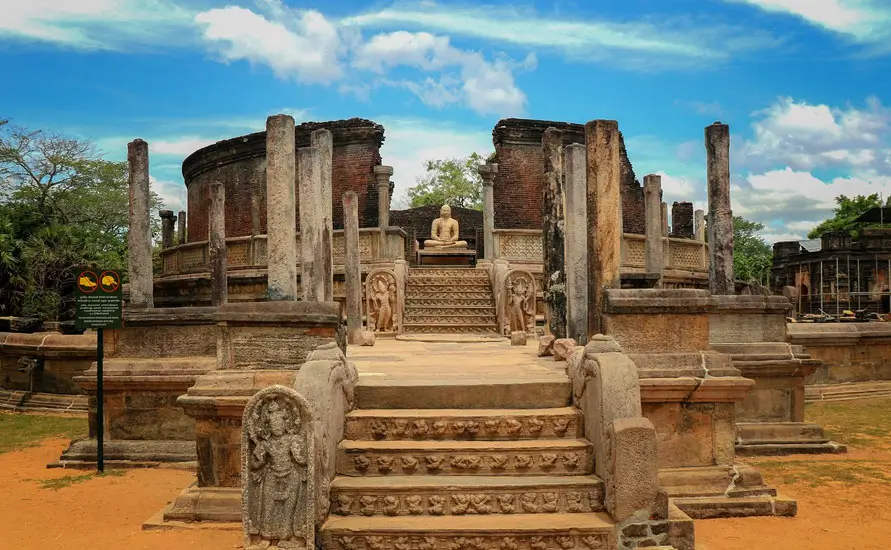
The Royal Palace of Parakramabahu is thought to have risen several stories, and its thick brick walls still show holes for the beams. Next door, the Council Chamber is lined with carved lions and elephants. In the Quadrangle, the round Vatadage shelters four seated Buddhas facing the cardinal points around a small stupa, approached by steps decorated with moonstones and guardstones. Nearby stands the Gal Pota, a stone slab carved to look like a palm-leaf book and inscribed with the deeds of King Nissanka Malla. Keep a hat and plenty of water at hand, because the site is open and hot by late morning.
After lunch you continue north to the Lankatilaka, a tall brick image house with a headless standing Buddha, and the bell-shaped Rankoth Vehera. The best is saved for last: the Gal Vihara, four Buddha figures carved from one long granite outcrop in the 12th century: a seated figure, a smaller seated figure in a cave, a standing figure with crossed arms and a 14-meter reclining Buddha entering nirvana. Shoes and hats must be removed, and visitors should not pose with their backs to the statues for photos. Drive back to Sigiriya in the late afternoon. Overnight in Sigiriya.
Reach the gate as it opens, around 7 am, to climb the Sigiriya rock fortress before the heat and the crowds. King Kashyapa made this 200-meter rock his capital in the late 5th century, after seizing the throne from his father, and the palace on the summit was abandoned after his death. The approach passes symmetrical water gardens with fountains that still work in the rainy season, then winds up through boulder gardens. Halfway, a spiral metal staircase leads to the famous frescoes of graceful women holding flowers, painted in a sheltered pocket of rock, where flash photography is forbidden.
Beyond the polished Mirror Wall, where visitors over a thousand years ago left short poems, you reach the Lion Terrace, where two massive paws remain from the brick lion that once guarded the final staircase. The last section climbs the bare rock on metal stairs to the summit, about 1,200 steps in total from the base. On the summit, brick footings of the royal buildings, a rock-cut tank and a throne cut in the rock look out over forest and reservoirs. Budget around three hours for the full visit, including the museum near the entrance, and wear good walking shoes.
After lunch you drive about half an hour south to the Dambulla Cave Temple, a complex of five caves high on a rock outcrop that has been a place of worship for more than two thousand years. The caves are full of Buddha images and painted ceilings, mostly from the 18th century when the Kandyan kings restored the site. Remove hats and shoes and dress modestly. The road then continues through Matale's spice country and down into Kandy, where the final Sinhalese kingdom held out until 1815, reaching it in the early evening for two nights. Overnight in Kandy.
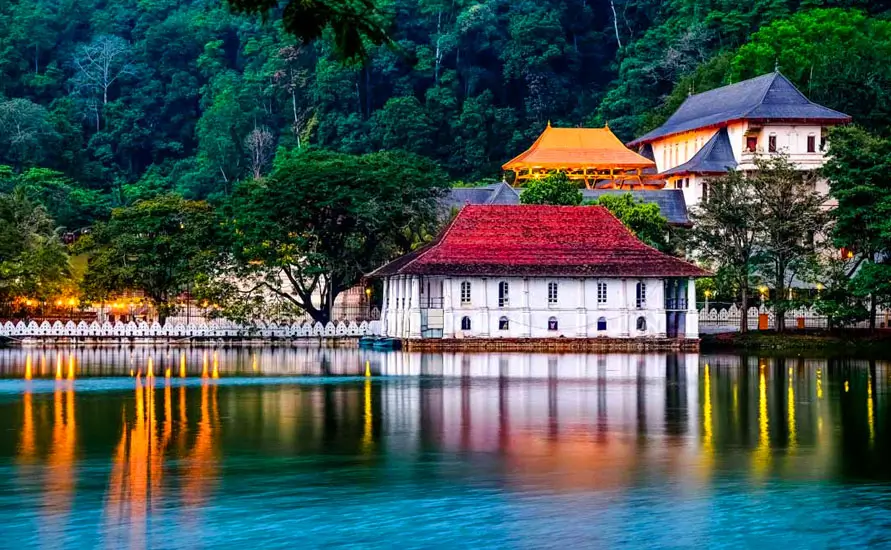
Arrive at the lakeside Tooth Relic temple, Sri Dalada Maligawa, in time for the morning puja, when drummers beat a steady rhythm and pilgrims carry lotus flowers to the upper chamber. The relic it guards has been the symbol of royal authority in Sri Lanka for centuries, moving from Anuradhapura to Polonnaruwa, Yapahuwa and other capitals before reaching Kandy, so it ties together nearly every site on this tour. Your guide explains the rules: covered shoulders and knees, hats removed, shoes left at the entrance and no posing for photos with your back to the shrine. Allow time for the museum and the Audience Hall of the last Kandyan kings.
In the late morning you drive into the hills west of Kandy for the loop of three temples built during the brief Gampola period in the 14th century. Gadaladeniya shows a strong South Indian influence in its stone architecture, a reminder of the craftsmen who crossed from India to work here. Lankatilaka Vihara sits on a rock outcrop with a fine painted interior, and Embekke Devale is famous for its hall of wooden columns covered with carvings of soldiers, dancers, swans and double-headed eagles. The country roads pass rice terraces and small villages, and lunch is a home-style rice and curry in a village eatery.
Back in Kandy in the afternoon, you can wander the shops along the lake and around the market, or rest at your hotel. In the early evening, a show of Kandyan dancing and drumming previews the costumes and music of Kandy's great summer pageant, held over ten nights in July or August, ending with fire-walking. Afterwards you might take a walk along the lake promenade, which locals call the Bogambara side. This is the last night of the tour, so your guide will review tomorrow's timings with you and suggest how early to leave for the airport. Overnight in Kandy.
No early start is needed this morning: the run to Bandaranaike airport at Katunayake is roughly three hours, partly on the new Central Expressway. Your chauffeur-guide counts back from the departure time on your ticket and builds in a cushion for expressway traffic near Colombo. If time allows, a short stop at a tea shop or cashew stall on the way lets you pick up final gifts. For late-night flights, we can book a beach room in Negombo for the day or an extra night, at a supplement.
Over sixteen nights you have walked through the abandoned capitals of the Hoysalas and Vijayanagara in Karnataka, then the Sinhalese royal cities that rose and fell from Anuradhapura to Kandy. The pattern of kings, monks and craftsmen moving between India and Sri Lanka has been clear throughout, from Chola temples in Polonnaruwa to South Indian stonework at Gadaladeniya. We hope the tour leaves you with a new picture of both countries, and we wish you a safe and easy trip home.
Your Journey

N.S. Rathore & Mrs. Omlata Rathore · Managing Director
We still read every enquiry ourselves. Tell us the places you liked and our planners will send a day-by-day route with drive times and a clear price.
Every package can be customised and no pressure to book. A planner from our office replies within 24 hours with a route written for your group.
Fill this in and your planner will send a first draft itinerary.
Explore more
Kerala Backwaters Escape Kerala Backwaters Escape
 Kerala Backwaters Escape
 Kerala Backwaters Escape
 Kerala Backwaters Escape
 Kerala Backwaters Escape
 Kerala Backwaters Escape
 Kerala Backwaters Escape
 Kerala Backwaters Escape
 Kerala Backwaters Escape
 Kerala Backwaters Escape
 Kerala Backwaters Escape
 Kerala Backwaters Escape
 Kerala Backwaters Escape Kerala Backwaters Escape Kerala Backwaters Escape Kerala Backwaters Escape