
 Kerala Backwaters Escape

South India with Sri Lanka and Maldives
Chennai – DakshinaChitra – Mahabalipuram – Pondicherry – Chennai – Male (Maldives)
At a glance
The Coromandel Coast and the atolls of the Maldives face the same Indian Ocean, yet they belong to different worlds. Our Chennai Pondicherry and Maldives holiday starts on the Tamil side, among temple towers, bronze idols, granite carvings and Franco-Tamil streets, and then crosses the water for four quiet days on a coral island. The first half is about people, food and history; the second is about reef, lagoon and rest. Both halves are private and paced for travelers who want to see something real before they switch off completely.
On the Indian side you spend one night in Chennai, one in Mahabalipuram and two in Pondicherry, and one AC car with its English-speaking driver handles each road leg. Local guides lead the Chennai, Mahabalipuram and Pondicherry visits, and no single drive on the East Coast Road runs past roughly three and a half hours. On day five you return to Chennai airport for the hop across to Male, nonstop or with one change according to the schedule, and a resort speedboat takes you on to your island.
This Chennai Pondicherry and Maldives holiday is designed for couples, honeymooners and families based in the UK, the EU, the Americas or Oceania, and also for NRI families with relatives in Tamil Nadu who want to add a beach break at the end of a visit. The Maldives days are planned with a snorkel trip, a sunset fishing outing and a visit to a fishing island, with free hours around each. Between November and March both the Tamil coast and the atolls tend to be at their driest. Dates, hotels and villa types can be changed.
Look for a sign with your name at the international exit, held by someone from our Chennai office, and within a few minutes you are in a private air-conditioned car heading into the city. Because so many overseas arrivals touch down in Chennai in the small hours, booking the room from the night before (a small supplement) which lets you go straight to sleep instead of waiting in a lobby. After breakfast and a few hours of rest, your guide comes to the lobby late in the morning to run through the week ahead and to answer practical questions on ATMs, local phone plans and temple dress.
The afternoon begins in Egmore at the Government Museum, set up in 1851 and among the country's oldest public collections. The bronze gallery here holds rows of Chola-period figures cast by the lost-wax method a thousand years ago, including several dancing Shiva images as Nataraja, ringed by a circle of flames. Your guide explains how these idols were carried through the streets on festival days, and why their faces and hands are so finely finished. Both this museum and the fort museum close on Fridays; on a Friday we keep to the fort grounds and church and add the temple quarter of Mylapore instead.
Next you drive to Fort St. George, built by the East India Company from 1640 and the starting point of the city once known as Madras. Inside the walls stand the state's legislative buildings, a small museum of colonial arms, coins and portraits, and St. Mary's Church, consecrated in 1680, where Elihu Yale, later the benefactor of Yale University, was married. As the light fades, a short drive along the seafront brings you back toward your hotel, and dinner might be crisp ghee roast dosa with coconut chutney and a tumbler of filter coffee. Overnight in Chennai.
Bags go in the car after breakfast and you drive the East Coast Road, the highway that runs along the Bay of Bengal past fishing villages, film studios and the walled compounds of beach resorts. Roughly sixty minutes out of town comes DakshinaChitra, a heritage village where old houses from all five southern states were taken down piece by piece and rebuilt on one site. Inside, there is a Chettiar trader's home with teak columns, a tile-roofed Syrian Christian home from Kerala and a potter's hut with its kiln still in use. The site is closed on Tuesdays.
Craftspeople often work in the courtyards, and on a given morning there might be a basket weaver, a glass-bangle maker or a puppeteer with leather shadow figures from Andhra Pradesh. Your guide explains how each house type answers its own climate, from thick mud walls in dry Tamil villages to steep roofs built for Kerala's monsoon. Lunch is at the on-site café, which serves simple regional meals, and there is a good craft shop for handloom cotton and toys. After lunch the car covers the last forty-odd minutes to Mahabalipuram, where a beach hotel waits.
Toward 5 pm your guide leads the way to the Shore Temple, timed so that you are there as evening light warms the two granite towers to pink. Raised around the early 8th century under Rajasimha, it ranks among the earliest free-standing stone temples in the south, and small Nandi bulls sit in a row along its enclosure wall. Waves have worn the outer sculptures smooth, and a breakwater now protects the site. After the visit, walk back through the village to a seafood restaurant where the waiters bring the morning's catch to your table so you can choose. Overnight in Mahabalipuram.
Start before the tour buses arrive. At seven in the morning the monuments of Mahabalipuram are almost empty, and your guide can show you the details without a crowd in the way. Begin at the relief that guides call Arjuna's Penance or the Descent of the Ganges, then walk up the hill to the Mahishasuramardini cave, where the goddess Durga rides a lion into battle against a buffalo-headed demon, a panel many scholars rank among the best Pallava work. Monkeys gather on the rocks above, so keep snacks out of sight. The hilltop also gives a good look at the old lighthouse and the village below.
After the Pancha Rathas, the five chariot-shaped shrines each cut from one boulder, you stop at a sculpture workshop on the main road. Mahabalipuram still has hundreds of stone carvers, many of them graduates of the state-run sculpture college in town, and you can stand beside them as they shape granite and soapstone deities with chisels and power grinders. Pieces range from palm-sized Ganeshas to temple statues several meters tall that are shipped abroad. Buyers can have pieces packed and shipped, and the workshop handles the export papers. A late breakfast or early lunch is taken in town before you leave.
The drive to Pondicherry follows the coast road south, passing salt pans, prawn farms and the backwater at Muthukadu, where fishermen cast nets from the bridges. A stop for chilled tender coconut at a beach stall is easy to add. Around three in the afternoon you arrive at a heritage hotel close to the seafront. From then on your time is free: rent a bicycle, linger over coffee near Rue Romain Rolland or join the evening crowd on Goubert Avenue, the beach promenade that becomes a pedestrian zone at dusk. Overnight in Pondicherry.
Pondicherry has two old towns divided by a canal, and most visitors see only the French side. Your guided walk today starts on the other bank, in the Tamil Quarter, where many homes keep a raised front platform, the thinnai, where neighbors and passers-by once sat out of the sun, and carved wooden doors painted in deep green and red. Your guide explains how the French colonial plan pushed Tamil families to this side of the canal, and how the two communities still mix in markets, churches and temples. A stop at Goubert Market shows you fish, flowers, fruit and spice stalls in full morning swing.
Crossing the canal into the French Quarter, the streets become straight, quiet and lined with walled mansions in pale yellow and white. You pass the old town hall, the French consulate and the Lycée Français, still teaching in French, and pause at Notre-Dame des Anges, the church facing the sea. The Sri Aurobindo Ashram is part of the route too, where you can sit in silence at the samadhi in the courtyard. Lunch is free, and the choice is wide: a Creole fish curry, a buckwheat crêpe or a Tamil vegetarian meal on a steel plate in a small mess.
After lunch the car heads twenty minutes north to Auroville, the township the Mother founded in 1968 as an attempt at a community without religion, politics or nationality. Start with the short film and exhibits at the visitor center, then walk about a kilometer through the trees to see the golden Matrimandir from the public viewing point. Going inside the inner chamber requires a pass booked well ahead at the visitor center, and places each day are few; let us know early. Back in town, the evening is free for a final walk by the sea. Overnight in Pondicherry.
Breakfast is early today, and then the coast road leads back north to Chennai International Airport, usually reached in three and a half hours if traffic allows. Chennai–Male services are nonstop on some days and one-stop on others, and the timing decides how early you leave Pondicherry. Before you fly, complete the Maldives online traveler declaration (IMUGA) within the window it allows before departure; our team emails the form link with simple notes. Male immigration stamps a free 30-day tourist visa into every passport, of any nationality, when you show a confirmed resort booking, six months of passport validity and a ticket out.
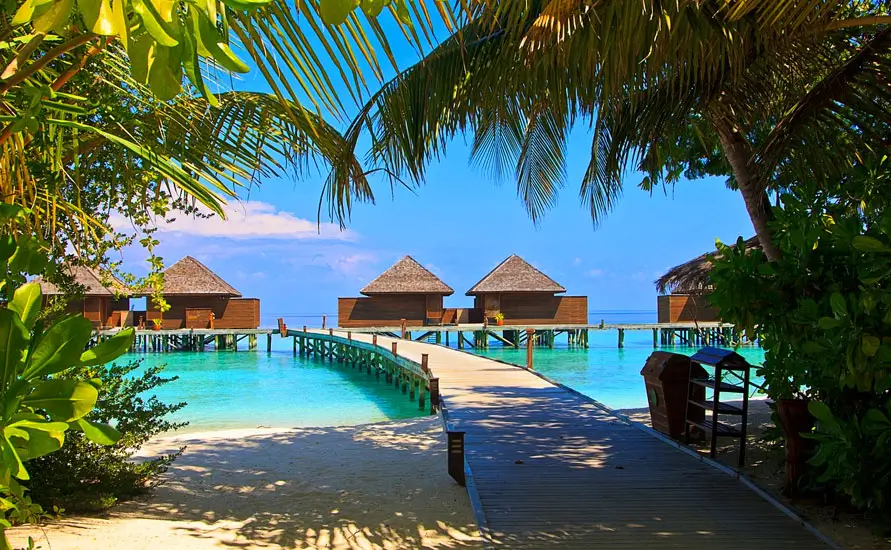
A resort host collects you once you are through customs at Velana International Airport and guides you to the boat jetty, a few steps from the terminal door. We select a resort reached by speedboat, which keeps the transfer short and works even with an evening landing, since seaplanes only operate in daylight. Over the next half hour or so the boat crosses open lagoon water toward your island, where staff wait on the pier with cold towels. After check-in and a briefing on the island, the first half-board dinner waits in the main restaurant. Overnight at your Maldives island resort.
Wake up to the sound of water on the shore and look out at a lagoon that changes color with the height of the sun, from pale mint at dawn to deep turquoise by midday. Breakfast is unhurried, and afterwards you can collect snorkel masks and fins from the water sports center, where staff check the fit and talk you through the tides and the safe entry points. The shallow lagoon in front of the beach is an easy place to practice, with sand flats where stingrays and small fish often feed close to shore. Children can join with life vests.
After lunch at your own expense, you join a snorkel trip by boat to a reef outside the resort lagoon, usually about fifteen to thirty minutes away. The guide chooses the spot according to the current and the visibility on the day, and the coral here tends to draw larger schools of fish: fusiliers, snappers, surgeonfish and sometimes eagle rays gliding along the drop-off. Turtles are common on many reefs, while manta rays and whale sharks depend on season and atoll, so we never promise them. The boat crew keeps an eye on everyone in the water and hands out drinking water between swims.
You come back to the island in the late afternoon sunburned at the edges and ready for a fresh-water rinse before sunset. The west-facing deck or beach of your resort is the place to be as the sun sinks behind the horizon, and some resorts serve tea or drinks at a sunset bar. Dinner is included on the half board plan, usually as a buffet or set menu, and many resorts run a Maldivian night once a week, with dishes such as mas huni, fish curry and roshi bread. Overnight at your Maldives island resort.
In the morning a boat takes you to a nearby inhabited island, a short trip that shows a very different Maldives from the resort. Around a thousand or a few thousand people may live on an island like this, with a harbor of fishing dhonis, a school, a health center and a mosque at its center. Walking along the coral-stone lanes, you may pass women sitting in the shade making rope from coconut fiber or men repairing nets. Modest dress is required: cover shoulders and knees, and keep swimwear for the resort or a designated tourist beach. No bars or alcohol exist on these islands.
Your guide explains how tuna fishing with pole and line kept the country going for centuries, and how tourism has changed island life since the first resorts opened in the 1970s. A stop at a small café gives you the chance to taste short eats such as gulha, small fried dumplings of tuna and coconut, served with sweet black tea. Some islands have a souvenir shop selling lacquerware and woven mats. You are back at the resort around lunchtime, with the afternoon free for a nap in the shade, a swim on the house reef or a book in a beach hammock.
Before sunset you set out on a traditional dhoni for sunset fishing, an old island pastime done the Maldivian way, with a simple handline wound around a block of wood and no rod. The crew baits the hooks with small fish and shows you how to drop the line to the reef and feel for a tug. Snappers, groupers and jacks are typical catches, and many resorts will grill yours for dinner on request. The sky usually turns orange and violet as the boat returns, and you can watch fruit bats flying between islands at dusk. Overnight at your Maldives island resort.
Your final full day has no fixed plan, so use it the way you like best. Early risers can walk the beach at dawn, when hermit crabs leave tracks across the sand and herons stand on the reef flat waiting for fish. If you have not tried it yet, a stand-up paddleboard is an easy way to cover the lagoon and see the bottom from above, and many resorts lend them free of charge. Those who want something new can take an introductory dive with a certified instructor, which starts in the pool or shallows and does not need any previous training.
The resort spa is the other popular choice for the last day. Treatments range from simple foot massages to long Balinese, Thai or Ayurvedic sessions, often with coconut oil and island-grown herbs, and couples' rooms can be booked together. Prices are charged separately and vary by resort, so it is wise to reserve a time a day ahead. In the afternoon, settle any bills at the front desk and confirm your speedboat time for tomorrow, so that the departure goes smoothly. Our team stays reachable by phone and messaging if anything about your flight changes.
For your last evening, many guests reserve a table for two on the sand or at the far end of a jetty, arranged by the resort as an optional extra, with a table set in the sand and lanterns around it. Others prefer the main restaurant and an early night after a last look at the stars, which are very bright with so little light around. Either way, take a few minutes to walk the shoreline after dark, where the water sometimes glows blue with bioluminescent plankton, a natural effect that appears on some nights in some seasons. Overnight at your Maldives island resort.
After breakfast and checkout, the resort speedboat returns you to Velana International Airport, ideally landing you there three hours ahead of take-off, so check-in and security can be handled without any rush. Porters wait at the jetty to help with heavy bags, and the departure hall has cafés and duty-free shops for last purchases. The terminal is a short walk from the boat jetty, and porters help with luggage. From Male most guests reach home with at most one change, via the Gulf, India or Southeast Asia.
Over nine days you have walked through Chennai's museum halls and colonial fort, watched sculptors at work in Mahabalipuram, crossed both halves of Pondicherry and finished with four days of reefs and island life. For a future visit we can build a longer trip through Madurai and Kerala or add Sri Lanka before the beach. Nandri from all of us in Chennai, and fly home safely.
Your Journey

N.S. Rathore & Mrs. Omlata Rathore · Managing Director
We still read every enquiry ourselves. Tell us the places you liked and our planners will send a day-by-day route with drive times and a clear price.
Every package can be customised and no pressure to book. A planner from our office replies within 24 hours with a route written for your group.
Fill this in and your planner will send a first draft itinerary.
Explore more
Kerala Backwaters Escape Kerala Backwaters Escape Kerala Backwaters Escape Kerala Backwaters Escape Kerala Backwaters Escape