


 Kerala Backwaters Escape

South India Tour Packages
Bangalore – Srirangapatna – Mysore – Bylakuppe – Coorg – Ooty – Madurai – Tanjore – Pondicherry – Mahabalipuram – Chennai – Kochi – Munnar – Thekkady – Alleppey – Kovalam – Trivandrum
At a glance
Three weeks is the amount of time South India asks for if you want to see its range rather than a sample. Our Grand South India Tour 21 Days follows a complete loop through Karnataka, Tamil Nadu and Kerala, beginning in the garden city of Bangalore and ending with your feet in the sand at Kovalam. Between those two points come the Wadiyar palaces of Mysore, coffee country in Coorg, cool Ooty in the Nilgiris, the towering shrines of Madurai and Tanjore, the pastel streets of Pondicherry, harborside Kochi, the tea-covered ridges of Munnar and a night afloat near Alleppey.
The route follows the map rather than doubling back. Karnataka comes first, with palaces, a Tibetan settlement and plantation estates, before the road climbs into the Nilgiris and then drops onto the Tamil plains for the great Chola and Nayak temples. A short flight from Chennai to Kochi takes you across the peninsula, and the final week in Kerala moves from hill station to wildlife reserve to houseboat to beach. Most drives take between three and five hours, and two-night stops in most places give you regular breaks from packing.
This grand South India tour is designed for travelers who have the time and want to use it well: retired couples, long-stay visitors from Europe and North America, and NRI families planning a full return trip with children. You travel by private car with a chauffeur who speaks English, and government-approved guides handle the major sites in each city. The trip ends with departure from Trivandrum, just half an hour from the beach. The months from October through March suit this route best, bringing crisp nights in the hills and little rain along the shoreline.
Your three-week trip opens in Bangalore, also called Bengaluru, the capital of Karnataka and India's largest technology hub. Thanks to its raised position on the Deccan plateau, Bangalore stays noticeably cooler and less humid than Chennai or Kochi, which you reach later. At Kempegowda International Airport, a member of our team greets you outside the terminal and escorts you to the car for the drive into town, normally around sixty minutes, though rush-hour jams can stretch it. Plenty of long-haul services touch down well after midnight, and if yours is one of them we can hold the room from the evening before so you can sleep on arrival.
After a rest, our tour coordinator meets you at the hotel to hand over your travel documents, introduce your driver and talk through the route ahead. Because this grand South India tour crosses three states, each with its own language, food and customs, the briefing covers simple things to know, such as greetings in Kannada, Tamil and Malayalam, how to tip and where to change money. Your driver will be with you for the Karnataka and Tamil Nadu parts of the trip, and a Kerala-based driver takes over after your flight to Kochi, since local drivers know their own roads best.
Once the heat of the day eases, your guide walks you through Lalbagh Botanical Garden, a royal garden begun by Hyder Ali and later enlarged by Tipu Sultan, who brought in plants from Persia, Afghanistan and France. Its glass house, a Victorian iron-and-glass structure dating from 1889, is the venue for the city's twice-yearly flower shows in January and August, and the paths lead past a lake and trees that are well over a century old. A rock outcrop in the garden is among the oldest formations on earth, and one of the four watchtowers built by the city's founder, Kempe Gowda, stands on top of it. Dinner is at a local restaurant or your hotel. Overnight in Bangalore.
Before leaving the city, your guide takes you to Tipu Sultan's Summer Palace, an airy wooden retreat of carved teak arches finished in 1791 near the old city fort. Its carved pillars, balconies and painted walls give a glimpse of court life under the ruler who fought the British in four wars. Nearby, the Bull Temple in the Basavanagudi district holds a large monolithic statue of Nandi, Shiva's mount, carved from a single granite rock and blackened by oil and age. Your guide also drives you past the Vidhana Soudha, the huge granite seat of the state legislature, built in the 1950s in a style inspired by Dravidian temple architecture.
The Bangalore–Mysore expressway then carries you out of the suburbs. Roughly two and a half hours later, your driver pulls off at Srirangapatna, a river island ringed by the Kaveri that Tipu ruled from until his death. Here you see the ruins of the fort where he fell in 1799 when British troops stormed the walls, the dungeon where British officers were held, and the Daria Daulat Bagh, his summer palace, whose walls are covered in murals of battles and processions. A short distance away stands the Gumbaz, the mausoleum of Tipu Sultan and his father Hyder Ali, framed by cypress trees and polished black pillars.
From the island, Mysore lies only some 30 minutes further on, so you should be settled in your room before dark. Mysore was the seat of the Wadiyar kings for more than five centuries, and today it is a calm city with wide avenues, old markets and colonial buildings painted in pale yellow and white. Your guide gives a short walking tour of the area around your hotel if time allows, or you can rest after the day's travel. Dinner is a good chance to try Mysore specialties such as bisi bele bath, a spicy rice and lentil dish, followed by Mysore pak, a rich sweet made with gram flour, sugar and ghee. Overnight in Mysore.
The day starts at Chamundi Hill, a short drive from the city, where the Chamundeshwari Temple stands on the summit at about 1,000 meters. The goddess Chamundi is the family deity of the Wadiyar kings, and pilgrims climb about a thousand steps to her temple, although you drive up. Partway down the hill road you pause beside the Nandi statue, a seated bull hewn from one block of black granite in the 1600s, its neck hung with sculpted chains of bells. From the viewpoint near the top you can see the whole of Mysore spread across the plain, with the palace domes clearly visible on a clear morning.
Late morning belongs to the Mysore Palace, the royal residence that replaced an older timber palace lost to fire in 1897. Henry Irwin, a British architect then working in Madras, drew up its plans, mixing domes, arches and towers from several traditions into one grand Indo-Saracenic facade. Inside, the Kalyana Mantapa, or wedding hall, has a ceiling of stained glass from Scotland and a floor of geometric tiles, while the Durbar Hall has carved columns and views of Chamundi Hill. Footwear goes into a supervised shoe stand before entry, and cameras stay switched off in the interiors, although pictures of the exterior and gardens are fine. Your guide explains the rules on arrival.
In the afternoon you walk through the Devaraja Market, a covered market dating back more than a century, where vendors sell flowers, fruit, incense and small hills of colored kumkum powder. Shoppers can ask the guide to stop at a state-run handicrafts showroom, where fixed prices take the guesswork out of buying Mysore silk saris, sandalwood soap or rosewood inlay. On Sunday and public holiday evenings, the Mysore Palace illumination switches on for roughly 45 minutes from about 7 pm, with close to a hundred thousand light bulbs tracing every dome and arch. It is worth timing your evening around it. Overnight in Mysore.
Your next base is Coorg, which locals call Kodagu, a hilly district west of Mysore where coffee bushes grow under a canopy of forest along the Western Ghats. The road leaves the flat farmland of the Mysore plateau and gradually climbs into greener, hillier country, and the air becomes cooler and fresher as you go. Two hours or so into the drive comes Bylakuppe, where the Karnataka government granted land around 1960 to Tibetans who had fled after the Chinese takeover, creating a community that is now among the biggest of its kind in India. Thousands of monks and lay families live here, and the settlement has its own schools, farms and monasteries.
Your visit centers on Namdroling Monastery, founded in 1963 and now housing thousands of Nyingma-order monks and nuns who study and pray there. Its large prayer hall, often called the Golden Temple, contains three gilded statues about 18 meters tall, of the Buddha, Padmasambhava and Amitayus, set against walls painted with Buddhist scenes. If a prayer session is underway, guests may take a seat near the entrance and listen as deep-voiced recitation mixes with long brass horns and cymbals. Outside, small cafés serve momos, thukpa noodle soup and butter tea, which make a good lunch stop before you continue the last hour of the drive to Coorg.
Coorg greets you in the afternoon, and you check in to a plantation stay or a resort surrounded by coffee and pepper. With the afternoon unscheduled, you can stroll between the coffee rows or sit on the veranda and listen to the birds after two days of cities. The district's original inhabitants, the Kodavas, have their own dress, customs and a long soldiering tradition, and their signature dish is pandi curry, pork slow-cooked until almost black and soured with kachampuli, a thick fruit vinegar made in the hills. Many plantation stays serve home-style Kodava meals, and your hosts can tell you about the region's history and festivals over dinner. Overnight in Coorg.
Start the day on foot inside a working Coorg coffee estate, following muddy tracks between robusta and arabica bushes sheltered by silver oaks that double as supports for twining pepper. Your guide, often a planter or estate worker, explains the full cycle from flowering after the first summer rains to harvest in the cool months, then pulping, drying and grading the beans. Cardamom and oranges are often grown on the same land, and you may see birds such as hornbills, barbets and bulbuls in the canopy. The walk ends with a cup of freshly brewed coffee and a chance to buy beans from the estate.
Before lunch the car climbs to Madikeri, the district headquarters, for a short visit to the Madikeri Fort, built in the 17th century and later rebuilt by Tipu Sultan. Inside the walls stand an old palace used as government offices, a small museum in a former church and two life-size stone elephants. A few kilometers outside town, Abbey Falls tumbles down a rock face screened by coffee bushes and cardamom. Expect a descent of a few hundred steps from the car park to the viewing area that faces the cascade, which carries the most water in the months right after the rains, roughly August to November.
For the end of the afternoon, your driver drops you at Raja's Seat, a terraced garden at the town's edge that, according to local tradition, was a favorite lookout of the Kodagu rulers. Ridge after ridge fades into the distance from here, often with mist lying in the folds between them as the light goes. Spice stalls near the garden sell wild honey, cardamom and fruit wines if you want a souvenir. Back at the estate, the hosts at many plantation stays light a campfire after dark or lead a short night walk with a flashlight to look for frogs and nightjars. Tomorrow is a long road day into the Nilgiris. Overnight in Coorg.
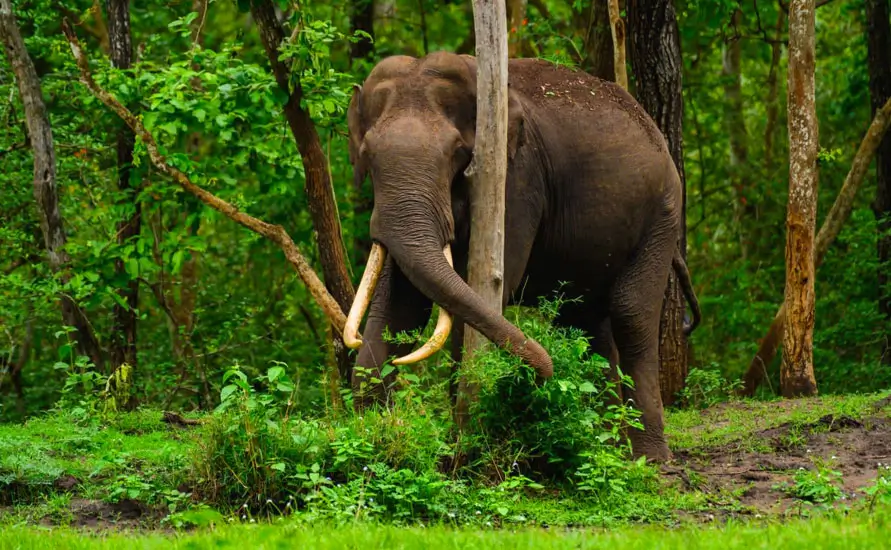
Today is one of the longer road days of the trip, so the car is loaded soon after an early breakfast. You travel south-east through Hunsur and Gundlupet, then enter Bandipur National Park in Karnataka and continue into Mudumalai National Park in Tamil Nadu, two connected reserves that form part of the Nilgiri Biosphere Reserve. The road through the forest is open to traffic during the day only, and speed limits are strict to protect wildlife. Spotted deer, langur monkeys, peacocks and wild elephants are often seen from the car, and your driver will stop where it is safe for a photo.
After Mudumalai, the road starts climbing toward the Nilgiri Hills, the blue mountains that rise steeply from the plains. Depending on conditions, your driver takes either the steep Kalhatti ghat road with its many hairpin bends or the longer but gentler route via Gudalur, which winds through tea estates and eucalyptus forests. The air cools quickly as you climb, and by the time you reach Ooty at about 2,200 meters, you may need a sweater, especially in December and January. Lunch is at a roadside restaurant along the way, and there are regular stops to stretch your legs and enjoy the views.
Each hot season, the government of colonial Madras moved its offices up to this hill town, known on official maps as Udhagamandalam, and stone churches, gabled bungalows and old clubhouses from those years still line its slopes. Your room for the next two nights is at a heritage hotel or hillside resort, where you arrive with a little daylight to spare. A cup of Nilgiri tea beside a log fire or a short wander through the garden is about all the evening needs. The local chocolate shops are well known, selling homemade chocolate in many flavors, and your guide can recommend a good one. Dinner at the hotel may include both Indian and continental dishes. Overnight in Ooty.
A seat on the Nilgiri Mountain Railway is the morning's highlight; in 2005 UNESCO added the line to its Mountain Railways of India listing, joining the Darjeeling Himalayan Railway. The full line runs from Mettupalayam at the foot of the hills to Ooty, and the upper section between Ooty and Coonoor passes through tea gardens, pine forests and small stations with old signal boxes. Tickets are booked in advance, subject to availability, and seats are usually in first class. Allow roughly 75 minutes for the trip downhill, with brief halts at Lovedale, Ketti and Wellington, small stations where passengers lean out of the windows to take pictures.
At Coonoor, your driver meets you at the station for local sightseeing. Sim's Park is a botanical garden laid out in the 19th century on the slopes of a valley, with old trees, ferns and flower beds. From there you continue to Dolphin's Nose, a viewpoint where a rocky outcrop overlooks a deep valley and the distant Catherine Falls. On the way, you visit a tea factory where green leaves are withered, rolled, fermented and dried into black tea. At the tasting counter you sample a few cups side by side and learn why whole-leaf orthodox tea and granular CTC tea, used mostly for chai, are made in different ways.
You return to Ooty by car in the afternoon and visit the Government Botanical Garden, established in 1848 and laid out on terraces on the slopes of Doddabetta. Its fossil tree trunk, believed to be about 20 million years old, Italian garden and many flower beds draw large crowds of Indian tourists, especially during the summer flower show in May. If time permits, you can also see Ooty Lake, an artificial lake built in the 1820s, where rowing and pedal boats are available. The evening is free to rest before tomorrow's long drive down to the Tamil plains. Overnight in Ooty.
Be ready for the most demanding road day of the whole tour: seven to eight hours in the car, which is why departure is soon after an early breakfast and the driver plans a rest stop roughly every two hours. The road from Ooty drops down the Nilgiris through Coonoor and the ghat road to Mettupalayam, passing tea gardens, forests and the toy train track running alongside in places. The descent takes about two and a half hours, and the temperature rises steadily as you reach the plains. Your driver takes it slowly on the hairpin bends, and the morning light on the hills makes the first part of the drive one of the most attractive in South India. Carry motion sickness tablets if you are sensitive to winding roads.
From Mettupalayam you pass Coimbatore, a large industrial city known for its textile mills, and continue south-east across the plains of western Tamil Nadu. The landscape changes to coconut farms, cotton fields and red earth, with occasional granite hills rising from the plain. Lunch is at a clean restaurant along the highway, where you can try a Kongu-style meal from this region, known for its use of coconut, lentils and pepper. The road then continues through Dindigul, famous for its locks and its biryani, and approaches Madurai from the north-west in the late afternoon.
Around dusk the car finally rolls into Madurai, where a hotel room is booked for the next two nights. The city was the seat of the Pandya dynasty and is celebrated in the earliest Tamil poems, and pilgrims and traders still pour in every day. Nothing is scheduled tonight, since most guests want a shower, dinner and an early bed after so many hours on the road. Anyone with energy left can ask the driver for a short spin past the temple quarter, where lamp-lit stalls stay open late and floodlights pick out the painted gopurams. Tomorrow is a full day of sightseeing in the temple city. Overnight in Madurai.
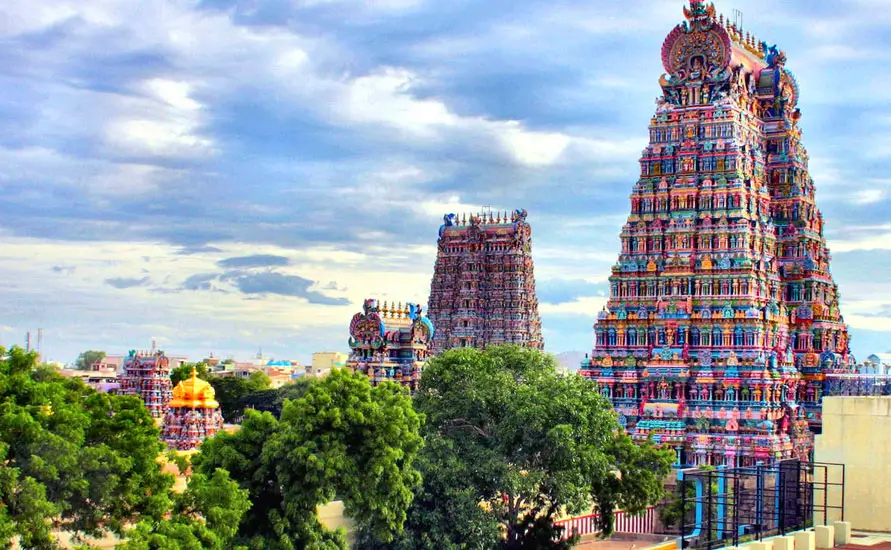
Rested after yesterday's long drive, you walk with your guide into the Meenakshi Amman Temple in the cooler hours after breakfast, when the morning pujas fill the corridors with the smell of jasmine and camphor. Fourteen gopurams, or entrance towers, rise over the complex, and the tallest, on the southern side, climbs to roughly 52 meters, its tiers crowded with gods, demons and animals repainted every twelve years or so for the consecration festival. Hand in your phone and camera at a deposit counter before going through the gate; non-Hindus are kept out of the inner sanctums, but everyone may walk the outer halls, the tank and the long pillared corridors.
Inside the walls, your guide points out the sculpted pillars of the Ashta Shakti Mandapam, the first hall most visitors pass through, where eight forms of the goddess are carved on the columns. You then reach the Potramarai Kulam, the tank of the golden lotus, and the long corridors where brides and grooms often come to be blessed. Before lunch you drive a short way south-east of the temple for the Thirumalai Nayak Palace, a 1630s royal home of which only about a quarter survives. Its great courtyard is lined with round white pillars, each so thick that two people can barely link arms around it, under a domed hall finished in lime plaster.
Wait out the midday heat at the hotel, and around four o'clock head for the Gandhi Memorial Museum, set in an old Nayak queen's residence; a darkened room there keeps the stained cloth the Mahatma had on when he was assassinated in Delhi in 1948. Near sunset your guide leads you through the cloth market on the temple's east side, where tailors can stitch a shirt within a day. Once you have eaten, your guide can walk you back for the palliyarai ceremony near 9 pm, when the god is carried to his consort's chamber for the night; nobody needs a ticket, though festival nights draw heavy crowds. Overnight in Madurai.
Leaving Madurai after breakfast, your driver heads north-east across the flat farmland of the old Pandya kingdom, where rice paddies alternate with stands of palmyra palms and small shrines guarded by painted clay horses. These horses, some taller than a man, are offerings to Ayyanar, a village guardian deity who is believed to ride out at night to protect fields and families. Your driver can stop at one of these roadside groves so you can take a closer look at the figures, many of which are renewed every few years by local potters. The drive is easy, on good roads, with a tea stop about halfway.
If you would like a short detour, the road can loop through a corner of the Chettinad region, home of the Nattukottai Chettiar merchant families who made fortunes in banking across Burma, Malaya and Ceylon. Their mansions have courtyards lined with Burma teak pillars, floors of Athangudi tiles made by hand and doorways carved with gods and flowers. A quick visit to one open house adds about an hour, and lunch is a chance to taste Chettinad cooking, famous for black pepper, star anise and fiery chicken dishes. Our team will confirm which mansions are open on your date, since many remain private homes kept by caretakers.
By mid-afternoon you check in at Tanjore, or Thanjavur, the royal seat from which Chola rulers governed most of the south and sent war fleets across the Bay of Bengal a millennium ago. Late afternoon is the best moment to see the Brihadeeswarar Temple, completed in 1010 by Rajaraja Chola, when the granite turns gold in the low sun. Your guide shows you the huge Nandi carved from a single stone, the Chola frescoes in the inner corridor and the inscriptions listing the temple dancers and their salaries. Worship still goes on daily, so cover shoulders and knees and hand your shoes in at the stand by the gate. Overnight in Tanjore.
Start the morning in the Thanjavur Palace complex, built in parts by the Nayaks and later the Marathas, who ruled here until the British took over. The art gallery displays dozens of Chola bronzes of Shiva as Nataraja, Parvati and the poet-saints, cast in the lost-wax method that craftsmen in nearby Swamimalai still use. Your guide also takes you into the Saraswati Mahal Library, one of the oldest surviving libraries in Asia, where a small display shows palm-leaf manuscripts, old maps and illustrated books on medicine and astronomy. Allow around ninety minutes for the visit before the car heads north toward the coast.
About two hours later you stop at Gangaikonda Cholapuram, the capital founded by Rajendra Chola after his armies marched to the Ganges around 1025. The temple here is quieter than Tanjore and has a softer, curved tower, and the stone carvings on its walls include a famous panel of Shiva garlanding the saint Chandesha. From there the road takes you on to Chidambaram, home of the Nataraja Temple, where Shiva is worshipped as the cosmic dancer. Gold-plated tiles cover part of the roof over the central shrine, and the temple is run by a family line of priests who wear their hair tied in a knot at the front. Men may be asked to remove their shirts in some inner areas.
The final stretch follows the coast road north to Pondicherry, passing cashew groves, salt pans and fishing villages where catamarans are pulled up on the sand. You reach your hotel in the early evening, and your room is booked for two nights. Pondicherry, or Puducherry, was the main French base in India until 1954, and parts of the town still use French street names, with signs written in French and Tamil. If you still have energy, walk along the seafront promenade on Goubert Avenue, which is closed to traffic in the evenings so families and couples can stroll by the water. Overnight in Pondicherry.
A slow morning in the French Quarter suits Pondicherry better than a rushed tour, so your guide starts on foot soon after breakfast, before the sun climbs. The grid of straight streets, laid out under the French governors in the 18th century, is lined with mustard and white villas behind high walls and bougainvillea. You stop at the French War Memorial, put up after 1918 for the colony's soldiers, and at the neo-Gothic Sacred Heart Basilica on the south boulevard, where rows of colored glass windows glow in the morning light. In between, there is time for a croissant or filter coffee at a café.
Your guide then crosses the old canal into the Tamil side of town to see the Sri Aurobindo Ashram, started in the 1920s around the Bengali philosopher and his Paris-born companion, remembered simply as the Mother. Visitors file past the flower-covered samadhi in silence, and photography is not allowed inside. Two streets away, the small Manakula Vinayagar Temple honors Ganesha, and its inner walls show the elephant-headed god in dozens of painted forms. Before lunch you can visit the paper factory linked to the ashram, where workers make handmade paper from cotton waste and pressed flowers, or browse the shops on Mission Street for khadi cotton, incense and leather sandals made in the region.
In the afternoon, a twenty-minute drive north brings you to Auroville, an experimental town set up in the late 1960s where residents from dozens of countries now live and work. At the visitor center you can watch a short film and then follow the path to the public viewpoint of the Matrimandir. Going inside the chamber is possible only with a reservation made ahead, and places are few, so tell us early if you would like us to request one. Auroville also has bakeries, organic farms and craft workshops, so you may want to stay longer and browse. Back in town, dinner at a Creole restaurant combines French and Tamil cooking. Overnight in Pondicherry.
After a leisurely breakfast, the car takes the East Coast Road north, a two-lane highway that runs close to the sea through fishing villages, casuarina plantations and the occasional beach resort. A little over two hours later you arrive at Mahabalipuram, also called Mamallapuram, the sea harbor from which Pallava rulers traded with Southeast Asia some 1,300 years ago. Your guide meets you at the stone carving workshops that line the main street, where sculptors still shape granite with hammers and chisels, making temple images for clients across India and abroad. Watching a craftsman cut fine features from raw stone gives context for the ancient work you see next.
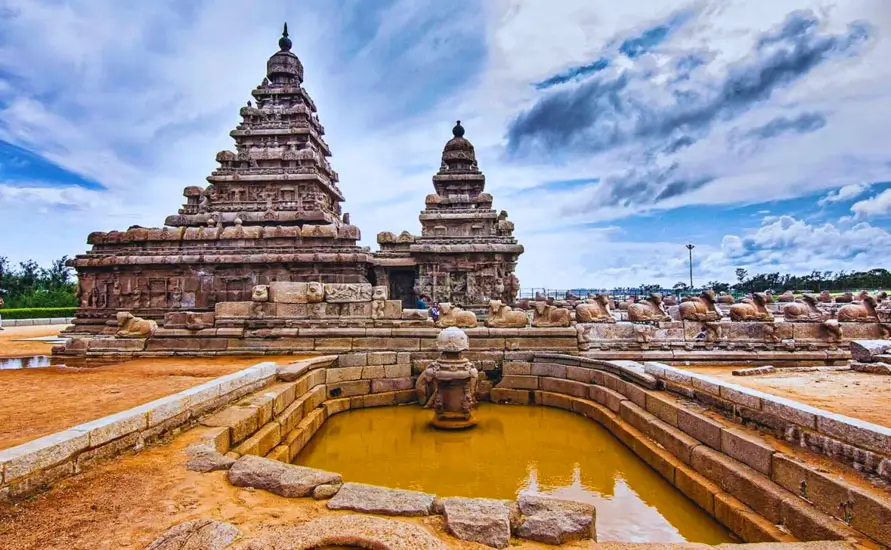
The Five Rathas are the first stop, a set of shrines cut from single outcrops of granite, each in a different form and named after the five Pandava heroes of the epic and their shared queen. A life-size elephant, lion and bull carved from the same rock stand beside them. You then walk past the cave temples on the main hill, including the Varaha Cave, before finishing at the Shore Temple, whose twin towers have faced the Bay of Bengal for some thirteen centuries. The 2004 tsunami briefly exposed older carvings on the seabed nearby, and archaeologists are still studying what lies under the sand.
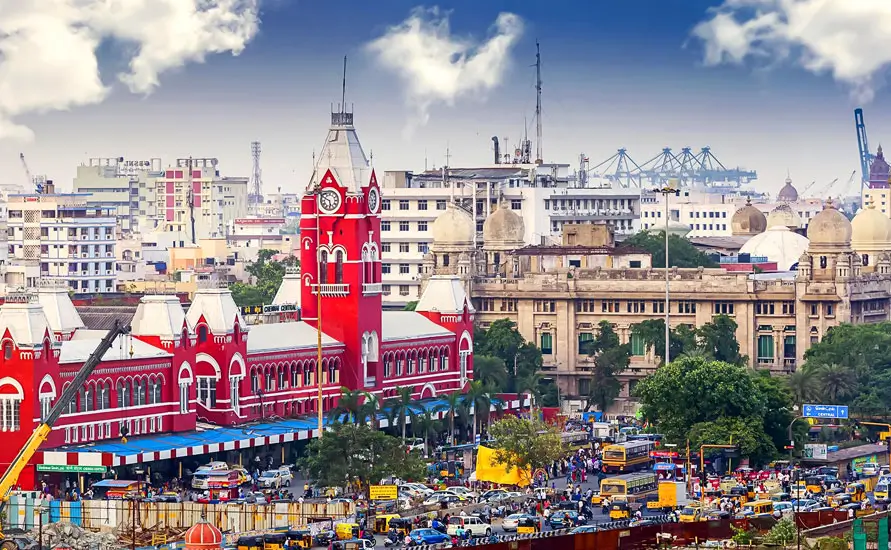
Lunch is at a seafood restaurant in the village, and then the final hour of driving brings you into Chennai, the old Madras, the capital of Tamil Nadu and the fourth largest city in India. If you reach the city early enough, your driver can pass through Marina Beach, a sandy stretch running for more than ten kilometers along the coast, where families gather in the evening for kites, roasted corn and sundal, a snack of spiced chickpeas. Your hotel is near the airport or in the center, depending on tomorrow's flight time. Tonight is your last evening in Tamil Nadu, so try a thali of Chettinad or Tamil Brahmin dishes. Overnight in Chennai.
Depending on your flight time, the morning can include a short tour of Chennai's colonial core before the drive to the airport. Your guide shows you Fort St. George, the East India Company's first stronghold in India, where the St. Mary's Church, consecrated in 1680, holds memorials to British soldiers and officials, including a register that records the marriage of Robert Clive. You also see the Kapaleeshwarar Temple in Mylapore, a living Shiva temple with a colorful tower and a large tank, where women draw kolam patterns at the entrance each morning. The guide can also point out the Santhome Basilica, built over the tomb of the apostle Thomas.
A flight of roughly an hour carries you across the peninsula from the east coast to the west, and you will notice the change as soon as you land at Kochi: the air is heavier, the vegetation thicker, and coconut palms crowd every view. Your new Kerala-based driver waits in arrivals holding a name card, and allow ninety minutes or so on the road into Fort Kochi, longer at rush hour. Kerala has its own language, Malayalam, and its own food, with coconut oil, curry leaves and fish dominating. Your room in a heritage hotel or boutique guesthouse is booked for two nights, a welcome rest after flying.
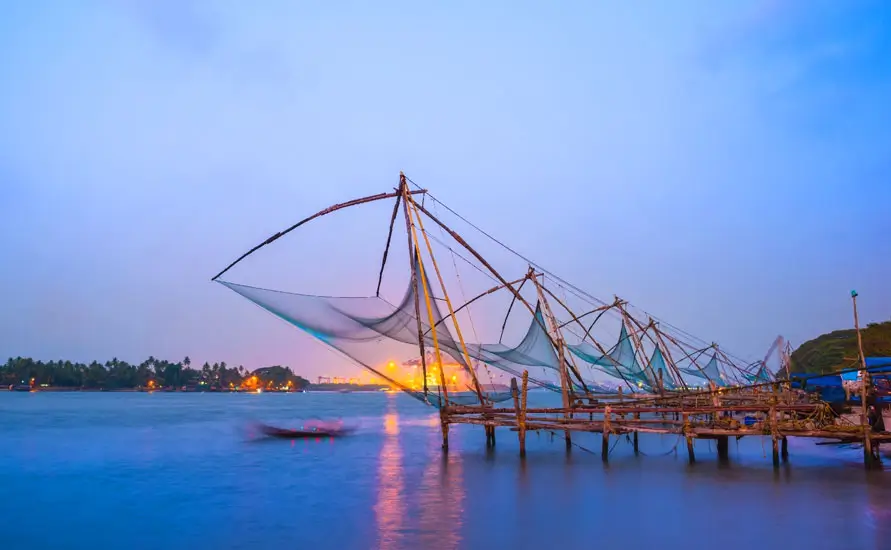
Late afternoon is the right moment for a first walk along the seafront at Fort Kochi, where the old Portuguese and Dutch port faces the mouth of the harbor. The Chinese fishing nets line the waterfront like giant spiders, and around sunset the crews lift their last catches of the day. Nearby fish stalls let you choose prawns, crab or seer fish and have it fried at a small café on the spot. Walk back along Princess Street, lined with old merchant houses, now turned into cafés and art shops. In winter, the town hosts the Kochi-Muziris Biennale art festival every two years. Overnight in Kochi.
A full day in old Kochi starts once breakfast is over, in a port where Arab dhows, Chinese junks and later European fleets all came for pepper. Start at the Dutch Cemetery, where worn grave slabs from the 1700s record the names of Dutch merchants, soldiers and their families, and continue to the Indo-Portuguese Museum, which displays church silver, vestments and altar pieces from Catholic parishes across the region. The museum stands in the grounds of the bishop's house, and its basement shows the remains of an old Portuguese fort wall. Please note that the museum may be closed on certain days of the week and on public holidays.
Keep in mind that Mattancherry Palace shuts every Friday, while the Paradesi Synagogue does not open on Friday, Saturday or any Jewish holiday; we plan your two Kochi days to fit. In the palace, the large wall paintings in the royal bedchamber show scenes from the Hindu epics, painted in reds, ochres and greens. A few minutes' walk takes you to the synagogue at the end of Jew Town Road, still used for prayer after more than four centuries, where a clock tower stands beside the entrance. Only a handful of Cochin Jews still live in the area today, and their story is told through the photographs in a small gallery.
Spend the afternoon at leisure, perhaps shopping for antiques or Kerala spices in Jew Town. Then, at about 5 pm, a small Fort Kochi playhouse stages Kathakali, the dance drama of Kerala's temples and courts. Arriving early lets you watch the dancers apply their makeup, a long process of painting the face with rice paste and natural pigments, and the green color tells you the character is a hero or a god. The show itself lasts about an hour and a half, and a short introduction explains the mudras or hand gestures used to tell the story without words. Dinner can be at a restaurant serving Kerala Syrian Christian food. Overnight in Kochi.
With Kochi behind you, the car turns inland toward the hills of the Western Ghats. The first part of the drive crosses the busy towns of Ernakulam district, with churches, banks and gold jewelry shops lining the road, before rubber plantations and pineapple farms take over near Kothamangalam. As the road starts climbing, the vegetation thickens into forest and the temperature drops. Along the way, your driver stops at Cheeyappara Falls and Valara Falls, two roadside waterfalls that pour over rock in several stages and are at their fullest in the months after the monsoon. Monkeys gather at the viewpoints, so keep food out of sight.
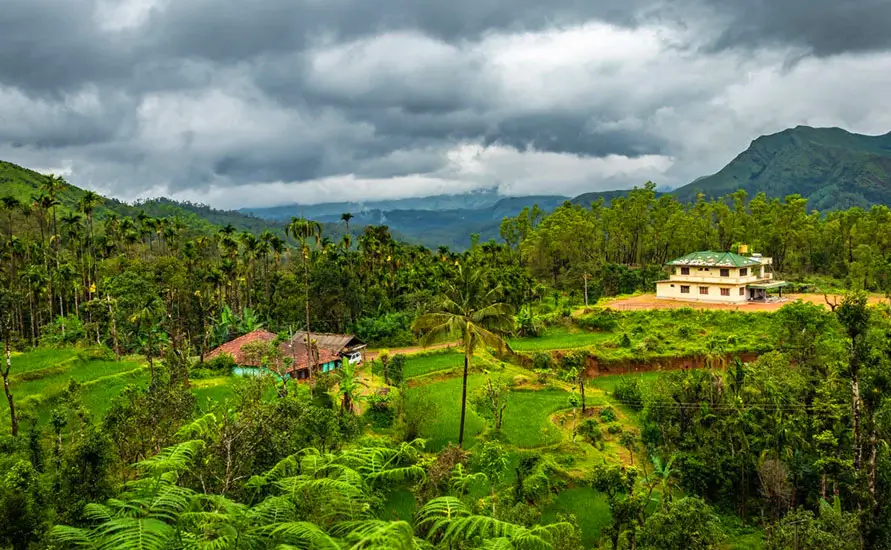
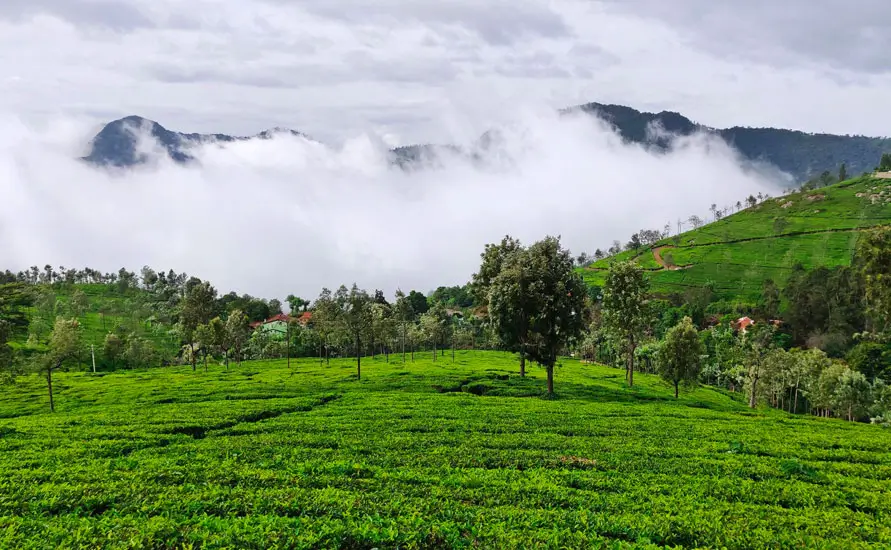
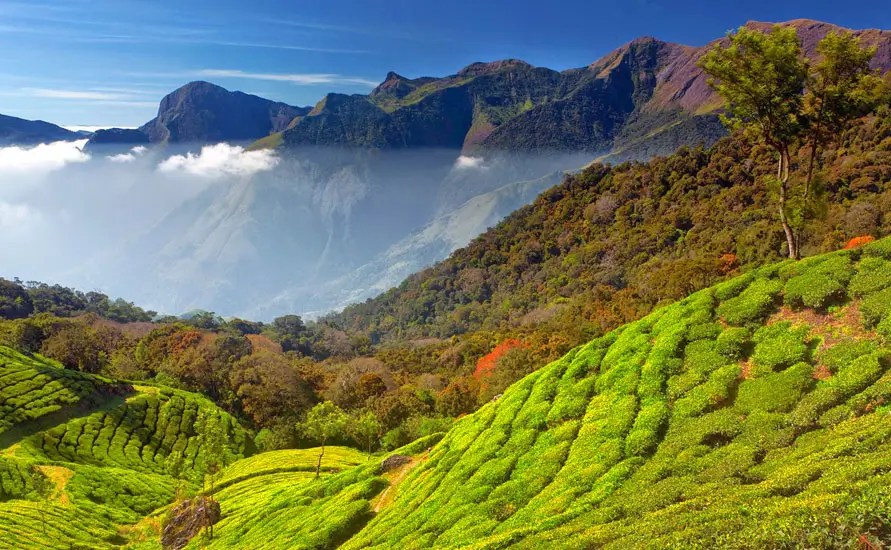
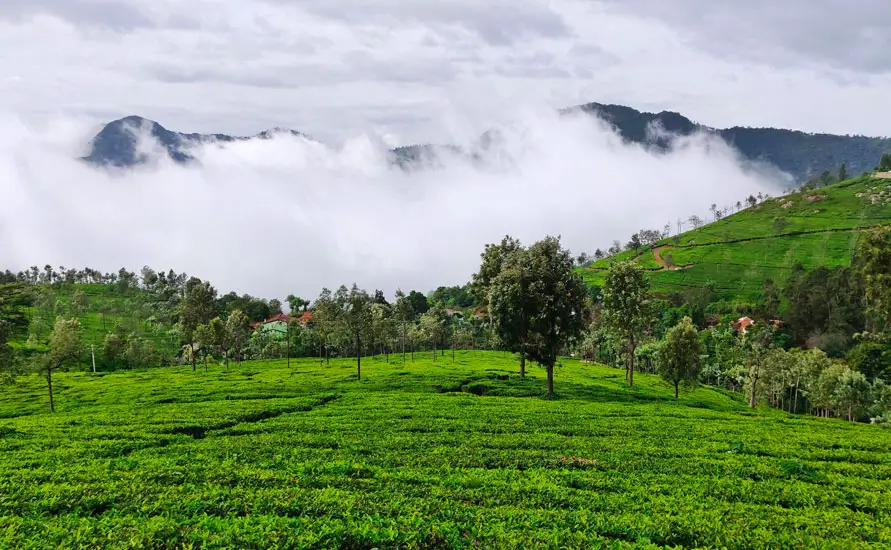
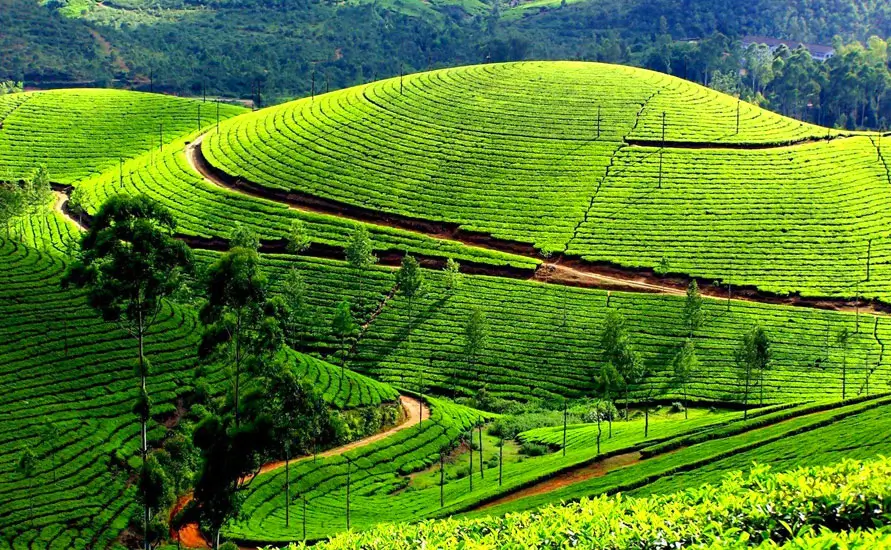
The last stretch climbs through tea estates, with the road winding in tight loops past slopes covered in neatly trimmed bushes. You reach Munnar at about 1,600 meters, a former British planters' retreat in the area known as the High Range, where three rivers meet. The name means three rivers in Malayalam and Tamil. Munnar is cooler than the plains all year round, and in December and January the early mornings can be quite cold, so a fleece or jacket is useful. Your room for two nights is at a tea estate resort or a hillside hotel, many of which have views over the plantations from their balconies.
The afternoon is free to rest and get used to the altitude. For some gentle exercise, walk to a viewpoint near your hotel or take a short stroll into the town, where the market sells homemade chocolates, cardamom and locally grown tea. Munnar was developed in the late 19th century by Scottish planters, and the Christ Church, built in 1910 with stone walls and stained glass, still holds services in Malayalam and English. The hotel can arrange an Ayurvedic massage, which many guests enjoy after three weeks of travel. Expect lacy appam and coconut-milk stew on the resort's dinner menu. Overnight in Munnar.
Your day begins with a drive to Eravikulam National Park, a high grassland reserve about 15 km from town, where forest department buses take visitors up the final section of the road. The park protects a rolling plateau of grass and stunted forest called shola, while the bulk of Anamudi, close to 2,700 meters high and unmatched anywhere in peninsular India, looms beyond the grass. Every twelve years, the hills here turn blue when the neelakurinji shrub flowers, an event last seen in 2018. Each year the gates shut for some weeks around late winter while the Nilgiri tahr give birth, and we check the reopening date before you travel.
Back in town, the Tea Museum at Nallathanni covers how planters cleared the High Range forest and turned it into estates, up to the present day. Displays include an old rolling machine, early tea chests and photographs of the planters and the Tamil workers who came from the plains to pick and process the leaf. After the museum, your guide walks you along a footpath through a tea estate, where pickers move along the rows with baskets on their backs, plucking two leaves and a bud from each bush. The guide explains how each bush is pruned to waist height so it can be harvested every week or two.
In the afternoon, drive out along the road to Mattupetty Dam, a reservoir surrounded by hills, where you can take an optional boat ride on the lake. Nearby, the Indo-Swiss dairy farm breeds cattle for the region, though visits are limited. Further on, Echo Point is a lakeside viewpoint where your voice bounces back from the opposite hills, and the stalls sell carrots, spiced corn and fresh fruit. On the way back, stop at a spice shop to buy cardamom, cinnamon and pepper grown in the surrounding hills. Your evening is yours, with a log fire or a quiet dinner. Overnight in Munnar.
The road south from Munnar follows the ridges of the Cardamom Hills, passing tea estates, small towns and long stretches of cardamom growing under a high forest canopy. Look out for the bright green pods drying on mats outside the houses, and for the stacks of sacks in the auction yards around Puttady and Vandanmedu. Your driver can stop at a viewpoint over the Tamil Nadu plains, which drop steeply on the eastern side of the hills. The drive takes about three hours, and you reach Thekkady, the market town beside Periyar Tiger Reserve, around lunchtime. Your hotel or forest lodge is booked for one night.
In the afternoon a local guide walks you through a spice plantation on the edge of Kumily town, where you see how pepper vines are trained on living trees, how vanilla is pollinated by hand, and how cloves, cinnamon, nutmeg and allspice are grown side by side. Kerala's spice trade drew Roman, Arab and later European ships for centuries, and many of these plants are still sold in the small shops that line the main street of Kumily. Your guide also shows you coffee and cocoa plants, and explains the uses of herbs in Ayurveda, the traditional medicine of Kerala, which uses many of the same roots and leaves.
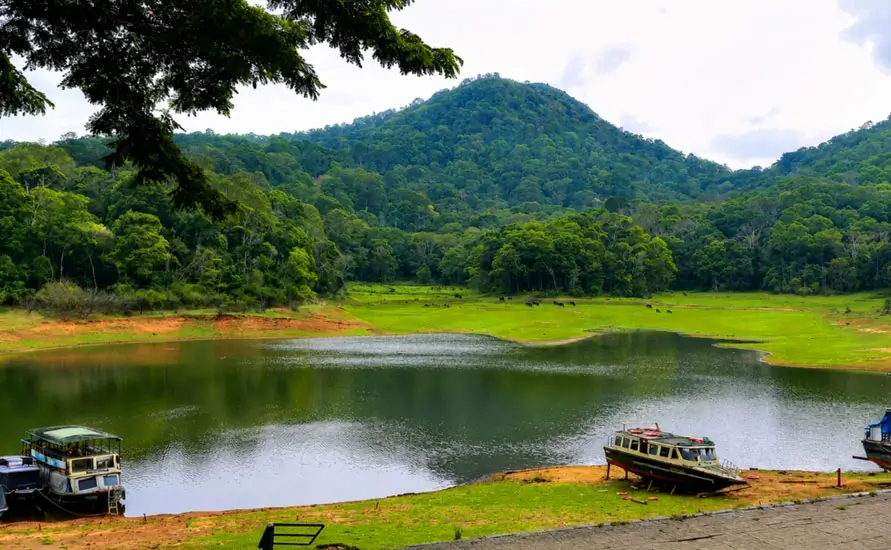
Late afternoon, you can take an optional boat ride on Periyar Lake, the reservoir created by a dam built in 1895, where elephants, gaur, sambar deer and wild boar often come down to drink at the water's edge. Tigers are rarely seen, but the forest around the lake is home to many birds, including kingfishers, darters and hornbills. The boat trips are run by the forest department and tickets are sold on the day, so timing can vary. In the evening, a cooking demonstration at a local home shows you how to make a simple Kerala fish curry or vegetable thoran. Overnight in Thekkady.
An early breakfast and a prompt start are needed today, because houseboats in Alleppey take on guests around noon. The road descends from the Cardamom Hills through rubber plantations, small churches and market towns like Kanjirappally and Kottayam, and the change in temperature is very noticeable as you leave the hills. Kottayam is known as the center of Kerala's Syrian Christian community and of the state's newspaper and publishing industry. In the last hour you cross the flat Kuttanad region, where rice fields lie below sea level and the road runs alongside canals filled with water hyacinth and narrow boats.
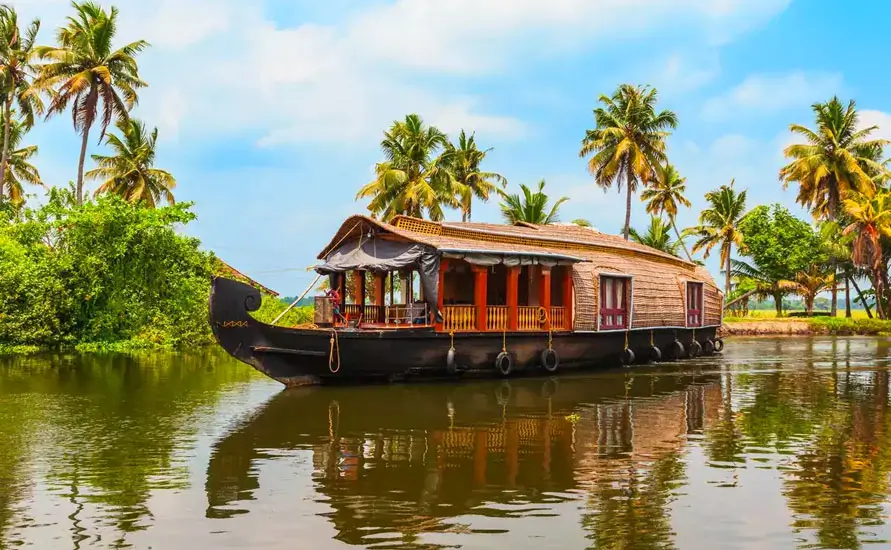
Waiting at the jetty, the crew helps you on board your private Kerala houseboat, which has a bedroom with an attached bathroom, a sitting area on deck and a small kitchen at the back. Lunch is served soon after departure, usually a spread of rice, fish curry, vegetables in coconut and pickles. In the afternoon the boat moves slowly through the canals, past churches, temples and small houses whose owners use the water for washing, bathing and transport. The crew points out the toddy tappers who climb coconut palms to collect sap for the local drink, and the ducks herded across the water by farmers in their canoes.
Houseboats must stop cruising in the early evening and anchor for the night, so your boat ties up at a quiet spot along the bank before dark. Use the last light to stroll on the mud bund or to watch the sun go down over the paddy. The cook prepares dinner on board, and you can ask for fish caught in the backwaters that day, such as karimeen, or a vegetarian meal. With no traffic and few lights, the only sounds are the frogs, crickets and the occasional passing canoe. Bring insect repellent, since mosquitoes come out at dusk, although boats provide nets. Overnight on the houseboat.
Wake up on the water to the sound of birds and the first boats passing, and eat breakfast on deck while the captain steers back to the landing. Checkout from the houseboat is around 9 am, and your driver will be waiting to load the luggage. The road south follows the coast of Kerala through Kollam, an old port that traded with China and the Arab world, where the Ashtamudi Lake spreads its eight arms inland. With an early enough start, a detour takes in Varkala, where red cliffs rise above the beach and the Janardhana Swamy Temple stands on the hill above, before continuing to Kovalam.
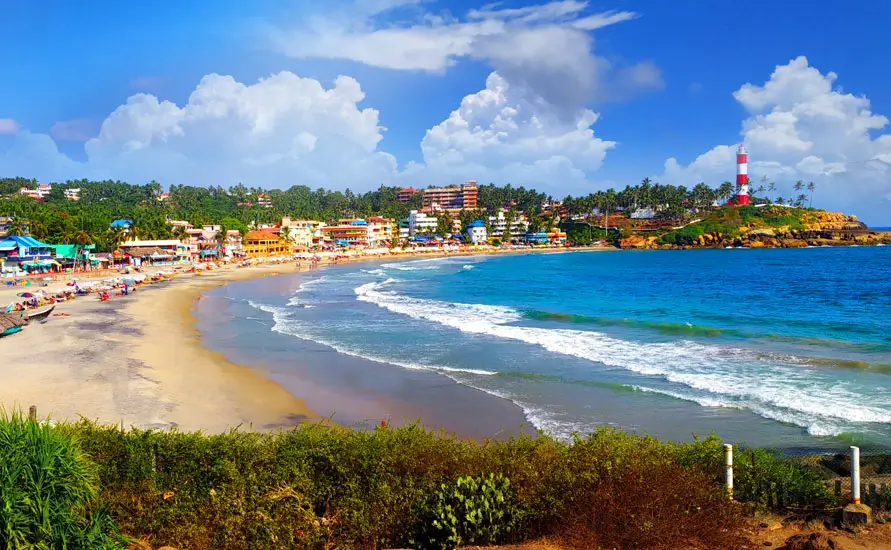
You reach Kovalam in the afternoon and check in at a beach resort for your final night. Kovalam has three crescent-shaped beaches separated by rocky headlands, and the southernmost, Lighthouse Beach, is the most popular, with a red-and-white striped lighthouse on the rocks at one end. You can climb the lighthouse for a view along the coast, swim in the sheltered sections when the lifeguards' flags allow, or take a walk along the promenade. Kovalam is also known for its Ayurvedic centers, and many resorts offer massages and treatments, which many guests book as a final treat.
The evening is free to rest or enjoy the beach. As the sun goes down, the fishermen pull their boats up on the sand and the beachside restaurants put out their catch of the day on ice, from tiger prawns to red snapper and squid. Choose your fish and have it grilled with Kerala spices or cooked in a coconut curry. For a glimpse of Trivandrum, the state capital, ask to be taken to the Napier Museum, whose banded red-and-cream exterior hides bronzes, temple carts and ivory work. Back at the resort, it is a good night to sort and pack your bags for the flight. Overnight in Kovalam.
Your final morning in South India begins on the beach, perhaps with an early walk along the sand while the fishing boats come in with their night's catch. Breakfast at the resort is a last chance to try Kerala favorites such as puttu, a steamed cylinder of rice flour and coconut, served with spicy black chickpea curry. Most resorts want the keys back at midday, so for an evening flight we can request extended use of the room for an extra charge. The drive to Trivandrum International Airport takes only about thirty minutes, so you have plenty of time to relax before leaving.
Trivandrum, also written Thiruvananthapuram, has direct flights to the Gulf states and to hubs such as Colombo, Singapore and Dubai, which connect to Europe, North America and Australia. Your driver will drop you at the terminal entrance with enough time to check in, usually three hours before an international departure. Before you leave, it is customary to tip your driver, who has looked after you through the Kerala part of the trip. Our team will be in touch to make sure your flight connection runs smoothly, and you can reach us by phone or WhatsApp at any time during the trip.
Over three weeks you have crossed Karnataka, Tamil Nadu and Kerala, from the palaces of Mysore and the coffee farms of Coorg to the temples of Madurai and Tanjore, the French streets of Pondicherry, the tea hills of Munnar and the backwaters of Alleppey. This grand South India tour gives you a broad and deep picture of the region's history, religion, food and landscapes. Many guests tell us they would like to return to see more, for example Hampi and Badami in northern Karnataka, the beaches of Goa or the temples of Kanchipuram. We would be happy to plan your next trip. Safe travels home.
Your Journey

N.S. Rathore & Mrs. Omlata Rathore · Managing Director
We still read every enquiry ourselves. Tell us the places you liked and our planners will send a day-by-day route with drive times and a clear price.
Every package can be customised and no pressure to book. A planner from our office replies within 24 hours with a route written for your group.
Fill this in and your planner will send a first draft itinerary.
Explore more
Kerala Backwaters Escape Kerala Backwaters Escape
 Kerala Backwaters Escape
 Kerala Backwaters Escape
 Kerala Backwaters Escape
 Kerala Backwaters Escape
 Kerala Backwaters Escape
 Kerala Backwaters Escape
 Kerala Backwaters Escape
 Kerala Backwaters Escape
 Kerala Backwaters Escape
 Kerala Backwaters Escape
 Kerala Backwaters Escape
 Kerala Backwaters Escape
 Kerala Backwaters Escape
 Kerala Backwaters Escape
 Kerala Backwaters Escape
 Kerala Backwaters Escape
 Kerala Backwaters Escape
 Kerala Backwaters Escape
 Kerala Backwaters Escape
 Kerala Backwaters Escape
 Kerala Backwaters Escape
 Kerala Backwaters Escape
 Kerala Backwaters Escape