 Kerala Backwaters Escape

Religious & Heritage Tour Of South India
Chennai (San Thome) – Velankanni – Tanjore – Kochi (St Francis Church) – Kodungallur – Goa (Old Goa churches)
At a glance
Christianity in India is older than in most of Europe. Tradition holds that the apostle Thomas landed on the Kerala coast in AD 52 and died near Chennai some twenty years later, and Portuguese, Danish, Dutch and British missions added their own layers over the centuries that followed. Our Velankanni and Christian heritage tour links those chapters in eleven days, from the tomb of the apostle at San Thome Basilica to the Marian shrine at Velankanni, the Chola city of Tanjore, the waterfront churches of Kochi, the apostle's landing place at Kodungallur and the UNESCO-listed Old Goa churches.
Two short domestic flights take care of the long jumps between the coasts, so road time stays reasonable, and three of the five bases have two or three nights each. That leaves room for Mass, confession or a quiet hour in a chapel, which many pilgrims value more than another sight. On the roads of each state you have your own chauffeur and cooled vehicle, while regional guides, several of them Catholic or Syrian Christian themselves, lead the church and heritage visits. Mass times are confirmed for your dates before you travel.
This Velankanni pilgrimage package is planned for Catholic, Orthodox and Protestant visitors from North America, Britain, Ireland and Australia, for parish groups, and for NRI families from Kerala, Goa and Tamil Nadu who want to share their heritage with children raised abroad. Modest dress is expected in every church: shoulders and knees covered, and no beachwear. The annual Velankanni feast from 29 August to 8 September and the Old Goa feast of St Francis Xavier on 3 December draw enormous crowds; we can plan around them or into them, as you prefer. Weather is kindest between November and February.
Whatever the hour of touchdown at Chennai, a staff member holding a placard with your surname stands beyond the customs doors, loads the luggage and rides with you into the city. Since many flights from the West reach Chennai after midnight, the first morning has no plans at all. On the drive into the city you receive a folder with your day-by-day program, the Mass schedule we have confirmed for each church and emergency contact numbers. Standard check-in is 2 pm, yet an extra pre-paid night lets jet-lagged guests collapse into bed at dawn.
Around four o'clock the guide collects you for an unhurried stroll in Mylapore, the old neighborhood where the apostle Thomas is believed to have lived and preached. The first stop is the Luz Church, Our Lady of Light, founded by Portuguese Franciscans around 1516 and among the oldest churches in the city. According to a local story, sailors caught in a storm followed a strange light to the shore and built the church in thanks. The baroque altar and the quiet nave make a gentle introduction to the faith history you will trace over the coming days.
Dusk is a lovely time on the streets ringing the Kapaleeshwarar Temple tank, where flower sellers, brass shops and coffee stalls show how Hindu and Christian Mylapore have grown up side by side for centuries. Your guide explains the Thomas traditions held by the St Thomas Christians of Kerala and the Catholics of Tamil Nadu, and what historians can and cannot confirm about the apostle's time in India. Supper can be Chettinad pepper chicken or a meatless banana-leaf spread, followed by bed at a sensible hour so that jet lag fades quickly. Overnight in Chennai.
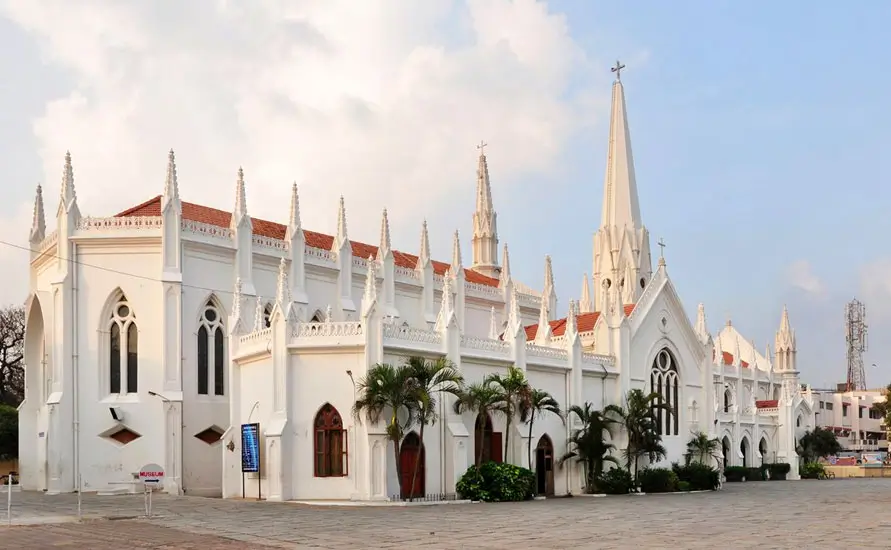
The day begins where many pilgrims most want to be, at San Thome Basilica, a tall white neo-Gothic church on the Mylapore seafront. The present building dates from 1896 and was raised to a minor basilica in 1956, but the site has been venerated as the tomb of St Thomas for far longer. Steps beside the church lead down to an underground chapel where a small museum and the tomb itself can be seen. Morning Mass is often celebrated in English as well as Tamil, and we arrange your visit around the service you would like to attend, with time for silent prayer at the tomb.
A 20-minute drive takes you to Little Mount in Saidapet, a rocky hillock where tradition says the apostle hid from his pursuers in a small cave. The narrow opening, a spring that never runs dry and a handprint pressed into the rock are all shown to visitors, and the older Portuguese chapel stands beside a modern round church. Further on, St Thomas Mount rises about 90 meters above the city near the airport, and some 130 steps lead up to the Church of Our Lady of Expectation. A stone cross found on the hill is linked to the apostle's martyrdom, and a painting of the Virgin is attributed by tradition to St Luke.
After lunch you visit St Mary's Church inside Fort St George, consecrated in 1680 and the oldest Anglican church in India. Brass and marble plaques recall Company officers, chaplains and children lost to fever, and the parish books note Robert Clive's wedding here in 1753. Photography inside is limited, and the fort area has security checks, so carry your passport. The rest of the afternoon is open; you might walk on Marina Beach at sunset or rest before tomorrow's early flight. Pack modest clothes for Velankanni, as you will spend a lot of time in prayer spaces. Overnight in Chennai.
Chennai to Velankanni is a long road trip, so the plan uses the short morning flight to Trichy instead, which takes about an hour. Pickup from the hotel is early, and on the tarmac at Trichy you are met by the vehicle and guide who will stay with you through Tamil Nadu. Before heading for the coast, a brief halt at Lourdes Church, a Gothic revival building near the Rock Fort inspired by the basilica at Lourdes in France, gives a first taste of the Catholic life of the Kaveri delta, where many villages have both a temple and a parish church.
The drive east to Velankanni runs through Thanjavur district and the paddy fields of the delta, with coconut palms, canals and small towns on the way. A lunch stop is planned at a clean local restaurant. As you approach the coast, the number of pilgrims grows, many dressed in saffron or yellow, some walking the last stretch barefoot as a vow. By mid-afternoon you are settled in a pleasant hotel a few minutes' walk from the shrine. Rooms near the shrine fill quickly at weekends and festivals, so we book well ahead for your dates.
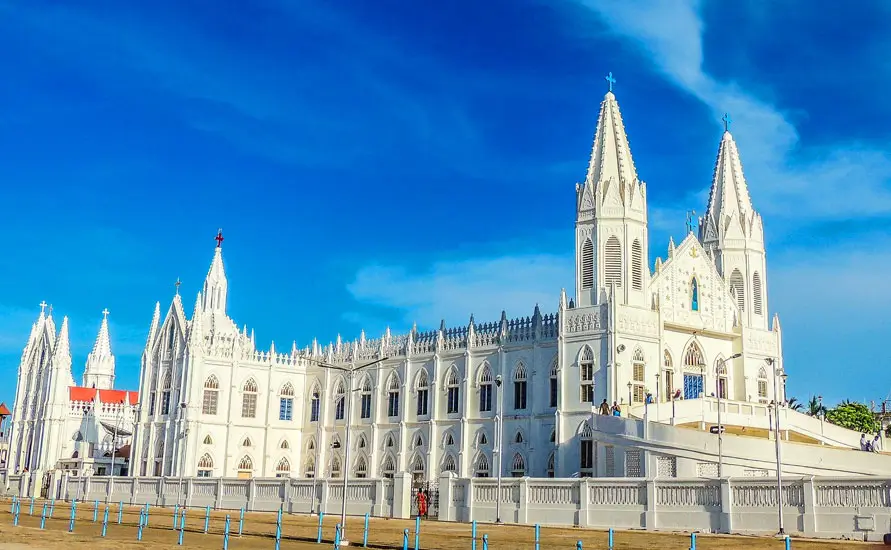
Once night falls, floodlights on the twin spires of Our Lady of Good Health call you out again. The daily rosary and candle procession around the square is one of the most moving sights of the trip, with prayers in Tamil, Malayalam, Konkani, English and other languages as pilgrims from across India join in. Your guide helps you find a good spot, and you are welcome to carry a candle. Shoes are removed at the main shrine, and the area is busy but orderly. Later you can buy rosaries or holy water bottles in the lanes outside. Overnight in Velankanni.
Morning Mass at Velankanni is said in several languages, with English services on many days, and attending one is a fine way to begin. Afterwards your guide explains the three traditions behind the shrine: the Virgin appearing to a shepherd boy carrying milk near a pond, then to a lame buttermilk seller who was healed, and finally Portuguese sailors who survived a storm in the 17th century and built the first chapel in gratitude. You visit Our Lady's Tank, the site of the first apparition, and the Morning Star Church, and walk the paved path many pilgrims cover on their knees.
The basilica's museum of offerings is a remarkable place, filled with silver and gold models of hands, eyes, houses and cars, wedding saris and letters left by people who believe their prayers were answered. It shows how deep devotion to Our Lady of Good Health runs among Catholics, Hindus and Muslims alike. Pope John XXIII granted the shrine the status of a minor basilica in 1962, and the main church now holds thousands of worshippers. Late morning is free for a nap or a stroll along the shore, where catamaran-style fishing craft lie in rows above the tide line.
After lunch a 90-minute drive north reaches Tranquebar, now called Tharangambadi, a small Danish trading post from 1620. In 1706 two German Lutheran missionaries, Bartholomäus Ziegenbalg and Heinrich Plütschau, landed here, the first Protestant missionaries in India. Ziegenbalg rendered the Gospels and Epistles into Tamil and had them printed on a press set up in the town, and the New Jerusalem Church he built in 1718 still stands. You also see Fort Dansborg on the shore and the Zion Church. Returning south, the car pauses at the Nagore dargah, a Sufi shrine whose minarets show the coast's mixed faith life. Overnight in Velankanni.
A last visit to the basilica after breakfast gives time for a final prayer or to collect a blessed medal, before the two-hour drive inland to Tanjore (Thanjavur). Chola emperors ruled from here a thousand years ago, and much later Maratha princes held court in the same city, who kept close links with European missionaries. Rooms are usually available by midday, and the fierce afternoon sun makes a siesta sensible. Lunch can include a full banana-leaf meal with rice, sambar, rasam and several vegetable dishes, or a lighter meal at the hotel if you prefer.
Your afternoon begins at the Schwartz Church, also known as Christ Church, built in 1779 beside the Sivaganga park near the great temple. It is named after the Danish-German missionary Christian Friedrich Schwartz, who served as tutor and adviser to the young Maratha prince Serfoji II. When his teacher died in 1798, Serfoji ordered a marble panel from John Flaxman in London depicting the missionary on his deathbed with the prince at his side, and it still hangs inside the church. The story of a Hindu ruler honoring his Christian teacher is one of the most touching of the trip.
Once the paving has cooled, a short walk leads to the Brihadeeswarar Temple, completed around 1010 under Rajaraja I and listed by UNESCO in 1987, its Chola-era fame now shared with two sister shrines under the title Great Living Chola Temples. Its granite vimana reaches roughly 66 meters, and the cloisters hold more than a hundred lingams and fading Chola murals. Non-Hindus may walk the courtyard and pillared halls freely once their footwear is left at the gate; only the sanctum is restricted. Your guide also points out the Tanjore paintings sold in nearby shops, a few of which show Christian themes in the same gold-leaf style. Overnight in Tanjore.
Crossing the peninsula fills most of today, beginning with a leisurely breakfast and a 90-minute road transfer to Trichy International Airport. There is usually no non-stop flight between Trichy and Kochi, so we reserve the smoothest change of planes, usually in Chennai or Bangalore, and door-to-door time runs four to six hours. Drop-off at the terminal leaves a generous margin, and our team keeps an eye on the flights and lets the Kochi team know your arrival time.
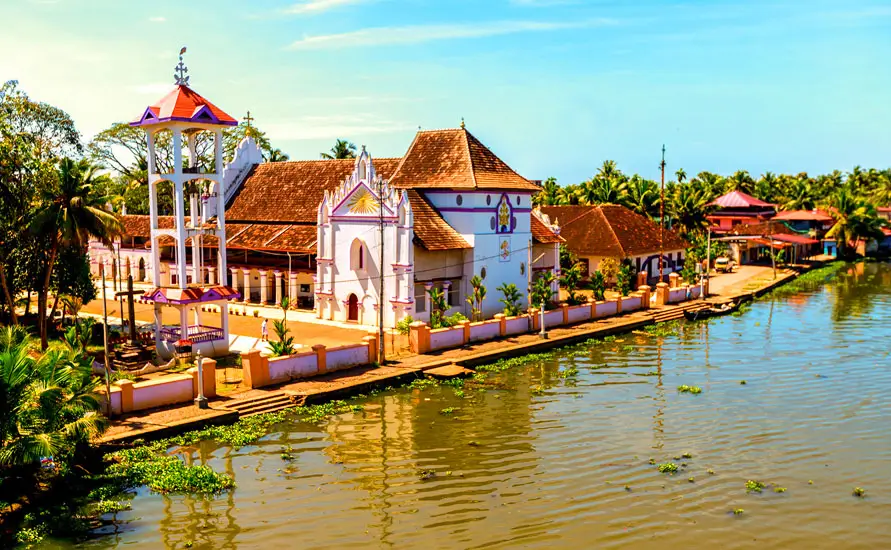
When you land at Cochin International Airport, our Kerala colleague greets you and drives roughly 90 minutes south via Aluva and Ernakulam to Fort Kochi. Kerala feels very different from Tamil Nadu: greener, wetter and full of churches of many traditions, from Syro-Malabar and Latin Catholic to Jacobite and Mar Thoma. With luck you reach the seafront before sunset, when the giant cantilevered nets dip into the channel one after another. Overnight in Kochi.
A short walk from most Fort Kochi hotels brings you to St Francis Church, raised in timber by Portuguese Franciscans in 1503 and replaced in stone some decades later, which puts it among the earliest churches built by Europeans anywhere in Asia. The Portuguese admiral Vasco da Gama died in the town during his third voyage and lay in this nave for about fifteen years before his bones were shipped to Lisbon; a fenced slab marks the empty grave. The church later became Dutch Reformed, then Anglican, and today belongs to the Church of South India. Look up at the old cloth punkah fans, once pulled by hand on ropes to cool the congregation.
Walking through the lanes past Dutch and British bungalows, you reach the Santa Cruz Cathedral Basilica, the seat of the Latin Catholic diocese of Kochi. The first church on this site was built by the Portuguese in 1505, and the present twin-spired building dates from 1905. Inside, the painted ceiling shows scenes of the Passion, and the pillars and arches are decorated in pastel colors. Your guide explains how the Portuguese, Dutch and British each treated the local St Thomas Christians differently, a story that still shapes the church divisions of Kerala today.
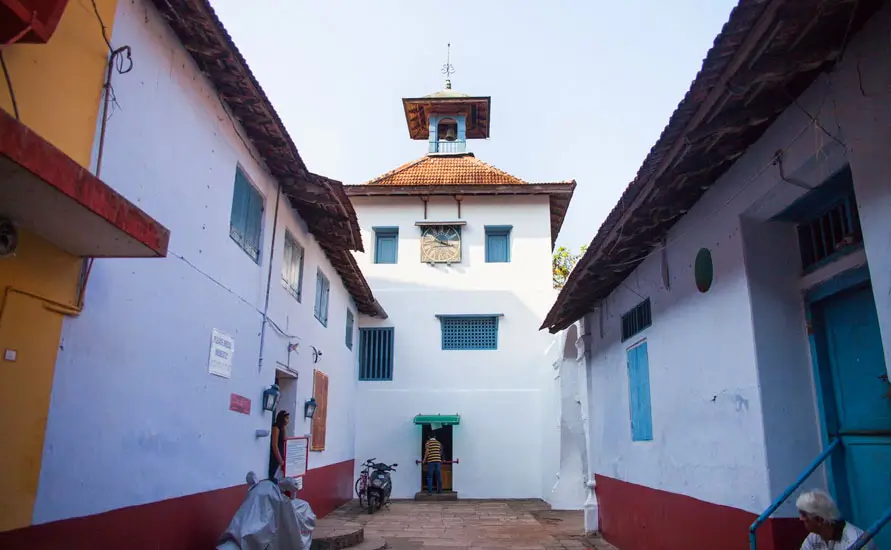
Later in the day the car takes you on to Mattancherry, where Ramayana scenes cover the bedchamber walls of the Mattancherry Palace, while the blue-tiled Paradesi Synagogue of 1568 recalls the long-settled Jewish community of Kochi. Friday closes both doors, and the synagogue stays shut on the Sabbath and Jewish festivals too, which is why we may swap today with tomorrow. The spice warehouses of Jew Town smell of pepper and ginger, and the lane is lined with antique shops. In the evening you might attend a Kathakali show or simply rest at the hotel. Overnight in Kochi.
Kodungallur, about 40 km north of Kochi, lies close to where the lost harbor of Muziris once stood, where Roman, Arab and Jewish traders once came for pepper. Tradition holds that St Thomas the apostle landed here in AD 52 and founded seven churches along the Kerala coast. On the way you stop at Kottakkavu in North Paravur, one of those seven churches according to the St Thomas Christian tradition, where an old granite cross and a well are shown to visitors. The present church is more recent, but the site is deeply loved by Syro-Malabar Catholics.
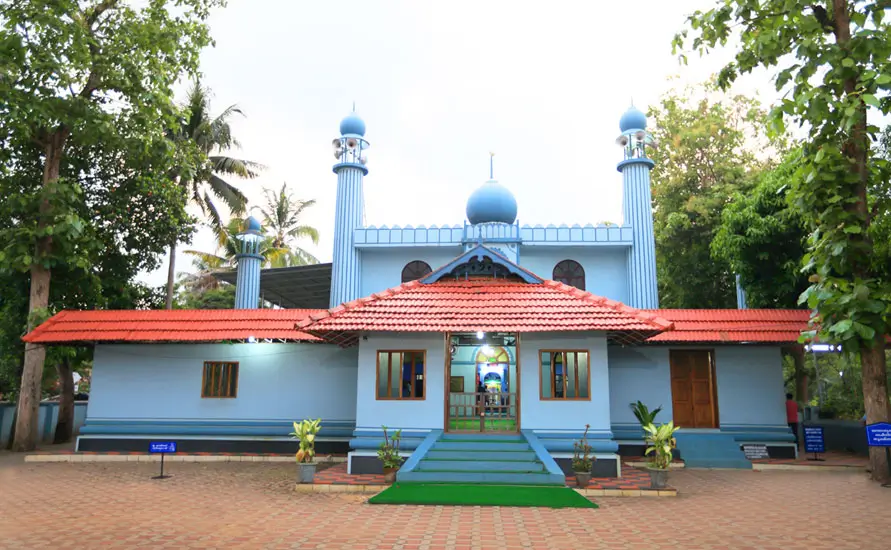
At Azhikode, close to the mouth of the Periyar river, the Marthoma Pontifical Shrine marks the traditional landing place of the apostle. It keeps a relic of St Thomas brought from Ortona in Italy in 1953, and the shrine's design recalls a ship arriving from the sea. Nearby, the Cheraman Juma Masjid, which tradition calls the oldest mosque in India, shows how early Islam also reached this coast. Visitors may see the mosque's museum and courtyard; women should cover their heads, and everyone removes shoes. Your guide explains the Muziris Heritage Project, which restored synagogues, a Dutch palace and other sites in the area.
Over a midday meal of pearl spot fish or coconut-milk stew with lacy appams, you can visit the Paravur Synagogue, now a museum under the same heritage project, before returning to Kochi in the late afternoon. If you would like, we can arrange an evening Mass at a parish church in Fort Kochi, or a meeting with a local Christian family to hear about Kerala church festivals and traditions. Later you are free for a final stroll along the Fort Kochi waterfront, where the ferries cross to Vypin and the lights of the harbor come on. Overnight in Kochi.
After breakfast you leave for Cochin International Airport and the direct flight to Goa, roughly 75 minutes in the air. Two airports serve the state, Dabolim on the southern plateau and Mopa up near the Maharashtra border, and we pick whichever suits your flight schedule and hotel. A Goan member of our team waits outside the terminal and takes you to a hotel near Panjim or the Mandovi riverfront. Goa was ruled by Portugal for more than 450 years, until 1961, and you will notice the difference immediately: white churches on every hill, red-tiled houses, and street signs in Portuguese as well as Konkani.
Once you have checked in, your guide takes you to Panjim, the state capital, for the Immaculate Conception Church, whose whitewashed front and criss-crossing stairway look over the main square. The first chapel here was built in 1541, and sailors arriving from Lisbon once stopped at it to give thanks for a safe voyage. Its large bell is said to be the second biggest in Goa, after the Golden Bell of the Se Cathedral. Inside, the gilded altars and statues follow the Portuguese baroque style you will see again in Old Goa tomorrow.
As the light softens, the guide walks you through Fontainhas, the old Latin Quarter beside the Ourem creek, where homes washed in ochre, indigo and lime carry hand-painted azulejo house numbers, oyster-shell windows and carved balconies. The small Chapel of St Sebastian, known for a crucifix with open eyes that was brought from the Inquisition building in Old Goa, sits at the heart of the quarter. Your guide can point out bakeries selling bebinca, the many-layered Goan sweet, and family restaurants serving Goan dishes such as xacuti and fish curry rice. Overnight in Goa.
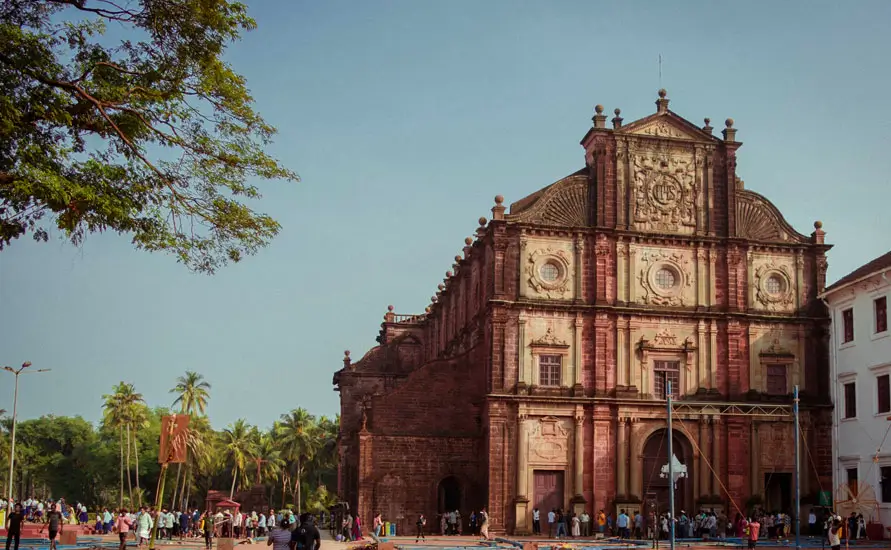
Old Goa, about 10 km east of Panjim, rivaled Lisbon in population in the late 1500s, but cholera and malaria emptied it over the following two centuries. The surviving religious buildings form a World Heritage site inscribed in 1986. You begin at the laterite-fronted Basilica of Bom Jesus, whose Jesuit builders completed it in 1605 and where the body of St Francis Xavier, co-founder of the Jesuits, who died on Shangchuan Island in 1552, rests in a silver casket above a marble tomb given by the Medici Grand Duke of Tuscany. Every ten years the relics are brought out for public veneration, most recently from November 2024 to January 2025.
Across the wide lawn stands the Se Cathedral, whose patron is St Catherine, because Goa fell to the Portuguese on her feast day in 1510. Its Golden Bell, named for its rich tone, still rings for services, and the main altar is covered in gilded carvings showing the saint's life. Alongside rises the Franciscan church with its gilded reredos and floor of carved tombstones, and the friary behind it now houses the Archaeological Museum with a gallery of viceroys' portraits; Friday is its usual closing day. Shoulders and knees must be covered in all churches, and photography of the relics is usually allowed without flash.
After lunch you visit the Church of St Cajetan, whose dome was designed after St Peter's, and the lone 46-meter belfry of St Augustine, all that stands of an Augustinian priory that was once one of the grandest in Goa. If you are interested in sacred art, the Museum of Christian Art at the Santa Monica convent displays silver, ivory and textiles made in Goa. In the evening you can attend Mass at Bom Jesus or one of the parish churches, or relax with a farewell dinner of Goan food. Your guide gives a short summary of the routes followed by St Thomas and St Francis Xavier across South India. Overnight in Goa.
Nothing is scheduled before checkout, so with a late flight you might visit a nearby chapel for a final prayer, or shop for cashews, feni or Goan sausages to take home. Pickup is timed for the run to Dabolim or Mopa, whichever your ticket uses, and our team checks your flight time the day before. From either one, flights to Mumbai, Delhi, Bangalore or the Gulf link with long-haul services home.
Over eleven days you have followed Christianity in India from the apostle's tomb in Chennai and his landing place at Kodungallur to the Marian shrine at Velankanni, the mission towns of the Tamil coast, the colonial churches of Kochi and the relics of St Francis Xavier in Old Goa. Each place adds a different chapter to a story nearly two thousand years old. A return visit timed for the Velankanni feast in early September or the Xavier novena in late November is easy to arrange. Go in peace, and safe travels.
Your Journey

N.S. Rathore & Mrs. Omlata Rathore · Managing Director
We still read every enquiry ourselves. Tell us the places you liked and our planners will send a day-by-day route with drive times and a clear price.
Every package can be customised and no pressure to book. A planner from our office replies within 24 hours with a route written for your group.
Fill this in and your planner will send a first draft itinerary.
Explore more
Kerala Backwaters Escape Kerala Backwaters Escape
 Kerala Backwaters Escape
 Kerala Backwaters Escape
 Kerala Backwaters Escape
 Kerala Backwaters Escape
 Kerala Backwaters Escape
 Kerala Backwaters Escape
 Kerala Backwaters Escape
 Kerala Backwaters Escape
 Kerala Backwaters Escape
 Kerala Backwaters Escape
 Kerala Backwaters Escape
 Kerala Backwaters Escape
 Kerala Backwaters Escape
 Kerala Backwaters Escape
 Kerala Backwaters Escape
 Kerala Backwaters Escape