 Kerala Backwaters Escape

Religious & Heritage Tour Of South India
Chennai – Gingee – Tiruvannamalai (Ramana Ashram) – Pondicherry (Aurobindo Ashram, Auroville) – Chennai – Flight to Trivandrum – Kollam (Amritapuri)
At a glance
Seekers have been coming to South India for more than a century, drawn by teachers who asked a simple question: who am I? Our spiritual ashram tour South India links three of the places where that question is still lived every day. You begin at the foot of the holy hill Arunachala, where Ramana Maharshi taught silent self-inquiry, then move to Pondicherry, home of the Sri Aurobindo Ashram and the international township of Auroville, and end on a strip of sand between the Arabian Sea and the Kerala backwaters at Amritapuri, the ashram of Mata Amritanandamayi, known to millions simply as Amma.
The pace is gentle by design. Each ashram gets three nights, so there is time for morning chanting, meditation halls, quiet reading and simple meals rather than a quick look between other sights. Chennai to Tiruvannamalai, the longest drive, takes around 270 minutes including the Gingee halt, and an hour-long flight from Chennai to Trivandrum replaces what would otherwise be a fourteen-hour drive across the peninsula. Transfers are handled by a dedicated vehicle whose driver speaks English, and in Chennai, Tiruvannamalai and Pondicherry a local guide adds history and temple etiquette. This ashram tour India is entirely private, so you can stay longer anywhere that speaks to you.
The spiritual ashram tour South India is written for foreign travelers and NRIs who want reflection more than sightseeing: yoga practitioners, meditators, readers of Ramana and Sri Aurobindo, and first-time visitors curious about ashram life. Each ashram has its own customs, so we brief you on dress, silence, photography and timings before every stay. Plan on loose cotton that hides shoulders and knees at every stop, and white or light colors are common at Amritapuri. The cooler months from November through February suit this route best, though Karthigai Deepam at Tiruvannamalai (November or December) and the darshan days at Pondicherry draw large crowds.
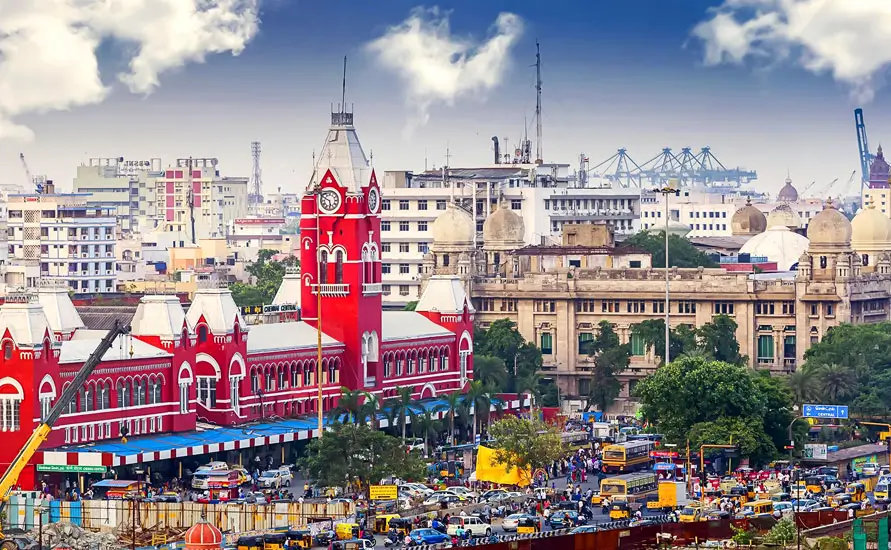
Your host for the first two days waits beyond customs at Chennai airport with a name card and leads you to the car park. Since the majority of overseas arrivals land around midnight or in the early hours, so this first day carries no fixed plan at all. The hotel is in the south of the city, about forty minutes away, close to the temple quarter you visit tomorrow. On the drive your host explains how the next twelve days are arranged, which ashram stays have been confirmed, and what each place asks of visitors in terms of clothing, silence and meal times.
After rest, the afternoon is a good moment to sort practical matters before the ashram days begin. Your host can sort out a phone SIM, change a little money, and pick up two or three sets of light cotton clothing, such as long kurtas, loose trousers and a shawl, from a shop in T. Nagar or Mylapore. Many guests also buy a small cotton bag for carrying shoes, since footwear comes off at every temple, shrine and meditation hall on this trip. If you have read Ramana or Sri Aurobindo, Chennai's bookshops stock their works and those of their disciples at modest prices.
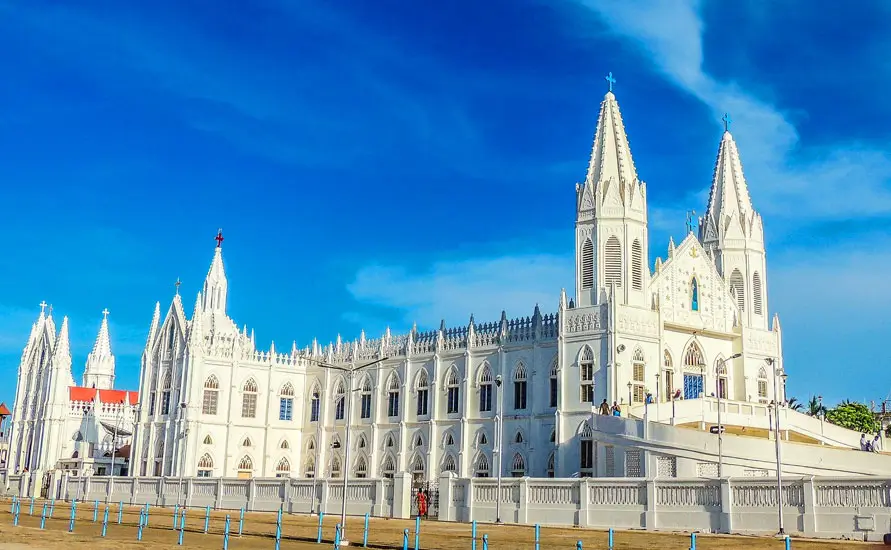
As the light fades, Elliot's Beach at Besant Nagar is a gentle place for a first stroll. Local families gather there at sunset, and the small Velankanni Church on the seafront, dedicated to Our Lady of Good Health, is often open for evening prayer. Idli, dosa and sambar at a neighborhood vegetarian eatery make an easy supper, which is good preparation for the mostly vegetarian food ahead. We suggest an early night, because jet lag eases fastest when you wake with the sunrise and spend the morning outside. Overnight in Chennai.
Morning finds you among the flower stalls of Mylapore, outside the gopuram of the Kapaleeshwarar Temple, a Shiva shrine praised by the Tamil saint-poets of the 7th century. Your guide explains the rhythm of the morning pujas, the meaning of the sacred ash worn by devotees, and why devotees circle the shrine clockwise before entering. Non-Hindu visitors may walk the outer corridors and courtyards, while the inner shrines are for worshippers, as the temple decides. A short walk away stands San Thome Basilica, raised over the tomb that Christian tradition links to St Thomas the Apostle, so the morning shows two faiths sharing one old neighborhood.
Mid-morning brings you to the Theosophical Society in Adyar, founded here in 1882, on wooded grounds beside the estuary. The campus holds a library, small shrines and halls dedicated to several world religions, and an enormous banyan tree whose aerial roots spread over a wide area. Theosophy introduced many Western readers to Hindu and Buddhist ideas, and its story helps explain why so many seekers later came south. Visiting hours are limited and the campus is closed on some days, so we fit the visit to its timetable. For lunch, a vegetarian thali of rice, rasam, kootu and payasam is served the traditional way, on a plantain leaf.
Toward evening the car returns to Mylapore and the Sri Ramakrishna Math, set up in 1897 when Swami Vivekananda sent Swami Ramakrishnananda to Madras. Its universal temple, opened in 2000, blends Hindu, Buddhist, Islamic and Christian architectural forms in one building, reflecting Ramakrishna's teaching that all faiths lead to the same truth. Visitors of every background may sit in the hall for the evening arati, when the monks sing the hymn Khandana Bhava Bandhana while lamps are waved before the altar. Cameras stay in your bag in the hall, and footwear goes on the racks by the gate. Afterward a quiet dinner and early rest prepare you for tomorrow's drive. Overnight in Chennai.
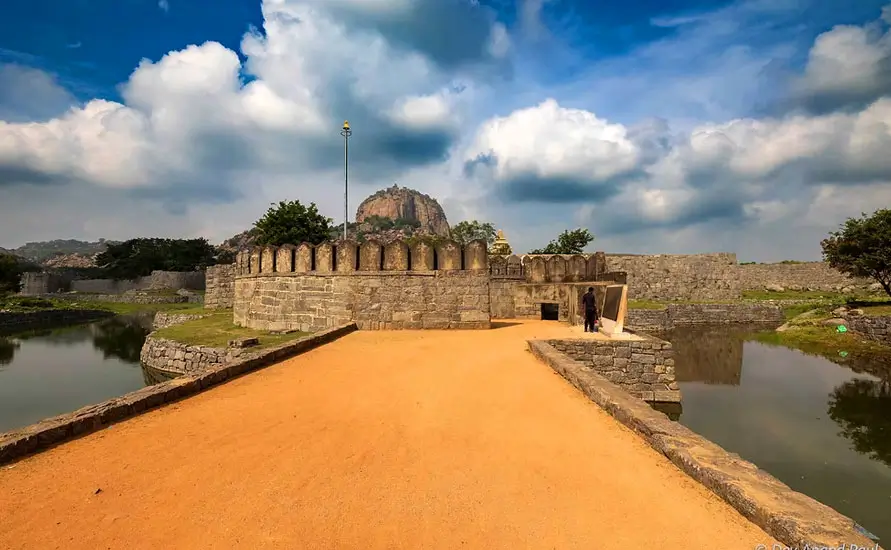
An early departure keeps you ahead of the outbound traffic on the GST Road, which leads southwest through Chengalpattu and Tindivanam. The landscape opens into paddy fields, palmyra palms and granite boulders, and after about three hours the three fortified hills of Gingee rise beside the road. The fort was held in turn by local chiefs, the Marathas, the Mughals and the French, and the Rajagiri citadel has a long climb to its summit. On this trip we suggest a shorter visit to the lower Krishnagiri area or simply a photo stop, so that you reach Tiruvannamalai with energy left for the ashram.
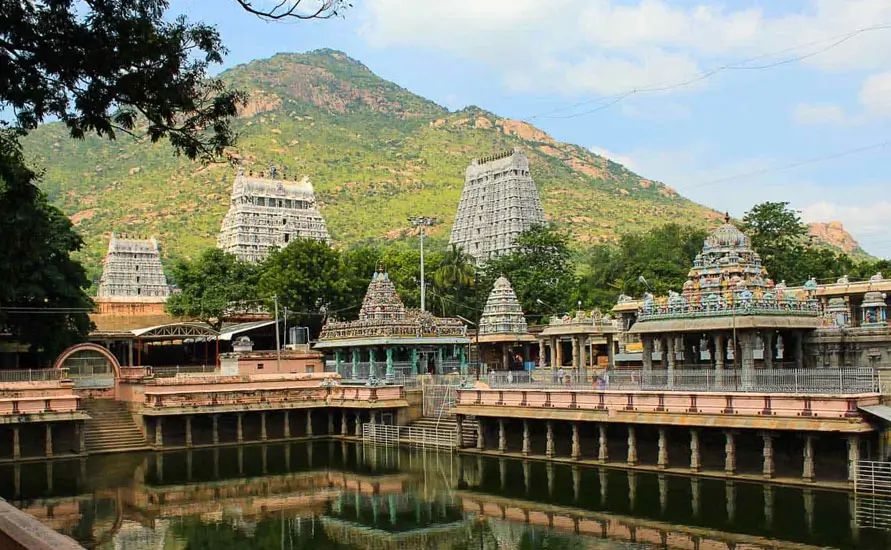
About an hour further on, the bare red dome of Arunachala comes into view, and many visitors fall silent when they first see it. For Hindus the hill is Shiva himself in the form of fire, and Ramana Maharshi called it his guru. You settle into a simple guesthouse or a small hotel on the road around the hill, close to the ashram; rooms inside Sri Ramana Ashram can only be requested in writing well ahead and are limited, so we arrange nearby lodging and help you apply if you would like to try. After lunch you rest during the heat of the afternoon.
Around five you walk into Sri Ramana Ashram for the first time, with your guide explaining the layout. The samadhi hall holds Ramana's tomb beneath a polished granite lingam, beside the shrine of his mother, and the ashram's peacocks and monkeys wander through the grounds. Each evening priests and students chant passages from the Vedas in the hall, and anyone may sit at the back and listen. The ashram asks for silence in the halls, modest clothing and no photography where signs say so. There is no fee to enter, and donations are entirely voluntary. Overnight in Tiruvannamalai.
Set out at first light to climb the path that begins just north of the ashram and winds up the slope of Arunachala. After twenty to thirty minutes of steady stone steps you reach Virupaksha Cave, where Ramana lived for about sixteen years in his youth, first in deep silence and later answering the questions of early visitors. The small inner chamber is dark and cool, and people sit inside for meditation; a volunteer usually keeps the door. Further up, Skandashram is the hillside hermitage built for Ramana and his mother, with a spring, a few coconut palms and a sweeping outlook across Tiruvannamalai to the temple gopurams below.
The walk back down takes about forty minutes, and you return for breakfast and a rest. Please carry water, wear a hat, and keep to the marked path, because walking elsewhere on the hill is not permitted without authorization. Before noon you enter the Arunachaleswarar Temple, whose walls enclose around ten hectares and whose four entrance towers face the cardinal directions. This is the Shiva temple linked to the element of fire among the five Pancha Bhoota shrines, and its thousand-pillared hall and the shrine where young Ramana once sat in a dark underground vault are both shown.
Non-Hindu visitors can walk the courtyards and corridors, see the gopurams and watch devotees, while the inner sanctum is reserved for Hindu worshippers according to temple custom. Shoes are left at the gate counter, and phones should be silenced. Later, back at the ashram, you sit in the Old Hall, where Ramana received visitors from a stone-framed couch through the 1920s, 30s and 40s and where visitors still meditate from morning until evening. A small bookshop and library on the grounds stock his talks in several languages. You might end the day reading Who Am I?, the short booklet of his teachings. Overnight in Tiruvannamalai.
Today is reserved for girivalam, the walk around the base of Arunachala, which pilgrims treat as a prayer in motion. The route is about 14 km on a paved road that loops the hill, lined with eight lingam shrines, small temples, tanks and the hermitages of earlier sadhus. Tradition asks that you walk barefoot, slowly and with the hill on your right, though comfortable sandals are perfectly acceptable for visitors. Starting at about five in the morning avoids the heat and traffic, and most people take three to four hours. Your driver follows at a distance with water and fruit, and you can stop the walk at any point.
The circuit offers many small moments: the Adi Annamalai temple on the far side of the hill, where the view of the peak changes shape, sadhus sitting in silence by the road, women drawing kolam patterns of rice flour on doorsteps, and tea stalls opening as the sun rises. Each full moon brings vast crowds onto the road after dark, and at Karthigai Deepam a beacon of ghee and cloth burns on the peak for days, visible across the district. If your dates fall on a full moon, we can arrange an evening walk instead, with a guide to stay close in the crowd.
Once you have eaten a late breakfast, nothing further is scheduled, and that is intentional. You may want to return to the Old Hall for meditation, sit beneath the trees in the ashram grounds, visit the nearby Seshadri Swamigal Ashram, linked to another revered saint of the town, or simply rest your legs. Tiruvannamalai also has many independent yoga teachers and talks by visiting speakers; your host can find a session that matches your interest, though attendance is entirely your choice. In the evening the Vedic chanting in the ashram hall offers a gentle close to your stay at the foot of the hill. Overnight in Tiruvannamalai.
A morning visit to the ashram for a last moment in the samadhi hall precedes the drive east toward the Bay of Bengal. The road passes through Villupuram district, past sugarcane fields, brick kilns and village shrines to Ayyanar, the guardian deity whose large clay horses stand at the edge of many fields. Roughly 150 minutes after leaving, you arrive in Pondicherry, the former French territory that still has its own government and a seafront promenade lined with colonial buildings. Rooms are booked in a restored French-era guesthouse a few streets from the ashram, and take lunch at a quiet café nearby.
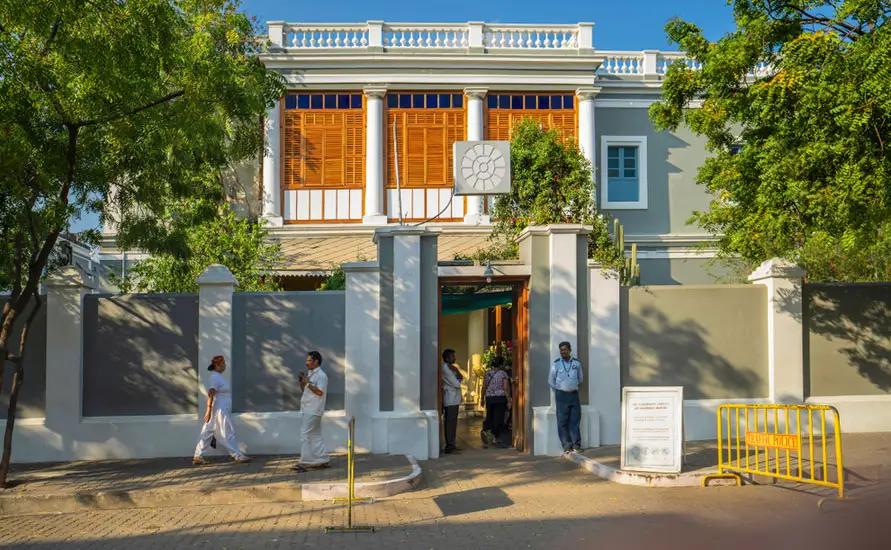
At around four you and your guide set out on foot for the Sri Aurobindo Ashram, which took shape in November 1926 around Sri Aurobindo, once a revolutionary in Bengal and later a philosopher and poet, and the Paris-born Mirra Alfassa, whom disciples call the Mother; together they taught Integral Yoga. At the center of the main building's courtyard lies their shared samadhi, covered every day with fresh flowers arranged in patterns by ashram members. Visitors sit around it on the stone floor in complete silence. Photography, phones and conversation are not allowed in the courtyard, and since the gates shut over the lunch hours, our timing follows the ashram's own clock.
Rather than a single building, the ashram is a set of houses, workshops and facilities spread across the French Quarter, including a dining hall, a paper factory, a press and a sports ground. On four darshan days each year, in February, April, August and November, the rooms of Sri Aurobindo and the Mother are opened to visitors, and the queues stretch around the block. Your guide explains how residents live, what the ashram does and does not offer to short-term visitors, and where to find the reading room. A walk along the seafront Goubert Avenue at dusk closes the day. Overnight in Pondicherry.
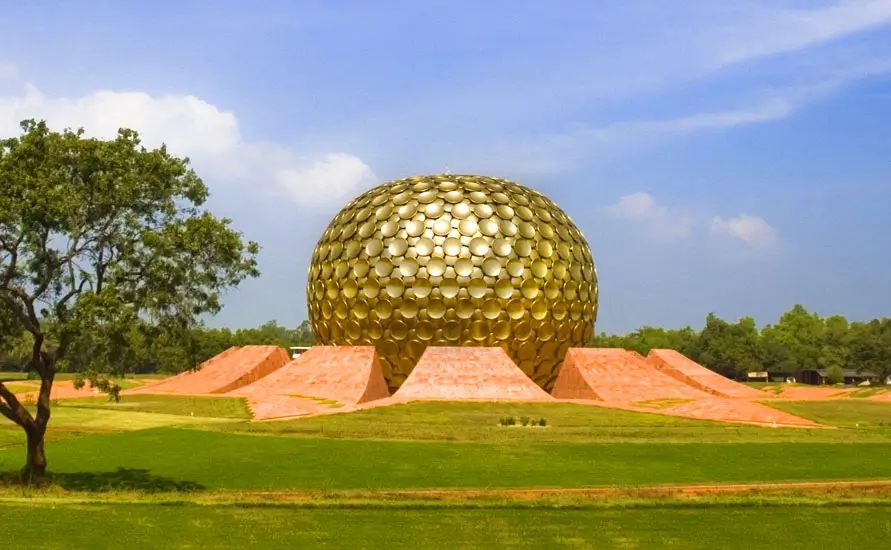
Auroville lies about 12 km north of Pondicherry, an experimental township inaugurated in February 1968, when young people from 124 countries placed soil from their homelands in an urn, following the Mother's vision of human unity. Today residents from more than fifty countries live here among forests they planted on what was once eroded red land. You begin at the visitor center, where an introductory video and exhibition explain the ideals of the township, and a shaded kilometer-long trail then brings you to the spot from which the public may look at the Matrimandir, a golden globe of gilded discs rising from the gardens at the township's center.
Going inside the Matrimandir, to a white marble chamber with a crystal globe lit by a single ray of sunlight, is reserved for a short period of silent concentration and needs advance booking in person at the visitor center, usually a day or more ahead; slots are limited and not guaranteed. If you would like to try, we plan an extra visit tomorrow. Lunch is at the visitor center café or at one of the community kitchens open to guests, where food grown on Auroville farms is served. Please respect the residential areas, which are private homes and workplaces, not tourist sites.
In the afternoon you visit Savitri Bhavan, a center devoted to Sri Aurobindo's epic poem Savitri, with exhibitions of paintings inspired by the work, a library and a quiet hall where readings are sometimes held. Afterward you can stop at one of Auroville's craft units, where incense, handmade paper, pottery and organic cotton clothing are produced by small teams; buying anything is optional. Some guests use this day to ask about short volunteer stays or programs for a future visit, and your guide can introduce the relevant information desk. The drive back to the old town takes about thirty minutes. Overnight in Pondicherry.
Early risers can join the walkers on the seafront promenade at sunrise, when the road is closed to traffic and people practice yoga or sit facing the sea. Next, on foot through the French Quarter, your guide points out ochre-washed villas, bougainvillea over garden walls and blue enamel signs reading rue Romain Rolland or rue Dumas, and explains how the town was divided by a canal into the European and Tamil quarters. You stop at the Manakula Vinayagar Temple, a Ganesha temple older than the French settlement, whose walls are covered with painted panels, and where visitors may watch the morning puja from the hall.
Pondicherry's churches reflect its French past. On the south side of town, the red-and-white Sacred Heart Basilica shows scenes from Christ's life in its tall stained-glass windows; nearer the center, the Immaculate Conception Cathedral, rebuilt in the late 1700s, was the mother church of the French missions. Mass is said in both every day, and visitors keep voices low and clothing modest. In the Tamil quarter your guide shows you houses with deep verandas and carved wooden doors, a contrast to the French villas. Lunch can be Creole-style Pondicherry food, which mixes French and Tamil flavors, or a simple meal in the ashram dining hall.
The afternoon belongs to you. Many guests return to the ashram samadhi for a second, longer sitting, now that they know the routine, or visit the Sri Aurobindo Ashram library and the exhibition of the Mother's symbols. Others take a bicycle along the quiet streets or visit the Pondicherry Museum for its bronzes and objects from the Roman-era trading port at Arikamedu. If you booked the Matrimandir inner chamber, this is when we return to Auroville. Your last Tamil Nadu evening can be spent on the rocks below the promenade, watching the catamaran lamps flicker out at sea. Overnight in Pondicherry.
Because two states and a flight fit into one day, the car leaves Pondicherry early and follows the East Coast Road up the shoreline to Chennai airport. Air time to Trivandrum is roughly seventy-five minutes, with a choice of daily services; we choose a midday departure to keep the schedule relaxed. A packed breakfast can be arranged if you leave before the hotel kitchen opens. On landing in Kerala, a second driver meets you for the drive north along the coastal highway, through a ribbon of coconut groves and market towns where steeples, minarets and temple towers rise within a few hundred meters of one another.
After about three hours you cross a bridge over the backwaters to the narrow coastal strip at Vallikavu, in Kollam district, where Amritapuri stands between the canal and the sea. Foreign visitors register at the international office with their passport, and the ashram assigns simple rooms that are shared or private depending on availability; we can arrange a nearby guesthouse if you prefer more comfort. Staff give you a schedule, a map and a short orientation on ashram rules: modest clothing, no alcohol or smoking, separate seating for men and women in some programs. Overnight in Amritapuri.
Life at Amritapuri begins before dawn with the archana, the chanting of the Lalita Sahasranama, the thousand names of the Divine Mother, in the main temple hall. Visitors may join or simply sit and listen; printed texts in roman script are available. After breakfast in the ashram canteen, which serves both Indian and Western vegetarian food at low prices, you join the short orientation tour run by volunteers. It covers the temple, the meditation areas, the beach, the ashram's charitable work and how the daily program changes when Amma, Mata Amritanandamayi, is in residence or traveling abroad, which happens for several months each year.
When Amma is at the ashram, she gives darshan, her well-known embrace, to thousands of people at a time, often for many hours. Tokens are distributed in the hall, and foreign visitors usually receive a specific time; volunteers guide the queue and ask that you remove glasses and wipe your face before your turn. If Amma is away, the ashram continues with meditation, talks by senior disciples and recorded programs. You can check her travel schedule before booking, and we will plan your dates around it if meeting her matters to you. Whatever the program, mobile phones should stay silent and out of sight in the hall.
In the afternoon many visitors join seva, the selfless service that keeps the ashram running, such as helping in the kitchen, sorting recycling, gardening or cleaning, usually for one or two hours. It is voluntary and gives a direct sense of the community's daily life. Late in the day you can walk to the beach behind the ashram, where the sea is too rough for swimming but the sunset over the Arabian Sea is wide and bright. In the evening the bhajans, devotional songs led by musicians and sometimes by Amma, fill the hall with harmonium, tabla and hundreds of voices. Overnight in Amritapuri.
The ashram offers a guided meditation each morning, often the IAM technique developed under Amma's guidance, or simply quiet time on the rooftop terraces facing the sea. On this second full day you can follow the program at your own rhythm: archana again before dawn, a yoga class if one is scheduled, or a walk along the coast road to see fishing families pulling in their nets. Your host checks the program for the day and suggests what fits best. Remember that pictures of the ashram, programs and residents should only be taken where permitted and never during darshan without permission.
At midday a short excursion takes you onto the Kerala backwaters, which lie just across the bridge from the ashram. A country boat ride on the canals around Vallikavu or a longer trip toward the lake shows coir making, toddy tappers climbing coconut palms and small Hindu shrines and churches on the water's edge. Alternatively, you can drive to Kollam, an old port town on Ashtamudi Lake that once traded with China and Arabia, for its lighthouse at Thangassery, its Portuguese-era ruins and a lunch of Kerala fish curry or vegetarian sadya at a local restaurant.
Back at Amritapuri in the late afternoon, you have time to pack, visit the ashram bookshop and say goodbye to anyone you have met. Many guests use this last evening for a final meditation by the sea or a quiet conversation with long-term residents, who are often happy to share how ashram life has shaped them. The evening bhajans are again open to all. If you feel you would like to stay longer, extra nights here can usually be added, subject to ashram room availability, and we will change your flights accordingly. Your host goes over tomorrow's departure plans. Overnight in Amritapuri.
After the morning program and an early lunch in the canteen, you leave Amritapuri for Trivandrum International Airport, about three hours south by road. Should your flight home leave from Kochi, the car goes north instead, roughly 140 km, which adds only half an hour or so. We build in a comfortable buffer, aiming for arrival three hours before an overseas flight. A stop at Varkala, on the way to Trivandrum, can be added for a walk on the clifftop and a last look at the sea, if your flight timing allows it.
Over twelve days you have sat in the halls of three living ashrams, walked around a sacred hill at dawn, and shared meals, silence and songs with people from every continent. Many guests leave with a reading list, a new daily practice and a wish to return for a longer stay at the ashram that spoke to them most. If you would like help planning that, or a future visit to other centers such as the Ramakrishna Math in Kolkata or the Himalayan ashrams of Rishikesh, our team is here to help. Go well, and may the calm of these days stay with you.
Your Journey

N.S. Rathore & Mrs. Omlata Rathore · Managing Director
We still read every enquiry ourselves. Tell us the places you liked and our planners will send a day-by-day route with drive times and a clear price.
Every package can be customised and no pressure to book. A planner from our office replies within 24 hours with a route written for your group.
Fill this in and your planner will send a first draft itinerary.
Explore more
Kerala Backwaters Escape Kerala Backwaters Escape
 Kerala Backwaters Escape
 Kerala Backwaters Escape
 Kerala Backwaters Escape
 Kerala Backwaters Escape
 Kerala Backwaters Escape
 Kerala Backwaters Escape
 Kerala Backwaters Escape
 Kerala Backwaters Escape
 Kerala Backwaters Escape
 Kerala Backwaters Escape
 Kerala Backwaters Escape
 Kerala Backwaters Escape
 Kerala Backwaters Escape
 Kerala Backwaters Escape
 Kerala Backwaters Escape
 Kerala Backwaters Escape